
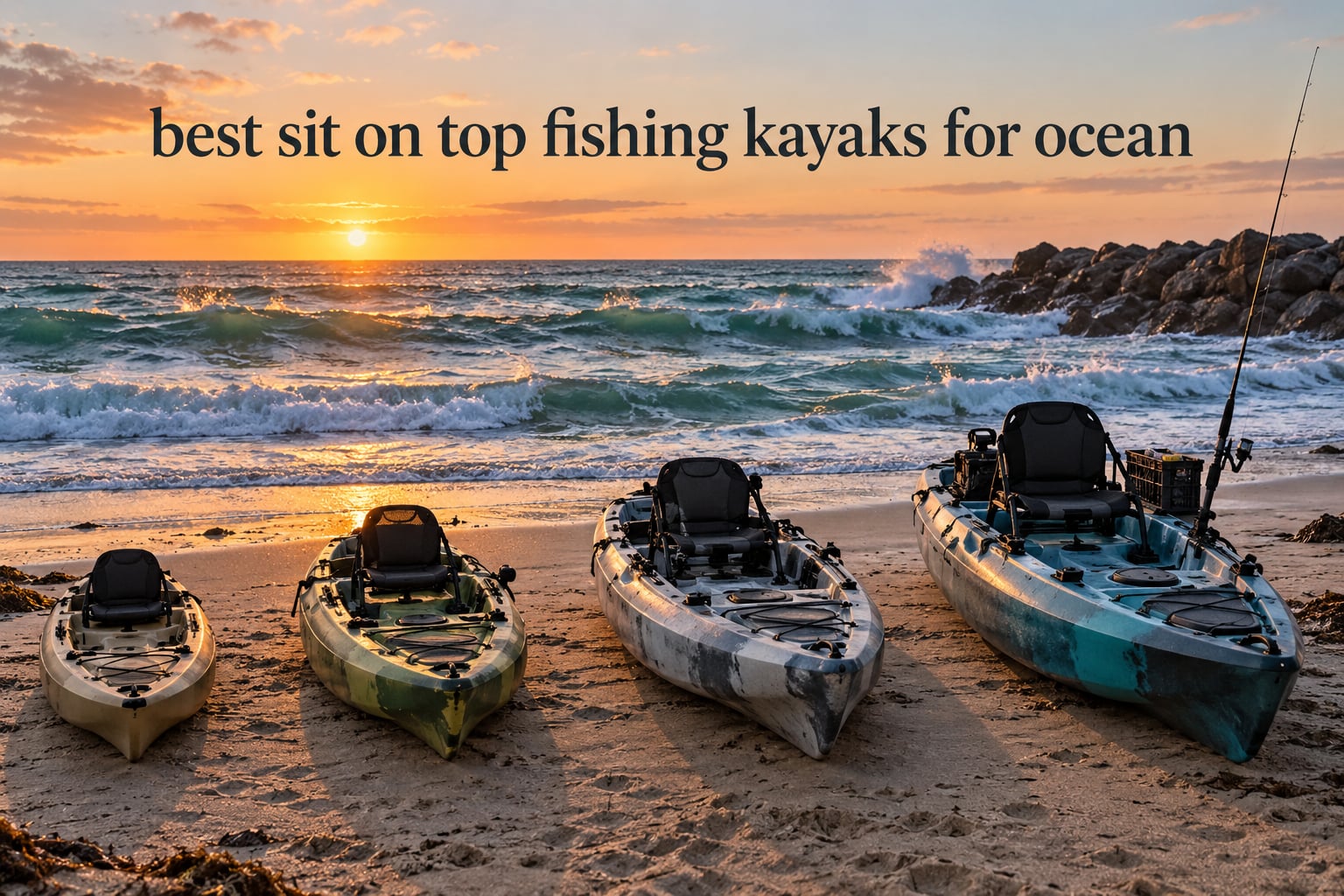
The best sit on top fishing kayaks for ocean water share four things: a long waterline, a high bow rocker that lifts the front over waves instead of burying it, a wide beam for casting stability, and real steering hardware rather than a wish and a prayer in cross-current. Add a usable capacity above 300 pounds and you can reach fish from a boat ramp that a 10-foot lake kayak would never survive.
That last part matters more than most buyers expect. A sit-on-top is open by design, which means you re-enter from the deck instead of through a skirt, and it means wind pushes against your whole body instead of a low hull. Both are fine in a sheltered bay and both are miserable when a tide rip picks up two miles out.
We spent weeks reading owner reviews on hull flex, rudder failures and salt corrosion, then sorted ten boats against the same ocean criteria: chop handling, tracking when you stop paddling, steering authority, hardware that survives salt water, real capacity after gear is loaded, and whether one person can get the boat to the water. If you want the wider picture first, our picks for the best fishing kayaks for anglers and the best kayaks for beginners cover calmer water in more detail.
Two of the ten boats here are not really open-water boats at all. We still included them, clearly labelled, because a lot of buyers assume any angler kayak belongs in the surf. Everything in this list was reviewed again for 2026, and every spec below comes from manufacturer data or owner feedback rather than brochure adjectives.
Table of Contents
Top 3 Picks: Sit-On-Top Fishing Kayaks for Ocean Water (October 2026)
Three boats stood out once we sorted for coastal use. The Lifetime Tamarack Angler 100 carries the most owner history of anything here and handles chop better than its size suggests. The Pelican Catch Mode 110 has the most stable platform and the highest owner rating in the group. The Pelican Sentinel 100X wins on weight and is the easiest boat on this list to carry to a launch on your own.

Lifetime Tamarack Angler 100
- 10 ft hull with sharp tracking bow
- Skeg for straight-line paddling
- 51 lb total weight
- 275 lb capacity
Pelican Catch Mode 110
- Tunnel hull with flat standing deck
- 375 lb rated capacity
- Extra in-hull flotation
- 63-67 lb hull

Pelican Sentinel 100X
- Under 10 ft and 44.6 lb
- Four rod holders
- ExoPak removable storage
- Ergolounge seat
Best Sit On Top Fishing Kayaks for Ocean (October 2026)
All ten boats, side by side. Ratings and review counts are the current owner figures; usable capacity is our own estimate of what is left for the angler once a seat, a tackle crate and safety gear are aboard.
| Product | Specifications | Action |
|---|---|---|
| Lifetime Tamarack Angler 100 |
|
Check Latest Price |
| Pelican Sentinel 100X |
|
Check Latest Price |
| Pelican Catch Mode 110 |
|
Check Latest Price |
 Reel Yaks Raptor Modular Reel Yaks Raptor Modular |
|
Check Latest Price |
 Perception Pescador Pro 12 Perception Pescador Pro 12 |
|
Check Latest Price |
 Wilderness Systems Tarpon 120 Wilderness Systems Tarpon 120 |
|
Check Latest Price |
 BKC Brooklyn 12.5 Pro BKC Brooklyn 12.5 Pro |
|
Check Latest Price |
 Pelican Catch PWR 100 Pelican Catch PWR 100 |
|
Check Latest Price |
 Reel Yaks Raider Modular Reel Yaks Raider Modular |
|
Check Latest Price |
 Albott Modular 9.4ft Albott Modular 9.4ft |
|
Check Latest Price |
1. Lifetime Tamarack Angler 100 – Best Overall Sit-On-Top for Nearshore Fishing
Lifetime Muskie Angler Sit-On-Top Kayak with Paddle, Tan, 120″
Length: 120 in
Width: 31 in
Capacity: 275 lb
Weight: 51 lb
Skeg steering
Pros
- Very stable in chop for a 10 ft boat
- Sharp bow tracks well when wind pushes from behind
- Light enough for one person to roof-rack
- Five-year warranty and deep tracking channels
Cons
- Included paddle is flimsy and short
- Seat connector clips bend under load
- Drifts to one side when you stop paddling
- Plastic chips inside hull on arrival
This is the boat we kept coming back to after reading owner reports. With more than 1,300 ratings behind it, there is a much bigger sample of people describing real chop conditions than any other sit-on-top in this group, and that sample keeps repeating the same three things: it is stable, it tracks, and it takes abuse.
The hull is 120 inches long and 31 inches wide, moulded from UV-protected high-density polyethylene with a flat bottom and a deliberately sharp bow. That sharp bow is the ocean-relevant part. It reduces wetted surface area, so the boat holds a line in a following sea instead of wallowing, and the skeg underneath keeps it from swinging wide the moment you stop paddling to cast.
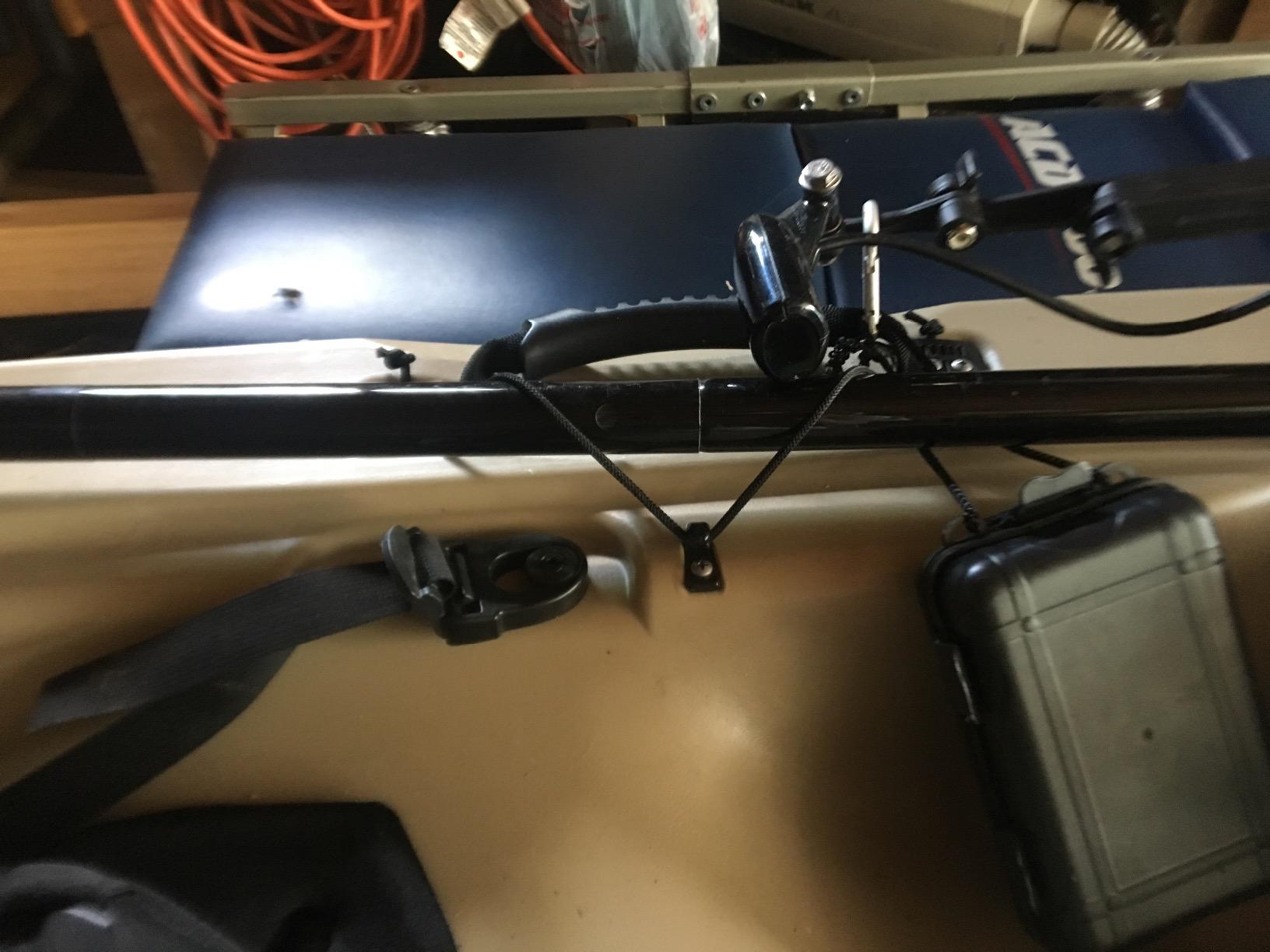
The honest weakness is drift. Owners regularly report the kayak pulling to one side when the paddle stops, which matters in current more than most reviews admit. At 51 pounds it is light for its length, and the front and rear T-handles mean one person can lift it onto a roof rack without a second set of hands.
Capacity is 275 pounds, which is the first number to check honestly. A 200 pound angler with a tackle crate, a dry bag and a battery leaves almost nothing spare. Fish it light. For a bigger platform, look at the best pedal kayaks for fishing roundup where we compare the drive systems in full.
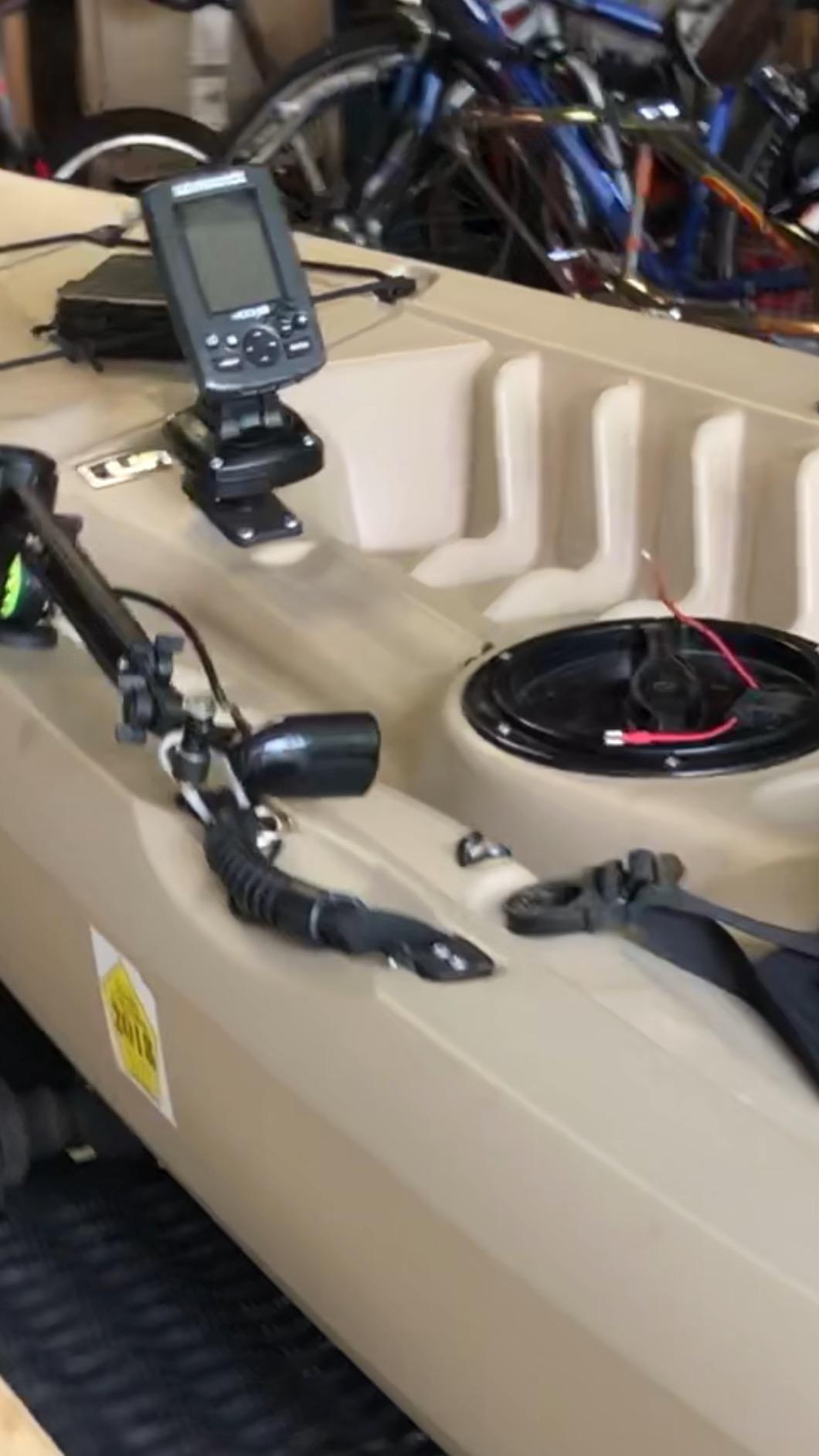
What holds up in breaking water
Owners use this boat in open bays, behind barriers and in two-foot chop with wind across the bow, and the polyethylene hull shows no flex complaints at any weight. The low centre of gravity from the flat bottom resists the rocking that makes 10-foot boats feel nervous. There is no pedal drive or rudder to jam with sand, which removes the two failure points that hurt pedal boats in surf.
Where it will disappoint you
Two flush-mounted rod holders and one top-mount holder is a thin spread, so rigged-up anglers will be adding hardware. The molded seat connector is the weakest part on the boat and owners replace it early. And the 275 pound rating plus a drifting hull means this suits protected coast and estuary fishing rather than a long paddle past the breakwater on a rising tide.
2. Pelican Sentinel 100X – Best Lightweight Angler Kayak for Shallow, Sheltered Water
Pelican Sentinel 100X – Angler Sit on top Fishing Kayak – Forest Mist – Lightweight – Ergolounge™ Seating System – 10 ft, Sentinel 100X Angler Fishing Kayak
Length: 114 in
Width: 30 in
Capacity: 275 lb
Weight: 44.6 lb
Pros
- Lightest angler boat here at 44.6 lb
- High wide backrest for long sessions
- Four rod holders with ExoPak storage
- Molded-in side carrying handles
Cons
- Short 9 ft 6 in length limits tracking
- 275 lb rating is tight for heavy gear
- Some units arrive missing rod holder parts
This is the easiest angler kayak here to get to the water alone. At 44.6 pounds with molded-in side handles, one person can walk it from a car park to a shallow launch without a cart, which is a bigger deal for beach and estuary fishing than any spec on the page.
The Ergolounge seating system is genuinely the best part of the boat. Owners running three-hour sessions report the thick cushioning and tall, wide backrest hold up well, and the seat doubles as the base for the ExoPak removable storage compartment, which carries two vertical rod holders alongside two flush mounts. For flats fishing in protected water, the setup is hard to argue with.
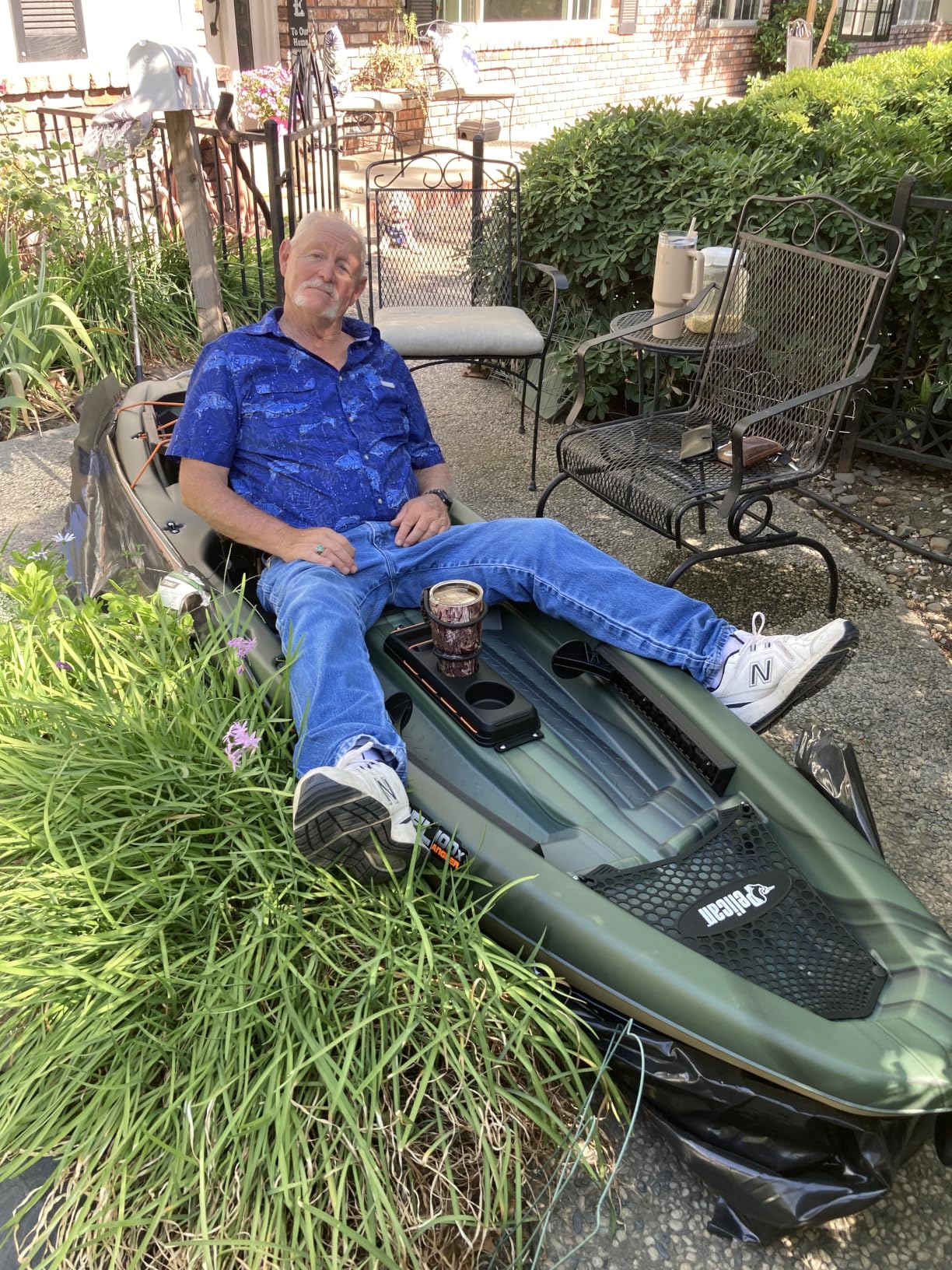
Open water is where the short length bites. At 9 feet 6 inches with a 30-inch beam, the waterline is short and the boat pivots when you shift weight to cast. In a stiff onshore breeze that means constant corrective strokes. The 275 pound rating also limits how much tackle you can carry, and there is no rudder or skeg, so wind-driven yaw is the default behaviour.
We think this is the right pick for wading anglers, sheltered bays and anyone who fishes a estuary mouth on a calm day. It is not the right pick for a paddle past the surf break.
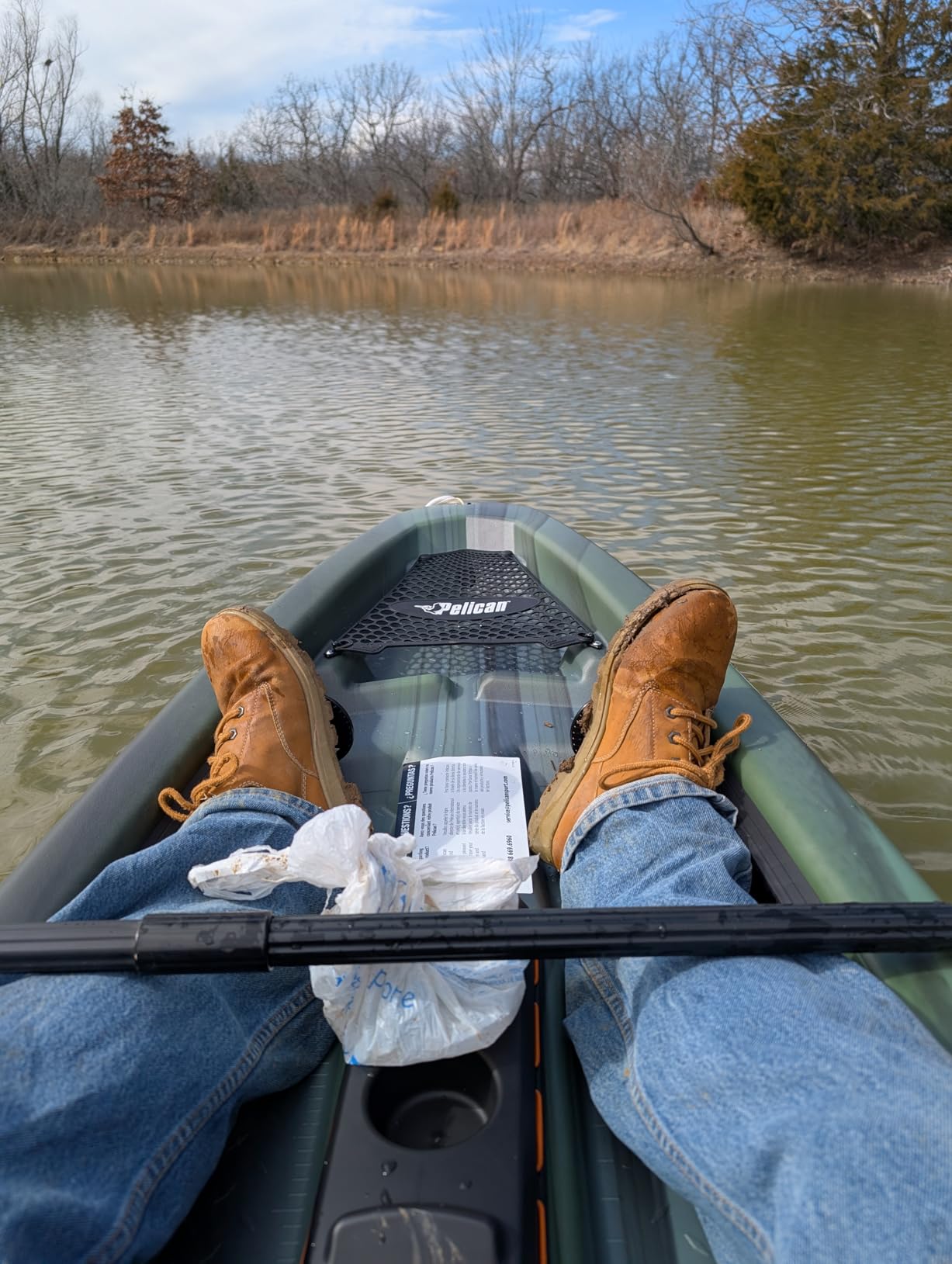
What works on flat water and in the shallows
Nothing about this boat is designed for open water, and nothing about it needs to be there. Shallow draft, low weight and a high seat suit working the edge of a flat in light chop, and the removable ExoPak means you can carry the boat a short distance, launch, then fish with storage already in place. The polyethylene hull is also among the easiest to keep in condition around rocks and oyster beds.
Where the ocean will punish you
The combination of a 275 pound rating, a short waterline and no steering hardware makes this a freshwater and nearshore boat. Owners fishing in wind report fighting the bow constantly. If your target water has tidal current that pushes back, the rudder-equipped boats further down this list are worth the extra money.
3. Pelican Catch Mode 110 – Most Stable Platform for Choppy Coastal Water
Pelican Catch Mode 110 Fishing Kayak – Premium Angler Kayak with Lawnchair seat, Granite – 10.5 Ft.
Length: 128 in
Width: 34.5 in
Capacity: 375 lb
Weight: 67 lb
Pros
- Tunnel hull is exceptionally stable in chop
- ERGOBOOST seat stays supportive over long hours
- Huge deck and tank well for heavy gear
- Transom holds a motor up to 2.5 hp
- Lifetime limited warranty
Cons
- Wide and slow for covering distance
- Deck flexes above 200 lb paddler
- Skeg can pop out of its mount
- Hull scuffs readily in handling
This boat has the highest owner rating in the group, and the reason is consistent across reviews: stability. The tunnel hull and 34.5 inch beam create a platform that feels planted in two-foot chop, and the wide flat deck lets you stand to cast without the wobble that sends fly line in the drink.
The ERGOBOOST seat runs from a low position close to the water up to a high position on tracks, with an EVA pad and under-seat storage. Owners fishing long days describe it as the most comfortable seat in this group. The rig list is also the most complete: two 4-inch rigging tracks, front and rear tank wells, bottle holders, three flush-mount rod holders and anti-slip deck carpet.
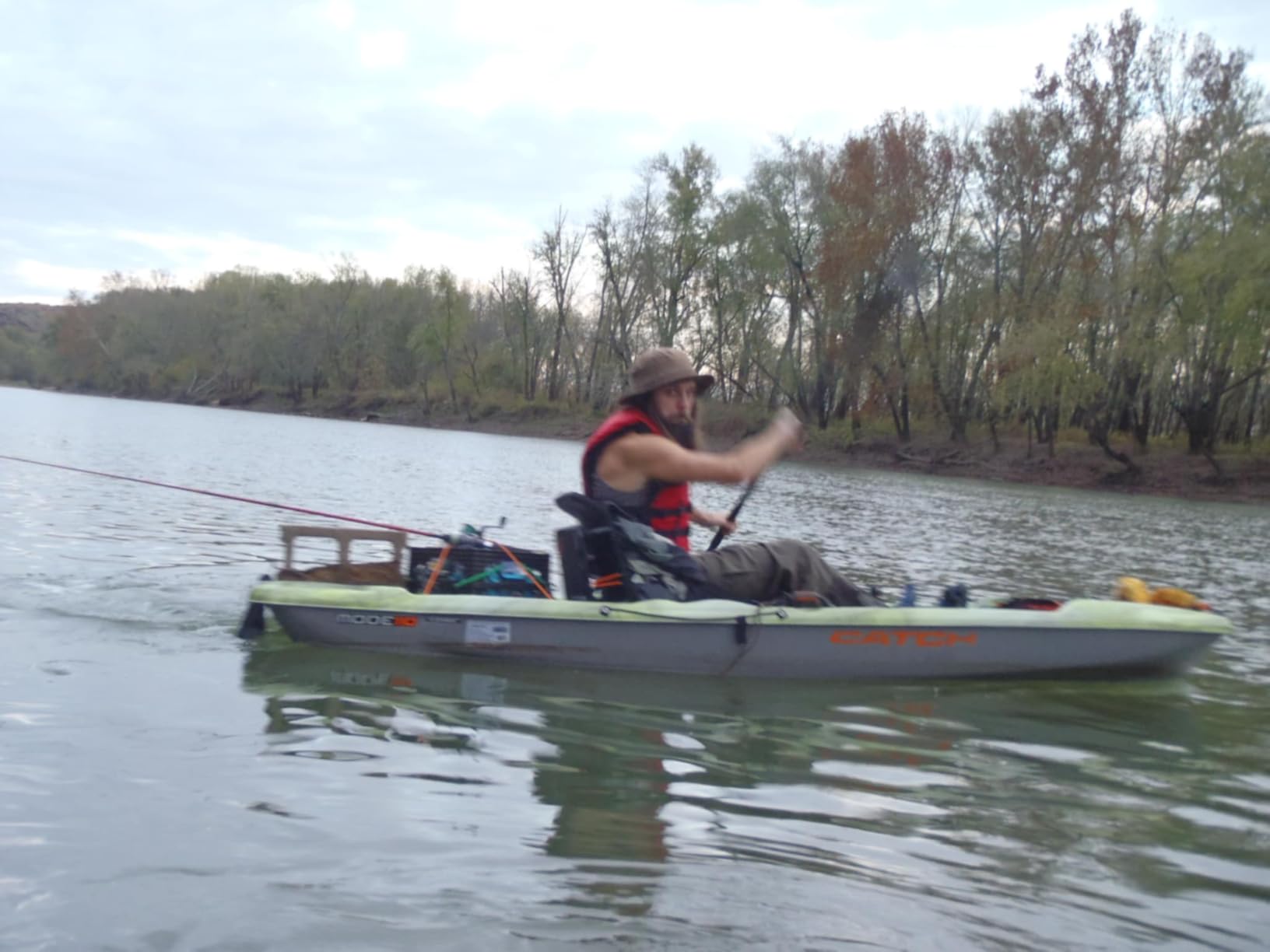
Two details matter for salt water specifically. Extra flotation is built into the hull to meet or exceed ABYC standards, and the boat is available with a rudder rather than a fixed skeg. On a motorised setup the transom accepts up to 2.5 hp, which makes it one of the few boats here that can legally take a small trolling motor and stay legal with the right registration.
The catch is speed. A 67 pound boat that is 34.5 inches wide will not cover ground quickly, and paddling hard into a headwind is a losing proposition. Owners also report deck flex above 200 pounds and hull scratches that show up quickly from launching. Plan on slow, deliberate paddling and a bow that never gets ahead of you.
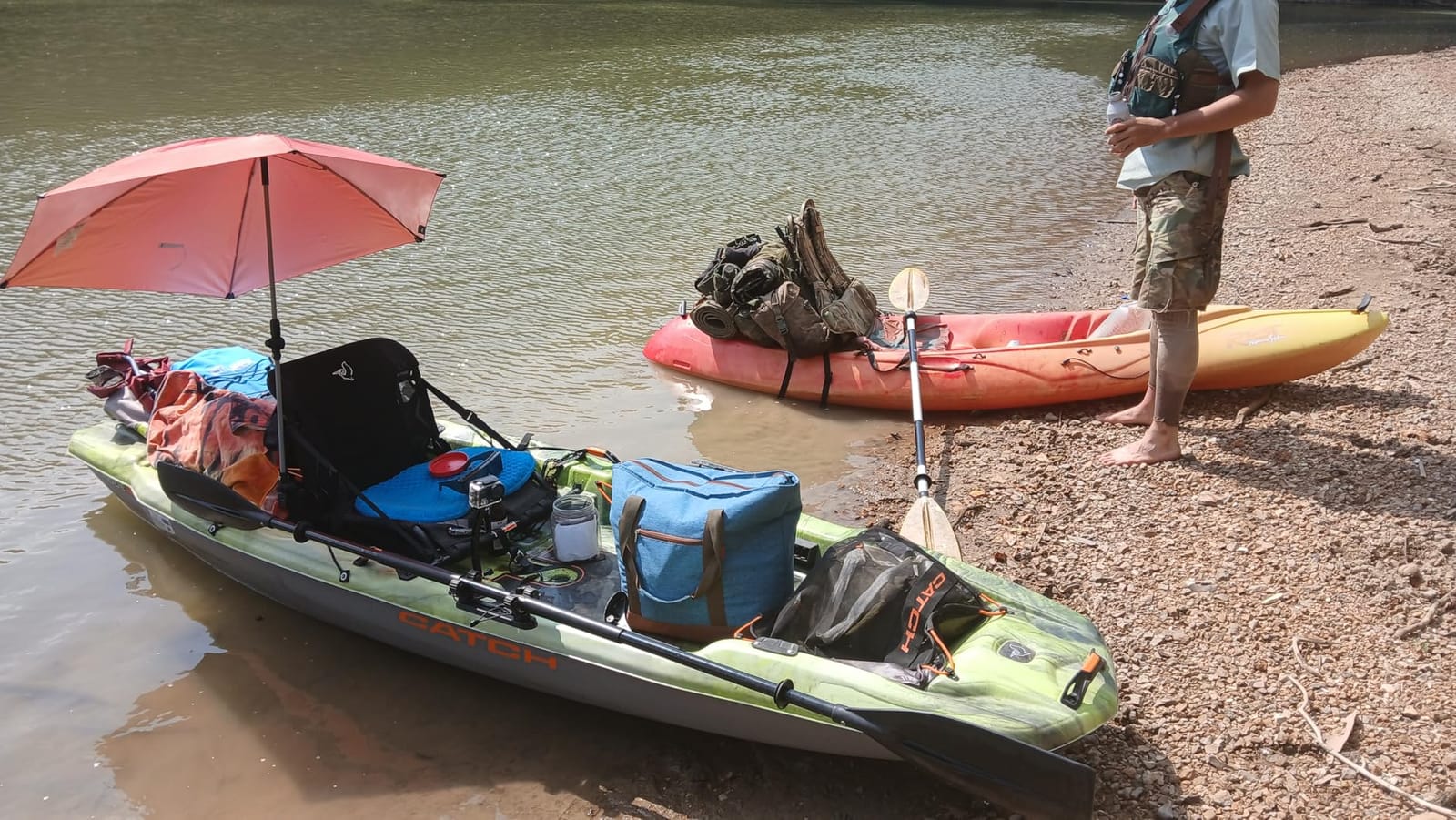
Why it holds steady in chop
Primary stability, the stability that keeps you upright when you move or stand, comes from that wide beam and the tunnel hull. In a confused sea the boat rocks rather than rolls, and the flat casting deck gives you a stable footing when a wave arrives mid-cast. For anglers working a jetty or a bar in wind, that is the single most useful trait on this list.
Where the trade-off bites
Secondary stability, the stability that matters when the boat is on edge, is limited by the same wide shape. If you capsize, you will be flat on the water rather than rolling back upright, which is why the re-entry practice later in this guide matters even on this boat. Buyers over 200 pounds should also test the deck before committing.
4. Reel Yaks Raptor Modular 9.5ft – Best Pedal Kayak for Trunk Storage
Reel Yaks Raptor Modular Fishing Kayak, Fin Drive 9.5ft, 380 lbs Capacity
Length: 115 in
Width: 30.3 in
Capacity: 380 lb
Weight: 62 lb
Fin drive
Pros
- Two-piece hull fits in an SUV trunk
- Fin drive is quiet and efficient against wind
- 380 lb capacity on a wide W-hull
- Fast four-step assembly
Cons
- Rudder control wires and ferrules break easily
- Guide screw can snap and leave it hard to steer
- Low seat with no height-extender option
- Rudder tends to float up instead of staying deployed
The Raptor solves a problem no other boat on this list does. The hull separates into two sections that fit in a car trunk, so you can fish coastal water without a roof rack, a trailer or a second adult. For anyone who has spent a winter watching an offshore kayak lean against a garage wall, that is worth more than any handling refinement.
Propulsion is hands-free fin drive, and owners consistently describe it as efficient and quiet against wind and current. The wide W-hull carries a 380 pound rating, which is generous for a 9.5 foot boat, and the boat is rigged with flush-mount rod holders, track rails and storage hatches out of the box.
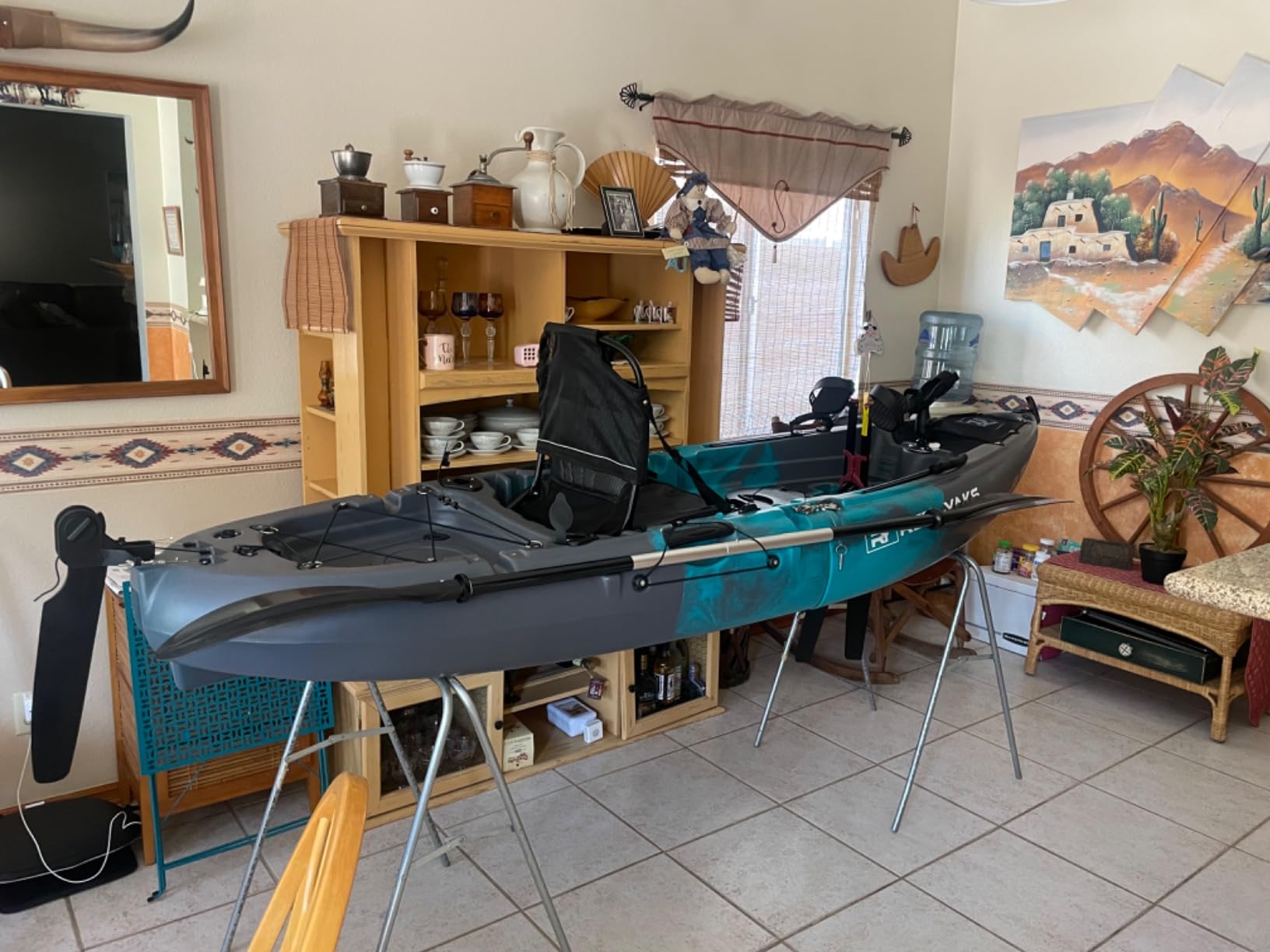
The recurring complaint in reviews is hardware. Rudder control wires and ferrules break, the rudder guide screw snaps and can leave the boat very hard to steer, and the rudder tends to pop up rather than stay deployed when it matters. Owners who add a spare rudder kit report the problem is manageable; owners who do not are stuck. This is exactly the saltwater failure mode that worries offshore anglers.
The seat is also low with no extender, which reduces visibility over a wave and makes casting from a seated position harder. Reel Yaks support is frequently singled out as fast and helpful, and that matters when a part fails two miles from a ramp.
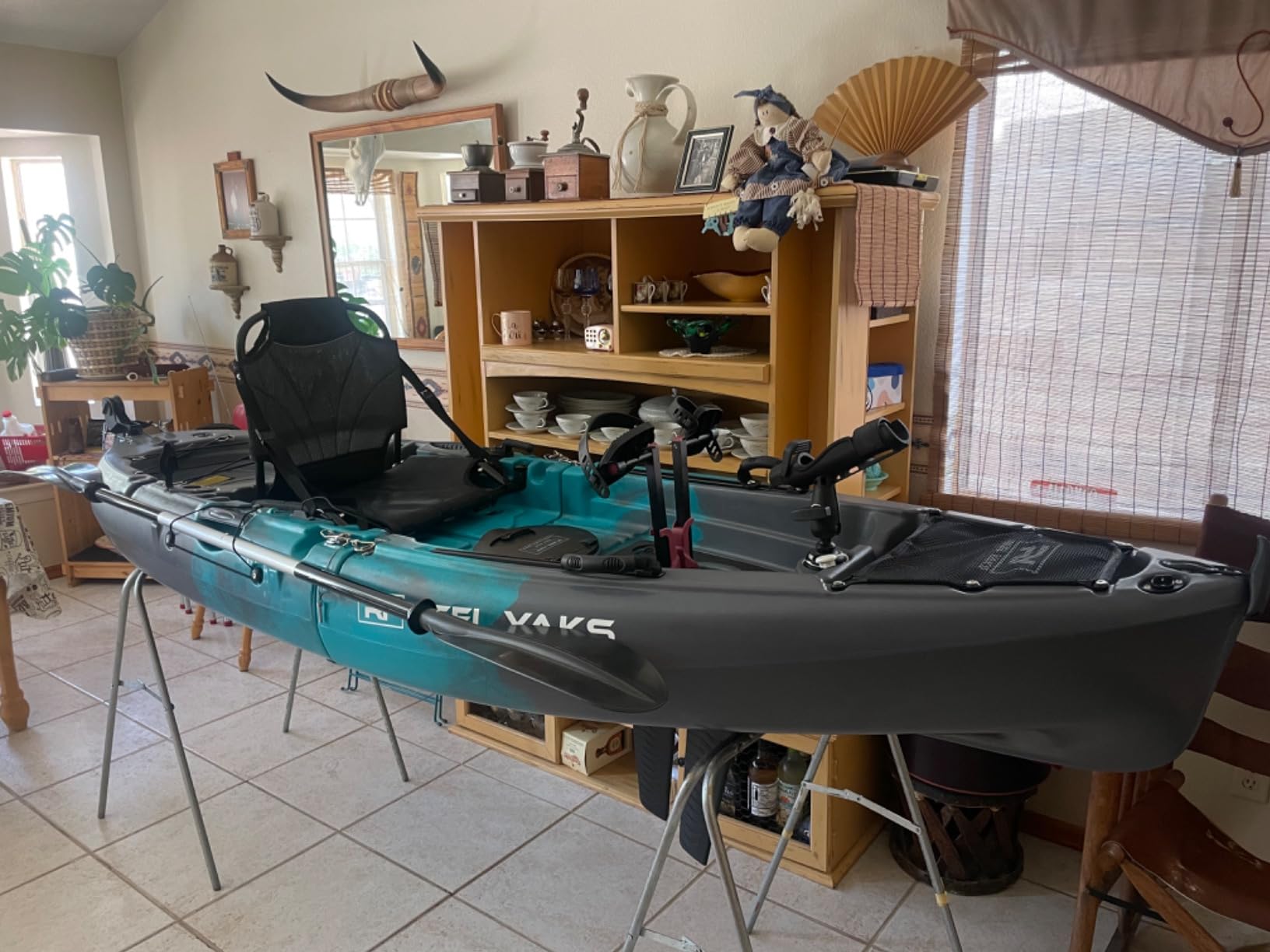
What makes sense for coastal water
Fin drive is the right kind of propulsion for salt. There is no propeller to snag eelgrass, no shaft to bend on a sandbar and no exhaust port to corrode. At 380 pounds rated with a wide hull, the boat has room for a 250 pound angler plus a real crate of tackle, which is more usable capacity than most 12-footers on this list offer.
Where it falls short offshore
Nine and a half feet is short for open water no matter how stable it is, and a low seat makes you look early over a wave. If your fishing involves crossing a bay mouth or working a bar in breaking water, spend the extra money on a longer hull with a rudder you trust.
5. Perception Pescador Pro 12 – Premium Paddle Power That Tracks Straight
perception Pescador Pro 12 | Sit on Top Fishing Kayak with Adjustable Lawn Chair Seat | Large Front and Rear Storage | 12′ | Dapper
Length: 144 in
Width: 32.5 in
Capacity: 375 lb
Weight: 64 lb
Pros
- Holds a line well in chop and boat wake
- Adjustable lawn chair seat supports three-hour trips
- Room to stretch out for taller paddlers
- Easy to rig with a fish finder and rod holders
- Five-year hull warranty
Cons
- Seat sits lower than buyers expect
- Standing stability limited above 200 lb
- Heavy to load solo without practice
- Frequent cosmetic shipping damage
At 144 inches long and 32.5 inches wide, the Pescador Pro 12 is the boat on this list that most obviously behaves like an angler kayak rather than a plastic dinghy. The long waterline gives it the straightest paddle track of the paddle-driven boats here, which is exactly what you want when you stop to cast in current or paddle into a headwind.
Owners with long tenure report tracking that holds through boat wake and small chop, and a seat that stays comfortable well past three hours. The adjustable lawn chair seat and generous leg room suit taller paddlers, and the deck takes a fish finder and rod holders without a fight. Capacity is 375 pounds, and with a hull this size you can carry a working load of gear behind the seat.
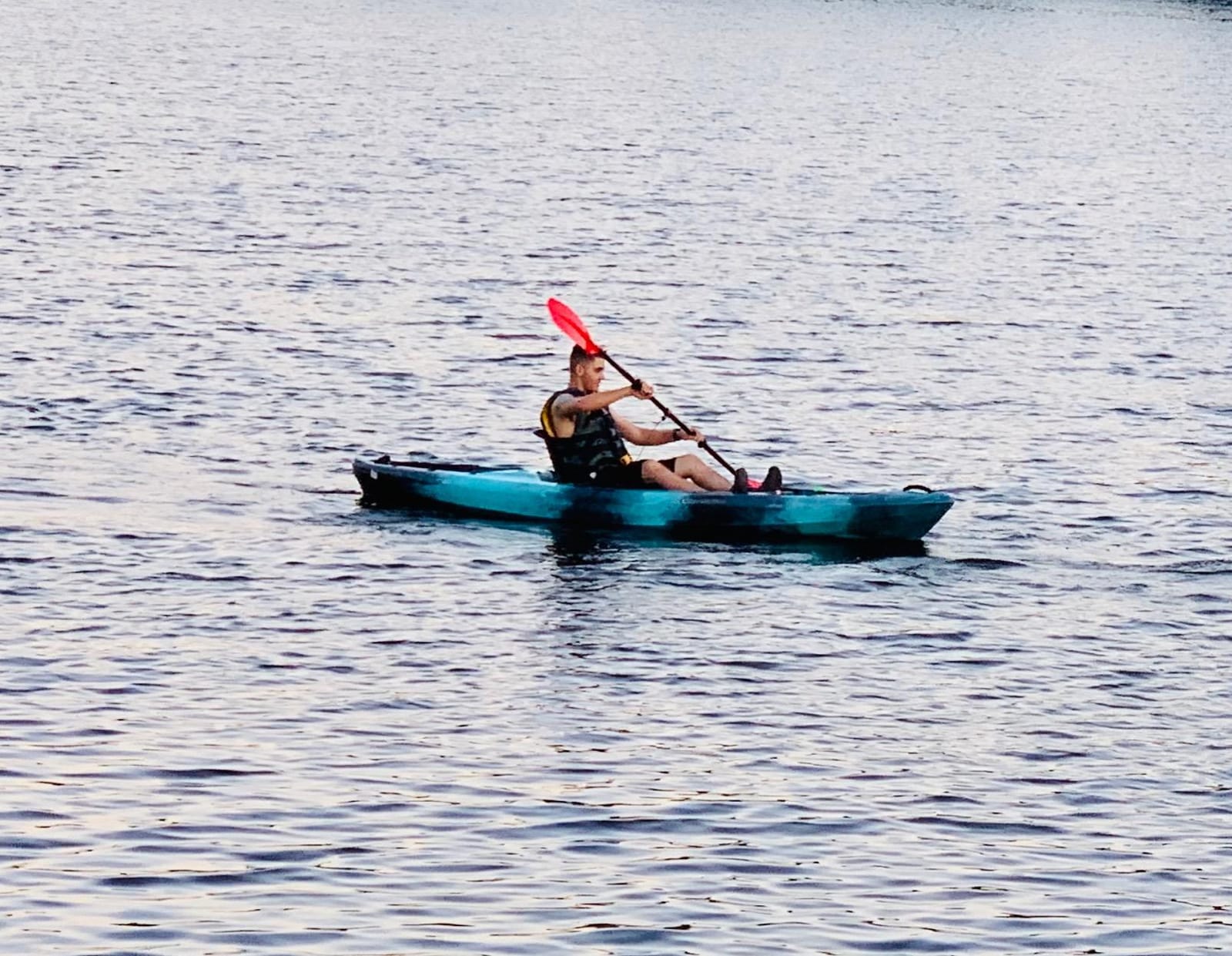
Manufacturer guidance positions it for lakes, slow rivers and calm coastal water, and owners agree with that framing. At 64 pounds it needs two hands or a practice run to get onto a car roof, and there is no rudder, so you hold your line with paddle correction rather than hardware. It is a paddling boat that fishes, not a motor platform.
The most common owner regret is seat height. Anglers who prefer sight casting from an elevated position find the lawn chair low, and that limits standing stability for heavier paddlers. Shipping damage and occasional missing hardware also show up more often than the brand’s reputation suggests.
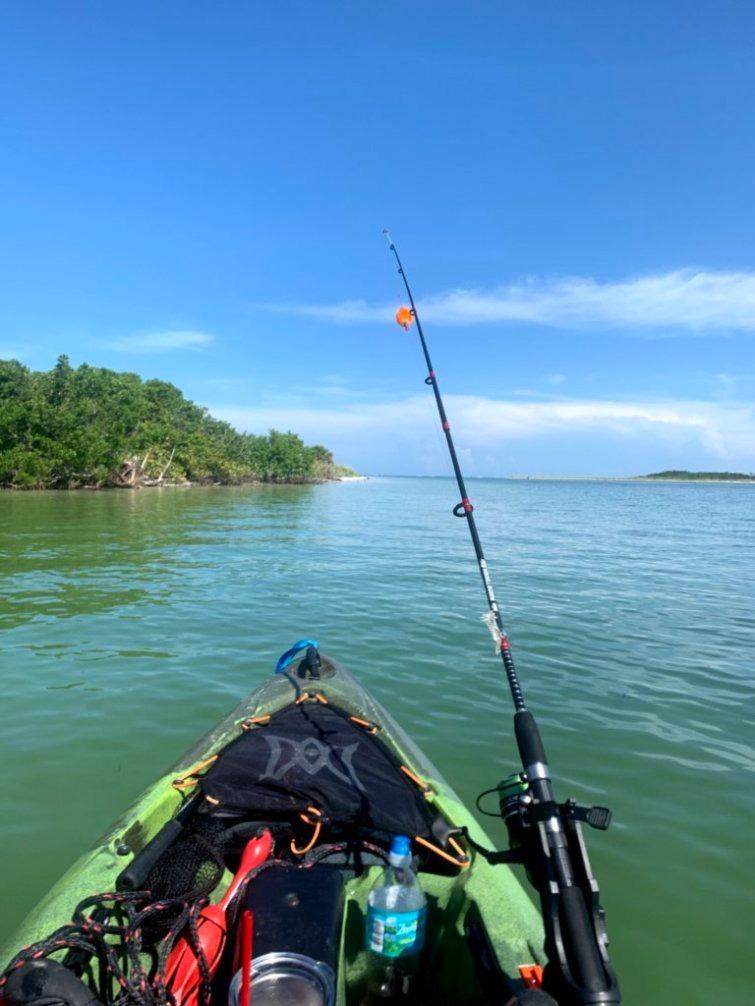
Why length beats width here
Tracking is the whole argument for this boat. A 144 inch waterline carries its momentum through wave faces and boat wake instead of stopping dead, so wind and current push you further off course before you correct. For an angler paddling a shoreline and stopping every hundred yards, that difference is felt on every drift.
Where it falls short
Short trips with heavy gear, solo roof transport and anything involving a motor are where this hull stops being the right answer. It also has no self-bailing dry storage worth the name, so wet gear rides with you home. If you are a bigger paddler, the rated capacity is generous but the seat height is not.
6. Wilderness Systems Tarpon 120 – Best Open-Water Tracker With Real Dry Storage
Wilderness Systems Tarpon 120 – Sit on Top Fishing Kayak – Premium Angler Kayak – Adjustable and Designed Seat – 12.3 ft – Galaxy
Length: 12 ft 3 in
Width: 31 in
Capacity: 350 lb
Weight: 63 lb
Dry box included
Pros
- Fast straight tracking with good surf and open-water stability
- Comfortable seat with multi-point strap adjustment
- Removable Dry Tec dry box plus large rear well
- Handles tight water despite its length
Cons
- Ships in minimal wrapping so hulls arrive scratched
- Accessories such as the dry box sometimes missing
- Seat fabric fades quickly without a cover
- Low seat with no raised position
The Tarpon is the most sea-capable hull shape on this list. At 12 feet 3 inches with a narrow 31 inch beam, it is the only boat here built around a fast hull that slices through chop rather than floating on top of it. Owners with experience on ocean, estuary and surf water describe it as holding course and cutting through waves better than the wider angler boats.
Storage is the reason many offshore anglers end up with one. The large rear well takes a crate or cooler, the front hatch is sealed dry storage, and the removable Dry Tec dry box with a sectioned tray keeps tackle and electronics dry on a wet ride. Sidetrack accessory rails and magnetic bottle straps finish a well-organised deck.
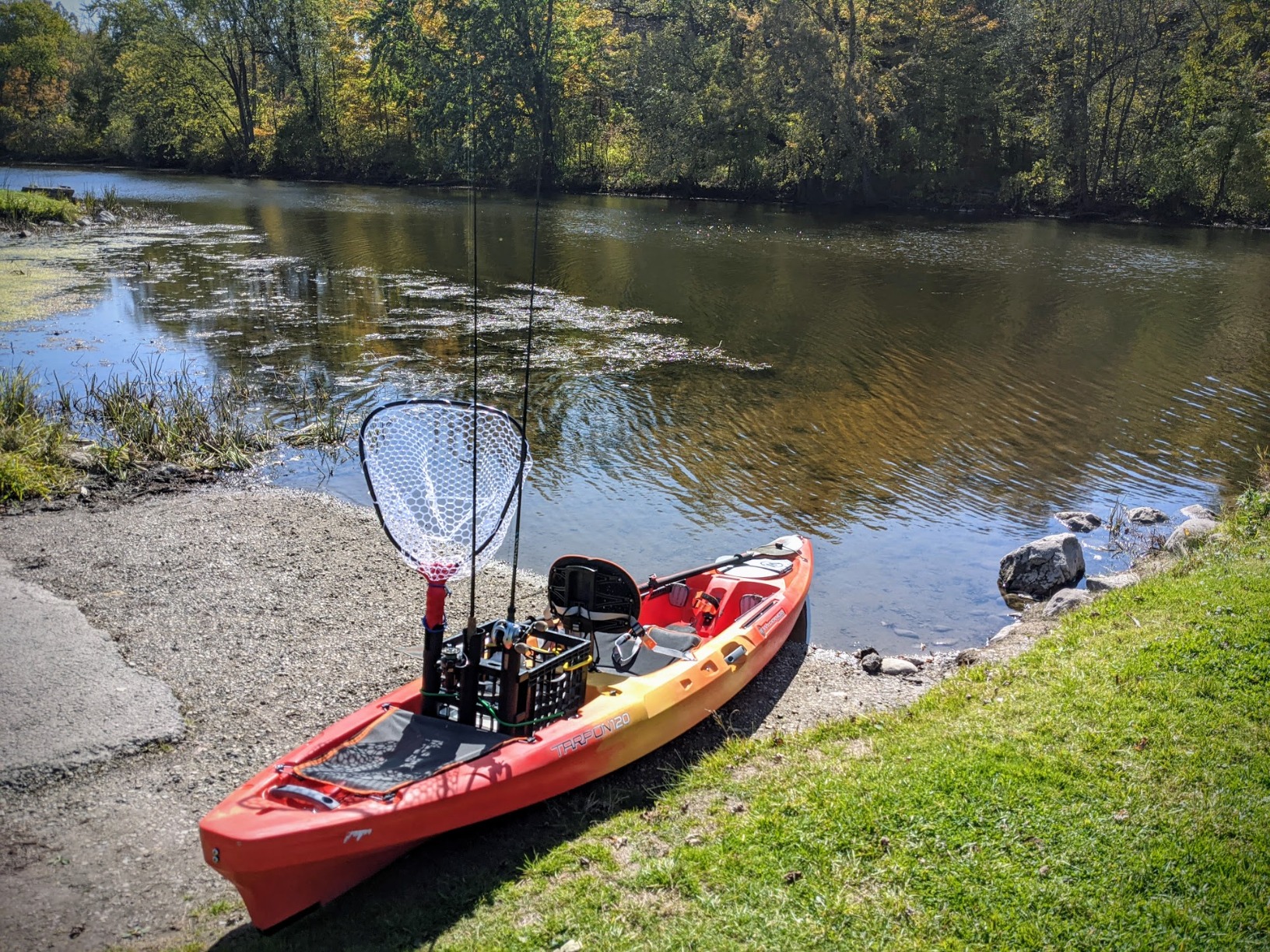
Where it disappoints is shipping and packaging. Owners repeatedly report hulls and seats arriving scratched or dirty because the boat ships with minimal wrapping, and some arrive without the dry box, bottle strap or scupper plugs. Inspect the boat within the return window. The cool-touch seat fabric also fades fast unless the boat is covered, which matters on a beach where the hull is in salt spray all day.
At 350 pounds the rating is workable, and the low seat means you sit rather than stand. Owners with back issues report weak lumbar support despite the multi-point adjustment. Slower than a narrow touring kayak but far quicker than a 34-inch fishing platform.
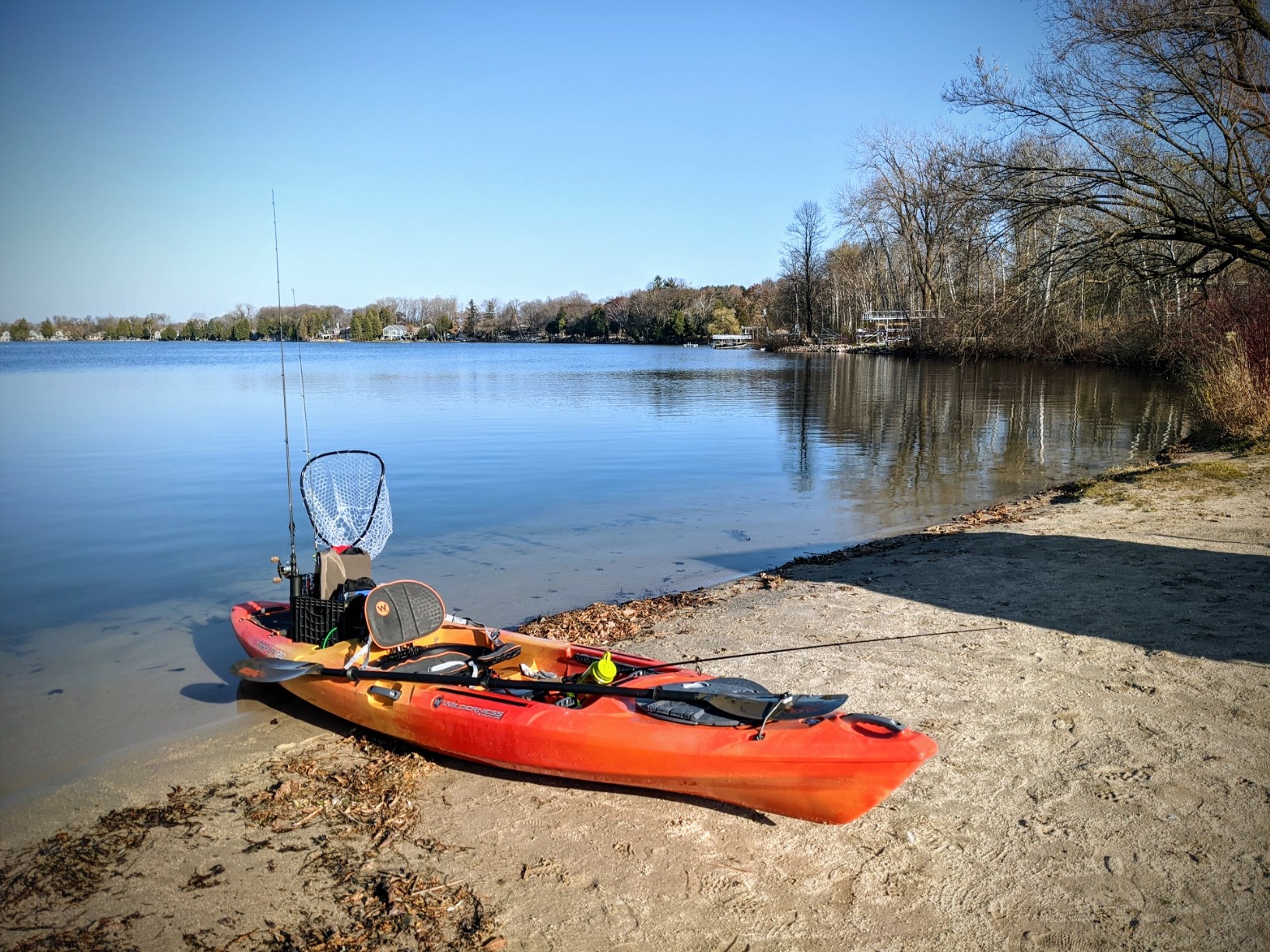
Why this hull behaves well in a seaway
Narrow and long is the surfing combination. The hull sheds water sideways rather than ploughing it, the bow rocker lifts the front over a face instead of driving it under, and the result is a boat that stays pointed where a wide flat-bottom angler kayak begins to wander. Owners fishing estuaries report it stays responsive even while playing a fish.
Where it falls short
A 31 inch beam gives up the wide casting deck that makes a stern-mounted fish finder easy to read from a seated position. At 63 pounds it still needs two people for a long carry. If you mostly cast from standing or read a screen at speed, the wider boats serve you better.
7. BKC Brooklyn 12.5 Pro – Best Boat With a Built-In Trolling Motor
BKC Brooklyn 12.5 Pro Motorized Fishing Kayak, Trolling Motor
Length: 12.5 ft
Capacity: 558 lb
Weight: 98 lb
Built-in trolling motor
Pros
- Built-in motor adds hands-free range against current
- 12.5 ft hull tracks straight in calm water and chop
- Very high 558 lb capacity for gear-heavy trips
- Extra-wide rudder gives responsive steering
- Three rod holders and dual water-resistant hatches
Cons
- Heaviest boat here at about 98 lb
- Only 47 owner ratings so far
- Highest price in the group
This is the only boat on the list with a trolling motor built into the boat from the factory. That single feature changes what you can fish. Instead of paddling two miles to reach a reef, you hold a slow, quiet line over structure while your hands work a rod, and you can hold position against current without drifting onto rocks.
The hull is 12.5 feet with geometry revised for steadiness under load, an extra-wide hand-operated rudder for steering response at speed, and a raised adjustable seat. Storage is unusually generous for a hard shell: three flush-mounted rod holders, dual water-resistant hatches and a rear cargo area under bungees. Capacity is rated at 558 pounds, by far the highest figure here.
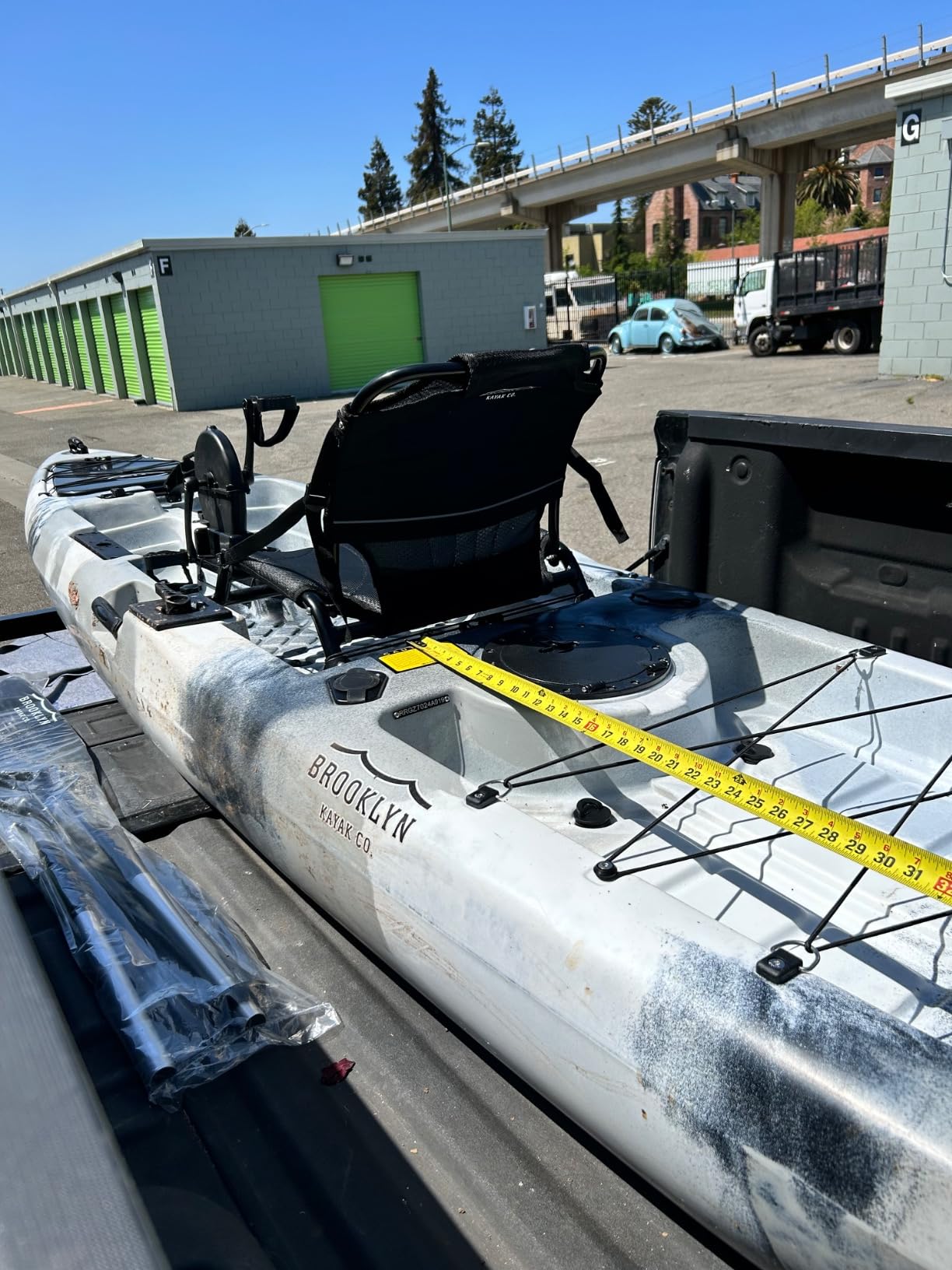
The problems are size and thin evidence. At roughly 98 pounds this is the heaviest boat in the group, and it is not something one person lifts onto a car roof or carries across a soft beach. With 47 ratings the owner history is thin, and the 4.0 average sits at the bottom of the list, so you are trusting the spec sheet more than the community.
A permanently fitted motor also changes the legal picture. Rules on registering a motorised craft vary by state and by whether the unit is electric or fuel-powered, and salt water is hard on a small motor shaft. Check your local registration requirements before you commit.
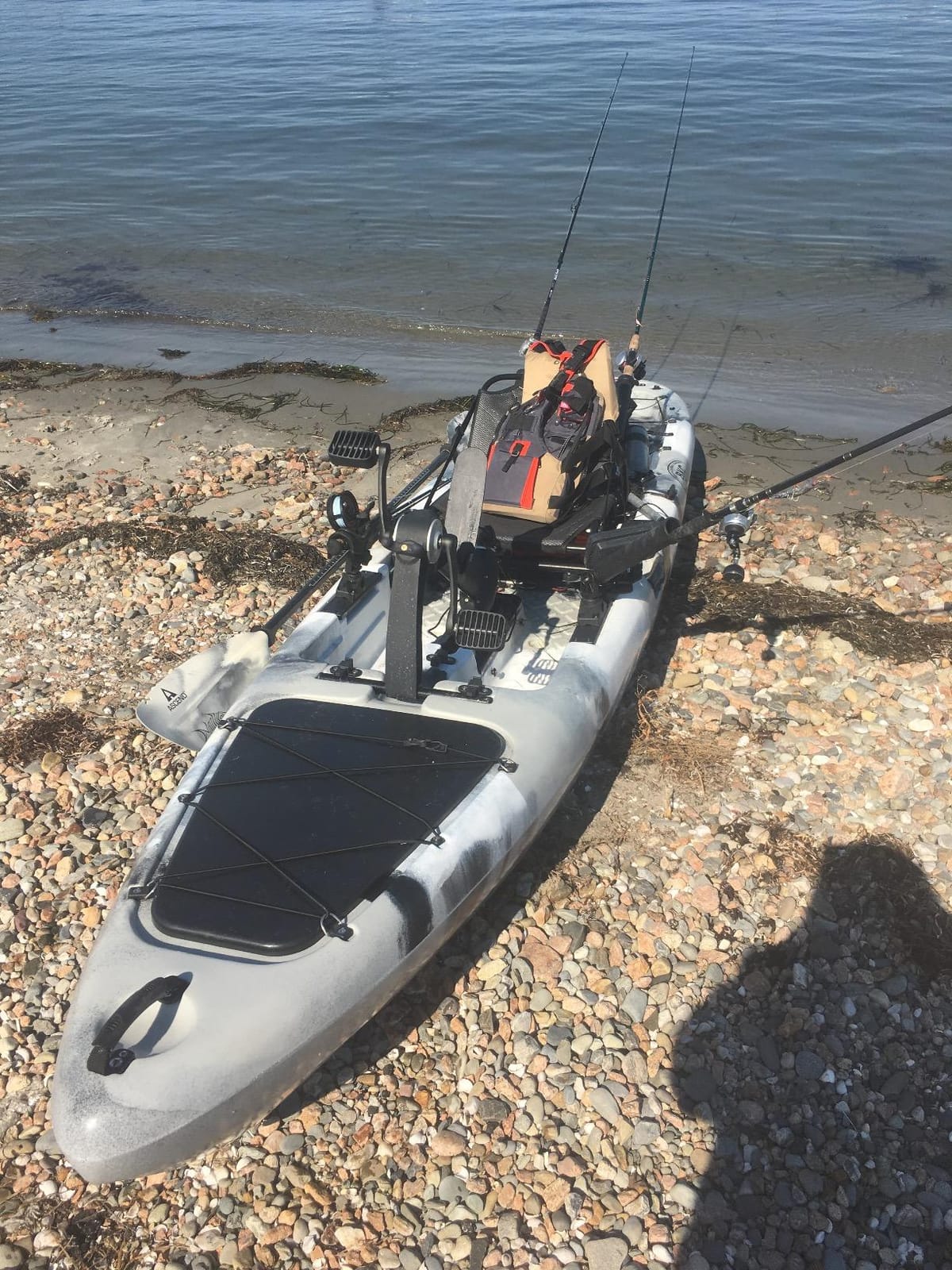
What the motor changes about fishing
A built-in unit means hands-free, low-speed control, which is how you hold position over a drop-off while casting into current. Paired with the wide rudder, you can make small corrections without shifting your weight and losing your balance mid-cast. The extra capacity also means a heavier tackle load without the boat sitting too low in the water.
Where it falls short
Transport, storage and launch are the practical problems. A 98 pound boat with a fixed motor needs a trailer, a lift or a second person at every end of the trip. It also is not a boat to carry through breaking surf on your shoulder, which is where most coastal anglers would want to paddle in.
8. Pelican Catch PWR 100 – Motor-Ready Platform for Big and Tall Anglers
Pelican Catch PWR 100 – Sit-on-Top Fishing Kayak – Ergo360 Seating System – 10 ft – Light Kaki
Length: 10 ft
Width: 15.75 in
Capacity: 450 lb
Weight: 75 lb
Pre-wired transom
Pros
- Stable and comfortable for 6 ft 320 lb paddlers
- Ergo360 seat swivels and slides on tracks
- Pre-wired with transom for gas or electric motor
- Plenty of room for gear and accessories
Cons
- 75 lb is heavy for a 10 ft kayak
- Wide beam needs a longer paddle
- Some units arrive with missing bolts or wiring
- Only 35 owner ratings
Capacity is the headline here. Rated at 450 pounds, the Catch PWR 100 gives big paddlers real usable load: owners report it staying stable and comfortable at 6 feet tall and 320 pounds, with room to move around the deck. The Ergo360 seat slides along tracks and rotates 360 degrees, so you can swivel to face a fish without shifting your hips.
It is also the cleanest motor installation on this list. The independent transom is pre-installed and accepts gas or electric motors up to 2.5 hp, and the boat arrives pre-wired with battery stowage in the front compartment, so a trolling motor is a bolt-on job rather than a rewiring project. Rigging runs to two 4-inch front tracks plus two 15-inch in-handle tracks, and the traction pads have a built-in ruler for measuring fish.
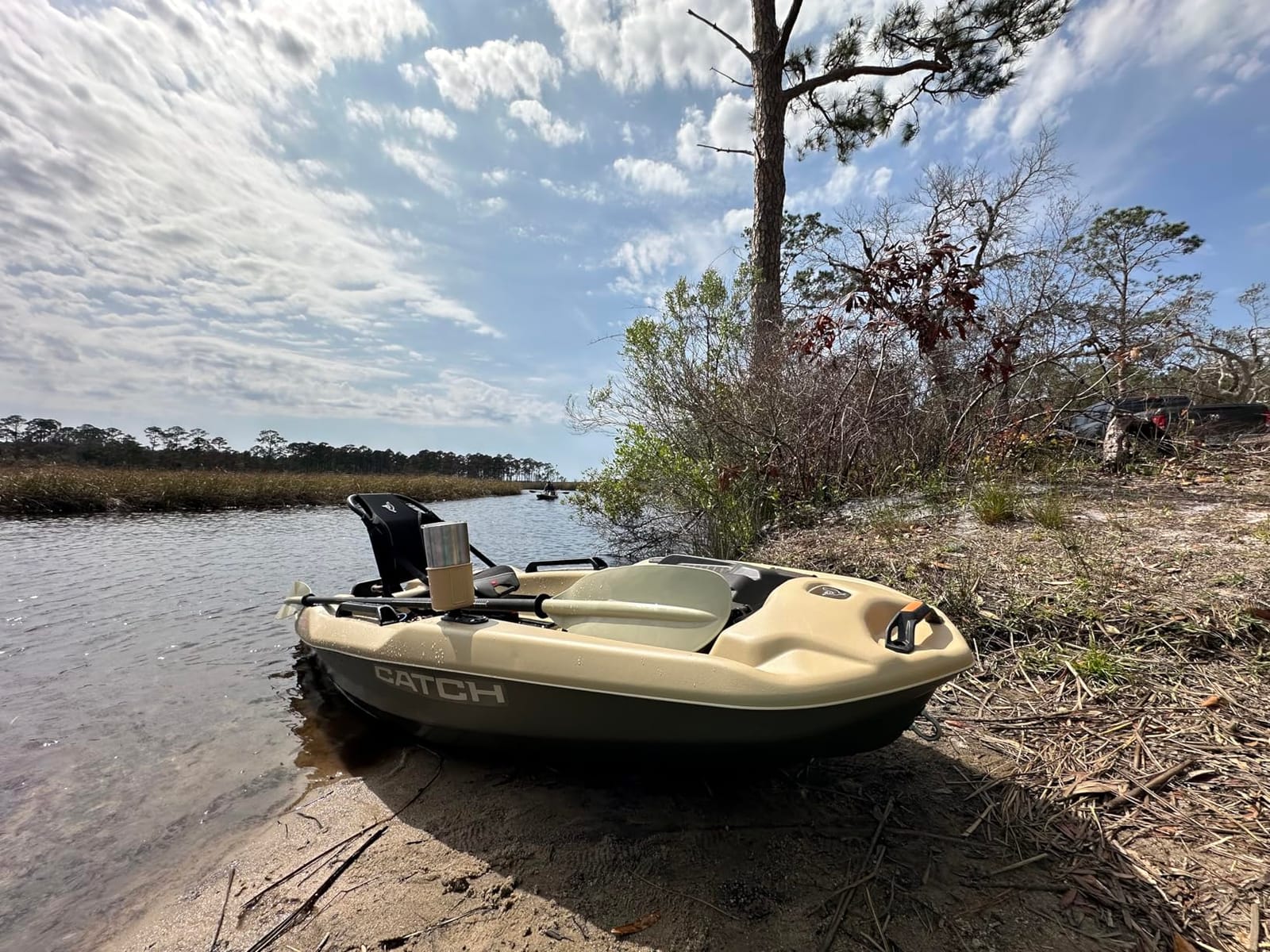
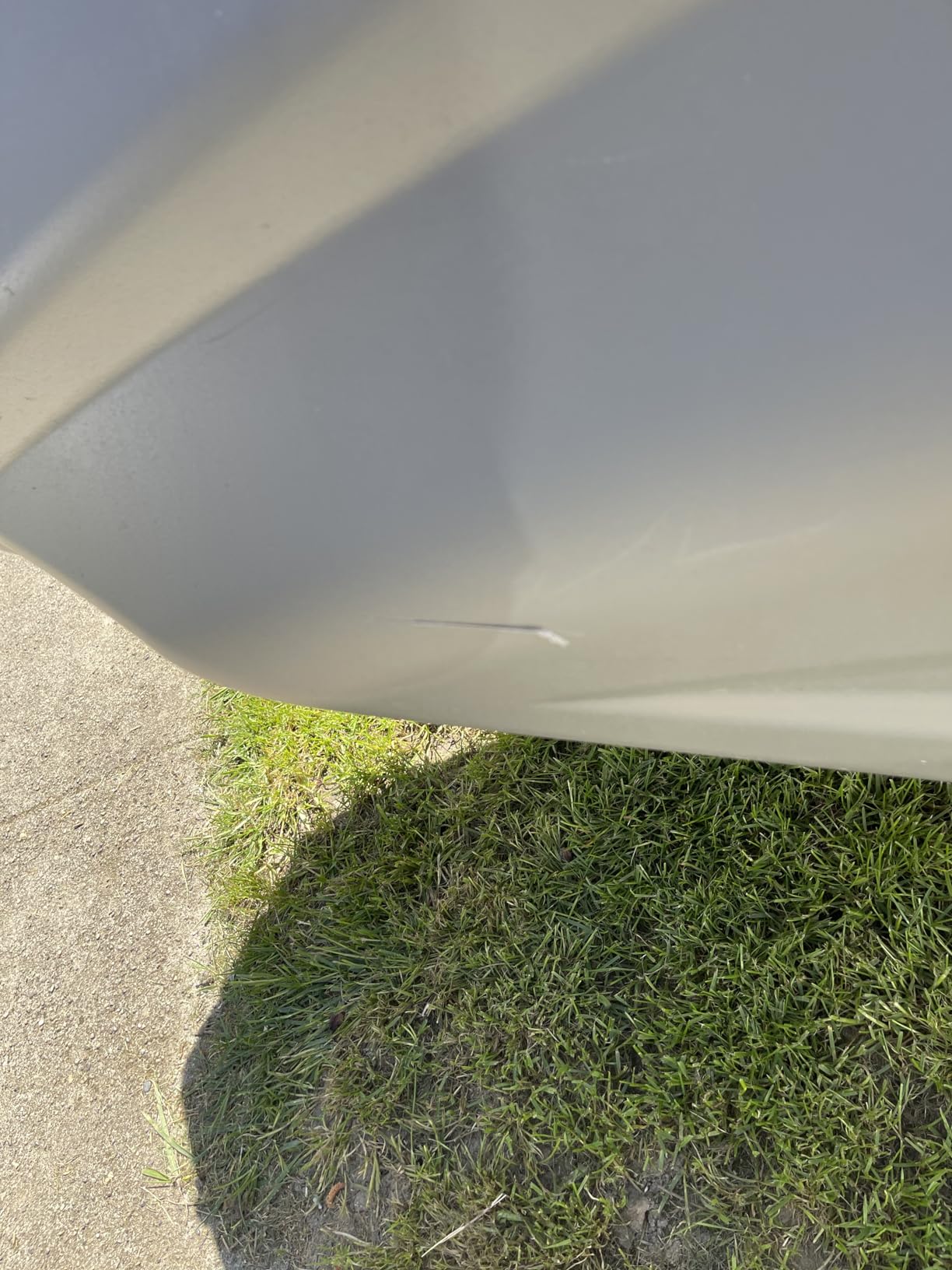
The honest limitation is weight versus size. Seventy-five pounds for a 10 foot kayak is heavy, and the wide beam means most paddlers need a longer paddle than the one they are used to. Owners also report units arriving with missing bolts, a missing wiring outlet or a missing rail, so check the delivery carefully. With 35 ratings the owner sample is small.
For larger anglers on protected coastal water who want the option of a motor later, this is a logical pick. For the same person fishing open water with current, the longer narrow hulls on this list will hold a line far better.
Why the capacity number matters more than it looks
Rated capacity is a structural limit, not a working limit. Usable capacity is roughly 30 to 40 percent lower once you subtract your weight, a tackle crate, a battery, a dry bag and safety gear. On a 450 pound rated boat a 320 pound paddler still has room to fish. On a 275 pound rated boat that same paddler is over the practical limit before a single rod goes in the tank well.
Where it falls short
The 15.75 inch listed width is measured differently to the other boats here, so do not compare it directly with the 34 inch beams above. In practice the platform is wide and stable rather than nimble, and it is slow. Solo lifting is a genuine problem at 75 pounds, so budget for a cart or a second person.
9. Reel Yaks Raider Modular 9.5ft – Propeller Drive That Beats Wind and Current
Reel Yaks Raider Modular Fishing Kayak – 9.5ft, 380 lbs Capacity, Red White Black – Pedal Fishing Kayaks for Adults & Youth, Sit on Top, Compact Storage, Lightweight, Easy Transport
Length: 114 in
Width: 35.4 in
Capacity: 380 lb
Weight: 66 lb
Propeller drive
Pros
- Propeller drive moves quickly across open water and up current
- Modular sections store in a car trunk without a rack
- W-hull holds up well loaded with gear
- Confident single-paddler ocean use reported
Cons
- Propeller snags weeds and can grind the gears
- Rudder string breaks and needs tension adjustment
- Each 31 lb section is awkward to lift
- Limited storage for fishing gear
The Raider is the pedal boat for anyone who fights the wind. A propeller drive produces far more thrust than a fin drive, and owners report it moving quickly across open water and holding speed up river current. That matters offshore, where a fin-driven boat can lose ground to a headwind for an hour.
The hull is a wide 35.4 inch W-hull rated at 380 pounds, and owners describe confident single-paddler use in open water with the boat loaded. Like the Raptor, it splits into two sections of 31 pounds each that assemble in four steps and fit in a car trunk, and the manufacturer is US Coast Guard registered.
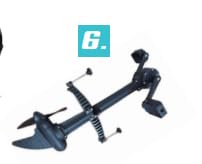
The propeller is also the liability. Owners report it snagging weeds and grinding the gears over time, and the drive is heavy to deploy once you are on the water. The rudder is the other weak point: it needs tension adjustment and the string breaks. Two halves that meet imperfectly out of the box is a common complaint too, and storage for fishing gear is limited.
We would add a spare prop and rudder line to the parts list. The propulsion advantage is real enough that most owners consider it worth the maintenance, but only if you accept working on drive hardware between trips.
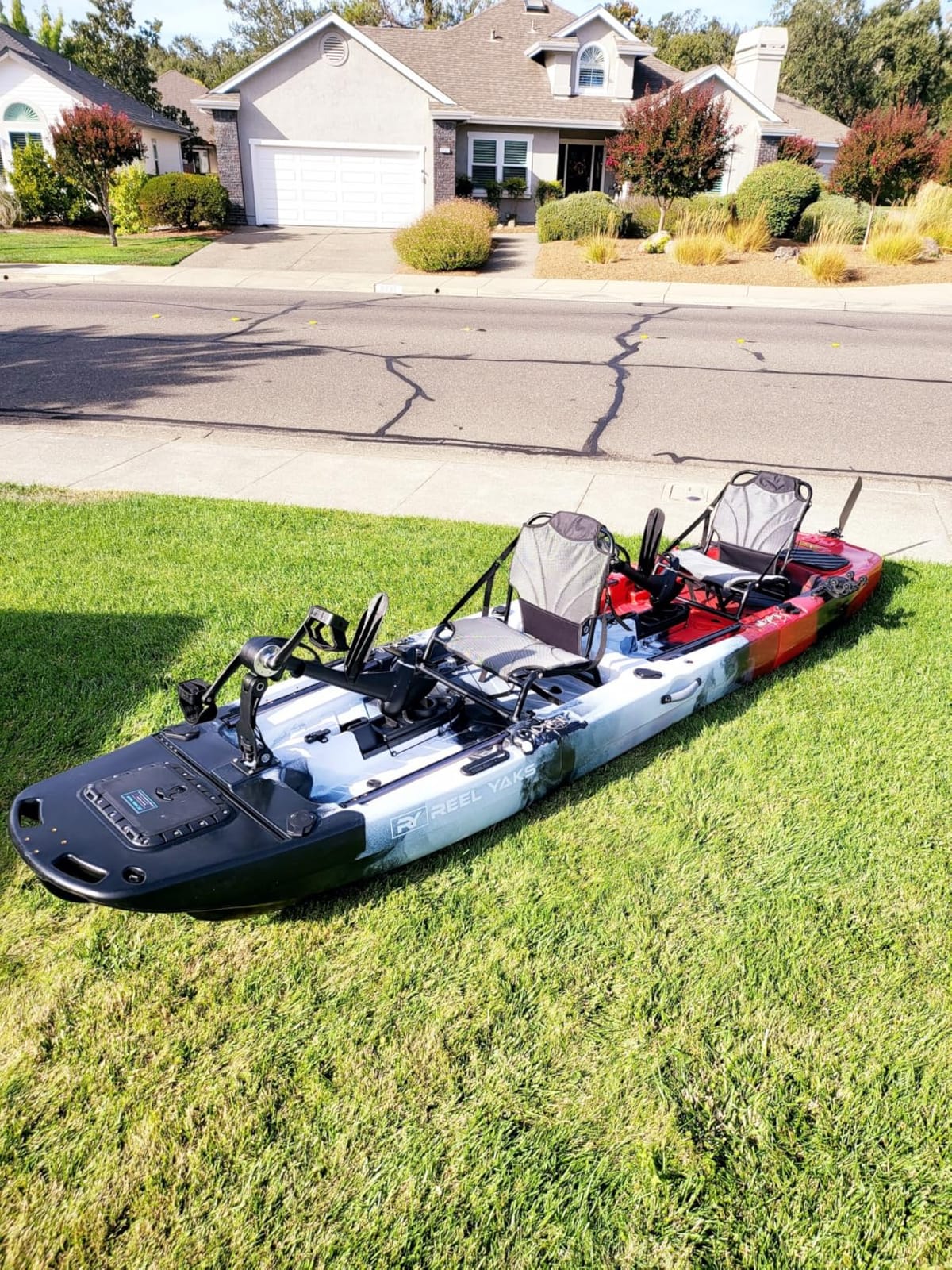
What propeller drive does for an angler
Thrust equals holding station. A propeller lets you sit over a specific drop-off in current, creep along a weed edge at low speed, or cover ground early in the morning when the wind is light. Fin drives are quieter and weed-proof, but you work harder for less speed, and in a chop the extra reserve matters.
Where it falls short
Nine and a half feet is a short hull, and while the wide beam keeps it steady, it does not track like a 12-footer. The rudder failures reported by owners are a real safety issue in current, because steering that goes light at the wrong moment is how paddlers end up in the drift. Inspect the rudder and control line before every offshore trip.
10. Albott Modular 9.4ft – Most Stable Standing Platform With Pedal Drive
Albott Modular Fishing Kayak with Fin Drive System & Durable HDPE
Length: 113 in
Width: 34.7 in
Capacity: 420 lb
Weight: 102.4 lb
Fin drive
Pros
- Very stable standing platform with a foam standing area
- Two-piece design fits a compact vehicle
- Pedal drive runs forward and reverse
- Stainless 304 hardware and pin-connection hull
Cons
- 102.4 lb total weight is very heavy for the size
- Hull thickness is light for rocky or surf use
- Pedal drive brackets feel flimsy
- Only a 6-month warranty
The Albott has the most genuinely stable standing platform in this group, and for sight casters that is the feature that matters. Owners describe a wide deck with a foam standing area that feels planted, and a 420 pound rating that leaves usable load even for a heavier angler. Pedal drive runs in both forward and reverse, which helps hold position against wind.
The modular hull splits into two sections with internal handles and four-step assembly, so it lives in a closet or a small vehicle rather than a garage rack. Hardware is 304 stainless steel with reinforced pin connections, and spare fins are included, which matters more for salt water than the spec sheet suggests.
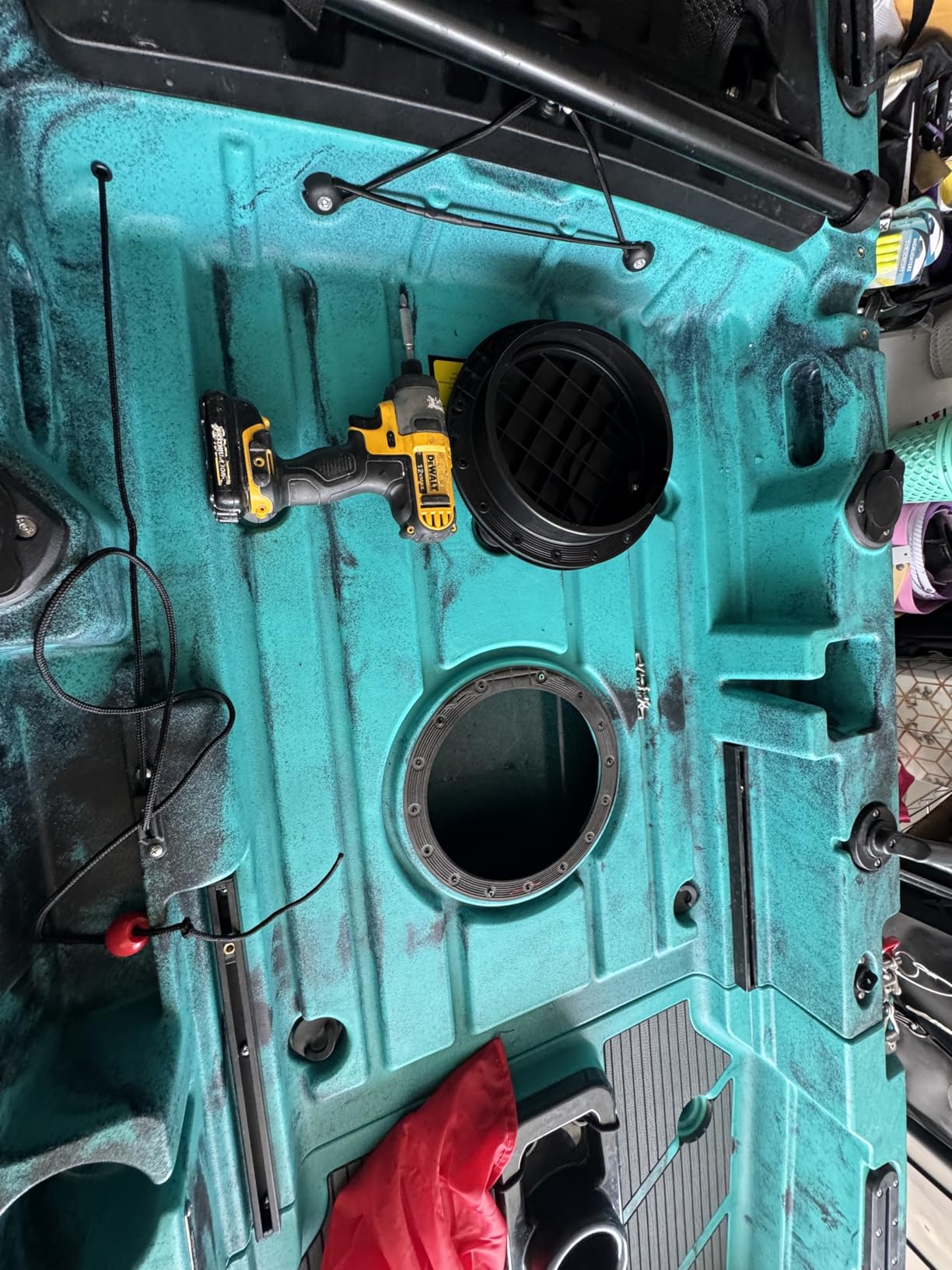
Now the compromises, and they are significant. At 102.4 pounds this is the second heaviest boat here and it is only 9.4 feet long, so it is a heavy object to carry across a beach. Owners report the hull thickness is lighter than premium kayaks and less suited to rocky water or surf, the pedal drive mounting brackets feel flimsy, and the included scupper plugs are poor quality.
The warranty is six months, which is far shorter than every established brand here, and that is the reason we place it last. Good stability at this rating is real, but for a boat that will live in salt water, build thickness and warranty length are how you judge long-term ownership.
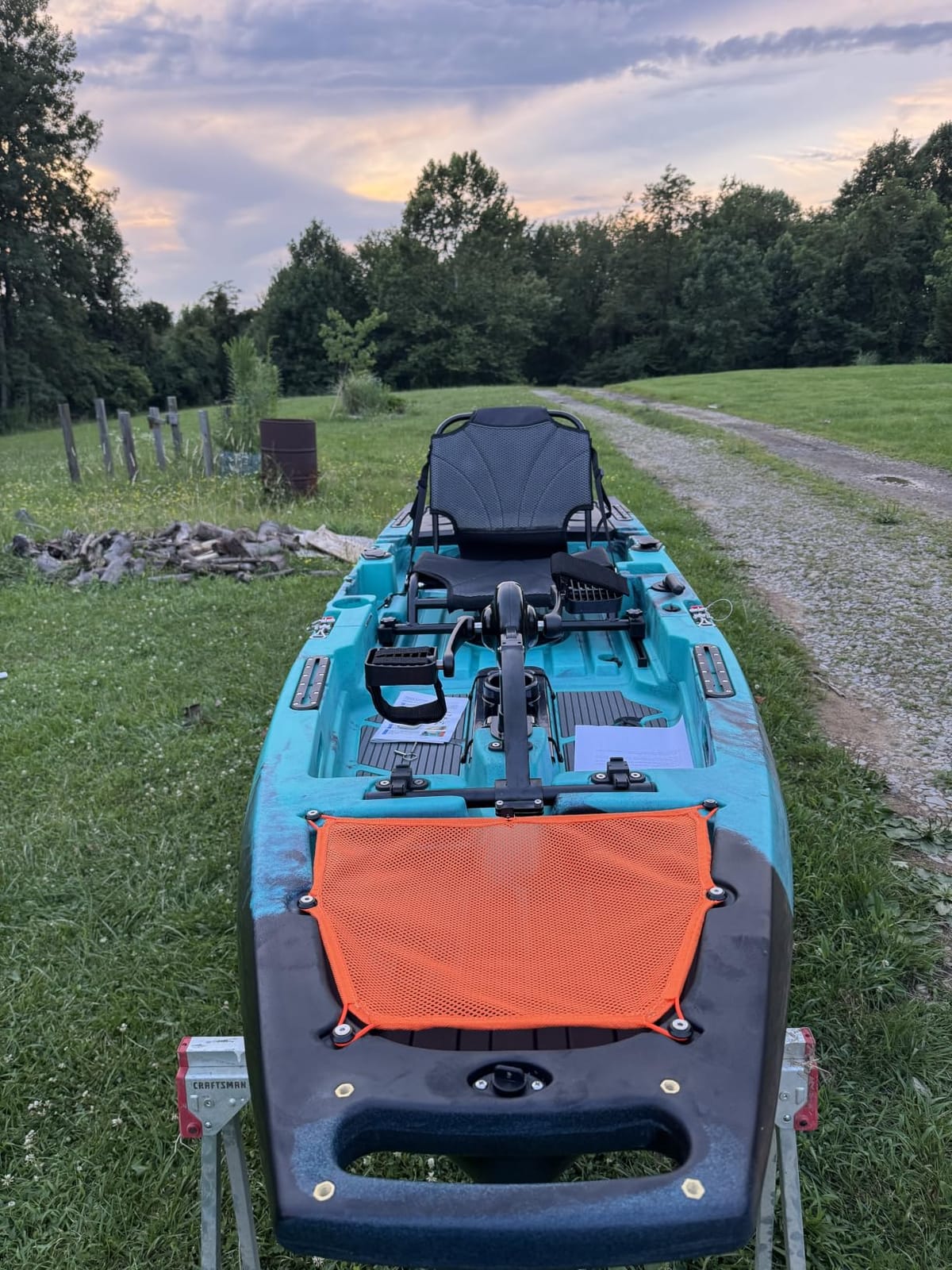
Why the standing deck matters offshore
A casting brace foot on a raised seat in a choppy sea puts your weight high in a small boat. A wide flat deck with a foam standing area spreads that weight across the whole hull and lets you keep fishing when a wave arrives instead of sitting down mid-cast. Add reverse pedal drive and you can back off structure without turning around.
Where it falls short
Weight and hull thickness are the two reasons. A light hull in rocky water flexes and eventually cracks, and 102 pounds is a hard load to handle solo from a car park to a shoreline launch. Mass-produced design does mean replacement parts are easy to find, which partly offsets the thin hardware.
How to Choose a Sit-On-Top Kayak for Ocean Water?
Length is the first filter, and it is the one most buyers get wrong. A boat under 10 feet has a short waterline, which means less momentum through a wave face and more yaw when you stop paddling. For open coastal water we would start at 12 feet. Under 10 feet works for sheltered bays and shallow flats; 10 to 12 feet covers most bay and estuary fishing; 12 feet and above is the range where boats start handling a real seaway.
Beam width is the trade-off opposite to length. A wide boat, 34 inches or more, gives primary stability, which is what keeps you upright and lets you stand to cast. A narrow boat, 30 to 32 inches, gives secondary stability and speed. You cannot maximise both. Coastal anglers casting from a seated position want width; anglers crossing a bar or surf want length.
Capacity needs honest arithmetic. Rated capacity is a structural number, and your working load is roughly 30 to 40 percent lower once you add a tackle crate, a dry bag, a battery and safety gear. A 380 pound rated boat fished by a 250 pound angler is loaded correctly. The same angler in a 275 pound rated boat is overloaded the moment they leave the ramp.
Steering hardware is not optional offshore. A rudder is a blade on a stern hinge with a control cable and gives real authority in wind and current; a skeg is a fixed fin that resists yaw but cannot turn the boat. A boat with neither will need constant paddle correction. Rudder systems fail in salt water, so budget for a spare cable and a spare guide screw, and check the linkage before every trip.
Propulsion is a separate decision. A paddle is cheapest and has nothing to break, and it is the right call in sheltered water. Pedal drive, whether fin or propeller, is the single biggest quality-of-life upgrade for reaching fish with effort, and both types have maintenance trade-offs. A trolling motor is the fastest way to cover water but adds registration questions, corrosion risk and a heavy power unit. Our pedal kayak guide covers drive mechanics in more detail.
Storage and seat height round out the decision. Self-bailing scuppers drain deck water but do nothing for gear, so a sealed dry box or hatch matters more in spray than on a lake. An elevated seat improves sight casting and visibility over waves but lowers the deck clearance that makes chop feel smaller. If you read a fish finder, our fish finder for kayak guide covers mounting options.
Finally, transport decides more purchases than hull shape. Boats here run from 44.6 pounds to 102.4 pounds. Anything under 60 pounds can go on a roof rack solo; anything above 90 pounds realistically needs a trailer, a lift or a second person at both ends of the trip. Buy the boat you can actually get to the water.
Ocean Safety and Self-Recovery From a Sit-On-Top
A sit-on-top is forgiving in one way and unforgiving in others. There is no skirt to trap water, so you empty yourself instantly, and the open deck makes re-entry far easier than a sit-in. But the open cockpit gives wind a sail area and means a capsize in a breaking sea can separate you from your boat for a few long seconds.
Before you launch, a short kit matters more than any hull feature. Wear a properly fitted PFD with a whistle and a light. Attach a paddle leash so a gust does not take your only means of propulsion. Carry a bilge pump if your boat has any enclosed storage, and tell someone your launch point, your route and your return time. In open water, that float plan is the difference between a bad afternoon and a rescue call.
Re-entry from a sit-on-top, alone, in open water, is a practised skill. Owners describe the fear of it more often than the difficulty of it, so work through these steps in shallow calm water first:
Stay with the boat. A paddle kayak is easier to spot than a person, and it floats. Do not swim away from it.
Get clear of the cockpit opening and check for a leash or line you are tangled in.
Roll the hull upright if it is inverted, using the seat or the hull side as the pivot.
Move along the hull to the side with the lowest freeboard and find the raised gunwale or mounting rail.
Pull the hull onto its side toward you, lay across the deck, and slide your torso onto the seat rather than trying to stand up.
Move yourself and your gear to the centre of the boat before you paddle, and check for a leak from the tank well or hatch.
Practise this twice before you leave the slipway. Anglers who have drilled it describe the capsize recovery as the moment the whole hobby clicked for them, and the boat you own does not change that requirement.
Saltwater Care: Stopping Corrosion Before It Starts
None of the roundups we studied covered this, and it is the maintenance task that decides whether a rudder cable survives three seasons. Salt water plus dissimilar metals plus a galvanic connection is a slow, quiet failure. Owners report rudder linkages and control wires going brittle long before anything looked wrong.
Rinse with fresh water every single trip, even a short one. Target the rudder blade, the linkages, the control cables, the trolley bolts, the pedal drive and every bolt hole. Salt crystallises in crevices and holds moisture against steel the whole time the boat sits on a roof rack or in a garage.
Then dry it, do not just towel it. Stand the boat on its side or on end, leave the hatches and scuppers open, and let it air out for a day. Wipe the steering cables with a light oil and check that the rudder guide screw and ferrule are still tight. On pedal drives, follow the maker’s lubrication points and keep a spare fin and prop on hand.
If you fit a trolling motor, add a sacrificial anode and check it every few trips. Keep dissimilar metals apart where you can, and rinse the motor head as well as the hull. Hull colour barely matters, but hardware condition is the thing that decides whether your rudder still steers after a year of spray.
Frequently Asked Questions
Can I use a regular kayak in the ocean?
Yes, most kayaks can physically be launched into salt water, but a short recreational hull behaves very differently once wind, current and swell are involved. Ocean-capable boats carry a longer waterline, more bow rocker, a rudder or skeg, and enough usable capacity for a loaded angler. Treating a lake boat as an offshore boat is where most capsizes happen.
Is there a difference between ocean and lake kayaks?
The main difference is the hull. Ocean-capable sit-on-tops have more bow rocker to lift over waves, a longer waterline for tracking, a rudder or drift skeg for steering authority, sealed dry storage, and hardware rated for corrosion. They also tend to sit lower in the water under load, which changes how they handle wind.
Can any kayak be used in the ocean?
Any kayak can be used, but not safely in conditions beyond its design. Boats under 10 feet, or boats with no steering hardware, are best kept to sheltered bays and calm estuaries. For open coastal water we would choose 12 feet or more, a rudder, and a hull that holds your line when wind and current push from the side.
What are the best kayaks for fishing?
For general angler fishing the standouts on this list are the Pelican Catch Mode 110 for stability, the Perception Pescador Pro 12 for tracking, and the Lifetime Tamarack Angler 100 for value and weight. Each fills a different water type, so the right answer depends on whether you fish sheltered bays or open coastline.
Is it better to have a longer or shorter kayak?
Longer boats hold a line and carry momentum through waves, which is what you want offshore. Shorter boats are easier to carry, quicker to turn and better in tight water. For open coastal water, length wins, and we would not go below 12 feet. Under 10 feet suits sheltered bays and shallow flats.
Do I need a rudder for an ocean fishing kayak?
We would treat a rudder as standard offshore equipment. Wind and current push a sit-on-top off course constantly, and a rudder gives you steering authority without using paddle strokes you need for balance while casting. A skeg resists yaw but cannot steer. If the rudder cable breaks, inspect and replace it before every salt-water season.
Do I have to register my kayak if it has a trolling motor on it?
It depends on where you live and on the motor. Many states require registration and a permit for any vessel with a motor above a small electric threshold, and some coastal states are stricter. Check your state boating agency rules before you fit a motor, and carry whatever documentation is required, because fines for an unregistered motorised craft are common.
How fast is a kayak with a trolling motor?
A small electric trolling motor typically holds a paddling walking pace, which is enough to cover a few miles of flat water comfortably and to hold position in light current. Propeller pedal drives go faster and climb current better than fin drives. None of them make a kayak safe in a rising swell, so speed does not change when you should turn back.
How do I get back into a sit-on-top kayak after capsizing?
Stay with the boat, roll the hull upright, move to the lowest side, pull the hull onto its side, lay across the deck and slide onto the seat instead of standing. Then centre yourself and your gear before you paddle. Practise the sequence in shallow calm water before your first offshore trip.
How do I clean and maintain a fishing kayak after use in salt water?
Rinse the hull, rudder, linkages, cables, trolley bolts and pedal drive with fresh water after every trip, then let the boat air dry with hatches and scuppers open. Oil the steering cables, check the rudder guide screw is tight, and re-grease pedal drive points on the maker’s schedule. If you run a trolling motor, fit a sacrificial anode and inspect it every few trips.
Which Sit-On-Top Kayak Is Right for Your Water?
The Lifetime Tamarack Angler 100 is our pick for the best sit on top fishing kayaks for ocean because it has the deepest owner history, the lightest weight in its class and a tracking bow that holds a line without pedal hardware to fail. If you want the most stable platform and plan to cast standing, take the Pelican Catch Mode 110. If you want the most sea-capable hull shape with genuine dry storage, the Wilderness Systems Tarpon 120 is the one.
Match the boat to the water instead. Shallow flats and sheltered bays suit the lighter, shorter boats. Open coastline, surf launches and anything with current want 12 feet, a rudder, and a rinse routine you actually follow. Whichever you choose, practise the re-entry before the first trip out, and check the 2026 forecast before you paddle past the breakwater.