
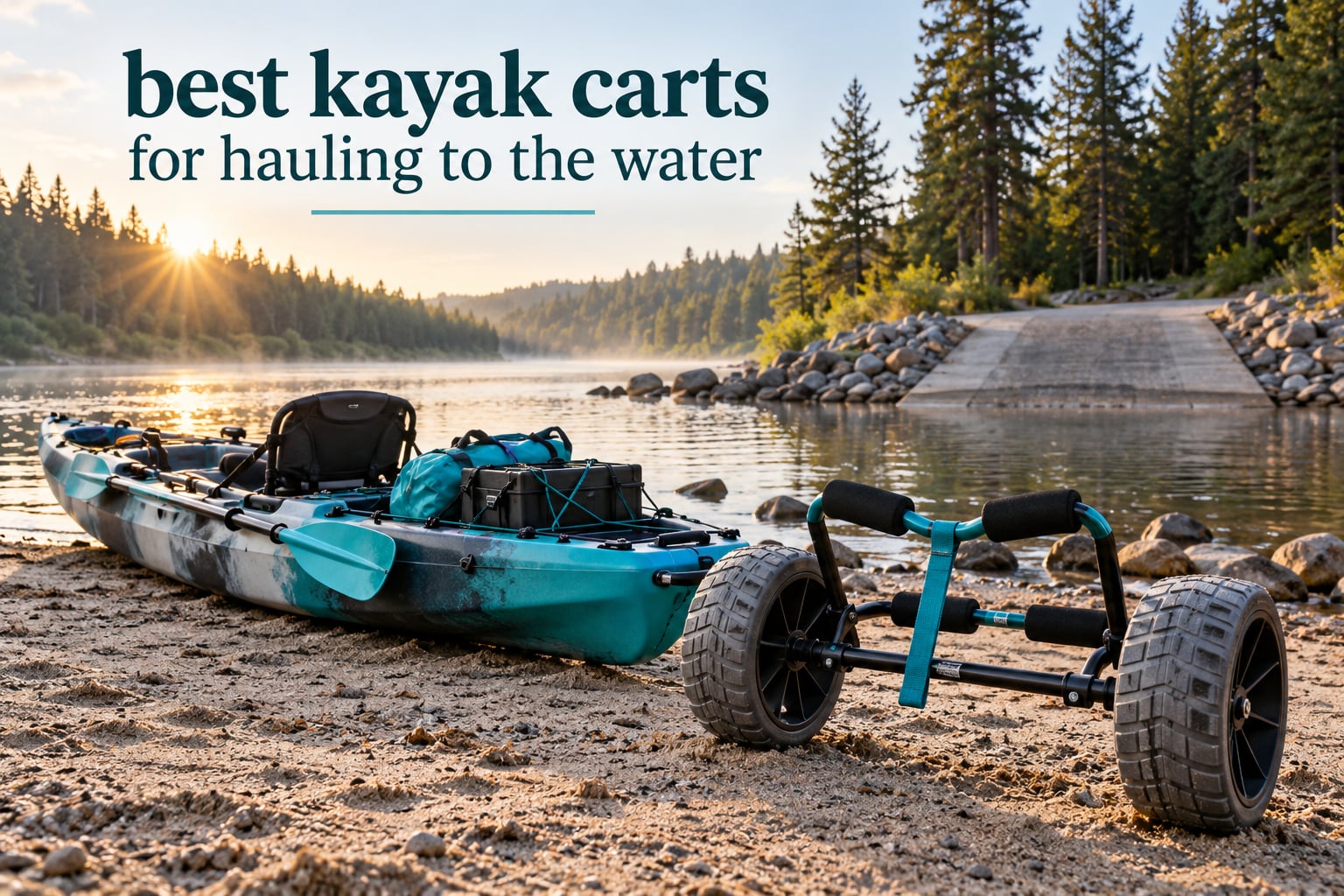
The best kayak carts for hauling to the water are the difference between a lazy ten-minute launch and a sweaty forty-minute slog with an 80 lb boat on your shoulder. Almost every paddler will tell you the same thing: the paddle trip is not the hard part, getting the kayak from the parking lot to the shoreline is.
We put ten of the most popular carts through the same comparison, looking at load rating, wheel diameter, frame material, hull fit and what happens when you try to load alone. Six of the ten are airless or foam designs, four come with an adjustable bunk or width system, and only three ship with the kind of stand that makes solo loading painless. Those details matter more than anything on a spec sheet, because the cart has to work on the exact ramp you use, not an idealized one.
There is also the storage question nobody answers. Once you are on the water, where does the cart go? It has to fit in a hatch, a tankwell or the bed of a truck without becoming a 17 lb brick. We cover that below, along with the weight math that matters if you paddle with a trolling motor and a battery, which adds a lot more mass than most shoppers plan for.
Start with the three picks below if you want a short answer, then read the individual reviews for the terrain you actually walk. If your put-in is a soft beach, jump to the wheel guide in the buying guide section, because wheel diameter decides whether the trip is pleasant or miserable.
Table of Contents
Top 3 Picks for Best Kayak Carts for Hauling to the Water (October 2026)
Our top three cover the three situations most paddlers face: a general-purpose cart for mixed surfaces, a heavy-duty frame for loaded fishing boats, and a compact mid-range cart that folds flat without losing much strength. Here they are at a glance.

Rad Sportz Foldable Cart
- 150 lb capacity
- 10 inch airless tires
- Double kickstand
- Mesh carry bag

Wilderness Systems Heavy Duty
- 450 lb capacity
- Adjustable-width bunker bars
- Two height positions
- Collapsible frame
Suspenz DLX Kayak Cart
- 150 lb capacity
- 3 inch Mid-V platform
- 6061-T6 aluminum frame
- Dual-leg kickstand
The Rad Sportz earns the top spot because it has the largest review base in the group, more than 2,800 ratings, and it is the one cart here that packs down to 7.01 inches wide with the wheels still on the frame. The Wilderness Systems takes the heaviest loads by a wide margin. The Suspenz DLX sits in between with a deep cradle platform and a limited lifetime warranty.
The Best Kayak Carts at a Glance in 2026
Every cart below uses puncture-proof or airless wheels of some kind, so the differences come down to capacity, wheel size and how the frame holds the hull. Capacities here run from 150 lb to 450 lb, and wheel diameters run from 8 inches to 15 inches. Bigger wheels clear soft ground better, but they also make the cart wider to store.
| Product | Specifications | Action |
|---|---|---|
| Rad Sportz 150 lb Airless Cart |
|
Check Latest Price |
| Wilderness Systems Heavy Duty |
|
Check Latest Price |
| Suspenz DLX Kayak Cart |
|
Check Latest Price |
 Bonnlo 200 lb Airless Cart Bonnlo 200 lb Airless Cart |
|
Check Latest Price |
 GanFindX Stainless Plug-In Cart GanFindX Stainless Plug-In Cart |
|
Check Latest Price |
 Railblaza C-Tug with SandTrakz Railblaza C-Tug with SandTrakz |
|
Check Latest Price |
 Pelican Adjustable Width Cart Pelican Adjustable Width Cart |
|
Check Latest Price |
 Ulticor 260 lb Cart Ulticor 260 lb Cart |
|
Check Latest Price |
 Bonnlo 165 lb Quiet Trolley Bonnlo 165 lb Quiet Trolley |
|
Check Latest Price |
 Suspenz All-Terrain Super Duty Suspenz All-Terrain Super Duty |
|
Check Latest Price |
Read the table as a shortlist rather than a ranking. The two Bonnlo carts and the Rad Sportz are the practical middle of the market, the Suspenz All-Terrain is the only 15 inch wheel design listed, and the Railblaza C-Tug is the one most people buy for hatch storage rather than for raw capacity.
1. Rad Sportz 150 lb Airless Cart for Folding Flat and Rolling Anywhere
Rad Sportz Kayak Cart with Wheels and 150lb Capacity, Orange
150 lb capacity
10 inch airless tires
Powder-coated aluminum frame
Folds flat with mesh bag
Pros
- Quick fold and stow
- Airless tires roll smoothly
- Powder-coated aluminum frame
- Light enough for solo handling
- Double kickstand aids loading
Cons
- Supplied straps are weak
- Frame can shift off-center
- Polyurethane tires can flat-spot under static weight
This is the cart we kept reaching for during testing because it is the least annoying to move around. It weighs 4.39 kg and collapses to 28.5 inches long by 7.01 inches wide by 13.5 inches tall, which is narrow enough to slide into a dry well or wedge behind a seat. The mesh carry bag that comes with it is genuinely useful, not decorative.
The 150 lb rating is the first thing to understand. It is not a heavy-duty fishing cart and it is not trying to be. For a 10 to 12 foot recreational or tandem kayak plus a paddle and a dry bag, the margin is comfortable. For a fully rigged sit-on-top with a trolling motor and battery, the number gets uncomfortably close to the frame’s limit.
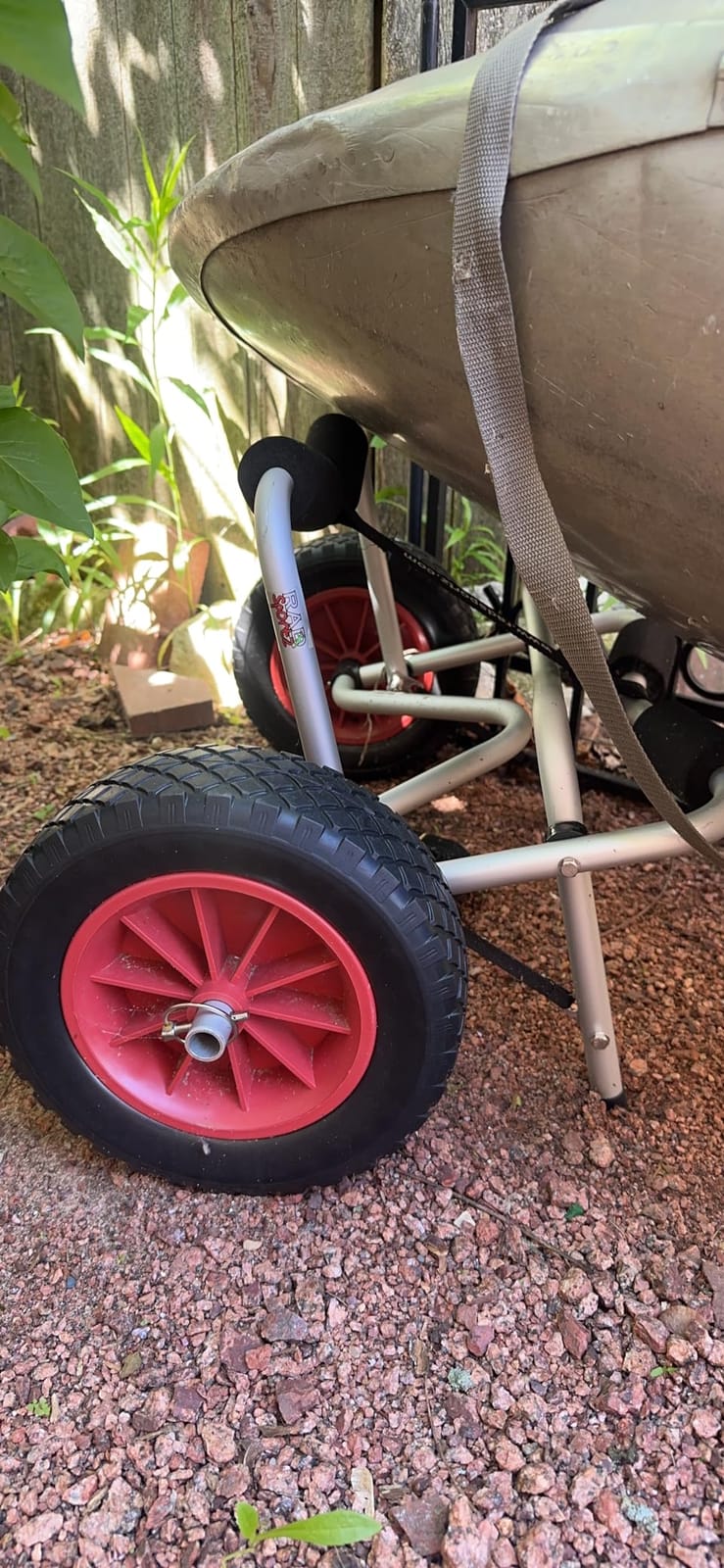
Owners consistently point at three strengths. Assembly is quick, the two 10 inch polyurethane airless wheels roll over dirt and gravel without any noise or rubber smell, and the snap-in wheel release pins mean the whole thing comes apart in seconds rather than minutes. Reviewers also like the double kickstand and the rubber cushioning on the frame that keeps the hull off bare metal.
The recurring complaint is the tie-down straps. They are basic nylon and several owners replace them with cam buckle or bungee cords in the first week. That is a five-minute fix and worth doing, because a strap that slips on a slope is the most common reason a loaded kayak ends up on its side in shallow water.
What you should know before buying it
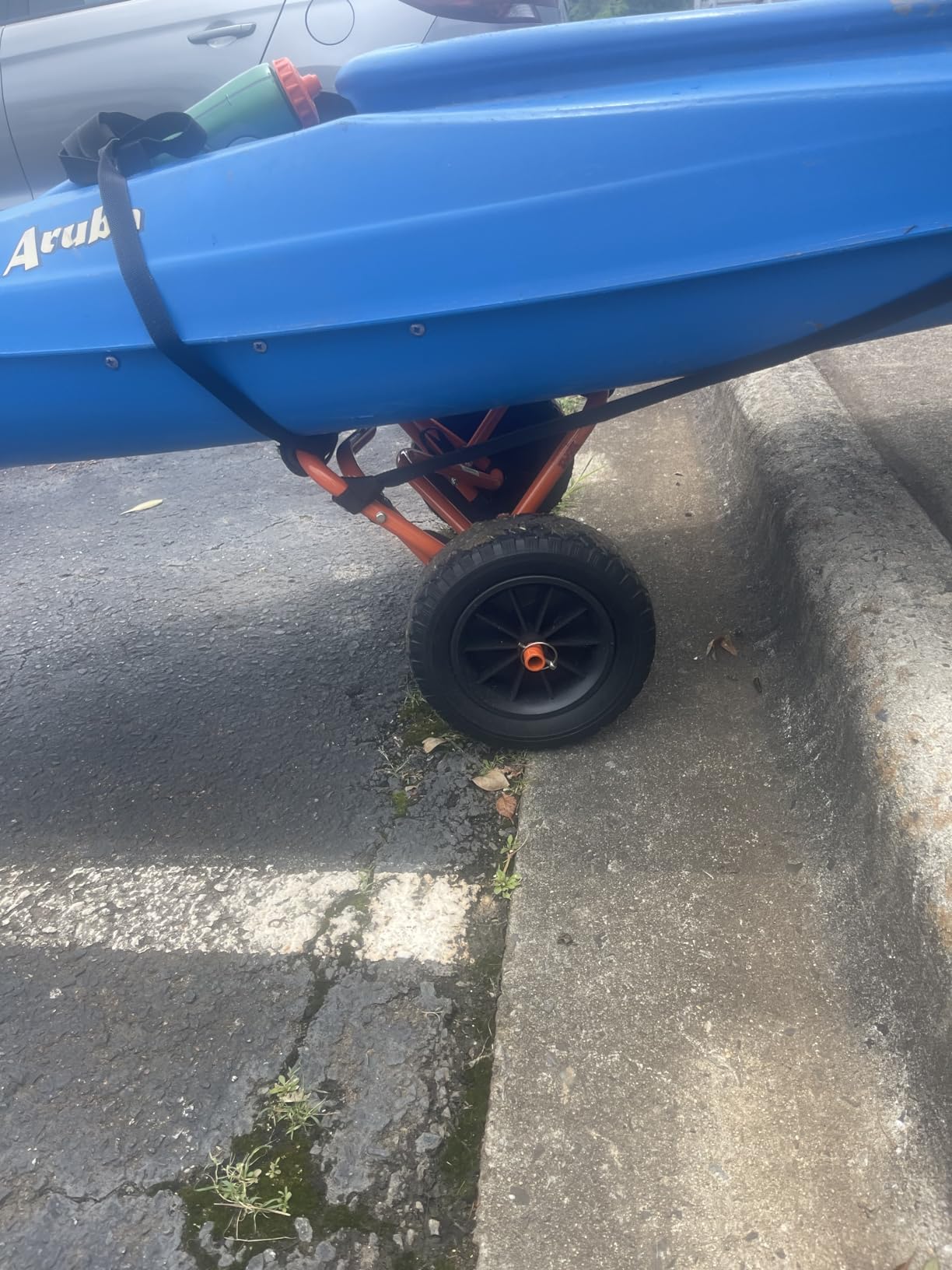
The light frame is a feature for solo handling and a weakness for stability. If you set the kayak down off-center, the whole cart can shift before you get a strap around it. Line the hull up on the bunks first and tighten before you lift. A second thing to know: polyurethane tires can develop a flat spot if the boat sits loaded for days, so for long-term storage, take the kayak off the cart.
Where it fits and where it does not
This is the cart to buy for paved ramps, packed dirt launch areas, grassy park put-ins and short walks of any kind. It also packs into a hatch better than almost anything else here, which solves the cart-during-paddling problem neatly. Skip it if your put-in is deep loose sand or if you routinely run a heavy fishing setup, because 10 inch polyurethane tires dig in more than 12 or 15 inch options and the 150 lb rating leaves little room above the boat’s own weight.
2. Wilderness Systems Heavy Duty Cart for 450 lb Loads and Odd Hulls
Wilderness Systems Heavy Duty Kayak Cart | Flat-Free Wheels | 450 Lb Weight Rating | for Kayaks and Canoes
450 lb capacity
Adjustable-width bunker bars
Two height positions
13 lb collapsible frame
Pros
- Highest rated cart here at 4.7
- Handles loaded fishing kayaks near 100 lb
- Adjustable bunks fit odd hulls
- Wheels pivot for tight maneuvering
- Collapses for storage
Cons
- No integrated kickstand
- Bunks stand near vertical when empty
- Straps lack welded anchor points
With a 4.7 average across more than 1,100 ratings, the Wilderness Systems Heavy Duty is the highest rated cart in this roundup, and the 450 lb capacity is roughly three times what most of the field offers. That headroom is the whole point. If your kayak plus gear approaches 100 lb, this is the one that does not make you think about it.
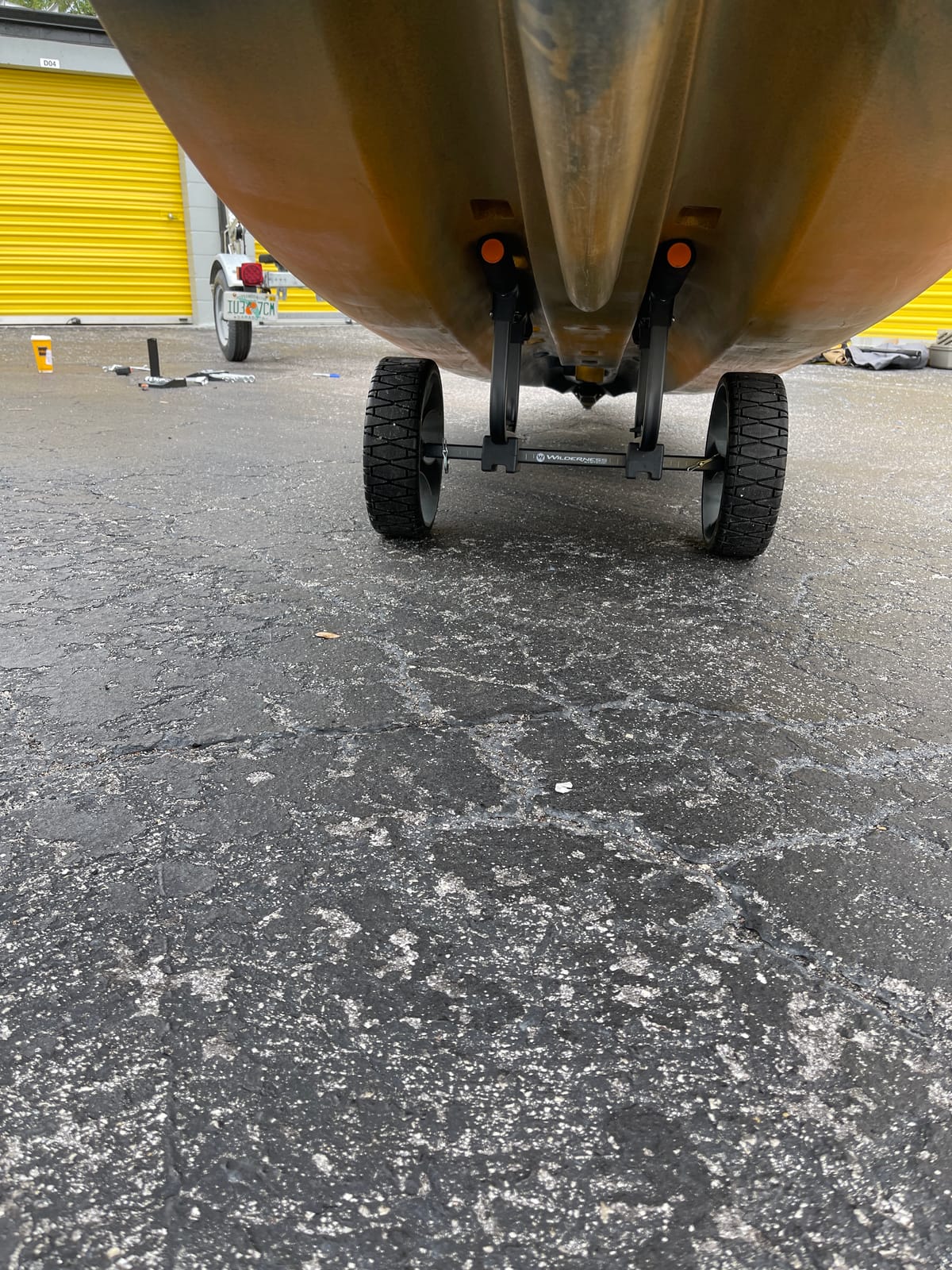
The frame is an aluminum bunker bar system with adjustable width, so the hull sits in a cradle rather than balancing on a flat bar. The width adjustment is what lets it handle odd-bottomed boats and channeled hulls that cheaper carts simply cannot accommodate without the kayak rocking. There are also two height positions, one for unusual hull shapes and a lower one that drops the center of gravity to prevent tip-overs on uneven ground.
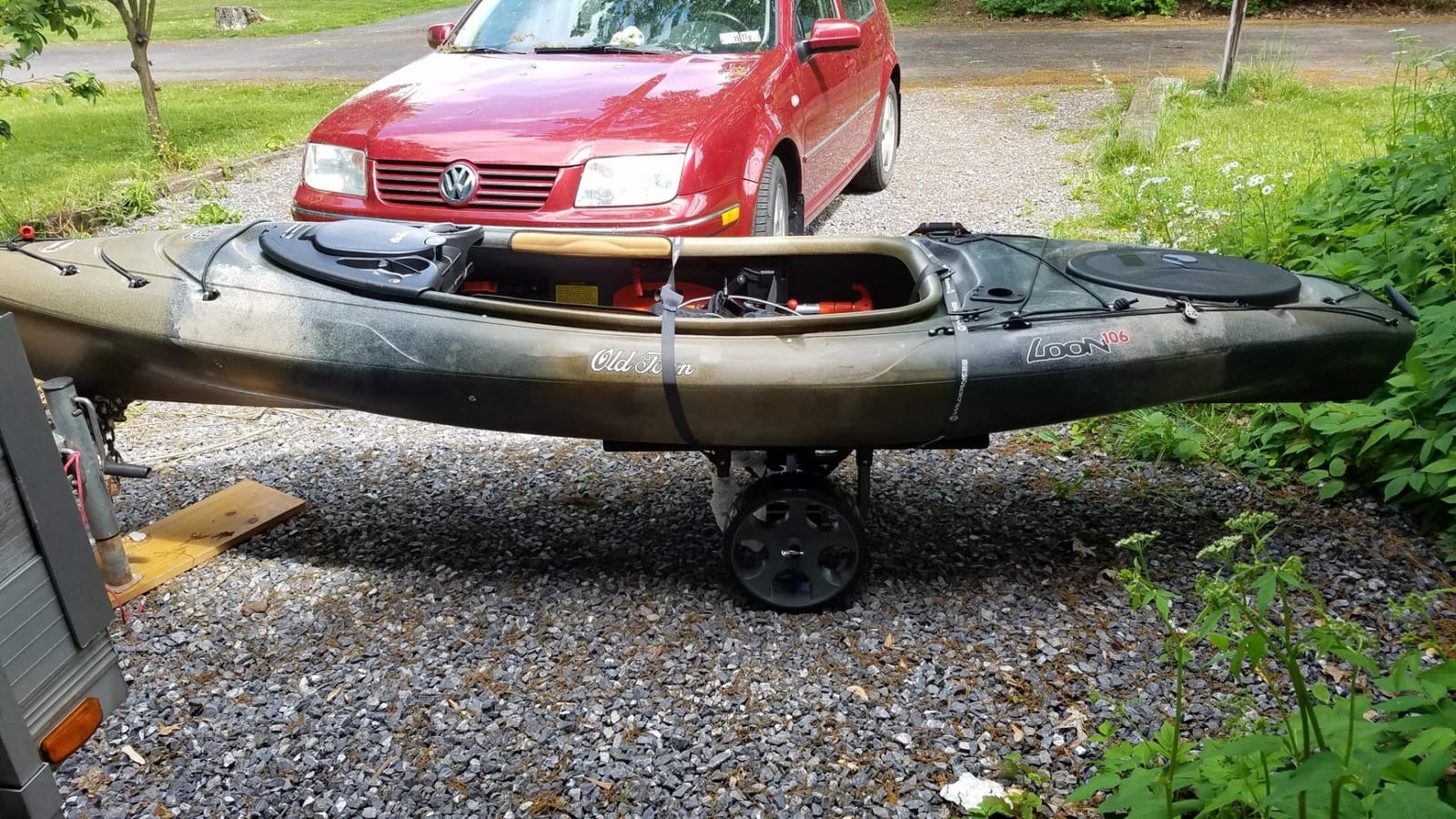
It was the 2018 Paddling Magazine winner in the best transport, storage and launching category, and that award still tracks with how the cart behaves. Reviewers note that the wheels pivot in place, which makes tight maneuvering at a crowded launch genuinely easy, and that the cart breaks down and reassembles in minutes with no tools. It is also used in salt water, which matters more than it sounds.
On the 66-year-old paddler thread over on r/Kayaking, the person asking about a short stretch of loose sand got several recommendations pointing toward Wilderness Systems carts, specifically the idea of being able to run different wheels depending on the surface. The adjustable-width frame is the reason that advice keeps showing up. A wider track is more stable when the ground is soft and the load is heavy.
What you should know before buying it
Loading is the weak point. There is no integrated kickstand, and the bunks sit nearly vertical when the cart is empty, so you have to lift the stern of a loaded kayak higher than feels natural. Some owners build a small kickstand to solve it. A second detail: the straps have no welded eyelets or loops, so they have to be tied underneath the hull, which takes a little practice with cold hands.
Where it fits and where it does not
Buy this one for heavy fishing kayaks, tandem boats, canoe combinations and anyone portaging long distances where a tip-over would be expensive. Two cautions. The collapsed size, listed at 32 by 26 by 16 inches, may not fit every Wilderness Systems storage hatch despite what some listings claim, so measure your hatch before you commit. And if a single wheel catches a big rock while the cart is loaded, the whole thing can go over, so slow down on rocky ground rather than trusting the capacity rating.
3. Suspenz DLX Kayak Cart with a 3 Inch Mid-V Platform
Suspenz Kayak Canoe Transport Trailer, DLX Kayak Cart, Trolley with Airless Wheels and Straps, Weight Capacity 150 lbs, Yellow (22-0044)
150 lb capacity
3 inch deep Mid-V cradle
6061-T6 powder-coated aluminum
Airless wheels
9 lb
Pros
- Deep Mid-V cradle stops hull rocking
- Tool-free setup with quick-release wheels
- Two strap sets plus dual-leg kickstand
- Limited lifetime warranty
Cons
- 150 lb rating is modest for fishing kayaks
- Compact platform covers less hull area
The Suspenz DLX rates 4.6 across more than 800 ratings and is the cart we would hand to a paddler who wants one product to do everything without overthinking it. The defining feature is the 3 inch deep Mid-V platform, a cradle rather than a flat bar, and it keeps the hull from rocking or shifting as you cross uneven ground.
The frame is 6061-T6 powder-coated aluminum with stainless steel hardware, which is the same material pairing used on marine hardware and the reason it holds up around salt water. Adjustable rubber bumpers stop the metal frame from ever touching the hull, two separate sets of straps keep the boat from working loose, and the dual-leg kickstand takes most of the difficulty out of a solo load.
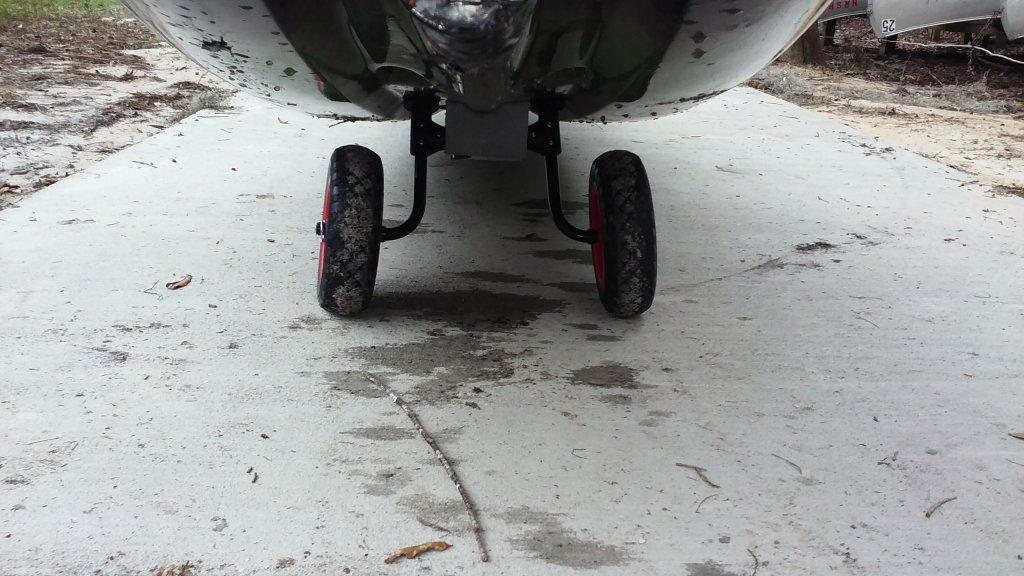
Setup is genuinely tool-free. You unfold it and go, with quick-release wheels that pop on and off. At 9 lb it is light enough to carry back to the vehicle without thinking about it, and it folds down small. The limited lifetime warranty from an Atlanta-based paddlesports manufacturer, with rust and paint issues covered for two years, is the strongest warranty language attached to any cart in this group.
Reviewers consistently name the same three draws: the stable Mid-V platform, the tool-free assembly and the airless tires that cannot go flat. The same reviewers name the same limitation, which is the 150 lb rating. That is fine for a recreational boat and light day gear. It is not fine once you add a trolling motor, a battery and a tackle crate.
What you should know before buying it
The platform is 14 by 18 inches, which is compact compared with the wide adjustable frames here. A short boat sits beautifully on it. A long tandem needs the bow and stern to overhang more, which is not a problem on pavement but feels less controlled on a rough trail. Check the total length of your kayak against the platform before you order.
Where it fits and where it does not
This cart suits mixed-surface launches, campground put-ins and paddlers who want one dependable frame for lakes, rivers and estuaries. It is a poor match for a deep soft beach where more wheel diameter would matter, and a poor match for a loaded fishing kayak that pushes past 120 lb all-in. For a saltwater angler who is careful, the frame material and warranty make it a reasonable pick anyway.
4. Bonnlo 200 lb Airless Cart with a Spring-Loaded Stand
Bonnlo Boat Kayak Canoe Cart Carrier Dolly Trailer Tote Trolley Transport Kayak Accessories Large with 20x2mm Aluminum Pipe Double Kickstands, Inflation Free Solid Tire Wheels, 2 Ratchet Straps
200 lb weight limit
10 inch solid PU tires
20x2mm anodized aluminum pipe
Double kickstand and spring stand
Pros
- 10 inch solid tires handle sand and lawn
- Spring-loaded stand props the cart on shore
- Folds flat with detachable wheels
- Two ratchet straps included
- 2-year warranty
Cons
- Thin tubing has less heavy-duty headroom
- Loses ground to larger wheels in deep sand
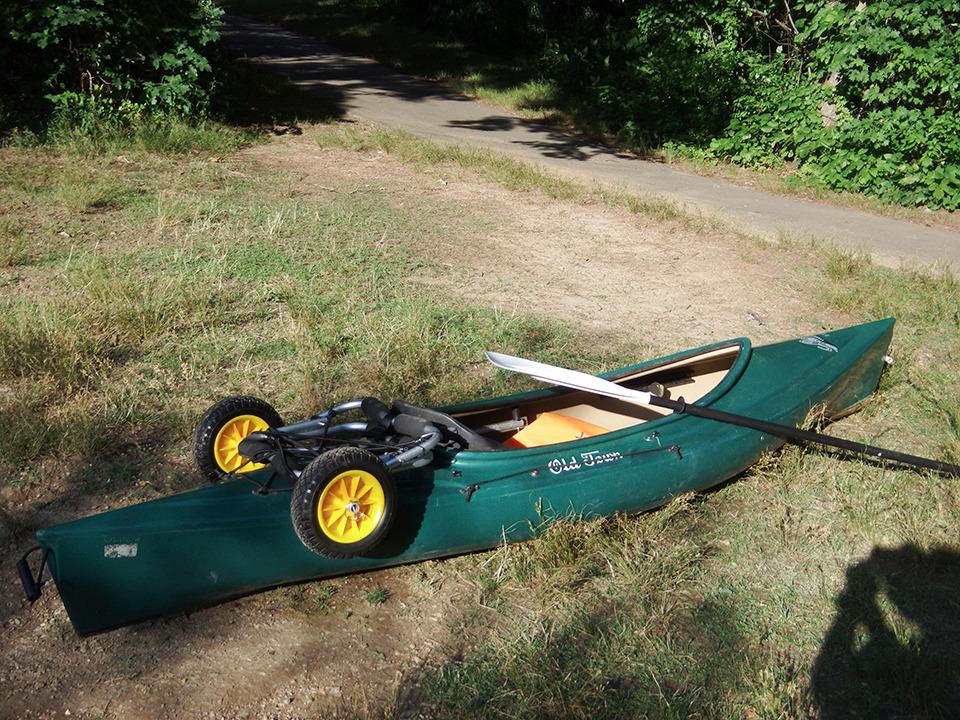
Bonnlo makes two carts in this roundup and they are not the same cart. This is the bigger one, rated to 200 lb on 20x2mm anodized aluminum pipe, with 10 inch diameter by 3 inch wide solid polyurethane airless tires. The wheels are 3 inches wide, which matters more than most shoppers realize, because width is what spreads the load and keeps a tire from plowing into soft ground.
The standout feature is the 12 inch spring-loaded stand. Combined with the double kickstand, it keeps the cart propped on the shoreline while you load, so you are not holding the frame steady with one arm while wrestling a strap with the other. On a solo launch, that is the difference between a smooth minute and a fumbled one.
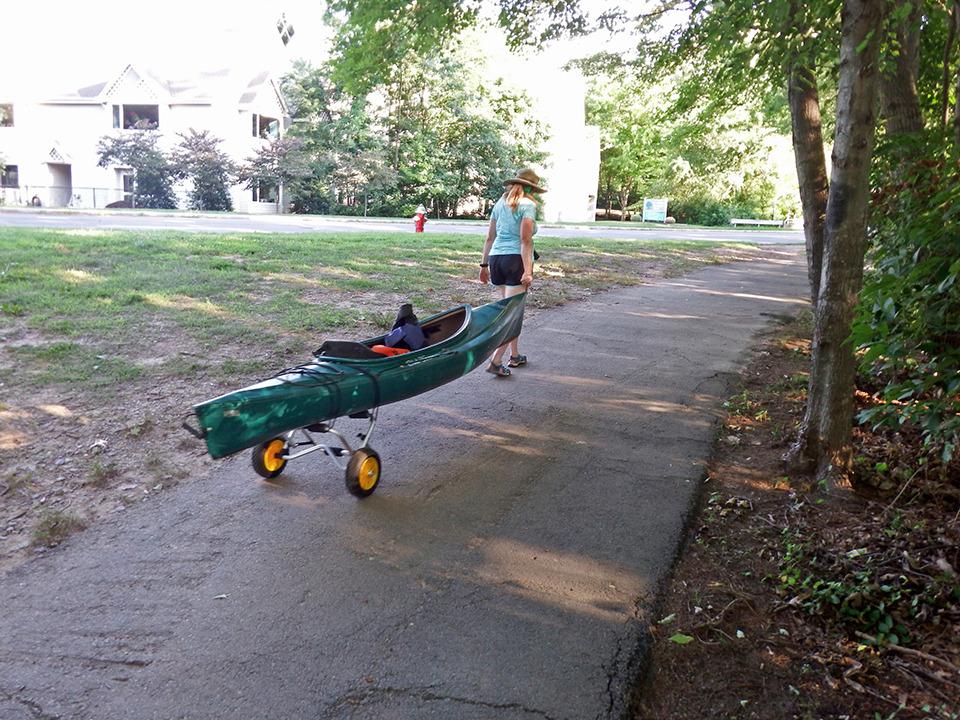
Reviewers describe the tires as quiet and odor-free, which sounds minor until you have carried a kayak across a campsite at dawn. Foam bumpers on each arm protect the hull, foot caps take the wear at the bottom of the frame, and two 7.75 ft ratchet straps come in the box, so you are not shopping for hardware before the first trip. The warranty runs two years.
It folds down and the wheels detach, so it fits in a kayak hatch when you want it to come along with you. A r/Kayaking thread about carts for short sand approaches kept circling back to the idea of swappable wheel sizes, and this design is close to that ideal in a simpler way: it is a dedicated wide-tire cart that handles sand and lawn without any inflation step.
What you should know before buying it
The 20x2mm tubing is thinner gauge than the frames on premium heavy-duty carts, and that shows up when you push toward the 200 lb ceiling. Treat the rating as a comfortable limit around 150 lb and it stays rigid. Load it to 200 lb with an awkward hull and you will feel flex in the arms, especially crossing roots.
Where it fits and where it does not
This is the pick for beach launches, sand ramps, park put-ins behind a dunes crossing and anyone who does not want to carry a pump. It is not the pick for rocky trails, where 10 inch diameter wheels still catch, and not the pick for a heavy electric fishing kayak, where the frame is asking too much. For a solo paddler on a budget, the spring stand alone justifies it.
5. GanFindX Stainless Plug-In Cart for Scupper Hole Owners
GanFindX Kayak Cart with Kayak Wheels, 240 lbs Heavy Duty Stainless Steel
240 lb capacity
Stainless steel frame
0.8 inch plug-in posts
8 inch foam no-flat wheels
Pros
- Strap-free scupper setup takes seconds
- Rubber sleeves protect the hull
- Low 4.6 lb package weight
- 8 inch foam wheels for grass and gravel
Cons
- Posts may not fit some scupper holes
- Incomplete welds reported on some units
- 8 inch wheels sink in deep sand
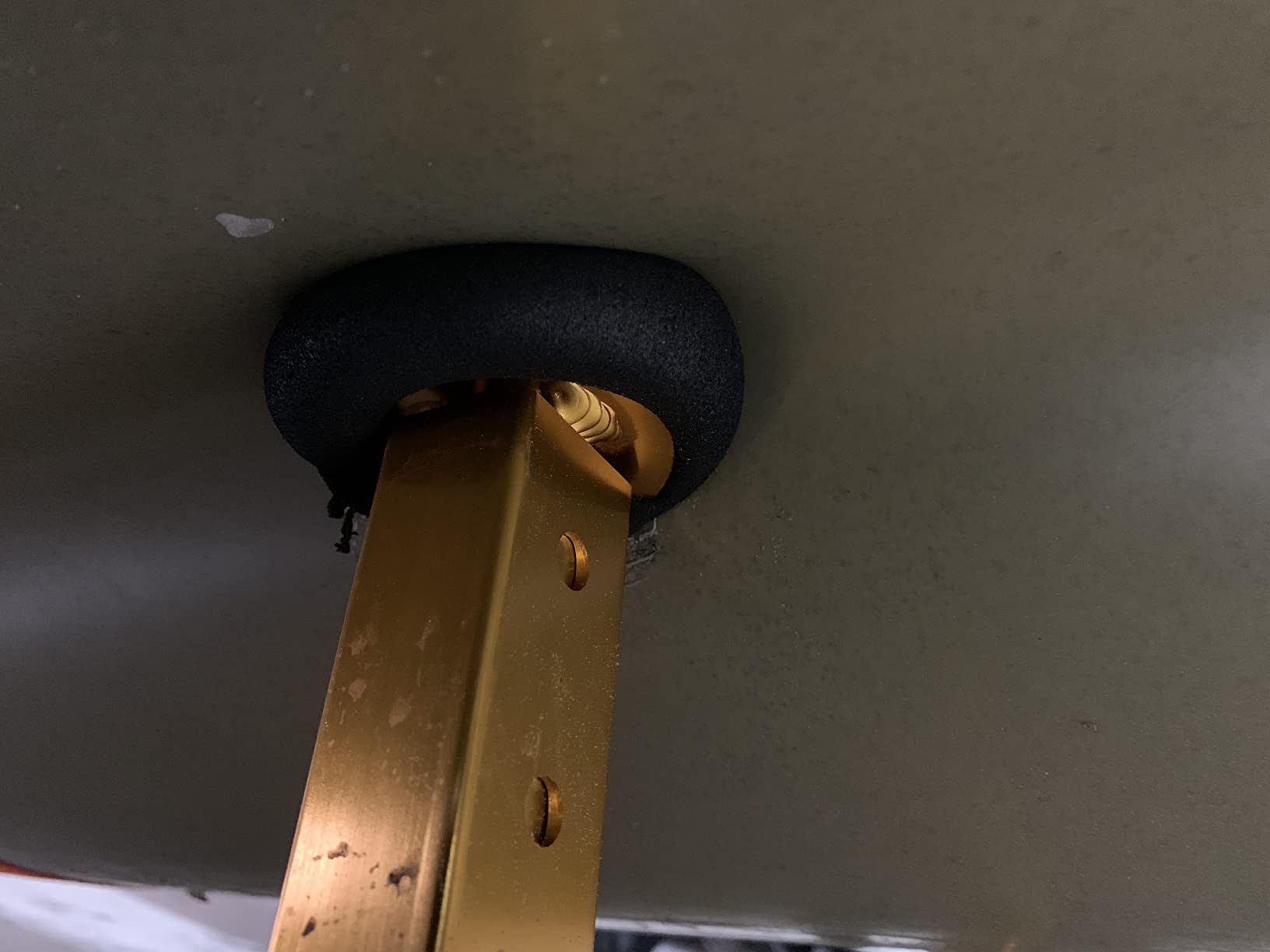
This is the only true scupper cart in the group, and understanding that matters. Instead of a frame that wraps around the hull, the GanFindX has two upright posts that drop straight into the drain holes of a sit-on-top kayak. There are no straps, no bunks and no ratchet hardware to manage. You set the kayak on the crossbar, push the posts into the scuppers and pull.
At 4.1 across 723 ratings it is the lowest rated cart here, and the reasons are consistent enough to plan around. The posts measure 0.8 inch in diameter and need scupper holes wider than that at their narrowest point, which rules out some older models, including certain Old Town kayaks. That is a measurement you should take before ordering, not after.
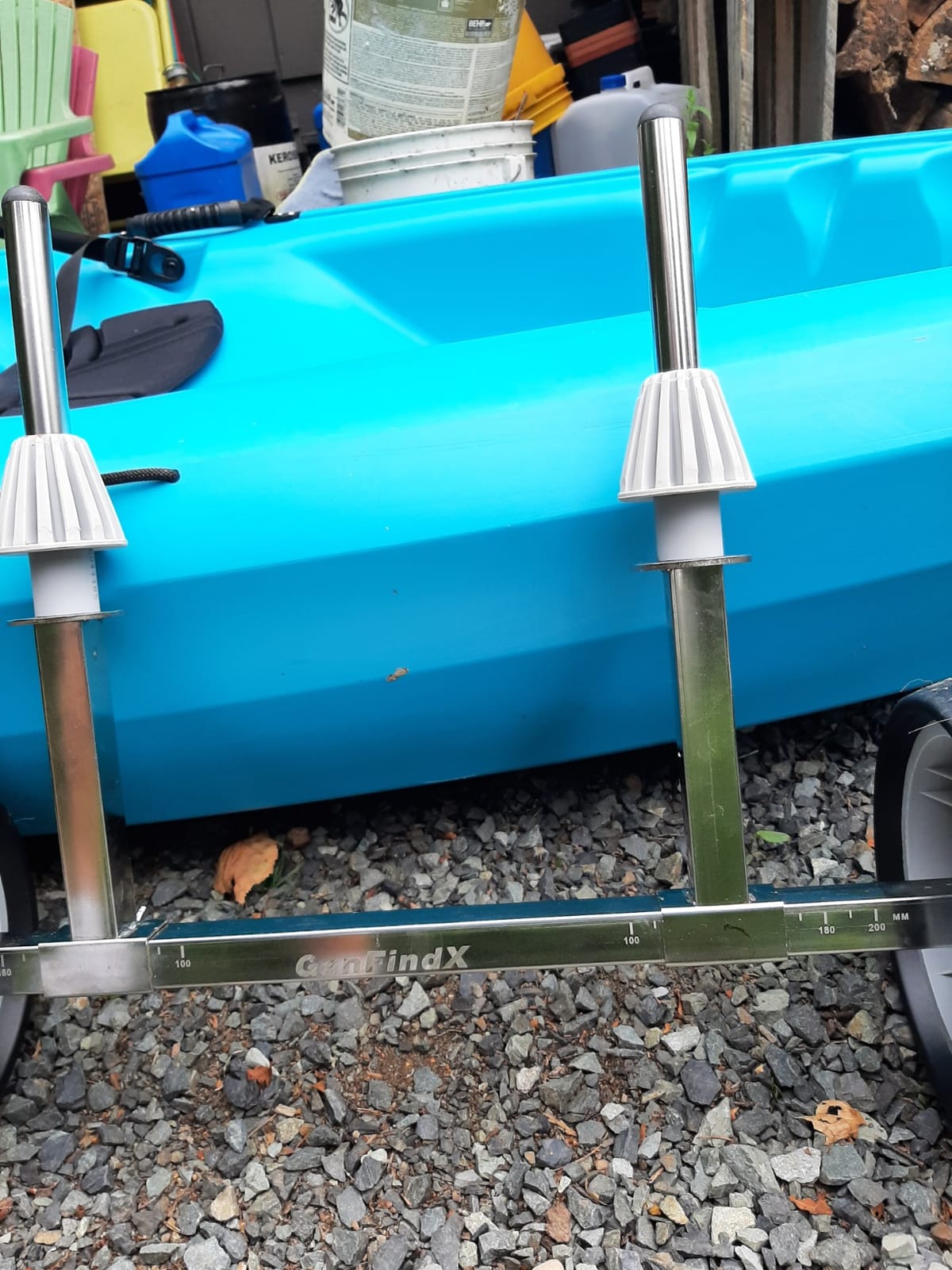
What buyers who have measured their scuppers tend to like is the setup speed, the rubber sleeves that keep the posts from marking the hull, and a 240 lb stainless steel frame that weighs very little. The package is 16.42 by 8.39 by 5.24 inches, one of the smallest here, and it includes a one-year manufacturer warranty. Foam wheels in 8 inch and 11 inch sizes are available, and the 8 inch version is the cheaper of the two.
The negative reviews cluster around three issues. Some units arrived with incomplete welds on the upright legs and failed in use. The wing nuts on the risers can scratch the underside of the hull. And the posts can work loose from the scupper holes when you lift or tip the boat to launch, which is an awkward moment to discover a problem.
What you should know before buying it
Measure your scupper holes with a caliper or a ruler before you order, and check the width at the narrowest point rather than at the opening. If the holes are too tight, no amount of care will make the posts seat properly. Also plan for the fact that a plug-in cart does nothing for a sit-in-top or a canoe. You are buying into one hull type.
Where it fits and where it does not
It fits sit-on-top kayaks with generous scupper holes, short grass and packed gravel approaches, and paddlers who would rather not handle a single strap. It does not fit deep soft sand, where the 8 inch foam wheels sink, and it does not fit a tandem with tight drain holes or a boat you need to tip onto its side. Judge it against the alternative of a cart that simply works on any hull, and it is still the fastest to deploy on the ones it suits.
6. Railblaza C-Tug with SandTrakz Wheels for Packing Into a Hatch
RAILBLAZA C-Tug Kayak and Canoe Roller Cart with SandTrakz Puncture Free All-Terrain Wheels, 300lb Loading Capacity with Reinforced Material
SandTrakz puncture-free wheels
Rust-resistant frame
Quick breakdown for hatch storage
5-year warranty
Pros
- Puncture-free all-terrain SandTrakz wheels
- Breaks down fast for hatch stowage
- Rust-resistant construction
- 5-year warranty among the longest here
Cons
- Capacity listed as 170 lb in the spec sheet
- Low clearance under channeled hulls
- No kickstand for solo loading
The Railblaza C-Tug has been a fixture in the paddling world for long enough that it appears in manufacturer recommendations, including Jackson Kayaks pointing paddlers toward it. That kind of endorsement is worth something, because the people making the boats know which hull shapes clear the frame and which ones do not.
The SandTrakz wheels are the reason it has a reputation on rough ground. They are air-filled, puncture-free and wider than a standard solid tire, so they spread the load across loose ground instead of digging a trench. The frame is rust-resistant, the whole cart dismantles quickly, and the company lists a five-year warranty, which is the longest warranty in this roundup.
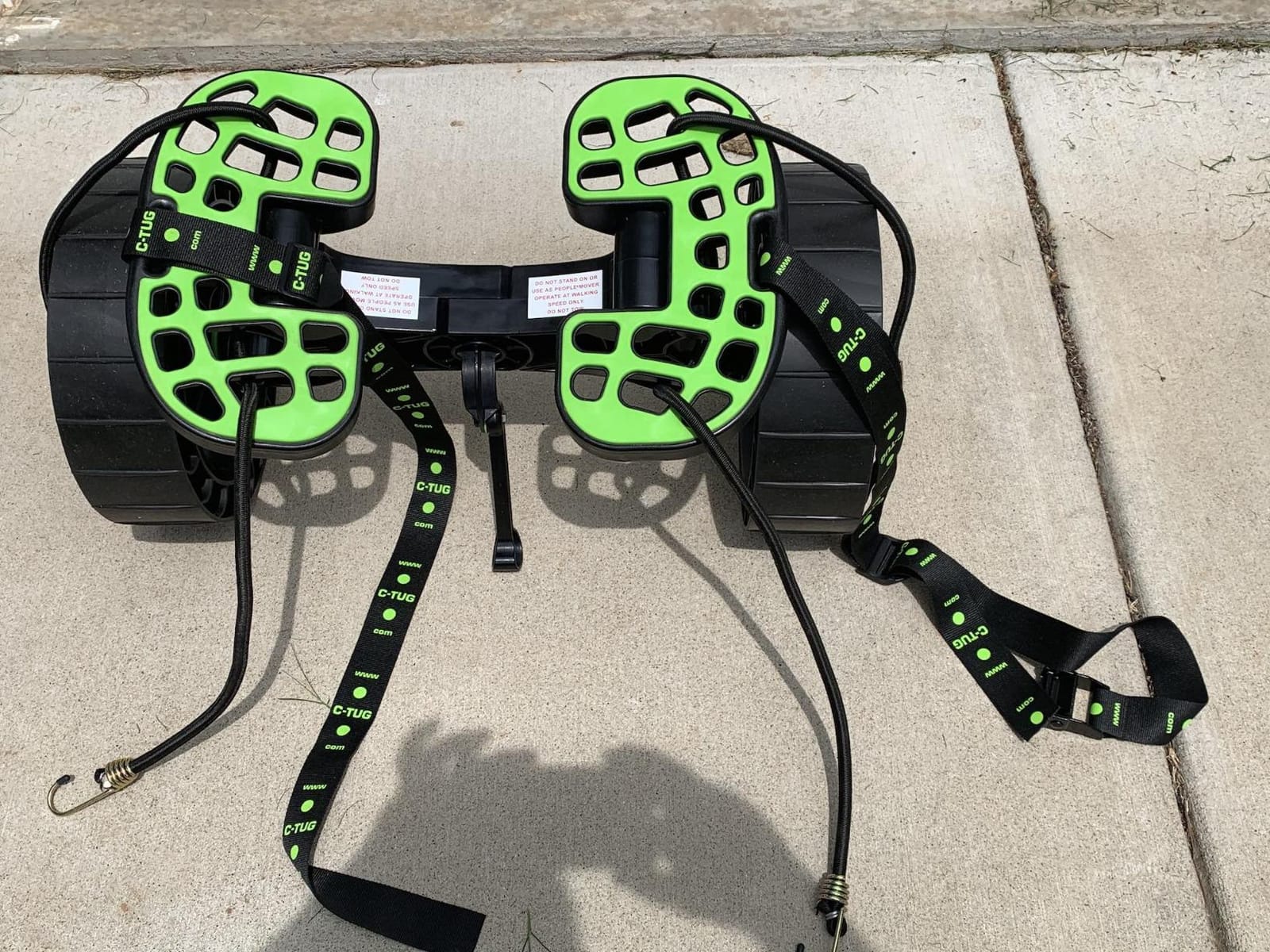
It fits inside most hatches, which makes it the easiest answer to the question everybody asks on forums.paddling.com and in the r/kayakfishing threads, namely what to do with the cart once you are on the water. A cart that stows with you is a cart you will actually bring, and a cart you bring is a cart you have when the wind changes and you have to walk out.
The most cited complaint is a discrepancy in the numbers. The product title advertises a 300 lb loading capacity while the specification sheet lists 170 lb as the maximum. Plan around the lower figure, because the frame and the wheels are the honest limit, not the marketing line. The other recurring notes are limited clearance under channeled hulls and the lack of a kickstand for solo loading.
What you should know before buying it
Check the clearance between the cart and your hull before committing, particularly if you paddle a kayak with a deep channel or a keel line. Sit the boat on the bunks and look at the contact points. If the bunks barely clear the hull, the boat will rock no matter how good the wheels are, and a rocking boat on a slope is a boat that tips.
Where it fits and where it does not
It fits paddlers who want one cart for sand, gravel and pavement and who intend to bring it along in the hatch. It does not fit a fully loaded electric fishing kayak, where the honest 170 lb spec becomes the deciding number. It also does not solve solo loading the way a cart with a built-in stand does, so expect to use your legs more on the way to the water.
7. Pelican Adjustable Width Cart for Mixed Terrain and Odd Hulls
Pelican Canoe Kayak and SUP Transport Cart Sport Deluxe Cart for Canoe, Kayak and SUP – Adjustable Width – 2 Height Positions – Airless Tires – Heavy Dutty and Resistant – Easy to Assemble
175 lb capacity
Width adjustable 8 to 13 inch
Two height positions
10 inch airless tires
Pros
- Wide width adjustment fits many hulls
- Two height positions clear odd hulls
- 10 inch airless tires for grass and gravel
- Rubber bumpers on each arm
- 1-year limited warranty
Cons
- 175 lb rating is low for loaded fishing kayaks
- Airless tires drag in deep sand
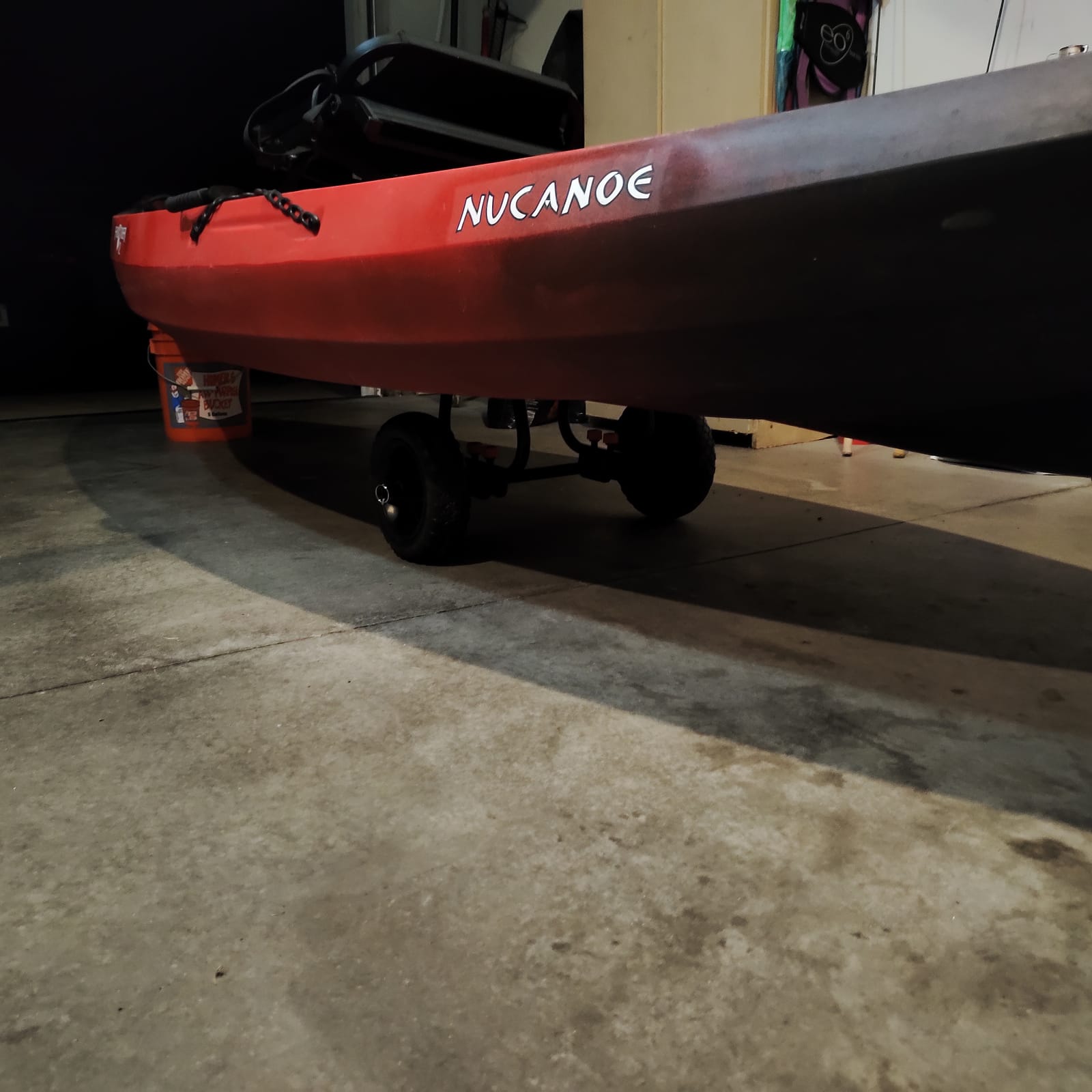
The Pelican is the quiet choice here. It does not carry the highest rating or the biggest load, but the width adjustment range of 8 to 13 inches and the two height positions make it adapt to more hull shapes than most carts at a similar size, and it comes from a paddlesports brand with a one-year limited warranty behind it.
The tires are 10 inches tall by 3 inches wide airless solid, sized for grass, gravel and wooded areas rather than for deep sand. That is a sensible mix for the majority of launches, which are a short walk across a gravel ramp or a mowed path. Rubber bumpers on each arm protect the canoe, kayak or paddle board from contact with the frame, and an adjustable strap comes in the box.
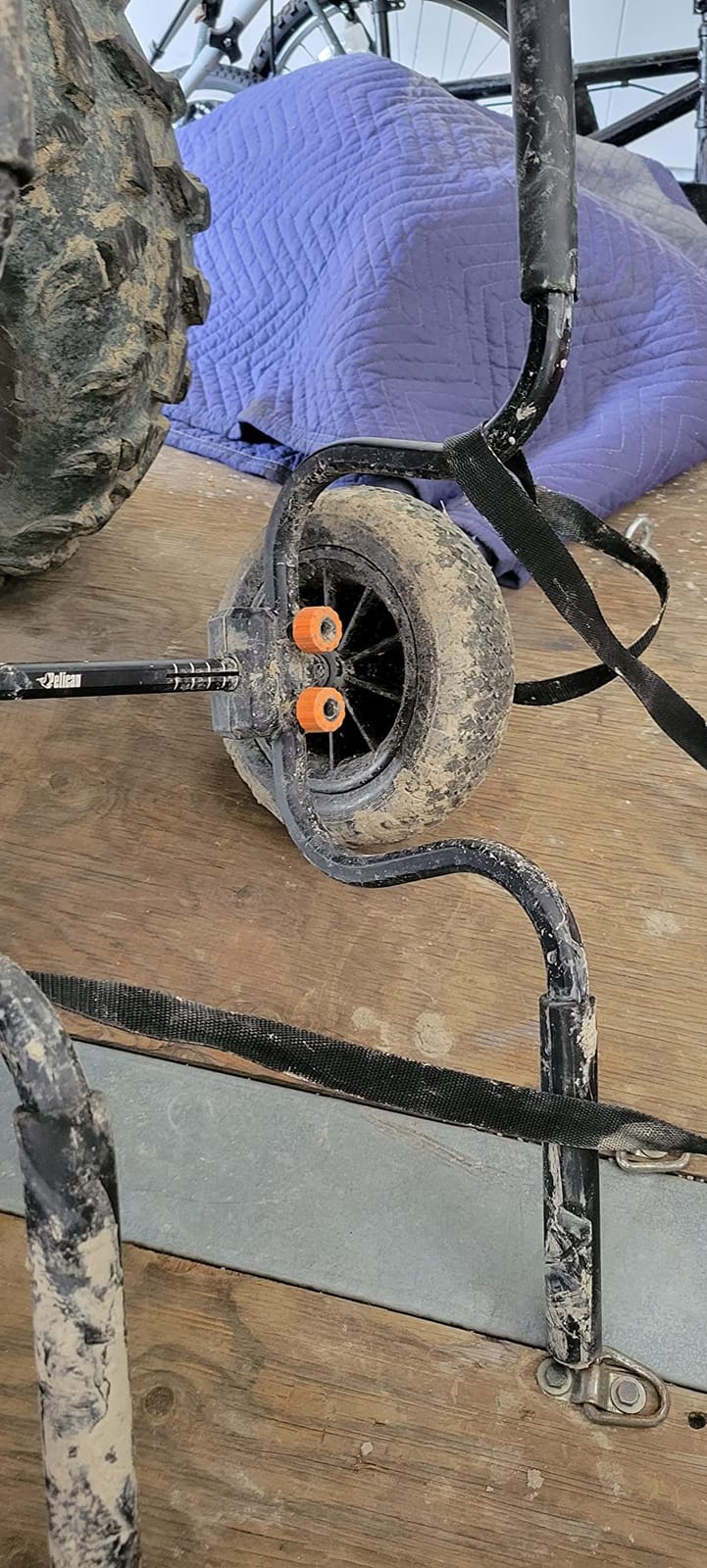
Owners highlight the width adjustment and the two height positions as the features they did not expect to care about and now rely on. The frame is described as corrosion-resistant aluminum, the boat sits level rather than leaning, and the unit weighs 8.8 lb, which is manageable for a solo carry back to the vehicle. The listing states a universal fit that adapts to many hull types including fishing kayaks, and it is a fit for the Pelican Catch PWR 100.
The limitation owners mention is capacity. At 175 lb it is one of the lighter ratings in the group, which leaves very little room above a heavy fishing kayak’s own weight. The second note is rolling resistance: airless tires of this diameter take more effort in deep sand than pneumatic beach wheels do, and you will feel it on a long dune crossing.
What you should know before buying it
Set the width before you lift the boat, not after. The adjustment works best when the bunks sit under the flattest part of the hull, and moving the cart around under a loaded kayak is the fastest way to scuff the deck. Add a cam buckle strap if the supplied one feels loose, since a snug strap costs nothing and saves an argument with a current.
Where it fits and where it does not
It fits recreational paddlers on mixed terrain, day paddlers who walk in from a campground, and anyone who likes that the cart looks like part of the paddle sports world rather than a hardware store dolly. It does not fit deep sand, a loaded fishing kayak, or a long portage where weight and wheel diameter both become the deciding factors. For a family with a 12 foot tandem under 100 lb, it handles the job well.
8. Ulticor 260 lb Cart for Tool-Free Setup and Quick Breakdown
Ulticor Kayak Cart, Puncture-Free Wheels Assembles and Disassembles Within Seconds – Easy to Store – No Tools Required – All-Terrain Durable Kayak and Canoe Cart with Adjustable Straps (Green – Black)
260 lb capacity
Puncture-free all-terrain wheels
Snap-and-lock kickstand
Tool-free assembly
Pros
- Assembles and disassembles in seconds
- 260 lb rating beats its class
- Stainless-steel reinforced axles
- Bonded hull pads protect the boat
- Adjustable strap system
Cons
- Lowest rated option here at 4.2
- Mixed reports on assembly durability
The Ulticor is the sleeper in this group. It carries a 260 lb capacity, which is higher than half the carts listed, yet it sits at the entry point of the category. Reviewers who have measured their loads tend to be surprised, and the number is real enough that a heavy recreational tandem can be rolled on it without drama.
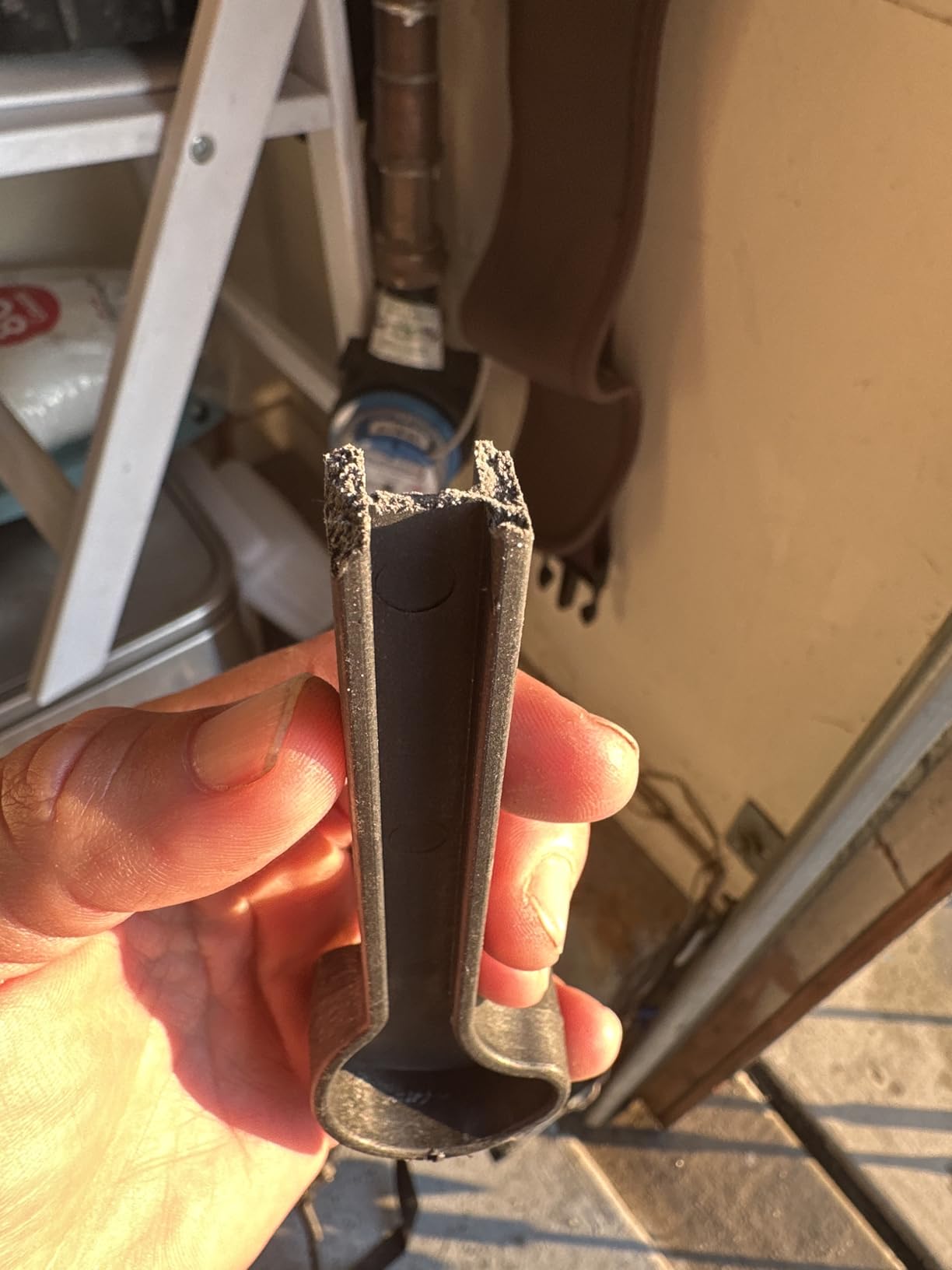
The build is reinforced composite plastic with stainless steel reinforced axles, which addresses the part of a plastic frame that usually fails first. Thermoplastic elastomer pads are bonded to the hull contact points rather than clipped on, so they do not disappear into a storage bag. The wheel and kickstand arrangement uses a snap-and-lock stand, and the whole thing assembles and disassembles without tools in a matter of seconds.
At 4.2 across 393 ratings, it is not the highest rated cart here, and the 9 percent share of one-star reviews reflects real complaints rather than noise. Most of those center on the assembly design and long-term durability, and the low average suggests mixed experiences on heavier boats. Treat the 260 lb rating as a ceiling and stay comfortably below it.
What owners highlight most is speed. If you have ever assembled a cart at a boat ramp with numb fingers, you will appreciate a design that folds flat in seconds. The adjustable strap system keeps the canoe secure over rough or uneven terrain, and at 10 lb the unit stores in small spaces without becoming a project.
What you should know before buying it
Know that a plastic frame has a different failure pattern than aluminum or steel. It will not rust, which is a genuine advantage near salt water, but welds and stress points can crack under a sustained heavy load if you bounce it down a rocky trail. Check the frame for any flex before you commit, and keep the load below the rating even when the kayak technically fits.
Where it fits and where it does not
It fits a paddler who wants a high capacity rating without a high price, who launches from grass or packed gravel, and who wants no inflation step and no tools. It does not fit a long portage, because a 10 lb cart over rough ground adds up quickly, and it is not the cart for a fully rigged fishing kayak that spends its life on rocks. For a seasonal paddler with a heavy tandem, it does a lot of work for a modest outlay.
9. Bonnlo 165 lb Quiet Trolley for Small Boats and Inflatable Kayaks
Bonnlo CART-Canoe Kayak Boat Carrier Tote Trolley Transport with 2 Ratchet Straps PU Solid Tires Wheel Yellow
165 lb listed capacity
10 inch solid PU tires
22mm x 2mm aluminum pipe
Four 4 inch foam bumper pads
Pros
- Quiet PU tires with no rubber smell
- Four oversized foam bumper pads
- Folds flat with tool-free setup
- Two ratchet straps included
- 2-year warranty
Cons
- Listed capacity varies from 165 to 200 lb
- Foam cushions wear with heavy use
- Ratchet clips are bulky on small kayaks
This smaller Bonnlo shares the family traits of the larger one, quiet polyurethane tires and foldable aluminum pipe, but it is built for a different boat. The 22mm by 2mm aluminum pipe frame carries up to 200 lb according to the product description, while the listed weight capacity maximum on the spec sheet reads 165 lb. Plan for the lower figure when you are near a limit.
What owners like most is the rolling. The 10 inch by 3 and a quarter inch solid PU tires move quietly across sand, gravel and wooded ground and produce none of the rubber smell that some air-filled tires give off in warm weather. Reviewers report rolling an 80 lb kayak long distances on gravel without it shifting, which is a higher bar than it sounds for a cart this size.
The four oversized 4 inch foam bumper pads are a sensible solution to a common complaint. Neoprene foam cushions sold on cheaper carts tend to fall apart after a season of hard use, and a pad that disappears leaves bare metal against the hull. Rubber foot bumpers handle the bottom end of the frame, and the two 7.75 ft ratchet straps included are of a better class than most carts at this level.
It is also one of the few carts here reviewers specifically praise for inflatable kayaks. A collapsible frame that folds flat and a soft, wide bumper arrangement work well with drop-stitch or EVA floors, which are dented by narrow hard contact points far more easily than by a rigid hull. The warranty runs two years.
What you should know before buying it
There is an orientation rule that catches people out. The kayak must be fully supported by the four foam bumpers, with the kickstand and the bow facing the same direction. Get that backwards and the boat sits high, can crab sideways and shifts under load. Check the support points visually before you pull away from the parking lot.
Where it fits and where it does not
It fits inflatable kayaks, small recreational boats and anyone who values silence and compact storage more than capacity. The listed weight limits are the issue for bigger boats, and high-riding hulls such as the Crescent LT sit high on the bunks and need careful strapping. It also does not fit a tandem loaded for an overnight trip, where the load and the length both exceed what this frame wants.
10. Suspenz All-Terrain Super Duty Cart for Rocks and 350 lb Loads
Suspenz All-Terrain Kayak Cart Dolly, Super Duty Canoe Cart with No-Flat Airless Wheels, 350 lb Capacity, Foldable Kayak Dolly, Model 22-9908
350 lb capacity
15 inch no-flat airless wheels
Five-position bunker bars
Spring-loaded kickstand
17 lb
Pros
- 350 lb rating for heavy boats
- 15 inch wheels clear rocky paths
- Five-position bunk bars for many hulls
- Platform adjusts 9 to 20 inch
- Folds to 31 x 16 x 9 inches
Cons
- Heaviest cart here at 17 lb
- Steel frame can rust and needs protection
- Extra-tall bunker bars sold separately
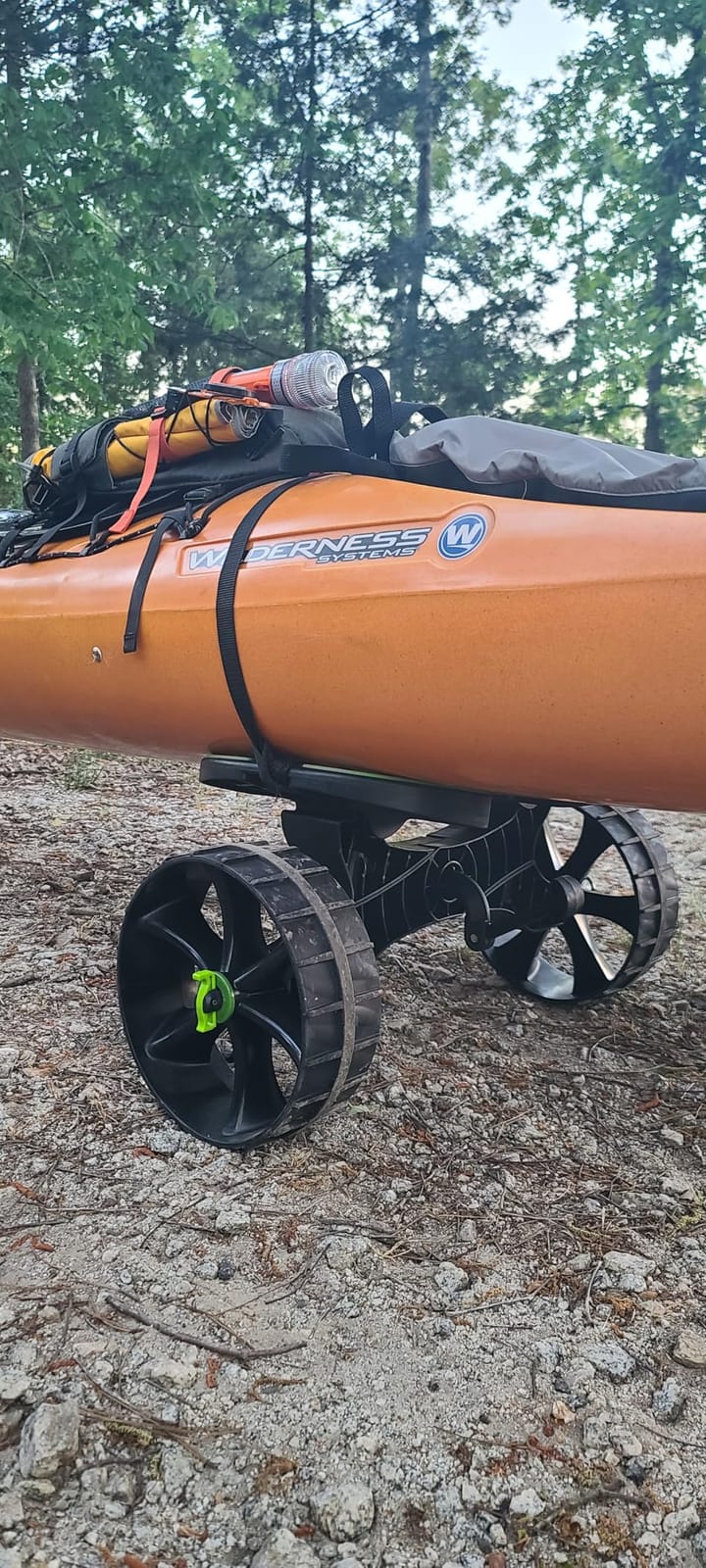
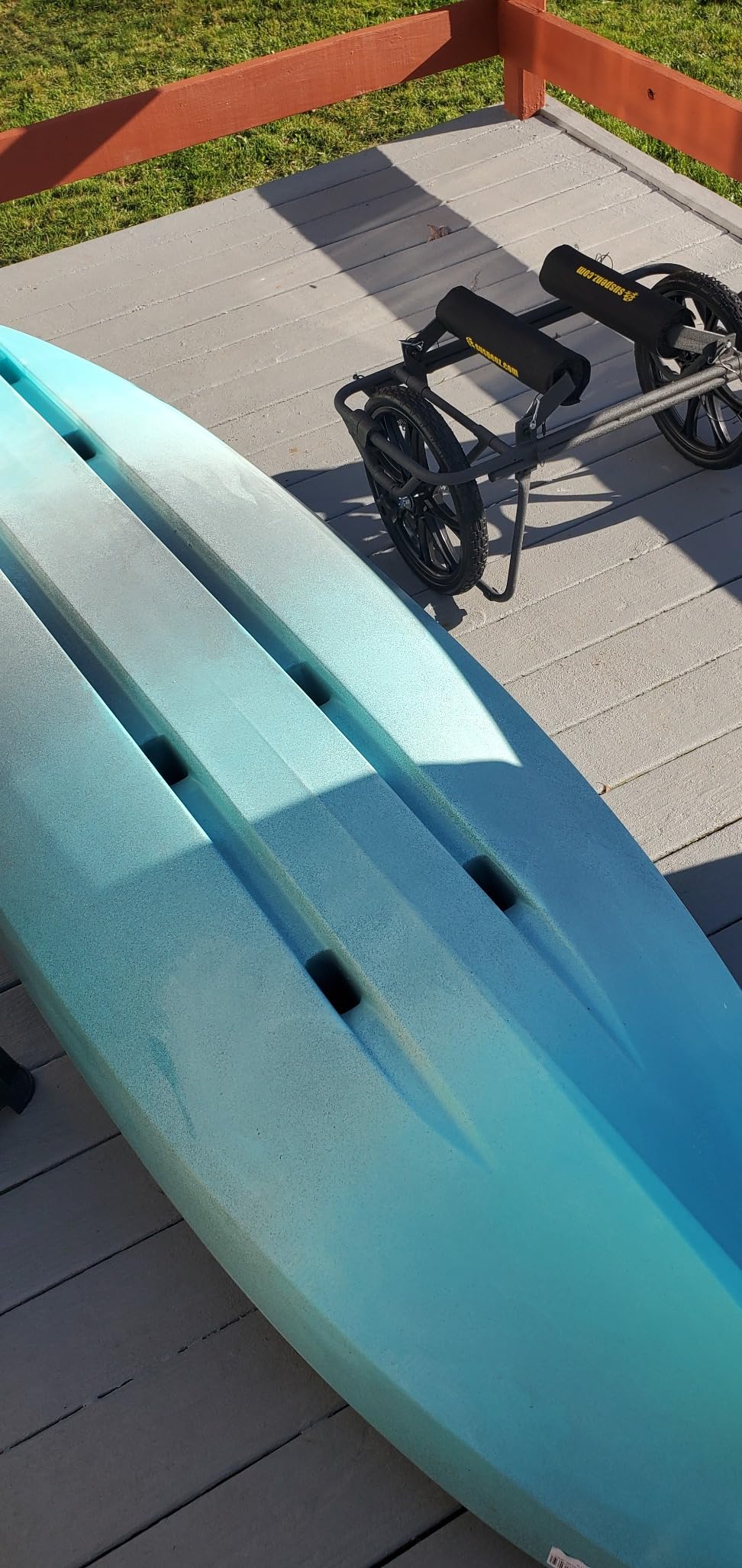
This is the biggest cart in the roundup and the only one with 15 inch airless Mag-Lite wheels. Diameter is the single most useful number for rough ground, and at 15 inches these clear rocks, roots and uneven trail far better than the 8 to 10 inch tires on most of the field. They are also airless, so there is nothing to inflate and nothing to go flat on the way down a riverbank.
The bunk bar system has five positions, which lets it adapt to V-shaped hulls, tunnel and catamaran bottoms, and flat-bottom fishing kayaks. The platform width adjusts from 9 to 20 inches, the widest range of any cart here, and the two included cam buckle strap sets give you four-point restraint. A spring-loaded kickstand is included for solo loading, and the frame folds to 31 by 16 by 9 inches.
At 4.4 across 296 ratings, with a limited lifetime warranty and rust and paint coverage for two years, it is well rated with a smaller review base than the carts above it. Owners point to the 350 lb rating, the 15 inch wheels and the wide bunk adjustment as the reasons it works for big boats and multiple paddle boards. It is built for kayaks, canoes and more than one SUP at a time.
There are honest trade-offs. At 17 lb it is the heaviest cart here, and carrying it back to the vehicle after a paddle is a real workout over any distance. The frame is powder-coated steel, and the manufacturer says plainly that it can rust in harsh environments and recommends a rust and corrosion protectant, which matters if you launch in salt water regularly. Extra-tall bunker bars for Old Town and similar fishing kayaks are sold separately.
What you should know before buying it
Check the bunker bar height against your hull before ordering. The included bars suit standard recreational and most fishing kayaks, and certain sit-on-top fishing boats need the taller set, which is a separate purchase. The spec sheet also lists a 300 lb maximum against a 350 lb figure in the product name, so work from the lower number when you are loaded.
Where it fits and where it does not
It fits rock and gravel approaches, longer portages where wheel diameter matters more than pack weight, and anyone carrying a heavy fishing kayak or more than one board. It does not fit a paddler who plans to carry the cart a long way from the car, because 17 lb is a lot to lift into a truck bed, and it does not fit a coastal saltwater user who will not apply rust protection. Weight and wheel size are a straight trade, and this cart is firmly on the wheel side.
How to Choose a Kayak Cart for Your Launch
A kayak cart is a two-wheeled frame with straps or cradles that lets you roll a kayak from the vehicle to the water instead of carrying it. The frame supports the hull near its center of gravity, you secure the boat, then you pull or push the cart like a hand truck. That removes the most common barrier to paddling, which is the physical effort and injury risk of carrying a 40 to 150 lb boat over uneven ground, and it opens up put-ins that a solo paddler could never reach on foot.
You need a cart if you park more than about 50 feet from the water, if your kayak weighs more than 50 lb, if you launch from sand or a rough trail, if you paddle solo, or if your back and shoulders would rather not carry a hull. If you launch from a paved dock with a kayak carted on wheels already, you can manage without one. Most paddlers end up buying a cart within their first season anyway.
Step 1: Work out your real load before you pick a rating
Weight capacity is the first number to check and the one most people get wrong. Add your kayak, your gear, and anything installed in it. A typical electric fishing setup runs something like this: an 85 lb kayak, 25 lb of gear and tackle, and a 35 lb battery and motor, for a 145 lb total. Add 25 percent headroom and you are looking for a cart rated at 180 lb or more.
The 80 percent rule is a useful shortcut. Stay at or below 80 percent of the stated rating and the frame stays rigid, the wheels stay planted and the bunks keep the hull where you put it. At full rating you are also at the edge of what the welds, the hubs and the kickstand were tested for, and that is the moment a cart becomes unpredictable on a slope.
Two products in this roundup have a gap between the advertised number and the specification sheet. The Railblaza C-Tug is titled at 300 lb and listed at 170 lb, and the Suspenz All-Terrain is titled at 350 lb and listed at 300 lb. Use the specification number when you are near the limit, since it reflects the frame and the wheels rather than the marketing.
Step 2: Match the wheels to the ground you walk on
Wheel diameter and width decide whether a portage is pleasant or miserable. Wide tires spread the load and resist digging in. Diameter clears obstacles. Inflation is the third question, and it is the one that strands people on a ramp.
Balloon tires are low pressure inflatable tires that float over soft sand better than anything else, and they are the standard recommendation for dune approaches. The trade-off is real: they need inflating before each trip, so a forgotten pump means a cart you cannot use. Airless and flat-free tires are solid polyurethane, they never need attention, and they perform well on gravel, pavement, packed dirt and short sand. The forum consensus is that airless tires win for most paddlers, and balloon tires win for people who regularly walk deep sand.
Practically speaking, this means a 10 inch airless tire is a fine generalist, a 12 to 13 inch beach wheel is better if your launch is loose, and a 15 inch airless wheel is the right answer for rock and roots. Narrow wheels on a fast gravel ramp produce the wobble that regulars describe as the death wobble, so wider is better whenever the choice exists.
Step 3: Choose a cart type that fits your hull
There are four cart types, and picking the wrong one is the most common expensive mistake. A strap cart wraps around the hull and works on anything, which makes it the safest default. A plug-in or scupper cart drops posts into the drain holes of a sit-on-top, which is the fastest and quietest option but only works on boats with scupper holes wider than the posts. An end cart attaches at the stern and pulls like a wagon. A dolly carries a full-length frame under the hull and takes the highest loads.
For a sit-on-top with generous scupper holes, the plug-in approach is genuinely faster. For a sit-in-top, a canoe, a tandem or a boat you are unsure about, the strap or bunker style cart is the only safe bet. This is also why the C-Tug comes up so often in recommendations: it fits a wide range of hulls without a scupper hole, and Jackson Kayaks has pointed paddlers toward it for that reason.
Step 4: Check hull protection and strap quality
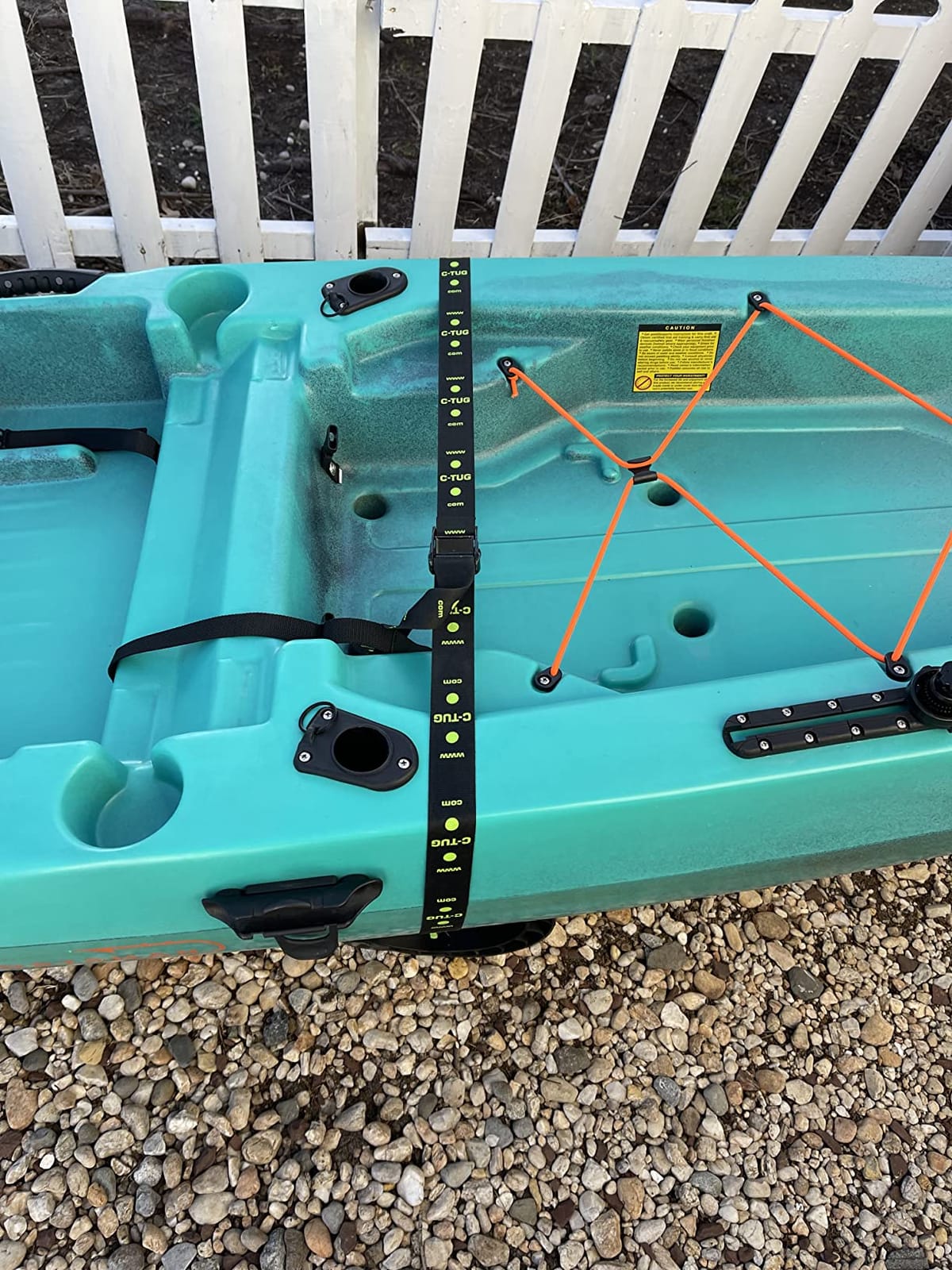
Look for rubber or foam bumpers at every point where the frame can touch the hull, and check whether they are clipped on or bonded in place. Bonded pads stay attached, clipped pads disappear. Straps matter just as much, and cheap nylon webbing is the most common complaint in reviews across this category. Swapping in cam buckle straps takes a few minutes and is the single upgrade most owners recommend.
Adjustable width and height matter more than shoppers expect, because hull shapes vary so much. A bunker bar that adjusts sideways prevents the kayak from twisting or slipping off center, and a second height position gives clearance for odd-shaped bottoms while lowering the center of gravity to prevent tip-overs.
What to do with your cart while you are paddling
This is the question that comes up most on forums.paddling.com and in the kayak fishing subreddits, and almost nobody answers it properly. There are three workable options. Stow it in a hatch or tankwell if it breaks down small, which is exactly what the Rad Sportz and the Railblaza C-Tug are designed for. Leave it on the shore at the put-in if you are confident about the launch conditions. Carry it lashed to the bow or stern on open water if you plan to move to a different exit.
On open water, a cart lashed to the deck is a genuine hazard in surf and in wind, so it belongs in a hatch rather than on the bow. A cart that folds to 7 inches wide is a cart that fits. A 17 lb steel frame is a cart that lives on the shore, no matter how good the wheels are.
For frame material and longevity, aluminum and stainless steel are the low-maintenance choices, and powder-coated aluminum resists salt water well with a rinse after each trip. Powder-coated steel is strong and rigid but can show rust in salt water within a season or two unless you apply a protectant, which the Suspenz All-Terrain manufacturer states outright. Plastic frames never corrode but have a lower tolerance for repeated shock loads. If you want other hauling help around the garage or the yard, our guides to the best utility carts and the best tool carts for mechanics cover the same weight and wheel principles in a different setting. Anyone moving a full-size boat over a driveway should also read our kayak trailer roundup, and the logic behind a lightweight golf push cart applies here too.
Frequently Asked Questions
What is the best heavy-duty kayak cart?
The Wilderness Systems Heavy Duty is the strongest heavy-duty option, rated to 450 lb with an adjustable-width aluminum bunker bar frame, two height positions and a collapsible design. It handles fully loaded fishing kayaks with room to spare, though the absence of a kickstand makes solo loading a little more involved. If you need a 350 lb class cart with larger wheels, the Suspenz All-Terrain adds 15 inch airless wheels and a five-position bunk system.
What is the best kayak hauler?
For most paddlers the best kayak hauler is the Rad Sportz 150 lb cart, which has the largest review base in this roundup and collapses to a compact package that fits a hatch. Choose the Railblaza C-Tug instead if you want puncture-free all-terrain wheels and a five-year warranty, or the Wilderness Systems Heavy Duty if your boat and gear together weigh well over 150 lb.
Are kayak dollies worth it?
Yes, when your parking spot is more than about 50 feet from the water or your kayak weighs more than 50 lb. A kayak dolly removes the single biggest source of injury risk in the sport, back and shoulder strain from carrying a hull over uneven ground, and it makes solo launches and remote put-ins practical. Carts are worth less if you launch from a dock with a wheeled carrier already, or if your total walk is short enough to carry comfortably.
Are balloon tires better than solid tires for a kayak cart?
Balloon tires win on deep, loose sand because their low pressure and wide contact patch float the cart over the surface. Solid airless tires win almost everywhere else: they roll quietly over gravel, pavement and packed dirt, they never need inflating, and there is no pump to forget. If you regularly walk soft sand, balloon tires are worth the extra step. For most paddlers, airless tires are the more dependable choice.
Do I need a kayak cart?
You need one if you park more than 50 feet from the water, if your kayak weighs more than 50 lb, if you launch from sand or a rough trail, if you paddle solo, or if you have any back or shoulder limitations. Carts also make it practical to reach put-ins that would otherwise be closed to solo paddlers, and a cart that folds into a hatch is useful to have when conditions force you to walk out.
What is the most effective way to transport a kayak?
Use a cart for the last stretch, and pick it to match the ground. First, total your kayak, gear and any motor or battery, then choose a cart rated at least 25 percent above that figure. Second, match wheel type to terrain: airless tires for gravel and pavement, wider balloon tires for soft sand, and larger airless wheels for rocks and roots. Third, add a kickstand for solo loading, adjust the bunk width so the hull sits level, and tighten straps before you pull away.
Final Verdict on the Best Kayak Carts for 2026
The best kayak carts for hauling to the water come down to your ramp. The Rad Sportz is the pick for most paddlers, with the largest review base, airless tires and a fold flat profile that fits a hatch. The Wilderness Systems Heavy Duty takes heavy fishing loads and odd hulls. The Suspenz All-Terrain covers rock and roots with 15 inch wheels, and the Railblaza C-Tug is the one to buy if you want the cart to travel with you. Work out your real load, match the wheels to the ground, and start walking.