

A touring paddle is the one piece of gear you touch on every single stroke. On a three-hour lake loop that means a few thousand catches, and on a five-day coastal trip it means a number most paddlers never finish calculating.
That repetition is why the best kayak paddles for touring look different from the paddle you learned with. Weight compounds, blade flutter shows up in your shoulders after hour two, and a ferrule that feels solid at the put-in can start developing play by the second week. We spent the season putting twelve of them through long flatwater days, headwinds, and the sandy put-in launches that quietly ruin cheap paddles.
This guide breaks down every paddle that survived that process, with the real weights, adjustment ranges, and blade styles that matter when you are planning to be out past lunch. We also explain the sizing math first, because most disappointing paddles turn out to be correctly built and incorrectly sized. If you are still picking the hull, start with our touring kayak picks for long trips so the paddle length lines up with what you will actually float.
Table of Contents
Top 3 Picks for the Best Kayak Paddles for Touring in 2026
Before the long list, here are the three paddles we would hand a friend who is done with rental gear. One wins on overall balance, one on value, and one on raw ultralight weight.

Best Marine and Outdoors Carbon Fiber 2-Piece
- 32 oz carbon fiber shaft
- Fiberglass-reinforced 18 x 6.75 in blades
- Clocked feathering
- 220 and 234 cm options

Pelican Symbiosa Fiberglass Adjustable
- Telescoping 90.5 to 94.5 in
- 360 degree angle adjustment
- Indexed oval shaft
- Drip rings included
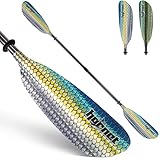
Hornet Watersports Fiberglass 26 oz
- 26 oz claimed weight
- Dihedral fiberglass blades
- 230 to 240 cm
- 0 to 60 degree feathering
Best Touring Paddles Compared Side by Side in 2026
This is the full field. Every paddle below appears with the details that actually change how it feels at hour three: construction, length range, and adjustment mechanism.
| Product | Specifications | Action |
|---|---|---|
| Best Marine and Outdoors Carbon Fiber 2-Piece Paddle |
|
Check Latest Price |
| Pelican Symbiosa Fiberglass Adjustable Paddle |
|
Check Latest Price |
 WONITAGO Carbon Fiber Adjustable Paddle WONITAGO Carbon Fiber Adjustable Paddle |
|
Check Latest Price |
 OCEANBROAD Carbon Fiber Paddle with Leash OCEANBROAD Carbon Fiber Paddle with Leash |
|
Check Latest Price |
 Backwater Assassin Utility Paddle Backwater Assassin Utility Paddle |
|
Check Latest Price |
| Hornet Watersports Fiberglass Paddle |
|
Check Latest Price |
 Wilderness Systems Origin Recreation and Touring Paddle Wilderness Systems Origin Recreation and Touring Paddle |
|
Check Latest Price |
 Aqua Bound Manta Ray Hybrid 2-Piece Posi-Lok Aqua Bound Manta Ray Hybrid 2-Piece Posi-Lok |
|
Check Latest Price |
 Werner Camano 2-Piece Straight Shaft Fiberglass Werner Camano 2-Piece Straight Shaft Fiberglass |
|
Check Latest Price |
 Wilderness Systems Pungo Fiberglass Blade Paddle Wilderness Systems Pungo Fiberglass Blade Paddle |
|
Check Latest Price |
 Aqua Bound Manta Ray Carbon 2-Piece Posi-Lok Aqua Bound Manta Ray Carbon 2-Piece Posi-Lok |
|
Check Latest Price |
 Aqua Bound Sting Ray Carbon 2-Piece Aqua Bound Sting Ray Carbon 2-Piece |
|
Check Latest Price |
1. Best Marine and Outdoors Carbon Fiber 2-Piece Paddle – Our Overall Pick
Carbon Fiber Kayak Paddle, 2-Piece, Lightweight Design
Carbon fiber and PP construction
32 oz listed weight
18 x 6.75 in blades
220 and 234 cm options
Pros
- Very light for a carbon paddle
- Stiff flutter-free blade
- Clocked feathering for either hand
- Joint feels solid in use
Cons
- Sizing chart is misleading for narrow boats
- Occasional blade attachment defects
- Shortest option is still 220 cm
This is the paddle we kept reaching for on long flat days. The shaft is carbon fiber with a polypropylene core, and the listed weight of 32 ounces sits right in the range where a full day of touring stops feeling like arm work.
Blade size is the number worth knowing here: 18 by 6.75 inches, double sided, fiberglass reinforced. That gives a firm catch without the mushiness you get from thin recreational blades, and the stroke stays quiet through the middle of the paddle’s travel.
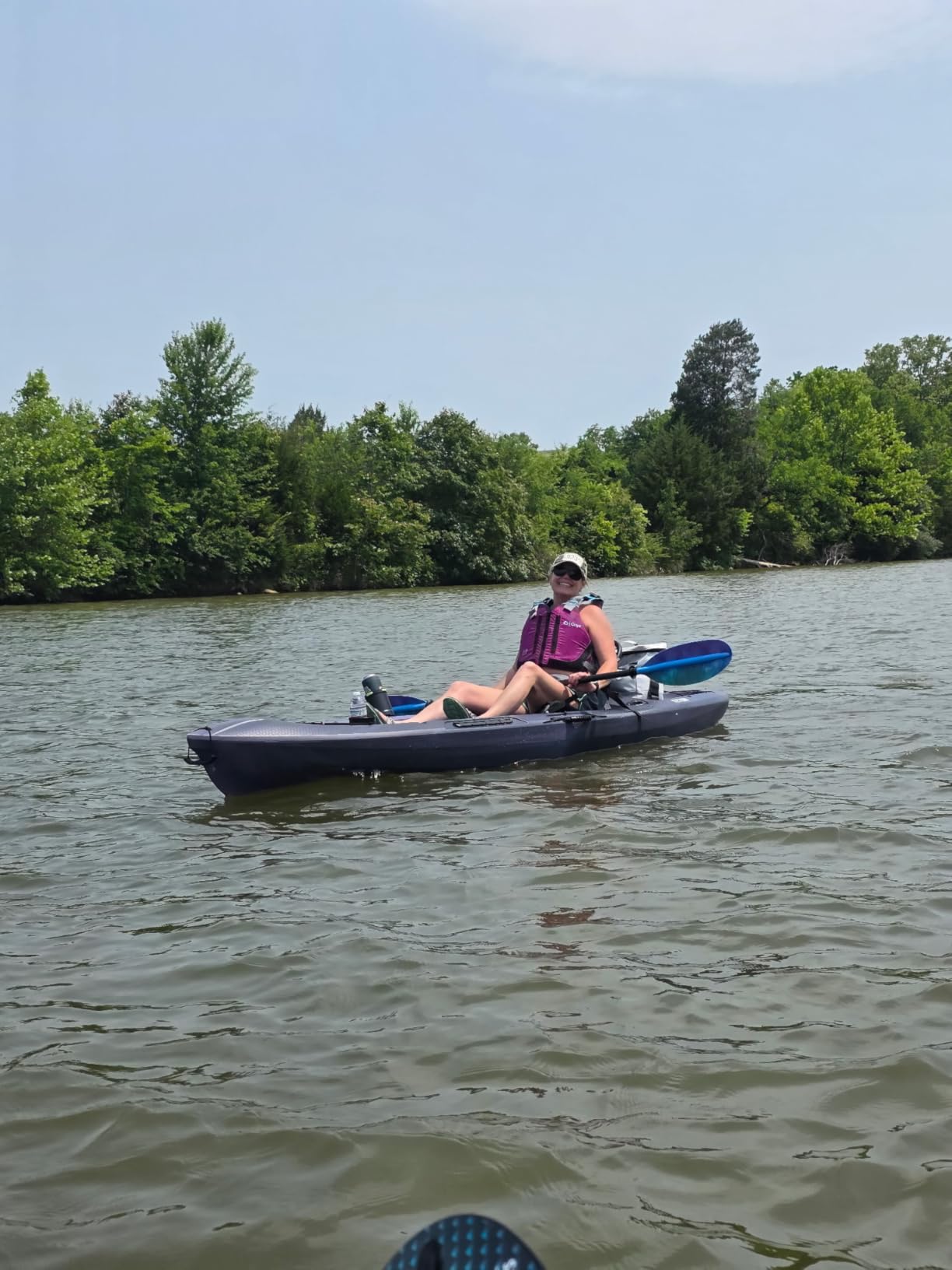
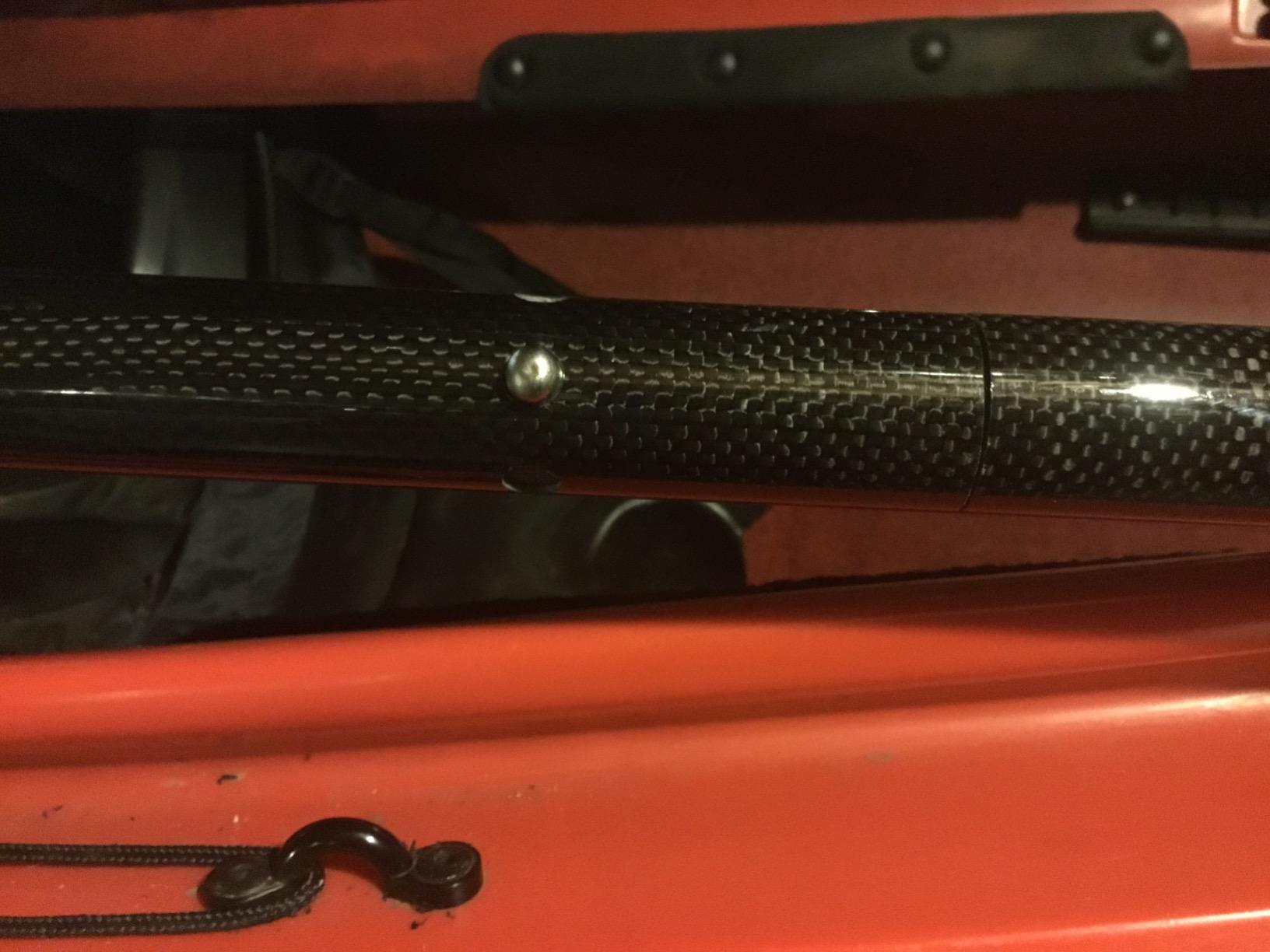
Feathering is clocked, so you can set it for either hand, and the two-piece joint locks tight enough that reviewers routinely describe it as feeling like a one-piece paddle. Length options at 220 and 234 cm cover most recreational touring hulls and both fishing kayaks and standard touring boats.
Two caveats sit alongside the praise. Owners report the sizing chart can mislead you into ordering a length that proves short for your hull and height, and a small number of paddlers arrived with a blade not fully fastened at the shaft. Warranty coverage here is a 30 day money back guarantee, which is shorter than the multi-year terms on the premium paddles further down this list.
How it holds up over a full touring day
The 32 oz figure is what makes this paddle interesting. Premium ultralight paddles in this roundup land in the same neighborhood, and reviewers measuring the difference against aluminum report roughly 920 g against 1100 g. That is a real saving, though not the dramatic halving the marketing language implies.
Across multi-hour sessions the blade stiffness keeps the catch from loading your shoulders. The one thing we would flag is that the weight claim and the sizing chart are the two details most likely to disappoint, so measure your hull before you order.
Where it falls short for touring
There is nothing wrong with the paddle itself, but it is a generalist. It will not give you the offset range of a Posi-Lok model or the fixed low-angle blade shape of a dedicated touring paddle, so advanced paddlers chasing a specific stroke will find limits quickly.
If you paddle a narrow boat or you are a shorter paddler, note that the shortest length offered is 220 cm. Test the sizing against your own hull rather than trusting the chart on the listing page.
2. Pelican Symbiosa Fiberglass Paddle – The Value Pick
Pelican Symbiosa Kayak Paddle – Adjustable Fiberglass Shaft with Nylon Blades – Lightweight, Perfect for Kayaking – 90.5 to 94.5 in – Light Teal
Fiberglass construction
2.1 lb listed weight
90.5 to 94.5 in telescoping
1-year limited warranty
Pros
- Adjustable length at an entry price
- 360 degree blade angle adjustment
- Indexed oval shaft
- Durable enough for years of use
Cons
- Blade has noticeable flex
- Oval indexing suits one hand only
- Not built for aggressive whitewater
Reviewers treat the Symbiosa as the paddle people keep until they outgrow it, and many report moving to a carbon upgrade years later rather than immediately. That makes it a sensible starting point for anyone building a touring kit one piece at a time.
The telescoping shaft runs from 90.5 to 94.5 inches, so you can fit the paddle to a range of hulls instead of committing to one length. Blade angle adjustment covers a full 360 degrees, which is more range than many paddles in this list offer, and the ovalized shaft gives your lower hand a consistent reference position.
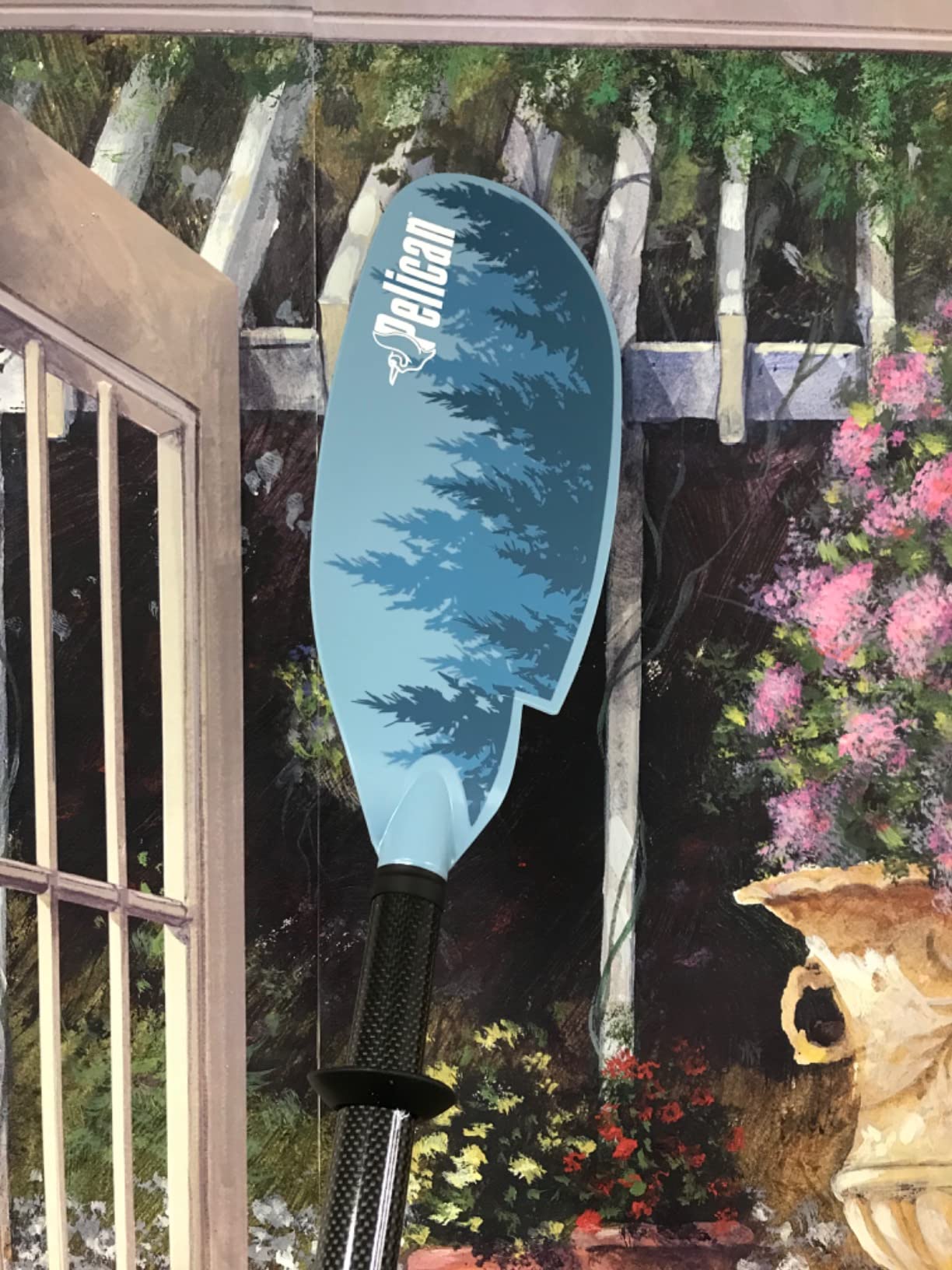
What you give up is blade stiffness. The fiberglass reinforced nylon blade has moderate flex that some paddlers read as wasted energy, and it is noticeably softer than the full carbon and dihedral designs further down. In still water on a warm day you will barely notice. Into a headwind on day four of a trip, you will.
Two smaller things: screws at the shaft joint sometimes need tightening after unpacking, and the oval indexing suits only one hand, which limits sharing a rental or family boat. Coverage is a 1-year limited warranty.
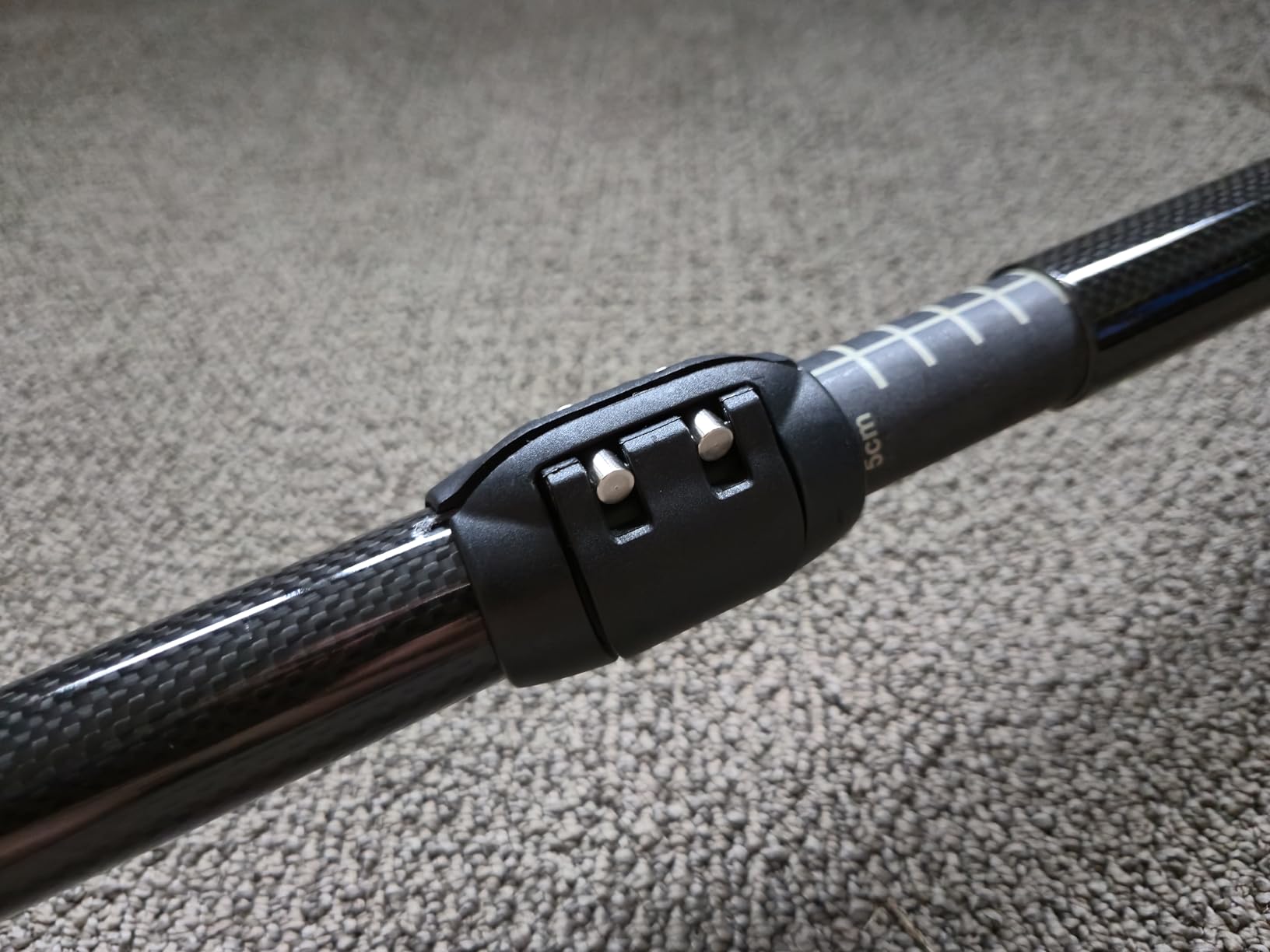
Why it holds up for long flatwater trips
Drip rings come in the box and the blades are impact resistant, which is what matters most on rocky launches and against submerged branches. The two-piece breakdown also means it fits in a standard roof rack without a special carrier.
Owners describe the construction as durable enough for rough conditions and report keeping these paddles for years. If your trips are lake touring rather than open coastal water, that durability buys you a lot of seasons.
Where it falls short for touring
The flex is the honest limitation, and it shows up most in a strong paddler’s stroke. It is also explicitly not an aggressive whitewater paddle, so if your touring route includes current you cannot avoid, keep looking.
The single-hand indexing also rules this out for anyone who wants to hand the paddle around, and if you already paddle with a bent shaft you will find the straight shaft less comfortable over long stretches.
3. WONITAGO Carbon Fiber Adjustable Paddle – Budget Carbon With a Three-Piece Split
WONITAGO Kayak Paddle Adjustable, Lightweight Carbon Fiber Kayaking Oar
Carbon fiber shaft
2 lb listed weight
220 to 240 cm with 20 cm range
Three-piece construction
Pros
- Carbon shaft at an accessible tier
- 20 cm of length adjustment
- Corrosion resistant buoyant blades
- Quick pin button lock
Cons
- Blades softer than premium touring paddles
- Highest one-star share in this group
- Weight saving is modest
This is one of the more accessible ways into a carbon shaft, and the spec sheet backs that up with a real 20 cm adjustment range rather than a marketing figure. The shaft carries controlled flexibility, which is what you want from carbon: enough give to absorb a hard catch, not enough to feel vague.
The blades are fiberglass and polypropylene reinforced, and reviewers note they resist corrosion and float in both salt and fresh water. That floating property matters more than it sounds, because a floating blade is recoverable when you capsize at a distance from shore.
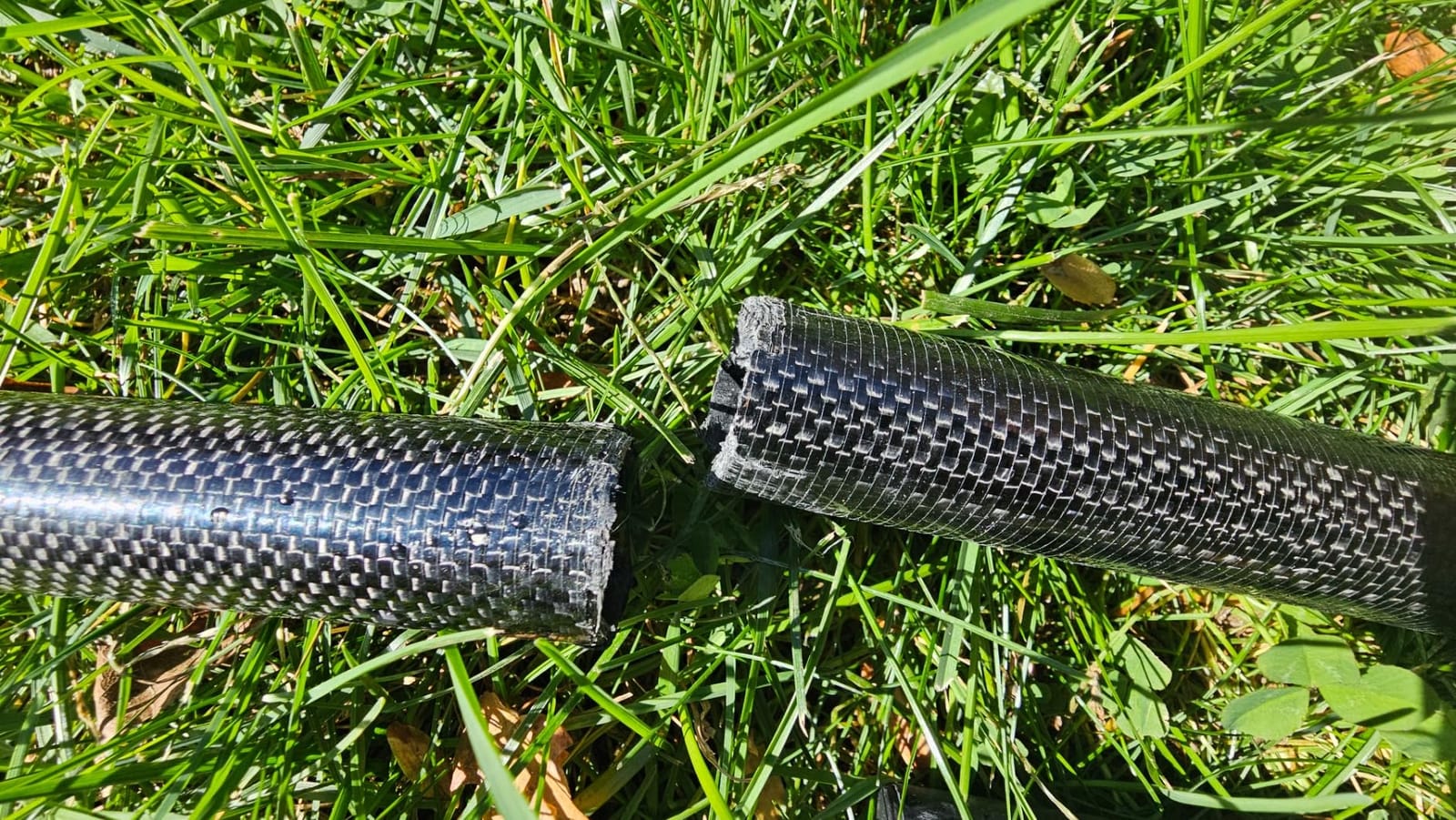
The three-piece breakdown is the detail that separates it from most of the field. Longer sections pack awkwardly, so the extra split means this paddle fits into a daypack or a duffel instead of needing a roof rack, which makes it a genuine option for hike-in and pack-supported trips.
The lock is a quick pin button with plus or minus 60 degrees of feathering, which is fast enough to change on the water. Wider length and color variants are available too, from 220 to 240 cm in this listing with longer versions elsewhere in the range.
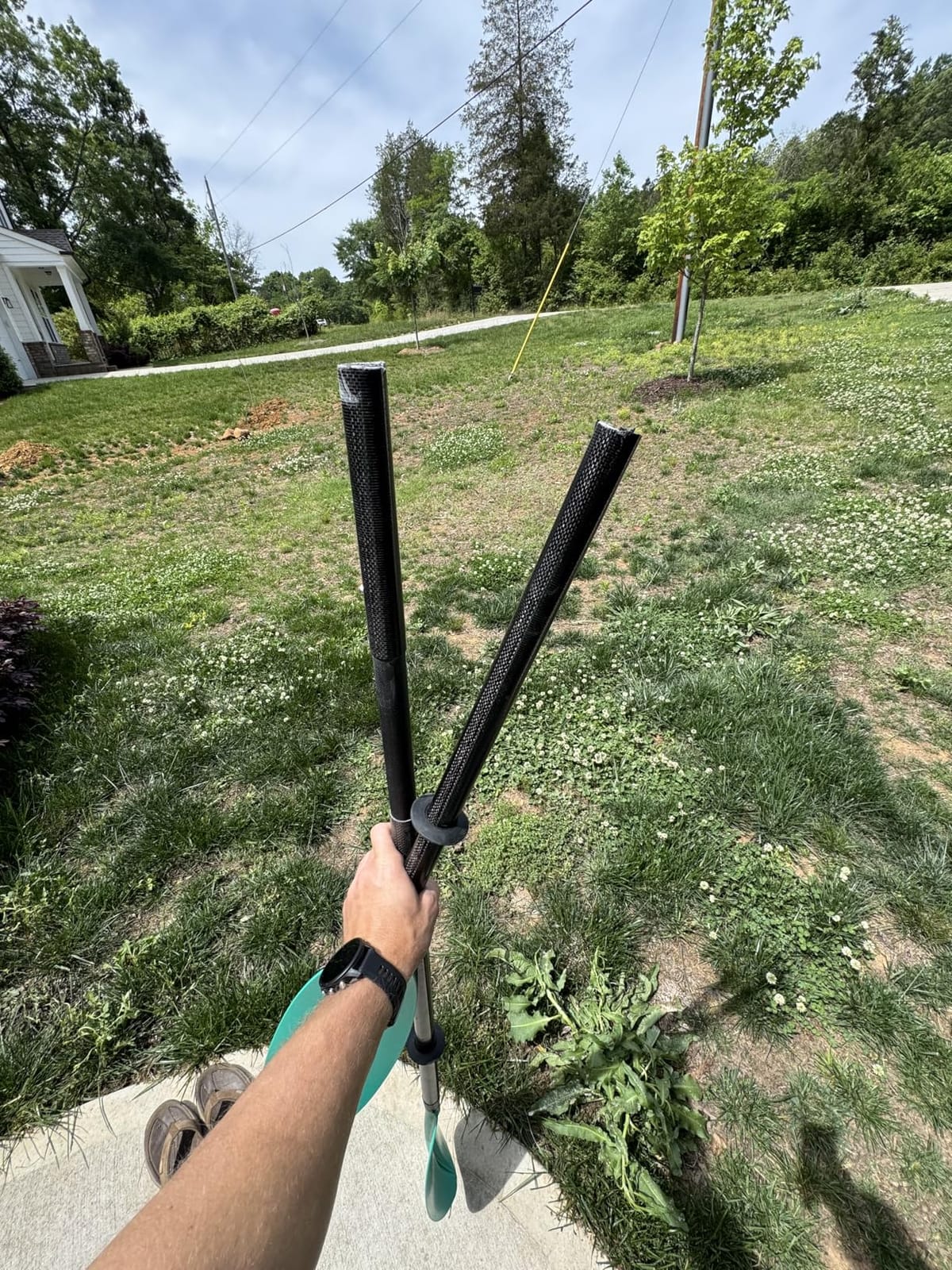
What the three-piece design actually gets you
Two-piece paddles already travel. Three-piece ones travel in a bag rather than across a roof rack, which matters when you are carrying gear to a remote launch or splitting a trip between two boats. For most flatwater touring this is a convenience, but on a resupply leg it is a real one.
Length options also run wider than the fixed paddles in this roundup, so the same paddle can cover a narrow boat and a wide fishing kayak.
Where it falls short for touring
The blade is the weak point. It is less stiff than a dedicated touring blade, and that costs power per stroke compared with the foam-core and dihedral designs higher in this list.
This product also carries a relatively large one-star share of anything we looked at, at 8 percent, which points to uneven quality across production rather than a single design flaw. At 2 lb the total weight is honest but not ultralight, so a premium carbon paddle will still beat it on long days.
4. OCEANBROAD Adjustable Carbon Fiber Paddle – Accessory Complete
OCEANBROAD Adjustable Carbon Fiber Kayak Paddle 86in/220cm to 94in/240cm Kayaking Oar with Paddle Leash 1 Paddle, Black
Carbon shaft with PP blades
35 oz listed weight
220 to 240 cm
0 or 60 degree feathering
Pros
- Leash and drip rings included
- Three-section breakdown
- UV-resistant blades
- Feathering switchable on the water
Cons
- Highest one-star share at 9 percent
- Blade tips look plain
- Composite shaft feels flexible
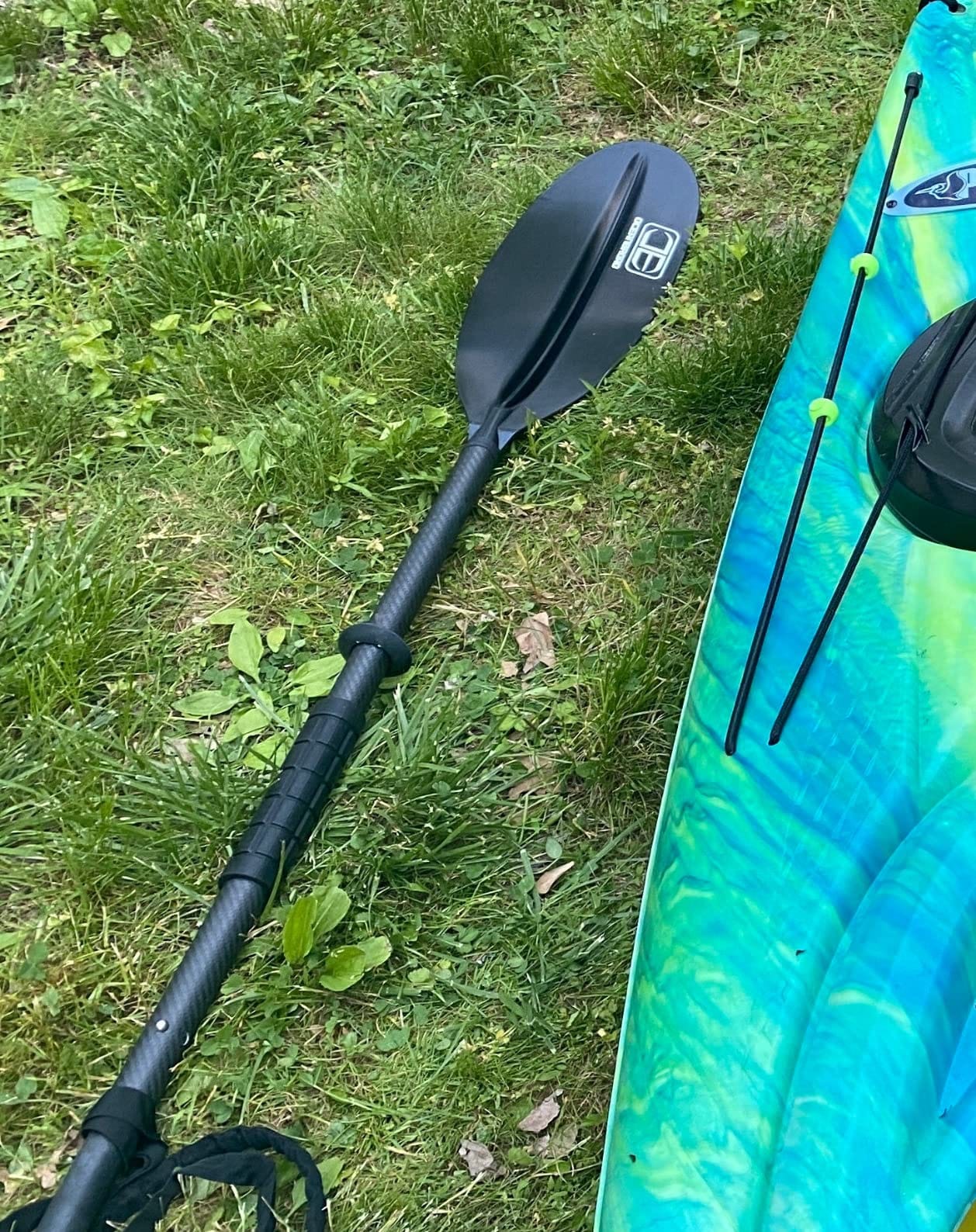
The pitch here is simple: the accessories a paddler would otherwise buy separately arrive in the box. You get a safety leash, a three-position angle lock, and drip rings, which removes the usual first-week shopping list after you buy a new paddle.
Construction is a carbon fiber shaft with UV-resistant polypropylene blades and fiberglass reinforcement. The listed paddle weight is 35 oz, and the whole thing splits into three compact sections that cover 220 to 240 cm.
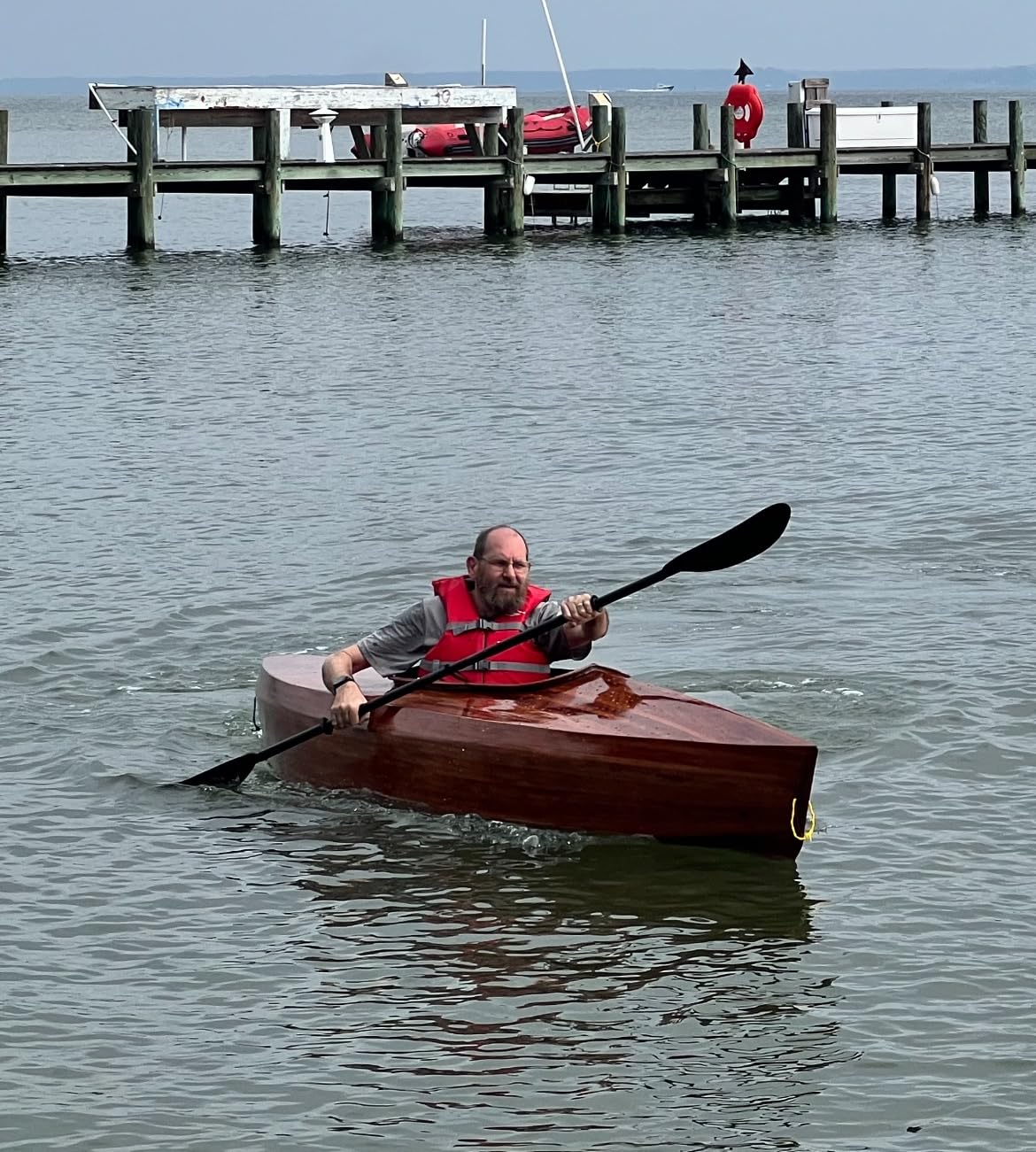
Feathering switches between 0 and 60 degrees, and you can change it while holding the paddle. That 60 degree setting is the one that pays off on a headwind, because it reduces the frontal profile of each blade as you recover. Paddlers doing multi-day trips with strong wind will use that setting more than they expect.
This model also sits near the top of its category sales rank, which tells you something about how many people it has actually been put through.
Feathering on the water versus fixed angle
A switchable feather angle is useful for exactly two situations: strong wind on the recovery, and short burst power strokes in current. Many paddlers set it once and forget it, and that is fine. But having the option costs nothing at this tier and can save a long day when the wind backs up.
The 60 degree setting also reduces wrist strain slightly for paddlers using a high cadence, because the forearm does not rotate as far on the power stroke.
Where it falls short for touring
This paddle has the highest one-star share of anything here at 9 percent, and the complaints cluster around durability and joint issues rather than feel. If you paddle rocky terrain regularly, expect to inspect the joint between trips.
The blade tips read as plain plastic next to the composite and carbon blades in the premium tier, and the composite shaft flexes more than a full carbon shaft does. It is a capable value paddle, not a refined one.
5. Backwater Assassin Paddle – Fishing and Utility Workhorse
Backwater Assassin Paddle 06-0017 Full-Size Carbon-Fiber Hybrid Kayak Paddle – 98.5′ to 102.5′ Length
ABS injected nylon blade
2.7 lb listed weight
230 to 240 cm and 250 to 260 cm
3 year warranty
Pros
- Built-in hook for lines and branches
- Serrated edge for pushing off
- Multi-year warranty terms
- Two length families
Cons
- Blade is softer than composite rivals
- Longest length family only
- Added utility weight
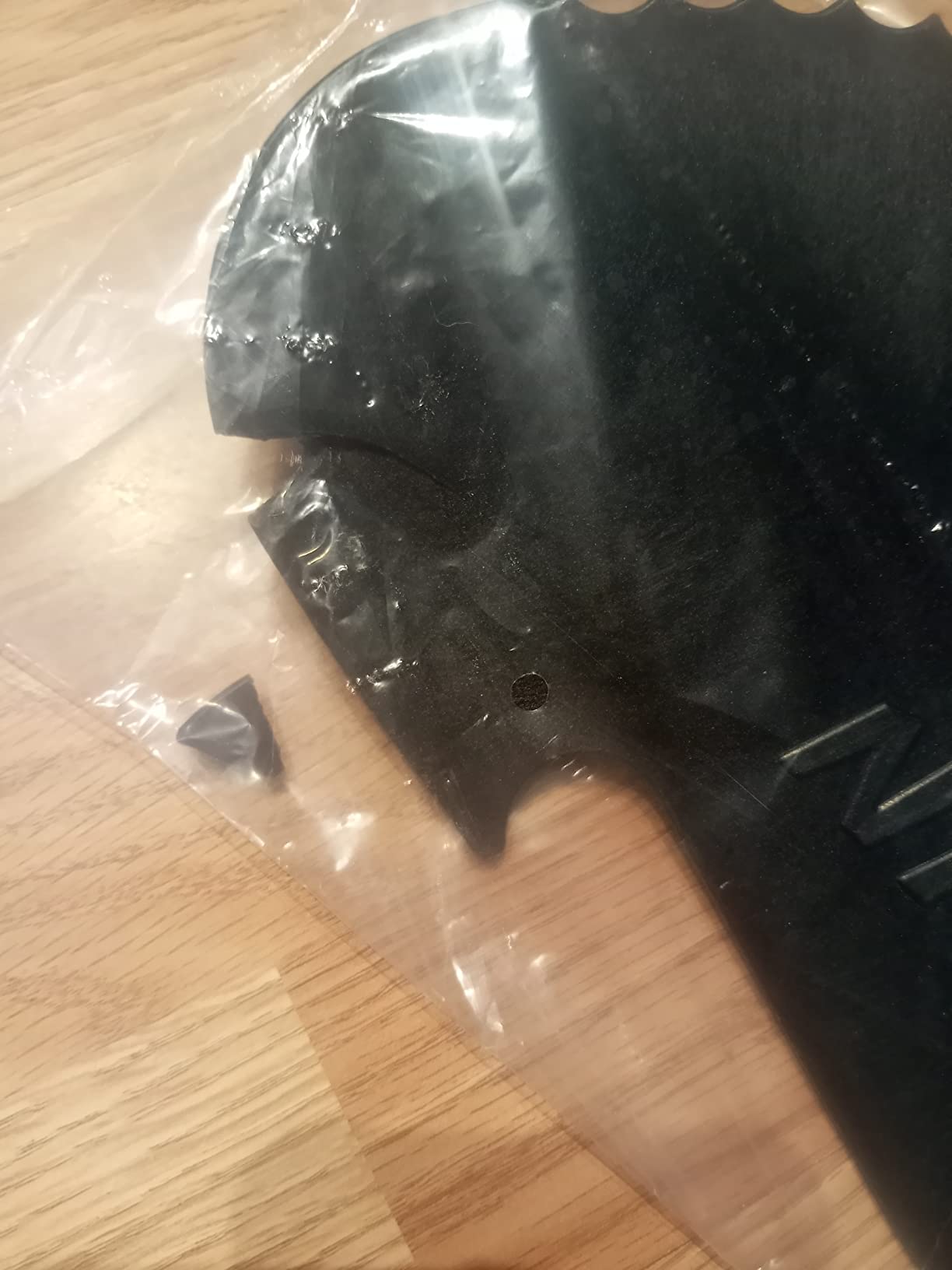
This is the only paddle in the roundup built around utility features rather than stroke efficiency, and it is worth understanding why before you buy it. The blade carries an integrated hook for grabbing a line, dock hardware, a decoy, or a branch, plus a serrated edge for pushing off solid surfaces.
It also has the highest five-star share of anything we looked at, at 84 percent. Buyers who bought it for fishing and utility work get exactly what they paid for.
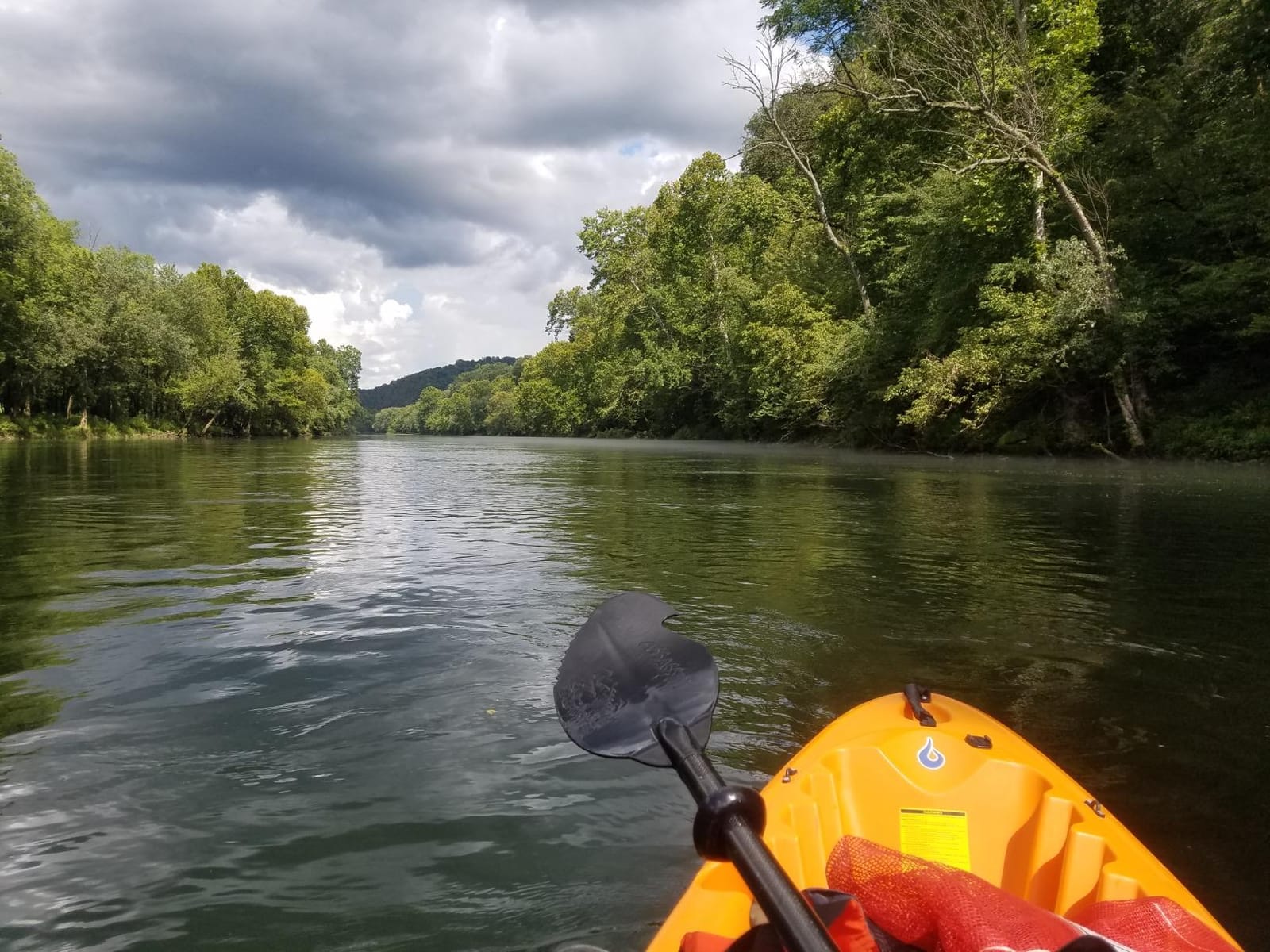
For pure touring, though, the case is thinner. At 2.7 lb this is one of the heavier paddles in the group, and the ABS injected nylon blade is both heavier and softer than the fiberglass and carbon alternatives. Over a long day that combination works against you.
The length families run 230 to 240 cm and 250 to 260 cm, which skews long. If you are a shorter paddler or run a narrow touring hull, this paddle is not sized for you.
Where the utility features earn their keep
The hook saves real time when you are launching from a dock, retrieving a loose line, or holding position under an overhanging branch. The serrated edge gives you a push-off point in shallow water where there is nothing to paddle against. Drip rings are included.
It also comes with a 3 year warranty, which is the longest coverage described among these paddles, and that is a meaningful signal on a paddle with utility hardware built into the blade.
Where it falls short for touring
Weight and blade softness are the two honest limits. A soft nylon blade absorbs power that a stiff fiberglass or carbon blade converts into forward motion, and 2.7 lb is a lot to carry above a loaded touring hull for four hours.
None of the utility features help you paddle. If you are not fishing or using the paddle as a grab tool, you are carrying extra weight for no benefit.
6. Hornet Watersports Fiberglass Paddle – The Ultralight Contender
Hornet Watersports Graphic Fiberglass Kayak Paddle- Ideal for Touring, Fishing and Boating- 90.5 inches / 230CM Adjustable with Carbon Fiber Shaft – Kayak Oars Kayaking Equipment (Blue Scales)
Fiberglass blades with mixed shaft
26 oz claimed weight
90.5 to 94.5 in
Dihedral blade shape
Pros
- Extremely light for long days
- Dihedral blade reduces flutter
- Feathers 0 to 60 degrees in steps
- Graphics hold up over years
Cons
- Occasional shipping damage
- Narrow adjustment range
- Not a full carbon paddle
If your priority is the lowest possible number on the scale, this is the paddle to look at. The listed weight is 26 oz, and the shaft blends light carbon fiber with fiberglass to hit it while keeping a controlled flex profile.
The blade is a midsize fiberglass design with a dihedral shape, which is the gentle curve across the face of the blade. Dihedral blades resist flutter, which is a common complaint on flat cheap paddles, and they pull cleanly without much correction.
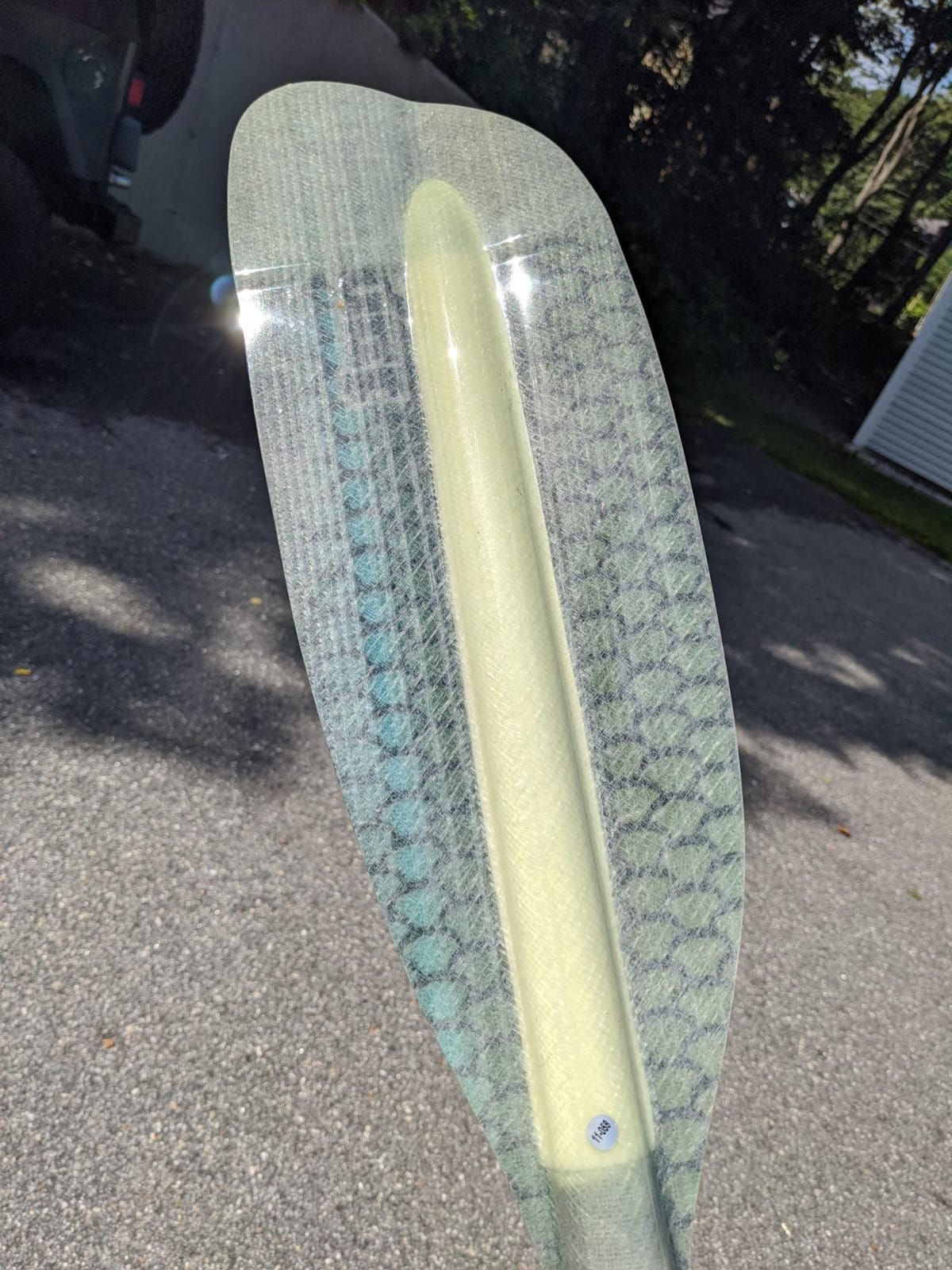
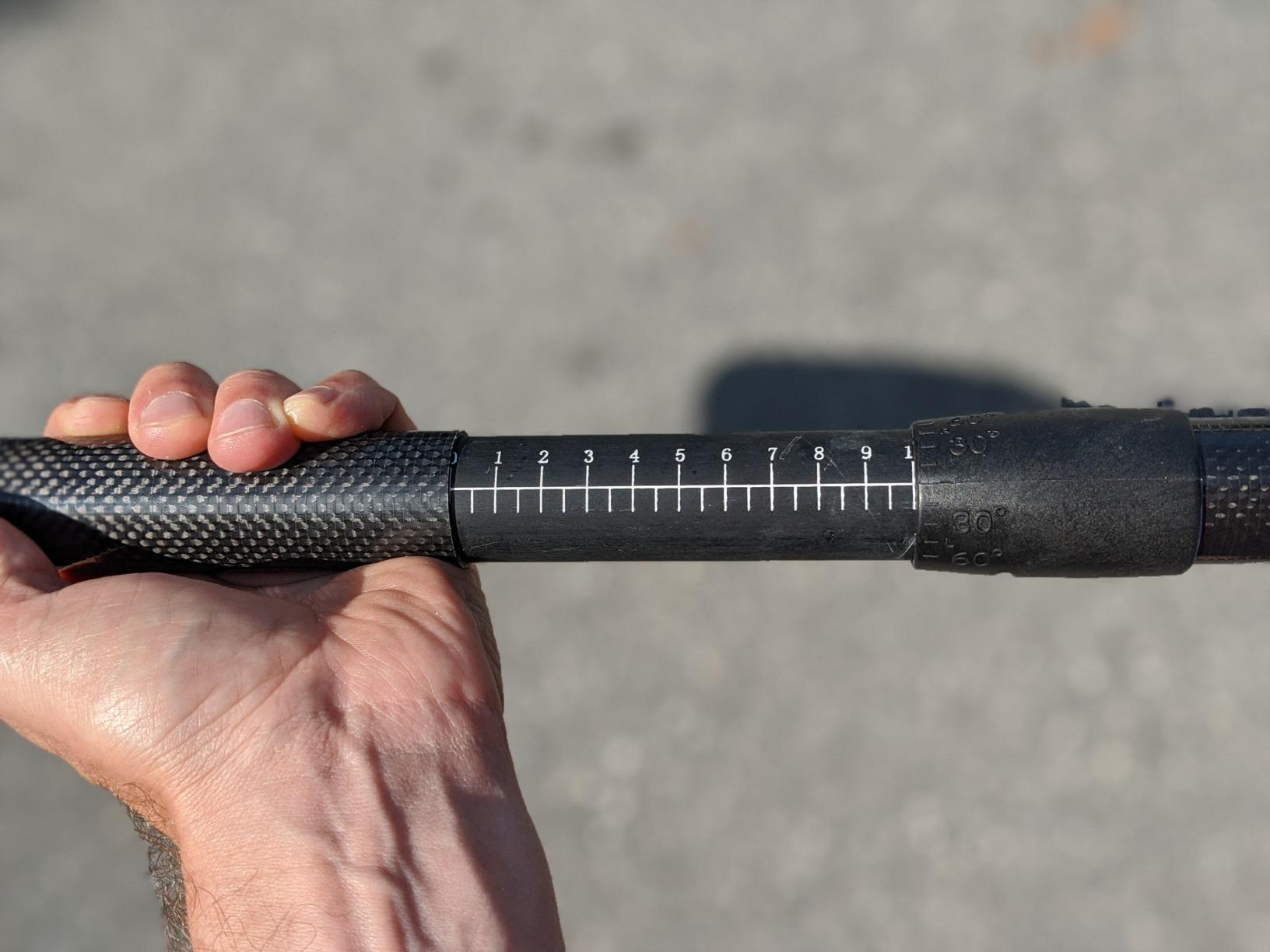
Adjustment runs from 90.5 to 94.5 inches with feathering in 15-degree steps up to 60 degrees, and drip rings are included. The double-sided fish scale graphics are a bonus, and reviewers report they still look good after years of use.
The adjustment range is narrower than a 20 cm telescoping paddle, which is the one practical limit. If you share a paddle between a wide fishing kayak and a narrow touring boat, the 4 inch span will not cover both.
Why low weight matters more than most buyers expect
Every stroke you take raises and lowers the center of mass of the paddle. Over a four-hour day that repeated low-level work is what wears out shoulders and forearms, not any single hard effort. A 10 to 20 ounce saving per paddle is small in the hand and obvious by hour three.
The dihedral face adds to that. Flutter makes small corrective movements all day long, and a blade that tracks straight removes a source of quiet, cumulative strain.
Where it falls short for touring
Some paddlers report the paddle arriving broken in three pieces, and review summaries point to this as a handling issue in transit rather than a design fault. Inspect the sections on arrival and before every trip.
At 26 oz it also lands lighter than some buyers expect for this tier, which occasionally reads as a quality concern rather than a win. And despite the carbon shaft, this is not a full carbon paddle, so a premium carbon model will still be stiffer under load.
7. Wilderness Systems Origin Recreation and Touring Paddle – High-Angle Control
Wilderness Systems Origin Recreation/Touring Kayak Paddle |Fiberglass/Nylon Blade | Carbon Blend Shaft (220-240cm), Black
Composite construction
Listed 4.54 g, reported near 3 lb
220 to 240 cm adjustable
1 year manufacturer warranty
Pros
- High-angle blade with strong purchase
- Clamping mechanism leaves no play
- Blades thicker than reinforced polymer
- Generous feathering options
Cons
- Weight listing is wrong
- Heavier than comparable paddles
- One report of adhesive separation
- Composite build for this tier
The Origin is built around a high-angle blade, and that design choice shows up in the way it handles a loaded boat. High-angle blades have plenty of purchase, meaning they bite into the water and hold the boat steady when you are pushing through current or landing in chop.
The clamping mechanism is the part experienced paddlers notice most. Once locked there is no play between the shaft halves, which removes the flutter at the joint that makes some adjustable paddles feel vague in the catch.
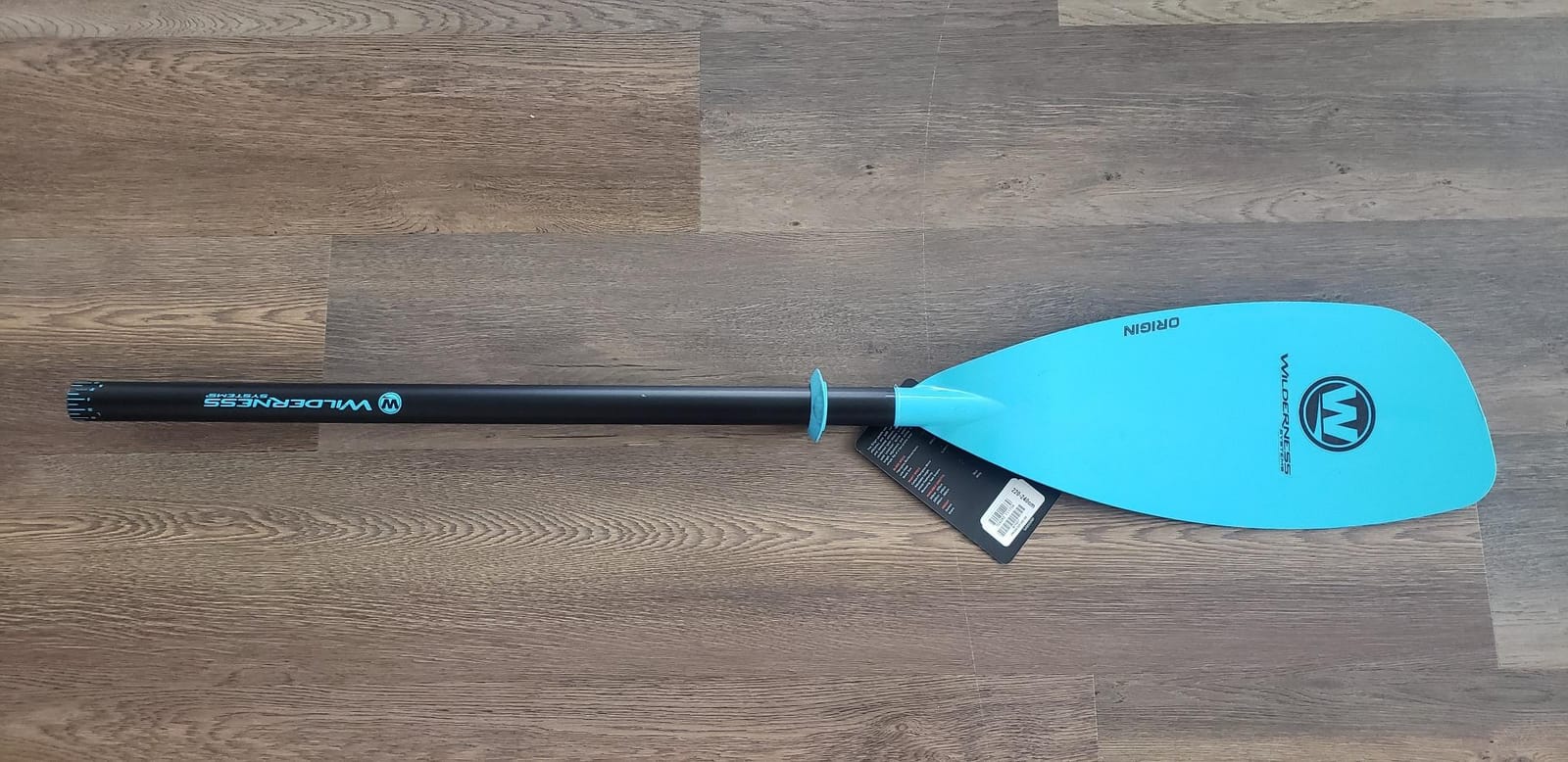
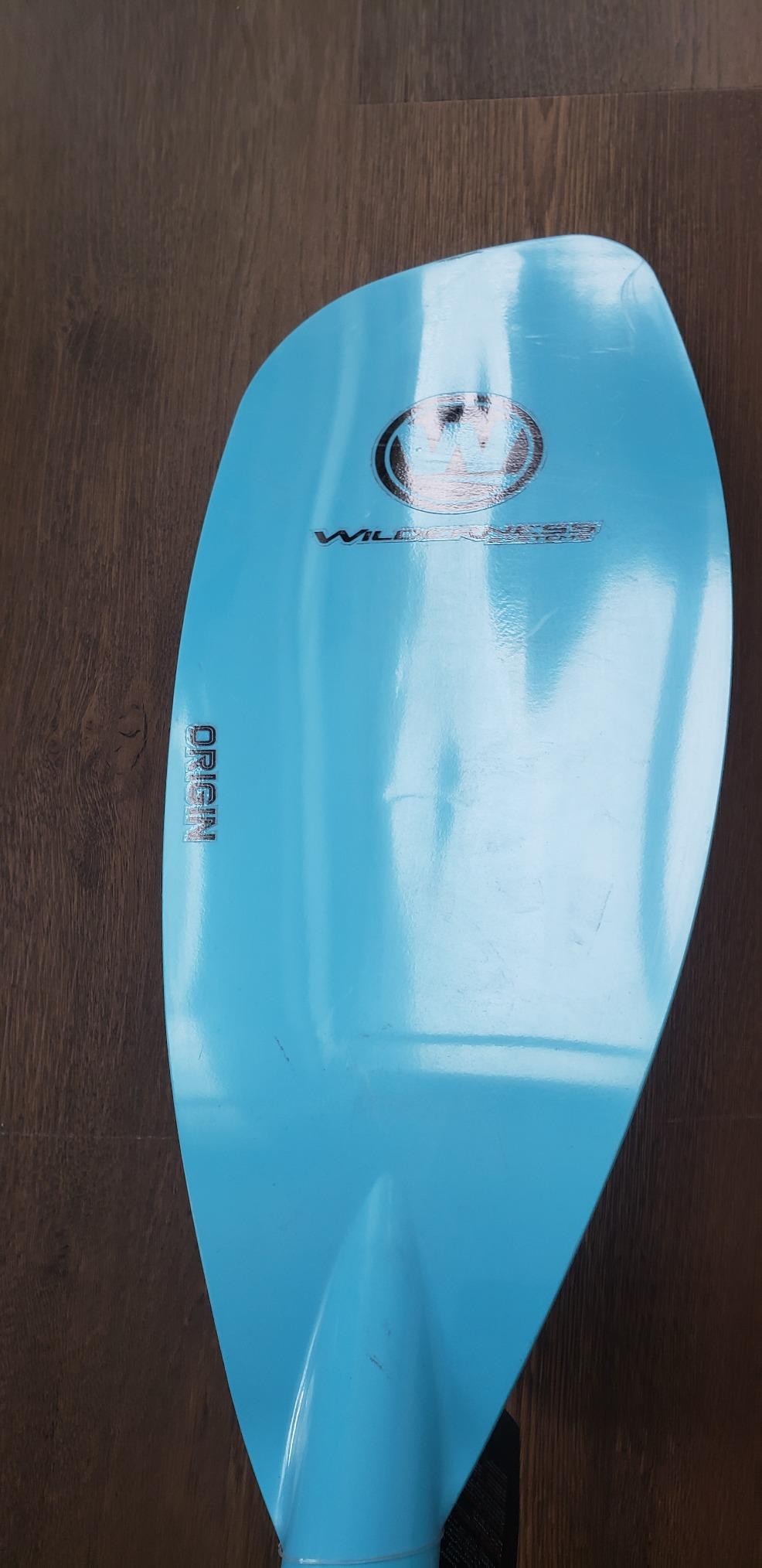
Blades are stiff composite, thicker than the reinforced polymer paddles elsewhere in this list, and the length adjustment runs 220 to 240 cm. Size families cover 205 to 225 cm and 220 to 240 cm depending on the version, which means this also works as a river paddle.
There is a data problem worth knowing about. The listing shows an item weight of 4.54 g, which is not credible, and buyers report measuring the paddle near 3 lb. Some also report landing about 10 ounces above the stated specification. Judge the weight yourself rather than trusting the number.
When high-angle beats low-angle
High-angle paddles trade raw efficiency for control. If your touring route has current you must power through, a wind paddle, or a shoreline landing that requires sudden stops, the extra purchase in the water is worth the effort per stroke.
Low-angle designs win the opposite trade, rewarding smooth efficient technique on long flat reaches. Paddlers moving between the two styles get the most out of an adjustable offset model rather than a fixed one.
Where it falls short for touring
Weight is the main issue. Close to 3 lb puts it at the heavy end of this roundup, and on a long flatwater day you will feel that compared with the 26 to 32 ounce paddles above. Paddlers buying for speed and endurance should look lighter.
One reviewer reported the blade-to-shaft adhesive separating on first use with the blade filling with water, which is a build defect rather than a design issue, but worth noting against the 1 year manufacturer warranty.
8. Aqua Bound Manta Ray Hybrid 2-Piece Posi-Lok Paddle – Adjustable Offset Star
AQUA BOUND Manta Ray Hybrid 2-Piece Posi-Lok™ Kayak Paddle – Carbon Shaft, Fiberglass-Reinforced Nylon Blades with Dihedral Design, Adjustable Offset, High-Angle Performance
Carbon shaft
1 kg package weight
250 cm listing length
Posi-Lok offset in 15-degree steps
Pros
- Highest rating in the roundup
- Ovalized shaft lowers swing weight
- Dihedral blades cut flutter
- Offset adjustable in 15-degree steps
Cons
- Nylon blades not as stiff as carbon
- Only 45 reviews so far
- Single length shown in this listing
This is the highest rated paddle in the group at 4.8, with no one-star reviews in its rating distribution. The rating rests on a 45 review base, so treat it as a strong signal rather than a settled reputation, but the technical design is exactly what a touring paddler should want.
The ovalized carbon shaft is the detail that matters most. Ovalizing moves material away from the vertical axis, which lowers swing weight without removing stiffness, and swing weight is what you feel every time you change the blade’s direction.
The Posi-Lok ferrule is the other reason to look closely. It adjusts blade offset in 15-degree increments, which means you can move from a relaxed low-angle cruise setting to a committed high-angle power stroke without owning two paddles. Built in the USA, it breaks into two pieces for car topping and storage.
Blades are fiberglass-reinforced nylon with a dihedral design. They are not as light or stiff as full carbon, but they absorb impacts better and shrug off the kind of contact that cracks a carbon blade on a rocky launch.
What adjustable offset actually gives you
Offset is the angle of the blade relative to the shaft. Low offset suits long efficient strokes and relaxed touring. High offset gives more vertical bite and control in rough water. With a fixed paddle you pick one and live with it; with Posi-Lok you can change between conditions in a few seconds at the put-in.
For a boat used on both flat lakes and open coastal water, that flexibility is worth more than a slightly heavier blade. The ovalized shaft and offset adjustment together are the reason this paddle rates highest here.
Where it falls short for touring
The reinforced nylon blades are the compromise. They will not produce the power per stroke of a full carbon blade on a strong paddler, and they add weight next to the pure carbon models at the end of this list.
Also note the review base of 45, which means long-term durability is not yet well documented. And this listing shows only 250 cm, so shorter paddlers need to look at the other lengths in the range.
9. Werner Camano 2-Piece Straight Shaft Fiberglass Paddle – Low-Angle Touring Classic
Werner Paddles Camano 2 Piece Straight Shaft Kayak Paddle – Lightweight Fiberglass Paddle for Touring & Recreation – Gradient: Citrus – 230 cm (Standard Shaft Diameter)
Fiberglass low-angle blade
761g (26.75 oz)
650 cm2 blade surface
1 year manufacturer warranty
Pros
- Award-winning low-angle blade design
- Smart-View ferrule locks like a one-piece
- 5-degree feather steps
- Two shaft diameter options
Cons
- No length adjustment
- Fixed low-angle blade only
- Sits above adjustable alternatives
The Camano is a fixed low-angle paddle, which means it makes no attempt to be versatile. It is built for a specific stroke, and that specialization is the whole argument for it on long flatwater trips.
The blade is fiberglass with a dihedral face and a stiff flex profile, and it produces a smooth, stable stroke that reviewers describe as noticeably smooth through the water. The carbon fiberglass blend straight shaft is tuned for the same purpose, absorbing energy at the catch and releasing it through the exit.
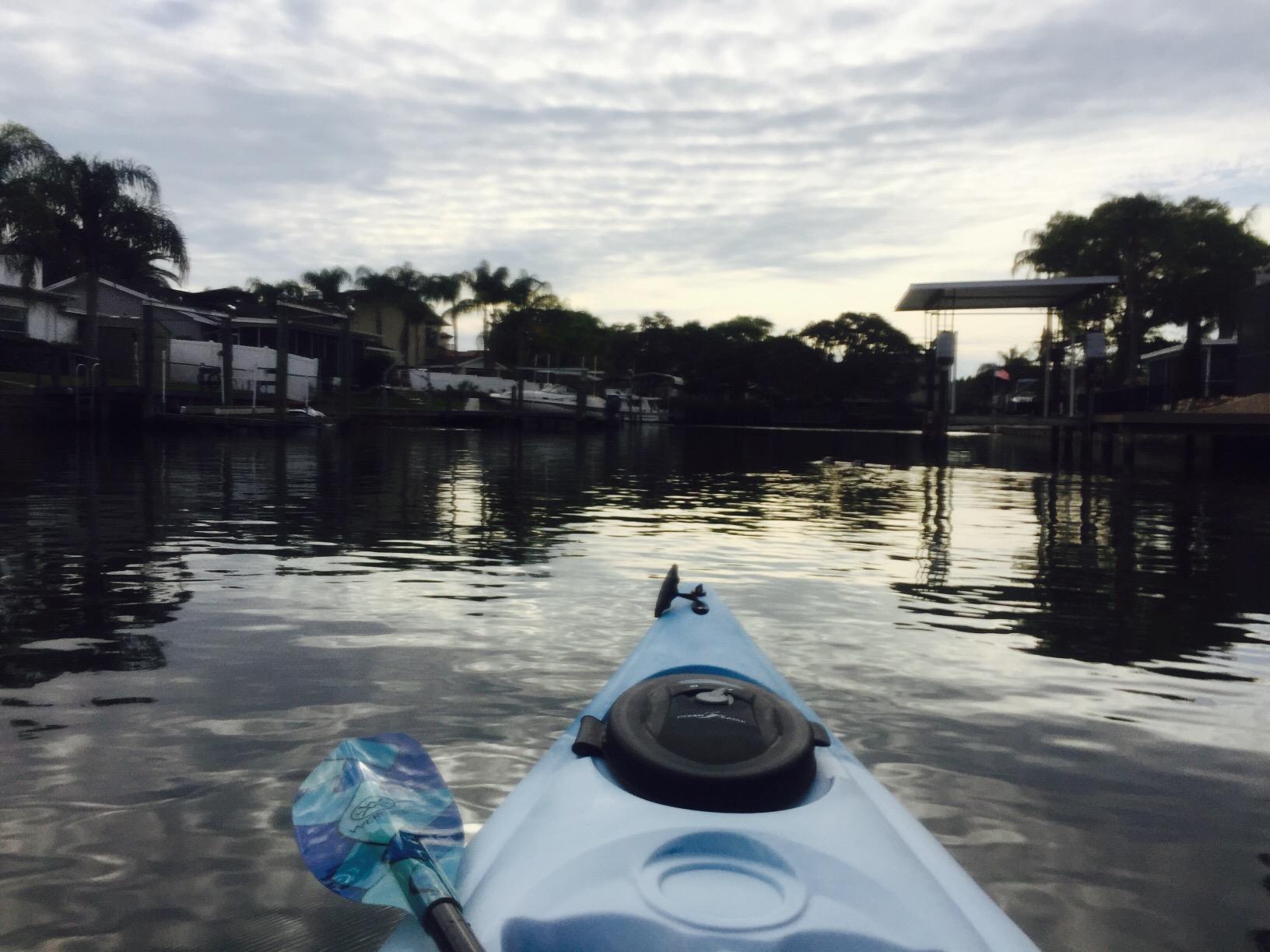
Specifics worth knowing: 761 g, which is 26.75 oz, a 650 cm2 blade surface, and blade dimensions of 52 by 16.5 cm. That is a mid-size blade area, and it fits the widest range of paddlers better than a large touring blade or a small one.
The Smart-View ferrule holds a one-piece feel once locked and adjusts feather in 5-degree steps from 0 to 60 degrees. Werner also offers small and standard shaft diameters, which matters if your hand length sits under or over 6.5 inches. It rates 4.7 with 81 percent five-star and no one-star reviews.
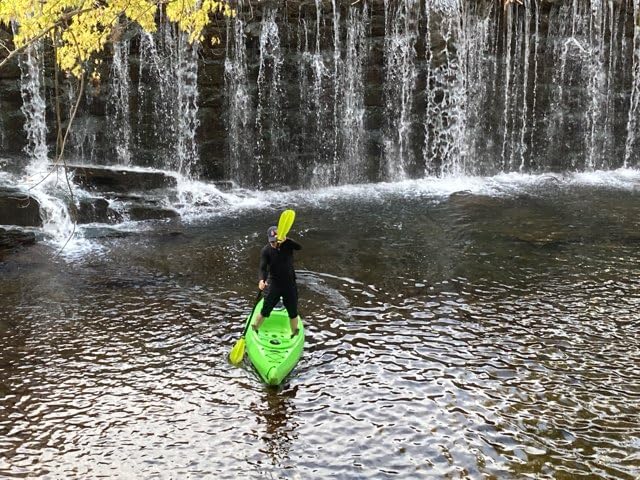
Who benefits most from a fixed low-angle blade
Low-angle paddles reward good technique. If you already have a relaxed, efficient stroke, a fixed low-angle blade lets you hold that shape without thinking about angle settings. It also works across different boats without adjustment, which removes one variable from a long trip.
The Smart-View ferrule gives you the feathering range to run a low angle for cruising and increase it when you need more purchase. That combination of a fixed blade and an adjustable feather is a good middle ground between single-piece purism and a fully offset paddle.
Where it falls short for touring
There is no length adjustment. You choose from 220, 230, or 240 cm at purchase, and getting it wrong means living with it. Measure your torso and check your hull width carefully before ordering, because this is the one decision you cannot revisit later.
The fixed low-angle blade also rules out high-angle technique, so paddlers who need power for surf or current should look at an offset model instead. Werner positions this at the top of its fiberglass range, which means adjustable alternatives can offer more versatility per paddle.
10. Wilderness Systems Pungo Fiberglass Blade Paddle – Built Around the Pungo Hull
Pungo Glass Recreation/Touring Kayak Paddle | Fiberglass Blade | Adjustable Carbon/Fiberglass Shaft (220-240cm)
Fiberglass composite blade
50 percent carbon shaft
Reported near 3 lb
220 to 240 cm adjustable
Pros
- Length and offset adjustment with marked positions
- Durable composite blade
- Color matched to Pungo hulls
- Works in other recreation kayaks
Cons
- Asymmetric halves do not fit standard bags
- Exposed joint mechanism
- No padded grips at this tier
If you own a Pungo, this paddle was designed for it, and that focus is the point. It fits Pungo kayaks across sizes and model years, and it works with other recreation kayaks too, but the sizing and geometry assume that hull family.
The blade is a durable fiberglass composite with a 50 percent carbon and 50 percent fiberglass shaft. Owners describe it as noticeably easier to paddle than entry-level paddles, with a finish that reads as a step up in quality.
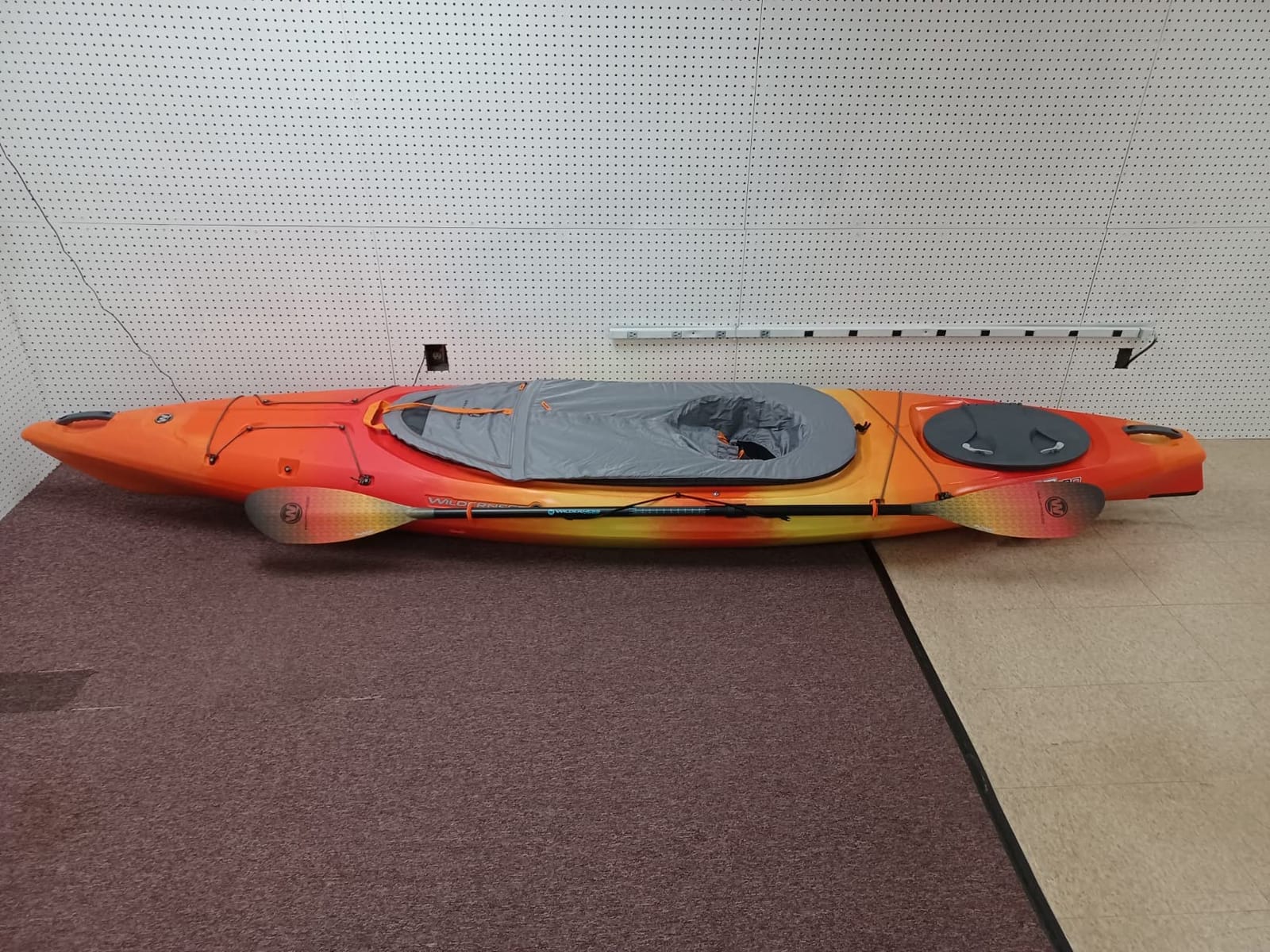
Adjustment is the strong point. Both length and offset adjust, and positions are clearly marked so you can return to a setting you liked rather than guessing. That reset capability is what separates a good touring paddle from one you fiddle with once and never think about again.
Coverage is a 1 year manufacturer warranty. Reviewers also point out that the listed item weight of 4.54 g is erroneous, with real measurements landing near 3 lb, so budget for a heavier paddle than the specification suggests.
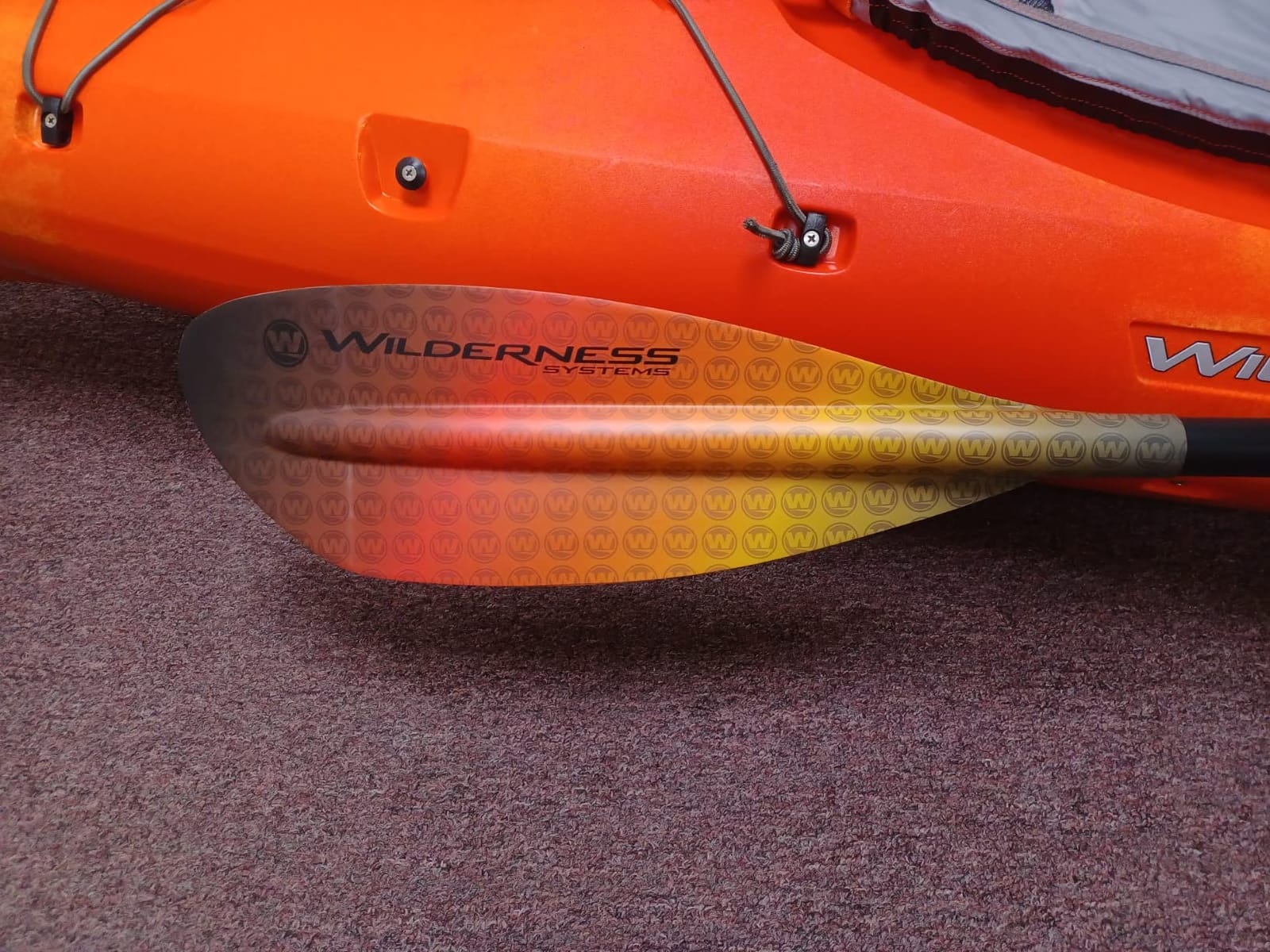
Why adjustable offset matters on a boat used year round
If you paddle the same hull in August on a calm lake and in April on a cold river, a fixed angle forces you to compromise. Adjusting offset takes a few seconds and lets the paddle match the water rather than you working around it.
The 220 to 240 cm range covers most paddlers and most Pungo hulls, so one paddle can serve as the boat moves between wide and narrow setups.
Where it falls short for touring
The halves are asymmetric in length, so standard paddle bags do not fit them. Plan for a dedicated bag or a roof rack strap system before a trip where the paddle goes in the hull.
The joint mechanism is exposed on the outside, which reviewers describe as looking fragile and being vulnerable to dents in transit. There are also no padded grips at this tier, which on a long day is a comfort you notice. This listing offers the fiberglass blade version even though the title mentions carbon.
11. Aqua Bound Manta Ray Carbon 2-Piece Posi-Lok Paddle – Full Carbon Power
AQUA BOUND Manta Ray Carbon 2 Piece Posi-Lok™ Kayak Paddle – Lightweight Carbon Shaft, Carbon-Reinforced Nylon Blades with Dihedral Design, High-Angle Performance
100 percent carbon shaft
0.84 kg package weight
220 cm listing length
Posi-Lok offset with dihedral blades
Pros
- Oversized dihedral blades move more water
- Dual pin coupling with low play
- Full carbon shaft with fast response
- Offset adjusts in 15-degree steps
Cons
- Only 26 reviews on record
- One report of factory carbon damage
- Sizing mistakes are common
This is the power option. The blade is oversized relative to the Sting Ray and moves noticeably more water per stroke without adding meaningful weight, which is the trade you want when you are pushing a loaded boat across flat water.
The shaft is 100 percent carbon, giving the fastest response of any paddle in this roundup. Paddlers describe the feel as a clear upgrade from entry-level gear, where the shaft absorbs effort instead of transmitting it. The offset setting adjusts in 15-degree increments, and the dual pin coupling gives a low-play connection between halves.
Low-play coupling matters on the catch, where a joint that moves under load makes a paddle feel vague. Blades are carbon-reinforced nylon rather than full carbon, which keeps impact resistance up, and reviewers note the oversized dihedral shape reduces flutter across a range of conditions. The two-piece breakdown makes car topping and storage simple.
Larger blades versus smaller blades for touring
A larger blade generates more force per stroke, which means you cover ground with fewer strokes. The cost is more work per stroke for a paddler without the power to move it, and more stress on the shoulder joint if you overreach for it.
Oversized blades suit strong paddlers, loaded boats, and shorter distances per stroke. Smaller blades suit lighter paddlers and boats and long efficient strokes. Match the blade to your strength and your trip length rather than to a spec sheet.
Where it falls short for touring
The review base is 26, which is the second smallest here, so the long-term track record is thin. One owner reported carbon fiber damage on arrival from a factory defect, which is a quality control concern on a paddle at this level.
Sizing mistakes are also common with this model. Because it is a fixed-length design at the listing level, confirm the length before ordering rather than assuming.
12. Aqua Bound Sting Ray Carbon 2-Piece Paddle – Flatwater and Fishing Focus
Aqua Bound Sting Ray Carbon 2-Piece Kayak Paddle with Posi-Lok™ Ferrule, Carbon Shaft, Reinforced Nylon Dihedral Blades for Flatwater Touring and Kayak Fishing (230 cm)
100 percent carbon shaft
0.82 kg package weight
230 cm listing length
Versa-Lok length and feather adjustment
Pros
- Reduced swing weight on long tours
- Dihedral blades with minimal flutter
- Infinite feathering options
- Two-piece breakdown for travel
Cons
- Lowest rating in the roundup at 4.2
- Nylon blades softer than carbon
- Listing mixes up ferrule names
- Not suited to rough water
This is the lowest rated paddle we included, at 4.2 with a 12 percent one-star share. It is here because the design fundamentals are sound and because the same blade shape is widely regarded as a good entry-to-mid upgrade.
The 100 percent carbon shaft is the selling point. It delivers reduced swing weight and responsive strength, which is what carries you through a long day rather than what you notice in the first hour. The Versa-Lok ferrule allows length adjustment and infinite feathering, which is more angle flexibility than the stepped systems on other paddles in this list. Diagonal reinforced nylon blades give smooth, stable forward strokes with minimal flutter.
The two-piece breakdown means it travels and stores without giving up performance, and the whole paddle is aimed at flatwater, light current, and kayak fishing rather than rough or whitewater conditions.
Where infinite feathering actually helps
Stepped systems give you fixed positions, usually in 15 or 60 degree increments. Continuous adjustment lets you dial in the exact angle that suits your stroke and the conditions, which is useful when you paddle a variety of water or share a boat with someone whose technique differs.
It also helps when you are experimenting. Adjustable angles make it easy to feel the difference between a 45 degree and a 60 degree feather and keep what works for you.
Where it falls short for touring
The nylon blades are softer than carbon blades, and that softness costs maximum touring power. This paddle is built for flatwater and light current, so if your route involves surf, strong current, or rock, look at a stiffer blade.
The listing also mixes up the Posi-Lok and Versa-Lok ferrule names, which is genuinely confusing when you are trying to understand what adjustment you actually have. Combined with the lowest rating in the group, it makes this the pick to buy only if the shaft and adjustability are what you are shopping for.
How to Choose a Touring Kayak Paddle in 2026
Every mistake we see in paddle buying comes down to sizing, material, and angle. Get those three right and the rest is preference.
Measure torso length and kayak width before anything else
Height alone is a poor guide. Sit upright in your kayak, measure the distance from your seat to the top of your head, and use that torso length as the base. Then check your hull width, because a wide fishing kayak or a touring boat with a wide beam needs a longer paddle than its torso length suggests.
For most paddlers in a standard recreational touring hull, adjustable paddles in the 220 to 240 cm range cover the useful middle. Check your manufacturer numbers against your own measurements rather than trusting a generic chart, since the sizing complaints we saw in this roundup all traced back to a chart rather than a faulty paddle.
Material: carbon fiber vs fiberglass vs aluminum
Aluminum is heavy and flexes. It suits rentals and instruction, and paddlers switching away from it report immediate fatigue reduction, but for touring days under 8 ounces you are carrying extra weight for nothing.
Fiberglass sits in the middle. It is tougher than carbon, absorbs impacts without cracking, and costs less, at the cost of some weight and some stiffness. For rocky launches and gear-hauling trips it is a defensible choice.
Carbon fiber is the lightest and the stiffest. That combination gives the most efficient stroke and the lowest fatigue, and the paddles at the top of this list all use a carbon or carbon-blend shaft. The trade is price and impact sensitivity, since carbon blades chip rather than bend. One owner described a top-tier carbon paddle as the last they would ever buy, while also warning about impact damage. That is the honest trade in one sentence.
Blade angle: high angle vs low angle
High angle blades bite more vertically and give you control, power, and boat tracking. They suit strong paddlers, heavy boats, and water with current or chop.
Low angle blades reward smooth technique with maximum efficiency per stroke and less fatigue over distance. They suit long flat days and paddlers with a relaxed, well-drilled stroke. An adjustable offset ferrule lets you move between the two, which is why Posi-Lok models appear repeatedly in premium lineups.
Shaft shape and ferrule types
A bent shaft angles the grip forward, keeping the wrist in a neutral position and reducing forearm fatigue. The cost is a two to four week adaptation period while your wrists relearn the angle, and reviewers who switched report never going back. A straight shaft is familiar immediately but asks more of the wrist on long days.
Ferrule systems fall into two groups. Screw button systems are fast and cheap but collect sand and salt, which is exactly the complaint forum users raise most. Posi-Lok and Smart-View style systems clamp with positive engagement and are widely praised for long-term reliability, at the cost of a slightly longer adjustment.
Two-piece versus multi-piece for travel
Two-piece paddles are the standard for car-topped and portaged trips. Three- and four-piece paddles pack into a bag, which matters for pack-supported and hike-in trips where you cannot leave gear in a vehicle.
The multi-piece versions in this roundup have a shorter shaft section, which means a smaller ferrule and more places for grit to sit. That is manageable with the maintenance routine below.
Static weight versus swing weight
Static weight is what you see on a scale. Swing weight is how hard the paddle is to change direction, and it is the number that actually determines whether you finish day three comfortably.
Swing weight is driven by where the mass sits relative to your hands, not by the total number on the scale. Ovalized shafts reduce it by moving material away from the vertical axis, which is why the ovalized carbon shaft on the Manta Ray Hybrid is called out as a touring feature rather than a detail.
Ferrule Care: The Maintenance Routine Most Buyers Skip
A ferrule is the failure point on nearly every paddle that breaks. It is also the cheapest part of the gear to look after, and sand and salt are the two things that turn a smooth adjustment into a jammed one.
Rinse the joint in fresh water after every salt water session. Dry it fully before reassembly, and pay attention to the seam where the two shaft halves meet, because moisture sitting in that line is what causes play to develop.
If the adjustment buttons start feeling gritty, a freshwater soak followed by a gentle cycle of the buttons usually restores them. Avoid forcing a sticky lock, since that is where crack reports tend to originate.
Check the joint for play at the start of a season and before any multi-day trip. Play that appears over a single trip is a loose ferrule you can service; play that has grown over a year is a joint reaching the end of its useful life.
Frequently Asked Questions
What is the 120 rule for kayaking?
The 120 rule says a kayak paddler should have about 120 cm of paddle length per meter of kayak length. It gives you a rough starting point for a fixed-length paddle, but torso length and hull width still decide the final number, which is why most paddlers end up choosing an adjustable model.
What is the best length for a kayak paddle?
Measure your torso length while sitting upright in the boat, then account for hull width. Most paddlers in a standard recreational touring hull land in the 220 to 240 cm range, and wide fishing kayaks need the longer end of that range. If you can only pick one measurement to trust, use torso length plus your hull width, not your height.
Do kayak paddles make a difference?
Yes, more than most buyers expect. Paddlers switching from aluminum to carbon or fiberglass report immediate fatigue reduction, and because a touring day involves thousands of strokes, even small gains in blade stiffness and swing weight add up. The biggest single improvement is usually a correctly sized paddle.
What is the best touring kayak paddle?
For most multi-day paddlers the Best Marine and Outdoors Carbon Fiber 2-Piece is the strongest all-round choice, combining a 32 oz carbon shaft with stiff fiberglass-reinforced blades and clocked feathering. Paddlers wanting fixed low-angle efficiency prefer the Werner Camano, and strong paddlers who want maximum power per stroke prefer the Aqua Bound Manta Ray Carbon.
How do I pick a good kayak paddle?
Work through four decisions in order. First measure your torso length and hull width. Second choose a material, where carbon is lightest and stiffest, fiberglass is tougher, and aluminum is heavy and flexes. Third choose a blade angle, high for control and low for efficiency, or adjustable offset for both. Fourth pick a ferrule system that resists sand and salt, then verify the length before ordering.
Should I get a carbon fiber or fiberglass paddle for touring?
Choose carbon if your trips are on flat or open water and you want the lowest weight and stiffest stroke. Choose fiberglass if you land on rocks, push off submerged objects, or carry heavy gear, because it absorbs impacts without cracking. Many paddlers use fiberglass blades with carbon shafts as the middle ground, which is what several of our top picks do.
Conclusion: The Touring Paddles Worth Your Money in 2026
After a season of long flatwater days and rough launches, the Best Marine and Outdoors Carbon Fiber 2-Piece is the pick we would hand most people looking for the best kayak paddles for touring. Its 32 oz carbon shaft and stiff fiberglass-reinforced blades give the best balance of weight, power, and adjustability in this group, and its 1353 reviews make it the most proven option here.
Paddlers buying at the value end should start with the Pelican Symbiosa, which holds up for years and adjusts across four inches of length. Strong paddlers chasing maximum power per stroke will prefer the Aqua Bound Manta Ray Carbon, and anyone committed to a smooth low-angle stroke will find the Werner Camano hard to argue with.
Measure your torso, choose your material honestly, and pick the paddle that fits the water you actually paddle. Our touring kayak guide covers the hulls these paddles were measured against, so check both before you order.