
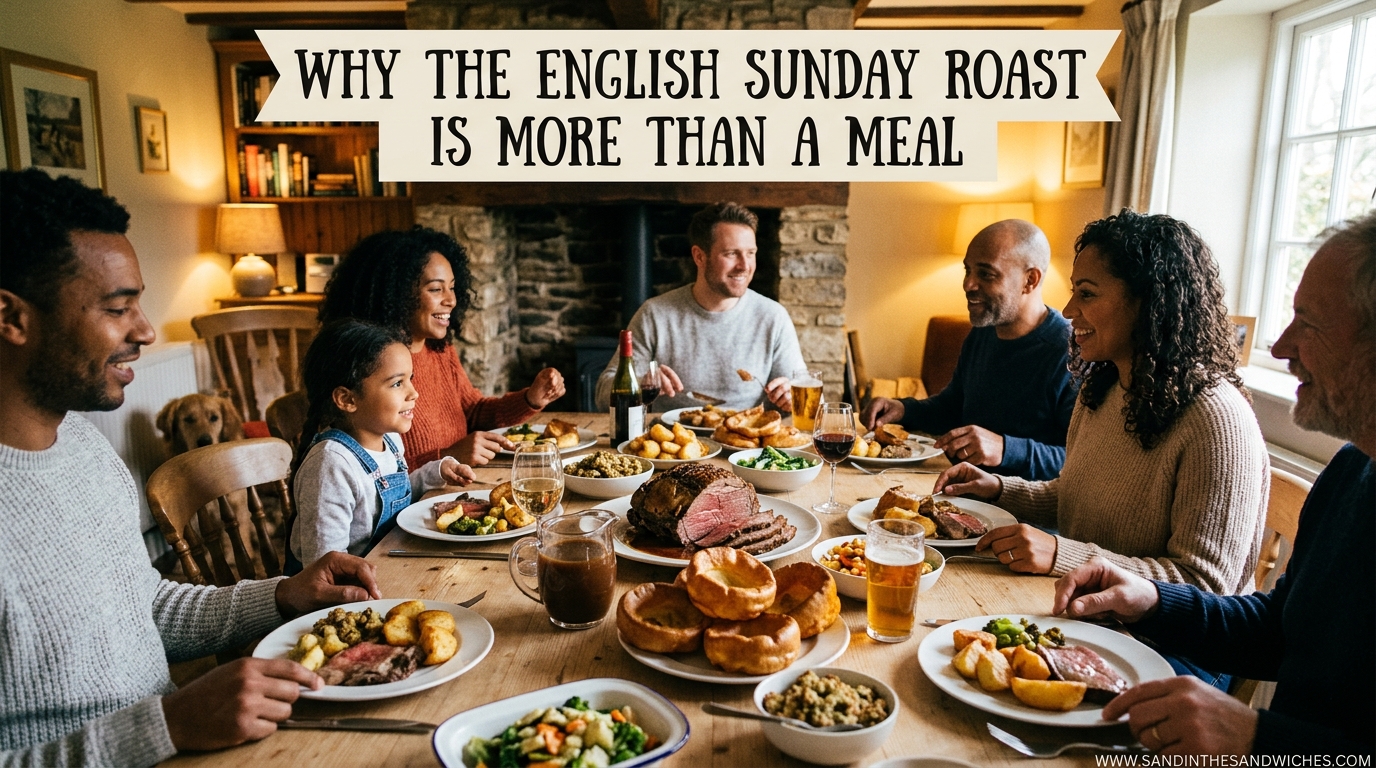
“If you had to name one meal that truly encapsulates what it means to be British, it would be the Sunday roast.” That sentence, written by a London restaurateur a few years back, stuck with me the first time I read it. I keep coming back to it whenever someone outside the UK asks me what the fuss is about. Because the English Sunday roast genuinely is more than a meal. It’s a weekly ritual, a family anchor, and a living piece of British culture that has survived rationing, food trends, and the disappearance of the very church service that gave it its name.
The English Sunday roast is a traditional hot, sit-down meal of roasted meat served with crispy roast potatoes, seasonal vegetables, gravy, and accompaniments such as Yorkshire pudding. It’s typically eaten in the early afternoon on a Sunday, either at home with family or in a pub. But that description, accurate as it is, doesn’t begin to explain why people queue for an hour outside a good gastropub for one, or why British expats go misty-eyed at the mention of it.
In this article I’ll walk through why the English Sunday roast is more than a meal: where it came from, what it actually involves, and what it means emotionally, socially, and culturally to the people who grew up with it. Whether you’re a curious visitor, a food lover, or a Brit wanting to put words to something you’ve always felt, by the end you’ll understand why this tradition refuses to die.
Table of Contents
The History and Origins of the Sunday Roast
The Sunday roast’s roots run deeper than most people realise. To understand why it carries so much weight, you have to look at how it began, how it changed, and how it refused to disappear.
Medieval Roots and the Church Tradition
The most widely told origin story points to medieval England, where village serfs served the local squire six days a week. On Sunday, after church, they would practice battle formations. As a reward, they were supposedly served a roast. It’s a story that’s been passed around for centuries, though historians debate how literally to take it.
What’s more firmly documented is the religious connection. Sunday was the Sabbath, a day of rest, and for Catholics it was also a day to break the weekly fast from meat. Families would pop a joint of beef into the oven before walking to church, add potatoes and root vegetables before they left, and return to a kitchen that smelled of dripping and slow-cooked meat. The meal was a reward at the end of a holy morning.
That practical arrangement, oven on low, family at worship, home to a feast, became the template. Even when the religious side faded, the meal stayed.
The Industrial Revolution Transforms the Meal
The Industrial Revolution changed everything about British life, and the Sunday roast with it. Workers moved into cramped terrace houses with tiny kitchens, and long factory hours made daily cooking nearly impossible. Sunday became the one day a working family could commit serious time to food.
The roast filled that role perfectly. It was cheap enough for a working-class family, stretching a single joint of meat across multiple people with the help of Yorkshire pudding (originally a filler, not a side dish) and seasonal vegetables from the garden or the market. Through the 1800s, the Sunday roast cemented itself as the one meal the whole household gathered for, no matter how hard the week had been.
This is also when roast beef became entangled with Englishness itself. Henry Fielding’s patriotic song “The Roast Beef of Old England”, written in the 1700s, was already a cultural fixture. By Victoria’s reign, the French nickname for the English, “les Rosbif”, was less an insult than a grudging acknowledgement that beef and English identity were now the same thing.
Rationing, Resilience, and Survival
The true test of any tradition is whether it survives hardship, and the Sunday roast faced its biggest test during and after World War II. Rationing, which didn’t fully end until 1954, made meat scarce and fat a luxury. Families grew their own vegetables, stretched joints further, and got creative with offal and cheaper cuts.
What’s striking is how the ritual held even when the ingredients thinned out. People still sat down together on Sunday. They still carved something at the table. The roast became a symbol of resilience as much as abundance, and that double meaning is part of why it still resonates.
What Makes a Sunday Roast Different From a Regular Roast
A fair question I see in food forums all the time: isn’t a Sunday roast just a roast dinner? The short answer is no. The Sunday roast is a specific meal with its own customs, timing, and rules. A midweek roast pork with potatoes is dinner. A Sunday roast is an event.
The Core Components
At minimum, an English Sunday roast includes roasted meat, roast potatoes, at least two vegetables, gravy, and a signature accompaniment. The choice of meat traditionally dictates the rest of the plate:
Beef comes with Yorkshire pudding, horseradish sauce, and mustard. Lamb pairs with mint sauce. Pork is served with crackling and apple sauce. Chicken tends to arrive with bread sauce or stuffing. Each combination has evolved over centuries, and while you can mix and match, traditionalists will notice.
The roast potatoes are non-negotiable. They should be crisp on the outside, fluffy inside, and roasted in beef dripping or goose fat if you’re doing it properly. Gravy is made from the meat juices, not a packet, and it ties everything on the plate together.
The Trimmings That Matter Most
Beyond the basics, the trimmings are where opinions get heated. Cauliflower cheese, glazed carrots, buttered cabbage, mashed swede, pigs in blankets (sausages wrapped in bacon, usually reserved for Christmas but increasingly seen year-round), and a jug of extra gravy all have their advocates.
The Yorkshire pudding deserves its own mention. Made from a simple batter of flour, eggs, and milk, cooked in smoking hot fat, it should rise dramatically and stay crisp. Whether it belongs only with beef or with every roast is one of the longest-running arguments in British food. Most northerners say every roast. Many southerners say beef only. Nobody is backing down.
Regional Variations Across England
Regional identity shapes the Sunday roast more than outsiders expect. In Yorkshire, the pudding is often served as a starter with onion gravy, a tradition I genuinely think more of the country should adopt. In the southwest, you might find a suet pudding stuffed with herbs and meat alongside the main event. In Cornwall, a side of saffron buns or a Cornish split can appear alongside.
The north tends towards heartier portions and a wider definition of what counts as a proper roast. The south, particularly London, has drifted towards more refined, gastropub-style plates with micro-herbs and jus. Both versions are legitimate. Both will be defended to the death by the people who grew up eating them.
Why It’s More Than a Meal: The Emotional Significance
This is where the simple definition of a Sunday roast breaks down. Because the food, however good, is only half the story. Ask anyone who grew up with the tradition what makes it special and they’ll talk about the kitchen, the people, the smell of the house at 1pm. The English Sunday roast is more than a meal because it carries memory, ritual, and belonging in every plate.
Family Togetherness and Weekly Ritual
For most British families, Sunday lunch was the one meal the whole household ate together. During the week, parents worked late, kids had football practice, teenagers disappeared to their rooms. On Sunday, everyone sat down at the same table, at the same time, for an hour or more.
That ritual is the real dish being served. The shared carving, the fight over the crispest potato, the second helping of gravy, the slow cup of tea afterwards. The Sunday roast creates a small, predictable island of togetherness in a life that’s otherwise scattered. When people talk about missing home, this is often what they mean.
The Comfort of Routine and Nostalgia
There’s a psychological weight to predictable rituals, and the Sunday roast provides exactly that. The same day, the same time, the same smells. For children it becomes a sensory memory of safety and home. For adults it becomes a way of marking time, of feeling like a week has properly ended and another is about to begin.
Nostalgia is powerful here. I’ve spoken to British friends in their forties and fifties who still judge every roast they eat against their mother’s version. The “mum test” is real, and almost nobody passes it. That comparison isn’t really about cooking. It’s about trying to recreate a feeling that’s tied to a specific time and place in childhood.
This is also why the tradition adapts rather than dies. People who no longer live near family, who don’t go to church, who cook modern fusion food all week, will still seek out a Sunday roast somewhere. It’s an anchor to a version of themselves that still feels true.
Connection to British Identity
The Sunday roast is, fairly or not, treated as a kind of national dish. It’s mentioned in the same breath as fish and chips or a full English breakfast, but it carries more weight because it requires effort, time, and company. It’s a meal that says something about how the person cooking it values tradition.
For expats, the Sunday roast is one of the most reliable triggers of homesickness. Australian, New Zealand, South African, and Canadian friends have all told me versions of the same story: a British friend tears up at a roast served abroad, not because the food is perfect but because it represents a thread back to where they came from. That’s not something most dinners can do.
Class, Prosperity, and the Social Story
You can’t fully understand the Sunday roast without talking about class. The dish carries a complicated social history, and it still triggers assumptions about who is “properly” British or “properly” traditional.
How Roast Beef Became a Status Symbol
Historically, beef was expensive. A family that could afford a large joint every week was signalling prosperity, even if quietly. Over time the meal became shorthand for “doing well”, for being able to feed a household properly on the one day that mattered. That association with abundance is baked into the dish, even now that beef is relatively cheap.
The Sunday roast also carried a whiff of aspiration. A working-class family serving a proper roast on Sunday was making a statement about self-respect, hospitality, and pride. You fed your family well on Sunday. You fed guests well on Sunday. It was a public display of competence in the most private room of the house.
Le Rosbif and National Pride
The French nickname for the English, “les Rosbif”, has been in use since at least the 18th century. It started as a slightly mocking label, but it stuck because it captured something real. Roast beef and Englishness had become inseparable in the European imagination.
That national pride side of the tradition is still alive. You’ll hear people describe the Sunday roast as a “birthright” or a “Great British institution”, language usually reserved for things like the monarchy or the BBC. Whether that pride is endearing or overblown depends on who you ask, but it confirms that the dish has escaped the category of mere food.
The Great Yorkshire Pudding Debate
Few food arguments in Britain run as hot as whether Yorkshire pudding belongs only with beef. The traditional position, still loudly defended, is yes. Yorkshire pudding was invented to accompany roast beef, the name is literally “Yorkshire”, and serving it with chicken is borderline sacrilege.
The modern position, increasingly common in pubs and home kitchens, is that Yorkshire pudding is too good to restrict to one meat. So it turns up with everything. Both sides have a point. The argument is part of the fun, and it’s a small reminder that the tradition is still alive enough to argue over.
The Modern Sunday Roast in 2026
The Sunday roast has not frozen in time. It’s adapted, sometimes awkwardly, to a Britain where Sunday trading is normal, families are scattered, and most people don’t cook for two hours on a weekend. The tradition looks different now, but it’s far from gone.
How the Tradition Adapts Today
Fewer households cook a full roast from scratch every Sunday. The cost, time, and logistics of feeding a family have all gone up. What’s changed is where the tradition lives. Many families now do a roast every other week, or once a month, or as a special occasion. The ritual is less frequent, but when it happens, it’s still treated as an event.
Vegetarian and vegan roasts are now mainstream. Nut roasts, cauliflower steaks, mushroom wellingtons, and plant-basedYorkshire puddings have all entered the rotation. The form of the meal, gathering, carving, plating, gravy, survives even when the meat doesn’t. That, I’d argue, is the clearest sign the tradition is healthy: people want to keep the ritual even when they change the ingredients.
The Pub Roast Experience
For many Brits in 2026, the pub is where the Sunday roast actually happens. A good pub roast is one of the great British food experiences. A roaring fire, a pint, a plate piled high, a long lazy lunch that drifts into the afternoon. Pubs know this, and the best ones treat their Sunday menu as seriously as a restaurant treats a tasting menu.
Quality varies wildly, which is a common complaint in food forums. A great pub roast is unforgettable. A bad one, a cold plate, watery gravy, soggy potatoes, limp cabbage, is genuinely upsetting to people who grew up with the real thing. The gap between the two is why Brits will travel an hour for a pub they trust and ignore the one next door.
International Spread and Adaptations
The Sunday roast travelled with the British Empire and put down roots in Australia, New Zealand, South Africa, Canada, and Ireland. Each country adapted it. Australians lean towards lamb. South Africans might add a malva pudding for dessert. The Irish version often features bacon and cabbage alongside, or instead of, beef.
In the United States, the tradition never quite landed in the same way. Americans have pot roast, which is a different beast entirely, braised rather than roasted, served without Yorkshire pudding, and not tied to a specific day. When Americans try a proper Sunday roast in the UK, the most common reaction is confusion followed by delight, followed by asking why this isn’t a thing back home.
That international spread confirms something important. The Sunday roast isn’t just English anymore. It’s a piece of culinary culture that has been carried, adapted, and claimed by people who never set foot in a Yorkshire kitchen. The origin matters, but the reach matters more.
FAQs
Why do British people eat Sunday roasts?
British people eat Sunday roasts because the tradition grew out of medieval and religious customs where Sunday was a day of rest and the one meal the whole household could share. After church, families would return to a slowly roasted joint of beef with potatoes and vegetables. Even as church attendance declined, the weekly ritual of gathering for a big shared meal on Sunday survived because it offered something rare: predictable, unhurried family time.
Is British Sunday roast lunch or dinner?
The Sunday roast is technically a lunch, served in the early afternoon, usually between 1pm and 3pm. Most British people still call it Sunday lunch or Sunday dinner interchangeably. The timing is deliberate: it leaves room for a long, slow meal and a relaxed afternoon, often followed by a smaller tea or sandwiches in the evening.
What’s the difference between an English roast and a regular roast?
An English Sunday roast differs from a regular roast dinner in three main ways: it happens on a specific day (Sunday), it follows traditional meat-and-accompaniment pairings (beef with Yorkshire pudding and horseradish, lamb with mint sauce, pork with crackling and apple sauce), and it is treated as an event rather than just a meal. A midweek roast pork with potatoes is dinner. A Sunday roast is a ritual with its own customs, timing, and social weight.
What is so special about Sunday roast?
The Sunday roast is special because it carries centuries of history, family ritual, and British identity in a single meal. It’s the one dish almost every British person has a personal memory of, usually tied to childhood, a parent’s kitchen, or a favourite pub. The food is good, but what makes it genuinely meaningful is the togetherness, the predictable weekly rhythm, and the sense of belonging it represents.
Conclusion: Why the Tradition Endures
The English Sunday roast is more than a meal because it carries too much history, ritual, and feeling to be reduced to ingredients. It started as a religious practice, survived rationing, adapted to modern kitchens, and still shows up on tables and in pubs every weekend across the country.
It endures because it offers something food rarely delivers on its own: predictable time with the people who matter. The meat changes, the trimmings get argued over, the venue shifts from kitchen to pub to friend’s flat. What stays the same is the act of sitting down together on a Sunday and treating a meal as an event worth protecting.
If you’ve never had a proper one, find a pub with a good reputation, go with people you like, and stay longer than you planned. If you grew up with the tradition, you already know why it’s more than a meal. And if you’re trying to recreate it for people who didn’t, the secret was never really in the recipe.