
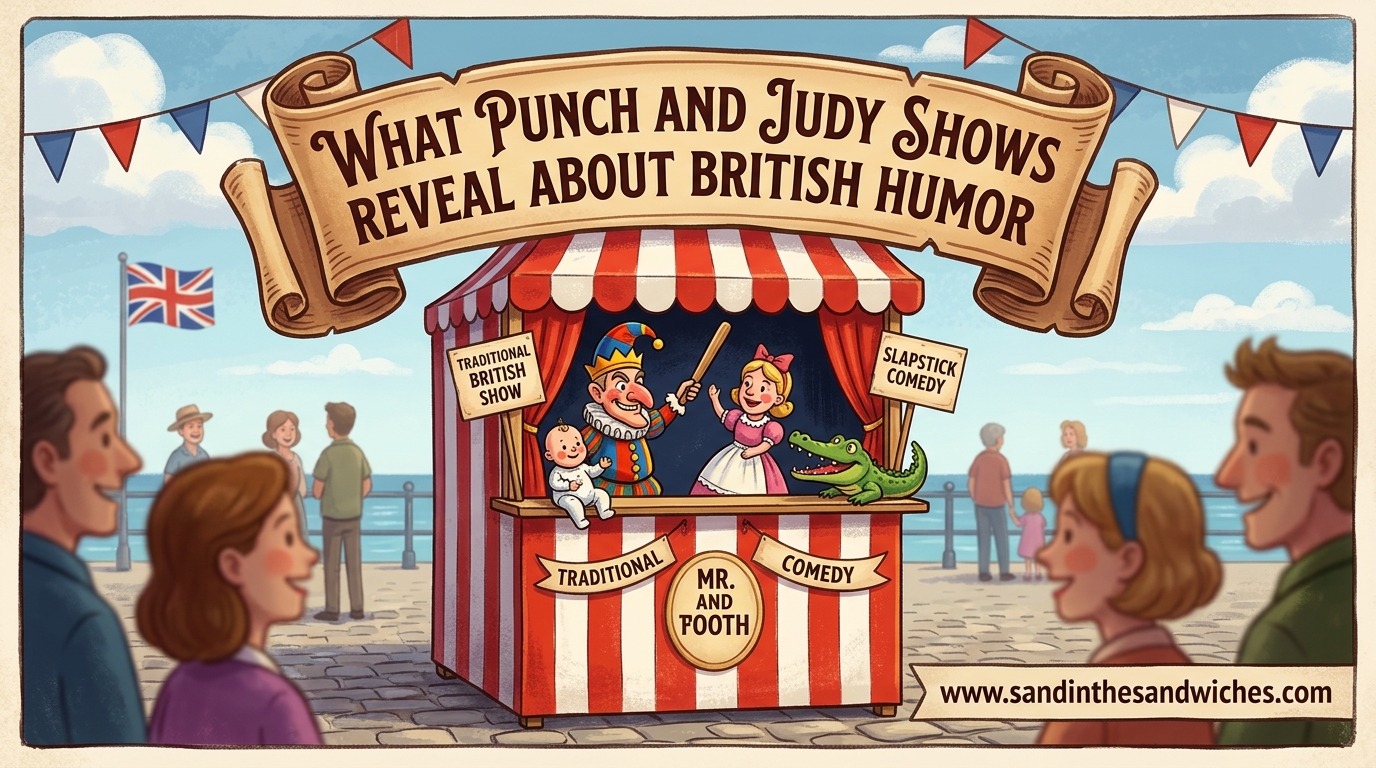
Walk along any British seaside promenade on a summer afternoon and you might still hear it — that unmistakable squawking voice, the slap of wood on wood, a chorus of children shrieking with laughter while a hunched puppet in a red cap beats every authority figure who dares to challenge him. To a visitor from outside the UK, the whole scene can feel baffling, even unsettling. Yet this strange little show has survived for over 360 years, was named one of 12 official “icons of Englishness” by the British government in 2006, and has shaped the way an entire nation laughs.
What Punch and Judy shows reveal about British humor is something quite specific: a deep, centuries-old affection for anarchic, subversive comedy that thumbs its nose at authority, celebrates the trickster who breaks every rule, and finds laughter in the chaos of ordinary life being turned violently upside down. The show is not really about a puppet hitting his wife. It is about a culture that has always used laughter as a pressure valve against power, propriety, and pretension.
I have spent years writing about British comedy traditions, and the more I dig into Punch and Judy, the more I see it as a Rosetta Stone for understanding the British comic sensibility. The same instincts that make Brits roar at Mr Bean dropping a turkey, or at Blackadder insulting royalty, or at Monty Python’s absurd violence, are all present in miniature on that tiny red-and-white striped stage. Understanding this puppet show is understanding something fundamental about the British character.
In this article I want to unpack exactly what Punch and Judy reveals about British humor — from its Italian street-theatre roots to its carnivalesque psychology, from its controversial violence to its linguistic fingerprints still echoing through the English language today. If you have ever wondered why British people find transgressive slapstick funny, or why this particular puppet show refuses to die, you are in the right place. Whether you are a cultural tourist, a student of comedy, or simply a non-Brit staring in confusion at a Mumsnet thread, the answer is more interesting than you might expect.
Table of Contents
Quick Answer: Five Things Punch and Judy Reveals About British Humor
If you want the short version, here are the five core traits of British humor that Punch and Judy puts on display every single performance:
- A love of anarchy over order. Punch always wins by breaking every rule, and British audiences have always rooted for the rule-breaker.
- Slapstick as a national language. Physical, visual comedy — the slap of the slapstick — has been a staple of British humor since long before cinema existed.
- Subversion of authority. Punch beats the policeman, the hangman, and the Devil himself. Laughing at power is a British reflex.
- The trickster as hero. From Mr Punch to Del Boy to Blackadder, the British comic protagonist is the cunning underdog who outsmarts the system.
- Comedy as catharsis. The violence is so exaggerated, so cartoonish, that it becomes a safety valve — a way to release tension about real social frustrations.
Keep those five traits in mind, because every section that follows circles back to them in some way. They are the framework that connects a 17th-century Italian puppet to the sitcoms and panel shows streaming on British television in 2026.
From Pulcinella to Mr Punch: A 360-Year Comedy History
To understand what Punch and Judy reveals about British humor, you first have to understand where the show came from — because Mr Punch is not originally British at all. He is an immigrant, and his arrival on these shores tells you something important about what British audiences were hungry for. The story of how an Italian servant character became the most enduring figure in English popular entertainment is also the story of how British comedy absorbed and transformed outside influences.
The Italian Roots: Commedia dell’Arte and Pulcinella
Mr Punch’s great-great-grandfather is Pulcinella, a hook-nosed, hunchbacked trickster character from the Italian commedia dell’arte tradition that flourished in the 16th and 17th centuries. Pulcinella was a servant figure — coarse, cunning, gluttonous, and entirely amoral. He lied, he cheated, he chased women, he dodged work, and he always escaped the consequences. Italian audiences adored him precisely because he refused to behave.
What is striking is how readily British culture embraced this character. Traveling Italian puppeteers brought Pulcinella across Europe in the mid-1600s, performing at fairs, markets, and taverns. When the show landed in England, it found an audience already primed for this kind of mischief. The British had their own folk tradition of the Lord of Misrule — a figure appointed during festivals to overturn social norms, mock the powerful, and preside over licensed chaos. Pulcinella fit that existing cultural slot almost perfectly, as though a space in the British imagination had been waiting for him.
The commedia dell’arte tradition also gave British comedy its vocabulary of stock characters, physical lazzi (comic business), and improvised scandalous scenarios. The Harlequin, the Pantaloon, the Captain — all entered English pantomime and popular theatre through this Italian pipeline. Punch was simply the character who refused to leave.
9 May 1662: Samuel Pepys and the First Recorded Performance
The earliest written record of a Punch show in England comes from the diary of Samuel Pepys, who on 9 May 1662 visited Covent Garden and watched an Italian puppeteer perform “an Italian puppet play, that is within the rails there, which is very pretty, the best that I ever saw.” Pepys was charmed. That moment — a London civil servant being delighted by a squawking foreign puppet — is the starting gun for 360 years of unbroken British Punch and Judy tradition.
The date matters because of what was happening in England at the time. Charles II had just been restored to the throne after the joyless years of Puritan rule, when theatres had been closed, Christmas celebrations banned, and dancing treated as a moral offence. The British public was hungry for colour, noise, irreverence, and laughter after more than a decade of enforced seriousness. Punch arrived at exactly the right cultural moment — a mascot for a nation rediscovering its appetite for fun.
Every May, the Covent Garden May Fayre and Puppet Festival still commemorates that first performance. Puppeteers from across the country gather at St Paul’s Church, where Pepys watched his show, to perform Punch and Judy in front of an audience of enthusiasts, families, and curious tourists. It is one of the quirks of British cultural life that a 1662 diary entry still generates an annual festival in 2026.
From Marionette to Glove Puppet: The Victorian Reinvention
For the first century or so, Punch was a string-operated marionette performing indoors for paying audiences. In the early 18th century, performers like Martin Powell brought Punch into indoor London theatres with elaborate programmes. But in the late 18th and early 19th centuries, something changed. Performers began using glove puppets instead, which were cheaper, more portable, and crucially much faster. A glove puppet could move with a frantic energy that strings simply did not allow.
This shift coincided with the rise of the Victorian seaside resort and the working-class holiday. Suddenly Punch was performing outdoors on beaches and promenades — Brighton, Scarborough, Blackpool, Llandudno, Great Yarmouth — to audiences of children and their parents who had come to the coast for fresh air and entertainment. The red-and-white striped booth became a fixture of British seaside culture. The performer (known as a “professor” or “punchman”) worked with a “bottler” who collected money, played a drum or panpipes, and drummed up a crowd with shouted come-ons.
That Victorian reinvention is when Punch and Judy became genuinely, unmistakably British. Pulcinella’s Italian bloodline was still there, but the show had absorbed something specifically English: a love of knockabout farce, a delight in bad behaviour, and a deep suspicion of anyone in a uniform. By the time the railways had made seaside holidays affordable to factory workers and clerks, Punch and Judy was already a fixture — as central to the British beach experience as fish and chips, donkey rides, and sticks of rock.
Why 360 Years of Survival Matters
Very few cultural artefacts last three and a half centuries. The fact that Punch and Judy has done so tells you that it is tapping into something durable in the British psyche. Fashions change, technology changes, moral sensibilities change — but the underlying appeal of an anarchic little man who refuses to obey the rules apparently does not. The show has survived the Industrial Revolution, two world wars, the decline of the seaside holiday, the rise of television, and the internet age.
That persistence is itself a clue about what British humor values at its deepest level. Cultures do not preserve what they find irrelevant. They preserve what they need. And what the British have apparently needed, for 360 years, is a small defiant puppet who refuses to do what he is told.
What Punch and Judy Shows Reveal About British Humor
This is the heart of the matter. Most articles about Punch and Judy tell you the history and leave it there. But the question we are really asking is more interesting: what does this strange, violent, squeaky-voiced puppet show actually reveal about the way British people think comedy should work? The answer, I would argue, comes down to five interlocking ideas that together form a kind of unified field theory of British comic taste.
1. The British Comic Hero Is the Anarchist, Not the Saint
In many comedy traditions, the hero is fundamentally decent — a good person who suffers indignities but ultimately triumphs through virtue. Think of American sitcom protagonists who, however bumbling, are basically well-meaning. Mr Punch is nothing like this. He is cruel, selfish, dishonest, and violent. He throws his own baby down the stairs. He beats his wife. He murders a policeman. He tricks the Hangman into hanging himself. He even defeats the Devil.
And the audience cheers for him.
This is one of the most revealing things about British humor. The British comic protagonist is not the person who follows the rules — he is the person who breaks all of them and gets away with it. From Punch to Blackadder to Alan Partridge to Del Boy, the lineage is unmistakable. There is something in the British comic imagination that loves the rogue, the schemer, the amoral survivor. Punch is the original template, and 360 years later he is still recognisably the same character type that fills British screens and stages.
Even when British comedy appears to give us a “nice” protagonist — David Mitchell’s Mark in Peep Show, Ricky Gervais’s David Brent in The Office — the joke is usually at their expense for failing to be the rogue they wish they were. The aspiration to anarchic self-interest is the comic engine. The pathos comes from the gap between aspiration and reality. But the underlying admiration for the trickster is unchanged.
2. Slapstick Is a Native British Comic Language
The very word “slapstick” comes from the physical comedy of Italian commedia dell’arte — the battacio, a paddle designed to make a loud crack when striking someone without causing real harm. Punch’s signature weapon is literally a slapstick, and the entire show is built around its rhythmic, satisfying whack as he dispatches each new adversary.
What Punch and Judy reveals is that physical, visual comedy has been a continuous thread in British humor for centuries. Long before cinema, British audiences were laughing at exaggerated violence performed at speed. When Tom and Jerry, Bugs Bunny cartoons, Mr Bean, or Monty Python’s giant foot came along, they were not introducing anything new — they were tapping into a comic appetite that Punch and Judy had been feeding for generations. As V&A curator Cathy Haill once observed, Punch’s violence “is no more real to a child than watching a cartoon.” The same instinct is at work.
British slapstick has its own distinct texture, too. It is faster and crueler than its American cousins, more willing to inflict pain on its protagonists and more willing to let the audience enjoy that pain. Benny Hill, the Carry On films, the physical punishment inflicted on Mr Bean, the violence of Bottom — all of these trace a direct line back to the booth on the seafront where a puppet gets whacked with a stick and the children howl.
3. Authority Exists to Be Deflated
Consider the roll call of characters Punch defeats: a policeman, a beadle (a kind of parish official), a hangman, and the Devil himself. Every one of them represents authority — the law, the state, the ultimate moral power. Punch beats them all, and the audience laughs every time.
This is not accidental. British humor has always had an anti-authoritarian streak. From the satirical cartoons of James Gillray and George Cruikshank in the 18th century, to the puppet parodies of politicians in Spitting Image, to the sneering contempt of Yes Minister, to the bleak cynicism of The Thick of It, British comedy delights in showing that the powerful are ridiculous. Punch and Judy is the simplest, purest version of that impulse. A small, ugly puppet in a jester’s cap humbles the mightiest figures in the imagined universe — and nobody in the audience thinks this is wrong. They think it is hilarious.
What this reveals is a culture that has never fully trusted authority and uses laughter to keep it in proportion. The British are not revolutionaries by temperament — they did not, after all, have a French-style revolution. But they are inveterate mockers. The instinct to puncture pomposity, to bring the powerful down a peg, to refuse the gravity that authority demands, runs right through British cultural life. Punch and Judy has lasted 360 years because the impulse to laugh at the powerful has lasted 360 years.
4. The Trickster Archetype and the Lord of Misrule
Punch is what folklorists call a trickster figure — a character found in cultures around the world who violates the rules of gods and men, who lies and steals and cheats, but who is nevertheless celebrated rather than condemned. The British Isles have a particularly rich trickster tradition, from the medieval Lord of Misrule (a peasant appointed to preside over Christmas feasts and mock the king) to Robin Hood to the grotesque puppets of folk performance.
What Punch and Judy reveals is that the trickster occupies a sacred-comic role in British humor. He is not just a bad man — he is a ritual figure who turns the world upside down so that audiences can experience, vicariously, what it feels like to defy every constraint. The technical term for this, borrowed from the Russian literary critic Mikhail Bakhtin, is the carnivalesque: the temporary suspension of social hierarchies, where the low mock the high and the rules that normally govern behaviour are gleefully suspended.
Bakhtin was writing about medieval carnival, but his theory fits Punch and Judy with eerie precision. Every performance is a miniature carnival. For ten minutes, the normal order is overturned. The servant defeats the master. The criminal defeats the law. The mortal defeats the Devil. And when the show is over, the audience returns to their ordinary lives — having exorcised, through laughter, the resentment and frustration that real social constraints produce.
This is why so many comedy historians describe Punch as the “Lord of Misrule.” Performer Glyn Edwards, one of the great modern professors of Punch, used exactly that phrase. Punch is not a character you are supposed to admire. He is a character you are supposed to release through — a vessel for all the antisocial impulses that polite British society requires you to suppress. In a culture historically defined by emotional restraint, the trickster puppet offers a rare, sanctioned space for the venting of taboo feeling.
5. Comedy as a Pressure Valve for Class and Power
This brings us to perhaps the deepest thing Punch and Judy reveals about British humor: its function as a social pressure valve. Britain is a class-conscious society with a long history of inequality, deference, and unspoken rules about who is allowed to do what. In such a culture, comedy is not just entertainment — it is a safety mechanism.
When a working-class crowd at a Victorian seaside resort watched Punch beat a Beadle (a parish official who, in real life, policed the poor), they were not just watching a puppet show. They were watching a fantasy of revenge against a figure who had real power over their lives. When Punch outwits the Hangman, the audience is cheering the defeat of a justice system that, in the 18th and 19th centuries, hanged people for relatively minor crimes. The violence on the tiny stage is a symbolic stand-in for real social tensions.
This is also why the humor does not translate easily to non-British audiences, as forum discussions repeatedly reveal. American viewers on Reddit and Mumsnet regularly express genuine bafflement: why is wife-beating supposed to be funny? Why is a puppet murdering a policeman entertaining? Without the cultural context — without the inherited British instinct to use comedy as a valve for class resentment and suspicion of authority — the show looks merely cruel. With that context, it looks like something much more interesting: a folk ritual of comic rebellion.
The Swazzle: How Sound Itself Makes the Violence Funny
One technical detail deserves more attention because it is central to why the humor works: the swazzle. The swazzle is a small metal-and-reed instrument hidden in the professor’s mouth that produces Punch’s distinctive piercing, squawking voice. It is so closely associated with the show that the world of Punch performers is sometimes called “swatchel omis” — cant for “swazzle men.” Learning to use a swazzle without choking is a rite of passage for any serious professor.
The swazzle matters because it does something crucial to the comedy: it makes everything Punch says sound absurd. No matter how violent, how transgressive, how shocking his actions, his voice is so ridiculous that the audience cannot take him seriously. The swazzle transforms potential horror into pure farce. It is the audio equivalent of the fixed grotesque grin on the puppet’s face — a constant signal that none of this is real, that we are in the realm of cartoon, that laughter is the only appropriate response.
Compare this to modern British comedy audio. The squeaky-voiced, sped-up, distorted voice is a recurring trope — from the Fast Show characters to League of Gentlemen creations to the squealing absurdism of The Mighty Boosh. All of these trace back, whether consciously or not, to the acoustic template the swazzle established. Punch’s voice is arguably the oldest continuously performed comic sound in British culture.
The Violence Question: Why British Audiences Laugh at Transgression
You cannot write honestly about Punch and Judy without addressing the elephant in the striped booth. The show is violent. Strikingly violent. Punch beats his wife Judy with a stick, throws their baby down the stairs, murders a policeman, tricks a hangman into hanging himself, and defeats the Devil. For modern audiences — and for many British audiences too — this raises a genuine and important question: why has this been considered children’s entertainment for over two centuries?
The Cartoon Defence: Why Puppets Are Different From People
The most common defence, and I think the most persuasive one, is the cartoon defence. Puppets are not people. Mr Punch has a fixed, grotesque expression — enormous nose, jutting chin, manic grin — that never changes whether he is being beaten or doing the beating. The slapstick makes a loud theatrical crack but the puppets never bleed, never bruise, never seem to suffer. The swazzle voice is so absurd, so piercing, so unlike any real human sound, that the whole experience registers as pure cartoon.
V&A curator Cathy Haill made the comparison directly: watching Punch and Judy is “no more real to a child than watching a cartoon.” And indeed, when you think about the violence children absorb in Tom and Jerry, Looney Tunes, or modern animated films, the violence in Punch and Judy is no more graphic — it is simply more literally staged, with physical objects rather than drawings. The humour comes from the rhythm, the escalation, the absurdity of one small puppet vanquishing every force in the universe.
Charles Dickens Defended the Show in 1849
This is not a new debate. In 1849, Charles Dickens — who loved Punch and Judy — wrote a letter defending the show against the moralists of his own day. He argued that the violence was so fantastical, so obviously unreal, that no child could possibly confuse it with actual behaviour. “It seems to me,” Dickens wrote, “that the street Punch is one of those extravagant reliefs from the realities of life which I am very much disposed to think are good.” In other words: it is precisely because the violence is absurd that it serves a healthy comic function.
Dickens’s argument has held up remarkably well. Every generation produces its own moral panic about Punch and Judy, and every generation finds the show still being performed. The British appetite for fantastical transgression apparently runs deeper than any single wave of concern. What changes is not whether the show is performed, but which particular elements provoke the lou objections — and how performers adapt in response.
The Modern Controversy: Bans, Adaptations, and the Judy Project
That said, the controversy is real and not without consequence. In 1947, Middlesex County Council banned Punch and Judy from council-run schools (the ban was later reversed). In 1999 and 2000, several other councils considered banning the show from publicly funded events on the grounds that domestic violence was no laughing matter. None of those proposed bans ultimately succeeded, but the pressure prompted many performers to adapt.
Modern professors of Punch often soften the show. Some remove Judy as a victim altogether, replacing domestic conflict with Punch’s battles against authority figures. Some reframing cast Judy as Punch’s equal, capable of beating him back. And in 2024, the University of Exeter launched something called the Judy Project — a feminist reinterpretation that gives Judy agency, voice, and a storyline of her own. The tradition, in other words, is not frozen. It evolves.
What this reveals about British humor is that even transgressive comedy is subject to ongoing renegotiation. The British do not abandon their comic traditions under pressure — they modify them. The core, the anarchic spirit, remains intact. But the specific targets and the specific forms of transgression shift as social attitudes shift. Punch and Judy is not dying. It is adapting, as it has done every century since 1662.
Why Children Laugh When Adults Squirm
One of the most striking things about Punch and Judy — confirmed by forum discussions on Mumsnet and Reddit — is the age divide in audience reaction. Young children typically howl with laughter. Adults, especially adults encountering the show for the first time, often feel uneasy. Why?
The answer reveals something important about how humor develops. Children under about seven have not yet fully internalised social norms. They do not have a strong sense that wife-beating is wrong, because they do not yet have a concept of domestic violence as a real social problem. What they respond to is the rhythm, the noise, the slapstick, the gleeful defiance of a small puppet beating figures who are bigger and more powerful. It is the same instinct that makes children love cartoon violence, playground rough-and-tumble, and stories where the small hero outwits the giant.
Adults, having internalised the real-world meaning of domestic violence, cannot help but overlay that knowledge onto the show. The result is a kind of cognitive dissonance — the form of the comedy (cartoon, absurd, rhythmic) pulls toward laughter, while the content (a man hitting his wife) pulls toward discomfort. British adults who grew up with Punch and Judy usually resolve this by accessing the childhood frame: they remember the show as pure fun, and they continue to experience it that way. Adults without that childhood memory often cannot make the leap. That, more than anything, is why the humor feels culturally specific.
One Mumsnet commenter captured this perfectly: “The humour comes from slapstick comedy (watching people get hit on the head or bitten by crocodiles). And from the shock value of watching someone violate social norms.” Another wrote simply: “Silly voices and comical violence appeals to kids. Think Tom and Jerry.” The instinct is universal. What is specifically British is the cultural scaffolding that has preserved this instinct in a 360-year-old tradition.
Pleased as Punch: The Lasting Imprint on British Comedy
If you want proof of how deeply Punch and Judy has shaped British humor, look at the English language itself. The phrase “pleased as Punch” — meaning smugly self-satisfied — comes directly from the show, where Punch gloats after each victory. Punch’s famous catchphrase, “That’s the way to do it!”, delivered in his squealing swazzle voice after every successful act of mischief, has entered the language as a shorthand expression of triumphant self-congratulation. These idioms are still used by Brits every day, often by people who have never seen a Punch and Judy show.
That linguistic fingerprint is a small but telling indicator of the show’s cultural reach. But the deeper legacy is in the DNA of British comedy itself.
The Punch Lineage in Modern British Comedy
Once you start looking, you see Mr Punch everywhere in British comedy. The trickster archetype — the amoral survivor who defeats more powerful opponents through cunning, lies, and sheer brass neck — runs through the entire tradition:
- Blackadder is Punch in Tudor, Regency, and First World War drag — a scheming servant who insults his social superiors to their faces and somehow survives.
- Del Boy in Only Fools and Horses is Punch as a Peckham market trader — a fast-talking chancer chasing schemes that always backfire but never quite destroy him.
- Mr Bean is the silent-film descendant of the slapstick tradition, all exaggerated physicality and cartoon catastrophe.
- Monty Python’s Flying Circus took Punch’s taste for absurd violence (giant foot, exploding Scotsmen, murderous insects) and scaled it up to television.
- Fawlty Towers gives us Basil Fawlty as a middle-class Punch — beating his car with a branch, insulting his guests, tyrannising Manuel — all while the universe refuses to cooperate.
- The Royle Family, Peep Show, The Office — all feature anti-heroes who are selfish, deluded, or outright cruel, yet who remain somehow lovable. That is pure Punch.
- Pantomime itself, the great British Christmas tradition, owes its villain-defeats-hero-then-gets-defeated structure and its call-and-response “He’s behind you!” audience participation to the same street-performance DNA that produced Punch.
The point is not that these shows directly descend from the puppet booth. The point is that they draw on the same comic instincts that Punch and Judy has been honing for 360 years: love of the underdog, suspicion of authority, appetite for transgression, delight in chaos. When British writers create comedy, they are working in a tradition that runs back through music hall, through pantomime, through Victorian farce, all the way to a squawking puppet on a London street in 1662.
The 2006 “Icons of Englishness” Poll
The clearest official recognition of this legacy came in 2006, when the UK government’s Department for Culture, Media and Sport ran a project to identify the defining icons of English national identity. Punch and Judy was named one of 12 icons, alongside the cup of tea, the red telephone box, the Angel of the North, and the King James Bible. That is a remarkable statement about what the British establishment thinks British culture actually is.
What the 2006 poll confirms is that Punch and Judy is not just a children’s show or a seaside curiosity. It is regarded, at an official level, as a piece of national heritage that says something important about what it means to be English. And what it says is precisely what this article has been arguing: that the British character, at its comic core, is anarchic, subversive, suspicious of authority, and deeply in love with the trickster who breaks the rules.
The poll also gave the tradition a measure of institutional protection. With the V&A maintaining the George Speaight Archive — the world’s greatest documentary resource on Punch and Judy — and organisations like the Punch and Judy Fellowship and the Punch and Judy College of Professors keeping the performance tradition alive, the show has a support infrastructure that few other folk traditions can match. The 2001 Royal Mail commemorative stamp set was another recognition. Punch may be an anarchist, but he is a well-archived one.
Punch’s European Cousins and Why Britain Kept Him Wild
It is worth noting that almost every European country has its own version of Punch. Germany has Kasperle. France has Guignol. Russia has Petrushka. Turkey has Karagoz. All descend from the same Pulcinella rootstock that travelled with Italian performers across Europe in the 17th century. But in most of those countries, the character has either faded into obscurity or been domesticated into a gentle children’s entertainer. Only in Britain did the anarchic original survive in something close to his full transgressive glory.
That fact is itself revealing. Other cultures, faced with the same violent trickster puppet, chose to tame him. Britain chose to keep him wild. Whether that reflects a deeper cultural attachment to anarchic humor, or simply the British conservatism about tradition (“we have always done it this way”), or both, the result is the same. Punch and Judy remains, uniquely in Europe, a living example of unapologetic carnivalesque comedy performed for children on public streets.
The contrast with Guignol is instructive. The French puppet, descended from Punch through a Lyon doctor named Laurent Mourguet in the early 19th century, was deliberately softened to appeal to bourgeois family audiences. Guignel is a wiser, kinder, more moral figure. He is also, arguably, less interesting. The British refusal to civilise Punch tells you that the British appetite for transgression — within a clearly framed comic space — is unusually strong.
FAQs
What is the famous British puppet show?
Punch and Judy is the famous British puppet show, featuring the anarchic Mr Punch and his wife Judy in a red-and-white striped booth. First recorded in London’s Covent Garden on 9 May 1662 by diarist Samuel Pepys, it has been performed in the UK for over 360 years and was named one of 12 icons of Englishness in a 2006 UK government poll.
What is the symbolism in Judy and Punch?
Punch symbolises the British trickster archetype and Lord of Misrule — an anarchic figure who defies authority and exposes social absurdities. Judy represents the long-suffering everyman. Together they embody the carnivalesque tradition of role reversal, where the powerless puppet becomes the most powerful figure by breaking every social norm. The violence is symbolic catharsis, not realism.
Do Americans know Punch and Judy?
Americans know Punch and Judy less universally than Brits, but the show has a long American history. The first American Punch performance was in Philadelphia in 1742, and George Washington reportedly bought tickets. The show spread across the United States in the 18th and 19th centuries, though it never became as central to American popular culture as it remains in Britain.
Are Punch and Judy shows still allowed?
Yes, Punch and Judy shows are still allowed and performed regularly across the UK at seaside resorts, festivals, schools, and private events. The show has faced periodic bans and controversy — Middlesex County Council banned it from schools in 1947 (later reversed), and other councils considered banning it in 1999-2000 over violence concerns but did not. Many modern performers have adapted the show to reduce domestic violence content.
Conclusion: What Punch and Judy Still Tells Us About Ourselves
So what does Punch and Judy ultimately reveal about British humor? It reveals that the British have spent at least 360 years finding laughter in defiance, chaos, and the puncturing of pretension. It reveals that slapstick is a native comic language, that the trickster is a national hero, that authority exists to be mocked, and that comedy has always served as a release valve for the pressures of a class-bound, rule-bound society. It reveals that the British appetite for transgressive humor is not a modern corruption but a deep, durable, centuries-old instinct — one that the show has been quietly preserving and renewing since the Restoration.
The show also reveals something more vulnerable: that every culture needs a space where the normal rules do not apply. Punch and Judy is that space. For ten minutes in a striped booth on a windy seafront, the small and powerless defeat the mighty, the rules collapse, chaos reigns, and everyone laughs. Then the show ends, the audience goes home, and the rules return — but lighter, having been laughed at.
If you want to understand what Punch and Judy shows reveal about British humor in 2026, you could do worse than spending an afternoon at a live performance. Watch the children. Listen to the catchphrases. Notice which characters the audience roots for. Everything you need to know about why British comedy works the way it does is right there, in miniature, on a tiny wooden stage — just as it has been since Samuel Pepys first stopped to watch in Covent Garden, smiled, and wrote in his diary that it was “very pretty, the best that I ever saw.”
And next time you hear a British friend describe themselves as “pleased as Punch,” or watch a sitcom protagonist scheme his way out of trouble, or laugh at a cartoon turkey being dropped onto someone’s head, you will know where all of it comes from. The anarchic little puppet with the hooked nose and the squawking voice is still with us. He has just changed costumes.