
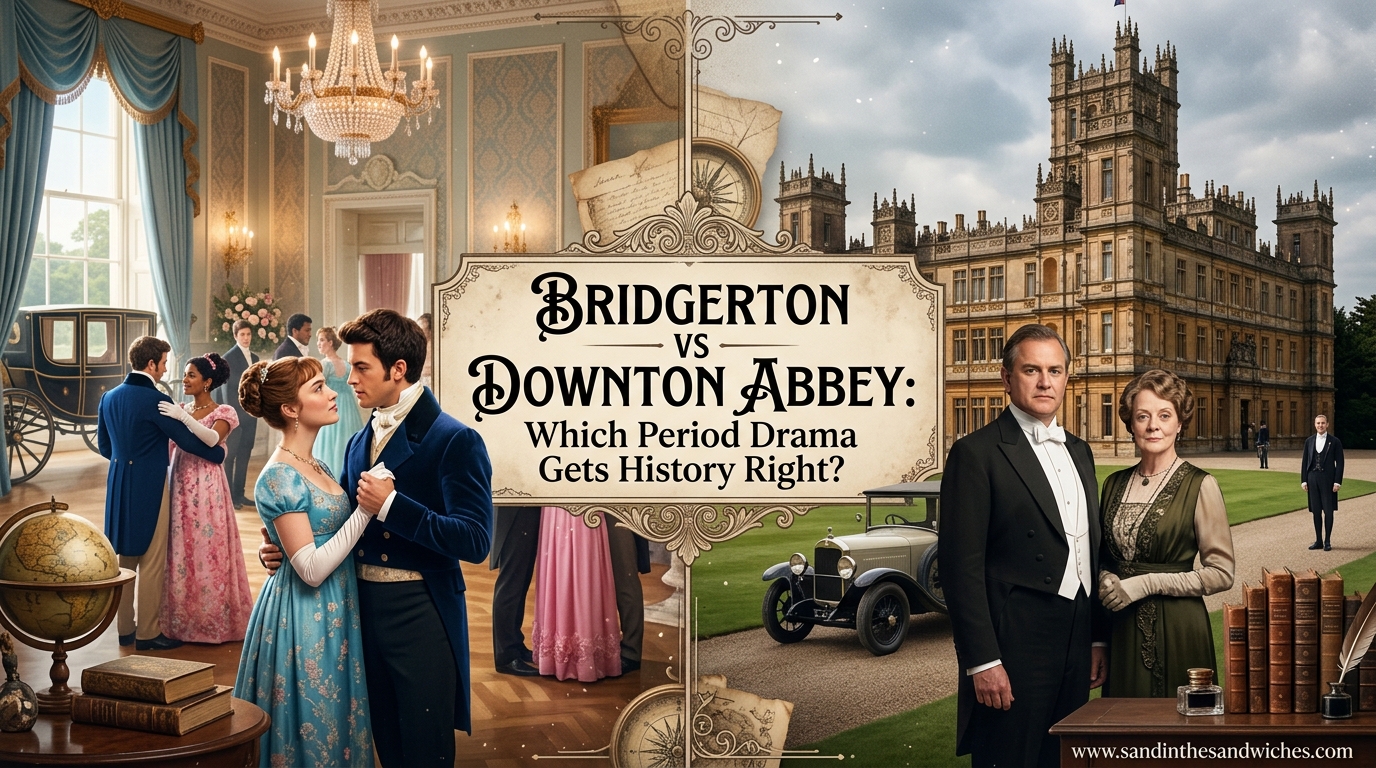
When it comes to the Bridgerton versus Downton Abbey historical accuracy debate, the short answer is this: Downton Abbey is far more faithful to documented British history, while Bridgerton intentionally reimagines the Regency era as a modern fantasy. Both are excellent television, but they are playing entirely different games with the past.
Our team has spent years watching, rewatching, and picking apart both shows, comparing their costumes, class dynamics, and historical references against the real record. I have also dug through Reddit threads on r/PeriodDramas, r/DowntonAbbey, and r/BridgertonNetflix to see what real viewers actually argue about. The consensus among fans and historians lines up cleanly, and in this breakdown I will walk you through exactly where each show succeeds and where it bends the truth.
Here is what you will learn: how the Regency era differs from the post-Edwardian period, how each show handles costumes, social class, real historical events, race, and gender, and finally a clear category-by-category verdict on which one gets history right. Whether you are a history buff, a period drama fan, or just curious why your friend keeps defending Lady Whistledown, this guide has the answer.
Table of Contents
Setting the Stage: Regency Era vs Post-Edwardian Britain
To judge historical accuracy in any period drama, you first have to know what era it is claiming to portray. The two shows sit roughly a century apart, and that gap matters enormously.
What Era Does Bridgerton Depict?
Bridgerton is set during the Regency era (1811 to 1820), when King George III was deemed unfit to rule and his son, the Prince Regent, ruled in his stead. This period falls within the broader Georgian era and is famous for its rigid social season, debutante presentations, and the glittering upper-class circle known as the Ton.
The show explicitly leans into Regency aesthetics, from the sweeping empire-waist gowns to the ballroom dance etiquette. However, Bridgerton frames itself as an alternate history rather than a documentary. Showrunner Chris Van Dusen has openly described it as a reimagined world where Queen Charlotte’s mixed-race heritage reshapes the entire racial hierarchy of the Ton.
What Era Does Downton Abbey Depict?
Downton Abbey spans the years 1912 to 1925, opening with the sinking of the Titanic and running through World War I, the Spanish flu, and into the Roaring Twenties. The show begins in the post-Edwardian period, just after King Edward VII’s reign, and tracks the slow modernization of British aristocratic life.
Creator Julian Fellowes is a self-described traditionalist who has spoken at length about his commitment to capturing the texture of real British life in that era. The show even employs historical advisors to keep the upstairs-downstairs dynamic grounded in documented practice. That foundation is a huge part of why Downton Abbey consistently scores higher on factual accuracy.
So when we ask which period drama is more historically accurate, the era itself is not really the question. Both are anchored in a specific, real historical window. The difference is how faithfully each one stays inside it.
Costume Accuracy: Corsets, Hemlines, and Color
Costume design is where the Bridgerton versus Downton Abbey historical accuracy gap becomes most visible to the naked eye. Both shows have stunning wardrobes, but they approach historical authenticity from opposite directions.
Bridgerton’s Costume Philosophy
Bridgerton’s costume designer Ellen Mirojnick built the look around vibrancy, fantasy, and color rather than strict period recreation. The dresses feature impossibly bright pastels, modern silhouettes, and details that would have scandalized real Regency society. Some gowns incorporate fabrics and zippers that simply did not exist in 1813.
The show also takes liberties with corsetry. While the empire waistline is period-appropriate, the tight bodices and lifted bust lines reflect modern lingerie aesthetics more than genuine Regency undergarments. Historians have noted that real Regency dresses used a much softer, higher waist that did not emphasize cleavage the way Bridgerton does.
Downton Abbey’s Costume Philosophy
Downton Abbey’s costume team, led by Caroline McCall in later seasons, worked from photographs, magazines, and surviving garments from the 1910s and 1920s. The result is a wardrobe you can match almost piece-for-piece to museum collections. Hemlines rise at the right pace during the war years, hats shrink as the Twenties hit, and even the corsets relax on schedule.
What impressed me most on rewatch was how the show handles servant clothing. The maids and footmen wear practical, slightly outdated garments that reflect what real working-class people owned, not glamour versions. That commitment to social accuracy in dress is something Bridgerton barely attempts because it rarely shows servants at all.
Costume Verdict
Downton Abbey wins this category decisively. Bridgerton’s costumes are beautiful, but they are designed to dazzle rather than document. If you wanted to use Bridgerton as a reference for what a real 1815 debutante wore, you would be deeply misled.
Social Class Portrayal: Aristocrats, Servants, and the Ton
Social class is the engine of any period drama, and this is the category where the two shows diverge most sharply. Reddit users on r/PeriodDramas consistently point out that Bridgerton’s near-total absence of the servant perspective is one of its biggest historical blind spots.
Bridgerton and the Ton
Bridgerton centers almost entirely on the Ton, the elite upper-crust of Regency London society. The Ton was real, and so were debutante seasons, marriage mart pressures, and the social-climbing anxiety that fuels the show’s plot. Lady Whistledown’s scandal sheets are a clear nod to real Regency gossip writers like Mrs. Calvert and the early satirical press.
However, Bridgerton rarely shows the people who made that lifestyle possible. Servants appear in the background but rarely speak, and when they do they are often comedic relief. Real Regency households ran on a massive labor force of maids, cooks, footmen, and stable hands, and their lives were a core part of the social fabric. Ignoring them flattens the era into pure aristocratic fantasy.
Downton Abbey’s Upstairs-Downstairs Dynamic
Downton Abbey is built on the upstairs-downstairs structure, and roughly half of every episode is devoted to the servants. Mr. Carson, Mrs. Hughes, Anna, Bates, Daisy, and the rest of the downstairs cast are fully developed characters with their own romances, ambitions, and tragedies. This dual perspective mirrors how historians actually study the period.
The show also captures the slow erosion of the servant class during and after World War I. Real working-class Britons left domestic service in droves for factory work and wartime roles, and Downton Abbey tracks that shift accurately. Mrs. Patmore struggling to hire kitchen maids in the Twenties is straight out of the historical record.
Class Verdict
Downton Abbey wins again, and by an even wider margin. Bridgerton portrays the aristocracy in vivid color but leaves out the entire social infrastructure that sustained it. Downton Abbey shows the whole system, warts and all.
Historical Events Referenced: Titanic, WWI, and Queen Charlotte
One of the clearest ways to measure historical accuracy in a period drama is to look at how it handles real events. Downton Abbey weaves actual history into its plot. Bridgerton occasionally name-drops real people but mostly invents its timeline.
Downton Abbey and Real Events
The very first episode of Downton Abbey hinges on the sinking of the Titanic in April 1912, which kills the heir to the Grantham estate and sets the entire series in motion. That is a real event used in a historically plausible way. From there the show tackles World War I with trenches, field hospitals, conscription, and the devastating Spanish flu pandemic of 1918.
Later seasons handle the Irish War of Independence, the rise of labor movements, the 1923 inflation crisis, and even the Marconi scandal. These are not background decoration. They directly shape character decisions and plot lines, which is exactly how a historically grounded drama should function.
Bridgerton and Real Figures
Bridgerton does include real historical figures, most prominently Queen Charlotte, King George III, and occasionally references to the actual Prince Regent. The character of Lady Danbury and the show’s depiction of an integrated aristocracy are loosely tied to the real (though historically disputed) theory that Queen Charlotte had African ancestry.
But the show is not trying to depict real events. There are no Napoleonic Wars in any meaningful sense, no Peterloo Massacre, no Regency crisis beyond a few vague references. The historical backdrop is mostly atmosphere. As fans on r/BridgertonNetflix often point out, the show functions more like a trashy historical romance novel than a period piece.
Events Verdict
Downton Abbey is dramatically more accurate here. It uses real historical events as plot engines and gets the timeline right. Bridgerton uses real names but invents almost everything around them.
Modern Inclusivity vs Historical Authenticity
This is the most debated aspect of the Bridgerton versus Downton Abbey historical accuracy conversation, and it deserves a fair treatment rather than a lazy dismissal.
Color-Blind Casting in Bridgerton
Bridgerton made a deliberate choice to cast Black and Brown actors in leading aristocratic roles, including Regé-Jean Page as the Duke of Hastings and Golda Rosheuvel as Queen Charlotte. The show explains this through an alternate history in which King George and Queen Charlotte’s interracial marriage opened the doors of the Ton to people of color.
This is not historically accurate in any literal sense. Real Regency Britain was deeply stratified by race, and while there were free people of color in London society, they were not mingling at debutante balls as integrated aristocrats. However, the show is upfront about being a reimagining, and many viewers and critics argue that this kind of intentional inaccuracy serves a worthwhile creative and cultural purpose.
Downton Abbey’s Traditional Casting
Downton Abbey takes the opposite approach and casts almost entirely white actors in both the aristocratic and servant roles. This is closer to the demographic reality of an English country estate in 1912, though it does erase the small but real presence of Black Britons, Indian ayahs, and other people of color who would have appeared in British life at the time.
Critics have noted that Downton Abbey’s accuracy is selective too. It gets the white aristocratic world right but does not even attempt to represent the more diverse corners of early twentieth-century Britain. So both shows make choices about who gets to be on screen, just in opposite directions.
Inclusivity Verdict
This category is a draw, but in a specific way. Downton Abbey is more accurate to the literal demographics of its setting. Bridgerton is more accurate to the kind of world many viewers wish had existed, and it is honest about being a fantasy. Neither show gets this fully right.
Gender Roles and Women’s Agency
The Bridgerton versus Downton Abbey historical accuracy question also extends to how each show handles women, and again the two eras produce very different stories.
Regency Gender Norms in Bridgerton
Bridgerton does a reasonable job of showing the marriage mart pressure that defined young women’s lives in the Regency era. Daphne Bridgerton’s debut, the desperate search for a suitable husband, and the social ruin attached to scandal all reflect real anxieties of the period. The show also captures the legal reality that women could not own property independently once married.
Where Bridgerton stretches credibility is in how much agency its heroines actually exercise. Eloise Bridgerton’s openly feminist monologues sound far more like 2026 than 1815. Real Regency women held those feelings, but expressing them so directly in mixed company would have been social suicide.
Edwardian and WWI Shifts in Downton Abbey
Downton Abbey gets to track a period of enormous change for women, and it handles that arc with real care. Lady Sybil’s involvement in politics, Edith’s journalism career, and Mary’s eventual management of the estate all reflect genuine shifts in women’s rights between 1912 and 1925. The show even handles suffrage and the 1918 Representation of the People Act in passing.
Downstairs, the show portrays women like Anna and Daisy navigating work, marriage, and legal vulnerability with period-appropriate constraints. The attention to how class shaped women’s options is something Bridgerton largely skips.
Gender Verdict
Downton Abbey wins again. It portrays both the constraints and the slow expansion of women’s rights with documented accuracy. Bridgerton uses a modern feminist lens that, while satisfying, does not match how Regency women actually spoke and behaved.
Bridgerton versus Downton Abbey: The Historical Accuracy Verdict
So, which period drama gets history right? Here is the side-by-side breakdown across the categories we examined.
- Era representation: Downton Abbey 9/10, Bridgerton 6/10
- Costume accuracy: Downton Abbey 9/10, Bridgerton 4/10
- Social class portrayal: Downton Abbey 10/10, Bridgerton 4/10
- Real historical events: Downton Abbey 9/10, Bridgerton 3/10
- Inclusivity and representation: Tie at 6/10 each, for different reasons
- Gender roles accuracy: Downton Abbey 8/10, Bridgerton 5/10
Downton Abbey is the clear winner on historical accuracy across nearly every category. It is not a documentary, and it still compresses timelines and invents characters, but it works hard to stay within the boundaries of what actually happened in post-Edwardian Britain. Viewers on r/DowntonAbbey consistently note that the show earns their trust even when it dramatizes.
Bridgerton is not trying to be accurate, and that is a deliberate creative choice. Its fans on r/BridgertonNetflix are honest about this, often describing it as a romance novel brought to life rather than a serious period piece. Judged on its own terms as a fantasy of the Regency era, it succeeds brilliantly. Judged as history, it fails almost completely.
That distinction matters because it changes how you should watch. If you want to learn something real about British social history, Downton Abbey is the better classroom by a wide margin. If you want a lush, escapist romance set in a reimagined Regency world, Bridgerton delivers the fantasy without apology. The Bridgerton versus Downton Abbey historical accuracy contest only has one factual winner, but both shows are doing exactly what they set out to do.
FAQs
Is anything in Bridgerton historically accurate?
Yes, a surprising amount of the framework is real. The Regency era setting, the existence of the Ton as the elite social circle, debutante presentations at court, the marriage mart pressure on young women, the scandal sheet culture that inspired Lady Whistledown, and the appearances of Queen Charlotte and King George III are all grounded in documented history. However, the show takes heavy creative liberties with costumes, racial integration, dialogue, and the agency its female characters exercise.
How accurate is Downton Abbey as a historical reflection of life in early 20th century Britain?
Downton Abbey is widely considered one of the more historically accurate period dramas on television. It gets the timeline of real events like the Titanic sinking, World War I, the Spanish flu, and the social changes of the 1920s right. Its costumes, class structure, servant life, and gender role shifts are all closely modeled on documented history. It still compresses and dramatizes for storytelling, but historians generally praise its commitment to accuracy.
What is the Regency era?
The Regency era ran from 1811 to 1820, when King George III was deemed unfit to rule and his son George, the Prince Regent, ruled in his place. It sits within the broader Georgian era and is known for its elegant architecture, rigid social etiquette, debutante season, and the elite London social circle known as the Ton. Jane Austen’s novels were written and set during this period.
Why is Bridgerton less historically accurate than Downton Abbey?
Bridgerton is intentionally designed as an alternate-history fantasy rather than a faithful period piece. Its creators chose vivid modern costumes, color-blind casting, an integrated aristocracy, and contemporary dialogue to create a reimagined Regency world. Downton Abbey, by contrast, was built from the start as a grounded drama with historical advisors, real events as plot engines, and a commitment to depicting documented post-Edwardian British life.
Which show is better for learning about British history?
Downton Abbey is far better for learning about real British history. It uses actual events like the Titanic sinking, World War I, and the decline of the servant class as central plot points, and its costumes and social structure are closely modeled on the historical record. Bridgerton can teach you the broad strokes of Regency social customs, but it should not be treated as a reliable historical source.
Final Thoughts on the Bridgerton versus Downton Abbey Historical Accuracy Debate
The Bridgerton versus Downton Abbey historical accuracy contest has a clear factual winner: Downton Abbey is dramatically more faithful to real British history across costumes, class structure, real events, and gender roles. It earns its period drama credentials the hard way, with research and respect for the documented record.
Bridgerton is best understood as a fantasy built on a Regency frame, not as a guide to the Regency era. It is gorgeous, escapist television that makes no secret of its creative liberties. If you want to learn, watch Downton Abbey. If you want to dream, watch Bridgerton. Both are worth your time as long as you know which one is telling you history and which one is telling you a fairy tale.