
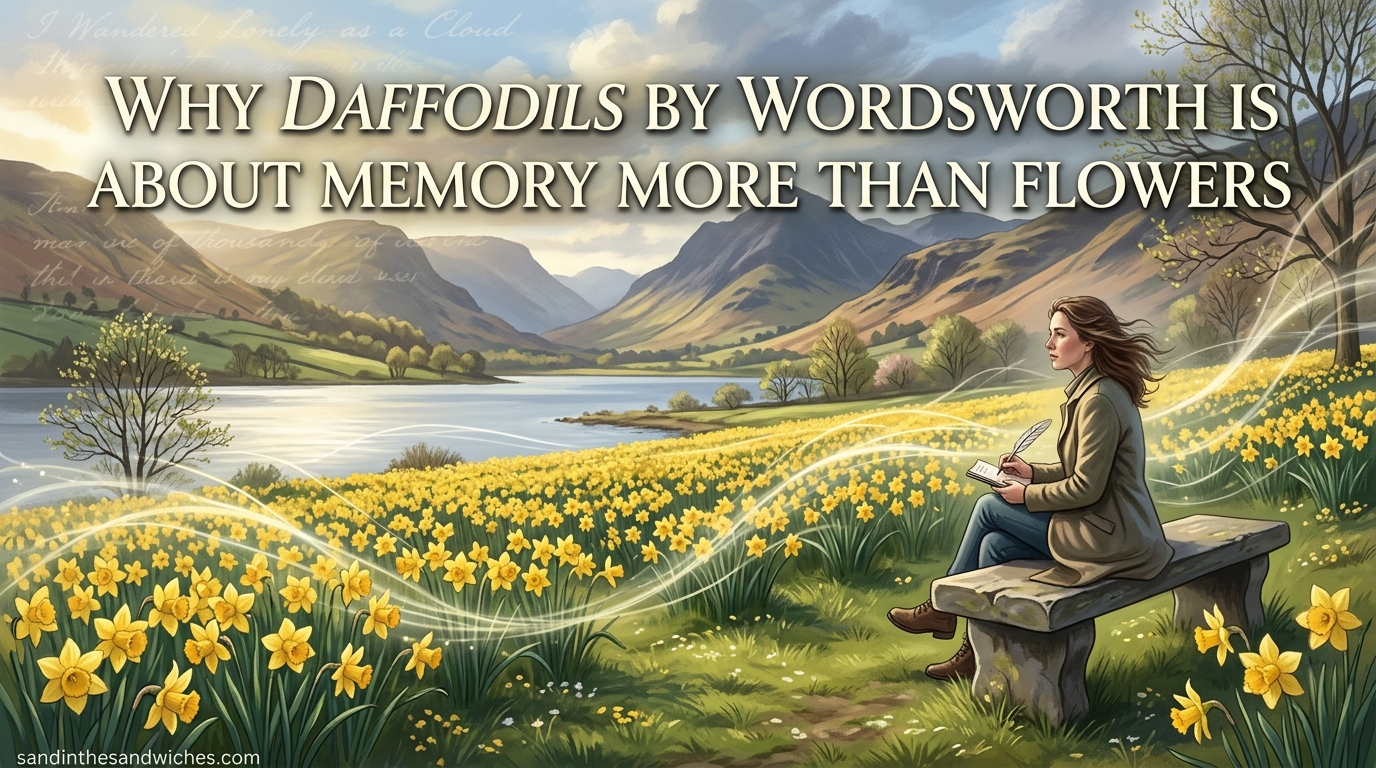
When we teach Wordsworth’s I Wandered Lonely as a Cloud, we often begin with the daffodils. We point at the dancing line, the golden crowd, the breeze beside the lake. We admire the picture. We move on. But the poem is not really about daffodils. The flowers are the doorway, not the room. What the poem is actually about is something stranger and more useful: how a single sensory moment gets banked inside the mind, and how, in moments of emptiness, that stored image returns to enrich the present.
Read the poem closely and the structure tells on itself. The first three stanzas are nearly all external eye. The fourth stanza is almost entirely inward eye. That pivot is the poem’s real subject. Wordsworth is not writing a nature lyric in the older, decorative sense. He is writing a phenomenology of recollection, and the daffodils are the experimental material that lets him show the mechanism at work.
Our reading in this guide is going to argue, line by line and stanza by stanza, that why Daffodils by Wordsworth is about memory more than flowers is not a contrarian interpretation. It is the interpretation the poem asks for, once you notice that the final stanza quietly takes over the argument and never gives it back. We will look at the full text, the difference between perception and recollection, the meaning of “bliss of solitude,” and the famous “inward eye.” We will connect the poem to Wordsworth’s larger theory of poetry as “emotion recollected in tranquility.” We will hear from his sister Dorothy, from his wife Mary, and from his sometimes skeptical friend Coleridge. By the end, we hope you will not be able to read the poem’s famous final lines the same way again.
Table of Contents
The Poem: I Wandered Lonely as a Cloud
Before we can argue that the poem is about memory, we need the poem in front of us. Here is the 1807 text, in the four-stanza form most readers know, and the form Wordsworth kept in his 1815 revision.
I wandered lonely as a cloud
That floats on high o’er vales and hills,
When all at once I saw a crowd,
A host, of golden daffodils;
Beside the lake, beneath the trees,
Fluttering and dancing in the breeze.Continuous as the stars that shine
And twinkle on the milky way,
They stretched in never-ending line
Along the margin of a bay:
Ten thousand saw I at a glance,
Tossing their heads in sprightly dance.The waves beside them danced; but they
Out-did the sparkling waves in glee:
A poet could not but be gay,
In such a jocund company:
I gazed—and gazed—but little thought
What wealth the show to me had brought.For oft, when on my couch I lie
In vacant or in pensive mood,
They flash upon that inward eye
Which is the bliss of solitude;
And then my heart with pleasure fills,
And dances with the daffodils.
Read the first three stanzas as a single unit. They are an account of an event. The verbs are mostly past-tense markers in disguise: “wandered,” “saw,” “stretched,” “gazed.” Even the verbs that look present (“floats,” “flutter,” “shine”) are pressed into the service of describing something that happened. The fourth stanza is different. Its verbs are present and habitual: “lie,” “flash,” “fills,” “dances.” The shift is small, and most readers never notice it on a casual pass. Wordsworth is counting on you not noticing. Once you do, the whole poem rearranges itself.
Why Daffodils by Wordsworth Is About Memory More Than Flowers
The simplest case for the memory reading is structural. Of the poem’s four stanzas, only the last one explains why the first three exist. Stanza 1 tells us what the speaker saw. Stanza 2 exaggerates the number. Stanza 3 compares the daffodils to waves and credits them with cheering the speaker. None of those stanzas, on their own, explains why a poem about a 1802 walk still matters two centuries later. Stanza 4 does. It tells us that the image of the daffodils has become a permanent inner resource. It tells us that memory, not the flowers, is the true subject.
Wordsworth was a deliberate writer, and he was a deliberate reviser. The 1815 version tightens the memory argument. He replaced “inward eye” with phrases that earlier drafts had weakened, and he cut lines that drifted away from the central claim. Every cut moves the poem further from “a nice description of flowers” and closer to “an essay on the psychology of recollection.”
There is also a question of emphasis. The word “flower” never actually appears in the poem. The word “daffodils” appears three times, and each time it is doing a different job: as visual spectacle, as counting unit, and as remembered image. The poem’s most repeated word family is not botanical. It is the sight-and-mind family: “saw,” “gazed,” “flash,” “eye.” The poem is not cataloguing flora. It is tracking perception and its afterlife.
Finally, there is the speaker’s confession in stanza 3: “I gazed—and gazed—but little thought / What wealth the show to me had brought.” At the moment of perception, the speaker does not understand the value of what he is seeing. He does not appreciate it. The appreciation comes later, in recollection. If the poem were about flowers, the speaker would be celebrating flowers in stanza 4. He is not. He is celebrating the mental act by which flowers, once seen, become permanently available to the mind.
The Three Glances and the Inward Turn
Helen Vendler, the twentieth-century critic who made this poem a teaching staple, identified three distinct glances in the first three stanzas. The first glance is the “lonely cloud” view from above, in which the daffodils appear as a “crowd” and a “host.” The second glance is the sidereal view, in which the daffodils are measured against “the stars that shine / And twinkle on the milky way.” The third glance is the social view, in which the daffodils become “jocund company” and the speaker imagines himself part of a happy crowd.
Each of these glances is external. The speaker is looking at the daffodils, comparing them to other things, and gradually drawing them into human social categories. None of them has yet explained why a poem should end with a couch, an inward eye, and a heart that dances. That explanation requires a fourth glance, and stanza 4 is where it happens. The inward eye is not a fourth external view. It is the eye turned back on its own stored contents. The poem is the record of the turn.
This is what we mean when we say the flowers are the doorway. Stanzas 1-3 hand the poem a vivid, well-organized image. Stanza 4 takes that image, lifts it out of nature, and parks it inside the speaker’s mind. The poem’s job, from that point on, is to follow the image from the bay to the couch. The flowers are not going anywhere. The mind is.
The Bliss of Solitude: What That Phrase Actually Means
“The bliss of solitude” is one of the most quoted phrases in English poetry, and one of the most misread. Most readers assume it means “the happiness of being alone.” That is close, but it misses the mechanism. The bliss is not in being alone. It is in what solitude allows. Solitude, in this poem, is the condition under which memory can do its work without interference.
Wordsworth chooses “vacant or in pensive mood” carefully. A vacant mood is not an unhappy mood. It is an unfocused one, a mood in which the mind is not actively working on a problem. A pensive mood is a mood of quiet thought, often tinged with sadness or longing. Both moods are low-energy. Both moods are precisely the conditions in which stored images, unbidden, rise to the surface. The daffodils do not arrive because the speaker summons them. They “flash upon that inward eye.” The verb is involuntary. The mind is the agent, but the act is not willed.
For Wordsworth, this involuntary replay is the “bliss” of solitude. The solitude strips away distractions. The inward eye finds the stored image. The image releases a small, steady pleasure. The pleasure is the bliss. It is not a thrill. It is a kind of quiet, renewable wealth. Note the language of stanza 3: “What wealth the show to me had brought.” The show did not bring money, status, or even, at the time, much pleasure. It brought something that could be turned into pleasure later, in solitude, on a couch.
This is also why the phrase is “bliss of solitude” rather than “bliss of company.” The daffodils are the company in the first three stanzas. The mind is the company in the fourth. The bliss comes from the latter. Wordsworth is gently suggesting that the most reliable companion you will ever have is the well-stocked archive of your own past perception.
Why “Solitude” Is the Right Word, Not “Loneliness”
Stanza 1 uses the word “lonely.” Stanza 4 uses the word “solitude.” They are not the same word, and they are not the same condition. “Lonely” in stanza 1 is descriptive: the speaker is walking alone through a field, and his aloneness is the condition for noticing the daffodils. If he had been in conversation, he would have missed them. “Solitude” in stanza 4 is a chosen state, a productive state, a state in which the mind can be present to its own contents.
This distinction matters because it is the basis of Wordsworth’s larger claim about Romantic solitude. Solitude is not absence. It is the space in which the inner life can be heard. Modern readers sometimes hear “solitude” as a sad word, and they read the final stanza as consolation for loneliness. Wordsworth is doing the opposite. He is showing that solitude is the precondition for the poem’s most intense joy. Without solitude, the inward eye has nothing private to see.
The Inward Eye: The Poem’s Central Metaphor
If the poem has a single image that does the philosophical work, it is “that inward eye.” Three things are worth saying about it.
First, the inward eye is not the imagination in the loose, romantic sense. It is a specific faculty. It is the mind’s capacity to retain, retrieve, and re-present sensory images that have already been perceived. Wordsworth had been thinking about this capacity for years before he wrote this poem. In the 1800 Preface to Lyrical Ballads, he described the imagination as a power that “reacts” upon past experience and produces new compounds from stored materials. The inward eye is the practical instrument of that power, applied to a specific memory.
Second, the inward eye is portable. This is its real value, and the reason the poem lingers. The daffodils, as flowers, were a one-time event. They were at Ullswater, on a specific day, in a specific wind. They are not portable. The inward eye, by contrast, can carry the image of the daffodils anywhere, including onto a couch in a dark room, in a vacant mood, weeks or months later. The poem is, in a real sense, about how the mind makes the world portable by remembering it.
Third, the inward eye is the locus of “bliss.” The daffodils, in stanzas 1-3, are located outdoors. The inward eye is located in the mind. Bliss, the poem says, is in the eye, not the flowers. This is Wordsworth’s quiet Copernican move. He has spent three stanzas pointing outward. He spends one stanza pointing inward, and he tells you, in the same breath, that this inward pointing is where the actual treasure lives.
Mary Wordsworth and the Two Best Lines in the Poem
A detail that surprises almost every reader the first time they hear it: the two closing lines of stanza 4 were not originally William’s. They were Mary Wordsworth’s. In the Fenwick note that William wrote late in life, describing the composition of the poem, he recorded that “the two best lines in it” — “They flash upon that inward eye / Which is the bliss of solitude” — were suggested by his wife, from her own recollection of the same 1802 walk. He told Isabella Fenwick that without Mary’s contribution, the poem would not have had the ending it needed.
There is a small irony here that is easy to miss. The poem is, in part, about how a memory can outlast the moment of perception. The two lines that clinch that argument were, themselves, the product of a memory: Mary’s memory of the same walk, retrieved in conversation, and offered as a completion to her husband’s draft. The poem is in some sense an act of joint recollection. Even the form of the poem enacts its theme.
It is also worth noticing that Wordsworth did not credit Mary publicly when the poem was first published. She appears in the Fenwick note as a remembered presence, not as a named author. This is partly a fact of nineteenth-century literary practice, and partly a fact of William’s particular investment in the idea that the poem is the speech of a single recollecting self. The poem’s “I” sounds solitary. The poem’s actual composition was not.
Stanza by Stanza: From Perception to Memory
One of the easiest ways to see that the poem is about memory is to walk through it slowly, paying attention to the verbs. The pattern is striking once you see it.
Stanza 1: encounter. The speaker is in motion (“wandered”). He sees something (“saw”). He is registering the image for the first time. The daffodils are introduced as a “crowd” and a “host,” words borrowed from social and military life. They are being named, not yet understood. There is no memory work here. There is only the raw intake of an image.
Stanza 2: amplification. The speaker moves from naming to counting. “Ten thousand saw I at a glance” is the line. It is hyperbolic, and it is meant to be. The point is not that there were exactly ten thousand daffodils. The point is that the image was, at the moment of perception, overwhelming. Memory cannot store “exactly what was there.” It stores the impression of overwhelming plenty, and the figure of “ten thousand” is the impression. The daffodils are already being turned into an internal measure, not a botanical one.
Stanza 3: misprision. The daffodils are compared to the waves, found to be gayer, and made into “jocund company.” The speaker notes his own cheerfulness. And then the stanza turns, in the last two lines, and confesses ignorance: “I gazed—and gazed—but little thought / What wealth the show to me had brought.” This is the hinge of the poem. At the moment of perception, the speaker does not know the value of what he is seeing. The value is not visible yet. It is in the future, on a couch, in a vacant mood. The stanza plants the value where the memory can later pick it up.
Stanza 4: recollection. Now the verbs change. “Oft, when on my couch I lie / In vacant or in pensive mood.” The verb is “lie.” Then “flash.” Then “fills.” Then “dances.” None of these verbs require an external referent. The image is being replayed. The daffodils are not on the bay. They are in the mind. The “show” of stanza 3 is being “brought” in stanza 4, exactly as stanza 3 promised. The wealth shows up, on schedule, in the form of pleasure.
Here is a small comparison to make the contrast easier to hold in mind:
| Stanzas 1-3 (perception) | Stanza 4 (recollection) |
|---|---|
| Speaker in motion, outdoors | Speaker at rest, indoors |
| Past and historic present tense | Present and habitual tense |
| Daffodils as crowd, host, stars | Daffodils as inward image |
| Outward eye (gazing, seeing) | Inward eye (flashing, filling) |
| Speaker confused about value | Speaker enjoying the wealth |
The table is a simplification, but it captures the asymmetry that the rest of the poem’s argument depends on. The first three stanzas build the bank account. The fourth stanza makes the withdrawal. The poem’s emotional arc is not “I saw flowers, I liked them.” It is “I saw flowers, I did not know what I was seeing, and now, in solitude, I do.”
Why the Tense Shift Matters
Writers of prose often underestimate what tense does in lyric poetry. Tense in this poem is not a grammatical choice. It is a structural claim. Stanzas 1-3 are in the past because the event is over. Stanza 4 is in the present because the recollection is recurring. By switching tense, Wordsworth tells the reader that the future of the image is not in the field where the daffodils grew. It is in the ongoing present of the speaker’s mind, where the same image can be replayed any time the conditions (vacant mood, solitude, an idle moment) align.
This is also why the closing verb is “dances,” not “remembered.” The daffodils are not being remembered. The heart is dancing with them. The daffodils are doing in recollection what they did in the field, and the heart is doing the dance. The poem’s final image collapses the distance between perception and memory. The inward eye has done its work so well that the daffodils are, for a moment, dancing again.
Wordsworth’s Theory: Recollected in Tranquility
The phrase “emotion recollected in tranquility” comes from the 1800 Preface to Lyrical Ballads. Wordsworth is explaining what kind of poem he is trying to write. He says that poetry “takes its origin from emotion recollected in tranquility.” The emotion comes first. Then comes the quiet, retrospective replay of that emotion. The poem is what happens in the second stage.
Many students find this phrase obscure. The Daffodils poem is one of the cleanest demonstrations of the theory in English. The walk in 1802 is the original emotion. The composition of the poem, in 1804, is the tranquility. The poem itself is the result. Notice that the poem is not written at the moment of perception. It is written after, in a chair, looking back, and what it records is not the walk but the mental image that the walk left behind. This is exactly the structure that the 1800 Preface describes.
Wordsworth is not just theorizing about poetry in this poem. He is also theorizing about what memory does for the mind more broadly. The Daffodils is, in a quiet way, an essay on memory as a moral resource. The mind that can replay an image of natural joy is a mind that has, in the banker’s sense, an asset. The mind that cannot is a mind that has to rely on whatever is happening in the present. The 1800 Preface is a statement about poetry. The 1807 poem is a statement about how minds work, and it uses the Daffodils as a test case.
The Theory Applied to This Specific Poem
Let’s make the application explicit. In 1802, Wordsworth and his sister Dorothy took a walk along the shore of Ullswater, in the English Lake District. They saw a long belt of daffodils. Dorothy, who kept a journal, wrote that evening about the wind-tossed flowers, and her note ends with a simple line: “I never saw daffodils so beautiful.” Two years later, William wrote the poem. The emotion is the 1802 walk. The tranquility is the 1804 composition. The poem is what survives.
And what survives is not the flowers. What survives is the image of the flowers, retrieved and shaped in the mind. By the time the poem is finished, the image has been worked on by the inward eye so many times that the daffodils in stanza 4 are not the daffodils of 1802. They are the daffodils of memory, the daffodils that exist only because the inward eye has agreed to host them. The poem is, in this sense, a case study in its own theory. It demonstrates, by being one, that emotion recollected in tranquility is not just a poetic technique. It is a way of being a person.
Critical Perspectives on the Poem
The memory reading is supported by a long critical tradition, but it is not the only reading the poem has ever received. It is worth knowing what some of the alternatives have been, partly because they sharpen the case for the memory reading and partly because they show how the poem has stayed alive in critical conversation for more than two centuries.
Helen Vendler: A Close Reading
Helen Vendler, in her introduction to Poems, Poets, Poetry, used Daffodils as her main teaching example for a generation of students. Her reading is a close reading, in the New Critical sense. She tracks the pronouns, the verbs, the tense shifts, and the spatial logic of the stanzas. She argues that the poem’s three external glances (the cloud view, the sidereal view, the social view) are all set up to be transcended by the fourth, inward glance in stanza 4. Vendler’s reading is one of the strongest formal defenses of the memory-first interpretation. She shows that the poem’s structure demands it.
Coleridge’s “Mental Bombast”
Samuel Taylor Coleridge, Wordsworth’s closest collaborator in the 1798 Lyrical Ballads, was not always a fan. In conversation and in his notebooks, he occasionally dismissed the Daffodils as “mental bombast.” His complaint was that the poem’s claim about inward wealth was inflated, and that the gap between the modest subject (some daffodils) and the grand claim (spiritual treasure) was unearned. The poem, for Coleridge, risked sounding as if it had swallowed its own rhetoric.
The defense of the poem against this charge is straightforward. The grand claim is not about daffodils. It is about the mind’s capacity to store and replay them. The inflation Coleridge objected to is, in the memory reading, the whole point. The daffodils do not need to be important in themselves. The mind that can hold them well is. The poem’s modesty about its subject is, in this sense, an asset. The flowers are small. The inward eye is large. The disproportion is the meaning.
Emerson and the Transcendentalist Reception
Ralph Waldo Emerson read the Daffodils as a Transcendentalist text. In his essay “Nature” and in his lectures, Emerson treated Wordsworth as a precursor who had already done the work of showing that the natural world and the human mind were continuous. The “transparent eye-ball” of Emerson’s famous passage in “Nature” — in which the speaker becomes a “transparent eye-ball” through which nature flows — is a cousin of Wordsworth’s inward eye. Both writers are making the same wager: that the boundary between perception and memory is thinner than it looks, and that a well-stored natural image is a kind of moral and spiritual wealth.
Dorothy’s Journal as Primary Source
Dorothy Wordsworth’s 1802 journal entry is one of the most important primary sources for the poem. She wrote, on April 15, 1802: “I never saw daffodils so beautiful. They grew among the mossy stones about and about them, some rested their heads upon these stones as on a pillow for weariness; and the rest tossed and reeled and danced, and seemed as if they verily laughed with the wind, they looked so gay, ever glancing, ever changing.” Note three things. The daffodils are described as tired, laughing, and changing. William’s poem keeps the dancing and the tossing, and quietly drops the weariness. He also drops the mossy stones. The poem is a curated memory, not a transcript of the journal.
It is striking, when you put the two side by side, how much shaping has gone into William’s version. Dorothy’s daffodils are individual, weary, and laughing. William’s daffodils are a host, ten thousand strong, and uniformly dancing. The poem’s image is more splendid, more abstract, and less human than Dorothy’s. The poem is not remembering what Dorothy saw. It is remembering what she made him see. The inward eye has been at work on the source material, and the result is a cleaner, sharper, more usable mental image.
Why Memory Beats Flowers: A Reader’s Summary
By the time we get to stanza 4, the case is no longer in dispute. The flowers are in the past. The image is in the present. The pleasure is in the present. The poem is in the present. The flowers themselves have been outgrown, in the sense that they have done their job and retired from view. What remains is the inward eye, the solitary couch, the recurring flash of remembered gold, and the small, renewable bliss that comes from being able to call them up at will.
This is why the poem has stayed in print for more than two centuries. It is not, finally, a poem about daffodils. There are plenty of poems about daffodils. It is a poem about how the mind holds joy. That is a topic with no expiration date, and Wordsworth found a form for it that is so well-built that it can carry the topic without sagging.
Frequently Asked Questions About the Daffodils
What is the main theme of I Wandered Lonely as a Cloud?
The main theme is the power of memory and the inward eye to preserve and replay joyful natural experiences. The daffodils are the trigger, but the poem is about the mind’s capacity to internally retrieve vivid images during moments of solitude, producing what Wordsworth calls the bliss of solitude.
Why is Daffodils more about memory than flowers?
Three of the four stanzas describe the perception of the flowers, but the fourth stanza explains why the experience matters. That final stanza is about the inward eye, the couch, the vacant or pensive mood, and the recurring flash of remembered gold. The poem’s actual subject is the mental mechanism that preserves sensory experience, not the sensory experience itself.
What does the inward eye mean in the poem?
The inward eye is the mind’s capacity to internally visualize and re-experience stored sensory images. In the poem, it is the faculty by which the image of the daffodils, once seen, can be recalled on a couch in a vacant or pensive mood, producing a quiet, renewable pleasure.
What is the bliss of solitude?
The bliss of solitude is the happiness Wordsworth describes as arising when the inward eye, in moments of aloneness, replays a stored image of joyful natural experience. The phrase is not about enjoying being alone. It is about the inner wealth that becomes accessible when external distractions are removed.
What does it mean to recollect in tranquility?
Recollecting in tranquility is Wordsworth’s theory, from the 1800 Preface to Lyrical Ballads, that poetry originates in past emotional experience that has been processed through contemplative distance. The Daffodils is one of the clearest examples: the 1802 walk is the emotion, the 1804 composition is the tranquility, and the poem is the result.
Why does the poem shift from past to present tense in stanza 4?
The shift marks the change from perception to recollection. Stanzas 1-3 describe an event that happened in the past. Stanza 4 describes a recurring present-tense act of mental replay. The tense change is Wordsworth’s quiet way of telling the reader that the daffodils’ true life is in the present-tense memory of them.
What is the significance of the ‘vacant or pensive mood’?
The vacant or pensive mood names the specific psychological state in which stored images most readily surface. The mood is not happy or sad. It is low-energy and undefended, and it is the condition in which the inward eye can do its work unbidden.
Did Dorothy Wordsworth write any of the poem?
Dorothy Wordsworth’s journal entry from April 15, 1802 is the immediate primary source for the experience. The two best lines of stanza 4 (‘They flash upon that inward eye / Which is the bliss of solitude’) were contributed by Mary Wordsworth, William’s wife, as William himself recorded in his Fenwick note.
Conclusion: A Poem About Remembering, Not Seeing
The next time you read the Daffodils, try reading it backwards. Read stanza 4 first. Read it as the actual poem. Then go back to stanzas 1-3 and notice how carefully Wordsworth is setting up a mind that will, eventually, need a remembered image. The flowers, in this reading, are not the treasure. The flowers are the deposit. The inward eye is the vault. The bliss of solitude is the interest.
This is why the poem has lasted. It is not a nature poem, in the sense that we usually use the word. It is a poem about how the mind holds on to nature, and about how the holding-on is itself a kind of wealth. Wordsworth saw the daffodils in 1802. He wrote the poem in 1804. We are still reading it in 2026. The inward eye is doing its work.