
If you have ever wondered how to write a sestina, the trick is to forget rhyme and fall in love with repetition. A sestina is a 39-line poem made of six six-line stanzas plus a three-line closing envoy (also called the tornada), all built around six end words that rotate through a fixed pattern.
I have drafted dozens of sestinas over the past few years, and I can tell you the form is less scary than it looks. Once the rotation clicks, you stop seeing a math puzzle and start seeing a strange little engine for meaning. In this guide I will walk you through how to write a sestina, explain the six rotating end words step by step, and show you how to make the form feel alive rather than mechanical.
Table of Contents
What Is a Sestina?
A sestina is a 39-line poem consisting of six six-line stanzas followed by a three-line envoy, with no required rhyme scheme. Instead of rhyme, the form uses six end words that repeat across the poem in a prescribed rotation pattern.
The sestina dates back to the 12th century and the troubadour tradition, most often credited to Arnaut Daniel of Provence. Dante and Petrarch later adopted it, and modern poets from Ezra Pound to Elizabeth Bishop to John Ashbery have made it their own.
Here is the basic shape:
- Six stanzas, each with six lines
- One three-line envoy at the end
- Six end words (one per line) drawn from the last words of stanza one
- Total of 39 lines, with the end words appearing 36 times in the stanzas and 6 more times in the envoy
- No required meter, although iambic pentameter is the most common choice
- No required rhyme scheme
That last point surprises most new sestina writers. You are not chasing rhyme at all. You are chasing six words and the way their meanings shift as you rearrange them.
The Six End Words: What They Are and Why They Matter
The “end words” in a sestina are the six final words of the lines in the first stanza. Every stanza after that reuses those same six words as its line endings, only in a different order. They are sometimes called teleutons, from the Greek word for ending, but most poets just call them end words.
The end words carry the poem. They are the thread your reader holds onto as the stanzas turn. If the words are weak, the whole poem sags. If the words are strong, the form almost writes itself.
Strong sestina end words tend to share a few qualities:
- They can function as multiple parts of speech (house, garden, light, river, name, door)
- They carry emotional or sensory weight
- They are specific enough to feel like images, not just abstractions
- They are flexible enough to fit different sentences without breaking grammar
Many of the best sestina poets I have followed online lean toward concrete nouns for their end words, because nouns tend to slot into sentences more gracefully than verbs or adjectives. A word like kitchen or harbor is easier to land at the end of a line than a word like beautiful or running.
The Six-Word Rotation Pattern Explained
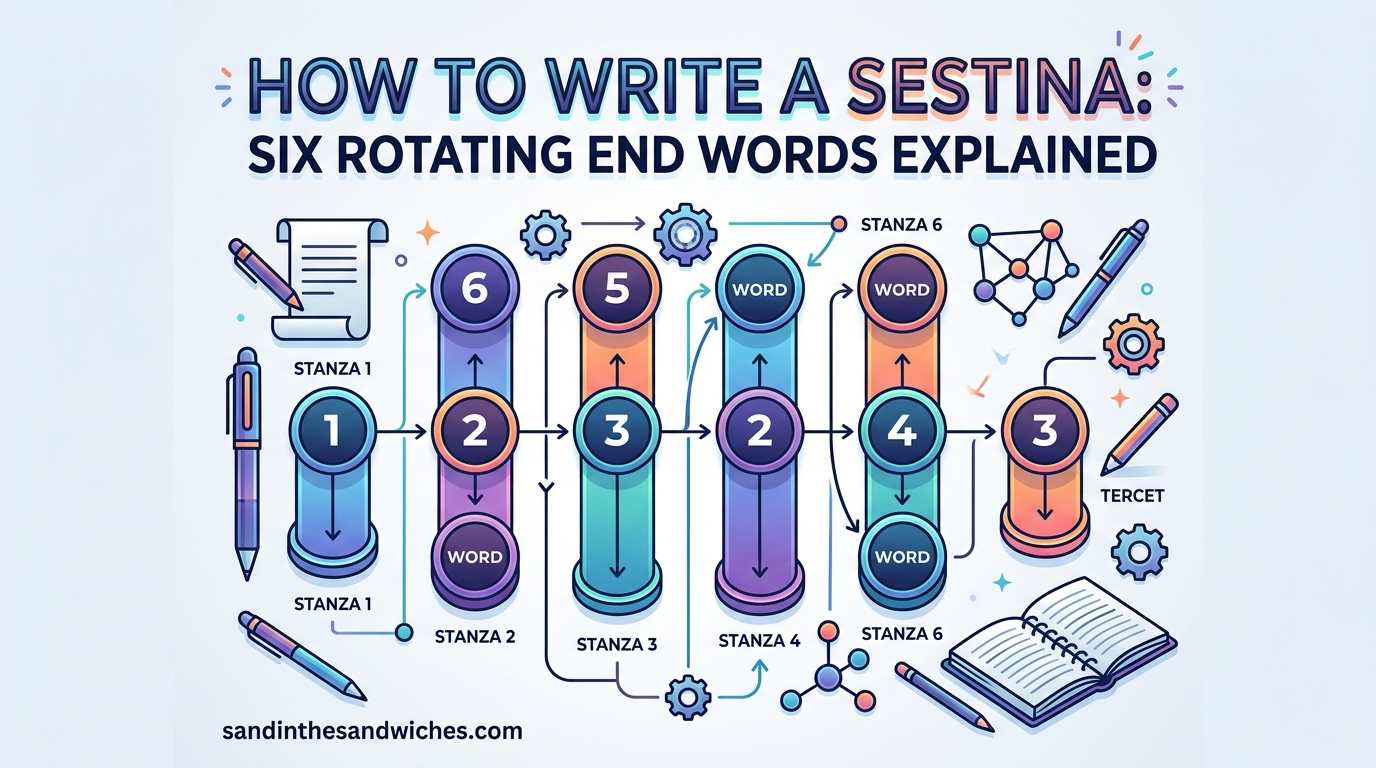
The rotation is the heart of the sestina form. Here is how to write a sestina rotation, with the six end words labeled A, B, C, D, E, F.
Stanza one is your only stanza of creative freedom for the order. You pick the sequence. After that, the pattern is fixed:
- Stanza 1: 1 2 3 4 5 6
- Stanza 2: 6 1 5 2 4 3
- Stanza 3: 3 6 4 1 2 5
- Stanza 4: 5 3 2 6 1 4
- Stanza 5: 4 5 1 3 6 2
- Stanza 6: 2 4 6 5 3 1
To read this clearly, imagine the end words of stanza one as A (house), B (garden), C (light), D (river), E (name), F (door). Stanza two would end with: door, house, name, garden, river, light. Stanza three: light, door, river, house, garden, name. And so on.
You do not have to memorize the pattern. Two tricks help. First, the last word of any line becomes the first word of the next stanza. Second, the final word of stanza six is the same as the first word of stanza one, which closes the loop. Some poets draw out a 6×6 grid on paper and fill in the columns to make the pattern obvious before they write a single line.
How to Write a Sestina Step by Step
Step 1: Choose Your Six End Words
Pick words that can each fit at least three different meanings or grammatical positions across the poem. Test each word by writing it at the end of three very different sentences. If you have to torture the grammar to make it work, swap it out.
Step 2: Draft Stanza One
Write six lines that end with your six chosen words in the order A B C D E F. Do not worry about the rest of the poem yet. Get one strong stanza on the page.
Step 3: Apply the Rotation Pattern to Stanzas 2 to 6
Keep your 6×6 grid next to you. Write stanza two using the 6 1 5 2 4 3 order. Each new stanza uses the same rotation logic. Read each line aloud to make sure it scans.
Step 4: Draft the Envoi
The envoy (also spelled envoi) is a three-line closing stanza, and it must contain all six end words. Traditionally, two of the words go in the middle of the three lines and the remaining four are placed at the very beginning and end of the lines, but many modern poets treat the rules loosely and simply require all six words to appear somewhere in the three lines.
Step 5: Revise for Freshness
Read the full poem aloud. If any stanza feels like it is just repeating the previous one, rewrite that stanza’s lines to push the end words into unexpected contexts. The hardest part of writing a sestina is keeping the same words feeling new, and this is where most of your revision time will go.
What Is the Envoi of a Sestina?
The envoi is the three-line closing stanza of a sestina. It typically contains all six of the poem’s end words, and many traditional versions place two of the words inside the three lines while the other four sit at the start and end of the three lines. The envoi functions as a small summary and a graceful exit for the poem.
In some medieval versions, the envoi also served as a dedication or address to a patron. Modern poets often use it as a quiet conclusion, a place to step back from the pattern and address the reader directly, or simply as a place to land the final image.
If you are writing your first sestina, the easiest version of the envoi is this: place all six end words anywhere inside three lines, with the understanding that some teachers and contests prefer the more traditional 2-inside-4-outside layout.
Tips for Choosing Strong End Words
Choosing your six end words is the most important decision in the form, and the one that will save you hours of frustration later. Here are some tips that have worked for me and for the poets I have learned from.
Stick with one part of speech if you can. Six nouns, or six verbs in the same tense, will be much easier to manage than a mix. Most of the best beginner sestinas you will read online use six concrete nouns.
Test each word in three tenses and three contexts before committing. For each candidate word, write: “Yesterday I [word] ___,” “Tomorrow I [word] ___,” and “I have [word] ___.” If you cannot complete the sentence naturally, drop the word.
Avoid pronouns (I, you, he, she) and articles (a, the, an) as end words. They feel flat at line endings and limit what you can say around them.
Choose words that can mean more than one thing. “Light” can be a noun, an adjective, a verb, or even a metaphor. “Bright” is stuck being an adjective. Lean toward words with range.
Try to weave a loose theme through your six words. They do not have to be a perfect thematic set, but if five of your six words share a semantic field (kitchen, bread, window, morning, child, name) the poem will have a more natural gravity.
Famous Sestina Examples to Learn From
Reading published sestinas is the fastest way to internalize the form. Elizabeth Bishop’s “Sestina” is the most-taught example in workshops, and for good reason. She uses the words house, grandmother, child, stove, almanac, and tears with such grace that the form feels almost inevitable.
Ezra Pound’s “Sestina: Altaforte” pushes the form into a more dramatic, almost violent register. John Ashbery’s “Farm Implements and Rutabagas in a Landscape” uses sestina structure for humor and surrealism. Rudyard Kipling’s “Sestina of the Tramp-Royal” shows how the form works in a narrative voice.
When you read these, pay less attention to the rotation and more attention to the way the same six words shift meanings across the stanzas. That shifting is the form’s whole point.
Common Mistakes to Avoid in Your First Sestina
Every first sestina has the same problems. Knowing them ahead of time will save you hours.
The most common mistake is monotony. The same six words end every line in every stanza, and it is easy to let the lines themselves fall into a similar rhythm or sentence structure. Fight this by varying line length, sentence structure, and tone across the stanzas.
The second most common mistake is grammar that fights the end words. If you find yourself writing “the house was it” just to land the word house, your line is broken. Rewrite the line so the end word falls naturally at the end, or swap the end word for something more flexible.
The third mistake is forgetting a word in the envoi. Count them out. I write the envoi on a separate line and circle each end word as I place it. Six words, three lines, no exceptions.
The fourth mistake is treating the rotation like a cage. Once the technical pattern is correct, the real work is making the poem feel like it had to be a sestina, not a sestina that had to be a poem. Choose a subject that benefits from repetition: memory, seasons, family, grief, change, return. Subjects that are naturally cyclical are natural fits.
Do Sestinas Have to Rhyme?
No. Sestinas do not require rhyme, which is one of the form’s biggest appeals for modern poets. The musicality of the sestina comes entirely from the repetition of the six end words, not from end-of-line rhyme sounds. Some poets write rhymed sestinas as a stylistic choice, but it is a variation, not a rule.
How Long Does It Take to Write a Sestina?
For most poets, a first sestina takes anywhere from a single afternoon to a full week. The drafting goes quickly once the end words are chosen, but the revision can stretch out, since every change to one line can ripple through the other 38 lines. Many poets report spending 10 to 20 hours on their first sestina, and that is normal. The form is dense. Give yourself time.
Frequently Asked Questions About Sestinas
What is a 6 word sestina?
A 6 word sestina is a sestina built around six end words. The sestina is a 39-line poem of six stanzas and a three-line envoi, and those six end words rotate through every stanza and appear in the envoi.
What is the pattern of the end words in a sestina?
The end words follow a fixed rotation. If stanza 1 ends in order 1-2-3-4-5-6, then stanza 2 ends in 6-1-5-2-4-3, stanza 3 ends in 3-6-4-1-2-5, stanza 4 ends in 5-3-2-6-1-4, stanza 5 ends in 4-5-1-3-6-2, and stanza 6 ends in 2-4-6-5-3-1.
What is a 39 line poem with six repeating end words called?
A 39 line poem with six repeating end words is called a sestina. It has six stanzas of six lines each plus a three-line envoi, for a total of 39 lines.
What is the hardest part of writing a sestina?
The hardest part of writing a sestina is making the same six end words feel fresh in every stanza. Most poets spend most of their revision time pushing those six words into new grammatical and emotional positions.
Do sestinas have to rhyme?
No, sestinas do not require rhyme. The form’s structure comes from the rotation of the six end words, not from end-of-line rhyme sounds. Some poets choose to rhyme as a stylistic variation, but it is not a rule.
How long does it take to write a sestina?
Most poets spend anywhere from a few hours to a full week on a sestina. Drafting is usually fast once the six end words are chosen, but revision can take much longer, since the form is dense and every change affects many lines.
Final Thoughts on How to Write a Sestina
The sestina is a strange and rewarding form. It gives you a tight container and asks you to fill it with the same six words over and over, in a different order, until something new emerges. If you remember the rotation pattern, choose flexible end words, and give yourself time to revise, you can write a sestina that feels alive in 2026 and beyond.
Pick your six words today. Draft stanza one tonight. Let the rest of the poem come to you across the week. That is the entire method for how to write a sestina, and the only way to truly understand the form is to sit down and try it.