
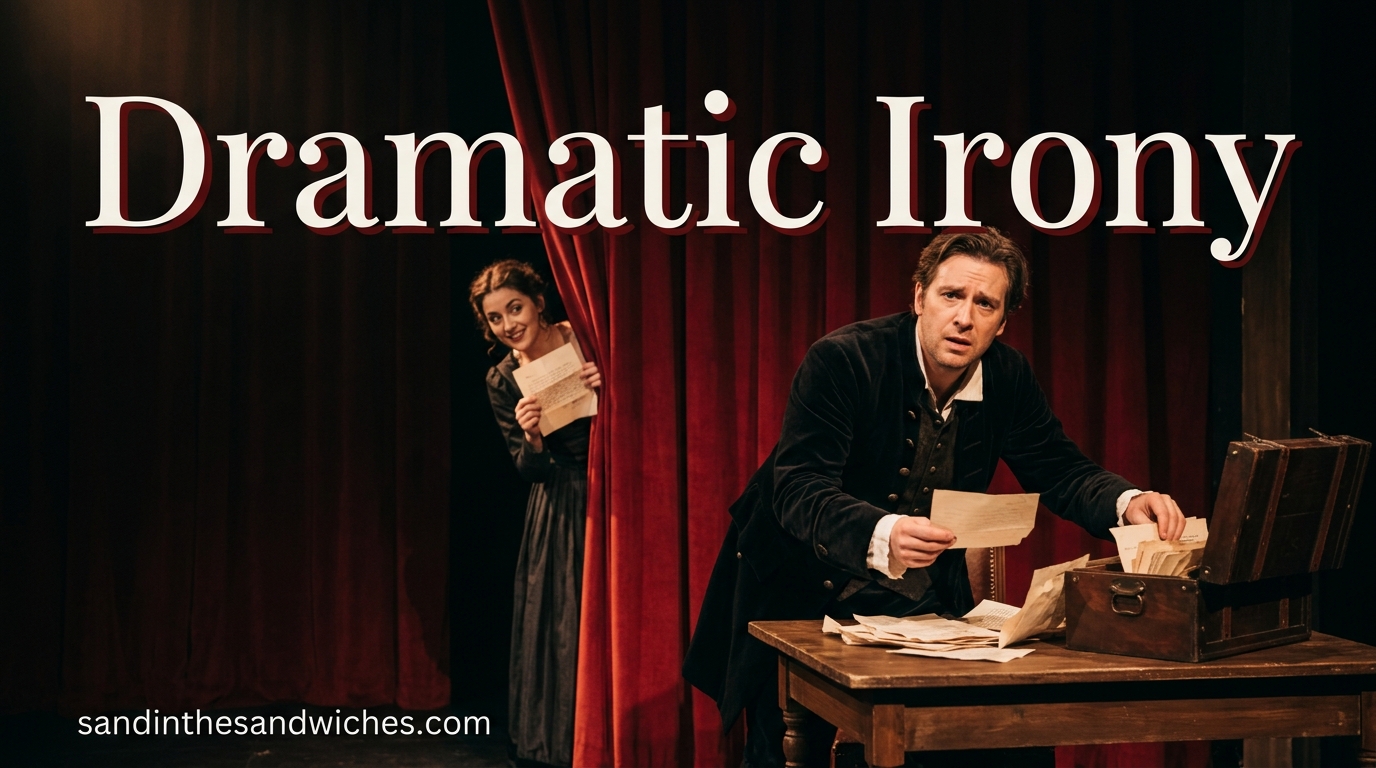
Dramatic irony is a storytelling device where the audience knows something important that one or more characters do not. In Romeo and Juliet, the audience watches Romeo drink poison moments before Juliet wakes up, knowing exactly what is about to happen while he remains oblivious. That gap between what we know and what the character knows is the engine of every unbearable scene you have ever screamed at your television.
I have spent years studying how stories work on audiences, and dramatic irony remains my favorite example of a technique that creates real physical discomfort. In this guide, I will walk you through what dramatic irony actually is, why it produces tension, how it differs from other types of irony, and the specific moment when it stops being suspenseful and starts feeling unbearable.
Table of Contents
What Is Dramatic Irony?
Dramatic irony is a literary device in which the audience possesses information that one or more characters lack. The term dates back to ancient Greek theatre, where audiences already knew the myths and watched playwrights dramatize familiar fates. The knowledge gap between viewer and character is what makes the technique work.
The Core Definition
Dramatic irony happens when the audience has information a character lacks. That single sentence captures the entire device, but the experience of watching it unfold is where the real magic happens. Writers use this technique deliberately to shape how an audience feels during a scene. A character can speak, act, or celebrate in ways that feel celebratory to them and heartbreaking to us at the same time.
The Audience-Character Knowledge Gap
The knowledge gap is the engine of dramatic irony. When the audience knows more than the character, every line of dialogue and every small action gets filtered through that extra layer of meaning. A toast becomes a farewell. A confident plan becomes an obvious trap. A knock at the door becomes a threat.
Writers control the size of this gap to control the emotional intensity. A small gap creates gentle humor. A massive gap, where the audience knows a character is about to die and the character does not, creates the unbearable tension we will explore below.
A Quick Example
In Shakespeare’s Romeo and Juliet, Romeo finds Juliet seemingly dead and drinks poison to join her in death. Seconds later, Juliet wakes. The audience knows she is alive. Romeo does not. His final moments are unbearable precisely because the audience cannot intervene, cannot warn him, and cannot look away.
How Dramatic Irony Creates Tension
Dramatic irony creates tension because the audience cannot act on the knowledge they hold. We are trapped as spectators. This is the difference between dramatic irony and a mystery, where the audience is solving alongside the detective. In a story built on dramatic irony, we have already solved it. We are simply waiting to watch the consequences arrive.
Suspense vs Dread
Suspense asks a question. Dread knows the answer. When you watch a thriller and wonder whether the bomb will go off, that is suspense. When you watch the same thriller knowing the bomb is under the table and the character is sitting down, that is dread. Dramatic irony produces dread because the outcome is no longer in question.
Dread hits harder than suspense because the body responds to certainty. Heart rates spike, muscles tense, and viewers physically lean forward as if proximity might change the outcome. Researchers have studied this response and found that audiences under dramatic irony show stronger physiological reactions than audiences under suspense in the same scene.
The Helpless Spectator Effect
Helplessness is the secret ingredient that makes dramatic irony uncomfortable. The audience possesses information that could save the character if only they could share it. That impossibility creates a low-grade frustration that lingers through the entire scene.
I notice this in myself when watching horror movies. A character walks into the basement. The audience has seen the killer hide behind the water heater. The audience screams at the screen. The character keeps walking. That gap between what we know and what the character does is the source of the discomfort, and it does not fade as the scene progresses. It intensifies.
Why We Cannot Look Away
The combination of dread and helplessness makes dramatic irony almost impossible to abandon. Psychologists describe this as the predictability effect. When an outcome is known but its arrival is delayed, viewers feel compelled to stay through the payoff. Walking away feels like leaving a wound uncovered.
Modern filmmakers understand this dynamic. They stretch the approach to danger across minutes of screen time. The slow pan toward the open window. The friendly phone call from the killer. The sound of footsteps behind the protagonist. Each beat adds another layer of knowledge the character lacks, and each layer makes the eventual horror feel more personal.
Dramatic Irony vs Other Types of Irony
Dramatic irony is one of three classical types of irony taught in literature classes. Each works through a different mechanism, and confusing them is one of the most common mistakes students make.
Dramatic Irony
The audience knows what the character does not. This produces dread, suspense, and emotional engagement. The classic example is the audience watching Oedipus Rex know that Oedipus has killed his father and married his mother, while Oedipus searches desperately for the truth.
Situational Irony
The outcome contradicts what the characters (and often the audience) expected. A fire station burns down. The lifeguard drowns. The chicken soup cures the patient who was misdiagnosed. The result surprises everyone, including the viewer. There is no knowledge gap, only a gap between expectation and reality.
Verbal Irony
A speaker says the opposite of what they mean. Sarcasm is the most familiar form. Saying “what lovely weather” during a storm is verbal irony. The audience understands the speaker’s true meaning, but no character is necessarily unaware of critical information.
Cosmic Irony
A higher power, fate, or the universe seems to be deliberately working against a character. The character makes plans and the world rearranges itself to frustrate them. Cosmic irony overlaps with dramatic irony in stories like The Truman Show, where the universe itself appears to conspire against one unaware protagonist.
Famous Examples of Dramatic Irony
The best examples of dramatic irony come from stories most readers already know. These are the scenes that have stayed with audiences for centuries or decades, and each one demonstrates a different way the knowledge gap can work.
Literature: Romeo and Juliet
Shakespeare built the final act of Romeo and Juliet on dramatic irony. The audience knows Juliet is not dead, only sleeping. Romeo does not. His final monologue, his decision to drink poison, and the seconds between his death and her awakening are unbearable precisely because the gap between audience knowledge and character knowledge has never been wider.
The play also uses a different kind of dramatic irony at the start. Tybalt wants to fight Romeo. The audience knows Romeo has just married Juliet. That single piece of information transforms every confrontation from a simple brawl into a tragedy waiting to unfold.
Film: The Truman Show and Psycho
The Truman Show is one of the purest examples of dramatic irony in modern cinema. Truman Burbank believes he lives a normal life. The audience knows he is the unwitting star of a 24-hour television show. Every smile, every neighborly chat, every cheerful wave carries the weight of that gap. Christopher Guest’s supporting cast and Ed Harris’s Christof are watching the same man we are, and we cannot warn him.
Alfred Hitchcock built the entire final act of Psycho on dramatic irony. Marion Crane is dead, but the audience stays with Norman Bates as he cleans up the evidence. We know what happened. Norman does not know we know. The tension of being complicit in the secret creates a unique discomfort.
Horror: Don’t Go in There
Reddit’s horror communities have spent years dissecting the same unbearable moments. Friday the 13th. A Nightmare on Elm Street. Saw. Alien. Scream. In each, the audience sees the killer and the victim in the same frame. The victim walks toward danger with confidence. The audience knows exactly what waits behind the door.
Quentin Tarantino built the basement bar scene in Inglourious Basterds on this exact principle. The characters inside the tavern know they are surrounded by strangers. The audience knows the strangers are undercover Allied soldiers waiting to act. Every raised glass and casual conversation carries the weight of what the characters cannot see. Reddit users regularly cite this scene as one of the most uncomfortable in modern cinema.
When Dramatic Irony Becomes Unbearable
Not every dramatic irony scene produces discomfort. The difference between effective dramatic irony and unbearable dramatic irony comes down to three factors: the stakes, the duration, and the helplessness of the audience.
The Dread Threshold
The dread threshold is the moment when suspense tips into something heavier. A character walking into a surprise birthday party is dramatic irony. A character walking into an ambush is dramatic irony on the other side of that threshold. The variable is stakes.
Writers who understand this can manipulate the audience with precision. They start with low stakes and gradually raise them across a scene. By the time the character makes the catastrophic decision, the audience has been primed to feel the impact before it lands.
Helplessness and Viewer Anxiety
Helplessness turns dramatic irony from a clever device into an emotional experience. Audiences who cannot intervene feel responsible for the character’s safety. When the character walks into danger, the audience feels they have failed, even though they were always passive observers.
I have watched this reaction in real time at screenings. People cover their eyes. People shout warnings. People literally stand up in their seats during chase scenes. The behavior is involuntary. The body treats the character’s danger as the viewer’s danger, even when the rational mind knows it is fiction.
When the Knowledge Gap Hurts
Some scenes hurt because the audience knows the outcome and cannot bear to watch it arrive. The Titanic scene where the lifeboats row away from the screaming passengers in the water. The ending of Old Yeller. The final act of Brokeback Mountain. These scenes work because the audience knows what is coming, and the slow approach to that knowledge is its own form of suffering.
This is also why dramatic irony can outlast a plot twist. A plot surprise hits once and fades. A dramatic irony scene builds over minutes, layering anticipation until the final moment feels inevitable and devastating at the same time. Many viewers on Reddit’s screenwriting forums argue that dramatic irony is more powerful than plot twists because the audience has time to prepare and is hurt anyway.
When Dramatic Irony Is Overused
Dramatic irony stops working when the audience can predict every move the writer will make. The technique is a tool, and like any tool, it weakens with repetition.
Predictability Fatigue
Predictability fatigue sets in when the same kind of dramatic irony appears in scene after scene. The audience learns that the character walking alone is always in danger, the character who says “I will be right back” never is, and the final girl always drops the weapon. After a few repetitions, the gap between audience knowledge and character knowledge collapses into a single expectation.
Modern horror franchises have trained audiences to spot dramatic irony instantly. The killer is in the house, the phone has no signal, the car will not start. These are the visual grammar of suspense, but they have become so familiar that they sometimes produce eye rolls instead of fear.
Telling vs Showing
Dramatic irony fails when the writer tells the audience what they should feel. If the music swells, the camera pushes in, and every character stares meaningfully, the audience feels manipulated instead of unsettled. The technique works best when the writer trusts the audience to feel the gap without commentary.
Trusting the Audience
The best writers trust the audience to do the emotional work. They plant a small piece of information early in the scene, then let the scene play out without underlining the consequences. The audience pieces together the danger themselves, and the discomfort is theirs to own. When the writer trusts the viewer, the viewer trusts the scene.
Frequently Asked Questions
What is dramatic irony in simple terms?
Dramatic irony is a storytelling device where the audience knows something important that one or more characters do not. The gap between what the audience knows and what the character knows creates tension, suspense, or emotional impact.
What is an example of dramatic irony in a horror movie?
In horror films like Friday the 13th or Scream, the audience sees the killer hiding while the victim walks toward danger with no idea what is waiting. The audience’s knowledge of the threat creates unbearable tension that builds until the final reveal.
How is dramatic irony used in The Story of an Hour?
In Kate Chopin’s The Story of an Hour, the characters believe Mrs. Mallard has died of grief when she actually felt joy at freedom. The readers know she was celebrating her new life, while the other characters assume she is heartbroken. That gap between reader knowledge and character assumption is dramatic irony at work.
Why does dramatic irony make stories unbearable to watch?
Dramatic irony feels unbearable because the audience cannot act on the information they hold. The viewer becomes a helpless spectator, watching a character approach danger with no ability to warn them. That helplessness, combined with certainty about the outcome, produces anxiety and dread rather than suspense.
Final Thoughts on Dramatic Irony
Dramatic irony is one of the oldest and most reliable storytelling tools in literature and film. It works because the audience already holds the answer, and the rest of the scene is the long walk toward it. That combination of knowledge and helplessness produces a uniquely uncomfortable kind of engagement.
If you are a writer, study the scenes that made you look away. Notice how long the screenwriter lets the danger sit. Count the beats between the warning sign and the character’s response. That rhythm is the technique, and once you see it, you will see it everywhere. If you are a viewer, the next time you find yourself shouting at a character on screen, remember that the discomfort is the point. Dramatic irony turns a story into a shared secret, and shared secrets can make even the smallest scene feel unbearable to watch.