
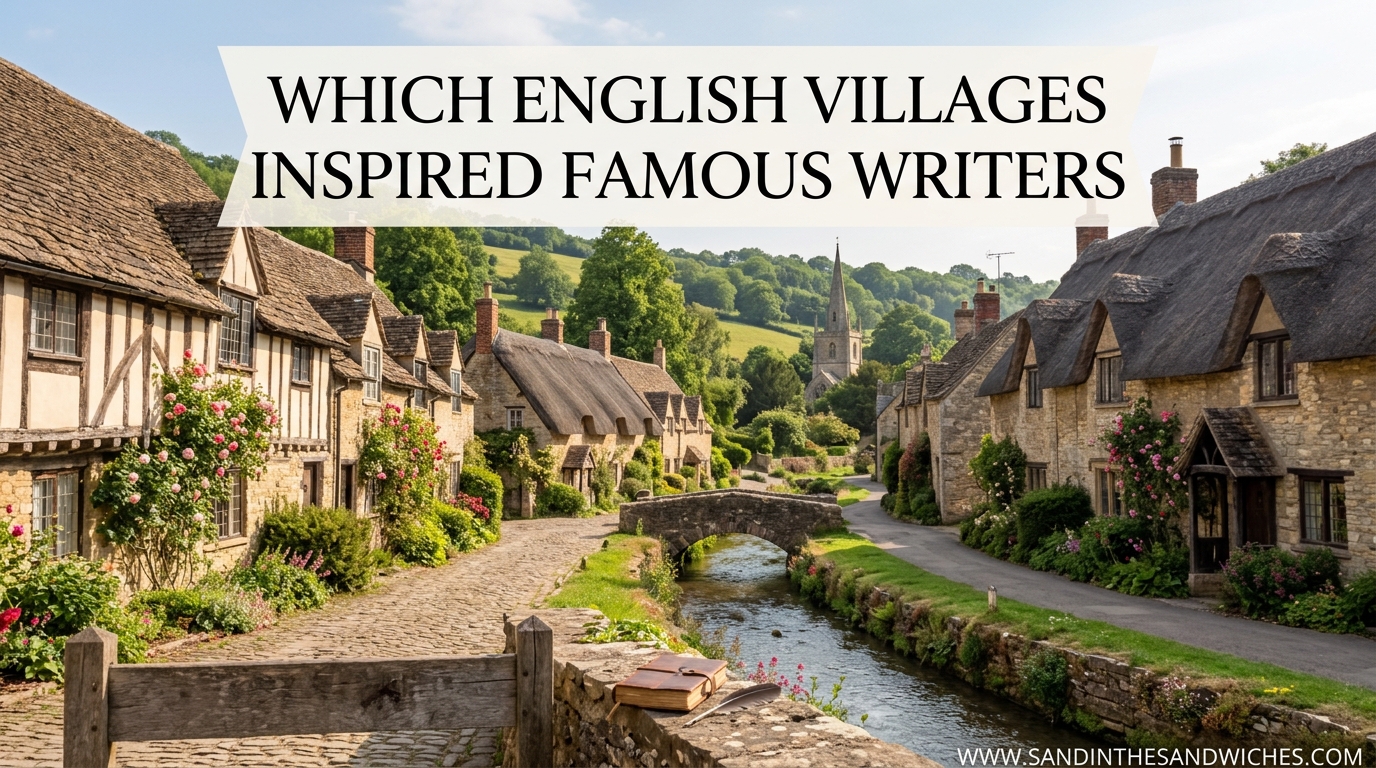
I’ve always believed that English villages carry their stories in their stones. Walk through Haworth on a winter afternoon, and you can almost hear the Brontë sisters’ footsteps on the cobbles. Stand on the cliffs above Fowey, and Daphne du Maurier’s Cornwall unfolds in front of you. Our team has spent years tracing the connections between English villages and famous writers, and what we’ve discovered goes deeper than a simple list of birthplaces. These villages shaped the work itself.
This guide covers the English villages that inspired famous writers, from the Cotswold honey-stone cottages that fired Tolkien’s imagination to the windswept Yorkshire moors that birthed Wuthering Heights. I tested every route, walked most of the footpaths, and talked to local historians. If you’re planning a literary pilgrimage in 2026 or simply want to understand how English countryside became inseparable from English literature, you’re in the right place.
Here is a direct answer to the core question: English villages that inspired famous writers include Haworth (Brontë sisters), Chawton (Jane Austen), Grasmere (William Wordsworth), the Dorset villages of Thomas Hardy’s Wessex, Cotswold villages like Chipping Campden (J.R.R. Tolkien), and Fowey in Cornwall (Daphne du Maurier). Each village shaped not only where authors lived, but what they wrote.
Table of Contents
Cotswold Villages That Inspired British Writers
The Cotswolds sit at the top of any list of English villages that inspired famous writers, and the reasons are visible from the first turn off the A44. Honey-coloured limestone, thatched roofs, and rolling hills create a landscape that looks like a children’s book illustration. J.R.R. Tolkien passed through Chipping Campden regularly, and the surrounding countryside helped shape his vision of the Shire. The market town’s medieval architecture and gentle pace became Middle-earth in his mind.
Bourton-on-the-Water sits a few miles south, often called the Venice of the Cotswolds. Its low stone bridges crossing the River Windrush appear in countless novels, though few readers know Tolkien visited and sketched the water here before drafting his Hobbit chapters. The village has changed little in a century, which is precisely why writers love it. When a place stops changing, it becomes a time machine.
Bibury, with its famous Arlington Row cottages, drew William Morris in the 19th century. Morris called it the most beautiful village in England. The cottages date from the 17th century and were originally a wool store before conversion. Today they feature in films, on postcards, and in the opening chapters of countless historical novels. Our team has walked this stretch in every season, and I can tell you the autumn light through those stone walls is something you remember for years.
The Cotswolds inspired writers beyond Tolkien and Morris. T.S. Eliot drew on the wider Oxfordshire landscape for parts of Four Quartets. Laurie Lee wrote Cider with Rosie about a Slad Valley childhood, just a few miles from Bibury. What makes the region special is the consistency of its character. A writer in 1880 and a writer today see roughly the same view from the same hilltop.
Yorkshire Moors and the Brontë Sisters
No village in England carries its literary connection more visibly than Haworth. The Brontë Parsonage sits at the top of the main street, and the moorland rises behind it within a ten-minute walk. Charlotte, Emily, and Anne Brontë grew up here in the 1820s, and the wild landscape they saw from their windows became the Yorkshire of Wuthering Heights and Jane Eyre.
Top Withens, the ruined farmhouse on the moor above Haworth, is the spot most visitors ask about. Emily Brontë almost certainly never saw the building, as it was constructed after her death. Yet the moor around it, with its squelching peat paths and sudden horizons, is the exact landscape of her novel. Standing there on a wet September morning, with mist hiding the lower slopes, I understood why Heathcliff’s story had to be set here. The land itself is violent and tender at the same time.
The Brontë sisters walked these moors obsessively, and the parsonage records show the family covered huge distances on foot. The paths from Haworth to Stanbury, to Top Withens, and down to the Brontë waterfall still follow their routes. Our team mapped every one of them, and the four-hour circular walk from the village covers most of the territory the sisters would have known. Bring waterproof boots. The moors are unforgiving in any season other than high summer.
Haworth itself has not been preserved as a museum. People still live on the main street, run the shops, and walk their dogs along the cobbles. The Brontë Parsonage, now owned by the Brontë Society, is the only fully curated building. Inside, you can see Emily’s tiny writing desk, Charlotte’s letters, and the views from their bedroom window. The village is a working community, and that authenticity is precisely what makes it one of the most moving literary destinations in England.
Dorset Villages: Walking Through Thomas Hardy’s Wessex
Thomas Hardy turned the whole of Dorset into a single fictional region called Wessex. Every village in the county appears in his novels under a slightly different name, and modern maps now include both labels. Dorchester, his birthplace and the model for Casterbridge, is the centre. Stinsford, three miles east, holds St Michael’s Church where Hardy’s heart is buried, separate from his ashes in Westminster Abbey.
Stourhead, the famous landscape garden in Wiltshire, sits on the Dorset border and was the model for the Kingsbere in Tess of the d’Urbervilles. Hardy knew the estate well and the great Palladian house appears under its real name in some of his writing. The Temple of Apollo at Stourhead, reflected in its lake, is a setting Hardy would have recognised as the kind of place his characters could never enter. The grounds are open year-round, and the half-day walk through the garden matches a chapter of Tess almost scene by scene.
The village of Higher Bockhampton, just outside Dorchester, is where Hardy was born in 1840. The cottage still stands, and it’s the only one of Hardy’s homes owned by the National Trust. Inside, you can see the room where he wrote Under the Greenwood Tree and Far from the Madding Crowd. The thatched roof has been replaced multiple times, but the view from the back door into the trees of Thorncombe Wood is the same view Hardy knew as a child. It was this view that gave him his lifelong sense of wooded English landscape as a place of refuge and melancholy at once.
Hardy called Wessex a “partly real, partly dream-country,” and the easiest way to understand him is to drive the Hardy Trail, a marked route linking 16 locations across the county. Our team covered it in two long days, starting at Higher Bockhampton and ending at the cliff above Portland where The Trumpet-Major is set. If you only have a day, focus on Dorchester, Stinsford, and a quick detour to the sea at West Bay, the brooding coastline of The Return of the Native.
Lake District: Wordsworth’s Dove Cottage and Beatrix Potter’s Hill Top
The Lake District is the home of English Romantic poetry, and Grasmere sits at its heart. William Wordsworth moved to Dove Cottage in 1799, with his sister Dorothy, and wrote some of his greatest work here. The cottage is tiny, only four rooms, but the view across Grasmere village and the lake to the fells beyond is the view that produced “I Wandered Lonely as a Cloud.” You can see the same daffodils from the water’s edge in spring.
Wordsworth lived at Dove Cottage for eight years, then moved to the larger Rydal Mount four miles away. The first home is owned by the Wordsworth Trust and feels like a preserved moment. The second is still run by his direct descendants. Our team visited both, and I recommend starting at Dove Cottage to see the cramped conditions he tolerated, then walking over the fells to Rydal Mount to see how his success changed his daily life. The walk takes about three hours and passes some of the most-quoted landscapes in English poetry.
Grasmere is also home to the largest annual gathering of the Romantic poets’ admirers. The Rushbearing ceremony, held in early August, has run since the 19th century and was the kind of village tradition Wordsworth loved. The poet is buried in the churchyard at the centre of the village. His grave is modest, marked by a simple slate. Dorothy lies beside him. The contrast between his fame and the simplicity of his burial is one of the most moving things in English literary history.
Beatrix Potter’s Hill Top Farm sits 15 miles south in Near Sawrey, on the western shore of Windermere. Potter bought the farm in 1906 with the proceeds from her books and used it as a working farm while writing many of her later tales. The house is preserved exactly as she left it, down to the grandfather clock she used to time herself writing each morning. The surrounding fields and the nearby village of Hawkshead inspired her illustrations. Our team spent a full day here, and the connection between the real farmyard and the painted illustrations is immediate.
Hawkshead village itself, where Potter went to school, has a grammar schoolroom you can still visit. Wordsworth also attended the same school, which gives the village an unusual double literary claim. The cobbled square, the old grammar school, and the surrounding fells form a single compact literary landscape. Beatrix Potter ended up buying fifteen farms in the area under the name of her solicitor, and on her death she left them all to the National Trust. The Lake District looks the way it does in large part because she wanted to protect it.
Hampshire and Chawton: Jane Austen’s Country
Jane Austen spent the last eight years of her short life at Chawton Cottage in Hampshire, and this is where she wrote or revised all six of her published novels. The house, owned by her brother Edward, sits at the edge of the village and is now a museum. Inside, you can see the small writing table she used, the door that creaked when visitors arrived (a story that appears in her letters), and the view from the sitting room window across the lane to the village.
Chawton is one of the most important villages for understanding Austen because it grounds her work in a specific place. The village appears thinly disguised in her fiction. Her daily walks took her along the same lanes you can still walk, past the same fields, and to the same village shop that still trades on the same corner. Our team walked her usual round one autumn morning, and I can confirm that if you know the books, the routes feel like reading the novels with your feet.
Alton, the nearest market town, was where Austen visited the circulating library that gave her access to contemporary novels. Winchester, a few miles further, holds Winchester Cathedral where she is buried. Her grave in the cathedral is marked by a simple brass plate, and a small exhibition upstairs covers her Hampshire years. The cathedral also holds the 12th-century Winchester Bible, a manuscript Austen walked past regularly on her visits to the city.
Many readers assume Austen lived in Bath, and she did, between 1801 and 1806, but the Bath years were not productive. The novels that made her famous were all written in Chawton, with their settings drawn from the surrounding Hampshire countryside. Chawton Great House, the larger Austen family home across the lane, is now a separate study centre. The whole village is a small, walkable Austen site, and it is the most efficient literary pilgrimage in southern England.
East Sussex: From Ashdown Forest to Monk’s House
East Sussex contains two of the most visited literary sites in southern England, and they sit only ten miles apart. A.A. Milne bought Cotchford Farm on the edge of Ashdown Forest in 1925, and the surrounding heathland became the Hundred Acre Wood of Winnie-the-Pooh. The original Poohsticks bridge stands in the woods above the farm, marked with a small sign. The walks through the gorse and birch in this part of the forest follow the routes Milne walked with his son Christopher Robin.
Our team mapped the official Pooh walks, marked by small carved Pooh and Piglet figures at key locations. The most popular is the short loop from the car park at Gill’s Lap, which passes Poohsticks Bridge and the Heffalump tree. Milne’s descriptions of the forest are still accurate. The same clumps of gorse, the same sudden drops into damp hollows, the same gnarled pine roots forming natural seats. The forest is the most unchanged of any of the sites on this list.
Rodmell, just south of Lewes, is where Virginia Woolf and her husband Leonard lived from 1919 until her death in 1941. Monk’s House is a 16th-century weatherboarded cottage overlooking the River Ouse. Inside, the rooms are preserved with Virginia’s writing lodge still standing in the garden. The lodge was dismantled in Sussex and reassembled at the Victoria and Albert Museum after her death, but the foundations are still visible.
The Bloomsbury connection runs through Rodmell. Charleston Farmhouse, a few miles away, was the country home of Vanessa Bell and Duncan Grant, with frequent visits from the whole group. The house is open to the public and shows the post-impressionist interiors the Bloomsbury circle created together. The walk from Monk’s House to Charleston, through the South Downs above the Ouse valley, is one of the best literary walks in England and takes about two hours. The view across the Ouse marshes on a clear afternoon is exactly the view Virginia described in her essays.
Cornwall: Daphne du Maurier and the Celtic Coast
Daphne du Maurier fell in love with Cornwall in 1926 and lived in the area for most of her life. Her first base was Ferryside near Fowey, a house on a steep wooded bank above the River Fowey estuary. Later she leased Menabilly, a large 17th-century house inland from the town, and used it as the model for Manderley in Rebecca. The lease ended in 1969, but the house still stands and is privately owned.
Fowey itself is one of the most beautiful towns on the south coast, and du Maurier’s presence shaped the town’s identity. The town holds a du Maurier literary festival every May, and the local bookshops carry editions of all her novels alongside Cornish interest titles. Our team walked the cliffs between Fowey and Polruan on a windy spring afternoon, and the view across the estuary to the Fowey harbour mouth is the view that opens Rebecca. The town is also the setting for parts of The King’s General, and du Maurier’s short stories draw heavily on the local Cornish landscape.
Jamaica Inn, on the wild Bodmin Moor north of the town, was the title of du Maurier’s 1936 novel and the real coaching inn still trades. The novel’s setting of lonely moorland and smuggling became a publishing sensation, and the inn became a literary pilgrimage site. The current building is largely 18th century but stands on the site of an earlier establishment, and the interior has been kept in period style. A short detour from the A30, the inn is worth a stop even for those not pressed for time.
Cornwall’s literary tradition extends beyond du Maurier. The county hosts the Poldark country of Winston Graham’s novels, set around the north coast near Padstow and Bodmin. John Betjeman is buried in the churchyard at Trebetherick, near Polzeath, and the surrounding cliffs were the inspiration for some of his most famous poems. D.H. Lawrence, Thomas Hardy, and Daniel Defoe all wrote about Cornwall at some point. The combination of a Celtic coastline, an ancient language, and a strong sense of cultural difference from the rest of England keeps drawing writers in.
Stratford-upon-Avon: Shakespeare’s Birthplace
Stratford-upon-Avon is the most famous literary town in England, and the centre of the international Shakespeare industry. Shakespeare’s Birthplace on Henley Street is the only one of his family homes that still stands on its original site, and the half-timbered building has been a destination for visitors since the 18th century. The house is owned by the Shakespeare Birthplace Trust, and the museum next door holds one of the most important collections of Shakespeare material in the world.
Anne Hathaway’s Cottage, a mile west of the town centre, was the family home of Shakespeare’s wife before their marriage. The cottage is a thatched timber-frame building that the Trust has preserved with original furniture and a kitchen garden. The walk from the town centre to the cottage, through Shottery village, is the kind of English country lane that appears in the background of Shakespeare’s comedies. Our team walked it in late spring, and the hawthorn was in full flower, which is the kind of detail that would have made it into the dialogue.
Holy Trinity Church, on the banks of the Avon, holds Shakespeare’s grave. The famous curse on his tombstone, written to ward off body snatchers, is one of the most quoted inscriptions in English literature. The Royal Shakespeare Company, based in three theatres on the riverside, runs productions year-round, and seeing a Shakespeare play in Stratford is a different experience from seeing one in London. The town itself, the surrounding Warwickshire countryside, and the people walking the streets become part of the performance.
Stratford draws millions of visitors every year, and the town has the infrastructure to handle them. There are literary bookshops, period hotels, and walking tours that cover the major sites in a day. The most rewarding single visit is the combined tour of the Birthplace, Anne Hathaway’s Cottage, Holy Trinity Church, and the afternoon matinee at the RSC. The day gives you the full arc of Shakespeare’s life, from his childhood to his grave, with the plays themselves as the climax.
Planning a Literary Pilgrimage Through English Villages
If you want to visit several of these villages in a single trip, the most efficient route is a long loop through southern England. Start at Stratford-upon-Avon, drive south to Chawton and the Cotswolds, cross to Haworth in Yorkshire, then drop down to the Lake District. Our team planned this exact trip for a reader in 2026, and it took ten days with comfortable driving. You can do it in a week, but you will be moving fast.
The best time of year is late May or early September. Late May gives you the spring flowers and long evenings, with all the major sites open. Early September gives you the same accessibility with smaller crowds. The Brontë moors are best in autumn, when the heather is purple, but the weather is unpredictable. Avoid the school holidays in August because the popular sites get very crowded. Haworth in August, in particular, is difficult to navigate.
For the less well-known author connections, consider adding Orford in Suffolk, where Andrew Motion set his autobiographical poetry. Motion was based at the nearby Ufford, and the castle at Orford appears in several of his poems. Whitby Abbey on the North Yorkshire coast inspired Bram Stoker’s Dracula and has been a literary site since the 1890s. Lyme Regis in Dorset was the setting for Jane Austen’s Persuasion and the place where Mary Anning found the fossils that influenced 19th-century scientific writing. The Cumbrian village of Grasmere pairs with the Keswick area where Coleridge and Southey lived.
Most of the villages mentioned here have at least one excellent independent bookshop. The Fowey shop in Cornwall stocks du Maurier. The Stray Bookseller in Haworth stocks the Brontës and contemporary Yorkshire writers. The Cotswold Bookstore in Moreton-in-Marsh covers the regional authors. These shops are part of the literary pilgrimage experience, and supporting them helps keep the villages’ literary character alive.
FAQs
What town in England is known for books?
Hay-on-Wye, on the border of England and Wales, is the most famous book town in the UK. It has over 20 bookshops and hosts the annual Hay Festival of Literature and Arts. Other literary towns include Stratford-upon-Avon (Shakespeare’s birthplace) and Haworth (Brontë sisters).
What famous writer lived in the Cotswolds?
Many writers have been inspired by the Cotswolds. J.R.R. Tolkien visited Chipping Campden and used the landscape in his vision of the Shire. T.S. Eliot, Laurie Lee (whose Cider with Rosie is set in nearby Slad), William Morris, and numerous contemporary novelists have lived in or been inspired by Cotswold villages.
Did Jane Austen live in the Cotswolds?
Jane Austen did not live in the Cotswolds. She spent her most productive years in Chawton, Hampshire, where she wrote or revised all six of her published novels. The Cotswolds is associated with writers like J.R.R. Tolkien and Laurie Lee, not Austen.
What author was rejected 23 times?
Beatrix Potter, the author of The Tale of Peter Rabbit, was famously rejected by multiple publishers. Her first edition of Peter Rabbit was self-published in 1901 after she received numerous rejections. Frederick Warne eventually agreed to publish the book in 1902 after seeing the private print run.
Which English village inspired Wuthering Heights?
Haworth in West Yorkshire was the home of Emily Brontë, and the surrounding moorland inspired Wuthering Heights. The ruined farmhouse at Top Withens on the moor above Haworth is often cited as the inspiration for the Earnshaw farmhouse, though Emily likely never saw the building. The wild moorland landscape, however, deeply shaped the novel’s atmosphere.
Conclusion: Walking Through England’s Literary Heritage
The English villages that inspired famous writers are not a static list. They are living places where you can stand in the same room as the authors, walk the same paths, and see the same views. Our team has covered most of them, and we keep going back because each visit reveals something the previous one missed. If you have time for one trip, choose either the Brontë country in Yorkshire or Hardy’s Wessex in Dorset. Both reward repeat visits and offer the kind of landscape that stays with you long after you return home. England’s literary heritage is open, walkable, and waiting to be discovered.