
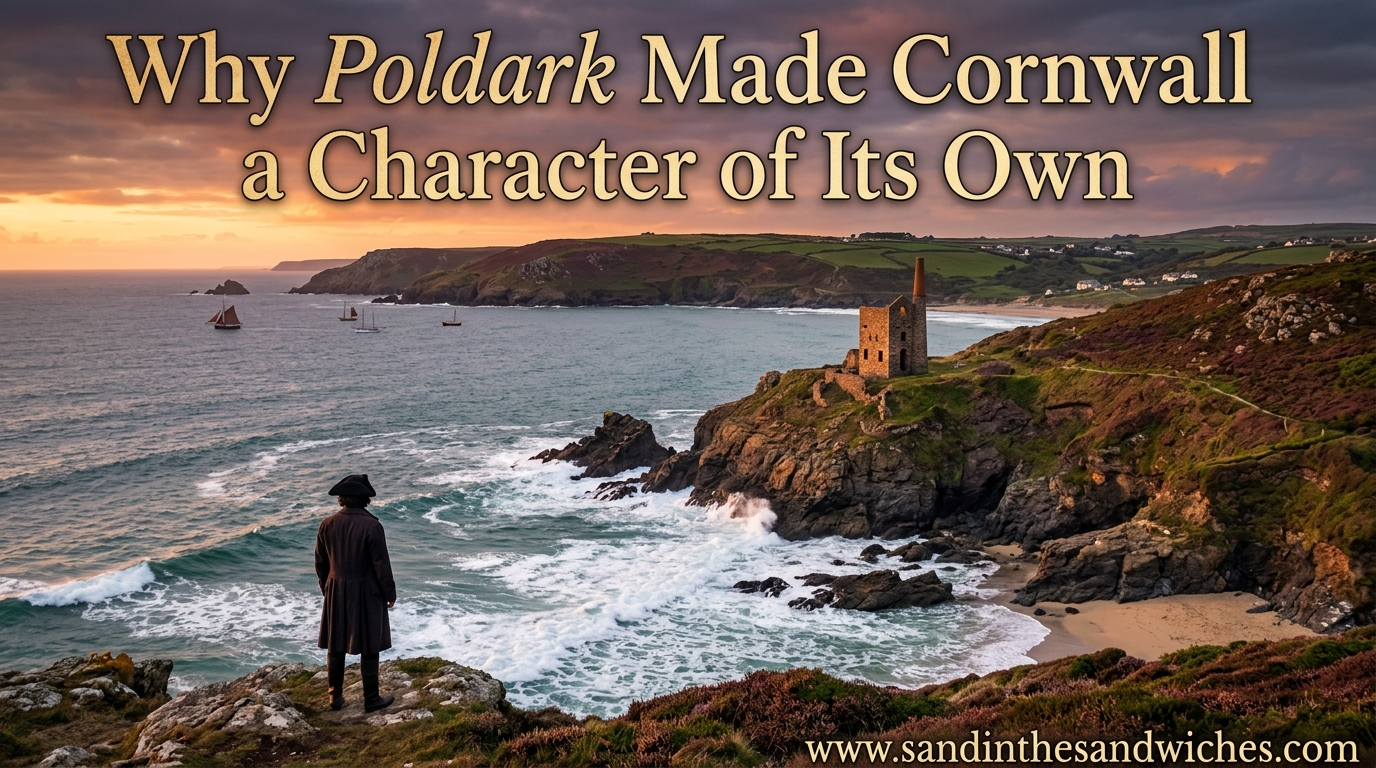
Poldark made Cornwall a character of its own, and that is exactly why the BBC and Masterpiece drama, which ran from 2015 to 2019, keeps drawing viewers back long after the final credits roll. Aidan Turner’s brooding Ross Poldark may be the face of the show, but the cliffs, coves, moors and engine houses of Cornwall act as a second lead in every scene. This is a series where the setting is never just a backdrop. It argues, it grieves, it resists, and it loves, sometimes in the same frame.
When I rewatched the series before writing this piece, I noticed something I had missed the first time. Every time a character makes a difficult decision, the camera lingers on the Cornish landscape just long enough to make the place feel complicit. Cornwall is not where the story happens. Cornwall is part of what happens. That is the trick the show pulls off, and almost no other period drama in recent memory has done it with the same confidence.
Table of Contents
Cornwall functions as the unspoken protagonist of Poldark
Cornwall is the unspoken protagonist of Poldark, shaping every emotional beat before the actors say a word. The series cinematographer shot the rugged coastline with the kind of care usually reserved for human cast members, holding on waves crashing against black rock, on mist crawling down mine shafts, on wind bending the gorse on Bodmin Moor.
Compare that to other period dramas where the setting is a pretty postcard. Poldark uses Cornwall as a dialogue partner. When Ross Poldark returns from the American War of Independence to find his estate in ruins, the camera does not just show him surveying the damage. It cuts to a wide shot of Nampara Valley, half-wild and unloved, and the message is unmistakable. This land is also coming home broken.
Without Cornwall, the narrative loses its internal logic. Ross is not a generic romantic hero. He is a man shaped by granite, salt air and the stubborn refusal of his county to be smoothed into English politeness. Cornwall gives him his moral code, his anger, his tenderness, and his stubbornness, all in one continuous shot.
Winston Graham’s personal connection shaped every page of the source novels
Winston Graham’s personal connection to Cornwall is the reason Poldark feels so rooted. Graham was born in Manchester in 1908, but his family moved to Perranporth on the north Cornwall coast when he was a child. He grew up hearing Cornish accents, watching Atlantic storms, and learning the names of local coves and mine workings.
That biographical detail matters. The 12 Poldark novels, written between 1945 and 2002, are not the work of an outside observer romanticising a pretty corner of England. They are the work of a writer who breathed Cornish air for most of his life and considered the county a character in its own right.
Graham once said that Cornwall was as much a part of the novels as any human character. You can feel that commitment in the books and on screen. Every scene set in Truro, every walk across the moors, every moment at Nampara carries the weight of a writer who had walked that exact ground and listened to those exact winds.
The dual personality of Cornwall mirrors the Poldark family itself
Cornwall has a split personality, and Poldark uses both halves to tell its story. The county’s north coast and south coast are almost two different countries, and the series leans into that contrast from the opening episode.
The harsh north coast and working-class mining communities
The north Cornwall coast is exposed, weather-beaten and shaped by the mining industry. This is the territory of the working class, of the Poldark tenants, of the men who descended into tin and copper mines every morning. It is also the territory of crashing Atlantic swells, of cliffs that drop into the sea, of villages that feel like the edge of the world.
When the camera is on the north coast, the framing is almost always wide and unforgiving. The characters look small against it. That visual choice reflects the social reality of 18th century Cornwall, where the wealth dug out of the ground rarely stayed with the people who dug it.
The gentler south coast and the merchant class harbour towns
The south Cornwall coast, where the Falmouth and Fowey harbours lie, is calmer, more sheltered, and home to the merchant class. This is the world of the Warleggans, the bankers and copper kings who grow rich on the labour of the north coast miners.
The series films these locations with warmer light, with tall ships in the harbour, with architecture that signals wealth. The contrast is not subtle, and it is not supposed to be. The Cornish landscape itself is a visual argument about class, power, and the geography of inequality in Georgian Britain.
Mining heritage gave the series its visual vocabulary and moral weight
The mining heritage of Cornwall gave Poldark both its most striking images and its most serious themes. The Cornish engine house, that small stone building with a tall chimney, is one of the most recognisable silhouettes in the series. It appears on cliff tops, in valleys, in opening credits, and on promotional posters. It is the visual logo of the show, and it carries the entire history of the Cornish tin and copper industries inside it.
A “wheal” is a Cornish word for a working mine, and the term appears constantly in Poldark. Wheal Leisure, the fictional mine at the centre of the story, is a composite of real Cornish mines. Producers used Wheal Coates, Levant Mine and Botallack as references, and the ruined engine houses you see on screen are real 18th and 19th century structures preserved by the National Trust and Cornwall Heritage Trust.
This is not decoration. Mining in 18th century Cornwall was the economic engine of the region, and the struggles over who owned the mineral rights, who worked the shafts, and who died in the tunnels drive almost every plot point in the series. Cornwall is a character in Poldark precisely because the land itself is contested ground.
Key filming locations doubled as narrative characters in their own right
The filming locations for Poldark are real Cornish places, and the producers chose them because each one could do narrative work that a film set could not. These are not interchangeable pretty views. Each location carries specific emotional and thematic weight.
Charlestown harbour and the tall ships
Charlestown, a Grade II listed harbour near St Austell, stood in for the fictional port of Truro throughout the series. Its intact Georgian architecture and tall ship fleet gave producers an 18th century port they did not have to build. Every scene set in a harbour carries the sound of real rope and real timber, and that authenticity is part of why the series feels grounded.
Wheal Coates and the engine house silhouette
Wheal Coates, perched on the cliffs above St Agnes, gave the show its most iconic backdrop. The crown engine houses here have become inseparable from the Poldark brand, and they appear in almost every trailer and poster for the series. Without Wheal Coates, the visual identity of the show would be unrecognisable.
Bodmin Moor as Ross Poldark’s wild backdrop
Bodmin Moor, the granite-strewn upland in the heart of Cornwall, doubled for the wild landscape around Nampara. The moor is unforgiving, fog-prone, and seemingly endless, and the series uses it to make Ross feel like a man caught between civilisation and the raw edges of his own county. The moor is where he goes when he needs to think, fight, or grieve, and the choice feels inevitable.
Weather and landscape carry the emotional weight of every scene
The weather in Poldark is not background. It is an invisible actor. The series was filmed on location in Cornwall, and the Atlantic weather system did most of the heavy lifting for free. Storms roll in from the Celtic Sea, the Gulf Stream keeps the south coast milder than the rest of Britain, and the light changes every fifteen minutes.
Producers leaned into that unpredictability. Joyful scenes get wide horizons and soft light. Tragic scenes get squalls, fog and sudden darkness. The Cornish weather becomes a kind of emotional barometer, and it works because it is real. You cannot fake the look of rain coming off the Atlantic in horizontal sheets.
This is the weather-landscape-emotion trinity that most reviews of the show barely mention, and it is one of the strongest arguments for Cornwall as a character. The land does not just sit there being beautiful. It reacts, it shifts, it pushes back, and it does so on a timescale that mirrors the human dramas unfolding in front of it.
Why no other location could have played Cornwall in Poldark
No other filming location could have played Cornwall in Poldark, and that is the strongest evidence for the county’s role as a character. The geology, the mining history, the dialects, the sense of cultural distance from the rest of England, the architecture, the light, the weather. Every element is specific to Cornwall, and removing any one of them would collapse the whole structure.
Producers could have filmed in Devon, in Wales, in Scotland, or in studio sets, and the result would have been a recognisable period drama. It would not have been Poldark. The series depends on the visual fact of Cornwall, and the emotional fact of Cornwall, in roughly equal measure.
That is why Poldark made Cornwall a character of its own. Not because the producers made a clever marketing decision, and not because the novels happen to be set there. The series works because Winston Graham understood, and the showrunners understood, that you cannot tell this particular story without this particular ground beneath it.
Frequently asked questions about Poldark and Cornwall
Was Poldark actually filmed in Cornwall?
Yes. The BBC and Masterpiece production filmed Poldark on location across Cornwall, using real harbours, moors, cliff tops and mine workings rather than studio sets. Key filming sites include Charlestown harbour, Wheal Coates, Bodmin Moor, Kynance Cove, Porthgwarra and Perranporth.
Did Cornwall used to be a separate country?
Cornwall was not a formally independent country in the modern sense, but it had its own king, its own language (Cornish, a Celtic tongue related to Welsh and Breton), and its own distinct legal and cultural identity well into the medieval period. By the 18th century, when Poldark is set, Cornwall was administratively part of England but retained a strong sense of separate Cornish identity that the series takes seriously.
Why is Cornwall important to Poldark?
Cornwall is important to Poldark because the landscape, mining heritage and class geography of the county drive the entire story. The contrast between the harsh mining north coast and the wealthier trading south coast mirrors the social conflict at the heart of the series, and the ruined engine houses and exposed cliffs give the show its visual identity.
What is the connection between Poldark and Cornwall?
Author Winston Graham grew up in Perranporth on the Cornish north coast, and he considered the county as important to his novels as any human character. The BBC adaptation honoured that connection by filming almost entirely on location in Cornwall and using real Georgian-era architecture, harbours and mine workings to ground the drama.
Poldark made Cornwall a character of its own, and that is the simplest explanation for why the show still feels alive a decade after it first aired. Few period dramas treat their setting with this much respect, and even fewer do it by actually going to the place they are pretending to be. Cornwall is not a backdrop in Poldark. It is a force, a mood, a moral compass, and a working-class history lesson, all framed by granite cliffs and salt spray.
If you have never visited Cornwall after watching the series, I would strongly recommend it. Stand on the cliffs above Wheal Coates at sunset, walk the harbour wall at Charlestown, and watch the weather roll in off the Atlantic. You will see exactly what the showrunners saw when they picked up their cameras. You will also understand, very quickly, why no other county could have played this part.