
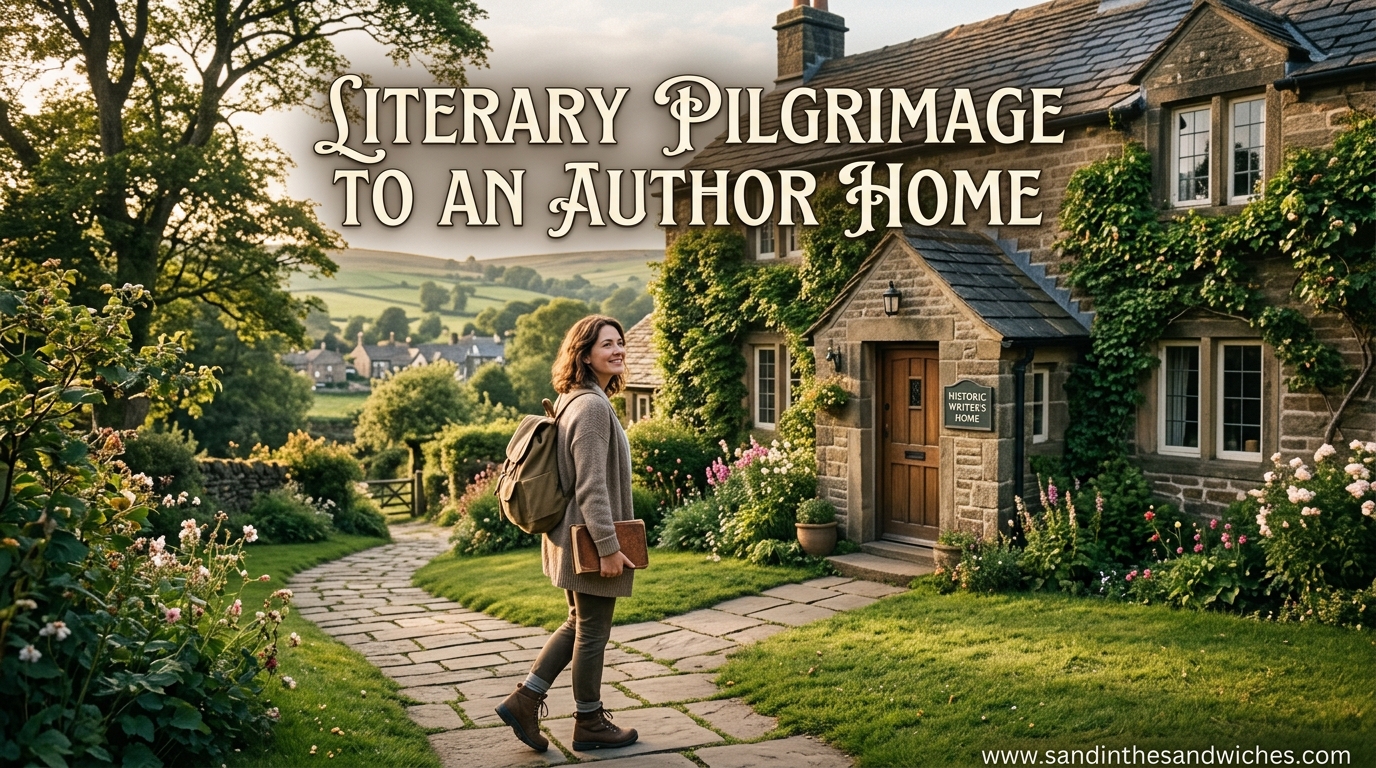
I finished Wuthering Heights for the third time on a wet Tuesday in October, closed the book, and immediately started searching flights to Yorkshire.
That impulse – to walk toward the page rather than away from it – is the quiet engine behind every literary pilgrimage. A literary pilgrimage to an author home is, at its simplest, travel with a book in your hand. But the experience itself is much stranger, much more layered, and far more rewarding than the phrase suggests. We have made these journeys ourselves, on long weekends and slow summers, in good weather and bad, and we want to share what they actually offer when you stop treating them as a checkbox on a literary bucket list and start treating them as a conversation with a writer who is no longer in the room. We have stood in kitchens where Dickens ate breakfast, looked out windows the Bronte sisters looked out of, walked streets James Joyce walked, and read novels in gardens where their authors read. None of those experiences were the same. All of them were worth the trip.
For readers who have ever closed a novel and wanted to step inside its world, this guide explains what a literary pilgrimage to an author home actually delivers. We will cover the tangible things you can see, the intangible things you can feel, the different shapes these journeys can take, eight specific homes that reward the trip, and how to plan your first one without overthinking it. We will also address the common worry that these visits might be too commercial or too distant from the books themselves, because that worry is reasonable and the answer is more interesting than the worry suggests.
Table of Contents
What a Literary Pilgrimage to an Author Home Actually Offers
If you want the direct answer, here it is: a literary pilgrimage to an author home offers a meeting with the writer’s working life that no biography, documentary, or critical essay can match. You see the desk where the books were written, the window the author looked through, the room the family lived in, the garden they walked in, the streets they walked to church. From there the visit radiates outward into sensory, emotional, and intellectual territory that reshapes how you read everything that writer ever produced. The visit gives you four distinct kinds of return – the tangible, the atmospheric, the psychological, and the communal – and most visitors notice at least three of them in the course of a single afternoon.
The core offerings, in plain language, are these:
- Access to authentic artifacts: original manuscripts, first editions, family furniture, the writer’s pen, ink, and personal items left exactly where they were used.
- Sensory immersion in the writer’s setting: the view, light, weather, and domestic atmosphere that shaped the prose.
- A new relationship with the texts: details that were abstract on the page snap into focus when you stand in the room where they were imagined.
- Corrected understanding of the author: many visitors discover the writer they loved is more complicated, stranger, or funnier than the public version.
- Connection to a wider reading community: the small gift shop conversation, the overheard tour, the moment a stranger nods at you in front of a manuscript case.
- A personal threshold experience: the moment a place becomes a memory you carry, instead of a name on a map.
Each of those deserves its own page, and we will give them that. But first, a quick story from our own first pilgrimage, because it captures the rest better than any summary, and because it is the kind of experience that does not survive being paraphrased into bullet points.
We went to Haworth Parsonage on a grey afternoon, the kind of weather the Bronte sisters wrote from every day of their adult lives. The volunteer at the front desk told us Charlotte’s writing slope was upstairs, in the room her father had given her as a study. The room was small. The window was thin. The moor outside looked exactly as bleak as the pages of Jane Eyre. We stood there for a long time, and what surprised us was not the artifact itself but how the room quietly refused to be a museum. It insisted on being the place where a person had worked. The volunteer had also pointed out, with a kind of careful pride, the well-worn path on the floorboards where Charlotte’s father Patrick walked back and forth while she read her latest chapters aloud to him. The boards are worn by his footsteps. You can see them. That is the kind of detail you cannot get anywhere but in the house.
What Does Visiting an Author’s Home Really Offer Readers?
When readers ask us whether an author home is worth the trip, we usually answer with a list of the things the visit gives you that no other experience can. There are four categories, and they layer on top of each other. A first visit to a major author home will tend to deliver the first two strongly. A return visit, or a visit to a quieter home, will start to deliver the third and fourth. We have found that visitors who plan only one pilgrimage in a lifetime get the first two; visitors who plan several over a few years start to get all four.
Tangible Artifacts: The Things You Can Actually See
Author homes are unusual among house museums because the central artifacts are not the building or the period decor. They are the working tools of a working writer. At the Bronte Parsonage, you see Charlotte’s tiny writing slope and the portable desk Emily used. At Chawton, you stand next to the little round table where Jane Austen revised six of her novels in a single burst of productivity. At the Ernest Hemingway Home in Key West, the upstairs writing studio is preserved with his typewriter set in a beam of light that any novelist would recognize. At the Mark Twain House in Hartford, you see the billiard table where he wrote, the custom-built rolling file cabinet he designed to organize his manuscripts by chapter, and the windows of the third-floor study he used for his morning work.
These are not replicas. They are the actual objects, and they carry a weight that photographs cannot transmit. When you see Austen’s spectacle case sitting by the table where she wrote Mansfield Park, you understand something about her daily discipline that no critic has ever managed to put into words. When you see the small lock of hair kept on Hemingway’s desk, you feel the life the writer was living while he wrote the books. The objects make the work feel earned. They also reveal a working rhythm: a writer writes at a particular height, on a particular kind of paper, in a particular kind of light, and the room will tell you those things whether or not anyone points them out.
One thing to look for on any author home visit is the writing surface itself. Almost every author home we have visited has preserved the desk, table, or slope as a centerpiece, and the way the room is arranged around that object tells you a great deal about how the writer worked. Was the chair high or low? Was the desk near a window? Was there a fireplace, and which way did it face? Did the writer sit upright or hunch? Did they face the wall or the room? These are choices the writer made every day, and they shaped the work. You can see them.
Atmospheric Resonance: The Light, The Air, The View
Books are written in specific places, by specific people, under specific skies. When you visit the place, you are absorbing all three. A literary pilgrimage to an author home gives you the same light the writer worked in, the same weather that came through the window, the same sounds drifting up from the street. This is what literary critics call sense of place, and it is one of the strongest things a visit can deliver. A novel that felt abstract on the page becomes anchored to a specific geography, a specific temperature, a specific quality of light, and a specific kind of quiet.
The Bronte moors are the obvious example. Many visitors arrive expecting a romantic landscape and find a windswept, often grim expanse that explains exactly why Wuthering Heights feels the way it does. The Paris of Victor Hugo’s last years shaped Les Miserables in ways you cannot see from a translation. Dublin made James Joyce; reading Ulysses after walking its streets is a different book. The Mississippi River that runs through Faulkner’s Yoknapatawpha County is the same river that runs past the house in Oxford, Mississippi, where he wrote the novels. You can stand on the bluff and see the water he saw. That simple act does something to a reader that no essay can.
Atmospheric resonance also works indoors. The draft in the Bronte Parsonage in winter, the damp on the walls of an Irish cottage, the quality of light through a London bay window – these are things a writer absorbed for years, and they seeped into the prose. You will not always be able to name what changes, but you will feel it. The books feel more present, more inhabited, more like the work of a person who was somewhere.
Psychological Transformation: Closing the Gap Between Text and Author
One of the most repeated things we hear from readers is that visiting an author’s home corrected something they thought they knew. At Robert Frost’s home, a visitor told us they expected the gentle pastoral poet of their school years and found a harder, more combative figure. At Mark Twain’s Hartford house, we learned that Twain was a devoted cat lover who named his cats Sin, Satan, Pestilence, and Famine, and that detail alone rewrote how we hear his humor. At the Langston Hughes house in Harlem, we learned about his daily discipline, his long walks, his listening practice, his quiet refusal to perform anger he did not feel, and the way he carried the neighborhood with him. The visit did not just add information. It changed the voice we heard when we read.
When the author is divorced from discussions of the work, understanding suffers. A literary pilgrimage to an author home rebuilds that bridge. You stop reading a writer as a name on a title page and start reading them as a person who sat in a specific chair and had a specific view. This is the deepest offering of the pilgrimage, and it is also the one that takes the most time. You do not feel it in the first ten minutes of the visit. You feel it a month later, when you open the same book and realize you are hearing a different writer.
The transformation is also bidirectional. We have had the experience of visiting an author home with low expectations and leaving with a much stronger sense of the writer’s importance, and we have had the opposite experience of visiting with high expectations and finding that the visit was uneven. The work itself does not always survive the trip. But when it does, the change is permanent. You stop being a reader of the writer and start being a reader of the writing life.
Discovery and Surprise
Some of the most rewarding author homes are not the ones on the obvious list. We have had extraordinary experiences in modest regional museums that almost no one visits. A small house in Tulsa connected to The Outsiders. A literary trail in Mississippi that picks up William Faulkner at the county courthouse and ends at his grave. A modest apartment in Amherst connected to Emily Dickinson, where the curators have assembled original manuscripts, letters, and household objects that carry more weight than the bigger museum-style exhibitions in other cities. The point is that the experience scales down as well as up. A literary pilgrimage to a less famous author home can be more intimate and more affecting than a grand tour, because the visitor has the place almost to themselves.
Surprise is part of the offering. You do not always know in advance what will move you. We have been unmoved by grand rooms and stopped cold by a small pencil mark on a wall, a chipped teacup in a glass case, a faded curtain in a window. The pilgrimage rewards the kind of attention that is not in a hurry. The places that are crowded and rushed often give less. The places that allow you to stand quietly and look are the ones that change you.
The Four Types of Literary Pilgrimage
Not every literary pilgrimage to an author home is the same shape. Travelers, readers, and scholars tend to fall into one of four patterns, and it helps to know which one calls to you before you book anything. Some pilgrims blend all four. Others find that one type stays with them for years. Knowing the categories helps you plan, and it helps you understand why a particular trip worked or did not work.
Author Home and Writing Room Pilgrimages
This is the classic form and the one the question itself describes. You visit the actual house or apartment where the writer lived and worked. These range from grand estates like the Mark Twain House in Hartford to modest parsonages like Haworth. The reward is direct: you stand in the room where the books were written. Most of the author homes in this article fall into this category. The visit usually lasts between one and three hours, depending on the size of the house, the quality of the guides, and the visitor’s appetite for detail. We recommend giving yourself more time than you think you need, because the pace of attention in a literary home is slower than a typical museum.
Gravesite and Memorial Pilgrimages
Many readers feel a particular pull to lay eyes on a writer’s grave, even when the home is gone. Edgar Allan Poe’s grave in Baltimore draws a steady stream of visitors who leave pennies and small notes. Oscar Wilde’s tomb at Pere Lachaise in Paris is covered in lipstick kisses. Shakespeare’s grave at Holy Trinity Church in Stratford-upon-Avon is a quiet spot that almost every literary pilgrim visits alongside the birthplace. A gravesite is not where the work was made, but it is where the work ended, and for some readers that closing gesture is the most moving part of the journey. There is something final about standing in front of a writer’s name on a stone, and it changes the way you read the books even if the visit itself is short.
Literary Landscape Pilgrimages
Some writers are inseparable from a specific terrain. The Bronte sisters are the moors. Hemingway is Key West, Paris, and the African plains. James Joyce is Dublin. A literary landscape pilgrimage means walking the streets, climbing the hills, or following the rivers that appear in the books, even if you never set foot inside a museum. This form is the oldest. Nineteenth-century readers made literary landscape pilgrimages long before the homes were opened to the public. Thomas Cook ran literary tours of the Lake District in the 1840s. George Eliot fans made their way to Coventry and the Midlands in the late nineteenth century. The form has not changed, and it is still one of the most rewarding ways to read a writer’s work in a new key.
Fictional Setting Pilgrimages
The fourth type is the strangest. Here, the destination is not the writer’s life but the world the writer invented. Whitby, the English seaside town that Bram Stoker used as the arrival point for Dracula in 1897, is one of the most visited literary destinations in Britain, and Stoker never lived there. St. Petersburg, the setting of Dostoevsky’s Crime and Punishment, draws literary tourists even though Dostoevsky only lived there for parts of his life. Yoknapatawpha County is Faulkner’s invention, but Oxford, Mississippi, the real town, lets you walk his fictional geography. These are pilgrimages to the imagined, and they work because the imagined can feel more real than the lived. Many readers find these trips the most powerful of all, because the writer has shaped the place for them in advance, and they arrive already seeing it through the prose.
Eight Author Homes That Reward the Journey
Below are eight author homes we have either visited ourselves or researched in depth, each chosen because it delivers something specific that a literary pilgrimage to an author home is supposed to offer. They are listed in rough order from the most visited to some of the quieter gems. Each profile is short, and we have tried to give a single reason to visit rather than a full list of every artifact. The places themselves do the rest.
Haworth Parsonage, Yorkshire: The Bronte Sisters
The Parsonage in Haworth is the literary pilgrimage most often described in terms of weather and moors, and rightly so. Charlotte, Emily, and Anne Bronte lived in this house for most of their adult lives, and the rooms are arranged with care to show how the family worked. The dining room is preserved, the study is preserved, and the view from the windows is the same one the sisters looked out at while writing some of the most influential novels in the English language. The museum also keeps a small collection of personal objects: the small sewing box Branwell Bronte used, a lock of Anne’s hair, the family Bible.
What it offers that is unique: the parsonage next to the church, the churchyard where the family is buried, and the moors that start almost at the back door. You can do all three in a single afternoon. The setting is not a backdrop. It is the book. A literary pilgrimage to Haworth is unusual because the parsonage, the church, and the landscape function as a single integrated site. Few author homes deliver this kind of depth.
Chawton Cottage, Hampshire: Jane Austen
Jane Austen’s house in Chawton is the place where she did most of her mature writing. She moved here in 1809, and over the next eight years she revised and prepared for publication Sense and Sensibility, Pride and Prejudice, Mansfield Park, and Emma. The little round table in the front parlor, where she worked, is still there. The room is small. The window is modest. The view is unremarkable. And yet, in that room, she produced some of the most precisely observed fiction in the English language. You can sit in the same light, see the same kind of view, and feel the domestic quiet that gave her novels their steady, amused attention.
What it offers that is unique: the intimacy of a small village, the quietness of a working writer’s life, and the chance to read passages from the novels in the rooms where they were written. The house does not feel like a museum. It feels like a relative’s parlor, with a particularly famous relative. The curators at Chawton have resisted the temptation to expand or modernize, and the result is one of the most concentrated literary pilgrimages available.
Ernest Hemingway Home, Key West, Florida
The Hemingway Home is the most architecturally striking author home in the United States. It is a Spanish Colonial house built in 1851, surrounded by dense tropical gardens, and furnished much as Hemingway left it when he departed in 1940. His writing studio above the house still holds his typewriter. The house is now a museum, and the gardens and pool are open to the public. There are also the famous six-toed cats, descendants of Hemingway’s pet Snow White, who live on the property and have become part of the visit in their own right.
What it offers that is unique: the lush setting that produced some of Hemingway’s most important work, the famous six-toed cats descended from his pet Snow White, and a sense of the writer’s daily rhythms. Key West itself is a literary pilgrimage landscape as well, and a Hemingway visit pairs naturally with walks to Sloppy Joe’s and the harbor. The studio, with its typewriter, is the heart of the visit. You can see where he stood. You can see the view he had. You can feel the discipline of his mornings.
Mark Twain House, Hartford, Connecticut
The Mark Twain House is a striking brick house in the Nook Farm neighborhood of Hartford, where Samuel Clemens lived with his family from 1874 to 1891. This is where he wrote The Adventures of Tom Sawyer, Adventures of Huckleberry Finn, A Connecticut Yankee in King Arthur’s Court, and much of his best work. The house is now a museum, and the curators have done an exceptional job with guided tours. The house is architecturally distinctive, with the work of Louis Comfort Tiffany and other notable designers of the period, and Twain’s own design touches, including the rolling file cabinet for his manuscripts.
What it offers that is unique: an understanding of Twain as a family man, a financial improviser, and a wit. The guided tour in particular includes details about his study, his smoking habits, his daughter Susy’s death in the house, and the famous fact that the billiards room is where he wrote. The tour reshapes Twain in ways the books alone cannot. The house is also a striking example of American Gilded Age domestic architecture, and the visit functions as a small history lesson in addition to a literary pilgrimage.
Shakespeare’s Birthplace, Stratford-upon-Avon
No literary pilgrimage to an author home is older or more established than the one to Shakespeare’s birthplace. The half-timbered house on Henley Street has been receiving visitors since at least 1759, and the town has built an entire literary tourism infrastructure around it. You can also visit Anne Hathaway’s Cottage, Holy Trinity Church where Shakespeare is buried, and the Royal Shakespeare Company theaters. The whole town functions as a single integrated literary destination, and there is a kind of historical pleasure in walking the same streets that literary pilgrims have walked for more than two hundred years.
What it offers that is unique: the experience of a literary pilgrimage as a public tradition. You are joining a long line of readers, including Dickens, Tolstoy, and Keats, who came to this town to pay homage. The town itself is a kind of living museum of literary tourism. The birthplace has been carefully reconstructed after a long history of being opened, modified, and restored, and the curators have done a thoughtful job of presenting what is known and what is unknown about the writer who lived there.
Maison de Victor Hugo, Paris
Victor Hugo’s apartment in the Place des Vosges is one of the most atmospheric author homes in Europe. Hugo lived here in exile for most of his time in Paris, and the rooms are arranged with his drawings, his furniture, and a striking view of the square. The museum is administered by the City of Paris and is free to enter. The rooms are arranged to show Hugo’s life in Paris, his family, his exile, and his return to France as a national figure. The collections include his drawings, his writing desk, and personal items from his long and public life.
What it offers that is unique: a writer’s eye for the city. Hugo drew Paris obsessively, and the apartment shows that side of him. The Place des Vosges itself is one of the most beautiful squares in Paris, and you can sit in the gardens after your visit and read a passage of Les Miserables. The combination of the apartment, the square, and the broader Marais neighborhood makes this one of the most rewarding literary pilgrimages in Europe. It is also one of the most affordable.
La Casa de Gabriel Garcia Marquez, Aracataca, Colombia
Garcia Marquez’s family home in Aracataca is the small house that became the model for Macondo, the fictional town at the heart of One Hundred Years of Solitude. The town has been slowly restored as a literary destination, and the house sits on a quiet street in a region that still feels like the world of the novel. The visit pairs well with the wider cultural landscape of Colombia’s Caribbean coast, including the banana plantation history that shaped the novel’s central political trauma. The restoration has been done with care, and the curators have tried to preserve the family atmosphere of the house.
What it offers that is unique: the sensation of stepping directly into a fictional universe. Macondo is a place, and Aracataca is that place. Few literary pilgrimages deliver this kind of direct contact between the imagined world and the real one. The visit also gives the reader a sense of the regional geography that shaped Garcia Marquez’s voice, including the heat, the light, the particular kind of Caribbean stillness, and the layered family histories that run through the novels.
Langston Hughes House, Harlem, New York
Langston Hughes lived on the top floor of 20 East 127th Street in Harlem from 1948 until his death in 1967. The house, often called the Langston Hughes House or the I, Too Arts Collective, is being preserved and restored as a community arts space. It is one of the few surviving homes of a major twentieth-century American writer that is also a center for ongoing literary and cultural work. The restoration has been slow and careful, and the project has been led by writers and neighbors rather than by a large institutional museum.
What it offers that is unique: a literary pilgrimage that doubles as a community experience. Hughes’s work was rooted in the neighborhood, and the house today is being restored to honor that. Visiting means seeing how literary tourism can be a force for community building, not just personal enrichment. The visit is also a chance to walk Harlem’s literary geography, including the Schomburg Center, the streets Hughes wrote about, and the broader neighborhood that shaped his voice.
The Deeper Payoff: Why Readers Make the Journey
There is a reason literary pilgrimages have grown steadily as a category of travel. They speak to something readers want and rarely find elsewhere.
Books are written in specific places by specific people. When you visit those places, the books change. Details that were abstract on the page snap into focus. Atmosphere that was suggested by the prose becomes something you have stood in. The author, often mysterious or mythical, becomes a person with a desk and a view and a routine. None of that is a small thing. Most of the time, readers meet writers only through the page, and the page is a careful construction. A house is not careful. A house is a window into how a writer actually worked. The window shows you things the writer did not intend to show, and those are often the most valuable things you take home.
For book clubs, the effect is even stronger. Visiting an author home together gives a reading group a shared experience that goes deeper than discussion. You have all stood in the same room. You have all read the same passage in the same light. The next book you choose together will sound different in the room. We have heard from several book clubs that a literary pilgrimage was the single most meaningful experience in their years of reading together, and we have come to believe them.
For solo travelers, the literary pilgrimage is one of the most rewarding kinds of independent travel. It is structured enough to plan and open enough to surprise. The research is part of the pleasure. The reading beforehand is part of the experience. And the destination almost always delivers something you did not expect. We have found that literary travel also tends to lead to more literary travel: once you start, you find yourself noticing authors you had not paid attention to, and the world gets a little larger.
There is also a quieter kind of payoff. Many visitors find that an author home visit changes how they read other books too. Once you have stood in one writer’s room and seen how the light fell, you start to imagine every writer you read in a room. The books become more inhabited. That change does not wear off. It is one of the few forms of cultural tourism that keeps paying you back long after the trip is over.
Planning Your First Literary Pilgrimage
If this is your first literary pilgrimage to an author home, our advice is simple. Pick one author you love, and follow that thread. Read or reread two of their books in the weeks before you go. Find one or two homes or landscapes associated with them, and give yourself at least half a day at each. Do not try to do five homes in three days. A single house, well-experienced, is worth more than a tour of ten. The pace of attention in a literary home is slow, and rushing the visit throws away the very thing you came for.
Most author homes are run by small, dedicated teams. Buy something in the gift shop, ask questions, and slow down. The smaller regional museums are often more rewarding than the headline destinations. And if you can, read a passage from the book in the room where it was written. It is a small ritual, and it works. The first time we did this, at Chawton, the room was quiet and the volunteer at the next desk gave us a few minutes without interrupting. By the time we finished, the room had become a different place.
You will also want to check opening hours and reservation policies in advance. Some author homes are open only on certain days of the week, and a few require advance booking for guided tours. Many close for parts of the winter. Plan around these constraints rather than against them, and give yourself a backup plan for the day in case the home is unexpectedly closed.
Frequently Asked Questions
What is a literary pilgrimage?
A literary pilgrimage is a journey to a place connected to a writer or their work, such as their home, gravesite, or a setting from their books, that allows readers to physically connect with the world that shaped the literature they love.
What does a literary pilgrimage to an author home actually offer?
It offers direct access to authentic artifacts like manuscripts and writing desks, sensory immersion in the setting that shaped the prose, a psychological shift in how you understand the writer and their work, surprise discoveries that correct common misconceptions, and a sense of connection to a wider reading community. The strongest offering is the moment the writer stops being a name and becomes a person who worked in a specific room.
Why do people visit author homes?
Readers visit author homes to bridge the gap between the solitary act of reading and the physical world where the books were written. Standing in the room, seeing the view, and reading a passage in the same light the author worked in transforms abstract literary appreciation into a tangible, sensory experience that deepens understanding of both the work and its creator.
How do you plan a literary pilgrimage?
Start with one author you love. Reread one or two of their books in the weeks before you go. Find one or two homes or landscapes tied to them, and give yourself at least half a day at each. Travel slowly, buy something from the small gift shops, ask the volunteers questions, and if you can, read a passage in the room where it was written.
Are author home visits worth the cost?
For most readers, yes. Author homes are among the most reasonably priced museums in the world of cultural tourism, and the payoff is unusually high because you are not just seeing a collection, you are standing in a specific working space. The smaller regional homes are often free or low cost and can be the most rewarding visits of all.
The Quiet Promise of a Literary Pilgrimage
A literary pilgrimage to an author home is, in the end, a small act of devotion. You travel to meet a writer you already know, and the writer answers by showing you the room where the work happened.
If you have been thinking about it, start with one author. Read the book. Buy the ticket. Go slow. Stand in the room. The trip will repay itself in ways you cannot quite predict, and the next book you read by anyone will be a little more alive.