
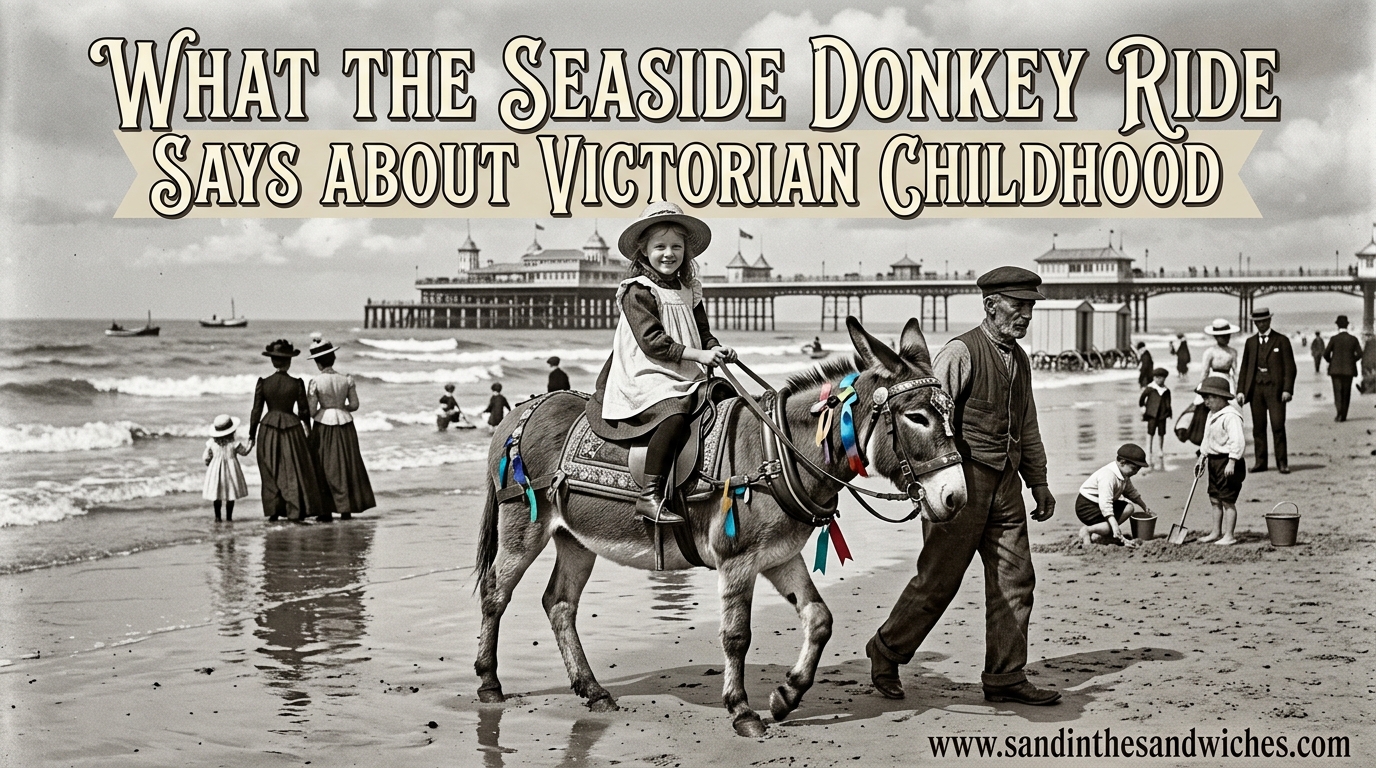
A child on a small grey donkey, sandals dangling above the sand, a sea breeze in their face. For most of us, that image is a postcard from a vanished British summer. It feels innocent, simple, almost weightless. But the seaside donkey ride was never just a ride. It was a small, slightly strange ritual that carried the contradictions of Victorian childhood on its back. A working animal, often borrowed from a cockle boat or a fish cart, was made to carry a child in a silk dress or a woollen bathing costume. The child laughed. The donkey walked. The Victorians took a photograph.
I have spent a long time reading about seaside holidays in the nineteenth century, and the donkey ride is one of those traditions that opens a much bigger story if you stop and look at it. In this piece, I want to show what the seaside donkey ride says about Victorian childhood, and why a penny ride on a beach in 1886 tells us so much about a world that was only just beginning to imagine that children deserved their own kind of pleasure.
Table of Contents
The Victorian Seaside Holiday: A World That Made the Donkey Ride Possible
Before the 1840s, the British seaside was mostly a place of work. Fishing villages, smuggler coves, salt pans. Few people went there for fun. The Victorians changed that, faster than almost anyone expected, and the donkey ride could not have existed without three big shifts happening at once.
The first shift was the railway. Cheap excursions from the new lines made the coast reachable for a day trip from inland cities. Trains carried trippers by the thousand to Blackpool, Scarborough, Brighton and Weston-super-Mare. A family that had never seen the sea could now step off a platform and be ankle deep in the surf by lunchtime.
The second shift was the Bank Holidays Act of 1871. For the first time, working people were given guaranteed paid holidays. A whole class of Britons suddenly had days off that did not belong to the church or the factory. They needed somewhere to go. The seaside, with its fresh air and its promise of health, was the obvious answer.
The third shift was medical fashion. Doctors such as Richard Russell had been prescribing seawater and sea air for decades. By the time ordinary families reached the coast, sea bathing was already seen as morally good, as well as bracing. A seaside holiday was framed as healthy, respectable and improving. Parents could justify the train fare as a tonic for pale, town-raised children.
With those three shifts in place, the Victorian seaside holiday exploded. And into that world stepped the donkey, already there from the working life of the beach, ready to be repurposed for a new kind of customer.
Where the Seaside Donkey Ride Actually Came From
The donkey did not arrive on the beach as a children’s ride. It arrived as a working animal. On the Somerset and Welsh coasts, small, hardy donkeys had long been used to pull carts of cockles, fish and luggage down to the water. The same animals moved baskets of fresh catch up to market. They were part of the working coastline long before any child climbed onto one.
At some point, almost certainly in the 1880s, someone realised that those same donkeys could be rented to tourists. Children paid a penny or two to be led along the sand in a string of perhaps six donkeys, each with a tiny rider perched on a padded saddle. The earliest firm record is often given as Weston-super-Mare in 1886, with Bridlington following in 1895. By the 1890s, the donkey string was a fixture of almost every major resort beach.
This is an important detail. The seaside donkey ride was not invented as a children’s attraction. It was improvised out of working life. A working animal that pulled cockle carts all winter was borrowed, in summer, to give working-class children the feeling of sitting above the sand, looking down at the waves. That origin matters, because it is the key to what the ride really meant.
What the Seaside Donkey Ride Says About Victorian Childhood
This is the heart of the question, and it is where the donkey ride stops being a charming postcard and starts being a small window onto a whole world. The ride says several things about Victorian childhood at once, and they are not all comfortable ones.
It shows that childhood was being invented as a separate stage of life
In the early nineteenth century, working-class children were seen as small adults. They worked in fields, down mines, up chimneys. They wore scaled-down versions of adult clothes. There was no clear line between the world of the child and the world of the worker.
By the 1880s, that line was being drawn. Childhood was starting to mean something different. Children were expected to play, to be protected, to have their own pleasures, to be sentimentalised. The donkey ride is one of the earliest, cheapest examples of a pleasure that was built purely for children. Not for adults watching children. For children themselves, sitting on a small animal, holding a frayed rope, feeling the sand shift under them.
For a working-class child in Manchester or the Black Country, that might have been the first time in their life they sat on top of a living animal that was not working. The donkey was working, of course, but the child was not. That tiny reversal mattered.
It shows a new kind of class mixing on the beach
The Victorian seaside was one of the few places where class lines genuinely softened. Middle-class families in expensive hotels, working-class trippers in rented rooms, day trippers from the train, all on the same stretch of sand. The donkey ride sat in the middle of that mixing. A penny or two was a price almost anyone could afford, but it was a price, not a free treat. It was a tiny piece of commerce that gave a working child a taste of a pleasure that richer children took for granted in pony traps and private gardens.
There is something democratic about that, and something limited. The donkey did not care which family the child came from. The sand felt the same under all of them. But the child still had to find the penny, still had to be brought to the coast, still had to be dressed for the day. The democratisation was real, and it was partial.
It shows the strange Victorian habit of putting children on top of working animals
This is the part that is hardest to look at directly. The Victorians were sentimental about children and brutal about animals in ways that look very strange to us now. A child in a frilled bonnet sitting on a small, tired donkey, with the beach photographer calling for everyone to smile, captures both sides of that at once.
Welfare campaigners in the late nineteenth century, including the SPCA, repeatedly raised concerns about the condition of beach donkeys. Court cases from Weymouth in 1866, 1877 and 1888 describe animals that were overworked, underfed and beaten. The very same era that produced the first RSPCA prosecutions also produced thousands of postcards of laughing children on donkeys. Both things are true. The donkey ride is a perfect small example of Victorian Britain in the late 1800s: tender towards the child, casual about the animal, sentimental in the photograph, harsh in the yard.
This is not a reason to cancel the tradition. It is a reason to read the photograph more carefully. The smile on the child’s face and the worn hooves of the donkey are part of the same image.
It shows how pleasure itself was being commercialised
The donkey ride was one of the first explicitly commercial children’s pleasures in Britain. You paid, you rode, you went back to your family with a memory. The Victorian seaside is sometimes painted as a world of innocent fun, but it was also where modern leisure was being invented. Punch and Judy shows, deck chair hire, ice cream sellers, bathing machines, photo booths, donkey rides. All of them were small businesses. All of them turned play into product.
The donkey ride is the earliest and the most affecting of these. A child on a working animal, sold as a moment of joy, is the whole late-Victorian leisure economy in one image.
What It Actually Felt Like to Be That Child
It is easy to write about the seaside donkey ride as a symbol. It is harder to remember that there was a child on top of the donkey, and that the ride felt like something to them.
For a working-class child in the 1880s or 1890s, the seaside holiday might happen once a year, if that. The donkey ride was the peak of the day. You queued with your brothers and sisters. You climbed up onto the broad, warm back of an animal that smelled of salt and harness. The donkey boy walked on ahead, leading the string. The sand gave a little under each step. The sea hissed. Your legs swung, because your feet did not reach the stirrups.
For many children, that was their first time on any animal. For most, it was their first time on anything larger than a dog. Parents remembered it for the rest of their lives. People born in the 1880s and 1890s, writing much later, often return to the donkey ride as the sharpest image of their childhood. Not the pier. Not the Punch and Judy. The donkey.
That emotional weight is real. A small, cheap, slightly shabby moment had the power to organise an entire childhood memory. That is one of the most telling things the seaside donkey ride says about Victorian childhood. Children did not need elaborate toys. They needed a different texture under them, a different view, a small piece of trust in the animal and the boy walking it.
The Legacy and Slow Decline of the Beach Donkey
The donkey ride never really went away. Through the twentieth century it carried on, in thinner and thinner numbers, at resorts like Blackpool, Scarborough, Weymouth, Mablethorpe and Cleethorpes. There were welfare reforms, weight limits for child riders, rest periods for the animals, and many of the worst practices died out.
But the tradition has been under pressure for decades. A 2017 petition to ban beach donkey rides gathered more than 110,000 signatures. Several councils have removed licences. Blackpool ended its rides in 2019. Each summer brings fresh debate about whether the tradition is a living piece of British heritage or a leftover cruelty dressed up in fairy lights.
For the Victorians, the question did not really exist. The donkey worked, the child laughed, the postcard was sent. For us, the donkey ride is something we have to look at twice, the way we look at many Victorian images of children. We see the joy, and we see the cost. The tradition is still here, smaller and more cautious than it was, and that caution is itself part of the long story of how British childhood has changed since the 1880s.
Conclusion
The seaside donkey ride looks like a small thing, and it is. A child, an animal, a strip of sand, a penny. But the seaside donkey ride says a great deal about Victorian childhood. It tells us that childhood was being carved out as a protected, sentimental stage of life. It tells us that working-class families were starting to have their own holidays, paid for in tiny sums. It tells us that leisure was being turned into a market, and that children were its newest customers. It tells us that the Victorians could be tender about a child on a donkey and careless about the donkey at the same time. None of that is comfortable, and all of it is true. A small ride on a small animal, repeated millions of times across a hundred British beaches, holds a surprisingly honest picture of a whole age.
FAQs
What did the Victorians do at the seaside?
Victorian families went to the seaside for sea bathing, walking on the pier, watching Punch and Judy shows, hiring deck chairs, eating fish and chips, taking photographs, and letting children ride donkeys along the sand. The donkey ride was one of the cheapest and most popular pleasures of the day, and one of the few built specifically for children.
When did seaside donkey rides start in Britain?
The first well-documented commercial donkey rides for children appeared in the 1880s, with Weston-super-Mare often given as the earliest recorded location in 1886, followed by Bridlington in 1895. The donkeys were originally working animals used to pull carts of cockles and fish, and were repurposed for children once seaside holidays became popular.
What is the tradition of the donkey rides at Weymouth Beach?
Weymouth Beach has one of the oldest continuous donkey ride traditions in Britain, going back to the mid-nineteenth century. The Downton family ran rides there for generations, and the tradition was famously the subject of court cases in 1866, 1877 and 1888 over the treatment of the animals. Weymouth still runs donkey rides today, although under tighter welfare rules.
What were seaside holidays like in the past?
Seaside holidays in the Victorian and Edwardian periods were a mix of fresh air, performance, fashion and small commercial pleasures. Visitors arrived by train, hired bathing machines, walked the promenades, watched Punch and Judy, ate ice cream, queued for donkey rides and took formal photographs in their best clothes. For working-class families, a day at the seaside was often the highlight of the year.