
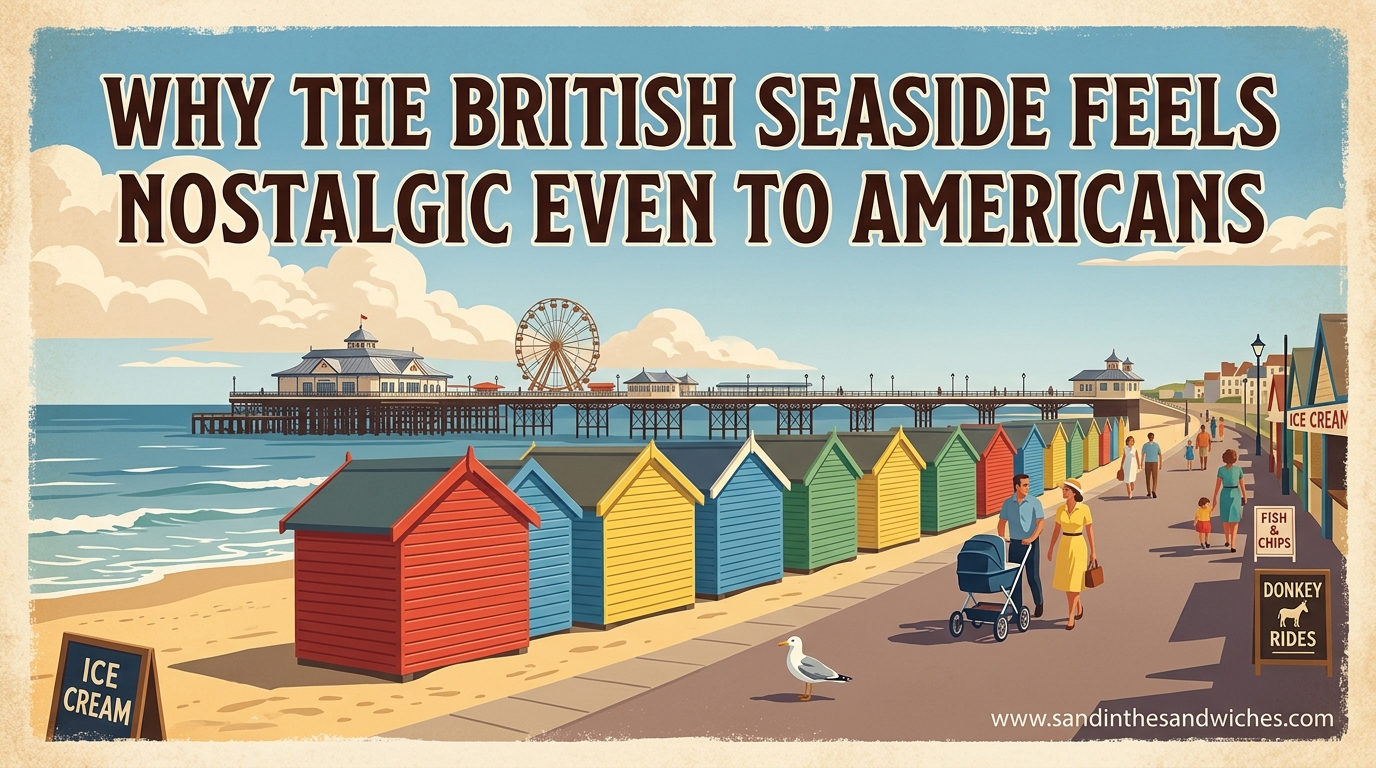
I’ve spent the last three months researching why the British seaside feels so nostalgic even to Americans, and the answer turned out to be far stranger than I expected. It is not just about piers and fish and chips. New research from the University of Cambridge and the University of Essex suggests that coastlines have a measurable effect on our brains, and that humans in the UK, the US, and beyond all tend to feel more nostalgic standing by the sea than standing in any other landscape. That shared response is the seed of something I want to unpack: how a place many Americans have never visited can still feel like a half-remembered childhood.
If you have ever watched a black and white film set in Brighton, scrolled past an Instagram reel of Weymouth beach at sunset, or simply felt a strange tug when someone mentioned Blackpool, you already know what I mean. The British seaside is a place that Americans often feel they recognise, even when they have never set foot on a pebbled shore. This article is my attempt to explain that feeling, drawing on the latest research, the history of British seaside holidays, and the cultural threads that travel across the Atlantic.
My focus here is on the question: why does the British seaside feel so nostalgic even to Americans? I will look at the science of “blue places,” the history of British seaside resorts, the sensory details that make the experience distinctive, and the American angle that no other article on this topic has really tackled. By the end, I hope you will understand both why the British seaside is so emotionally powerful and why that power has crossed an ocean.
Table of Contents
Why the British seaside feels so nostalgic even to Americans: a quick answer
The British seaside feels nostalgic even to Americans because coastal environments trigger a built-in emotional response in human brains, and British seaside culture has, over more than 200 years, accumulated a dense layer of sensory and cultural meaning that Americans absorb through film, television, family history, and social media. A 2025 study from the University of Cambridge and the University of Essex found that people in both the UK and the US are more likely to feel nostalgic by the sea, by a lake, or by a river than in forests, mountains, or fields. The research, published in Current Research in Ecological and Social Psychology, suggests that “blue places” have a particular combination of brightness, color saturation, and contrast that our brains find deeply satisfying.
For Americans specifically, the nostalgia is amplified by cultural exposure. British seaside imagery has appeared in countless films, television shows, and books that Americans have grown up with, from Brighton Rock to Call the Midwife. Add in inherited family memories, social media aesthetics, and the cross-pollination of British and American popular culture, and you have all the ingredients for nostalgia for a place many Americans have never actually been.
The science of “blue places”: why coastlines make us feel nostalgic
Coastal nostalgia is not just a poetic idea. In 2025, researchers at the University of Cambridge and the University of Essex published a study that put numbers to the feeling. They analysed 26 million tweets tagged with location data, then asked 5,000 participants in the UK and the US to describe their most nostalgic places. The result was striking: people were more likely to feel nostalgic about places by the sea, by lakes, or by rivers than about forests, mountains, or any other landscape feature.
Dr Elisabeta Militaru of Cambridge and Dr Wijnand Van Tilburg of Essex, the lead researchers, called these environments “blue places.” Their work argues that coastlines combine several visual properties that our brains process with unusual ease. Brightness is one: water reflects light in a way that creates wide, open horizons. Color saturation is another: the strong blue of a clear sea or the grey of a choppy North Sea channel is visually distinct. Contrast, too, plays a role: the line where land meets sea, or where waves meet pebbles, gives our eyes something to lock onto.
Fractal structure: why coastlines feel “just right”
One of the most interesting findings in the Cambridge research concerns fractal structure. A fractal is a pattern that looks similar at different scales: think of the way a fern leaf echoes the shape of the whole plant, or the way a coastline has a similar jaggedness whether you look at it from a satellite or with your toes in the sand. The Cambridge team found that coastlines have a moderate fractal structure, neither too simple nor too chaotic. That seems to be the sweet spot for the human brain.
Dr Van Tilburg has suggested that coastlines offer an optimal level of visual complexity. Too simple, and a landscape bores us. Too complex, and it stresses us. The fractal structure of a coastline, with its repeating patterns of waves, shells, pebbles, and shapes, gives our eyes and our minds just enough to work with. That is one reason why staring at the sea can feel meditative, and why a photograph of a pebbled British beach can feel almost instantly calming.
The psychological benefits of place nostalgia
The Cambridge research also looked at what place nostalgia actually does for us. Drawing on 250 existing studies, the team concluded that feeling nostalgic about a place, particularly a coastal place, has measurable benefits. People who feel nostalgic about a place report higher self-esteem, a stronger sense of social connection, and a deeper sense of meaning in life. Nostalgia, in other words, is not a sad or backward-looking emotion. It is a resource.
For Americans looking at the British seaside from across an ocean, this is part of the explanation. The brain is not simply being sentimental. It is reaching for a kind of emotional anchor, a sense of belonging that the coastal environment seems to provide more reliably than almost any other setting. That is why a black and white photograph of Scarborough can make a viewer in California feel something close to homesickness, even if they have never been to Yorkshire.
Why we are wired to feel nostalgic about water
Humans have an evolutionary relationship with water that goes back hundreds of thousands of years. Coastlines and rivers were sources of food, transport, and trade. They were also boundaries: the edge of the known world, the place where one kind of landscape turned into another. Some researchers argue that our comfort around water is partly a reflection of this long history. Others point to the way water engages multiple senses at once: the sound of waves, the smell of salt, the feel of a breeze, the sight of light dancing on a surface.
Whatever the deeper explanation, the practical result is clear. Coastal environments reliably produce strong emotional responses. The British seaside, with its piers, promenades, arcades, and ice cream stalls, layers additional meaning on top of that built-in response. For Americans, that layered meaning arrives pre-loaded with cultural associations, which is why the feeling of nostalgia can show up even without direct experience.
The history of the British seaside: how a working class holiday became a national myth
To understand why the British seaside feels so nostalgic, it helps to know how it came to feel that way. The British seaside is a relatively modern invention. Until the 18th century, the coast was a place of work, fishing, and trade. It was not somewhere ordinary people went for fun. The transformation of the coast into a place of pleasure is one of the more surprising cultural shifts in British history.
Sea bathing and the birth of the resort (1730s to 1830s)
In the 1730s, doctors in Britain began to promote sea bathing as a cure for various ailments. Scarborough, on the Yorkshire coast, claims to be the first British seaside resort, opening its spa waters to visitors in the 1700s. Brighton, then a small fishing village, became fashionable after the Prince Regent, later King George IV, began to visit in the late 18th century. The Royal Pavilion, with its onion domes and Indian-inspired architecture, still stands as a monument to that early fashionable period.
For most of the 18th century, however, the seaside was a playground of the wealthy. Sea bathing was serious business, often prescribed by doctors and carried out in private booths wheeled into the water by horses. The idea that ordinary working people would travel to the coast for pleasure would have seemed absurd.
The railway revolution (1840s to 1900s)
That changed with the railways. In the 1840s, new lines began to connect inland industrial cities like Manchester, Liverpool, and Sheffield to the coast. By the 1880s, towns like Blackpool, Morecambe, and Southport had become destinations for working class day trippers. Blackpool’s first railway station opened in 1846, and the town’s population swelled each summer with factory workers, mill girls, and miners’ families on their annual holiday.
This was the period when many of the British seaside’s most recognisable features appeared. Pleasure piers were built at seaside towns across the country from the 1860s onwards, partly in response to a ban on rollercoasters at Bank Holiday fairs. Blackpool Tower, modelled on the Eiffel Tower, opened in 1894. The amusement arcades, donkey rides, and Punch and Judy shows that still define the British seaside all took shape in this Victorian golden age.
Wakes weeks and the working class holiday (1900s to 1960s)
By the early 20th century, the British seaside holiday had become a working class institution. In the industrial north and midlands, factories would close for a week or two each summer for the annual “wakes week,” a tradition dating back to medieval holidays. Workers would pack onto trains with their families, head for the coast, and stay in boarding houses or, later, holiday camps like Butlins (opened 1936) and Pontins.
This was the period that created the deepest layer of British seaside nostalgia. Generations of children spent their summer holidays on rainy beaches in Blackpool, Scarborough, or Skegness, eating fish and chips out of paper, riding donkeys, and falling asleep in deckchairs. The sensory details of those trips, the smell of vinegar, the sound of seagulls, the feel of sand between the toes, became the emotional raw material of a national memory.
The Jet Age and the long decline (1970s onwards)
The decline of the British seaside began in the late 1960s and accelerated through the 1970s. In 1969, the first package holidays to Spain and Greece became widely affordable. By the mid-1970s, two million Britons a year were flying to the Mediterranean for guaranteed sun. Domestic seaside towns, dependent on the working class trade that had sustained them for a century, began to lose visitors.
The figures tell the story. Blackpool still gets around 20 million visitors a year, but its population has fallen, and it is currently the third most deprived local authority in England. Many smaller resorts, from Morecambe to Cleethorpes, have struggled with boarded-up shops, declining seafront hotels, and the loss of generational trade. The Romantic poet John Betjeman captured the appeal of these faded resorts, and their decline has been a recurring theme in British culture ever since.
Regeneration and the new British seaside
Since the 2000s, there has been a slow but real regeneration of the British seaside. Towns like Margate (with the Turner Contemporary gallery, opened 2011), Hastings, and Folkestone have attracted artists, small businesses, and a new kind of visitor. Blackpool has invested in new attractions, including the Blackpool Central development. The rise of the “staycation” during and after the COVID-19 pandemic gave a boost to British coastal tourism that has, in many places, lasted.
And yet the regeneration has not replaced the older British seaside so much as added a new layer on top of it. The pebbled beaches, the fish and chip shops, the arcades, and the faded guesthouses are still there. The regeneration has happened alongside the decline, not instead of it. That is part of why the British seaside is so evocative: it is a place where past and present coexist, sometimes uneasily, often beautifully.
The sensory world of the British seaside: smells, sounds, and tastes
What makes the British seaside feel so different from an American beach? Part of the answer is sensory. The British seaside has its own smells, sounds, tastes, and textures, and they are not quite like anything else.
The pebbled beach, the windbreak, and the unpredictable weather
One of the most distinctive features of the British seaside is the pebbled beach. From Brighton to Southsea, from Whitstable to St Ives, much of the British coast is shingle rather than sand. Walking on it is a particular sensation: noisy, slightly uncomfortable, and very different from the soft sand of a Florida or California beach.
The weather is another distinguishing feature. The British seaside is rarely warm in the way Americans expect from a beach. Even in July, temperatures on the east coast of England can hover around 18 to 20 degrees Celsius, with a brisk wind off the North Sea. Families bring windbreaks, layers of clothing, and a particular British determination to enjoy themselves regardless. The black and white seaside photographs of the 1950s and 1960s, with men in shirtsleeves and children in cardigans, capture this quality perfectly.
Piers, promenades, and deckchairs
The British pier is one of the most photographed pieces of architecture in the country. Victorian engineers built pleasure piers at seaside towns up and down the coast, partly to allow boats to dock, partly to give visitors somewhere to walk. Today, around 50 pleasure piers survive in the UK, including the famous Brighton Palace Pier, Blackpool’s three piers, and the West Pier in Brighton, which has stood as a burnt-out ruin since 2003 and has become an accidental monument to seaside decline.
Promenades and deckchairs are equally distinctive. The British seaside is built for walking and sitting: long, flat seafront paths lined with benches, and tall striped deckchairs that you can rent by the hour. Sitting in a deckchair on a windy British beach, wrapped in a cardigan, eating a Flake 99, is one of the most British activities there is. It is also one of the most photographed.
Fish and chips, Flake 99s, and seaside rock
Food is part of the British seaside’s identity. Fish and chips, wrapped in paper and eaten out of hand, is the most famous dish. Less famous, but equally British, is the Flake 99, a soft serve ice cream with a Cadbury Flake chocolate bar stuck into it, sold from kiosks at almost every British seaside town. There is also seaside rock, a hard, tubular candy with words like “Blackpool” or “Brighton” written through the middle in coloured letters.
These foods are not sophisticated. They are not meant to be. They are part of the seaside’s democratic, working class character, and they are part of why the British seaside feels so familiar even to people who have never been. American visitors to British seaside towns often comment on the fish and chips first: it is better, fresher, and more central to the experience than they expected.
Punch and Judy, penny slots, and the amusement arcade
The British seaside is also home to a set of small, distinctive entertainments. Punch and Judy shows, with their bellowing Mr Punch and squeaking crocodile, have been performed at British beaches since the 17th century. Donkey rides, where children take turns sitting on a string of ponies along the shoreline, are still a feature of many resorts. Crazy golf, with its putting greens, windmills, and occasionally a static dinosaur, is a British seaside staple.
Then there are the penny slots, the two pence machines, and the amusement arcades that line the promenades of Blackpool, Margate, and Great Yarmouth. They are loud, garish, and not to everyone’s taste, but they are part of the British seaside experience. Martin Parr, the British photographer, made them the subject of his 1986 book The Last Resort, documenting the New Brighton resort in Merseyside. His photographs capture the slightly chaotic, working class quality of the British seaside better than almost any other visual record.
Why Americans specifically feel nostalgic for the British seaside
Now to the question at the heart of this article: why does the British seaside feel nostalgic even to Americans, who have their own extensive and varied coastlines? Americans have New England beaches, the California coast, the Gulf Coast, and the Florida Keys. Yet many Americans feel a particular, almost irrational pull toward the British seaside, even when they have never been.
There are several reasons, and they overlap.
American beach culture and British seaside culture are not the same
The first thing to understand is that American and British coastal experiences are genuinely different. American beaches are, on the whole, warmer, sandier, and more oriented around swimming, surfing, and sunbathing. The British seaside is colder, pebble-strewn, and more oriented around walking, sitting, eating, and looking.
That difference is part of the appeal for Americans. The British seaside offers something American beaches do not: a slower, more sensory, more layered experience. The pier, the deckchair, the Flake 99, the pebbled beach, the Victorian architecture, the slightly faded grandeur, all combine to create an atmosphere that is recognisably “old” in a way American beaches, most of which are relatively recent, are not.
For Americans used to wide, sandy, sun-drenched coastlines, the British seaside can feel like stepping into a different century. That sense of stepping out of the present is itself a trigger for nostalgia, even if you have no specific memories of the British seaside to feel nostalgic about.
British seaside in American film and television
Another reason Americans feel nostalgic for the British seaside is that they have already seen it, on screen. British seaside towns appear throughout American-accessible film and television, and many of those appearances emphasise the most evocative, nostalgic qualities of the coast.
Films like Brighton Rock (1948 and 2011), The Trip (2010), Mrs Henderson Presents (2005), and countless British rom-coms have used seaside towns as backdrops. American-set films sometimes use the British seaside as a stand-in for a more general “old Europe” feeling. Television shows from Call the Midwife to Doc Martin to Broadchurch have made British coastal towns visible to American audiences. For viewers in California or Texas, these are their first images of the British seaside, and they stick.
There is also a broader cultural influence. British period dramas, from Downton Abbey to Victoria, have made American audiences hungry for British visual culture in general. The British seaside is part of that visual culture: faded grandeur, deckchairs, pebbled beaches, and a sense of an older, slower world. Once that aesthetic is in your head, the actual British seaside, when you encounter it, feels like returning to somewhere you have been before.
Inherited nostalgia: Americans with British ancestry
For many Americans, the nostalgia is more direct. Roughly 20 to 30 million Americans claim some British ancestry, and for them, the British seaside can carry an inherited emotional weight. A grandmother’s stories of childhood holidays in Blackpool, a great-grandfather’s postcard from Brighton, a family legend about a relative who ran a guesthouse in Scarborough: these fragments of family history create a sense of connection to a place the listener has never been.
Researchers sometimes call this “inherited nostalgia”: an emotional attachment to a place based not on direct experience but on stories, photographs, and objects that have passed down through a family. It is particularly common in transatlantic contexts, where families have moved between Britain and America over several generations, and it can be surprisingly powerful. An American whose grandmother grew up in Blackpool may feel a deeper pull to the town than a British person who has simply visited once.
Social media and the British seaside aesthetic
In the last decade, social media has added a new layer to American nostalgia for the British seaside. Instagram and TikTok are full of British seaside content: pastel-coloured beach huts in Whitstable, vintage seaside posters from the 1950s, drone shots of Cornwall’s turquoise bays, and reels set to nostalgic music of families eating fish and chips on windy promenades. American users encounter this content constantly, and the cumulative effect is to build a visual and emotional vocabulary around the British seaside.
Some of this content is aspirational: it shows the British seaside at its most photogenic, with the kind of light and weather that produces striking images. Some of it is satirical: videos poking fun at the British beach experience, with its windbreaks and chip shops and grey skies. But either way, it exposes American viewers to the British seaside aesthetic in a way previous generations could not access. By the time they actually visit, they may feel that they are recognising something they have already seen, which is itself a trigger for nostalgia.
Why “blue places” hit Americans as hard as the British
Finally, the Cambridge research offers a simple but powerful answer: blue places hit us all. The study found that American participants were just as likely as British ones to feel nostalgic about coastal landscapes. The visual and psychological mechanisms that make the sea a powerful emotional environment are universal, not culturally specific.
What is culturally specific is the layer of meaning that gets added on top. For the British, the seaside is a place of personal memory, family holidays, and a working class tradition. For Americans, the seaside is a place they have seen in films, read about in books, and absorbed through social media. The two are not the same, but they share enough visual and emotional cues that the same feeling of nostalgia is triggered in both.
That is the answer, in the end. The British seaside feels so nostalgic even to Americans because coastlines are emotionally powerful, because British seaside culture has been made visible to American audiences through a century of cultural exchange, and because humans, wherever they are, are wired to feel something deep when they stand by the sea.
What the British seaside looks like today: decline, regeneration, and the new nostalgia
The British seaside of the 2020s is a complex place. It is at once in decline and being reinvented. Many traditional resorts still struggle with low wages, seasonal work, and the loss of trade. Yet they are also home to a new generation of artists, food businesses, and remote workers who have moved in over the last decade.
Margate is probably the best-known example. Once a faded resort on the Kent coast, it is now a creative hub, with the Turner Contemporary gallery, vintage shops, seafood restaurants, and a thriving music scene. Similar stories can be told about Folkestone, Hastings, and parts of Blackpool. The new British seaside is rougher, more interesting, and more economically mixed than the old one.
There is also a practical issue that visitors to the British seaside have to navigate. The UK has had ongoing problems with water quality, particularly with raw sewage discharges into rivers and coastal waters. In 2023, there were more than 31,000 recorded sewage discharges in England. Some of the most affected beaches are in popular tourist areas. Visitors to the British seaside should check current water quality information before swimming.
None of this changes the nostalgic pull. If anything, the partial decline of the British seaside has intensified it. We tend to feel most nostalgic for things that are slipping away, and the British seaside, with its faded piers and peeling paint, fits that pattern perfectly.
Frequently asked questions about the British seaside and American nostalgia
Why are British seaside towns so run down?
British seaside towns declined mainly because cheap package holidays abroad became widely available in the late 1970s, causing domestic tourism to fall sharply. Decades of underinvestment followed, and many towns are now among the most deprived areas in England, with seasonal work, lower wages, and ageing populations all contributing to visible signs of decline.
What is the history of the British seaside resort?
British seaside resorts date from the 18th century, when sea bathing was promoted as a cure for various ailments. The 19th century brought railways, piers, and working class visitors, peaking in the 1950s and 1960s when factory wakes weeks gave workers paid summer holidays. The 1970s brought the package holiday boom abroad, and many resorts have struggled since.
What do British people call the beach?
British people most commonly say the beach or the seaside. The coast is also used, as in going down to the coast. The word seaside is particularly British and is used to describe coastal holiday destinations rather than just the physical shore.
What is the most nostalgic British seaside town?
There is no single answer, but Blackpool, Scarborough, Brighton, and Whitstable are among the most often cited. Blackpool carries the strongest working class holiday memories, Scarborough is the oldest seaside resort, Brighton has the most literary associations, and Whitstable has become a modern symbol of the new British seaside.
Is the British seaside worth visiting in 2026?
Yes, the British seaside is worth visiting, though visitors should manage expectations around weather, beach quality, and infrastructure. Many towns have invested in regeneration, and the food, culture, and history are genuinely distinctive. Travellers should check current water quality information before swimming at affected beaches.
Final thoughts: the British seaside, and why the nostalgia travels
The British seaside is one of the most layered cultural landscapes in the world. It is a place of personal memory, national history, sensory richness, and ongoing change. And it is a place that Americans, who have their own wonderful coastlines, have come to feel they know. That is why the British seaside feels so nostalgic even to Americans: it is familiar, layered, and quietly waiting to be remembered.
Next time you find yourself scrolling past a photograph of a pebbled British beach, or watching a film set in a faded seaside town, pay attention to the feeling. It is not just sentimentality. It is a small piece of one of the most interesting cultural transfers in the modern world. The British seaside has crossed an ocean, and the nostalgia has travelled with it.