
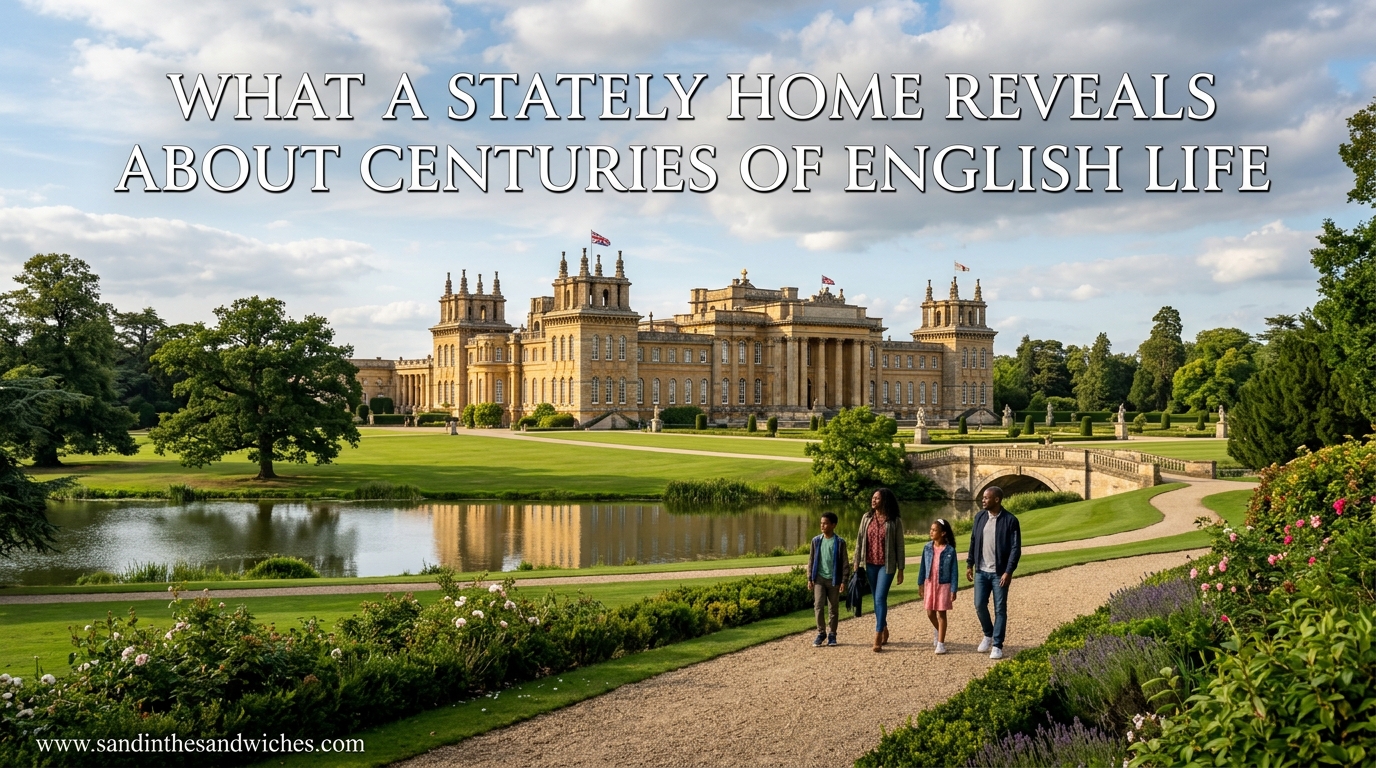
A stately home is a large English country house, typically built between the mid-sixteenth and early twentieth centuries by aristocratic families to display wealth, host political gatherings, and serve as the social seat of a landed estate. When you walk through one of these houses today, you are reading a four-hundred-year diary of English life — its politics, its class structures, its family ambitions, and its hidden labor. Understanding what a stately home reveals about centuries of English life means looking beyond the chandeliers and portraits to see how each room, garden, and corridor documents a specific moment in the nation’s history.
These houses were never just residences. They were the headquarters of families who shaped Parliament, commanded armies, and influenced fashion, food, and manners across the British Isles. Every architectural choice — from the position of the front door to the layout of the servants’ wing — tells us what the family valued, who they wanted to impress, and how they organized the people who kept the household running.
In this article we’ll walk through what a stately home reveals about English life, era by era and room by room. We’ll cover the definition of the stately home itself, the Golden Age that produced so many of them, the architectural fingerprints left by Tudor, Stuart, Georgian, Victorian, and Edwardian builders, the hidden world below stairs, the dramatic decline of the twentieth century, and how these remarkable survivors are preserved in 2026.
Table of Contents
What Is a Stately Home? A Clear Definition
A stately home is a substantial English country house built by a wealthy landowning family, large enough to host extended households, political gatherings, and elaborate entertaining. The term itself is surprisingly recent. It comes from the poet Felicia Hemans, whose 1827 poem “The Homes of England” described “the stately Homes of England” as symbols of national identity.
Not every old house qualifies. A manor house is typically smaller — the principal residence of a medieval manor, often home to a single gentry family. A stately home, by contrast, is the seat of major aristocratic wealth, with dozens of rooms, formal gardens, and usually a substantial service wing. The two terms are often used interchangeably today, but historians draw a clear line based on scale, social function, and the status of the owning family.
Most stately homes were built or significantly rebuilt between roughly 1550 and 1914. They were constructed by peers of the realm, wealthy baronets, and successful merchants who had bought their way into the landed gentry. Their houses were statements — architectural arguments that the family mattered.
What a stately home reveals about centuries of English life starts with this simple fact: the house was never private in the modern sense. It was a public stage where power was performed, alliances were sealed over dinner, and the local community was employed, housed, and governed from the estate office.
The Golden Age of the English Country House
The Golden Age of the English country house stretched from the Elizabethan era of the late 1500s through the long Edwardian summer that ended with World War I. For more than three centuries these houses grew larger, more elaborate, and more central to national life.
Several forces converged to make this possible. The Dissolution of the Monasteries under Henry VIII released huge tracts of land to ambitious families. The growth of global trade and, later, the Industrial Revolution created new fortunes that could be converted into estates. And a legal device called strict settlement, combined with primogeniture, kept those estates intact across generations rather than being divided among heirs.
At their peak, the largest estates functioned almost as small towns. Blenheim Palace, Chatsworth, and Castle Howard employed hundreds of people — gardeners, gamekeepers, maids, footmen, grooms, dairymen, and estate workers. The big house was the local economy. If it thrived, the village thrived. If it faltered, the village faltered.
The country house also served as a political machine. Before the Reform Acts of the nineteenth century, landowners effectively controlled Parliamentary representation for their districts. A great house was the visible proof of that power — a place where voters were hosted, candidates were introduced, and political futures were decided over port and shooting parties.
This is what makes the English country house social history so revealing. You cannot separate the architecture from the politics, or the gardens from the economics. They were one interconnected system, and the house was its headquarters.
Windows into Different Eras: How Architecture Tells England’s Story
The clearest way to understand what a stately home reveals about English life is to read its architecture chronologically. Each era left distinctive fingerprints — and each style reflected a specific political and social moment.
Tudor and Elizabethan Houses: Power on Display
Tudor stately houses like Hardwick Hall and Burghley House burst with decorative ambition. Long galleries, prodigy windows, and elaborate plasterwork announced that a family had arrived. The great hall survived as a symbolic heart of the house, but it had shifted from a medieval dining space to a ceremony room where the family’s lineage was put on display through portraits and coats of arms.
Elizabethan houses also reveal how unstable power still was. Many retained moats, gatehouses, and battlements — not for real defense, but to signal authority in a century where a nobleman’s seat needed to look like it could hold its own if the political winds turned.
Stuart and Jacobean Houses: Refinement and Order
Under the Stuarts, English country house architecture grew more ordered and classically literate. Inigo Jones introduced true Palladian principles with the Queen’s House at Greenwich, and Jacobean builders began to favour symmetry, classical columns, and restrained ornament over the busy exuberance of Elizabethan work.
What this reveals is a society that was growing more confident and more self-conscious about taste. The Jacobean country house was about demonstrating cultivation as much as wealth — a family that could quote Vitruvius and display a properly ordered facade was making a claim to intellectual authority, not just money.
Georgian Palladian Houses: Symmetry and Politics
The Georgian era produced the classic English country house image that most visitors recognise today. Palladian design — pioneered by Lord Burlington and William Kent in the early 1700s — emphasised strict symmetry, sash windows, porticoes, and restrained classical detailing. Holkham Hall and Houghton Hall are textbook examples.
Georgian houses reveal an intensely political society. The state rooms were designed as settings for political entertaining — for hosting Ministers, foreign ambassadors, and the local MP candidates a peer was expected to support. The picture galleries were often filled with Old Masters purchased on the Grand Tour, signalling cosmopolitan taste and moneyed access to continental culture.
The gardens changed too. Lancelot “Capability” Brown swept away formal parterres and replaced them with naturalistic landscapes of grass, lakes, and clumps of trees. These landscapes were enormously expensive to create — and that was the point. A Capability Brown landscape was visible proof that the owner could afford to move rivers and reshape nature itself.
Victorian Houses: Industrial Wealth and Gothic Revival
The Victorian country house tells a more conflicted story. On one hand, new industrial fortunes — from railways, manufacturing, and imperial trade — funded ever-grander houses. On the other, the Gothic Revival led by A. W. N. Pugin and John Ruskin rejected classical restraint in favour of medieval richness, religious seriousness, and moral weight.
Houses like Highclere Castle (the real Downton Abbey) and Kelham Hall show the result: multiple wings, towers, ornate carving, and a deliberate visual link to medieval Christianity. Victorian stately homes were also the first to install proper plumbing, gas lighting, and eventually electricity. The technology of the Industrial Revolution arrived at the front door even as the architecture pretended to look backward.
Edwardian Houses: The Last Flourish
The Edwardian era, from 1901 to 1914, was the swansong of the traditional stately home. Houses like the redesigned Buckingham Palace interiors and country houses updated for the new King’s social whirl show extraordinary luxury — but also a system on the edge of collapse.
What Edwardian houses reveal is a class trying to ignore the future. Servants were still plentiful, but their numbers had begun to shrink. Inheritance taxes were rising. The political mood was turning against unearned aristocratic privilege. The Great House of 1910 looked magnificent — but it was living on borrowed time.
Life Below Stairs: The Hidden Workforce
No part of a stately home reveals English social history more starkly than the servants’ wing. Life below stairs in a British manor was its own complete world, with its own hierarchy, its own dining room, its own rules, and its own language.
A great Victorian country house might employ fifty or more indoor servants. At the top sat the butler, who managed the wine cellar, the silver, and the male staff. Beside him was the housekeeper, who ran the linen, the female staff, and the household accounts. Below them came the cook, the lady’s maid, the valet, the footmen, the housemaids, the kitchen maids, the scullery maids, and the stillroom maids. Stable staff, gamekeepers, and gardeners worked outdoors.
The physical layout of the house enforced this hierarchy. Servants’ corridors, back stairs, and hidden passageways let staff move through the building without being seen by the family. The servants’ hall was their dining room. The housekeeper’s room and the butler’s pantry were their private offices. Servants’ bedrooms — small, plain, often in the attic — were a world away from the family’s suites below.
What this reveals about English life is profound. A whole class of people lived their entire working lives inside these houses, serving a family they rarely spoke to outside of formal duties. Their hours were brutal — often sixteen-hour days with one half-day off a week. Pay was modest. But for many rural workers, service offered food, lodging, and a degree of security that farm labour could not match.
The country house documented England’s class structure in brick and stone. When you walk through a preserved servants’ wing today — at houses like Audley End or Erddig — you are walking through the most honest record we have of how most people in these houses actually lived.
What Each Room Reveals: A Microcosm of English Life
One of the most overlooked ways to read what a stately home reveals about English life is room by room. Each space had a specific function, and each function reflected a particular aspect of family, politics, and society.
The state rooms — the saloon, the drawing room, the state bedroom — were the public face of the house. Their size, their decoration, and their art collections were all about projecting the family’s importance to visitors. A monarch might be hosted there. A daughter might be married off there. A political alliance might be sealed over dinner there.
The library reveals the family’s intellectual and political connections. Books were expensive status symbols, and a great country house library often contained everything from ancient classics to political pamphlets, estate records, and family correspondence. The library was also often where the men withdrew after dinner to drink port and discuss politics.
The nursery wing is one of the most poignant spaces. Here children were raised by nannies and governesses, largely separate from their parents. The nursery reveals how aristocratic childhood worked — and the complex role women played in managing these enormous households. A mistress of a great house was effectively the CEO of a small corporation, overseeing budgets, menus, staffing, and social strategy.
The chapel or private orangery reveals the family’s religious authority and its connections to the local parish. The walled kitchen garden, the stable block, and the dairy show the working economy that kept the household fed, dressed, and transported. Every room has a story about English life, if you know how to read it.
The Decline: Why So Many English Country Houses Fell
The decline of the English country house is one of the most dramatic stories in modern British social history. Between 1900 and 1975, more than 1,200 stately homes in England were demolished. Why did British estates fail so spectacularly?
The first blow was agricultural depression. From the 1870s onwards, cheap grain imports from North America drove down British farm incomes. Land that had generated comfortable rents for generations suddenly produced a fraction of its old return. Many estates were land-rich but cash-poor, and the rents no longer covered the upkeep of the house.
World War I devastated the system in two ways. Huge numbers of male servants enlisted and never returned — or returned unwilling to go back into service. The war also shifted the social mood. A country that had just buried a generation of young men had less patience for the conspicuous luxury of the country house weekend.
Taxation was the final blow. Inheritance tax, income tax, and the super-tax introduced in the early twentieth century rose sharply through both world wars. When a peer died, the family often faced a tax bill that could only be paid by selling land, contents, or the house itself. Many families auctioned off centuries of art and furniture in single, heartbreaking sales.
World War II made things worse. Hundreds of country houses were requisitioned by the military — as barracks, hospitals, evacuee housing, and command centres. Returning owners often found their houses damaged, damp, stripped of lead, and faced with repair bills they could not afford. Demolition sometimes cost less than restoration.
The emotional impact on the families who lost these estates is rarely discussed but very real. These houses had been family seats for three or four hundred years. Losing one was not just a financial blow — it was the loss of a family’s entire identity. Visiting a surviving house today, you are often walking through a story of survival as much as a story of wealth.
Modern Preservation: How Stately Homes Survive in 2026
The story of the stately home did not end with the demolitions of the twentieth century. Today, hundreds of these houses survive and thrive — but they do so in ways their original builders would barely recognise.
The National Trust, founded in 1895, has been the single most important force in saving English country houses. Through gifts, bequests, and outright purchase, the Trust now owns and opens hundreds of historic houses, gardens, and estates. English Heritage, founded later, looks after another major collection. A National Trust membership is now a near-universal feature of middle-class British family life, and heritage tourism generates billions of pounds for the UK economy each year.
The Downton Abbey effect has been a powerful secondary force. Since the show first aired in 2010, visitor numbers at country houses across Britain have risen sharply. People come to see the real settings behind the fiction — and many discover, in the process, that the historical reality is even more interesting than the drama.
Most surviving stately homes now operate as businesses. They host weddings, corporate events, film shoots, and holiday rentals. Many have added hotels, restaurants, and adventure playgrounds. The economic model that supports them is completely different from the one that built them — but the houses themselves endure.
Modern preservation has also begun a difficult and necessary reckoning with the darker histories embedded in these houses. The National Trust’s 2026 research on colonial and slavery connections has begun to make explicit what was previously left unsaid: that many of these great fortunes came, directly or indirectly, from the transatlantic slave trade, from Caribbean plantations, or from imperial exploitation. Honest preservation means telling that story alongside the architecture.
The future of heritage preservation in England depends on this honesty. Stately homes are treasures, but they are also documents. Reading them fully — including the parts that are uncomfortable — is the only way to keep them genuinely alive for the next generation.
FAQs
What is a stately home in England?
A stately home in England is a large country house, typically built between the mid-sixteenth and early twentieth centuries, that served as the seat of an aristocratic or wealthy landed family. The term comes from Felicia Hemans’ 1827 poem ‘The Homes of England’ and describes houses large enough to host political gatherings, employ dozens of servants, and function as the social and economic centre of a landed estate.
What is the difference between a manor house and a stately home?
A manor house is typically smaller and was historically the principal residence of a medieval manor, often home to a single gentry family. A stately home is larger, more architecturally ambitious, and was the seat of significant aristocratic wealth, with formal state rooms, extensive service wings, and landscaped grounds. The terms are often used interchangeably today, but historians distinguish them by scale and social function.
Why did British estates fail?
British estates failed due to a combination of agricultural depression from the 1870s, the loss of domestic servants during and after World War I, sharply rising inheritance and income taxes, and the damage caused by wartime requisition during World War II. More than 1,200 English country houses were demolished between 1900 and 1975 because owners could no longer afford the upkeep or the tax bills.
Do any houses like Downton Abbey still exist?
Yes. Highclere Castle, the real filming location for Downton Abbey, is a surviving Victorian stately home still owned by the Carnarvon family. Hundreds of similar houses across England remain standing, many now owned by the National Trust or English Heritage and open to the public. The Downton Abbey effect has boosted visitor numbers significantly since 2010.
How long have people been visiting stately homes?
People have visited stately homes for centuries. Even in the eighteenth century, polite visitors with letters of introduction could tour great houses to see the art collections and gardens. Mass public visiting began in earnest in the twentieth century as the National Trust opened houses to members, and heritage tourism is now a major part of the UK visitor economy.
Conclusion: Reading the Houses for Yourself
Understanding what a stately home reveals about centuries of English life means treating each house as a layered document. The architecture tells you what a family believed about itself in a specific decade. The state rooms reveal political ambition. The servants’ wing documents the class system that funded the whole enterprise. The gardens, libraries, and nurseries each add their own chapter to the story.
These houses survived agricultural depression, two world wars, crippling taxation, and the dismantling of the social order that built them. The ones still standing in 2026 are rare and precious survivors — fewer than half of the country houses that existed in 1900 are with us today.
When you next visit a National Trust property or an English Heritage site, take a moment to read the house, not just photograph it. Look at how the windows are arranged. Notice where the servants’ door sits. Imagine the family in the drawing room and the cook in the kitchen. Stately homes are the most complete physical record we have of how English families lived, worked, and saw themselves across four extraordinary centuries — and they have a great deal more to tell us, if we are willing to listen.