
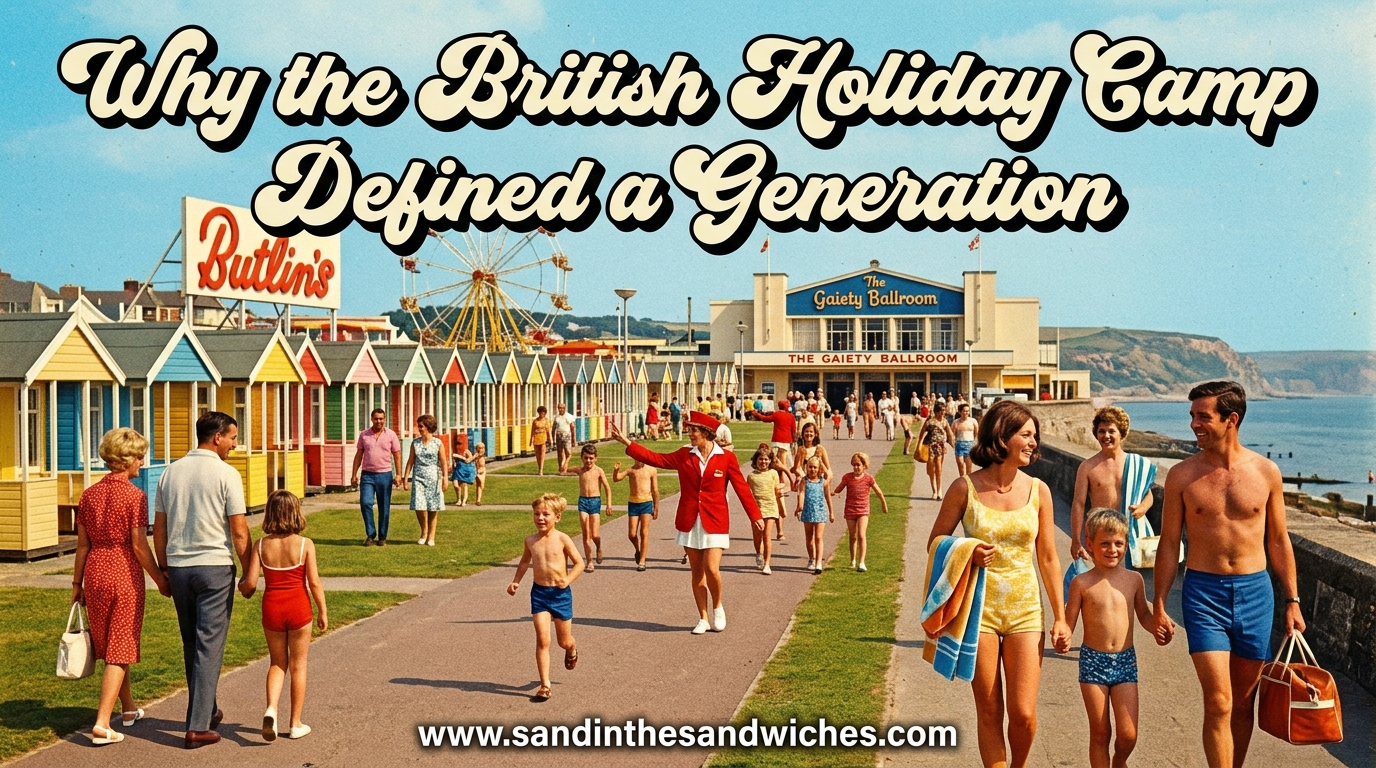
A British holiday camp is an all-inclusive seaside holiday accommodation, primarily in the United Kingdom, where guests stay in chalets on a self-contained site and receive meals, entertainment, and activities bundled into one weekly price. Billy Butlin opened the first purpose-built camp at Skegness in 1936, and within three decades the model had shaped how millions of working-class British families experienced their annual break. The question of why the British holiday camp defined a generation is not simply one of nostalgia or architecture. It touches on post-war social mobility, the democratisation of leisure, and the creation of a shared cultural memory that still echoes through British life in 2026.
For the parents and grandparents who first walked through those gates, the holiday camp offered something genuinely new: a week away from the factory floor, the pit or the mill, where everything from breakfast to bedtime was taken care of. Children roamed in packs between the funfair, the swimming pool and the amusement arcade without their parents fearing for their safety. By the peak of the golden age, Butlin’s alone was serving tens of thousands of holidaymakers every single week across multiple sites. This was not a niche phenomenon. It was mass leisure on an industrial scale, and it rewired what a generation of Britons expected from a holiday.
Table of Contents
What Was a British Holiday Camp?
A British holiday camp was a self-contained holiday resort where guests paid a single flat fee for a week’s accommodation, all meals, and on-site entertainment. The defining feature was the boundary: holidaymakers were encouraged, and in the early days sometimes required, to stay within the camp grounds for the duration of their stay. Everything they needed was inside the perimeter.
Accommodation was in rows of timber or precast concrete chalets, modest in size but functional, laid out in neat grids across the site. Meals were served in vast communal dining halls where thousands sat down together at fixed sittings. Entertainment ran from morning until late evening, with staff in brightly coloured uniforms orchestrating competitions, dances, cabaret shows and Bingo sessions. This was full board taken to its logical extreme, a complete holiday ecosystem designed so guests never needed to leave the gate.
The all-inclusive pricing model was the real breakthrough. At a time when most working-class families could afford only a boarding house in a rainy seaside town, the holiday camp offered weather-proof fun, guaranteed food, and structured activities for children under one predictable price. Half board and self-catering options arrived later as the market diversified, but the original promise was simple: pay one fee, get everything.
How Billy Butlin Built a Seaside Empire
William “Billy” Butlin was not the first person to run a holiday camp in Britain, but he was the first to industrialise the concept. Born in South Africa in 1899 and raised in Canada, Butlin arrived in England as a young man and made his early money running fairground stalls at travelling funfairs. He understood working-class customers because he had spent his career entertaining them for pennies at a time.
The story goes that Butlin spotted the gap in the market while running a fairground at Barry Island in the early 1930s. He watched holidaymakers trudge back to grim boarding houses at the end of each day, unhappy with landladies who locked them out between meals and complained if they returned with sand on their shoes. He reasoned that families would pay for somewhere that combined the fun of the fairground with decent accommodation and predictable food.
Butlin opened his first camp at Ingoldmells near Skegness in April 1936. He placed a single newspaper advertisement offering a week’s all-inclusive holiday for under three pounds. The advertisement pulled in over 10,000 enquiries. By the outbreak of war in 1939, Butlin’s was operating multiple camps and the holiday camp phenomenon had firmly arrived. Billy Butlin himself would go on to become a millionaire many times over, eventually receiving a knighthood for his services to the holiday industry and donating substantial sums to charity.
It is worth noting that Butlin did not invent the format from nothing. Cunningham’s Young Men’s Holiday Camp at Douglas on the Isle of Man had been running since 1894, and Caister Camp in Norfolk had been hosting holidaymakers under strict no-alcohol, no-Sunday-trading rules since 1906. Potters at Hopton-on-Sea, still operating today, traces its roots back to 1924. What Butlin did was scale the idea, brand it, and make it affordable to ordinary families who had never had a proper holiday before.
The Rivals: Pontins, Warner and the Battle for British Holidays
Billy Butlin’s success did not go unchallenged for long. Fred Pontin, a Liverpudlian stockbroker who had been running a chain of snack bars, opened his first holiday camp at Brean Sands in Somerset in 1946. Pontin’s model was broadly similar to Butlin’s, with chalet accommodation, communal dining and on-site entertainment, but Pontin pitched his camps as slightly smaller, slightly smarter, and slightly more genteel than his rival’s.
The two brands developed distinct identities that became part of British popular culture. Butlin’s Redcoats became the friendly, brash face of mass entertainment, while Pontin’s Bluecoats cultivated a marginally more polished image. Both companies trained young entertainers who would go on to national fame, and both ran their camps with the same basic formula of compulsory fun, structured activity, and communal living. Warner Leisure Hotels, the third major player, eventually moved upmarket and away from the traditional holiday camp model, focusing on adult-only country house hotels rather than family resorts.
Other operators came and went. Chancellor’s, Rusty’s, and a host of smaller independent camps dotted the British coastline. A few developed their own staff colours, including the short-lived Greencoats at some Warner sites. But by the 1960s the British holiday camp market was essentially a duopoly between Butlin’s and Pontin’s, with both chains operating dozens of camps and hosting well over a million guests every summer between them.
Redcoats and Compulsory Fun: The Entertainment Revolution
The genius of the holiday camp was not the chalets or the dining hall. It was the entertainment programme, and at the centre of that programme stood the Redcoats. Butlin’s Redcoats, easily spotted in their distinctive red blazers, were the hosts, activity leaders and morale officers of the camp. They ran the knobbly knees contests, taught ballroom dancing in the afternoon, refereed the donkey derbies, organised the beauty competitions, and ushered guests into the cabaret theatre each evening.
Pontin’s Bluecoats performed the same role under a different colour. The job became a coveted stepping stone for young performers. Cliff Richard worked as a Bluecoat at Pontin’s before his music career took off. Michael Barrymore, Dave Allen, Jimmy Tarbuck and Stephen Mulhern all spent time in coloured coats learning how to work a room of strangers. The training ground produced some of the most recognisable entertainers in British television history.
The entertainment ran to a strict timetable that guests came to know by heart. Morning brought the wake-up music broadcast across the camp and the announcements of the day’s competitions. Afternoons featured sports coaching, swimming galas and craft sessions for children. Evenings meant cabaret, Bingo, ballroom dancing and the famous Grand Finals of whatever competitions had been running all week. Critics called it compulsory fun, and the regimentation of it all became a running joke in British comedy. But for guests, especially children, that structure was precisely what made the experience feel safe, predictable and endlessly exciting.
The Redcoats created something that is harder to measure than meals served or chalets occupied. They manufactured a sense of community among strangers within hours of arrival. By the second day, families who had never met were competing together in house teams, cheering each other on at the talent show, and saving seats for each other at the evening cabaret. That engineered sociability was the real product, and it is the part former guests remember most vividly decades later.
Why 1945-1970 Was the Golden Age
The British holiday camp did not emerge from nothing in 1945, but the years immediately after the Second World War were when the format truly conquered the country. The Paid Holidays Act of 1938 had given millions of workers the legal right to a paid week off for the first time. The war interrupted that, with Butlin’s and Pontin’s camps requisitioned by the military, but when peace returned there was an enormous, newly entitled workforce looking for somewhere to go.
The camps reopened and expanded at speed. Butlin’s Skegness, Filey, Clacton, Pwllheli, Ayr and Mosney in Ireland each hosted thousands of guests per week during the summer season. At peak, Butlin’s claimed to be cooking millions of meals a year and serving 3.5 million eggs annually. The catering alone was an industrial operation on the scale of a small town. Mosney in County Meath, opened in 1948, was at one point the largest holiday camp in Europe.
What made this the golden age was the audience. The generation that filled those camps between 1945 and 1970 had lived through depression, war, rationing and austerity. For many of them, a week at Butlin’s or Pontin’s was the first proper holiday they had ever had. The chalet might have been small and the food institutional, but compared with a damp boarding house or a week at home doing the same old things, it felt like affordable luxury. The camps offered indoor swimming pools when most towns had none, live cabaret every night, and the simple miracle of being somewhere different with everything provided.
This was the democratisation of leisure in action. Activities that had once been the preserve of the wealthy, swimming pools, organised sport, evening entertainment, a change of scene, were packaged and sold to factory workers, miners, shop assistants and office clerks at a price they could afford. That is why the period sticks in the cultural memory. It was the moment when holidaying stopped being a middle-class privilege and became a normal part of British working life.
Why the British Holiday Camp Defined a Generation
This is the question the whole article turns on, and the answer is not simply that the camps were popular. They were popular, but so were many things that have faded without leaving a generational imprint. The reason the British holiday camp defined a generation is that it created a shared experience so intense, so uniform and so emotionally loaded that an entire cohort of Britons grew up with the same memories baked in.
Consider what children experienced. At a holiday camp in the 1950s or 1960s, a child could leave the family chalet in the morning, join a gang of new friends at the funfair, swim in the pool, enter the talent show, watch the evening cabaret with their parents, and fall asleep exhausted in a tiny bedroom they shared with siblings. They did this for a solid week, every summer, often at the same camp year after year. Forum discussions on Reddit’s AskUK and CasualUK communities, along with threads on Gransnet and Mumsnet, are full of former camp kids recalling the smell of the dining hall, the sound of the wake-up music, and the strange freedom of roaming a site where every adult seemed to know every child.
That childhood independence was central to the camps’ appeal and to their generational impact. Parents trusted the environment because it was enclosed, supervised and structured. Children learned to make friends quickly, navigate social situations without adults, and treat a week of communal living as normal. The regimentation that adults joked about, the fixed mealtimes, the organised competitions, the colour-coded entertainment schedules, was exactly what gave children the confidence to roam.
The multi-generational loyalty was real and measurable. Families returned to the same camp year after year, then brought their own children, and then their grandchildren. On forums, grandparents describe booking the same Butlin’s chalet block for three decades. That kind of repeat business created not just customers but communities of memory.
There was also a class dimension that is easy to miss from a modern distance. The holiday camp was one of the few places in post-war Britain where a miner from Durham, a factory worker from Coventry and a clerk from London could spend a week eating the same food, watching the same cabaret and competing in the same donkey derby. The camps flattened class distinctions for a week. Everyone wore a name badge, everyone queued for the same dining hall, and everyone’s children played together in the same pool. For a generation raised on sharp social hierarchies, that temporary equality left an impression.
Finally, the camps generated shared cultural references that an entire generation could trade. The knobbly knees contest, the glamorous granny competition, the cry of “Ooh, you are awful” from the cabaret, the Bluecoat giggle, the morning announcement that the pool was open, these became the lingua franca of working-class Britain. When people of a certain age meet and mention Butlin’s or Pontin’s, they do not need to explain what they mean. The reference is understood instantly because the experience was so widely shared.
The Decline: How Package Holidays Killed the Camp
The golden age did not last. By the mid-1970s the holiday camp model was under sustained pressure from a new competitor that offered something the camps could not match: guaranteed sunshine. Cheap package holidays to Spain, made possible by the rise of charter flights and the growth of resorts along the Costa del Sol and the Costa Blanca, gave British families a week abroad for not much more than a week at Butlin’s.
The package holiday undercut the camps on the very thing they had promised: an escape from British weather. A week in Torremolinos offered sun, sea and a swimming pool that did not need a roof. Once British tastes shifted towards foreign travel, the holiday camp’s all-inclusive model started to look less like affordable luxury and more like a compromise. Pontin’s and Butlin’s both struggled to adapt. Camps closed or were sold off. Mosney in Ireland shut its doors as a holiday camp in 2000. Many of the great names, Filey, Clacton, Margate, disappeared from the brochures.
The survivors pivoted. Butlin’s rebranded its remaining resorts as modern holiday parks, dropped the communal dining model in favour of self-catering apartments, and added big-name live music weekends. Pontin’s endured a more turbulent path, changing hands several times and closing more camps before its parent company announced the closure of its remaining sites in 2023. What survives today is recognisably descended from the original holiday camp, but the communal dining, the regimentation and the enclosed-site model that defined the golden age are largely gone.
FAQs
What is a British holiday camp?
A British holiday camp is a self-contained holiday resort, primarily in the UK, where guests pay a single all-inclusive price for chalet accommodation, meals in a communal dining hall, and on-site entertainment. The format was pioneered at scale by Billy Butlin at Skegness in 1936 and dominated British working-class leisure from the 1940s to the 1970s.
What does camp mean in British slang?
In British slang, ‘camp’ describes a style or performance that is exaggerated, theatrical and deliberately over-the-top, often associated with theatrical entertainment, pantomime and the end-of-the-pier tradition. The holiday camp’s cabaret culture, with its glamour competitions and variety acts, leaned heavily into this sensibility.
How rich was Billy Butlin?
Billy Butlin became a multi-millionaire through his holiday camp empire and was knighted in 1964 for services to the holiday industry. At the peak of Butlin’s operations he controlled dozens of camps serving over a million guests a year, and he also gave substantial sums to charity, including funding a chalet at each of his camps for underprivileged children.
Why is summer camp so nostalgic?
Summer camps, including British holiday camps, are nostalgic because they combine intense shared experiences, childhood freedom and structured novelty in a short, repeated window. Former guests remember the sensory details, the smell of the dining hall, the sound of the wake-up music, the feel of the pool, because those experiences were repeated every summer and formed a stable backdrop to childhood.
Why were British holiday camps so popular?
British holiday camps were popular because they offered working-class families an affordable, weather-proof, all-inclusive week away with guaranteed food, structured children’s activities, swimming pools and nightly entertainment. For a generation with new statutory paid holidays and limited disposable income, the camps provided a level of leisure that had previously been out of reach.
Are there any Pontins still open?
Pontin’s remaining holiday parks were closed in 2023 after the parent company, Britannia Hotels, announced it was shutting all five sites. Butlin’s continues to operate three resorts at Skegness, Minehead and Bognor Regis, having rebranded as a modern holiday park operator with self-catering accommodation and live music weekends.
Why It Still Matters
The reason we keep asking why the British holiday camp defined a generation is that the answer keeps changing as we get further away from it. For those who lived through the golden age, the camps were simply where they went on holiday. For their children, they are a memory of childhood freedom that modern parents find almost impossible to imagine granting. For grandchildren, they are a story, a smell from a chalet kitchen, a yellowing photograph of mum in a glamorous granny sash.
The camps also left a structural legacy. The all-inclusive model they pioneered now dominates cruise ships and foreign package resorts. The entertainment formula they perfected, the friendly host, the daily schedule, the talent show final, lives on in television formats and modern holiday parks. Even the modern staycation boom that followed the pandemic borrowed heavily from the holiday camp playbook of enclosed-site, weather-proof, family-first leisure. Butlin’s Big Weekenders and adult-only nostalgia events have found a new audience in 2026, proving that the appetite for communal, structured fun has not vanished, only changed shape.
Why the British holiday camp defined a generation comes down to this. It arrived at the exact moment when ordinary British families gained the time, the money and the legal right to take a holiday, and it gave them somewhere to go that felt designed for them. For roughly thirty years, the camps produced a shared national experience at a scale that has never quite been repeated. The chalets have largely gone, the communal dining halls have been refitted, and the Redcoats wear different uniforms now. But the memory, and the cultural imprint, are still very much with us.