
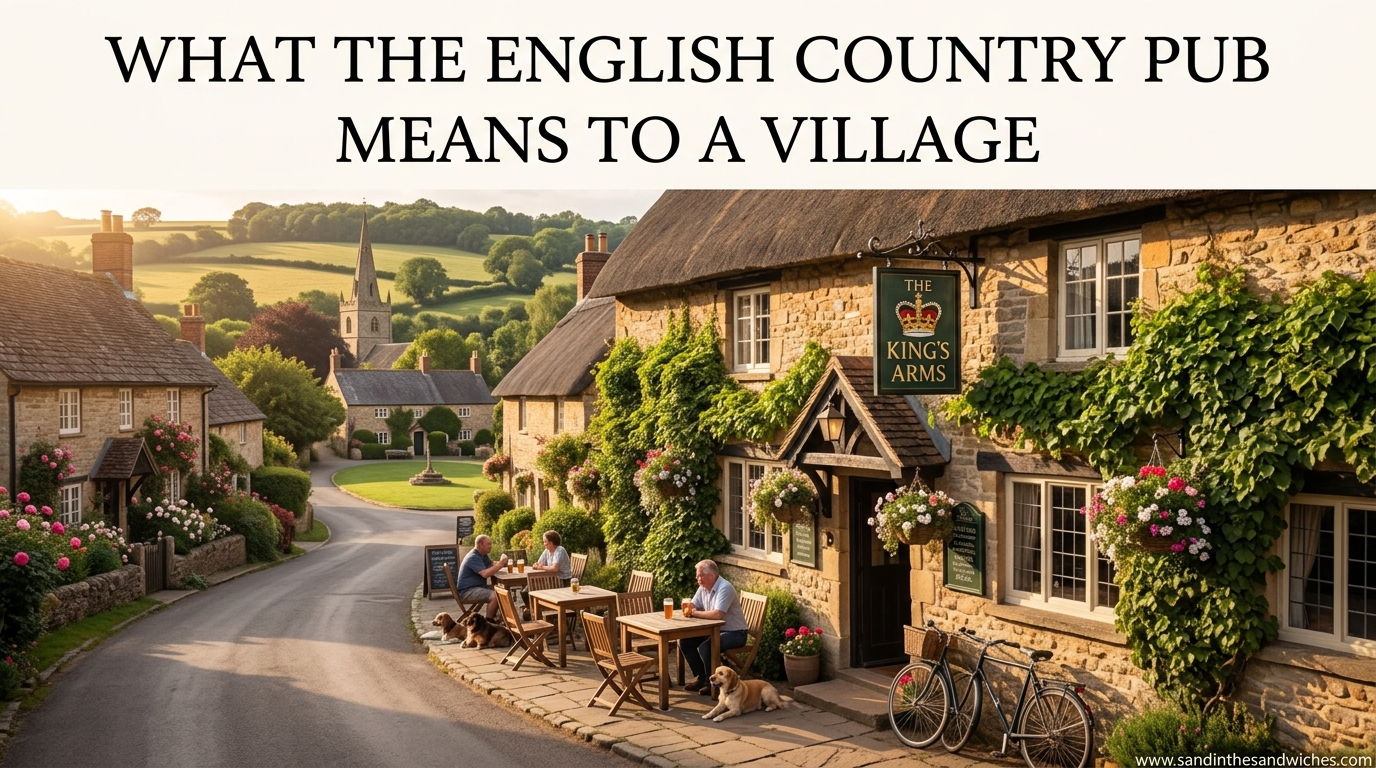
Push open the door of an English country pub on a winter evening and the world changes. The cold lane, the dark church tower, the wind in the elms – all of it falls away behind you. What meets you instead is low golden light, the smell of woodsmoke and spilled beer, a fire shifting in an inglenook fireplace, and the low hum of conversation that has been running, in one form or another, in this same room for four hundred years.
This is what the English country pub means to a village. Not just a place to drink, but a place to belong.
Samuel Pepys, the seventeenth-century diarist, called the pub “the heart of England.” He was writing about London taverns, but the phrase has clung to the country pub for good reason. In a village – where there may be no cafe, no community centre, no village hall that opens past nine, and sometimes no shop at all – the pub is often the last truly public space left. It is the secular heart of the community. It is where villagers gather, gossip, argue, mourn, celebrate, and quietly look after one another.
Yet the village pub is also mythologised, romanticised, and mourned in almost equal measure. Roughly half a pub closes in England every week, and in rural areas the loss cuts deepest. When a village loses its pub, it loses far more than a place to buy a pint. It loses a social centre, an economic anchor, an informal welfare network, and a piece of its own identity.
This article explores what the English country pub means to a village in 2026 – not as a nostalgic postcard, but as a living, struggling, adapting institution that remains, for many rural communities, utterly irreplaceable.
Table of Contents
What the English Country Pub Means to a Village: A Definition
A country pub is a rural public house in the English countryside that serves as the social, cultural, and often economic heart of its village. Unlike an urban bar, a country pub is not simply a commercial venue for selling drinks; it is a community institution characterised by open fires, low beams, real ale, and a clientele drawn from across the village – farmers, shopkeepers, retirees, newcomers, and weekend visitors alike.
The word “pub” itself is short for “public house,” a phrase that emerged in the late eighteenth and nineteenth centuries to describe licensed premises open to the general public. The term distinguished these establishments from private members’ clubs, gentleman’s chambers, and the older travellers’ inns that catered mainly to those passing through. A public house was, from the start, a democratic space – a house that belonged, in spirit, to everyone.
That democratic ideal sits at the core of what the English country pub means to a village. Anyone can walk in. Anyone can sit down. There is no membership fee, no dress code in most cases, no requirement to buy more than a single half of ale. In a society that has steadily privatised its shared spaces – selling off playing fields, closing libraries, gating footpaths – the pub remains one of the few indoor places in rural England where you can simply exist among other people without a transaction justifying your presence.
This is not a small thing. Sociologists call such spaces “third places” – somewhere that is neither home nor work, where informal community forms. The village pub is the original English third place, and for many villages it is the only one that survives.
The History Behind the English Village Pub
To understand what the English country pub means to a village, it helps to know where the institution came from. The village pub is not a recent invention. It is the layered descendant of Roman tavernas, Saxon alehouses, medieval inns, and Victorian beerhouses, each of which left its mark on what we now recognise as the country pub.
The earliest drinking establishments in England were alehouses – typically a villager’s own home where ale was brewed and sold. Ale was a staple drink in an era when water was unreliable, and alehouses were regulated as early as the twelfth century. By the late Middle Ages, larger inns had developed alongside the alehouse, offering lodgings and stabling for travellers and their horses. These inns, often built around a courtyard with a gallery above, gave us many of the architectural features – the heavy beams, the wide fireplaces, the wide-oak settles – we still associate with a traditional pub today.
The great shift came in the nineteenth century. The Beerhouse Act of 1830 allowed almost anyone to sell beer from their home for a small fee, leading to a rapid proliferation of small beerhouses across rural England. Many of these became the village pubs we know now. At the same time, the rise of the large commercial breweries created the “tied house” system, in which a pub was owned by a brewery and required to sell that brewery’s beer. A “free house,” by contrast, was an independent pub free to buy beer from any brewer – a distinction that still carries social and political weight among pub traditionalists.
The term “pub” itself – a contraction of “public house” – became common in the Victorian era. By the late nineteenth century, the institution we would recognise today was largely in place: a licensed premises with a public bar and a more comfortable lounge or saloon bar, a beer engine for pulling cask ale, a landlord or landlady living on the premises, and a small community of regulars who treated the place as an extension of their own front room.
That continuity matters. When you sit in a country pub that has been serving since 1620 or 1750, you are sitting inside a tradition that predates the railway, the telegraph, and the NHS. The pub is one of the oldest continuous social institutions in English village life, and that long memory is part of what gives the place its weight.
The Village Pub as Community Hub and Social Heart
Ask anyone who lives in a village with a thriving pub what makes it special, and they will eventually stop talking about the beer. They will talk about people.
The country pub functions as the village’s community hub in a way no other institution quite manages. The parish church may have a congregation of twenty on a Sunday. The village hall may host a knitting circle and a toddler group. The post office – if it survives at all – may open three mornings a week. But the pub is the one place that opens every evening, that welcomes everyone, and where the full cross-section of village life can be found under a single low oak beam.
This is the pub’s role as social glue. A farmer finishing a lambing shift, a retired schoolteacher, a young family who have just moved from London, the local vicar, the plumber, the second-homer down for the weekend – all of them rub along together at the bar in a way that simply does not happen anywhere else in modern English life. The pub is a social equaliser. Whatever hierarchy exists in the village by day dissolves, at least partially, around the bar of an evening.
The landlord or landlady is central to this function. A good pub landlord is part publican, part therapist, part mayor, and part matchmaker. They know who is ill, who has had a baby, who is struggling with money, who is newly widowed. They pass news between tables. They keep an eye on the elderly regular who has not been in for three days. Research from Northumbria University has found that the busy village pub is a reliable sign of a thriving rural community, and the landlord is usually at the centre of that vitality.
The regulars give the pub its texture. Regulars have their own seats, their own glasses, their own running jokes that have been refined over decades. They are the continuity of the place. When a newcomer is finally accepted into the circle – when someone remembers their name, saves them their usual seat, asks after their children – that acceptance is, in a small but real way, acceptance into the village itself.
None of this is accidental. The pub works as a community hub because it is informal. You do not need a reason to be there. You do not need an agenda. You simply turn up, and the social fabric of the village does the rest.
The Architecture and Atmosphere of the Country Pub
Walk into a country pub and the building itself tells you what kind of place you are in. The architecture of the English country pub is one of the most distinctive and beloved vernacular styles in the world – and it is not just decoration. The design of a pub shapes who feels welcome and what kind of community it fosters.
The classic country pub sits at the heart of the village, often facing the green or beside the church. Externally, it may be whitewashed stone, weatherboarded timber, or red brick, with a thatched roof in the western counties and a slate one in the north. A painted sign swings from a bracket – the Red Lion, the White Hart, the Crown, the Plough – names that date back to medieval heraldry and coaching-inn tradition.
Inside, the atmosphere is the point. Low ceilings with dark oak beams force you to bow your head slightly, an instinctive gesture of intimacy. An inglenook fireplace – a wide, deep hearth big enough to sit in – dominates the main room, with a real fire burning through the winter. Settle benches with high backs block the draught. The floors are scrubbed stone or bare boards, sometimes scattered with sawdust in the oldest examples. The walls carry horse brasses, old framed engravings, faded photographs of village cricket teams, and the occasional mounted trout or pheasant.
Historically, the interior of a pub was divided into rooms that mirrored the class structure of the village. The public bar was the working-class room – bare floors, cheaper beer, darts board, no frills. The lounge bar or saloon bar was more comfortable, with carpet, soft seating, and a slightly higher price for the same drink. The snug was a tiny private room, often with its own hatch to the bar, where the vicar, the doctor’s wife, or the well-to-do widow could drink discreetly. Many of these divisions have been knocked through in modern refurbishments, but the ghosts of them remain in the layout of the building.
The atmosphere these spaces create is hard to replicate. It is warm without being plush, sociable without being loud, old without being staged. When a gastro-pub refit strips out the original bar, lays pale oak flooring, and installs designer lighting, something more than decor is lost. The building stops feeling like a shared living room and starts feeling like a restaurant. And a restaurant, however good, is not a community hub.
Pub Games, Traditions and Village Rituals
The country pub is also the venue for a web of traditions that bind a village together. Some of these are national – the pub quiz, the Sunday roast, the Christmas Eve carol sing – but in a village they take on a local character that makes them feel irreplaceable.
Pub games are the most visible example. Darts is the great survivor: the dartboard on the wall of the public bar is one of the surest signs that a pub is still a community pub rather than a drinking restaurant. Skittles, the West Country cousin of ten-pin bowling, is still played in leagues across Somerset, Dorset, and Wiltshire, with pub teams travelling to neighbouring villages for matches that have been running since the nineteenth century. Aunt Sally in Oxfordshire, quoits in Yorkshire, dominoes in Lancashire – each region has its own pub game, and each game has its own league, its own trophies, its own rivalries.
The pub quiz is the modern descendant of these traditions. A weekly quiz night draws the village together in a way nothing else does – mixed teams of all ages, a brief flurry of competitive camaraderie, and a chance to raise money for the village hall or the lifeboat appeal. Live music, folk sessions, race nights, meat raffles, harvest supper, St George’s night, Burns Night – the calendar of a village pub is, in many places, the calendar of the village itself.
More quietly, the pub hosts the milestones of village life. A birth is toasted at the bar. A wedding reception spills out onto the beer garden. A wake, after a funeral at the church next door, fills the lounge with neighbours bringing food and sharing stories. Few institutions outside the family and the church touch so many points of a villager’s life.
This is part of what the English country pub means to a village that a cafe or a restaurant cannot replace. You can buy a flat white anywhere. You can eat a good meal in many places. But you cannot replicate, in a new venue, the accumulated weight of a hundred years of skittles matches, quiz nights, and wakes. That weight is what makes the pub feel like home.
The Ideal Village Pub Versus the Reality
It would be dishonest to write about what the English country pub means to a village without acknowledging that the ideal and the reality do not always match. The country pub has been heavily romanticised, and the version that lives in the national imagination – all roaring fires, rosy-cheeked locals, and conversation that crosses every class boundary – is not the whole truth.
The writers Boak and Bailey, in their thoughtful 2018 essay on the reality of the village inn, made an uncomfortable observation based on years of visiting rural pubs. In many villages, they noted, the pub has split along class lines. The working people’s pub – where the farmhands, the builders, and the pensioners drink, where the darts board still hangs and the carpet is still threadbare – is often a different establishment entirely from the gastro-pub that serves the second-homers and the weekend tourists. The romantic idea of the pub as a classless social melting pot is, in some villages, more aspiration than fact.
Ian Nairn, the architectural critic, warned about this as far back as 1978. In his writing on pub interiors, he argued that the country pub was in danger of becoming a “museum-piece” – a stage-set version of itself, scrubbed and prettified for visitors, with the real community life drained out. That warning has aged grimly. Many villages now have a pub that looks exactly like the postcard version and serves almost no one who actually lives there.
George Orwell, in his famous 1946 essay “The Moon Under Water,” described his ideal pub in loving detail – the Victorian fittings, the stout in a pewter pot, the lunchtime mutton stew, the garden where families could sit in summer. The essay is a masterpiece of pub-romanticism, but it is also a fantasy. Orwell’s ideal pub did not exist then, and it does not exist now. What does exist, in villages across England, is a much messier, more various, more flawed institution – sometimes wonderful, sometimes cliquey, sometimes struggling, sometimes exclusionary, but still, at its best, the nearest thing rural England has to a shared living room.
Holding both the ideal and the reality at once is the honest way to write about the village pub. It is wonderful and it is imperfect, and that is exactly what makes it worth defending.
Why the English Country Pub Matters to a Village: Economic and Social Value
The case for the village pub is not only sentimental. There is hard economic and social value wrapped up in a thriving country pub, and that value becomes brutally visible only when the pub is gone.
Economically, the village pub is an anchor. It employs local people – often young people, for whom a bar job may be the first rung of working life. It buys from local suppliers: the butcher who makes the sausages, the brewery that delivers the ale, the farmer who rents the grazing, the vegetable box scheme that supplies the kitchen. It draws visitors, who in turn spend money at the village shop, the tearoom, the holiday cottage. A study published in the journal Habitat International found that the village pub adds measurable economic, social, and cultural value to its community, functioning as a small but real engine of the rural economy.
Socially, the pub’s value is even greater, and harder to quantify. Rural England has a loneliness problem. An ageing population, the hollowing-out of villages by second-home ownership, the closure of bus routes and village shops, and the slow disappearance of the parish pub have combined to leave many rural residents – particularly the elderly – profoundly isolated. The pub is one of the few remaining antidotes. It is a place where an isolated villager can go, sit among other people, and belong to something without having to justify their presence.
This is the pub’s role as informal welfare network. A good pub landlord notices when a regular has not been in. The bar staff ask after the old man who lives alone up the lane. A collection is quietly taken up for the family whose roof has collapsed. News is passed – who is in hospital, who needs a lift to the surgery, who has died. None of this appears in any official statistic, but it is the social infrastructure that keeps a village functional.
When a village loses its pub, all of this goes. Research on villages that have lost their only pub describes a measurable decline in community cohesion, a rise in reported loneliness, and a weakening of the informal networks that villagers relied on for news, help, and company. The pub is not a luxury in a small village. It is part of the social scaffolding, and when it falls, other things fall with it.
This is the deepest answer to what the English country pub means to a village. It means a place to belong. It means a network of care. It means a shared living room in a society that has fewer and fewer shared spaces. And it means the difference, for many rural residents, between a village that feels alive and one that feels like a dormitory.
The Threat Facing Village Pubs in 2026
The threats facing the English country pub in 2026 are serious and well-documented. Roughly half a pub closes its doors for good every week in England, and rural pubs have been hit disproportionately hard. The causes are tangled, and no single villain explains the decline.
Economics is the blunt instrument. Many village pubs simply do not turn a profit on local trade alone. A pub that once served a village of farm labourers and their families now serves a population split between retirees, commuters who are rarely home, and second-home owners who arrive on Friday night and leave on Sunday afternoon. The weekday evening trade that once sustained the local has withered. Pubs that try to survive on weekend tourist traffic alone are fragile – one bad summer, one road closure, one change in holiday habits, and the books tip into the red.
Second-home ownership has hollowed out village populations across large parts of rural England, particularly in Cornwall, Devon, the Lake District, and Norfolk. A village where a third of the houses stand empty for much of the year cannot sustain a pub on local custom. The forum discussions on Reddit and Pubs Galore are full of villagers describing exactly this dynamic – the pub “constantly on the brink of closure,” kept alive by the determination of a landlord and a handful of loyal regulars rather than by any realistic business case.
Demographic change cuts the other way too. Young people, priced out of village housing, have left for towns and cities. The village pub that once catered to a working population now often finds itself squeezed between an elderly clientele who cannot come out as often as they used to and a younger generation who never arrived. The “gastro-ification” of surviving pubs – turning the public bar into a dining room to chase the food margin – can rescue the business while quietly killing the community function. A pub where you cannot get a drink at the bar without booking a table for dinner is, functionally, a restaurant.
Brexit and the COVID-19 pandemic left their marks too. Staff shortages, supply chain disruption, and a long period of closure during lockdown tested many pubs to breaking point. Some never reopened. The pubs that have survived are often leaner, more adaptive, and more reliant on a mix of food, drink, events, and sheer community goodwill than their predecessors were.
Hope for the Future: Community-Owned Pubs and Revival
The story of the village pub is not only one of decline, and any honest account of what the English country pub means to a village must include the revival that is happening alongside the closures.
Across rural England, villages are buying their pubs. The community-owned pub movement has grown by roughly 62.6 percent over five years, according to data gathered by the community business sector, and the model is proving remarkably durable. When the villagers themselves own the pub – through a community share issue, supported by organisations like the Plunkett Foundation – the business case shifts. Profit is no longer the only metric. The pub exists to serve the community, and the community is willing to support it: volunteering behind the bar, turning out for quiz nights, and treating the place as the shared asset it has now legally become.
The Campaign for Real Ale, better known as CAMRA, has been fighting on this front for fifty years. Founded in 1971 to defend cask-conditioned beer against the rise of mass-produced keg ale, CAMRA has grown into the most effective grassroots champion of the British pub. Its Good Beer Guide is the most trusted recommendation source in pub culture, and its campaigns on planning law, taxation, and tied-house reform have helped slow the rate of closures and give communities legal tools to protect their locals.
The pubs that thrive in 2026 tend to share certain traits, and the forums and trust signals point to them clearly. They are run by landlords who know their regulars by name and engage with the village. They serve genuine food and local real ale rather than pretension. They host regular events – quizzes, live music, charity nights, skittles matches. They open at sensible hours. They welcome dogs and muddy boots. They are, in other words, still operating as community pubs rather than as businesses that happen to be housed in an old pub building.
The village pub is not dead. It is changing, under pressure, and often endangered – but it is also being defended, rebuilt, and reimagined by the very communities it serves. That, in the end, is the strongest evidence of what the English country pub means to a village. People do not fight this hard for something they do not love.
FAQs
What does pub mean in England?
In England, a pub (short for ‘public house’) is a licensed establishment where alcoholic drinks are sold for consumption on the premises. The term dates to the late eighteenth and nineteenth centuries and distinguishes these premises from private clubs or inns that historically catered only to travellers. A pub is open to the general public and functions as a democratic social space, particularly in villages where it may be the last remaining truly public gathering place.
What is a country pub?
A country pub is a rural public house in the English countryside, traditionally characterised by features such as thatched roofs, whitewashed stone walls, open fires, low oak beams, and a community-focused atmosphere. Unlike urban bars, country pubs serve as village social hubs where residents of all classes and generations gather for conversation, companionship, real ale, and community events. Many have served their villages continuously for centuries.
Why do British people call bars pubs?
British people call bars pubs because the word is a contraction of ‘public house’, a term that emerged in the Victorian era to describe licensed premises open to the general public. The phrase deliberately distinguished these establishments from private members’ clubs, household taprooms, and the older travellers’ inns. A public house was, from the start, a democratic space accessible to all, and that democratic character remains central to how the British understand the institution today.
Why do British people love the pub?
British people love the pub because it is one of the last remaining truly public social spaces in an increasingly privatised society. Pubs offer informal community, social mixing across class and generation, a ‘third place’ distinct from home and work, a setting for traditions such as quizzes and pub games, and a sense of belonging that is increasingly rare in modern life. As Samuel Pepys wrote, the pub is the heart of England, and for many rural villages the local pub is still exactly that.
Conclusion: The Heart That Still Beats
So what does the English country pub mean to a village? It means a shared living room in a place that has few shared spaces left. It means an informal welfare network, a social equaliser, a calendar of rituals, a small economic engine, and a building whose low beams and open fire carry the memory of four centuries of village life. It means, in Pepys’s phrase, the heart of England – and when it stops beating, the village feels it.
The village pub is romanticised, and that romance can obscure the real and imperfect institution underneath. But the pub survives because it is useful, not only because it is loved. It survives because villagers still need a place to meet, to belong, and to look after one another. In 2026, in villages across rural England, that need has not gone away.
If you have a country pub in your village, use it. If you have lost one, you know already what is gone. And if you are fighting to keep yours open or reopen it as a community asset, you are doing the work that keeps the heart of the village – and the heart of England – still beating.