
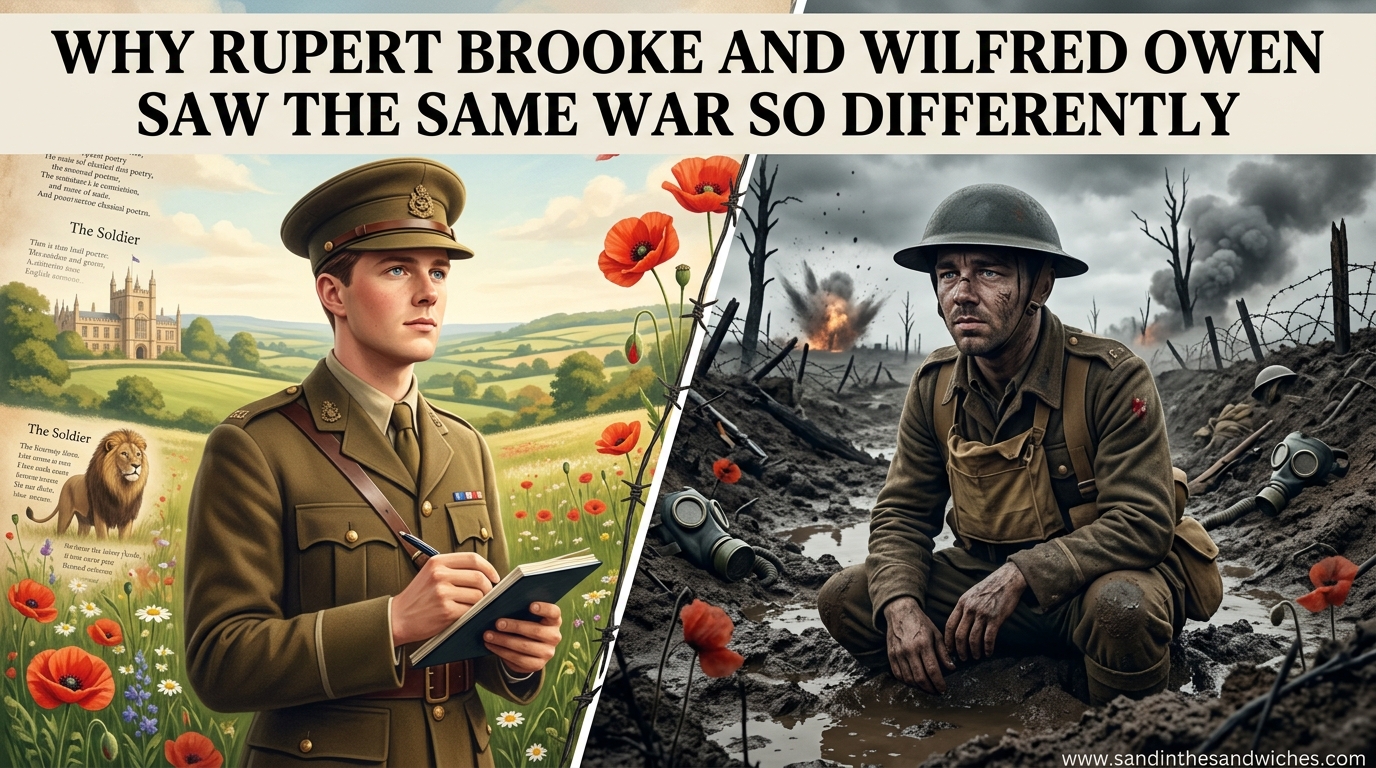
Rupert Brooke and Wilfred Owen both served as British soldiers in the First World War. Both wrote poetry that would define how generations understood that conflict. And both died before the fighting stopped — Brooke in April 1915, Owen in November 1918, exactly one week before the Armistice. Yet the poetry they left behind could hardly sound more different.
Brooke’s verse pulses with patriotic idealism, painting sacrifice for one’s country as holy and beautiful. Owen’s work tears that same idea apart with graphic, unflinching depictions of suffering, famously calling patriotic sacrifice “The old Lie.” Understanding why Rupert Brooke and Wilfred Owen saw the same war so differently requires looking at what each man actually experienced — and when he experienced it.
Their divergent perspectives are not simply a matter of personality or temperament. They reflect a fundamental shift in how the war itself was perceived, a shift that happened between 1914 and 1917 as the reality of industrialized warfare replaced the romantic ideals of the early months. Brooke and Owen became, in effect, bookends for a national loss of innocence.
Table of Contents
Two Poets, One War: The Core Difference
Rupert Brooke and Wilfred Owen had fundamentally different perspectives on war because they experienced fundamentally different wars. Brooke died of blood poisoning from an infected mosquito bite on a hospital ship off the island of Skyros in April 1915, before he ever reached a battlefield. He saw only a brief, almost theatrical glimpse of military life during the evacuation of Antwerp in October 1914. His poetry reflects the spirit of 1914 — the rush of enlistment, the sense of moral purpose, the belief that war could purify and ennoble.
Owen, by contrast, spent months in the front lines of the Somme. He endured artillery bombardments, gas attacks, and the claustrophobic misery of trench warfare. He was diagnosed with shell shock and sent to Craiglockhart War Hospital, where he met Siegfried Sassoon and began writing the searing, realistic poems that would make him the most celebrated British war poet of the twentieth century.
Brooke wrote about the idea of war. Owen wrote about the reality of it. That single distinction explains nearly every difference in their imagery, tone, and philosophy.
Rupert Brooke: The Poet Who Never Saw the Trenches
Brooke’s Path to War
Rupert Brooke was born in 1887 into a privileged, intellectual English family. He was educated at Rugby School, where his father was a housemaster, and then at King’s College, Cambridge. By the time war broke out in August 1914, Brooke had already established himself as one of England’s most promising young poets. He was handsome, charismatic, and well-connected — friends with Edward Thomas, Eleanor Farjeon, and other figures in the Georgian poetry movement that dominated British literary circles before the war.
Brooke’s personal life was more complicated than his golden-boy reputation suggested. He had suffered a serious emotional breakdown in 1913, tangled in a web of complicated relationships and struggling with his sense of identity. Some biographers have noted that his idealization of England and of sacrifice may have carried a psychological dimension — a yearning for purity and purpose that found an outlet in patriotic verse.
When war was declared, Brooke joined the Royal Naval Division, a curious military unit that fought as infantry but maintained naval traditions. His unit was sent to Belgium in October 1914 as part of the defense of Antwerp. What Brooke witnessed there was less a battle than a confused, chaotic retreat through streets lit by burning buildings and the glow of distant artillery. He wrote about it in letters home with a kind of dark excitement.
That brief, mostly secondhand glimpse of war was all Brooke would ever see. He sailed for the Dardanelles campaign in March 1915 but never arrived. On the way, he developed sepsis from an insect bite on his lip. He died on a French hospital ship on April 23, 1915 — coincidentally, St. George’s Day, the feast day of England’s patron saint.
The symbolism was almost too perfect. Winston Churchill, then First Lord of the Admiralty, wrote Brooke’s obituary in The Times, hailing him as a voice of England’s noblest ideals. Brooke’s death transformed him from a promising poet into an instant martyr for the national cause.
The Soldier: A Patriotic Ideal
“The Soldier,” Brooke’s most famous poem, was written in 1914 and published as part of a series of five sonnets called “1914.” It captures everything that makes Brooke’s war poetry so distinct from Owen’s. The poem opens with one of the most quoted lines in English literature:
“If I should die, think only this of me:
That there’s some corner of a foreign field
That is for ever England.”
The poem transforms death in battle into something gentle and beautiful — a kind of spiritual homecoming. The soldier’s body becomes a piece of England transplanted to foreign soil, “A dust whom England bore, shaped, made aware.” The imagery is soft, pastoral, and deeply religious without referencing any specific denomination. England itself becomes a sacred entity.
Notice what is absent from Brooke’s poem. There is no mud, no blood, no screaming, no gas, no dismembered bodies. There is no fear, no doubt, no horror. The sonnet form itself — with its balanced octave and sestet, its controlled rhyme scheme — reinforces the sense of order and harmony. Even death is rendered as serene and purposeful.
Brooke believed, or at least chose to express in his poetry, that dying for England was the highest calling a young man could answer. “The Soldier” presents sacrifice as an act that enriches both the individual and the nation. There is no irony here. No bitterness. No challenge to authority. The poem reads today almost like a recruiting poster set to verse — which, in effect, is what it became.
This is not a failure of imagination on Brooke’s part. It is an honest expression of what many educated young Englishmen genuinely felt in the early months of the war. Brooke gave voice to a real sentiment, one that would be shattered on the barbed wire of the Western Front within two years.
Wilfred Owen: The Poet in the Trenches
Owen’s War Experience
Wilfred Owen was born in 1893 in Shropshire, six years after Brooke. His background was less privileged — his father was a railway clerk — and his path to literary recognition was far more difficult. He was working as a tutor in France when war was declared, and he enlisted in the British Army in October 1915, eventually joining the Artists’ Rifles and later the Manchester Regiment.
Owen arrived in France in December 1916 and was sent to the Somme sector, where some of the war’s most devastating fighting had taken place only months earlier. His letters home describe a world of almost unimaginable suffering — frozen trenches, constant shellfire, the stench of decay, men driven to madness by what they witnessed. He wrote of sleeping in holes filled with water, of seeing comrades blown apart, of the crushing weight of exhaustion and fear.
In 1917, Owen fell through a shell crater and spent days trapped near a decaying corpse. The experience broke something in him. He was diagnosed with neurasthenia — what we now recognize as shell shock or post-traumatic stress — and sent to Craiglockhart War Hospital near Edinburgh to recover.
At Craiglockhart, Owen met Siegfried Sassoon, a decorated war hero who had begun writing anti-war poetry that shocked the British establishment. Sassoon recognized Owen’s talent immediately and became his mentor, encouraging him to write directly about what he had seen. Owen later credited Sassoon with helping him find his authentic voice — one that refused to prettify or romanticize the reality of war.
Owen returned to France in September 1918 and was killed by machine-gun fire on November 4, 1918, while leading his men across the Sambre-Oise Canal. The Armistice was signed seven days later. His mother received the telegram announcing his death on November 11, as church bells rang across England to celebrate peace.
Dulce et Decorum Est: The Old Lie
“Dulce et Decorum Est” is Owen’s most famous poem and the most direct rebuttal to everything Brooke represented. Written in 1917 and revised during his time at Craiglockhart, the poem describes a gas attack and its aftermath with a level of graphic detail that was unprecedented in English war poetry.
The poem opens with soldiers retreating from the front, described with imagery that strips away any trace of glory:
“Bent double, like old beggars under sacks,
Knock-kneed, coughing like hags, we cursed through sludge.”
These are not noble warriors marching to a sacred cause. They are exhausted, sick, and broken men stumbling through mud. Owen’s similes deliberately dehumanize and diminish them — “old beggars,” “hags” — to underscore how far reality falls from the heroic ideal.
The poem’s central scene is a chlorine gas attack. Owen describes a soldier who fails to get his gas mask on in time:
“In all my dreams, before my helpless sight,
He plunges at me, guttering, choking, drowning.”
The horror of this image is its persistence. Owen makes clear that witnessing this death did not end when the moment passed — it returned nightly in dreams. This is the voice of trauma, not of romantic adventure.
The poem’s famous final stanza addresses the reader directly. Owen challenges anyone who still believes in the old patriotic ideal — specifically, anyone who would tell children “desperate for some ardent glory” that it is sweet and proper to die for one’s country:
“My friend, you would not tell with such high zest
To children ardent for some desperate glory,
The old Lie: Dulce et decorum est
Pro patria mori.”
The Latin phrase translates as “It is sweet and fitting to die for one’s country.” It comes from the Roman poet Horace. Owen capitalizes “Lie” as if it were a proper noun — a doctrine, an institution — and presents it not as a mistake but as a deliberate deception. This is the most important word in the poem. Brooke’s “The Soldier” embodies that lie. Owen’s poem names and destroys it.
Why Timing Was Everything: Historical Context
The timing of each poet’s experience explains more about their different perspectives than any personal trait. When Brooke wrote “The Soldier” in 1914, the British public still believed the war would be short, glorious, and morally clear. Volunteer enlistment was at its peak. The idea that European civilization was engaged in a righteous struggle against barbarism was nearly universal among the educated classes.
The reality of trench warfare had not yet been communicated home. Newspaper reports were censored and optimistic. Letters from the front were subject to the same censorship. The Battle of the Somme, which would kill or wound more than one million men on all sides, was still two years away. The gas attacks that Owen described so vividly had not yet become a standard feature of the battlefield.
By the time Owen was writing in 1917 and 1918, everything had changed. The Somme had demonstrated that courage and patriotism meant nothing against machine guns and artillery. Passchendaele would demonstrate it again in 1917, with 600,000 Allied and German casualties for territory that was soon abandoned. Conscription had been introduced in Britain in January 1916, which meant the volunteer idealism of 1914 had been replaced by something closer to mass compulsion.
Public attitudes shifted accordingly. The patriotic poetry of the early war years began to feel naive, even offensive, to those who had seen the reality. Sassoon’s public declaration against the war in 1917 — read in Parliament and published in The Times — crystallized a growing sense of disillusionment. Owen’s poetry emerged from this atmosphere of hard-won, bitter clarity.
Brooke was a poet of 1914. Owen was a poet of 1917. The war itself had changed between those years, and so had what it was possible to honestly say about it.
Poetic Technique: How Form Reflected Philosophy
One of the most striking facts about Brooke and Owen is that both wrote primarily in the sonnet form. “The Soldier” is a Petrarchan sonnet, with an octave and sestet following the traditional Italian pattern. “Dulce et Decorum Est” is a modified sonnet, broken into two unequal parts. Yet they use the same form to utterly different ends.
Brooke uses the sonnet’s inherent balance and symmetry to create a sense of harmony and rightness. The octave presents the physical idea of the soldier dying abroad; the sestet shifts to the spiritual dimension — the soul returning to England, “thoughts by England given,” her “flowers to love, her ways to roam.” The traditional volta, or turn, at line nine feels natural and reassuring. Everything about the poem’s structure reinforces its message: this death is ordered, purposeful, and beautiful.
Owen disrupts the sonnet form. “Dulce et Decorum Est” has 28 lines instead of 14, effectively doubling the traditional length. The rhythm stumbles and lurches, mirroring the exhaustion of the marching soldiers. The meter breaks down during the gas attack scene, reflecting the chaos and panic. Owen uses the sonnet’s associations with love and beauty ironically — he takes a form traditionally used for romantic devotion and fills it with images of vomiting blood and rotting flesh.
The imagery itself could not be more different. Brooke’s imagery is pastoral and serene — “flowers,” “rivers,” “suns of home.” Owen’s imagery is industrial and grotesque — “misty panes,” “thick green light,” “white eyes writhing in his face.” Brooke conjures an England of the imagination. Owen conjures a battlefield of inescapable, physical reality.
Even their use of religious language diverges sharply. Brooke’s England is “blessed” and her sacrifice is implicitly holy. Owen, who had deep religious interests earlier in his life, fills his poems with imagery of crucifixion, sacrifice, and abandonment by God — but always with an edge of questioning or protest. In “Anthem for Doomed Youth,” Owen asks what funeral rites these soldiers will receive: “What passing-bells for these who die as cattle?” The implied answer is none — there is no sacred framework to contain this slaughter.
The Deeper Differences: Patriotism, Religion, and Death
Beyond poetic technique, Brooke and Owen differed on three fundamental questions that every war forces its participants to confront.
On patriotism, Brooke offered wholehearted devotion. England was, for him, a sacred entity worthy of the ultimate sacrifice. The idea that one’s death could create “some corner of a foreign field that is for ever England” was a source of comfort and pride. Owen, having seen what that sacrifice actually looked like, treated patriotic rhetoric as a tool of manipulation — something used to send young men to die for purposes they did not fully understand.
On religion, Brooke’s poetry implies a natural, effortless faith in divine order. God and England are almost interchangeable in “The Soldier.” Owen’s poetry, by contrast, wrestles with the apparent absence of God from the battlefield. His images of soldiers as sacrificial victims evoke Christ’s crucifixion, but without the resurrection — death here leads nowhere, redeems nothing.
On death itself, the contrast is absolute. Brooke’s death imagery is peaceful, almost seductive — “dreams happy as her day,” “an English heaven.” Owen’s death imagery is violent and unforgettable — the drowning man, the “devil’s sick of sin” face of the gassed soldier, the “sob and clubbing of a crazy rhyme.” Brooke makes death in war seem gentle and desirable. Owen makes it seem like the worst thing a human being can endure.
These differences are not just aesthetic choices. They reflect two fundamentally different relationships with the truth. Brooke’s poetry tells the truth as it was understood by someone who had not yet been disillusioned. Owen’s poetry tells the truth as it was experienced by someone who had.
Both can be called honest. Brooke was honestly expressing a sincere belief in the nobility of sacrifice. Owen was honestly recording what he saw and felt. But history has judged that Owen’s honesty was the more complete, because it was tested against reality in a way Brooke’s never was.
FAQs
How did Rupert Brooke’s view of war differ from Owen and Sassoon’s?
Brooke saw war as a noble, purifying endeavor worthy of patriotic sacrifice, while Owen and Sassoon portrayed it as a horrific slaughter driven by political incompetence and patriotic propaganda. Brooke died before experiencing combat; Owen and Sassoon both endured months of trench warfare, which is why their poetry is grounded in graphic realism rather than idealism.
Did Rupert Brooke ever fight in the war?
Rupert Brooke saw only brief, limited military action during the evacuation of Antwerp in October 1914, which was more of a confused retreat than a battle. He never experienced trench warfare on the Western Front. He died of blood poisoning from an infected insect bite on April 23, 1915, while sailing toward the Gallipoli campaign, before reaching any battlefield.
Who is considered the greatest war poet in the English language?
Wilfred Owen is widely considered the greatest war poet in the English language. His poems, including Dulce et Decorum Est, Anthem for Doomed Youth, and Strange Meeting, are studied worldwide and set the standard for honest, realistic depictions of armed conflict. Though he published only four poems during his lifetime, his posthumous collection established him as the definitive voice of First World War poetry.
What is Wilfred Owen’s perspective on war?
Owen described his own poetic mission as being to warn people about the reality of war. In his famous preface, he wrote, ‘My subject is War, and the pity of War. The Poetry is in the pity.’ He viewed patriotic sacrifice as a lie used to manipulate young men, and he used graphic, visceral imagery to force readers to confront the true horror of combat rather than its romanticized version.
What does Dulce et Decorum Est pro patria mori mean?
The phrase Dulce et decorum est pro patria mori is Latin for ‘It is sweet and fitting to die for one’s country.’ It comes from the Roman poet Horace (Odes, Book III). Wilfred Owen called this phrase ‘The old Lie,’ arguing that after witnessing a chlorine gas attack and the suffering it caused, no honest person could call such a death sweet or fitting.
Why did Brooke and Owen both use the sonnet form?
Both poets used the sonnet because it was the most prestigious poetic form in English literature, traditionally associated with love and deep emotion. Brooke used it sincerely to express his devotion to England, while Owen used it ironically, filling a form built for romantic idealism with images of physical horror. Owen’s disruption of the sonnet structure mirrors his rejection of the ideals the form traditionally represented.
Conclusion: Two Voices, One Incomprehensible War
Rupert Brooke and Wilfred Owen saw the same war so differently because they were, in a real sense, fighting different wars. Brooke’s war was the war of 1914 — short, noble, and full of purpose. Owen’s war was the war of 1916 onward — industrial, dehumanizing, and seemingly endless. The gap between their visions measures the distance England traveled, morally and emotionally, during the four years of the conflict.
Brooke’s legacy is more complicated than it might first appear. His poetry is easy to dismiss as naive or even propagandistic from a modern vantage point. But “The Soldier” expressed something genuine — a real love of country and a real willingness to serve. Millions of young men who enlisted in 1914 felt exactly as Brooke described. His poetry captured a moment in history with perfect fidelity, even if that moment was brief.
Owen’s legacy is more secure. His poems are read in schools and universities around the world as the definitive literary response to the First World War. His phrasing — “The old Lie,” “the pity of War,” “What passing-bells for these who die as cattle?” — has become inseparable from how we remember that conflict. When we picture the First World War today, we see it through Owen’s eyes.
Yet both perspectives are needed to understand the full arc of the war’s cultural impact. Brooke shows us what was believed before the truth was known. Owen shows us what the truth actually looked like. Together, their contrasting voices tell a more complete story than either could alone — the story of a civilization that marched to war with songs of glory and emerged four years later chanting something very different.
Understanding why Rupert Brooke and Wilfred Owen had such different perspectives on war is ultimately about understanding how experience shapes truth. Brooke’s truth was the truth of hope and idealism. Owen’s was the truth of mud, gas, and grief. The First World War contained both — and the English language is richer for having both poets to testify to it.