
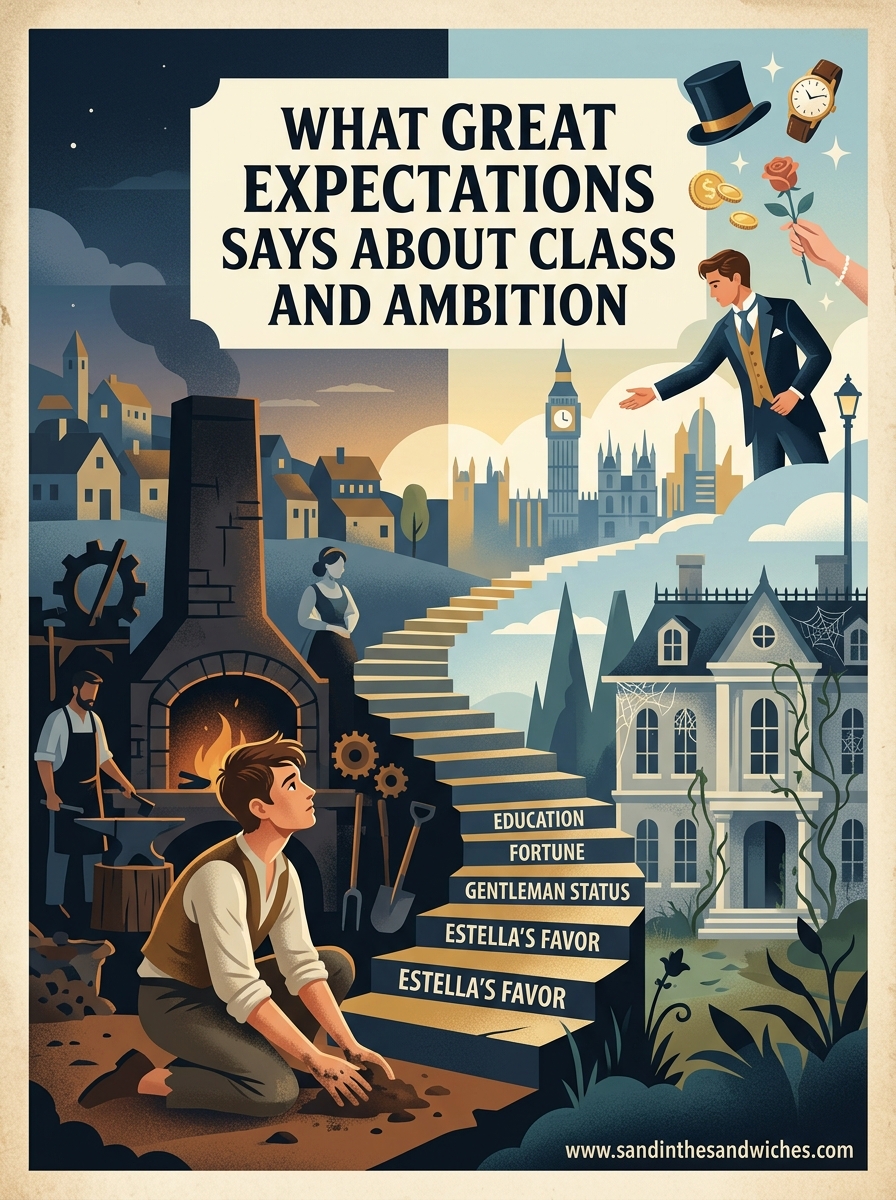
Charles Dickens published Great Expectations in 1861, and more than 160 years later the novel still has something urgent to say about the tension between where we come from and where we want to go. At its core, the book tracks a young orphan named Pip who receives a mysterious fortune and uses it to climb from a blacksmith’s forge into London’s gentleman class. But Dickens is not writing a simple rags-to-riches fantasy. He is asking a far more uncomfortable question: what happens to your soul when you decide your origins are not good enough?
What Great Expectations says about class and ambition is that the pursuit of social elevation can corrode your most important relationships, distort your sense of self-worth, and blind you to the people who actually love you. The novel does not condemn ambition itself. Instead, it draws a sharp line between self-improvement rooted in genuine growth and social climbing driven by shame. Dickens shows us that a society obsessed with status produces people who mistake the trappings of gentility for actual goodness.
In this analysis, I want to walk through the major ways Dickens explores class and ambition in the novel. We will look at the Victorian context that made Pip’s journey possible, examine the characters who embody different responses to the class system, and connect Dickens’s insights to struggles that still feel familiar today. Whether you are studying the novel, revisiting it as an adult, or simply curious about why it endures, the themes here cut deeper than most readers expect.
Table of Contents
Victorian England and the Shifting Class System
To understand what Great Expectations says about class and ambition, you first need to picture the world Dickens was writing about. Mid-nineteenth-century England was in the middle of a massive social rearrangement. The Industrial Revolution had created new wealth that did not depend on inherited land, and a growing middle class was pushing against the old hereditary aristocracy. For the first time in English history, it was conceivable, though still rare, for someone born into poverty to rise into gentility through a combination of money, education, and luck.
Dickens set his novel squarely in this transitional moment. Pip’s trajectory from a Kent marsh village to a London gentleman’s life would have been nearly impossible a century earlier, when birth determined your station with almost mathematical rigidity. The fact that Pip can even imagine a different future is itself a product of this new, slightly more fluid class system. As one LitCharts analysis notes, Pip’s ascent through the class system represents a trajectory that “would not have been possible within the rigid class hierarchy of the past.”
But Dickens is not celebrating this new mobility without reservation. He shows that the loosening of old class boundaries created its own form of misery. When status becomes something you can acquire rather than something you are born into, people begin to see themselves as projects to be improved. Pip’s ambition is born not from curiosity or passion but from a wound. He wants to change his class because he has been made to feel that his current one is shameful.
The novel also captures how the class system in Victorian England still punished people for their origins even as it pretended to offer escape routes. Convicts like Magwitch are branded by society and given no path to redemption through legitimate means. Women like Biddy are intelligent and capable but have no access to the education that Pip receives simply because money falls into his lap. Dickens presents a world where the rules of class are bending but not breaking, and the people caught inside that system suffer the consequences.
What Great Expectations Says About Class and Ambition
The central argument of Great Expectations is that class and ambition are deeply intertwined, and that the way a society defines success reveals its moral priorities. Dickens uses Pip’s coming-of-age journey, what scholars call a Bildungsroman, to show that the desire for social advancement is not inherently corrupting. What corrupts is the belief that you must abandon your past, your family, and your authentic self to deserve a higher place in the social order.
Pip’s ambition awakens the moment Estella looks at him with contempt and calls him coarse and common. That single encounter reframes everything about his life. The forge where he was apprenticed, the good-hearted brother-in-law who raised him, the simple village existence that had been perfectly adequate, all suddenly feel like evidence of his own inferiority. His ambition becomes inseparable from his shame. He does not want to improve himself because he is curious about the world. He wants to improve himself because he has been taught to despise where he started.
Dickens makes a crucial distinction throughout the novel between ambition that enriches a person and ambition that empties them out. When Pip first arrives in London and begins his education with Matthew Pocket, there are moments of genuine intellectual awakening. He reads, he learns, he starts to see the world through a wider lens. But these moments are overshadowed by his obsession with appearances. He spends lavishly, accumulates debts, and distances himself from Joe Gargery, the man who embodies unconditional love and honest labor.
The novel’s famous twist, that Pip’s fortune comes not from the aristocratic Miss Havisham but from the convict Magwitch, is where Dickens delivers his most devastating commentary on class. Pip has spent years believing his wealth connected him to the upper class. He thought his patron was a refined gentlewoman. Instead, his benefactor is a transported felon who made his fortune in sheep farming in Australia. The money that lifted Pip above his origins came from someone who started even lower on the social ladder than he did.
This revelation forces Pip to confront the emptiness of his assumptions about class. If a convict can produce the wealth of a gentleman, then wealth itself proves nothing about a person’s character or worth. The entire social hierarchy Pip has been chasing turns out to be built on sand. Dickens is telling us that the markers of class, money, accent, clothing, manners are surface decorations. They tell you nothing about what is underneath.
Pip’s Shame: The Engine of Ambition
Pip’s shame is the psychological engine that drives the entire novel, and understanding it is essential to grasping what Great Expectations says about class and ambition. Before Estella, Pip is content. He is a frightened orphan in some ways, terrified of his sister’s temper and haunted by guilt over helping the convict in the graveyard. But he is not ashamed of his class. He does not look at the forge or at Joe and feel disgust. Those feelings arrive only after he enters Satis House.
Estella’s contempt is the spark. She is specifically trained by Miss Havisham to make men feel small, and she does this through class-based cruelty. She calls Pip common. She mocks his hands, his boots, his way of speaking. Everything about him that marks him as working class becomes, in Estella’s gaze, evidence of failure. Pip internalizes this judgment completely and permanently. From that point forward, his ambition is not about growth. It is about escape.
Dickens captures the interior cost of this shame with painful precision. Pip writes that he had never thought about being ashamed of his hands before, but now he begins to view them through Estella’s eyes. He becomes preoccupied with the details of his appearance, his speech, his manners, measuring each one against an invisible aristocratic standard he can never fully meet. This is the psychological tax of a class system: it makes people police themselves, turning their own identities into a source of pain.
What makes Pip such a frustrating and yet sympathetic protagonist is that his shame makes him cruel to the people who love him most. He becomes embarrassed by Joe’s simplicity and lack of formal education. He resents having to introduce Joe to his London acquaintances. He starts to see Biddy, the intelligent and warm-hearted girl from the village, as beneath him. Readers on forums like r/charlesdickens and r/books frequently mention finding Pip frustrating on a first read, only to realize on reflection that his behavior is a painfully accurate depiction of what internalized class prejudice does to a person.
Dickens does not let Pip off the hook for this behavior, but he also makes clear that Pip is a product of a system that teaches people to value status over connection. Pip’s journey is ultimately one of recovery. He must learn to see Joe, Biddy, and even Magwitch as fully human and worthy of respect, not in spite of their class but independent of it. His ambition nearly destroys him, and only after he loses his fortune and faces the consequences of his choices does he begin to understand what actually matters.
The novel also shows how shame operates differently across class lines. Joe never feels ashamed of being a blacksmith. He takes pride in his work and treats every person he meets with the same unforced dignity. When Joe comes to London to visit Pip, he is out of place but not diminished. He tells Pip that he and the blacksmith’s forge are one and the same, and that he cannot be separated from his work without losing himself. Joe’s self-acceptance is the quiet moral counterweight to Pip’s restless self-rejection.
Wealth, Inheritance, and the Illusion of Identity
One of the most powerful things Great Expectations says about class and ambition is that wealth does not create identity. It only creates the illusion of identity. Dickens explores this idea through several characters, but the most striking examples are Pip, Miss Havisham, and Magwitch.
Pip’s gentlemanly identity is entirely dependent on money he did not earn. His fine clothes, his London lodgings, his cultural education, all of it rests on expectations of a future inheritance. When that expectation is fulfilled, but from the wrong source, Pip’s entire self-image collapses. He has built his sense of who he is on a foundation of unearned wealth, and when the truth about Magwitch surfaces, he has to face the fact that his gentility was always hollow. He is a gentleman only because someone paid for him to look like one.
Miss Havisham represents the opposite failure. She was born into wealth and used it to build a life of seclusion and revenge. Her fortune has not made her happy or secure. It has made her bitter, frozen in time, surrounded by the decay of a wedding that never happened. Satis House, with its stopped clocks and rotting wedding cake, is a physical monument to the emptiness of wealth without purpose. Dickens uses Miss Havisham to show that inherited money can be just as corrosive as suddenly acquired money. Wealth without moral grounding becomes a prison.
Magwitch’s story adds a third dimension to this critique. He is a convict, a man from the very bottom of the social order, who works hard in Australia and accumulates a fortune. He then uses that fortune to bankroll Pip’s gentleman transformation. His motivation is a mix of gratitude and pride. He wants to prove that he can create a gentleman, that someone from his class can own the means of social elevation. In a strange way, Magwitch is the novel’s most ambitious character. His ambition just operates from below.
Dickens uses these three characters to show that wealth is morally neutral. It does not make you good or evil. It simply amplifies whatever you already are. Pip’s money amplifies his vanity. Miss Havisham’s money amplifies her bitterness. Magwitch’s money amplifies his loyalty and stubbornness. The novel rejects the idea that wealth is a marker of worth as decisively as it rejects the idea that poverty is a marker of failure.
Education and the Making of a Victorian Gentleman
Education is one of the key vehicles of social mobility in Great Expectations, and Dickens treats it with characteristic nuance. On the surface, education is presented as a genuine good. Pip’s tutoring under Matthew Pocket gives him access to knowledge, critical thinking, and a wider intellectual world. Mr. Pocket is one of the few genuinely decent people in Pip’s London circle, a man who values learning for its own sake rather than as a status marker. Through Pocket, Dickens acknowledges that education can be a real path to self-improvement.
But the novel also shows how education can be corrupted when it becomes purely performative. Pip’s London education is tangled up with his desire to appear gentlemanly. He learns how to speak, dress, and conduct himself in polite society, but these skills are treated as ornaments rather than tools for genuine growth. The gentleman Pip constructs is all surface. He has the manners but not the moral substance. He can navigate a dinner party but cannot recognize the value of the people who raised him.
Dickens draws a sharp contrast between Pip’s formal education and the practical intelligence of characters like Biddy. Biddy runs the village school and teaches Pip basic literacy before he ever reaches London. She is described as bright, capable, and emotionally perceptive in ways Pip completely fails to appreciate. Biddy represents the kind of education that serves a community rather than an individual ego. She is also one of the most underexplored characters in critical discussions of the novel, a content gap that several forums and competitor analyses have flagged.
The novel also contrasts Pip’s gentleman training with the example of Bentley Drummle, a fellow student who is wealthy, titled, and cruel. Drummle has every external marker of the gentleman class. He has money, pedigree, and education. He is also a brute who mistreats Estella and eventually dies in a horse-related accident brought on by his own violence. Through Drummle, Dickens insists that the ingredients of a Victorian gentleman, birth, wealth, and education, do not actually produce a good person. Drummle is the cautionary tale that proves Pip’s chosen path is not a reliable road to virtue.
What Dickens ultimately argues is that the Victorian concept of a gentleman was almost entirely superficial. Society defined gentility by what a person owned and how they behaved in public. Dickens redefines it by what a person does when no one is watching. Joe Gargery, who has almost no formal education and works with his hands, is more of a gentleman in Dickens’s moral universe than Drummle will ever be. True gentility is about kindness, integrity, and how you treat people who have nothing to offer you.
Joe Gargery and the Working-Class Moral Anchor
If Pip represents the danger of unchecked ambition, Joe Gargery represents its cure. Joe is the novel’s moral center, the character against whom all others are measured. He is a blacksmith, married to Pip’s abusive sister, and he has raised Pip with a gentleness that stands in stark contrast to the harshness of his circumstances. Joe is uneducated in the formal sense, but he possesses a natural wisdom and decency that no amount of London tutoring can replicate.
What makes Joe so important to the novel’s argument about class is that he is completely comfortable with who he is. He does not aspire to be anything other than a blacksmith. He does not look down on anyone, and he does not look up to anyone with unearned reverence. When he visits Pip in London, he is awkward and out of place, but he is not diminished. His famous line, that he and the forge are one, is a declaration of identity that does not depend on social approval. Joe knows who he is, and that self-knowledge is something Pip spends most of the novel desperately lacking.
Biddy serves as Joe’s counterpart in the younger generation. She is working class, but she is also intelligent, practical, and emotionally mature. Where Estella has been trained to use beauty as a weapon, Biddy uses her intelligence to help and connect with others. Pip is drawn to Estella because she represents the class he wants to join. He overlooks Biddy because she represents the class he wants to escape. This contrast is one of the novel’s clearest illustrations of how class prejudice distorts personal relationships. Pip cannot see Biddy’s worth because his ambition has made him blind to the value of his own world.
Dickens also uses Joe and Biddy to challenge the Victorian assumption that moral superiority flows downward from the upper class. In Great Expectations, the working-class characters are consistently more ethical than the wealthy ones. Joe is loyal and forgiving. Biddy is patient and perceptive. Even Magwitch, the convict, shows more devotion and generosity than the supposedly respectable Compeyson, the gentleman criminal who swindled Miss Havisham. Dickens flips the expected hierarchy. Goodness in this novel rises from below.
This inversion was radical for its time and remains powerful today. Dickens is not romanticizing poverty or suggesting that working-class life is inherently virtuous. He is simply insisting that the moral scorecard does not line up with the financial one. A blacksmith can be a better man than a lord. A convict can show more loyalty than a gentleman. The novel asks readers to judge people by their actions and their hearts, not by their position on a social ladder that was always arbitrary to begin with.
Magwitch: The Convict’s View of Class
Abel Magwitch is one of the most overlooked figures in discussions of class in Great Expectations, but his perspective is essential to understanding the novel’s full argument. Magwitch begins the story as a terrifying figure in the marsh graveyard, a escaped convict who threatens the young Pip into bringing him food and a file. But by the novel’s midpoint, we learn that this same man is Pip’s secret benefactor, the source of all the wealth Pip has been spending in London.
Magwitch’s story is itself a class narrative. Born into extreme poverty, he survived by stealing and scrambling. He was exploited by Compeyson, a genuinely upper-class criminal who used Magwitch as a tool and then received a lighter sentence at trial because his manners and appearance made him seem more respectable. The courtroom scene where Compeyson’s gentility earns him judicial leniency while Magwitch’s roughness earns him harsher punishment is one of Dickens’s most pointed indictments of the class system. Justice itself is distorted by class prejudice.
What Magwitch reveals about class is that the bottom of the social order is not empty of ambition or capability. Magwitch works hard in Australia, builds a fortune, and dedicates it entirely to making Pip a gentleman. His ambition is immense. But unlike Pip, Magwitch’s ambition is not driven by shame. It is driven by a desire to prove something, to show that a man from his background can produce a gentleman. He calls Pip his gentleman the way a creator talks about a work of art. Magwitch’s class ambition is externalized. He does not want to climb the ladder himself. He wants to build someone who stands at the top.
This makes Magwitch both sympathetic and troubling. His generosity to Pip is genuine, but it is also possessive. He treats Pip as evidence of his own success, a living trophy of what a convict can achieve. Dickens complicates our response to Magwitch by showing that even ambition from below can become distorted when it is channeled through a class system that values position over people.
Magwitch’s eventual death, following his capture and sentencing, closes this thread with quiet devastation. He dies having poured everything he earned into a young man who was initially horrified to discover where his money came from. The novel’s final evaluation of Magwitch is compassionate. Pip comes to care for him genuinely, seeing past the convict label to the loyal, generous, wounded person underneath. In that recognition, Pip finally begins to practice the kind of class-blind moral seeing that the novel has been advocating all along.
What Great Expectations Says About Class and Ambition: Modern Parallels
The reason Great Expectations still resonates in 2026 is that the dynamics Dickens described have not disappeared. They have simply changed form. Pip’s shame about his background, his desire to code-switch and remake himself, his fear that his origins will be discovered and used against him, these experiences will be familiar to anyone who has navigated a class transition in their own life.
First-generation college students often describe a version of Pip’s inner conflict. They enter institutions designed for people with different backgrounds and find themselves caught between the world they came from and the world they are trying to join. Like Pip, they may feel pressure to distance themselves from family or community markers that mark them as different. The novel’s insight, that this self-erasure extracts a moral and emotional cost, remains as relevant as ever.
The novel also speaks to contemporary conversations about meritocracy. Victorian England told itself a story about social mobility, that talented, hard-working people could rise. Dickens exposes the gaps in that story. Pip rises not because of merit but because of a convict’s generosity. Miss Havisham’s wealth comes from inheritance, not achievement. Compeyson escapes justice because of his manners, not his innocence. The system rewards the wrong things and punishes the wrong people, and the people inside it often cannot see the injustice because they are too busy trying to navigate it.
Dickens’s ultimate message is not that ambition is bad or that social mobility is impossible. It is that ambition untethered from self-knowledge and authentic relationships becomes self-destructive. Pip does not find peace by abandoning his ambitions. He finds it by reordering them, placing connection, integrity, and gratitude above status and appearance. That reordering is the real work of the novel, and it is work that every generation has to do for itself.
FAQs
How is ambition presented in Great Expectations?
Ambition in Great Expectations is presented as a double-edged force. Pip’s ambition to become a gentleman is born from shame after Estella mocks his working-class origins, and it drives him to abandon the people who genuinely love him. Dickens shows that ambition rooted in self-rejection is destructive, while ambition rooted in genuine growth and moral development can be enriching.
What role does social class play in Great Expectations?
Social class is the central organizing force in Great Expectations. It shapes every relationship, drives the plot forward, and determines how characters see themselves and each other. Dickens uses the class system to critique Victorian society’s obsession with wealth and status, showing that moral worth has nothing to do with social position.
What is the famous quote from Great Expectations?
One of the most famous quotes from Great Expectations is Joe Gargery’s statement about his identity: ‘Pip, dear old chap, life is made of ever so many partings welded together, as I may say, and one man’s a blacksmith, and one’s a whitesmith, and one’s a goldsmith, and one’s a coppersmith.’ Joe’s acceptance of his own place and identity stands as the novel’s moral anchor.
How does Dickens present social class?
Dickens presents social class as an artificial and often unjust system that distorts human relationships and moral judgment. He contrasts the genuine decency of working-class characters like Joe Gargery and Biddy with the corruption and emptiness of wealthy characters like Miss Havisham and Bentley Drummle, arguing that true gentility comes from character, not from money or social position.
Conclusion: True Gentility and the Cost of Climbing
What Great Expectations says about class and ambition ultimately comes down to a single, hard-won insight: the markers of social success are not the same as the markers of human worth. Pip spends most of the novel chasing the former and losing sight of the latter. His journey from the forge to London and back again is the story of a man who had to lose everything he thought he wanted before he could see what actually mattered.
Dickens does not give us a neat resolution. Pip never becomes rich again in the way he was during his expectations. He does not win Estella in the original ending, and even in the revised ending their reunion is ambiguous. What Pip gains instead is something quieter and more durable: the ability to value people for who they are rather than for where they sit on a social hierarchy. He learns to see Joe as the truest gentleman he has ever known. He learns to honor Magwitch’s loyalty. He learns that his origins were never the problem. The problem was believing they were something to overcome.
That lesson is why the novel endures. We still live in a world that confuses wealth with worth, that equates success with status, and that teaches people to be ashamed of where they come from. Dickens saw this clearly in 1861, and his diagnosis still fits. The cure he prescribed is the same one Joe Gargery embodied: know who you are, treat people with decency, and do not let the world’s ladder tell you where you belong.