
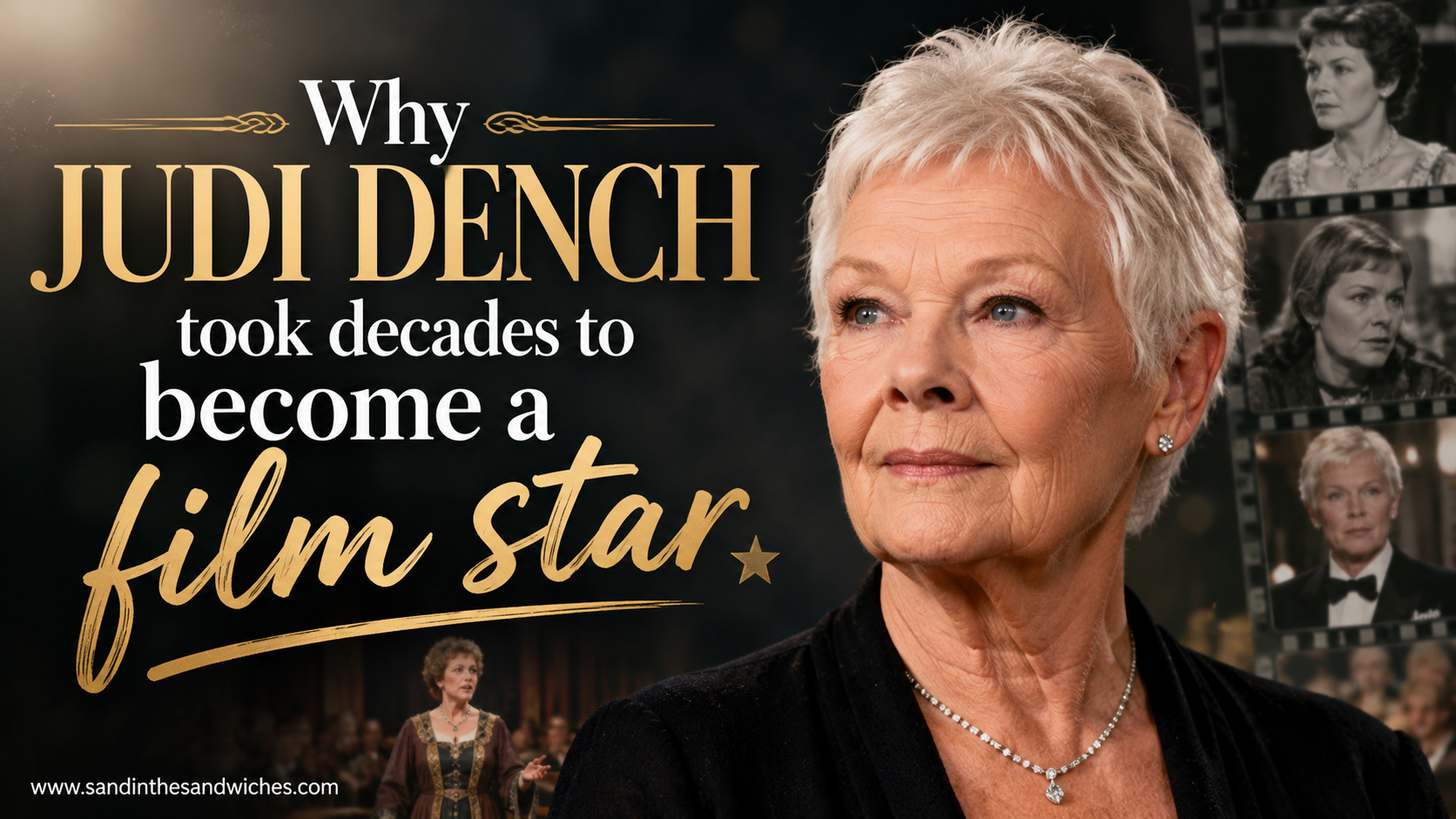
When I first read that a director had told Judi Dench she had “the wrong face” for film, I could not believe what I was reading. This is the same Judi Dench who went on to win an Academy Award, play M in seven James Bond films, and earn eight Oscar nominations. Yet the comment came early, and it stuck. The real answer to why Judi Dench took decades to become a film star is not a single rejection. It is a chain of choices, an old industry, and one woman who refused to be hurried.
Dame Judith Olivia Dench was born on 9 December 1934 in York, England. By the time she reached her 60s, she had already been one of the most respected stage actresses in Britain for nearly four decades. The film world was about to discover what the theatre world had known since 1957. In this piece, I want to walk through the real timeline, the turning point, and the lessons her career still offers in 2026.
Table of Contents
The theatre foundations that shaped her career
Judi Dench did not stumble into acting. She trained for it. After school, she studied at the Central School of Speech and Drama in London, a place that treated the voice and the body as a single instrument. Even now, when you watch her in interviews, you can see that training. She does not fidget. She listens. She answers in full, considered sentences. That discipline began in a classroom, not on a film set.
Her professional stage debut came in 1957 with the Old Vic Company, playing Ophelia in Hamlet opposite John Gielgud. That debut matters. The Old Vic was not a small regional theatre. It was one of the great training grounds of British acting, and being cast opposite Gielgud at 22 marked Dench as someone to watch.
By the early 1960s, she had joined the Royal Shakespeare Company in Stratford-upon-Avon. There she played many of the roles she would become known for: Lady Macbeth, Titania, Juliet. The RSC in that era was a kind of finishing school for British actors. You learned verse, you learned stillness, and you learned how to fill a 1,500-seat theatre with a whisper. That is a very different muscle from the one required to hold a close-up on a 35mm frame.
By 1968, Dench was already winning major awards. She picked up an Olivier Award nomination for her work in London, and a Tony Award for her Broadway role in Cabaret. The theatre world had made up its mind about her. The film world, famously, had not.
The director who told her she had ‘the wrong face’ for film
This is the moment the whole story turns on. In the 1960s, a director gave Judi Dench feedback after a screen test. The verdict, by her own telling, was blunt. He said she had “the wrong face” for film. The phrasing has become famous, partly because Dench has repeated it in interviews over the years, including a 2022 appearance on BBC America.
You have to imagine what that did to a young actress. Dench was in her late 20s, already established on stage, and trying to break into the more lucrative, more visible world of cinema. The message was not just that she was not photogenic enough. It was that her whole face, the instrument she had spent her life training, was the wrong tool for the job.
Dench has said the comment “put her off” a film career for years. That is honest and a little surprising coming from someone of her stature. The right face, in that era, often meant soft features, big eyes, the kind of look that the camera could fall in love with in a single shot. Dench’s face was sharper, more particular, more particular than that. It asked you to meet her, instead of inviting you to gaze at her.
It would have been easy to internalize the verdict. Many actors would have quit, or at least stopped trying. Dench did neither. She went back to the stage, sharpened her craft, and waited. The waiting lasted about 30 years.
Why she chose the stage over the screen for decades
It is tempting to read Dench’s theatre-first life as a kind of consolation prize. It was not. By her own account, she loved the stage for what it demanded. A theatre audience cannot be cut away in the edit. You have to win them in the room, night after night, with breath, timing, and presence. That kind of work builds stamina that films rarely ask for.
Dench has also spoken about the discipline of repetition. A film shoot, she has noted, often demands many takes of the same moment. Theatre, by contrast, runs in one direction. You cannot go back. The audience is in the room with you. Mistakes become part of the performance. That kind of pressure suited her, and she has said so more than once.
There were also practical realities. In the 1960s and 1970s, the British film industry was going through one of its periodic collapses. Cinema attendance had dropped sharply. Many actors, Dench included, simply had more work in theatre and television than in film. Choosing the stage was not always a grand philosophical statement. Sometimes it was the only work on offer.
Still, there is something more in her story. Dench has talked about not wanting to “do the same thing twice.” The stage gave her new plays, new roles, and a new audience every night. Cinema, especially at the time, often meant typecasting once you had a hit. By staying on stage, she kept her range wide. That range would matter enormously when the camera finally did come calling.
Mrs Brown: the lead film role that arrived at 63
The phone call that changed Judi Dench’s film life came in the mid-1990s. She was 61, a Dame of the British Empire since 1988, and had never carried a film on her own. Then the director John Madden approached her about a small, quiet drama about Queen Victoria and her servant John Brown, played by Billy Connolly. The film was Mrs Brown, and it was almost not made. The producers were nervous about casting an actress in her 60s in the lead. Dench was nervous too.
The risk paid off. Mrs Brown, released in 1997, was a quiet hit. Critics praised Dench for bringing a real woman to a role that had often been treated as a caricature. Audiences responded. Dench won a BAFTA, a Golden Globe, and an Oscar nomination for Best Actress. The director who had once told her she had the wrong face for film must have noticed. By then, Dench was 63 years old.
What happened next is one of the great late-career runs in modern film. In 1998, she won the Academy Award for Best Supporting Actress for Shakespeare in Love, in which she played Queen Elizabeth I in just eight minutes of screen time. From 1997 onward, she collected eight Oscar nominations in total, a remarkable run for any actor, let alone one who only started leading films in her 60s.
She also became M in the James Bond franchise starting with GoldenEye in 1995, a role she would play through 2012’s Skyfall. That role alone is a study in late-career reinvention. M was sharp, dry, often funny, and completely unsentimental. She made the character her own in a way the films had not seen before. None of that would have been possible without the decades of stage work that came before.
She kept going. She earned Oscar nominations for Iris (2001), Mrs Henderson Presents (2006), Notes on a Scandal (2006), Philomena (2013), and Belfast (2021). She also won the hearts of a new generation as the elderly Queen in Shakespeare in Love, and as a recovering pirate captain in the 2017 blockbuster Pirates of the Caribbean: Dead Men Tell No Tales. By 2026, the woman once told she had the wrong face for film has more than 130 screen credits to her name.
What her career teaches us about timing and persistence
I think the most useful thing about Dench’s story is that it is not really about being discovered. It is about being ready. The director’s “wrong face” comment hurt, but Dench used the time it gave her. She built a voice, a physical presence, and a depth of range that younger film stars often do not have time to develop.
There is a lesson in there for any creative. Late breakthroughs are not failures of early effort. They are often the result of early effort that the wider world has not caught up with yet. Dench’s work in the Old Vic and the RSC in the 1960s and 1970s is what made Mrs Brown and Shakespeare in Love possible. The 30 years of waiting were not wasted. They were preparation.
There is also a lesson about what we mean by a film career. For decades, Dench had a career. It was just not the kind the trade papers measured. Once cinema finally did come to her, she did not behave like a newcomer. She behaved like a veteran, which is what she was. That difference is hard to fake, and it shows on screen.
Finally, there is a quiet kind of stubbornness in her story. The industry told her no. She did not argue, did not chase, did not try to fit the mould. She kept doing the work that felt honest to her. Eventually, the work proved the industry wrong. That is not the fastest path. It is, however, an extremely durable one.
Frequently Asked Questions
What medical condition does Judi Dench have?
Judi Dench has spoken publicly about being diagnosed with age-related macular degeneration (AMD), a condition that affects her central vision. She was first diagnosed around 2012. Despite the condition, she has continued to act, though she has said she now relies more heavily on her colleagues and on scripts printed in large type. As of 2026, the condition is not considered curable, but it is manageable, and Dench has not retired from acting because of it.
How did Judi Dench start her career?
Judi Dench started her career on the British stage. She trained at the Central School of Speech and Drama in London, then made her professional debut in 1957 with the Old Vic Company as Ophelia in Hamlet opposite John Gielgud. She went on to join the Royal Shakespeare Company, where she built a reputation as one of the most versatile Shakespearean actresses of her generation. Her film career came much later, with her first lead role in Mrs Brown in 1997.
Is Judi Dench considered a great actress?
Yes. Judi Dench is widely considered one of the greatest British actresses of the modern era. She has won an Academy Award, ten BAFTAs, and an Olivier Award, and has been made a Dame Commander of the Order of the British Empire. The Royal Shakespeare Company, the National Theatre, and international film academies have all honoured her work across stage, television, and film.
Why did Judi Dench retire from acting?
Judi Dench has not formally retired. In recent years she has stepped back from certain kinds of work because of age-related macular degeneration, which makes reading scripts difficult. She has said she will continue to take on roles she feels she can do well, particularly projects that suit her condition. In 2026 she is still regarded as an active, if selective, performer.
Has Judi Dench ever won Best Actress?
Judi Dench has won the Academy Award for Best Supporting Actress, for Shakespeare in Love (1998). She has also been nominated eight times for Best Actress, including for Mrs Brown, Iris, Mrs Henderson Presents, Notes on a Scandal, Philomena, and Belfast. She has won multiple BAFTA Best Actress awards, and was named Best Actress at the Golden Globes for Mrs Brown.
When did Judi Dench get her first movie role?
Judi Dench’s earliest film appearances date back to the 1960s, often in small television or supporting roles. Her first major leading film role was in Mrs Brown in 1997, when she was 63 years old. From that point on, she became a regular presence in major films, including the James Bond franchise and Shakespeare in Love.
What did the director mean when he told Judi Dench she had the wrong face for film?
In the 1960s, a director told Judi Dench she had the wrong face for film, meaning her features did not match the conventional Hollywood or British film standards of the time, which favoured softer, more conventionally photogenic looks. Dench has said the comment put her off a film career for years and pushed her to focus on stage work, where her particular qualities became a strength rather than a limitation.
A film star, on her own terms
The question of why Judi Dench took decades to become a film star does not have a tidy answer. There is the director who said she had the wrong face. There is the British film industry that was too small to give her a stage of her own. There is her own stubborn love of the theatre, and her refusal to chase the camera. All of those things combined to keep her off the screen for most of her 30s, 40s, and 50s.
And then there is Mrs Brown, at 63. Eight Oscar nominations in the years that followed. A James Bond run that lasted nearly 20 years. An Academy Award for eight minutes of screen time in Shakespeare in Love. A career that has now crossed nine decades. In 2026, Dench is still working, still in demand, and still the same woman the theatre first noticed in 1957.
The director’s verdict was wrong. It was not just wrong about her face. It was wrong about what a film face has to be. Dench proved that a face can sharpen with age, that presence can deepen with time, and that a wrong verdict in 1964 does not have to be the last word. Her story is not a comeback. It is a long, slow arrival at the place she always deserved to reach.