
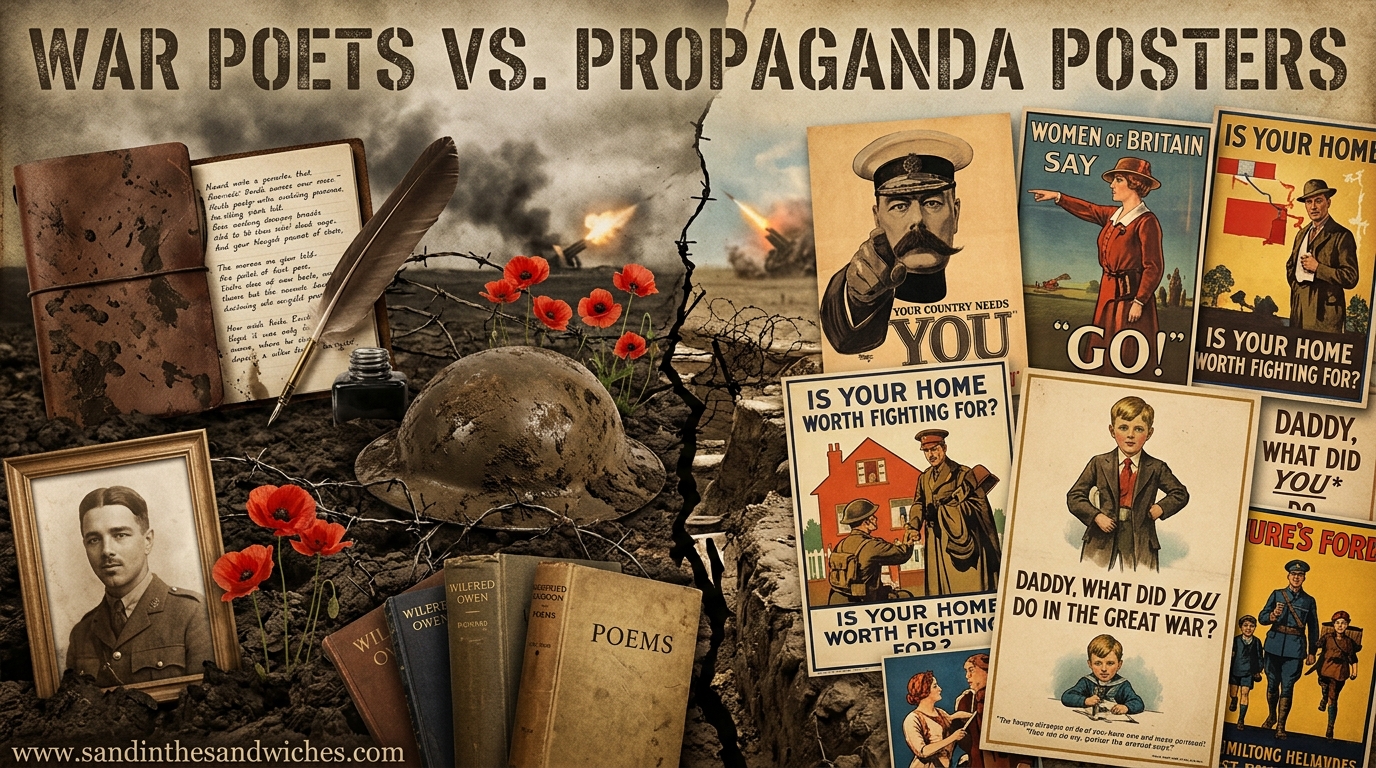
Picture a young man in 1914, walking past a colorful poster showing a proud soldier, bayonet gleaming, with the words “Your Country Needs YOU” printed in bold letters beneath. Now picture that same man months later, standing in a flooded trench, knee-deep in mud, watching a fellow soldier choke to death on poison gas. The distance between those two images is enormous. That gap is exactly what the war poets understood that the propaganda posters hid.
During World War I and World War II, governments produced thousands of recruitment and propaganda posters designed to inspire patriotism, encourage enlistment, and maintain civilian morale. These posters used heroic imagery, emotional appeals, and simplified narratives about good versus evil. They showed war as noble, soldiers as heroes, and service as the highest calling a citizen could answer.
But the men who actually fought in those wars told a different story. The war poets, soldiers who wrote about their experiences in verse, documented what the posters left out. They wrote about rats the size of cats in the trenches, about friends blown apart beside them, about gas attacks and gangrene and the mental collapse we now call PTSD. They captured the soldier experience in all its unfiltered, heartbreaking reality.
In this article, we explore what the war poets understood that the propaganda posters hid. We examine the specific messages posters sold to the public, what soldiers actually witnessed on the battlefield, and why this contrast still matters for how we consume media today.
Table of Contents
What Propaganda Posters Told Us
Propaganda posters were the dominant mass communication tool of the early 20th century. Before television and the internet, governments relied on posters plastered on walls, in shop windows, and along roadsides to shape public opinion and drive recruitment. These posters told a carefully constructed story about war that bore little resemblance to the actual conditions soldiers would face.
The core message of most WWI propaganda posters was simple: war is glorious, your country needs you, and real men fight. Heroic imagery dominated every design. Soldiers stood tall and strong, uniforms crisp and clean, faces set with determination. There was no mud, no blood, no barbed wire, and no visible suffering. The recruitment posters presented war as an adventure, a chance to prove your manhood and serve a noble cause.
British posters featured Lord Kitchener, the Secretary of State for War, staring directly at the viewer with an accusing finger and the words “Your Country Needs YOU.” American versions adapted this into the famous Uncle Sam poster by James Montgomery Flagg, which became one of the most reproduced images in history. These posters used a direct, personal appeal that made the viewer feel individually called to duty.
Other posters relied on guilt and shame. A British poster from 1915 showed a man sitting comfortably at home while his daughter asked, “Daddy, what did YOU do in the Great War?” The implication was clear. If you did not enlist, you were a coward who would have to explain your inaction to your children. This emotional manipulation was deliberate and effective.
Enemy demonization was another powerful tool. German soldiers were depicted as ape-like brutes wielding bloody clubs, as in the infamous “Destroy This Mad Brute” poster from America. British posters showed the Kaiser as a madman and German soldiers bayoneting babies. These dehumanizing images made it easier for ordinary citizens to accept killing other human beings, because the enemy was no longer human.
What propaganda posters hid was the reality of industrialized, mechanical warfare. They did not show machine guns that could fire 600 rounds per minute, artillery barrages that could flatten entire landscapes, or poison gas that could blind and suffocate. They did not mention trench foot, dysentery, or the psychological collapse that came from living under constant shelling. The posters sold a version of war that had not existed for centuries, if it ever existed at all.
What War Poets Actually Saw
The war poets experienced something the propaganda posters never acknowledged. Trench warfare on the Western Front was a nightmare of mud, disease, and death that defied description. Yet these soldiers found words for it, and their poetry remains some of the most powerful testimony in the English language.
Wilfred Owen, perhaps the most famous of the WWI poets, described a gas attack in “Dulce et Decorum Est” with horrifying precision. He wrote about a soldier who failed to get his gas mask on in time, describing the man’s “white eyes writhing in his face” and the blood “gargling from the froth-corrupted lungs.” This was not the clean, heroic death that recruitment posters implied. It was slow, agonizing, and utterly dehumanizing.
The daily conditions of trench life were equally grim. Soldiers stood for hours in waist-deep water and mud, developing trench foot, a condition where the feet would literally rot from constant dampness. Rats fed on the bodies of dead soldiers in No Man’s Land and grew to the size of small cats. Lice infested every man, and the constant itching drove some soldiers to distraction. Disease killed as effectively as any bullet.
Siegfried Sassoon, another major war poet, wrote about the psychological toll of constant shelling and the loss of friends. In poems like “Suicide in the Trenches,” he told the story of a simple soldier who “put a bullet through his brain” after enduring what no human should have to endure. Sassoon himself suffered from what was then called shell shock, now known as PTSD, and was hospitalized at Craiglockhart War Hospital.
The war poets understood something that propaganda posters could never admit. Modern warfare was not a test of individual courage or a glorious adventure. It was a mechanized slaughterhouse where individual bravery mattered far less than artillery, machine guns, and poison gas. Men died by the thousands in attacks that gained a few yards of mud, only to lose that ground the next day. The heroic individual of the propaganda poster was irrelevant in a war dominated by industrial killing.
They also understood the emotional cost that no poster could capture. The grief of watching friends die. The guilt of surviving when others did not. The horror of realizing that the patriotic phrases on the recruitment posters were, as Owen wrote, “The old Lie.” The poets documented the soldier experience not as propaganda but as testimony, and that testimony changed how the world understood war.
Famous War Poets: Voices from the Trenches
The war poets were not a single, unified movement. They came from different backgrounds, held different beliefs, and wrote in different styles. But together, they created a body of work that challenged the official narrative of war in ways no government could suppress.
Wilfred Owen: The Anti-War Voice
Wilfred Owen served as a lieutenant in the Manchester Regiment and experienced some of the worst fighting of the war. His time at the front, combined with his treatment for shell shock at Craiglockhart, transformed him into one of history’s most powerful anti-war voices. His poem “Dulce et Decorum Est” directly attacked the Latin phrase “It is sweet and fitting to die for one’s country,” calling it “The old Lie.” Owen was killed in action on November 4, 1918, exactly one week before the Armistice. His mother received the telegram announcing his death on November 11, the day the war ended.
Siegfried Sassoon: The Brave Protester
Siegfried Sassoon was known as “Mad Jack” for his fearless, almost reckless courage in battle. He was decorated for bravery and respected by his men. But after years of fighting, Sassoon wrote an open letter declaring that the war was being prolonged for no good reason. He threw his Military Cross into a river and refused to return to duty. Rather than court-martial a decorated war hero, the military sent him to Craiglockhart, where he befriended Wilfred Owen. Sassoon’s poetry combined bitter satire with genuine grief, as in “The General,” which exposed the incompetence and indifference of military leadership.
Rupert Brooke: The Romantic Tragedy
Rupert Brooke represents a different kind of war poet. His early sonnets, especially “The Soldier,” captured the idealistic patriotism that many felt at the start of the war. Brooke wrote of “some corner of a foreign field that is for ever England” and described death in battle as a noble sacrifice. But Brooke never experienced the trenches. He died of blood poisoning from an infected mosquito bite in 1915 while sailing to Gallipoli. His romantic vision of war remained untested by the reality that Owen and Sassoon would later document. Brooke’s poetry reminds us that early war enthusiasm, stoked by propaganda, was real and sincerely felt by many before the scale of the slaughter became clear.
Isaac Rosenberg: The Working-Class Witness
Isaac Rosenberg came from a working-class Jewish family in London’s East End, unlike the upper-middle-class backgrounds of Owen, Sassoon, and Brooke. He enlisted not out of patriotism but for the daily pay, and his poetry reflects a different perspective on the war. In “Break of Day in the Trenches,” Rosenberg wrote about a rat that “cosy” crossed between German and British lines, an image that captured the absurdity and horror of the conflict. His work was raw, modern, and unromantic. Rosenberg was killed on April 1, 1918, while on night patrol. His death went almost unnoticed at the time, but his poetry has since been recognized as some of the most original to come out of the war.
Iconic Propaganda Posters: Selling the War
To understand what the war poets understood that the propaganda posters hid, we need to examine the specific messages those posters delivered. Each major poster used distinct psychological techniques to manipulate public opinion and drive recruitment.
Uncle Sam Wants You
James Montgomery Flagg’s Uncle Sam poster, created in 1916 and used extensively during both world wars, is perhaps the most famous propaganda image in American history. Uncle Sam stares directly at the viewer, finger pointed, with the words “I Want YOU for U.S. Army.” The technique is personal accusation. The poster does not ask for volunteers in the abstract. It singles out each individual viewer and makes a direct demand. This created a sense of personal obligation that was difficult to refuse.
Lord Kitchener: Britain’s Call
Alfred Leete’s 1914 poster featuring Lord Kitchener used the same pointing finger and direct gaze technique as Uncle Sam. Kitchener, the face of the British military establishment, looked out from the poster with the words “Your Country Needs YOU.” Over three million copies were printed, and the image became so iconic that it defined British recruitment for the entire war. The poster was so effective at creating urgency that recruitment centers were overwhelmed with volunteers in the early months of the war.
Destroy This Mad Brute
The “Destroy This Mad Brute” poster from 1917 showed a massive, ape-like creature wearing a German military helmet and carrying a bloody club in one hand and a limp woman in the other. The caption read “Enlist” and was designed by Harry Ryle Hopps. This poster exemplified enemy demonization at its most extreme. By depicting the German enemy as a literal monster, the poster removed any moral complexity from the war. Killing was no longer a tragic necessity but a heroic duty against evil itself.
Daddy, What Did YOU Do in the Great War?
This 1915 British poster by Savile Lumley showed a man sitting comfortably at home while his son played with toy soldiers and his daughter asked the titular question. No blood, no violence, just the quiet implication that a man who did not fight would face a lifetime of shame. This poster manipulated family dynamics and masculine pride to drive recruitment. It was designed to make staying at home feel like a betrayal of one’s own children.
The Clash of Narratives: Official vs. Personal Truth
The conflict between propaganda and poetry was really a conflict between official narrative and personal truth. Governments needed to maintain public support for the war, and that required controlling what people knew about the fighting. The propaganda poster was a tool of that control. The war poet was a threat to it.
Censorship was a major factor in how both narratives developed. Letters from the front were censored by officers. Newspapers were censored by government agencies. Casualty figures were often manipulated or suppressed. The British government established the War Propaganda Bureau in 1914, which controlled what information reached the public. Official war correspondents were embedded with troops and discouraged from reporting anything that might damage morale.
This censorship meant that the public’s understanding of the war came largely from propaganda posters, newspaper articles, and official communiques, all of which painted a heroic picture of the conflict. The horrors of trench warfare, the futility of many battles, and the scale of casualties were all minimized or hidden entirely.
Soldiers turned to poetry partly because it was one of the few forms of expression they could control. A poem written in a trench journal or sent in a letter home could capture truth in a way that official reports could not. Poetry was personal, emotional, and difficult to censor without seeming heavy-handed. A government that censored soldiers’ poetry would be admitting that there was something to hide.
The clash between these narratives became public after the war. Owen’s poetry was published posthumously in 1920, edited by Sassoon. Sassoon’s own collections appeared throughout the 1920s. The public, which had been fed propaganda for four years, suddenly had access to the soldiers’ actual experience. The result was a cultural shift. War poetry became required reading in schools, and the phrase “lions led by donkeys” came to summarize the public’s new understanding of the conflict.
What the war poets understood that the propaganda posters hid was that the truth, however painful, was more valuable than any comforting lie. The poets did not write to demoralize. They wrote because someone needed to tell the truth about what was happening, and no one else was doing it.
How Posters Recruited and Poets Revealed
The recruitment strategies used in propaganda posters were sophisticated and psychologically powerful. Understanding how they worked helps us appreciate why the poets’ testimony was so necessary and so threatening to the official narrative.
Posters used four main techniques. First, patriotic appeal, which connected military service to love of country and framed enlistment as a moral duty. Second, masculine challenge, which implied that men who did not enlist were cowards. Third, emotional manipulation, which used images of suffering women and children to create a sense of protective urgency. Fourth, enemy demonization, which made the enemy seem so monstrous that fighting them became a moral imperative.
These techniques were developed by professional illustrators and advertising experts. The Division of Pictorial Publicity in the United States, led by Charles Dana Gibson, enlisted hundreds of commercial artists to create propaganda. In Britain, the Parliamentary Recruiting Committee coordinated poster production. These were not amateur efforts but professional campaigns designed by people who understood visual persuasion.
Poetry served as counter-propaganda because it could not be dismissed as unpatriotic. Owen and Sassoon were decorated soldiers who had risked their lives in battle. When they wrote about the horrors of war, they spoke from experience and sacrifice. Their words could not be dismissed as the complaints of cowards or the fantasies of civilians who did not understand the stakes.
The poets revealed what the posters concealed. Owen’s “Anthem for Doomed Youth” described the deaths of soldiers as “die as cattle” and asked what passing-bells would ring for them. The image was deliberately industrial, reducing soldiers to animals being slaughtered. No propaganda poster would ever show soldiers dying like cattle, because that image undermined the entire premise of heroic sacrifice.
Sassoon’s “The Rear-Guard” described a soldier descending into a dugout and treading on a corpse, discovering the dead man after feeling something soft under his foot. The poem’s power came from its specificity. This was not an abstraction. It was a physical, sensory experience that the reader could not escape. Propaganda generalized. Poetry particularized. And in the particular, the truth was unavoidable.
Why the Contrast Matters Today
The gap between what propaganda posters showed and what war poets experienced is not just a historical curiosity. It offers lessons that remain relevant for how we consume media, evaluate government messaging, and understand the gap between official narratives and lived reality.
Media literacy starts with recognizing that every message has a purpose. Propaganda posters were designed to persuade, not to inform. They selected facts, used emotional appeals, and omitted inconvenient truths to achieve their goals. The same principles apply to modern media. Government statements, corporate advertising, and social media campaigns all use selective messaging to shape how we think and feel.
The war poets teach us to seek out primary sources and firsthand testimony. When official narratives conflict with the experience of those actually involved, the testimony of participants deserves attention. The soldiers who wrote poetry were not journalists or politicians. They were witnesses who documented what they saw because someone needed to know.
The contrast also highlights the importance of diverse voices. Propaganda works best when only one perspective is available. Owen, Sassoon, Brooke, and Rosenberg each offered different views of the war. Brooke’s early idealism, Sassoon’s bitter protest, Owen’s horrified testimony, and Rosenberg’s raw realism together created a fuller picture than any single voice could provide.
Perhaps most importantly, the story of propaganda posters and war poets reminds us that truth has a way of emerging, even when powerful forces try to suppress it. The poets wrote because they needed to. The poems survived because they resonated. And the truth they told eventually became the dominant understanding of what the war was really like.
The Legacy of Honest War Testimony
The impact of war poetry extended far beyond the immediate postwar period. It changed how societies remember war, how militaries communicate with the public, and how literature represents violence and suffering. The legacy of what the war poets understood that the propaganda posters hid continues to shape our culture.
In Britain, war poetry became a cornerstone of the national curriculum. Every schoolchild reads Owen and Sassoon. The poems are recited at Remembrance Day ceremonies. They have shaped how the British understand World War I, transforming it in public memory from a necessary patriotic struggle into a tragedy of industrialized slaughter and incompetent leadership.
The war poets also changed the language of military memory. Before WWI, war literature tended toward heroic narrative and patriotic celebration. After the war poets, that approach became difficult to sustain. Modern war literature, from Erich Maria Remarque’s “All Quiet on the Western Front” to the memoirs of modern soldiers, owes a debt to the honesty and courage of Owen, Sassoon, and their contemporaries.
Propaganda posters from later conflicts also changed in response. By World War II, governments were more careful about making promises that reality could not support. The “Loose Lips Sink Ships” campaign focused on operational security rather than heroic adventure. The tone had shifted, partly because the truth told by the WWI poets had made naive patriotism harder to sell.
The poets also created a template for how soldiers can bear witness. The tradition of soldier testimony, from the Vietnam Veterans Memorial to modern memoirs and oral history projects, draws on the idea that those who experience war have a duty to tell the truth about it. The war poets showed that testimony itself is an act of service, one that honors the dead and informs the living.
Understanding what the war poets understood that the propaganda posters hid is ultimately about the enduring conflict between power and truth. Governments will always have reasons to shape narratives. But the experience of individuals, honestly told, has a power that propaganda can never match. The poets proved that a single voice, speaking truth from experience, can outlast a thousand posters printed in support of a lie.
FAQs
How might war posters be understood as propaganda?
War posters functioned as propaganda by using emotional appeals, heroic imagery, and simplified narratives to shape public opinion and drive recruitment. They presented a selective, idealized version of war that concealed the reality of trench warfare, mass casualties, and psychological trauma. Governments commissioned professional artists to create posters that manipulated viewers through patriotism, guilt, and enemy demonization.
What is the main idea of the propaganda poster?
The main idea of most WWI and WWII propaganda posters was to persuade citizens to support the war effort through enlistment, fundraising, or compliance with government policies. Posters presented war as a noble adventure, framed military service as a moral duty, and depicted the enemy as a monstrous threat that had to be defeated.
Did propaganda posters work in WW1?
Yes, propaganda posters were highly effective in WW1, especially for recruitment. The Lord Kitchener poster alone helped drive millions of British volunteers to enlist in the early years of the war. American posters produced by the Committee on Public Information reached every community. However, as the war progressed and news of conditions at the front filtered home, the effectiveness of recruitment posters declined and conscription became necessary.
What made WW1 posters so powerful?
WW1 posters were powerful because they combined professional commercial advertising techniques with intense emotional appeals. They used direct personal address like the pointing finger of Uncle Sam, manipulated family loyalty and masculine pride, and relied on vivid visual imagery that could be understood by people of all literacy levels. Professional illustrators applied lessons from the advertising industry to create images that were impossible to ignore.
What defines a war poet?
A war poet is a writer who documents the experience of war through poetry, typically drawing on firsthand experience as a soldier or civilian in a conflict zone. War poets are distinguished by their willingness to confront the reality of war honestly, even when that reality contradicts official narratives or patriotic expectations. The term is most strongly associated with the soldier-poets of World War I.
Who are the realistic war poets?
The realistic war poets are those who wrote about the actual conditions of warfare rather than idealized or patriotic visions. Wilfred Owen and Siegfried Sassoon are the most prominent realistic war poets, known for their graphic depictions of trench warfare, gas attacks, and psychological trauma. Isaac Rosenberg is also considered a realistic war poet for his raw, unsentimental portrayal of the soldier experience. Rupert Brooke, by contrast, is often classified as a romantic war poet for his idealistic early sonnets.
Conclusion
The story of what the war poets understood that the propaganda posters hid is really a story about the power of honest testimony against manufactured narrative. Propaganda posters sold a version of war that was clean, heroic, and noble. The poets who fought in those wars documented a reality that was muddy, terrifying, and dehumanizing. Both were products of the same conflict, but only one told the truth.
Wilfred Owen, Siegfried Sassoon, Isaac Rosenberg, and others risked their lives in battle and then risked their reputations by writing honestly about what they experienced. They challenged official narratives, confronted patriotic myths, and gave voice to the millions of soldiers who could not speak for themselves. Their poetry outlasted the governments that produced the propaganda, and it continues to shape how we understand war today.
The lessons from this contrast remain relevant. Official narratives and personal truths will always exist in tension. The powerful will always have reasons to simplify, sanitize, and manipulate. But the testimony of those who experience events firsthand, told honestly and without compromise, has a power that propaganda can never replicate. What the war poets understood that the propaganda posters hid was simply this: that the truth, however painful, deserves to be told. And that a poem written in a trench can outlive a thousand posters printed to support a lie.