
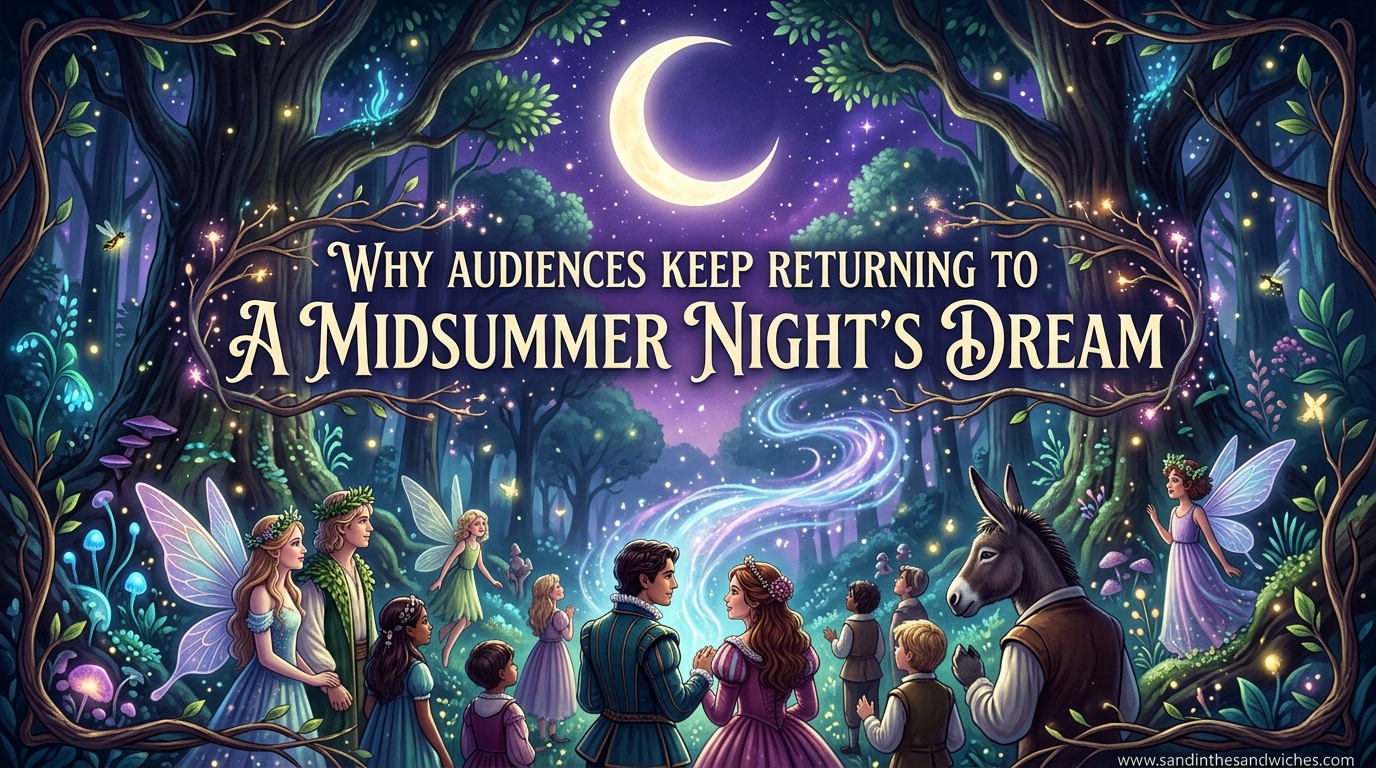
Some plays you see once. A Midsummer Night’s Dream you see again and again. Theater companies revive it more than almost any other Shakespeare comedy, audiences line up for productions they have already watched, and students who first meet it in a classroom often return to it decades later on stage. That pattern raises a question worth taking seriously: why audiences keep returning to A Midsummer Night Dream, century after century, when so many other Elizabethan comedies have quietly slipped off the stage.
The short answer is that the play is engineered for return. It rewards repeat viewing because its layers shift depending on what you bring to them, and because its most famous moments become more interesting, not less, once you know them by heart.
In this article I want to break down the specific reasons behind that pull. We will look at the psychology of return, the contradictions at the heart of the play’s love story, the dream world that audiences find so seductive, the visual magic of transformation, the meta-theatrical play-within-a-play, and the political courage that helped the play survive. We will end with the famous lines that draw people back, and a few practical reasons each new staging still feels fresh.
Table of Contents
Why Audiences Keep Returning to A Midsummer Night Dream: The Psychology of Return
The reason audiences keep returning to A Midsummer Night Dream is that the play builds a recognition loop into its structure. You arrive knowing certain lines and certain images, and the production has to deliver them, but the delivery never quite lands the way you remember. That gap between expectation and surprise is the engine of repeat viewing.
Think about what happens when you already know Puck’s closing speech, Bottom’s transformation, or the wall scene in Pyramus and Thisbe. You are not waiting to find out what happens. You are waiting to find out how this cast, this director, and this design will solve a problem every production has to solve differently. The fairy king and queen can be played as regal, comic, sinister, or erotic. Bottom can be a clown, a egomaniac, or a working man quietly touched by grace. Every choice rewrites the play slightly.
That is the heart of the enduring popularity of this Shakespeare comedy. It is dense enough to support endless reinterpretation, and loose enough that no single staging can exhaust it. First-time viewers come for the story; repeat viewers come for the variation.
There is also a quieter psychological pull. The play is partly about returning itself. The lovers fall asleep, wake transformed, and return to Athens as different people. Bottom wakes from his vision unable to describe it, only able to say he has been touched by something. Audiences mirror that journey. They leave the theater changed in a small way and want to feel it again.
Love’s Many Faces: The Central Conflict
If you ask what the problem is in A Midsummer Night’s Dream, the answer is love itself. Not the absence of love, but its instability. Helena loves Demetrius, who loved her and now loves Hermia, who loves Lysander, whose father disapproves. By the time the lovers reach the forest, the mess is complete.
What makes the central conflict so durable is that Shakespeare refuses to flatten love into one thing. In this play love is romantic, irrational, fickle, cruel, comic, and redemptive, often within the same scene. The love potion is the perfect emblem for that. It does not create love out of nothing; it redirects it arbitrarily, exposing how thin the line is between devotion and obsession.
Audiences recognize this. They have lived the version of love that suddenly shifts target for no good reason. They have watched a friend fall for the wrong person and known that no argument will reach them. The play stages that experience openly and refuses to apologize for it.
This is also why the play’s gender dynamics still feel raw. Helena’s pursuit of Demetrius is uncomfortable in a way Shakespeare clearly noticed, and productions in 2026 continue to wrestle with how to play her without making the audience cringe. The play is honest enough about love’s darkness that each generation finds a new angle.
Return viewers often say the love story hits differently as they get older. Younger audiences see the comedy; older audiences see the ache underneath.
The Dream World: Why Dreams Resonate With Us
The dream vision in Shakespeare’s writing here is not decoration. It is the structure of the play. The forest sequences are designed to feel neither fully real nor fully imagined, and that liminal quality is exactly what audiences find so addictive.
When Hermia dreams of a serpent eating her heart while Lysander watches, the moment is not just a creepy image. It is the play telling us, in its own language, that the rules have changed. Inside the forest, logic bends. People fall out of love and into it. A man gets an ass’s head and a fairy queen kisses him. A play rehearsal becomes a haunting.
Dreams resonate with audiences because they share that structure with memory. Dreams mix faces, scramble chronology, and produce images whose meaning you feel before you can name. So does this play. You walk out of the theater unsure which moments were jokes, which were threats, and which were genuinely tender. That uncertainty invites you back.
The end of the play leans into the puzzle deliberately. Theseus dismisses the lovers’ story as the product of “seething brains,” and Puck’s final speech offers to dismiss the entire evening as a dream if the audience did not enjoy it. The play hands you, the viewer, the choice of how real it was. Few works are that generous.
The Magic of Transformation: Puck, the Potion, and Wonder
Puck is one of the great characters in English drama, and a big part of why audiences keep returning to A Midsummer Night Dream is simply to see what an actor will do with him. He is mischief, menace, and charm in one figure, and every production casts him slightly differently. Some make him a child. Some make him a trickster spirit. Some make him darker than you expect.
The love potion he carries on Oberon’s orders is the plot’s mechanism, but the more lasting transformation is Bottom’s. When Puck fixes an ass’s head on the weaver and Titania falls in love with him, the play stages something stranger than comedy. Bottom, the most pompous man in Athens, becomes the object of a fairy queen’s devotion, and for a few scenes the joke gives way to something close to tenderness.
That tonal shift is hard to bring off, and audiences who have seen it done well tend to chase the feeling. They return hoping for the production that gets Bottom’s transformation exactly right, the one where the laughter dries up for a second and you glimpse something underneath.
Visual magic also rewards repeat viewing. Different productions stage the fairies differently, use puppetry, shadow, dance, or pure language. The transformations are concrete enough to be reimagined without losing their shape. That keeps the play alive on stage.
The Play-Within-a-Play: Layers of Audience Identification
The metadrama in A Midsummer Night’s Dream is not a side feature. It is the reason the play feels modern. Shakespeare builds a comedy about amateur actors rehearsing a tragedy inside a comedy about lovers, inside a fairy plot, and then has Puck address the audience directly at the end.
The Mechanicals’ staging of Pyramus and Thisbe is funny on its own terms. It is also Shakespeare mocking the conventions of tragic theater, including his own Romeo and Juliet. The audience inside the play watches a bad production; the audience outside the play watches both the bad production and the aristocrats mocking it, while quietly identifying with both.
That layered identification is what scholars call the play-within-a-play device, and it is one of the main reasons the play survives. It is not just telling you a story. It is showing you what stories are made of, and inviting you to laugh at the machinery without losing your pleasure in it.
Return viewers often focus on the Pyramus and Thisbe scene in a different way than first-timers. They notice the craft inside the comedy. They appreciate how the bad rhymes are themselves perfectly written. The play rewards that second look.
Political Courage: How the Play Got Away with It
One reason the play endured long enough to become canonical is that Shakespeare had the political instincts to push boundaries and the craft to escape punishment for it. The “apologies to the king” tradition in Elizabethan theater let playwrights stage risky content and then frame it as inadvertent, and A Midsummer Night’s Dream uses that escape hatch brilliantly.
The play mocks aristocratic marriage, stages a queen (Titania) humiliated by a working man with an ass’s head, lets young lovers defy parental authority and win, and ends with a fairy invasion of the palace itself. Any one of those could have caused trouble. Together they should have been dangerous.
Shakespeare protected the play by framing it as a dream and as a wedding entertainment. The framing gave him cover, and the quality of the writing gave the court a reason to forgive the edge. That survival is part of why audiences still feel the play’s subversive charge in 2026. It is not just a pretty comedy. It is a comedy that got away with things, and audiences sense that.
Productions that lean into that edge, rather than smoothing it over, tend to be the ones people remember and recommend.
Why Each Staging Feels New: Performance and Production
If the play were only a text, it would still be read. What keeps it on stage is that it is unusually generous to directors and actors. The script leaves enormous room for interpretation, and theater companies know that a fresh Midsummer is one of the most reliable draws in the repertoire.
Part of that openness comes from the fairies. Shakespeare gives them almost no fixed physical description, so designers can make them almost anything: shadows, insects, children, voices offstage, dancers, puppets. The forest itself is also underdescribed. It can be a literal wood, a dreamscape, an empty stage with lighting, or a neon club. All of these have worked.
The lovers are flexible too. The four young Athenians are written as nearly interchangeable in temperament, which lets a production draw sharp distinctions or none at all. Some versions make Helena’s pursuit of Demetrius genuinely painful. Others play the whole quartet as pure farce. Neither is wrong.
That is the durability of the play. It is not that every production is good. It is that almost every production is different, and audiences who love the play keep coming back to find out what this one will be.
Why It Feels Modern: Enduring Relevance
People often ask why A Midsummer Night’s Dream is still relevant today, and the most honest answer is that the questions it asks have not gone away. The play asks whether love is something you choose or something that happens to you. It asks what counts as real. It asks whether art can tell us true things even when it is obviously fake. Those questions still land.
The play is also modern in form. The genre mixing, the direct address to the audience, the refusal to settle into a single tone, and the deliberate ambiguity of the ending all feel closer to contemporary storytelling than to most Elizabethan comedy. Audiences in 2026 are comfortable with works that shift mode, and this play has been doing that for over four centuries.
Then there is the simple fact that the play is funny. The wordplay holds up. The physical comedy holds up. The Pyramus and Thisbe scene still gets laughs from audiences who have never read a line of Shakespeare. Comedy is a powerful preservative, and this one has aged unusually well.
New generations connect with it for those reasons and one more. The play takes its young people seriously even when it mocks them. That combination of sympathy and satire is rare, and it keeps reading true.
Famous Lines That Pull Audiences Back
Part of the answer to why audiences keep returning to A Midsummer Night Dream is that the play has deposited lines into the culture that work as bookmarks. People who have never seen a production know “The course of true love never did run smooth” and “Lord, what fools these mortals be!” Knowing the lines creates anticipation.
That anticipation is itself a reason to attend. You wait for the moment Helena delivers her speech about love’s transience. You wait for Puck’s “If we shadows have offended.” You wait for Bottom’s bewildered “I have had a most rare vision.” Each production has to land those moments, and the differences between landings are part of the pleasure.
The lines also function as cultural shorthand. People quote them at weddings, in essays, in arguments. The play keeps circling back into ordinary life, and that circulation keeps pulling people toward the stage to see where the words came from.
For many return viewers, the famous lines are not the high points. They are the signposts. The real reward is everything that happens around them, in the spaces the lines leave open.
FAQs
Why does A Midsummer Night’s Dream remain so popular?
A Midsummer Night’s Dream remains popular because it rewards repeat viewing, mixes comedy, romance, and magic in a way few plays manage, and leaves enough open space for each new production to feel distinct. The psychology of return is built into its structure: audiences come back to see how a different cast solves the same scenes.
What is the problem in A Midsummer Night’s Dream?
The central problem in the play is love’s instability. Hermia loves Lysander but her father wants her to marry Demetrius, who was previously engaged to Helena. The lovers flee to a forest ruled by warring fairy royalty, where a love potion scrambles everyones affections and turns the conflict into chaos before it is finally sorted out.
What is the main message of A Midsummer Night’s Dream?
The main message is that love is irrational, transformative, and impossible to fully control, and that art and imagination help us live with that fact. The play suggests that dreams and theater are not escapes from reality but ways of making sense of it.
What is the most famous line in A Midsummer Night’s Dream?
The most quoted line is ‘The course of true love never did run smooth,’ spoken by Lysander in Act I. Other famous lines include Puck’s ‘Lord, what fools these mortals be!’ and his closing speech ‘If we shadows have offended, think but this, and all is mended, that you have but slumbered here, while these visions did appear.’
Why is A Midsummer Night’s Dream still relevant today?
The play is still relevant because its questions about love, identity, and what counts as real have not been answered. Its mixed tone, direct address to the audience, and deliberate ambiguity feel closer to modern storytelling than most Elizabethan comedy, and its humor still works on audiences who have never read Shakespeare.
Conclusion: The Enduring Pull of the Dream
So why audiences keep returning to A Midsummer Night Dream comes down to a combination that no other play quite matches. It is structurally engineered for repeat viewing, with layers that shift depending on what you bring to them. It is honest about love’s instability without becoming cynical about it. It stages a dream world that mirrors the texture of memory itself.
It also has the courage to push at political boundaries, the craft to escape the consequences, and the generosity to hand the audience the final choice about how real the whole thing was. Add Puck, the love potion, Bottom’s transformation, and a play-within-a-play that jokes about plays, and you have a work that no single production can exhaust.
The famous lines pull audiences in. The variations keep them coming back. And the play’s refusal to fully explain itself leaves enough room for every generation to find a new angle, which is why directors in 2026 keep staging it and audiences keep buying tickets.
If you have only read it, see it on stage. If you have only seen it once, see it again with a different company. The best way to understand why people return to this play is to return to it yourself.