
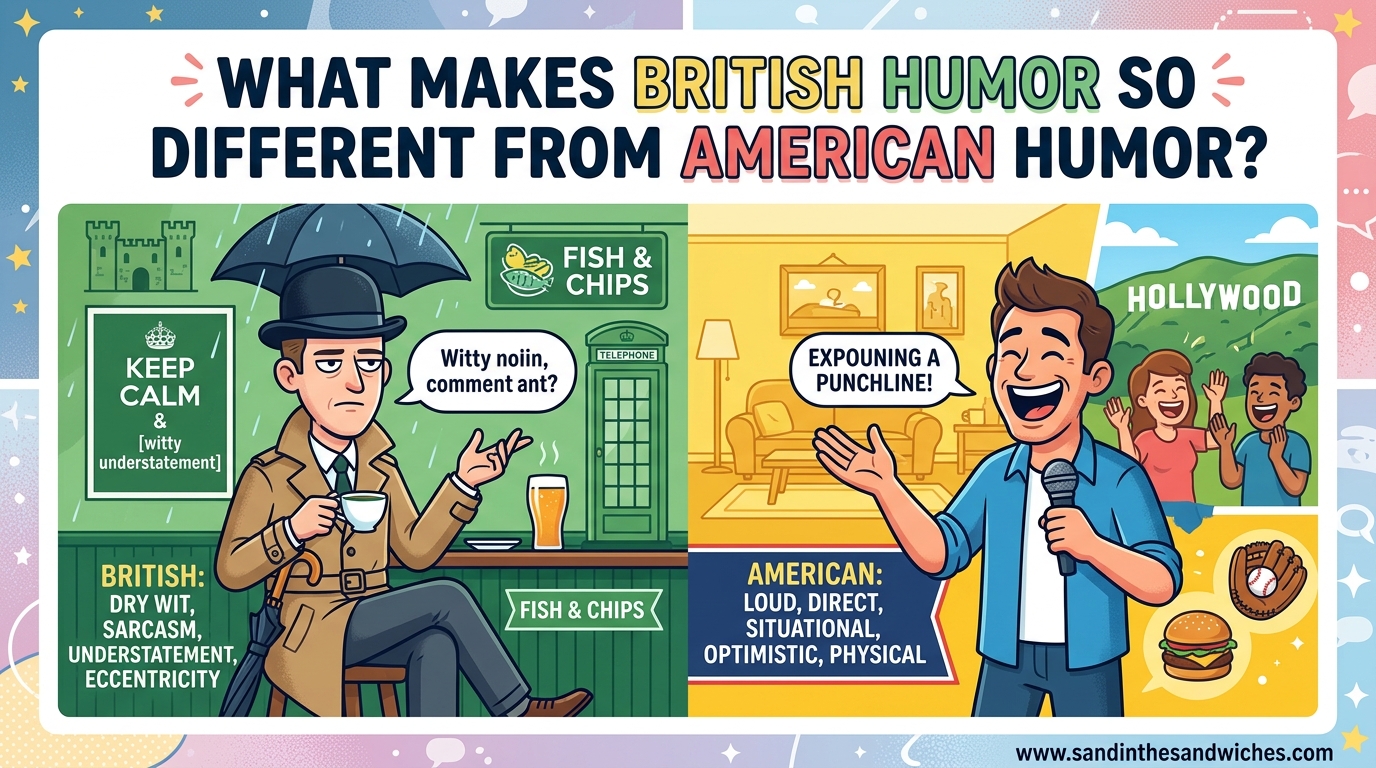
I have spent the last decade toggling between British and American comedy, and the gap still catches me off guard. A line that gets a knowing smirk in London gets blank stares in Texas. A punchline that slays a Boston crowd leaves Brits shifting awkwardly in their seats. The split is real, and it runs deeper than accent. What makes British humor so different from American humor comes down to a handful of cultural reflexes that took centuries to bake in.
In this guide I will walk you through the six core differences, the historical reasons behind them, and why crossing the Atlantic often means missing the joke entirely. We will use examples from shows you have probably seen, and I will explain why some of them feel like nails on a chalkboard depending on which side of the pond you grew up on.
Table of Contents
British humor relies on self-deprecation while American humor celebrates confidence
The biggest cultural split comes down to who the hero of the joke is. British humor targets the speaker, while American humor tends to lift the speaker up. The British comic says, “I am a disaster.” The American comic says, “I am winning, and here is the funny bit about it.”
This is why Ricky Gervais argued in his Time piece that Americans are more “down the line” while Brits are comfortable with failure narratives. A British sitcom protagonist trips over their own ambitions, gets rejected, and shrugs it off with a cup of tea. An American sitcom protagonist chases a dream, gets the job, and high-fives their best friend. The emotional payoffs are opposites.
Forum users on r/AskAnAmerican put it bluntly: “Americans love success. British audiences love failure.” That single sentence captures most of the difference. In British comedy, falling flat is the point. The joke lands harder when the person telling it loses face.
Self-deprecation is also a social license. By mocking yourself first, you defuse tension. It is why a Brit can insult you affectionately and call it banter. In American comedy, the same move lands as low self-esteem unless it is wrapped in a clear, confident punchline.
Irony, sarcasm, and deadpan delivery define the British style
British humor runs on irony, sarcasm, and deadpan delivery. The comedian says the literal opposite of what they mean, with a straight face, and trusts you to flip it. American comedy tends to be more direct, more emotive, and more willing to point at the punchline.
I learned this the hard way. A British colleague once told me, in front of our entire team, that my presentation was “absolutely fine.” I thanked her. The room looked away. Turns out “absolutely fine” was a polite disaster report. I had been completely sandbagged by a Brit, and the worst part is I had no idea.
Deadpan delivery is the default in British comedy. Think of Mr Bean, who almost never speaks, or Fleabag, who breaks the fourth wall with a look. The face does the work. In American comedy, the face sells the joke with a wink, a smile, or a raised eyebrow that screams “this is funny.”
Irony also acts as a safety valve. Saying the opposite of what you mean lets you comment on things you cannot say directly. Politics, class, religion, and sex all get a pass because the speaker technically never said them. American comedy is more willing to just say the thing and trust the audience to keep up.
British comedy favors subtlety and understatement over obvious punchlines
If you have ever watched a British sitcom in confused silence while the studio audience stayed quiet, you have hit the subtlety wall. British comedy builds its jokes with pauses, glances, and understatement. American comedy builds them with setups that practically announce the punchline.
This is why American sitcoms use laugh tracks and punch-up writing rooms. The job is to make the joke land even if you missed it. British comedies are often filmed before a live audience too, but the writer’s job is to leave a little space. The audience is meant to feel clever for catching it.
Understatement is its own art form in British humor. “Slight problem with the brakes” might mean the car is on fire. “Not bad” from a Brit is a glowing review. “Quite good” is borderline worship. The flatter the language, the more sincere the praise.
American comedy, by contrast, leans into the big finish. The volume goes up, the camera zooms in, and the punchline arrives like a fireworks display. Both styles work. They just train the audience in completely different listening habits. If you grew up on one, the other can feel slow or, worse, smug.
Absurdity and surrealism thrive in British comedy traditions
British comedy has always had a soft spot for the surreal. Monty Python is the obvious example, but the tradition runs through The Mighty Boosh, Blackadder, and half of Doctor Who. The logic does not have to make sense. The joke just has to feel right.
American comedy does surrealism too, but it tends to anchor it in a punchline or a character. The Simpsons is surreal, but the family keeps it grounded. Arrested Development is chaotic, but the narration keeps it on rails. British surrealism is happy to lose the plot entirely. The Spanish Inquisition sketch is not really about Spain.
This is partly because British sketch comedy came out of the university revue tradition, where wordplay, callbacks, and nonsense were free to run wild. American sketch comedy grew out of vaudeville and standup, where the rule was always “get them laughing in three beats.” The cultures trained for different muscles.
Absurdism also gives British comedy a get-out-of-jail-free card. If a joke is too dark or too weird to land straight, you can shove it inside a surreal frame and pretend it never happened. American comedy is usually more linear. The audience expects the joke to mean exactly what it says.
Historical and cultural roots explain the divergence
None of this happened by accident. The two comedy traditions grew out of genuinely different social soil. Britain is an old, class-bound society where mocking the powerful was one of the few safe moves available. America is a younger, frontier-built culture where optimism, ambition, and self-promotion were practically civic duties.
British comedy has always punched up at authority. The king, the prime minister, the boss, the vicar. A punchline that embarrasses someone in charge feels like a small victory. American comedy has always punched sideways or down, often at the comic’s own expense, to win the room. The American hero is the underdog who makes good. The British hero is the underdog who stays put and has a laugh about it.
Class also sneaks into British humor in ways that almost never show up in American comedy. Class jokes, accent jokes, and gentle digs at someone’s education are second nature. American comedy can be regional, but the class lens is usually missing. The two countries basically evolved different reflexes about who gets mocked, and why.
World War II also left a mark. British wartime humor was grim, dry, and survivalist. The joke was a way to get through rationing and bombing. American wartime humor was brighter, more patriotic, and aimed at lifting morale. Those reflexes never really went away. They got amplified through generations of standup, sitcoms, and sketch shows on both sides.
Why Americans sometimes miss the joke (and Brits miss theirs)
When Americans first watch British comedy, they often think the actors are not trying. When Brits first watch American comedy, they often think the actors are trying too hard. Both reactions come from the same place. Each side is reading the other with the wrong rulebook.
British irony can sound like rudeness to an American ear. The flat delivery, the lack of obvious cues, the absence of a laugh track. Without those signposts, the joke can feel like an insult. Brits returning the favor hear American jokes and assume the comic is bragging. The volume and the confidence read as showing off.
Taboo subjects also divide the rooms. British comedy is famously comfortable with dark humor, awkward sex jokes, and cringeworthy social failures. American comedy is more cautious, more brand-friendly, and more likely to read the room for offense. The same joke can play brilliantly in a London pub and get a comedian cancelled in a Chicago club. That gap is closing in both directions, but it is still wide.
The trick, honestly, is just exposure. Watch a few episodes of Blackadder after a season of Friends, and your ear recalibrates. Watch The Office (US) right after Fawlty Towers, and the beats start to feel obvious in the other direction. Neither style is better. They are just tuned to different audiences, and once you know the rules, both can land beautifully.
FAQs
What is the main difference between British and American humor?
British humor leans on irony, sarcasm, self-deprecation, and deadpan delivery, often understating the joke. American humor tends to be more direct, more confident, and more willing to point at the punchline with warmth, optimism, and big emotional payoffs.
Why do Americans not understand British humor?
Americans often miss British humor because the delivery is flat, the irony is hidden, and there is no laugh track to signal when the joke lands. The jokes require the audience to read between the lines, which can feel cold or rude to viewers trained on American sitcom rhythms.
What are the features of British comedy?
British comedy is defined by dry wit, sarcasm, irony, self-deprecation, understatement, and a comfort with dark or taboo subjects. Sketches and sitcoms often lean on absurdism, clever wordplay, and the audience’s ability to catch a subtle joke.
What do Americans say differently to Brits in jokes?
Americans often signal a joke with a smile, a wink, or an obvious punchline, and they praise the comic as the hero of the story. Brits tend to keep a straight face, mock themselves, and trust the listener to catch the irony without any extra clues.
Is British humor better than American humor?
Neither style is objectively better. They are tuned to different audiences, different histories, and different social reflexes. Most comedy fans enjoy both once they learn the unwritten rules of each tradition.
Final thoughts on British humor vs American humor
The split between British humor and American humor is not a ranking. It is a fork in the road that happened centuries ago and hardened into habit. British comedy asks you to lean in, read the room, and reward the underdog. American comedy asks you to root for the winner, share the warmth, and let the comic lead you to the punchline.
Both styles get a real reaction when they land. The trick is to stop treating the other side’s default as a personal insult. Watch a few episodes outside your comfort zone, let the new rhythm wash over you, and the jokes will start landing. British humor and American humor both work, just on different clocks. Pick up both, and you double your comedy library in 2026.