
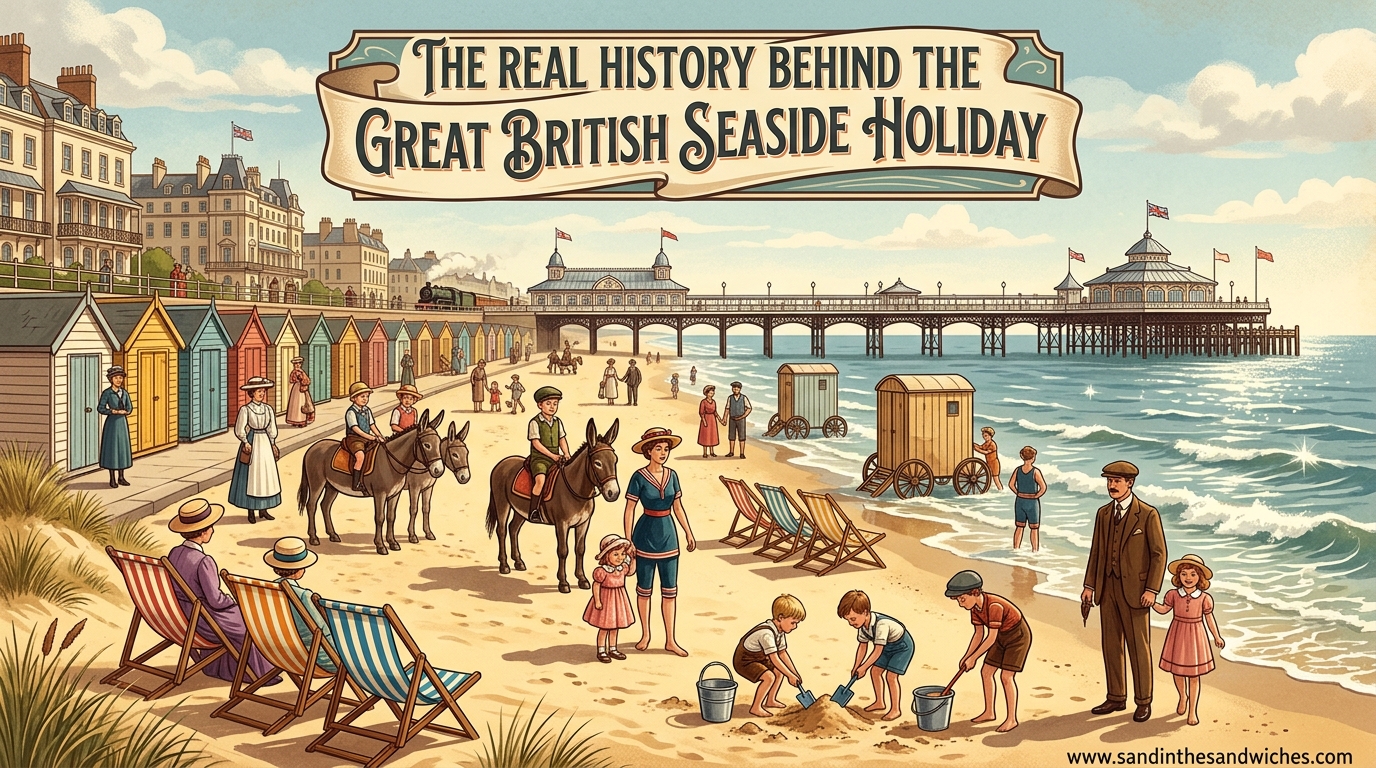
I have always loved a British seaside town. The smell of vinegar on chips, the thump of a distant helter skelter, a row of pastel beach huts that look exactly as they did in my grandparents’ photos. But where did all of this come from? The history of the great British seaside holiday is stranger, slower, and more touching than most of us realise. It is a story of doctors, kings, railway timetables, factory workers, and a deep national belief that salt water could fix almost anything.
What started as a niche medical treatment for the wealthy in the 1700s became, two centuries later, the most democratic holiday in the world. Every working family had a right to the beach. This is the real story of how that happened, and why it still matters.
Table of Contents
How did the great British seaside holiday begin?
The British seaside holiday did not begin with sandcastles or rock candy. It began with doctors. Throughout the 17th and early 18th centuries, well-to-do patients travelled inland to places like Bath, Tunbridge Wells, and Buxton to take the mineral-rich waters. These spa towns promised relief from gout, scurvy, skin complaints, and what we would now call depression.
By the mid-1700s, physicians started to wonder if sea water might work even better. A famous 1750 medical text by Dr Richard Russell, A Dissertation on the Use of Sea Water in the Diseases of the Glands, helped turn seabathing into a serious prescription. Russell himself moved to Brighton in 1753 to treat patients with salt water and advice on diet. Within decades, taking the waters had shifted from the countryside to the coast.
Seaside towns like Weymouth, Scarborough, and Margate began to fashion themselves as health resorts. The idea was simple: dip in the sea, drink the sea, breathe the sea, and feel better. The fact that the resorts were also pleasant to look at was, at first, almost a side effect.
Why was the sea thought to be healthy?
18th century medicine did not have much to offer, so doctors reached for the dramatic. Cold sea water was said to strengthen the nerves, improve circulation, and shock the body back into balance. Patients were dunked, doused, and ordered to swallow small measures of brine. For tuberculosis, melancholy, and even rabies, the coast became the prescription of choice among those who could afford it.
When did royalty make the seaside fashionable?
What the doctors started, the monarchy finished. Royalty did not invent the British seaside holiday, but they turned it into a status symbol that the gentry had to copy. The first big royal moment came in 1789, when King George III began spending summers in Weymouth, Dorset. He famously waded into the sea in full view of the public, an act so unusual that a band played God Save the King from a nearby barge.
Once the king had bathed, the smart thing to do was to bathe too. Weymouth’s Georgian seafront terraces filled with aristocrats following his lead. Prints of the king paddling sold briskly, and other royal figures soon joined in. The Prince of Wales, the future George IV, made Brighton his playground from the 1780s onwards. He hired Henry Holland to transform a small farmhouse into the exotic Royal Pavilion, completed in its Indian-inspired form by John Nash in 1823.
By the early 1800s, Brighton was the most fashionable resort in England. Beau Brummell promenaded there. The fashionable world came to see and be seen. For the first time, going to the seaside was not just about health. It was about identity.
How did the Victorians shape the seaside holiday?
If the Georgians invented the British seaside holiday, the Victorians democratised it. This is the period when the trip to the coast became something close to what we still recognise. Three big forces made it happen: bathing machines, railways, and a new idea called the bank holiday.
What was a bathing machine?
For most of the 18th and 19th centuries, respectable people did not swim in the sea in ordinary clothes. They were wheeled into the water inside a small wooden hut on wheels called a bathing machine. The machine was pulled by a horse or, famously, pushed into the surf by a strong local known as a dipper. Once the machine was deep enough, the bather stepped down a short ladder into the sea, still shielded from public view.
Bathers wore heavy woollen swimming costumes that covered almost everything, and women in particular were warned against showing an ankle. Some machines even had modesty hoods that could be lowered over the user in deeper water. The whole performance looks absurd now, but at the time it was treated as the price of decency. It was also very good for business, since each bather needed an attendant.
How did the railways change everything?
Before the railways, a journey from London to Brighton could take a full day by coach. A trip to Blackpool or Scarborough was a serious expedition. From the 1840s onwards, the new rail network shrank the country. By 1860, you could reach almost every major English seaside town in a single day. The price of a third class ticket was still real money for a working family, but day trips by charabanc and rail became common.
The arrival of the train at places like Blackpool, Bournemouth, Eastbourne, and Whitby was the moment those towns stopped being quiet fishing villages and started being resorts. Terraces of guesthouses, fish and chip shops, and photographic studios appeared within a season. Blackpool’s North Pier opened in 1863, the Central Pier in 1868, and the South Pier in 1893, an extraordinary burst of pier building that defined the British seaside for a generation.
What did the Bank Holidays Act 1871 do?
Until 1871, English workers had very few guaranteed days off, and most of them were tied up with saints’ days and local traditions. The Bank Holidays Act, introduced by Sir John Lubbock, gave the country its first proper public holidays: Easter Monday, Whit Monday, the first Monday in August, and Boxing Day in England and Wales. Scotland and Ireland got their own versions.
For seaside towns, the new bank holidays were a gift. The August long weekend in particular became a magnet. Working families saved all year for a single annual week, and a whole chapter of British culture grew up around that one trip away. By the time Queen Victoria died in 1901, the British seaside holiday was no longer the property of the rich. It belonged to almost everyone.
Why did the 1950s and 60s become the golden age?
The mid-20th century is what most of us picture when we think of the great British seaside holiday. The knotted handkerchief on the head, the windbreak that never quite worked, the smell of sun cream mixed with tobacco. The 1950s and 60s were the golden age for a clear reason: paid holidays finally arrived for the average worker.
What was the Holiday Pay Act 1938?
The Holiday Pay Act 1938 was one of those quiet pieces of legislation that changed daily life for millions. It gave most British workers a legal right to one week of paid holiday a year, rising to two weeks from 1956. It sounds modest now, but in 1938 a working man or woman could, for the first time, plan a real trip without losing a week’s wages. For coastal towns from Skegness to Paignton, the Act was effectively a tourism stimulus package.
Combined with full employment, rationing finally ending in 1954, and a baby boom generation being carried into the back seats of Morris Minors and Ford Anglias, the new paid leave created a market that the resorts rushed to serve.
What were wakes weeks?
Long before package holidays existed, the country had a system called wakes weeks, sometimes called the trades fortnight. Different towns and industries would shut down at the same time each summer, and the whole workforce would decamp en masse to the coast. The mills of Lancashire would empty into Blackpool. The potteries of Stoke would head for North Wales. The glassworks of St Helens would descend on Southport.
Wakes weeks gave the British seaside a working-class character that no amount of royal bathing had ever created. Entire streets of terraced houses were suddenly empty, and the promenades of Blackpool were jammed with mill workers who had saved all year for a single week of chips, donkeys, and a paddle.
What made holiday camps such a British institution?
No story of the British seaside holiday is complete without holiday camps. They were a uniquely British invention, halfway between a hotel, a school trip, and a small military operation. The first and most famous was Butlin’s, opened by Billy Butlin at Skegness in 1936. Within a few years there were camps at Clacton, Bognor Regis, Pwllheli, and Ayr.
Butlin’s promise was simple. For a fixed weekly price, you got a bed, three meals a day, entertainment, swimming, sports, and the chance to meet the famous redcoats who organised it all. Pontins, founded later in 1946, offered a similar model. Holiday camps were sometimes mocked as being a bit like the army with knobbly knees, but for many families they were the first time they had ever been away from home.
What did camp life actually involve?
A day at a 1950s holiday camp started with a bugle call and a communal breakfast. Mornings might involve archery, knock-up tennis, or swimming lessons in the camp pool. Afternoons featured talent contests, beauty pageants, and the famous redcoat-campion races, where children raced wooden hobby horses round a track. Evenings were a different matter altogether.
Knock-knock jokes, knobbly-knee competitions, and, on serious nights, names like Frankie Howerd, Arthur Askey, and Max Bygraves would appear in the camp’s own theatre. Saturday night gala dinners ended with a dance where the redcoats were expressly not allowed to pair off with the same guest twice in a row. It was raucous, exhausting, and oddly touching. For working-class families who had never had a holiday, it felt like a glimpse of a different life.
What about the beaches themselves?
Outside the camps, the beaches of the 1950s and 60s were their own little worlds. Donkey rides at Margate. Punch and Judy shows at Lyme Regis. Rock candy made on the spot at Blackpool and Brighton, with letters running right through the middle. Deckchairs for thruppence an hour. Helter skelters and dodgems on the piers. Windbreaks in stripes that flapped furiously in the onshore breeze.
Children spent the day building sandcastles with a bucket and spade, while parents queued for tea in a kiosk that served it in a plastic beaker. Piers, that great Victorian invention, were still in their pomp. Southend Pier, the longest pleasure pier in the world at 1.34 miles, was busy from morning to night. Piers hosted palmists, slot machines, and What the Butler Saw machines that were treated as very daring indeed.
What happened to the British seaside holiday after the golden age?
The story of the British seaside holiday after the 1960s is a familiar one of slow decline followed by cautious revival. The first blow was the jet age. From the late 1960s, package holidays to Spain, Greece, and the Canary Islands became affordable for the very families who had once filled Blackpool and Skegness. By the 1980s, reliable sunshine and guaranteed warmth were within reach of almost any British household. The 1964 Mods and Rockers clashes at Clacton and Margate, with their iconic headlines about seaside violence, felt like a turning point in the national mood.
Holiday camps declined alongside the resorts. Butlin’s closed its Clacton and Bognor sites and pulled back to Minehead. Pontins shed most of its locations. Many of the old guest houses were converted into flats or care homes. The fish and chip shops and amusement arcades soldiered on, but the heyday had passed.
What saved the British seaside was, in part, the staycation. The 2012 Olympics gave the country a new interest in its own coastline. Programmes like Coast and a wave of nostalgia television reminded people of what they had been missing. Today, places like Whitby, St Ives, Whitstable, and Margate have reinvented themselves as food, art, and culture destinations. The beach huts have been painted in fresh colours. The fish and chips still taste the same.
I find that hopeful, honestly. The British seaside holiday has been killed off a few times in my lifetime, and it keeps coming back. There is something stubborn about the British and their coast. We complain about the weather, but we keep going. The smell of vinegar on the wind is part of who we are.
Conclusion
The history of the great British seaside holiday is a story of slow, accidental progress. Doctors tried to cure rich people with sea water, and accidentally created a fashion. The railways shrank the country, and a whole new class of resorts sprang up. The Bank Holidays Act of 1871 and the Holiday Pay Act of 1938 turned a luxury into a right. Butlin’s and Pontins turned a working-class treat into a national institution. Cheap flights dented it, and staycations brought it back. It is one of the most quietly democratic traditions we have.
Next time you unpack the bucket and spade, or queue for tea in a plastic beaker, you are taking part in something that stretches back more than 250 years. It has changed a great deal. The bathing machines are gone, the knotted hankies are gone, even the redcoats are mostly gone. But the heart of it is still there. The British seaside holiday is, like the country itself, a work in progress.
FAQs
What is the history of the British seaside resort?
The British seaside resort began in the 18th century when doctors began prescribing seabathing for illnesses such as gout and tuberculosis. Wealthy patients first travelled to inland spas before shifting to the coast, with Brighton and Weymouth leading the way after royal endorsement from King George III in 1789. The Victorian railway network, the Bank Holidays Act 1871, and the Holiday Pay Act 1938 turned the seaside trip into a mass-market tradition that reached its golden age in the 1950s and 1960s.
How was the seaside different 100 years ago?
A hundred years ago, around the 1920s, the British seaside was already a mass destination but still had strong Victorian habits. Bathers used bathing machines and heavy woollen costumes well into the early 20th century, piers were major entertainment hubs, and most families arrived by charabanc or rail. Holiday camps were just beginning with Butlin’s opening in 1936, and paid annual leave was not yet a legal right for most workers.
Why did Victorians go to the seaside?
Victorians went to the seaside for health, fashion, and entertainment. Doctors still recommended sea air and seabathing for a wide range of complaints, while the new railway network made coastal towns accessible. Piers, promenades, and pierrot shows offered entertainment, and the Bank Holidays Act 1871 gave the growing middle class regular reasons to escape the industrial cities for a few days by the sea.
When did seaside holidays start in Britain?
Seaside holidays in Britain started in the mid-18th century, with Scarborough widely regarded as one of the first true seaside resorts from around 1730. The fashion accelerated after Dr Richard Russell promoted seabathing in the 1750s, and reached the royal court with King George III’s visits to Weymouth from 1789 onwards.