
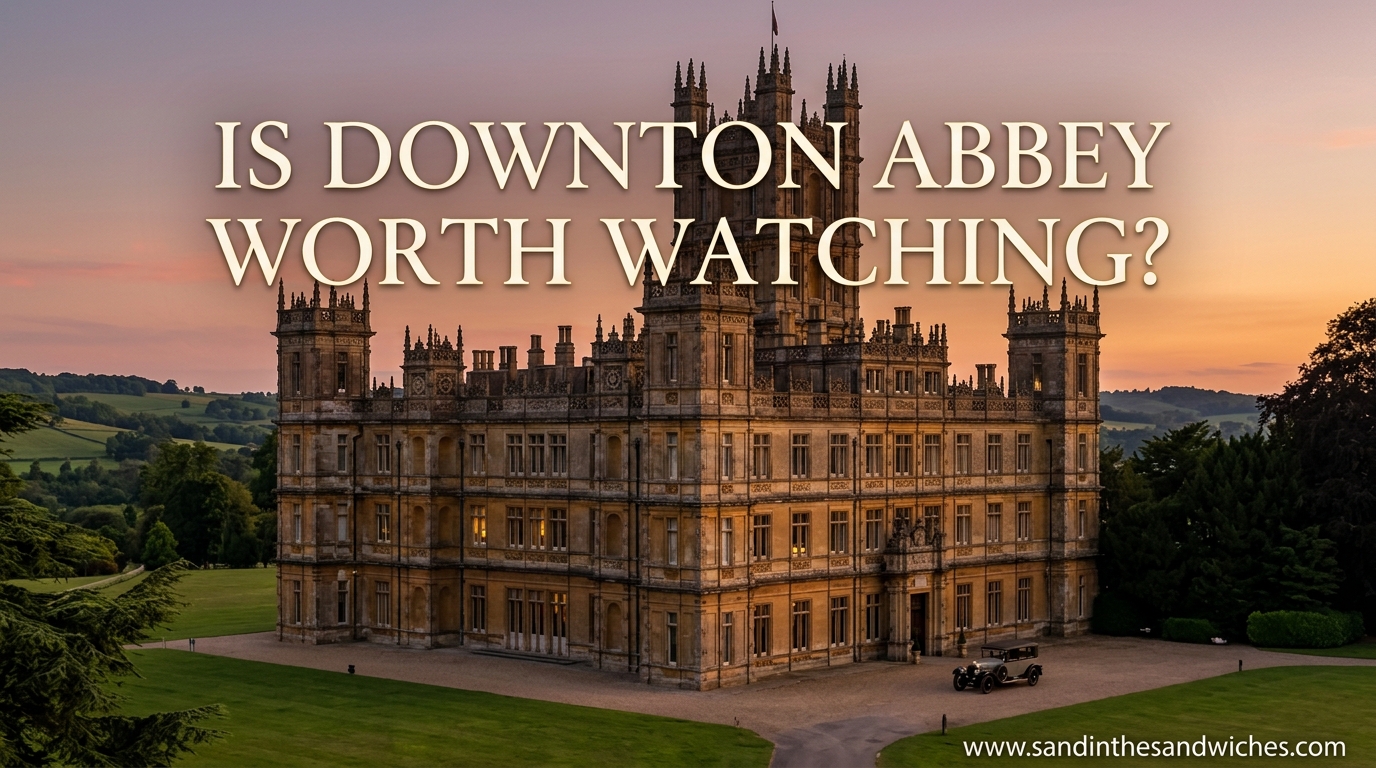
Yes, Downton Abbey is worth watching, and no, it is not just pretty escapism, though the line between those two things is thinner than most fans admit. I have sat through all six seasons, both feature films, and more rewatched dinner-party scenes than I can count, and my honest take is that the show earns its reputation more than its critics allow and less than its die-hards insist. The question of whether it is “just pretty escapism” usually comes from people who have either never finished a season or who burned out somewhere around season four and never forgave the writers for it.
This article is for the people hovering on the edge, the ones who keep hearing about Downton Abbey from a parent, a partner, or a coworker and wondering whether to commit fifty-plus hours of their life to a British period drama. I am going to be direct about what works, what does not, who it is for, and where the escapism versus substance debate actually lands in 2026. If you want a quick verdict, here it is: watch it, but go in with realistic expectations.
Table of Contents
What Downton Abbey Actually Is
Downton Abbey is a British period drama created by Julian Fellowes that aired on ITV in the UK and PBS Masterpiece in the US from 2010 to 2015, with two follow-up films released since. It follows the aristocratic Crawley family and their household of servants at the fictional Yorkshire estate of Downton Abbey, shot at the real Highclere Castle. The story spans roughly from the sinking of the Titanic in 1912 through the late 1920s, tracking the slow erosion of the Edwardian class system through two world wars, social reform, and technological change.
The structure is essentially an upstairs-downstairs ensemble drama. Half the scenes happen in the drawing room with the family, the other half below stairs with the cook, the valets, the maids, and the butler. The show uses that split to look at how historical events filtered down differently depending on which floor of the house you lived on.
Is Downton Abbey Worth Watching? The Case For
The single strongest argument for watching Downton Abbey is the production value. This is one of the best-looking television shows of its decade, full stop. The cinematography, the costume design, the use of Highclere Castle as a near-character, the score by John Lunn, and the period-accurate set dressing all sit at a level most modern streaming dramas still cannot match. If you enjoy costume drama as a sensory experience, the show delivers consistently across all six seasons.
The second argument is the ensemble cast. Maggie Smith as Violet Crawley, the Dowager Countess, is the obvious draw and the reason most people cite for sticking with the show. Her line readings alone are worth the price of admission, and Fellowes wrote her dialogue with a sharpness that the rest of the script rarely matches. Hugh Bonneville, Michelle Dockery, Laura Carmichael, Jim Carter, and Phyllis Logan all do strong, restrained work that holds the melodrama together when the plotting gets wobbly.
The third argument is historical sweep done in a genuinely readable way. Fellowes is not a historian, and the show takes liberties, but it does a better job than most period dramas of weaving real events, the Titanic, the Great War, the Spanish flu, the General Strike, the rise of labor politics, into domestic storylines without turning into a lecture. For viewers who want to absorb early twentieth-century British history without reading a textbook, Downton Abbey is a surprisingly effective entry point.
Finally, there is the comfort-viewing factor, and I do not think this should be dismissed. A lot of the discussion online, especially on the r/DowntonAbbey subreddit and on Mumsnet, frames the show as a “comfort watch,” and that is a legitimate reason to recommend it. Comfort viewing is not the same as mindless viewing. The show rewards attention with small character moments, callbacks, and slow-burn arcs that pay off seasons later.
Is Downton Abbey Just Pretty Escapism? The Honest Answer
This is the part of the question most reviews either dodge or answer too harshly. My honest take, having watched the whole run, is that Downton Abbey is pretty escapism with more substance than its detractors admit and less than its fans claim.
The substance is real. The show genuinely engages with the class system, the decline of the British aristocracy, the limited options available to women of every social tier, the slow entry of technology into domestic life, and the trauma that the First World War inflicted on every level of British society. Some of these threads, especially Thomas Barrow’s storyline around sexuality and the female servants navigating pregnancy, marriage, and labor rights, are handled with more care than people give the show credit for.
The escapism is also real, and it is the part critics correctly point at. The show has a nostalgic fondness for the aristocratic world that softens the injustice it portrays. Lord Grantham is written as fundamentally decent even when he is wrong. The servants are largely loyal and content. Real upstairs-downstairs exploitation rarely surfaces in a sustained way, and when the show tries to address it, it usually retreats into sentimentality within an episode or two.
So is it “just pretty escapism”? No. The performances, the historical scaffolding, and the genuine character work lift it above pure eye candy. Is it a serious critique of the British class system? Also no. It is a well-made drama that wants to have its aristocratic cake and eat it too, and most of the time that compromise works well enough to be worth your time.
The Case Against Downton Abbey
None of this means the show is flawless, and a few issues are worth flagging before you commit. The first is the pacing of early season one. The first few episodes are slow, and multiple viewers I have discussed the show with, and several Reddit threads, report nearly bailing before the back half of season one locks them in. If you try it and feel nothing by episode four, the show may genuinely not be for you.
The second issue is the quality dip after season three. Without spoiling specifics, the show loses two of its most central characters around that point, and the writers spend much of season four scrambling to rebuild around the remaining cast. Most fans consider seasons one through three the strongest run and seasons four and five the weakest, with season six recovering some ground.
The third issue is melodrama. Downton Abbey will, with little warning, throw in a sudden death, a scandal, a sudden illness, or a shocking reveal. Some of these land. Others feel like a soap opera wearing a corset. If you cannot tolerate that register shift, the show will periodically frustrate you.
The fourth issue is specific. Season four includes a storyline involving the assault of a major character. It is handled unevenly and is a common reason viewers cite for quitting. If that is a dealbreaker for you, it is worth knowing in advance rather than being surprised by it.
How Downton Abbey Compares to Other Period Dramas
People asking about Downton Abbey in 2026 are usually comparing it to one of three other shows, so here is a quick orientation.
Versus Bridgerton: Bridgerton is faster, sexier, more overtly escapist, and less interested in historical accuracy. Downton Abbey is slower, more grounded, and more concerned with class and social change. If you want a romance-forward binge with modern energy, Bridgerton wins. If you want a long ensemble drama with historical scaffolding, Downton Abbey wins.
Versus The Crown: The Crown is more serious, more cinematic, and more focused on a single figure. Downton Abbey is warmer, more soapy, and more accessible. They scratch overlapping but distinct itches.
Versus The Gilded Age: Fellowes created both, and The Gilded Age is essentially Downton Abbey transplanted to 1880s New York. If you love the Fellowes formula, watch both. If you only want one, Downton Abbey has the deeper character bench.
Which Seasons to Prioritize (and Which to Push Through)
If you want the strongest Downton Abbey experience with the least wasted time, here is the practical guidance I would give based on fan consensus and my own watch.
Seasons one through three are essential. This is the peak run, covering the Titanic through the aftermath of the Great War, and it contains the show’s best character work and most earned emotional beats. Watch all of it.
Seasons four and five are the dip. They are not bad, but they are more uneven, and several storylines spin their wheels. If you find yourself bored, you are not alone. Push through if you care about the characters, but do not judge the entire show by this stretch.
Season six is a partial recovery and sets up the films. Watch it if you have made it this far, and then decide whether the two feature films are worth your time. Most fans consider them enjoyable but inessential.
So, Is Downton Abbey Worth Watching? The Verdict
For most viewers asking the question in 2026, yes. Downton Abbey is worth watching if you enjoy period drama, ensemble casts, slow-burn character arcs, and well-produced comfort viewing. It is not worth watching if you need fast pacing, hard-edged social critique, or a story that resists melodrama.
The “pretty escapism” label is half-right and half-unfair. The show looks beautiful and it does want you to feel cozy inside its world. But underneath the costumes and the candlelight there is genuine character work, real engagement with a period of massive social change, and a level of craftsmanship that most of its imitators never matched. Calling it just pretty escapism undersells the writing; pretending it is a serious class critique oversells it.
If you are still on the fence, my practical recommendation is to commit to the first four episodes of season one. That is enough to know whether the show’s rhythm works for you. If it does not click by then, it likely will not. If it does, you have roughly fifty hours of rewarding television ahead of you.
FAQs
Is Downton Abbey worth seeing?
Yes. For most viewers, Downton Abbey is worth seeing at least through season three, which contains the strongest writing and character work. The production value, ensemble cast, and historical sweep make it one of the most accessible British period dramas of the last twenty years.
Why is Mary so unlikeable in Downton Abbey?
Mary Crawley is written as cold, calculating, and often cruel in early seasons, which is intentional. Michelle Dockery plays her as a product of her class and time, someone trained to suppress emotion and secure her position. Many viewers warm to her over the run as her arc softens, but the unlikeability is a deliberate character choice, not a writing accident.
Did Jessica Brown Findlay regret leaving Downton Abbey?
Jessica Brown Findlay, who played Lady Sybil, has not publicly expressed regret about leaving the show. Her departure was planned in advance with the producers, and she left to pursue film work. Fans were upset by Sybil’s exit, but the actor herself has spoken about it as a positive career decision.
Is there any LGBTQ representation in Downton Abbey?
Yes. Thomas Barrow’s storyline is the show’s most sustained LGBTQ arc, and it is handled with more care than most period dramas of its era. The storyline explores the legal and social dangers of being gay in early twentieth-century Britain, and while some viewers find parts of it heavy-handed, it is one of the more substantive threads in the series.
Who is the most unlikable character in Downton Abbey?
Viewer consensus usually lands on one of a few names: Vera Bates for her cruelty, Miss O’Brien for her scheming, Larry Grey for his snobbery, and early-seasons Mary Crawley for her coldness. The show rarely writes villains who stay unlikable forever, though, and several of these characters are given either redemptive or humanizing arcs.
Final Thoughts
So, is Downton Abbey worth watching or just pretty escapism? It is worth watching, and it is pretty escapism with more going on under the surface than the dismissive version of that label allows. The costumes are gorgeous, the castle is stunning, and Maggie Smith is worth the run all by herself, but the show also earns its place by taking its characters and its historical moment seriously enough to stick with you after the credits roll.
If you are the kind of viewer who liked The Crown, Bridgerton, or The Gilded Age and wants something in between, Downton Abbey is still the show that defined the modern period-drama revival, and in 2026 it remains the most rewarding entry point into the genre. Give it four episodes, trust the slow start, and decide from there.