
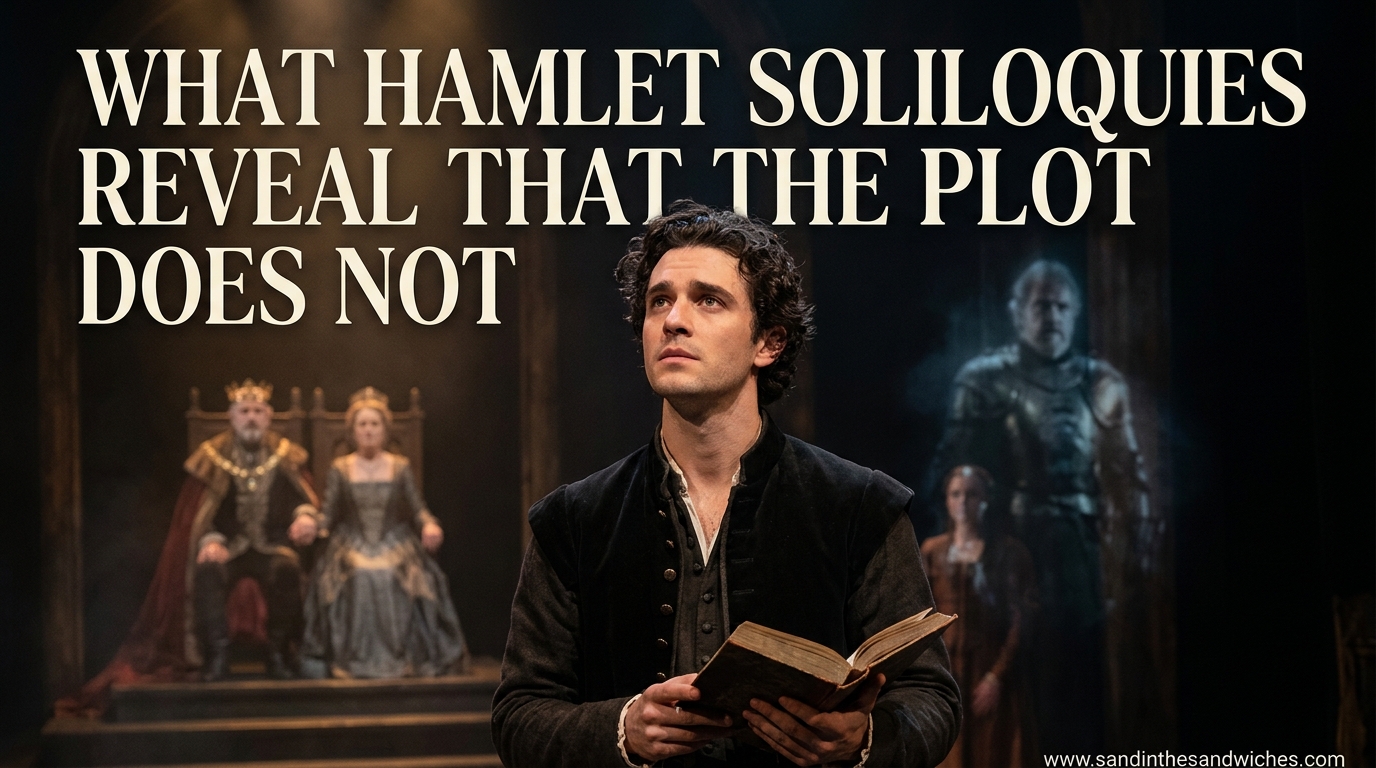
Hamlet’s soliloquies reveal the private psychological interiority that the public plot cannot directly show: his existential dread, his moral reasoning behind delaying revenge, his disgust at the corruption around him, and his fear of the unknown afterlife. While the plot moves from ghost to duel through external events, the soliloquies let us see the mind that those events pass through. That gap between action and thought is where the play actually lives.
Most readers come to Hamlet expecting a revenge story and leave wondering why the hero cannot act. The answer is not in what happens on stage but in what Hamlet says when he is alone. I have spent years teaching this play, and the question students ask most often is the same one this article addresses: what do these speeches tell us that the plot leaves out?
Table of Contents
What Are Soliloquies and Why Do They Matter in Hamlet?
A soliloquy is a speech delivered by a character alone on stage, revealing innermost thoughts, emotions, and motivations that would otherwise remain hidden from the audience. Unlike a monologue, which is spoken to other characters, a soliloquy pretends no one is listening. Shakespeare uses this convention as a kind of stage keyhole.
In Hamlet, the soliloquies matter because the plot is action-driven and the protagonist is famously slow to act. Without these speeches, audiences would see a man who delays revenge for no clear reason. With them, audiences see someone wrestling with consequences the plot cannot stage.
Shakespearean stagecraft treated soliloquies as a privileged space. When Hamlet says “To be, or not to be,” he is not performing for the court. He is performing for the audience, who alone gets to hear what the rest of Denmark never will.
What Hamlet’s Soliloquies Reveal That the Plot Does Not
Hamlet’s soliloquies reveal his private emotional and philosophical life that the external plot events cannot show directly. The plot shows Claudius poisoning a king, Hamlet staging a play, Polonius hiding behind an arras, and a fatal duel. The soliloquies show what none of these visible events can: the cognitive and emotional turmoil underneath.
Specifically, the soliloquies reveal four layers of interiority that the plot action leaves invisible:
- The depth of Hamlet’s grief, which plot events only suggest through his black clothing and erratic behavior
- His genuine fear of death and what lies beyond it, a fear that no plot scene can dramatize
- His moral reasoning about killing, including doubts the revenge code itself never answers
- His self-criticism and self-doubt, especially in Act IV when he reproaches himself for inaction
Forum readers often describe Hamlet’s thoughts as “muddled,” but the soliloquies reveal a pattern, not confusion. Hamlet is a rational, educated man processing irrational circumstances in real time. The plot cannot stage that processing. Only the soliloquies can.
The Soliloquies That Stay Disconnected from Plot Action
“To be or not to be” is the clearest example of a Hamlet soliloquy that stays disconnected from plot action. In Act III, Scene 1, Hamlet contemplates suicide and the afterlife, yet the speech makes no mention of Claudius, the ghost, his murdered father, or his revenge vow.
This is unusual. Almost every other Hamlet soliloquy ties itself to plot events. “O, all you host of heaven” responds to the ghost’s command. “Now might I do it” describes Claudius at prayer. But “To be or not to be” floats free.
The speech reveals something the plot cannot: Hamlet is not primarily a man with a revenge problem. He is a man with an existence problem. The famous “undiscovered country” passage exposes fear of what comes after death as the deeper engine of his delay. The plot only shows a prince failing to kill a king. The soliloquy shows a human being too afraid of eternity to act in time.
That single revelation reshapes how readers interpret everything that follows. Hamlet’s hesitation is no longer a character flaw or a plot device. It is a philosophical crisis the action of the play simply cannot stage.
Public Action vs Private Thought: Hamlet’s Divided Self
The plot shows a Hamlet who performs madness, spars verbally with Polonius and Claudius, and stabs through a curtain. The soliloquies reveal a different Hamlet entirely: eloquent, self-aware, philosophically rigorous, and deeply uncertain.
This split between public action and private thought is what makes Hamlet psychologically modern. Most Elizabethan heroes have one register. Hamlet has two, and the soliloquies expose the gap.
When Hamlet tells Rosencrantz and Guildenstern that he “knows not ‘seems,'” he is performing a public identity. When he admits alone that his “words fly up, my thoughts remain below,” he is revealing the truth the plot cannot stage: that he cannot easily align his inner convictions with his outer behavior.
The “antic disposition” only makes sense once you hear the private soliloquies. Without them, Hamlet looks insane. With them, he looks like a rational man hiding his rationality from a dangerous court. That contrast is pure interiority, and it lives nowhere except in the speeches.
Major Themes the Plot Cannot Show Without Soliloquies
The plot events of Hamlet cannot stage the play’s deepest themes on their own. They need the soliloquies to make those themes visible.
Consider death. The plot shows Ophelia’s drowning and the graveyard scene, but the contemplative fear of dying is staged only through speeches like “To be or not to be” and “O that this too solid flesh would melt.”
Consider moral hesitation. The plot shows Hamlet with a sword over Claudius at prayer and choosing not to strike, but the reasoning behind that choice appears only in the soliloquy that explains sending Claudius to heaven instead of hell.
Consider disgust at corruption. The plot shows a rotten Denmark through imagery and dialogue, but the emotional weight of that rot comes through Hamlet’s private fury and his wish that his “too sullied flesh would melt.”
Without soliloquies, these themes would remain intellectual. With them, they become felt experience. That is what the speeches add that the action cannot.
The Seven Soliloquies and What Each One Adds Beyond the Plot
Hamlet speaks seven major soliloquies across the play. Each one reveals a layer of interiority the surrounding plot events cannot show:
“O that this too solid flesh would melt” (Act I, Scene 2): Reveals Hamlet’s suicidal grief immediately after Claudius’s coronation, exposing despair the public scene of celebration cannot capture.
“O all you host of heaven” (Act I, Scene 5): Reveals Hamlet’s vow to “wipe away all trivial fond records” and remember only his father’s command, showing commitment the plot will later test.
“To be or not to be” (Act III, Scene 1): Reveals philosophical paralysis about death itself, entirely disconnected from revenge, exposing the existential fear beneath the plot.
“Tis now the very witching time of night” (Act III, Scene 2): Reveals Hamlet’s anticipation and tension before confronting his mother, an emotional state the staging alone cannot communicate.
“Now might I do it” (Act III, Scene 3): Reveals the reasoning for not killing Claudius at prayer, exposing theological scruples invisible from the audience’s vantage point.
“How all occasions do inform against me” (Act IV, Scene 4): Reveals Hamlet’s self-reproach after seeing Fortinbras’s army, showing his capacity for self-criticism that the plot events alone never make explicit.
“The rest is silence” (Act V, Scene 2): Reveals final acceptance of death, exposing interior peace beneath the dying body the duel leaves behind.
Taken together, the seven soliloquies form an inner biography the plot cannot produce. They trace a mind moving from grief, to vow, to paralysis, to resolution. The action of the play is what Hamlet does. The soliloquies are who Hamlet is.
Frequently Asked Questions About Hamlet’s Soliloquies
What do Hamlet’s soliloquies reveal about his character?
Hamlet’s soliloquies reveal a deeply intelligent, philosophically minded character whose internal struggles, including grief, indecision, and fear of death, drive the action more than his external behavior does. They expose a rational mind processing irrational circumstances in real time.
What do soliloquies reveal in general?
Soliloquies reveal the private thoughts, emotions, and motivations of a character alone on stage. They give the audience direct access to interiority that plot events and dialogue with other characters cannot show, creating dramatic irony and psychological depth.
What are the major soliloquies in Hamlet?
The seven major soliloquies in Hamlet are: O that this too solid flesh (Act I.2), O all you host of heaven (Act I.5), To be or not to be (Act III.1), Tis now the very witching time of night (Act III.2), Now might I do it (Act III.3), How all occasions do inform against me (Act IV.4), and The rest is silence (Act V.2).
Are Hamlet’s soliloquies difficult to understand?
Hamlet’s soliloquies can feel difficult because they use archaic language and follow his associative leaps between grief, philosophy, and revenge. Once you follow his reasoning rather than the plot, the speeches become clearer and more coherent than they first appear.
Final Thoughts on What Hamlet’s Soliloquies Reveal That the Plot Does Not
What Hamlet soliloquies reveal that the plot does not is precisely the interior life that turns a revenge story into a meditation on being. Without the speeches, we would watch a prince fail to act. With them, we watch a human being confront death, doubt, duty, and corruption, and choose how to carry on anyway.
Shakespeare’s choice to use soliloquies so heavily in this play is the choice to make the audience Hamlet’s confidant. We are the only ones who hear the full argument he has with himself. That privilege is what gives the tragedy its depth, and it is the gift the plot alone could never give us.