
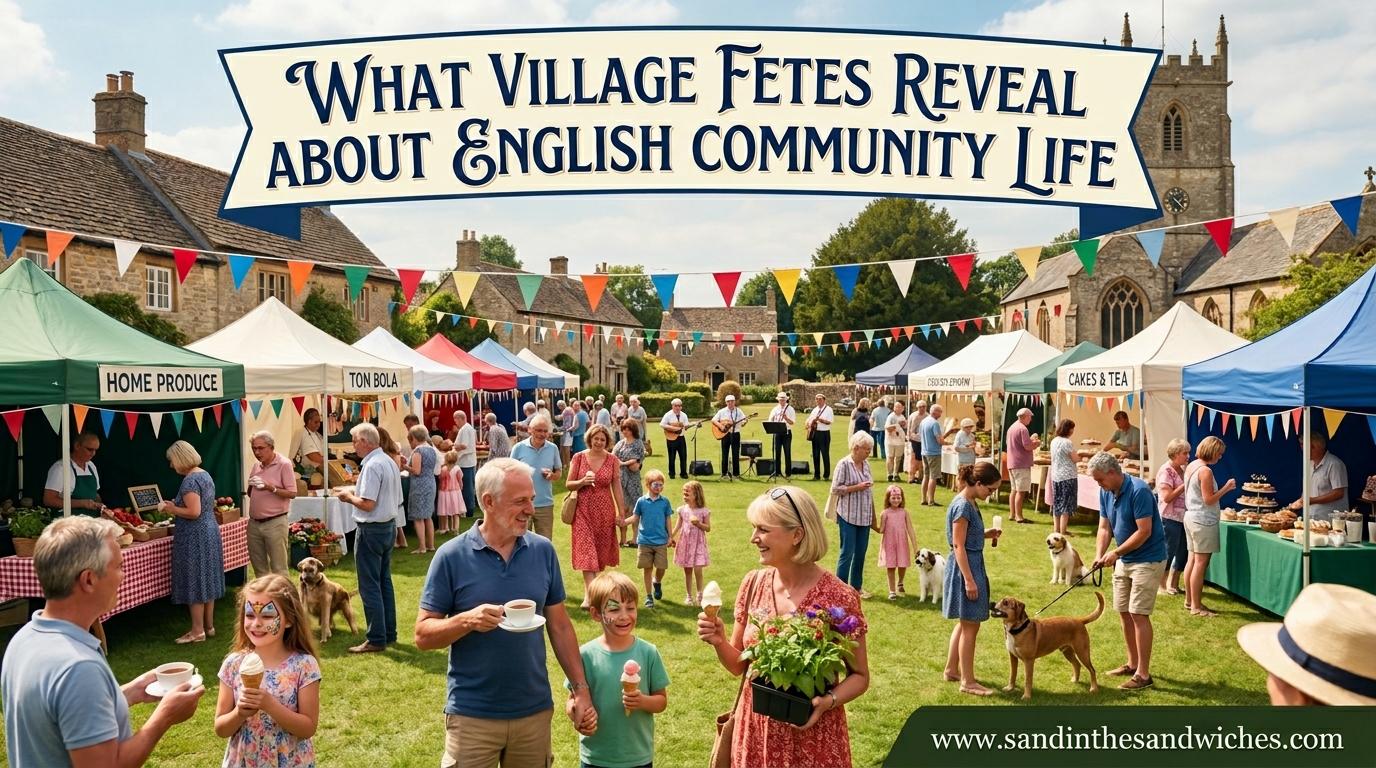
The first time I ducked under a striped marquee in a Surrey village and watched a retired schoolteacher in a straw hat win a jar of gooseberry jam at the tombola, I realised I was watching something more than a fundraiser. I was watching a small, half-forgotten piece of England quietly keep itself alive. The smell of cut grass, Pimms, and burnt burgers drifted across the village green while a Morris dancer adjusted his bells nearby and a vicar handed change from a five pound note to a small boy clutching a coconut he had just won at the shy.
That afternoon taught me what the village fete reveals about English community life in a way no sociological survey ever quite manages. It showed me a place where neighbours who nod politely at each other for 364 days of the year suddenly work side by side, where a nine year old and a ninety year old share the same queue for the cake stall, and where the entire social machinery of a parish runs on nothing more than goodwill, scones, and a slight sense of obligation.
An English village fete is a traditional outdoor community event held on a village green or recreation ground, featuring games, stalls, food, and entertainment, typically organised by volunteers as a fundraiser for local causes. That one sentence captures the shape of the thing, but barely hints at what it actually does for the people who attend.
This article digs into what the village fete reveals about English community life: where it comes from, what really happens under those striped tents, why it keeps surviving despite everything from wet weather to TikTok, and what its stubborn persistence tells us about how English people build belonging in 2026.
Table of Contents
What Is an English Village Fete?
An English village fete (pronounced “fait,” rhyming with “fate,” from the Old French fest) is a quintessentially English summer gathering held outdoors on a village green, recreation ground, or church grounds. It brings together stalls selling homemade goods, traditional games, food and drink, contests, and light entertainment, all run by volunteers and almost always in aid of a local cause such as the parish church, the village hall, or a charity.
What sets the fete apart from a commercial fair is the amateurism baked into it. Nobody is here to make a profit. The woman selling scones is also your neighbour. The man running the coconut shy coaches the village under-elevens on Saturdays. The girl handing you a raffle ticket is the vicar’s daughter, slightly embarrassed to be wearing a sash. Everything is run by people who already know each other, or soon will.
The core ingredients have barely changed in a century: a patch of grass, a few marquees, a tombola, a cake stall, a bric-a-brac table, some games, a raffle with dubious prizes, tea served from an urn, and a Pimms tent for the adults. Add bunting, a brass band or Morris side, and a slightly harassed committee chair with a clipboard, and you have the architecture of an English summer afternoon.
It is worth distinguishing the village fete from its close cousins. A school fete is the same idea but held on school grounds, organised by the PTA, and raising money for the school rather than the wider parish. A country fair or agricultural show is bigger, more commercial, and usually features livestock judging, tractor displays, and trade stands. A carnival involves a procession, floats, and often a carnival queen, and tends to be a town rather than a village event. The village fete is smaller, more intimate, more amateur, and almost always more about people than produce.
Where an American county fair might boast Ferris wheels, livestock auctions, and deep fried everything on a stick, the English village fete is endearingly modest. The thrills here are a slightly faster sack race and the possibility of winning a bottle of cassis in the raffle. That modesty, I would argue, is the whole point.
The Surprisingly Short History of the Village Fete
Here is the surprise. The English village fete, that supposedly ancient tradition, is not really old at all. Most historians trace its modern form to the years after the First World War, when communities needed to rebuild social bonds shattered by the trenches and to raise money for war memorials, returning soldiers, and struggling local causes.
Before that, there were charitably-minded Regency era fairs and church garden parties, often held on the grounds of the big estate with the squire’s blessing. The V&A’s archives and writers like P. G. Wodehouse and E. F. Benson capture that earlier world of white-flannelled gentry sipping lemonade on the lawn while the village children raced for currant buns. But the fete as we know it, run by the parish for the parish, is essentially a 1920s invention.
Those early fetes grew out of “sales of work,” Victorian fundraisers where parishioners sold items they had made themselves, embroidered handkerchiefs, knitted mittens, bottled fruit, jam, and chutney, to raise money for the church or a charitable cause. The format was genteel, domestic, and built around the idea that giving your time and your handiwork to the community was a Christian duty and a social pleasure.
By the 1920s and 1930s, the village fete had settled into the shape we still recognise today, and remarkably, it has barely changed since. The bunting is the same. The cake stall is the same. The slightly forced jollity of the vicar opening proceedings at 2pm sharp is the same. As more than one writer has observed, the English village fete is one of the few social institutions that has remained essentially unchanged since the interwar years.
The tradition did wobble in the 1970s and 1980s. Television, supermarkets, and the slow hollowing out of rural services left many villages without the volunteer base to keep their fetes going. Some folded entirely. Others soldiered on with dwindling crowds and aging committees. The version of the fete that appears in Midsomer Murders, all suspicious deaths and suspicious Victoria sponges, is in part a nostalgia piece for a world people worried was disappearing.
And then, over the last decade and a half, something shifted. The fete came back. Farmers’ markets, the Great British Bake-Off, a cultural hunger for “real” community after years of social media, and a renewed interest in local food and craft all fed into a quiet revival. The village fete turned out to be exactly the kind of low-key, in-person, mildly nostalgic ritual that a screen-addicted society suddenly craved.
Inside the Fete: Stalls, Games, and Curious Traditions
If you have never been to a village fete, the easiest way to picture one is to imagine a car boot sale that has been to finishing school. Everything is a little cleaner, a little more genteel, and run by someone who will, in the week ahead, greet you by name at the post office.
The Essential Stalls
Every well-run village fete has a core set of stalls, and woe betide the committee that forgets the cake stall. The cake stall is the heart of the event: a groaning table of Victoria sponges, lemon drizzle, flapjacks, scones, and the inevitable tray of slightly burnt brownies baked by someone’s fourteen year old as their contribution. Prices are handwritten on sticky labels, and haggling is faintly discouraged.
The bric-a-brac stall is where the village quietly recycles its unwanted china dogs, jigsaw puzzles with two pieces missing, and hardback copies of Jeffrey Archer novels from 1987. It is also, somewhat unexpectedly, where you can pick up a surprisingly decent Le Creuset casserole dish for two pounds.
The tombola is the great leveller. You buy a strip of numbered tickets, pull them out of a wire drum, and if the number ends in a zero or a five you win a bottle, usually wine, sometimes shampoo, occasionally something as baffling as a tin of anchovies. The tombola is run by a woman of formidable cheerfulness who knows every child in the village by name.
The raffle is the more ambitious cousin of the tombola, with prizes donated by local businesses, a haircut at the village salon, a meal at the pub, a hamper from the farm shop, a week in someone’s cottage in Wales. Tickets are sold by a man in a blazer who looks like he might also be on the parish council, because he almost certainly is.
Then there is the produce stall, selling homegrown vegetables, eggs from someone’s hens, jams, jellies, chutneys, and pickles. In a good year you can go home with a jar of gooseberry jam, a bunch of mint, a cucumber, and four duck eggs for less than the price of a high street coffee.
The Games: Aunt Sally, Skittles, and Welly Wanging
This is where the fete gets properly English. Forget bouncy castles and rodeo bulls (though both appear at the more modern versions). The traditional village fete runs on a diet of weirdly specific games that have been played in one form or another for centuries.
Aunt Sally is an Oxfordshire and Cotswolds game in which players throw sticks at a white skittle, the “Aunt Sally,” balanced on a post. The aim is to knock the Sally off without hitting the post. No one is entirely sure who Aunt Sally was, but she has been knocked off her perch at village fetes since at least the nineteenth century.
Skittles, the ancestor of ten-pin bowling, involves rolling a wooden ball at nine pins arranged in a diamond. Village skittles is usually played in the pub skittle alley, but a portable version often appears at the fete, run by the pub landlord as his contribution.
Quoits involves throwing rope or rubber rings over a wooden peg. Hoopla is the same idea with wooden hoops. Both are maddeningly difficult and inexplicably compelling.
The coconut shy, where you throw wooden balls at coconuts balanced on posts, is the fete in microcosm: mildly impossible, deeply traditional, and presided over by a man who has clearly been doing this since 1974. You never actually win the coconut, but you go home happy.
Welly wanging, the sport of throwing a Wellington boot as far as possible, is a more recent and self-consciously silly addition. Hook-a-duck is for the under-eights. Crockery smashing, where you throw balls at a wall of old plates, satisfies a deep British urge to break things politely.
The classic children’s races round out the programme: sack race, three-legged race, egg and spoon, and tug of war. The tug of war, inevitably, comes down to the pub team versus the cricket team, and is taken far more seriously than is strictly necessary.
Food and Drink: Cream Teas, Pimms, and Burnt Burgers
The refreshments tent is where the fete reveals its class dynamics most openly. Under one marquee, a queue forms for cream teas: scones, jam, clotted cream, and tea served from a vast aluminium urn. (The Devon versus Cornwall debate, cream first or jam first, will not be settled here.)
Outside, the barbecue produces burgers and sausages of varying quality for the dads and children. The beer tent, run by the local pub, serves warm real ale. And somewhere in the middle, the Pimms tent mixes the great English summer cocktail: Pimms No. 1, lemonade, mint, cucumber, strawberries, and ice, served in a plastic cup that will inevitably tip over on the grass.
The Contests: Cakes, Marrows, and Dogs
The baking competition is the spiritual heart of the fete. Categories include best Victoria sponge, best fruitcake, best traybake, and, increasingly, best vegan bake. Judging is done by a local dignitary, usually with a straight face and a scorecard. The standard is wildly variable. Feelings run high.
The vegetable show awards the biggest marrow, the longest carrot, the most perfect truss of tomatoes. These categories are taken with extraordinary seriousness by a small group of allotment holders who have been known to fall out over the result for months afterwards.
The dog show is the most popular contest of the day. Categories include waggiest tail, best rescue, best child handler, and the invariably chaotic “dog the judge would most like to take home.” It is the one event where the whole fete crowds around the ring and cheers.
The Entertainment: Morris, Maypoles, and Brass
Entertainment at a traditional fete is gentle and often baffling to outsiders. A Morris side will dance with handkerchiefs and sticks in a tradition whose origins are genuinely disputed. The Maypole, bedecked with ribbons, will be danced around by village children in a weave that almost, but never quite, descends into chaos. A brass band will play Sousa marches and a selection from Oliver!. Punch and Judy may make an appearance for the children, to the polite discomfort of their parents.
What the Village Fete Reveals About English Community Life
Here is where things get interesting. Because while you can describe a village fete in a paragraph, explaining what it actually does, what it reveals about how English communities hold themselves together, takes rather more work. So here are six things the fete tells us about English community life in 2026.
1. Volunteering Is the Invisible Skeleton of English Society
Every village fete in the country is the product of months of unpaid labour. A committee meets through the winter. Someone designs the poster. Someone else books the marquee. A third person badgers local businesses for raffle prizes. On the day, forty or fifty volunteers run the stalls, pour the tea, judge the cakes, marshal the cars, and clean up the field at the end.
This is the part of English life that rarely makes the headlines but quietly keeps the country running. Parish councils, school governors, village hall committees, scout groups, befriending schemes, food banks, the lot of it rests on the same volunteer muscle that powers the fete. The fete is the most visible expression of a vast, largely invisible civic infrastructure. When people worry that “community is dying,” what they are usually worried about is the slow thinning of that volunteer base.
2. The Fete Is One of the Few Genuinely Intergenerational Events Left
Spend an afternoon at a village fete and you will see something that has become genuinely rare in modern English life: large numbers of people of every age in the same place at the same time. Toddlers on a parent’s shoulders. Teenagers reluctantly staffing the hook-a-duck. Young families with pushchairs. Middle aged people catching up with neighbours. Retired people holding court at the cake stall. The very old, brought in wheelchairs by relatives, sipping tea under the marquee.
Modern English life sorts people ruthlessly by age. Schools for the young, workplaces for the middle aged, care homes and lunch clubs for the old. The fete is one of the few remaining institutions where those age silos briefly dissolve. A nine year old and a ninety year old will both queue for the same scone. That matters more than it sounds.
3. Amateurism Is a Quietly Held English Value
The fete is not slick. The PA system will feed back at the worst moment. The bunting will droop. The tombola will run out of prizes by 3.30pm. And none of this is a failure, because the entire spirit of the thing depends on its being run by amateurs.
There is a strain of English culture that genuinely prizes the try, the effort, the homemade, the “good enough.” You see it in the Bake-Off tent, in village pantomimes, in church flower festivals, in amateur dramatics. The fete celebrates the volunteer who has a go over the professional who gets it perfect. That tells you something real about how many English people prefer their community to feel: warm, slightly ramshackle, and unmistakably human.
4. Local Identity Still Matters, Even in a Globalised Country
England is one of the most centralised countries in Europe, and English village life has been hollowed out by decades of post office closures, pub closures, bus cuts, and the slow drift of services online. And yet the fete persists, because it is one of the few moments when a village gets to assert, however briefly, that it is still a place rather than just a postcode.
The fete is a performance of village identity. The homegrown produce on the stall is a statement that this soil grows things. The local business donations to the raffle are a statement that this economy still functions. The presence of the brass band or the Morris side is a statement that this place has a history. None of it is loud. All of it adds up.
5. Charity Is Woven Through Everyday English Life
Village fetes raise money. That is their stated purpose. But the sums involved are usually modest, a few hundred pounds for the church roof, a thousand for the village hall refurbishment, a couple of thousand split between three local causes. What matters is not the amount but the principle: that a community will give its time, its cakes, and its unwanted Jeffrey Archer novels to support shared infrastructure that no one else is going to fund.
This is the same impulse that powers Children in Need, Comic Relief, the Macmillan coffee morning, and the sponsored silence at the primary school. The English give a lot, but they give particularly well to small, local, concrete causes they can see and touch. The fete is the original version of that instinct.
6. The Fete Offers a Rare Piece of Common Ground Across Class Lines
English life is famously stratified by class, and rural English life is no exception. The big house, the rectory, the council houses, the new build estate, the weekend cottage owned by Londoners, all coexist in the same village with varying degrees of contact. The fete is one of the few events where everyone genuinely turns up.
The squire opens the proceedings (or these days, the local MP or a minor celebrity). The farmer judges the vegetable show. The retired teacher runs the book stall. The young family from the new estate wins the raffle. The pensioner from the council bungalow takes second in the sponge competition. Briefly, for an afternoon, the village operates as a single body. You do not have to be sentimental about it to recognise that this is rare, and quietly radical.
Tradition Under Pressure: Modern Challenges and Urban Revival
None of this means the village fete is universally thriving. The tradition faces real pressures in 2026, and how it adapts will determine whether it survives another century.
The biggest challenge is volunteer recruitment. The committees that run village fetes are aging, and younger residents, often commuting long hours or raising families without nearby grandparents, are not always stepping forward to replace them. A fete that takes forty volunteers to run can collapse to a committee of six within a decade if nobody new joins, and several villages I have visited have quietly let their fete lapse for exactly this reason.
The second challenge is competition. A Saturday afternoon in June is no longer automatically devoted to the village green. Children’s sport, online entertainment, weekend city breaks, and the sheer gravitational pull of screens all eat into the fete’s audience. The fete can feel, to a teenager, like a relic from a world before they were born.
And yet, against all of this, the fete keeps coming back, and in some surprising places. The urban village fete movement has taken the format into city parks, square gardens, and even rooftops in places like London, Bristol, and Manchester. These urban fetes keep the bunting, the cake stall, and the slightly ramshackle charm, but swap the village green for a patch of Hackney and the Morris side for a local indie band. The instinct, to gather outside with neighbours, eat cake, and raise money for something local, turns out to translate surprisingly well.
One of the most striking things I have noticed at recent fetes, both rural and urban, is the absence of phones. People genuinely put them away. Children run around unbothered by screens. Adults talk to each other face to face for hours at a stretch. Several parents I have spoken to describe the fete as a kind of “digital detox” that they did not realise they needed. In a culture increasingly anxious about screen time and social isolation, the fete offers something genuinely scarce: a few hours of unstructured, in-person, multi-generational community.
Modern fetes are also quietly getting greener. Reusable cups instead of plastic, locally sourced food instead of supermarket burgers, plant-based cake categories, and even the occasional carbon-neutral marquee. None of this is loud, but it reflects a real shift in how communities think about the events they run. The fete, for all its nostalgia, is not actually stuck in aspic.
What the best modern fetes share, according to organisers I have spoken to on Reddit’s r/CasualUK threads and at events themselves, is a willingness to keep the bones of the tradition, the cake stall, the tombola, the dog show, while adding fresh elements that pull in younger crowds. Live music, street food, craft beer, vintage markets, even the odd escape room. The format bends. The spirit holds.
How the Fete Varies Across England
Although the bones of the village fete are broadly the same from Cornwall to Northumberland, the flavour varies in ways that tell you a good deal about regional English life.
In the Surrey Hills and the Cotswolds, where the middle class commuter belt meets deep countryside, fetes tend to be well funded, well attended, and slightly manicured. The cake stall may feature actual patisserie. The raffle prizes may include a week in someone’s second home in France. The whole event has a faint whiff of the Sunday supplement about it.
In Yorkshire, Northumberland, and the north more broadly, fetes are often grittier, warmer, and more openly communal. The brass band is more likely to be a colliery band than a village band. The food may feature parkin rather than Victoria sponge. The sense of a community that has known real hardship sticking together is more audible.
In the West Country, the fete shades into the country show, with more livestock, more cider, and a stronger agricultural flavour. In East Anglia, you are more likely to encounter a village “show” with a heavy emphasis on horticulture and poultry.
It is also worth comparing the English fete to its British cousins. The Scottish Highland Games share the community fundraising impulse but centre on heavy athletics, caber tossing, hammer throwing, and pipe bands. The Welsh eisteddfod, similarly communal, focuses on literature, music, and performance rather than cake and coconut shies. Each tradition reflects its own culture. The English fete, with its emphasis on amateurism, gentle competition, tea, and indirect socialising, tells you something quite specific about how the English like to be together: side by side, around shared low-stakes activities, never quite saying what we mean.
FAQs
What is an English village fete?
An English village fete is a traditional outdoor community event held on a village green or recreation ground, featuring games, stalls, food, and entertainment, typically organised by volunteers as a fundraiser for local causes such as the parish church, village hall, or a charity.
What does an English school fete mean?
An English school fete is a fundraising event held on school grounds and organised by the Parent Teacher Association. It follows the same format as a village fete, with stalls, games, raffles, and food, but the money raised goes to the school rather than the wider parish.
What is a British summer fete stall?
A British summer fete stall is a small table or stand at a fete selling homemade or second-hand goods. Common stalls include the cake stall (homemade bakes), the bric-a-brac stall (second-hand items), the tombola (a bottle raffle), the produce stall (homegrown vegetables, jams, and eggs), and the book stall.
What is a fete in the UK?
In the UK, a fete is an outdoor community event, usually held in summer, that combines fundraising, socialising, stalls, games, food, and light entertainment. The village fete is the most iconic form, but school fetes, church fetes, and urban village fetes follow the same broad format.
Are village fetes still popular in 2026?
Yes. After a period of decline in the 1970s and 1980s, village fetes have seen a revival driven by interest in local food, community events, and digital detox culture. Urban village fetes in city parks have also brought the format to new audiences.
What the Village Fete Says About Us
So what does the village fete reveal about English community life? More than anything, it reveals a country that, beneath the surface of noise and noise and screens and stress, still knows how to gather. It reveals a culture that values volunteering, even when it forgets to say so. It reveals communities that, given half a chance and a dry Saturday in June, will still turn out to eat scones, win jam, and quietly keep their village alive.
The fete is small, amateur, often unglamorous, and occasionally soggy. But it is also one of the most resilient pieces of social infrastructure England has. It works because it asks very little, gives a surprising amount, and depends on nothing more exotic than the willingness of a few dozen people to give up an afternoon for the place they live.
If you have never been to an English village fete, find one this summer. Take cash, take a folding chair, and take the spirit of low expectations and high tolerance for slightly burnt sausages. Buy a raffle ticket. Enter the sponge competition. Have a Pimms. Talk to whoever is next to you in the queue for the tombola. You will, almost certainly, see what the village fete reveals about English community life more clearly than any article, including this one, can ever quite explain.
And if you live in a village that still runs a fete, consider joining the committee. They almost certainly need you. The cake stall can wait. The community, in the end, cannot.