
Few works in the English language have earned a reputation quite like King Lear. Directors, actors, and scholars routinely call it the most demanding play Shakespeare ever wrote, and the reasons go far beyond its length or its bleakness. When people ask why King Lear is Shakespeare’s hardest play to stage, the honest answer involves a near-impossible combination of emotional depth, technical complexity, and interpretive risk. The play asks a great deal of everyone in the room, from the lead actor holding the stage for three hours to the youngest ensemble member shifting between kingdoms, storms, and hovels in the space of a single scene.
What follows is a guide to those challenges, written for readers who want to understand what makes staging King Lear such a singular undertaking. We will look at the demands on the lead actor, the technical puzzles of the storm and the Dover cliffs, the doubling weight of the Gloucester subplot, and the long history of directors wrestling with the play’s refusal to offer easy answers.
Table of Contents
What Makes King Lear the Hardest Play to Stage: An Overview
King Lear is widely regarded as the hardest play to stage because it stacks several major difficulties on top of each other, and the production team has to solve all of them at once. The play runs roughly three hours uncut, contains twenty-six scenes, jumps between royal courts, open heaths, hovels, cliffs, and battlefields, and asks the audience to track two parallel tragic arcs that echo and contradict each other. No subplot is dispensable, no character can be cut without weakening the structure, and the lead role demands an actor capable of moving from absolute authority to abject madness in a single evening.
Seven specific challenges appear in almost every production casebook. The actor playing Lear must sustain a punishing emotional and physical arc. The storm scene requires staging decisions that can make or break a director’s reputation. The Dover cliffs moment only works on a particular kind of stage. The dual plot with Gloucester and Edgar doubles the cast’s workload. Madness, senility, and mental decline have to be performed without tipping into melodrama. The director must commit to a vision while accepting that no production of Lear has ever felt definitive. And the audience must be willing to sit with suffering that has no neat resolution at the end.
The Emotional Demands on the Lead Actor
Of all the reasons King Lear is Shakespeare’s hardest play to stage, the role of Lear himself is the one actors speak about with a kind of awe. The character appears in nearly every scene, often for extended monologues, and must travel from a king holding court to a man crawling in the rain, raging at the heavens, cradling his dead daughter, and finally breathing his last. There is no other Shakespearean role that demands this much range in a single performance.
Ian McKellen, who played Lear in a celebrated 2007 RSC production, has spoken about the role as something he could only attempt once in his career. The performance requires an actor who can carry authority in the opening scenes and then surrender every marker of that authority as the play progresses. Vocal projection has to shift from courtly command to broken whisper. The body has to register old age, exhaustion, and grief. By the final act, the actor is essentially playing a body that is failing in real time while also performing the most demanding emotional material in the canon.
Brian Cox’s 1990 Lear, Glenda Jackson’s 2018 return to the role at the Old Vic, and Antony Sher’s 2016 RSC Lear are all remembered partly because the actors gave years of their lives to the project. The role is not a part an actor plays between other commitments. It reshapes the actor’s calendar, vocal health, and emotional reserves. Most professional actors who have tackled Lear describe it as a feat of endurance on a par with running a marathon in the Alps, and several have openly said they would not do it again.
Add to this the challenge of playing against type. The first act requires a Lear who can fill a throne room and silence a court. The third act requires a Lear who can be ignored by his own knights, mocked by his Fool, and pitied by a blind beggar. An actor who can command the first scene will struggle to disappear into the second; an actor comfortable with the broken Lear of the heath will find it hard to summon the king of the opening act. The role is essentially two performances in one.
The Storm Scene: Theatre’s Greatest Technical Challenge
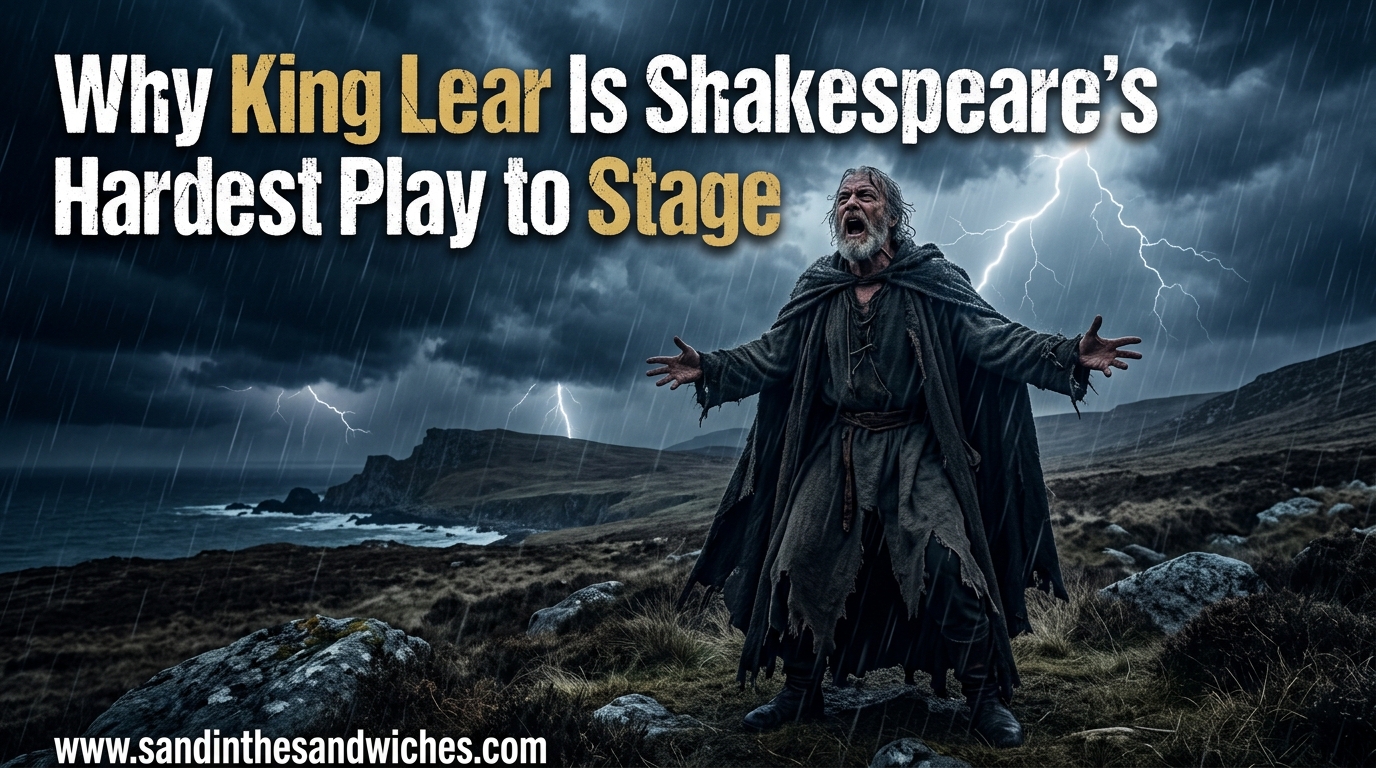
Act 3, Scene 2 of King Lear contains what many directors consider the single most difficult scene in all of Shakespeare to stage well. Lear, half-mad and soaked through, stands on a windswept heath and delivers the line “Blow, winds, and crack your cheeks! Rage! Blow!” The scene demands that the production somehow make an audience feel a real storm, or at least a credible theatrical version of one, while an actor performs emotional work that can easily be overwhelmed by noise and weather effects.
The technical problems are considerable. On a thrust stage, sound has to travel past rain machines, wind fans, and thunder sheets without losing the words. The Fool and Kent have to remain visible and audible inside the chaos. Edgar, disguised as Poor Tom, has to wander in from the wings at exactly the right moment, naked or nearly so, and convince the audience he is a Bedlam beggar rather than a frightened young man in a costume. And the storm has to stop the moment Lear cries “I am a man more sinned against than sinning,” because the play is now about the interior weather, not the physical one.
Directors have approached this scene in two broad ways. The traditional realistic approach tries to put a real storm on stage, with water, wind, and lighting that mimics lightning. The rival minimalist approach, favored by directors like Peter Brook and Yukio Ninagawa, treats the storm as essentially internal and uses simple props, light, and sound to suggest a cosmic disturbance. Each approach has its disasters. A heavy-handed realistic storm drowns out the verse. A too-spare abstract staging can feel under-rehearsed. The right balance is so difficult to find that many otherwise excellent productions are remembered chiefly for getting the storm wrong.
The scene also places unusual physical demands on the lead actor. Lear is on stage for the entire sequence, often standing in real water, shouting into artificial wind, and projecting over amplified thunder. By the time he delivers the great “Poor naked wretches” speech, his body has to convey a king who has become, in his own words, “a poor, infirm, weak, and despised old man.” Few actors reach the end of this scene with any voice left in reserve, and the rest of the play has to be played on whatever vocal and physical resources remain.
The Dover Cliffs Scene: A Purely Theatrical Moment
One of the most famous arguments for why King Lear is Shakespeare’s hardest play to stage comes from a scene that, on paper, sounds simple. Gloucester, blinded and despairing, asks his son Edgar to lead him to a cliff at Dover so he can jump. Edgar, disguised and protecting his father, pretends to guide him to the edge of an imaginary cliff, then pretends his father has fallen and survived. The audience watches a man walk across a flat wooden stage and believes he is at the edge of a precipice. The scene only works in live theatre, and only on a stage willing to be empty.
As scholars at Berkeley have noted, this is the moment in Shakespeare that most clearly refuses to translate to film or radio. The eye-gouging earlier in the play is visceral enough on screen, but the Dover cliffs scene depends on a contract between actors and audience. The actor playing Gloucester has to commit to a fall that is not a fall. The actor playing Edgar has to lie convincingly about what is happening in front of the audience. The audience has to agree to see a cliff where there is none. If any part of that contract breaks, the scene collapses into something that looks absurd rather than heartbreaking.
Directors have tried, occasionally, to give the scene a literal edge: a real platform, a drop, a projection of cliffs. Almost every time, the result has been less powerful than the bare-stage version. The moment is, at heart, a piece of theatrical magic that depends on absence rather than presence. Staging it requires the discipline to leave the stage empty and trust the actors and the verse to do the work. That kind of trust is hard to ask of a design team that has spent the rest of the play building elaborate storms and royal courts.
The scene also lands at the worst possible moment in the production schedule. By the time Gloucester arrives at the imagined cliffs, the audience has already endured the storm, the hovel, the blinding, and the long carry of Lear’s decline. Directors have to time the scene so that the audience is emotionally exhausted enough to weep at the imaginary fall, but not so exhausted that they have nothing left to give. Getting that calibration right is one of the quiet skills that separates a good Lear from a great one.
The Dual Plot Structure: Two Tragedies in One
Part of what makes King Lear Shakespeare’s hardest play to stage is that it is, in effect, two full-length tragedies braided together. The story of Lear, his daughters, and the Fool is the headline. Running parallel to it is the story of Gloucester, his legitimate son Edgar, and his illegitimate son Edmund, which mirrors and amplifies the main plot at almost every turn. A Lear without Gloucester is a lesser play, but a Lear with both plots fully intact is a production challenge of the first order.
The Gloucester subplot adds roughly half the play’s running time, half its scene count, and half its major characters. It also requires its own technical and emotional high points, including the blinding of Gloucester on stage, which has to be staged in a way that is shocking but not gratuitous. Directors who try to soften it lose the play’s moral weight. Directors who stage it too graphically push the production into territory modern audiences find intolerable. The eye-gouging scene is one of the reasons many stage adaptations of Lear are rated 15 or higher.
Edgar’s arc is just as demanding. He has to appear early as Gloucester’s loyal son, then disappear, then reappear as the half-mad beggar Tom o’Bedlam, then lead his father to the imaginary cliffs, then re-enter as a champion in disguise, and finally mourn his father and lose in battle. The role is a test of physical and vocal transformation comparable to the role of Lear himself, and most productions cast an actor of significant range to play it. Some directors have experimented with doubling Edgar and the Fool, but the vocal and physical demands of both roles are so high that the doubling rarely works in practice.
The two plots are not just parallel. They comment on each other. Lear’s division of his kingdom mirrors Gloucester’s trust in Edmund. Cordelia’s banishment mirrors Edgar’s exile. The two storms, the two madnesses, the two reunions with loyal children, and the two tragic endings all rhyme. Directing the play means staging those rhymes carefully so the audience registers the structural echo without feeling lectured. It is a balancing act that requires a clear interpretative spine and a design that supports it.
Madness, Senility, and Mental Decline on Stage
Any discussion of why King Lear is Shakespeare’s hardest play to stage has to grapple with the play’s central interpretive problem: how do you stage madness? Lear is a king who descends into the howling of the heath, and the production has to show that descent without parodying mental illness, romanticizing it, or turning it into a clinical case study. The Fool’s own disappearance from the play has often been read as Lear’s internalization of that voice, and several directors have staged the Fool’s exit as the moment Lear’s mind fully breaks.
The challenge is compounded by the fact that Lear is not a young man at the start of the play. His authority is already shaky, his judgment is poor, and his demand for public declarations of love suggests an aging monarch trying to feel loved before he dies. The madness that follows is not a sudden collapse but a long, terrible acceleration of tendencies already present in the opening scene. The actor has to trace that arc without giving the audience permission to laugh at the king in Act 1, when the play still needs us to take his authority seriously.
Edgar’s disguise as Tom o’Bedlam adds another layer. The actor playing Edgar has to suggest a real, if theatrical, form of Bedlam-style madness in order to fool his blinded father and to move Lear to sudden compassion. The role has historically attracted strong opinions: some directors play Tom as genuinely disturbed, others as a performance of madness by a sane young man, and others as something in between. There is no consensus, and each production has to find its own answer.
Finally, there is the matter of the ending. Cordelia’s death, which comes after the play’s apparent reconciliation, has broken the hearts of audiences for four centuries. The play refuses to offer the consolation of a heroic ending, and the actor playing Lear has to register, in the final scenes, a mind that has briefly cleared, only to break again. It is the kind of ending that no amount of clever staging can fully prepare an audience for, and it is one of the reasons productions of Lear often feel like a shared ordeal between actors and spectators.
The Director’s Burden: Minimalism Versus Grandeur
Every director who tackles King Lear does so knowing that no production of the play has ever felt definitive. There is no single staging that the profession agrees on, no design that has entered the standard repertoire, no Lear that the next generation is expected to follow. The play is constantly being reinvented, and that is part of its theatrical reputation. A director of King Lear is not joining a tradition so much as entering an argument that has been running for four hundred years.
Some directors have committed to a stripped-back, minimalist approach. Peter Brook’s famous 1962 production used a near-empty stage, simple white blocks, and a stark white-on-white palette that mirrored the play’s spiritual bleakness. Yukio Ninagawa’s 1999 production placed Lear in a brilliant white space framed by cherry blossom and battlefield mud. Sam Gold’s 2019 Broadway production, with Glenda Jackson, used a similarly austere setting and let the verse carry the weight. These productions are remembered precisely because they trusted the text and the actors.
Other directors have gone in the opposite direction. Traditional RSC productions in the twentieth century tended to dress Lear in historically inspired costumes, set the storm on a fully realized heath, and use large casts in doublet and hose. The 1982 Jonathan Miller production for the BBC used a similar approach but on television, and the 1983 Granada Television version, with Eric Porter, set the play in a vaguely Edwardian world. Each approach asks a different set of questions of the actors, and each can succeed or fail on the same night.
Modern productions have begun to explore contemporary settings. Lear has been staged as a media mogul, a corporate patriarch, a dictator, and a wounded veteran. These productions often have a single clear political point to make, and they can be powerful. They can also be reductive, turning a play that asks the audience to feel the full weight of human suffering into a polemic. The director’s job is to find a staging that is committed to its own reading without flattening the play, and that is a narrow line to walk.
Why the Payoff Justifies the Pain
If King Lear is so hard to stage, the natural question is why anyone stages it at all. The short answer is that the play gives back, in performance, a measure of the suffering it asks of its makers. The Polish critic Jan Kott argued in Shakespeare Our Contemporary that Lear is, in some sense, Shakespeare’s most modern play, a work that anticipates the dark absurdism of Beckett and Ionesco. A well-staged Lear does feel, in 2026, more contemporary than almost anything else in the canon, because it puts on stage the things we usually try not to look at: old age, betrayal, cruelty, and grief.
Audiences who sit through a strong production tend to describe the experience as exhausting and unforgettable in equal measure. The play asks them to stay with Lear through his worst moments, and the reward is the strange, almost physical relief of the reconciliation scene in Act 4, and the even stranger aftermath of the final scene. There is nothing else quite like it in the theatre.
For actors, the role of Lear remains the one that many consider the summit of the profession, a part that justifies a season of sacrifice. For directors, the play offers the chance to put a distinctive reading on a major work without the burden of feeling that the play has been definitively staged. For audiences, the experience is the kind that justifies the existence of theatre in the first place. That is why the show keeps getting revived, despite everything it asks of everyone involved.
Frequently Asked Questions About Staging King Lear
Is King Lear really Shakespeare’s hardest play to stage?
Most directors, actors, and scholars agree that it is. The play combines a punishing lead role, a parallel subplot of equal weight, technically demanding scenes like the storm and the Dover cliffs, and an ending that refuses to console the audience. No other Shakespearean tragedy asks this much of a production team at the same time.
What is Lear’s fatal flaw?
Tradition has often named pride or vanity as Lear’s flaw, since the play opens with his demand for public declarations of love. More recent readings focus on his need for control, his inability to hear honesty when it is offered plainly, and his habit of testing loyalty through spectacle rather than trust.
Is King Lear harder than Hamlet to perform?
Many actors and directors consider Lear the harder role, partly because the character appears in nearly every scene and has to register a complete collapse of authority, while Hamlet has fewer scenes and ends in a more familiar heroic posture. Lear is also a much older character, which limits the casting pool.
Why is King Lear so emotionally painful to watch?
The play stages suffering with very little protection for the audience. Cordelia’s death at the end, the blinding of Gloucester, and Lear’s howling on the heath are presented without comic relief for long stretches, and the ending refuses the consolation of a redemptive arc. Audiences leave productions feeling exhausted because the play insists on staying with grief.
How long is a typical King Lear production?
Most uncut productions run between three and three and a half hours, including a single interval. Productions that cut the Fool or trim the Gloucester subplot can run shorter, but the consensus among directors is that the play needs at least three hours to register properly.
What is the Fool’s role in King Lear and why is it often cut?
The Fool is Lear’s licensed truth-teller, the only character who can criticize the king to his face. Many productions cut the role to keep the runtime manageable or because the Fool’s lyrics are hard to land for modern audiences. Directors who keep the Fool usually find that the role adds a great deal to the play’s emotional center of gravity.
The Hardest Play, and the One Worth Doing
King Lear remains the hardest play to stage in the English language because it asks every part of the production to do something difficult at the same time. The lead actor has to play two kings in one evening. The design team has to find a storm and a cliff that feel both real and symbolic. The director has to commit to a reading without flattening the play. The audience has to stay with suffering that the play refuses to soften. There is no other work in the canon that asks all of this at once, which is why even the most experienced theatre-makers approach a new production with a kind of respectful dread.
And yet, productions of King Lear keep being mounted, in Stratford and London and New York and small theatres around the world, because the play gives back what it asks for. A great night of King Lear leaves an audience quiet, exhausted, and strangely grateful. It is the hardest play to stage, and it is also the one that, when it works, makes the entire art form feel necessary. That, more than any technical analysis, is why the play has survived on our stages for four hundred years and will be staged for four hundred more.