
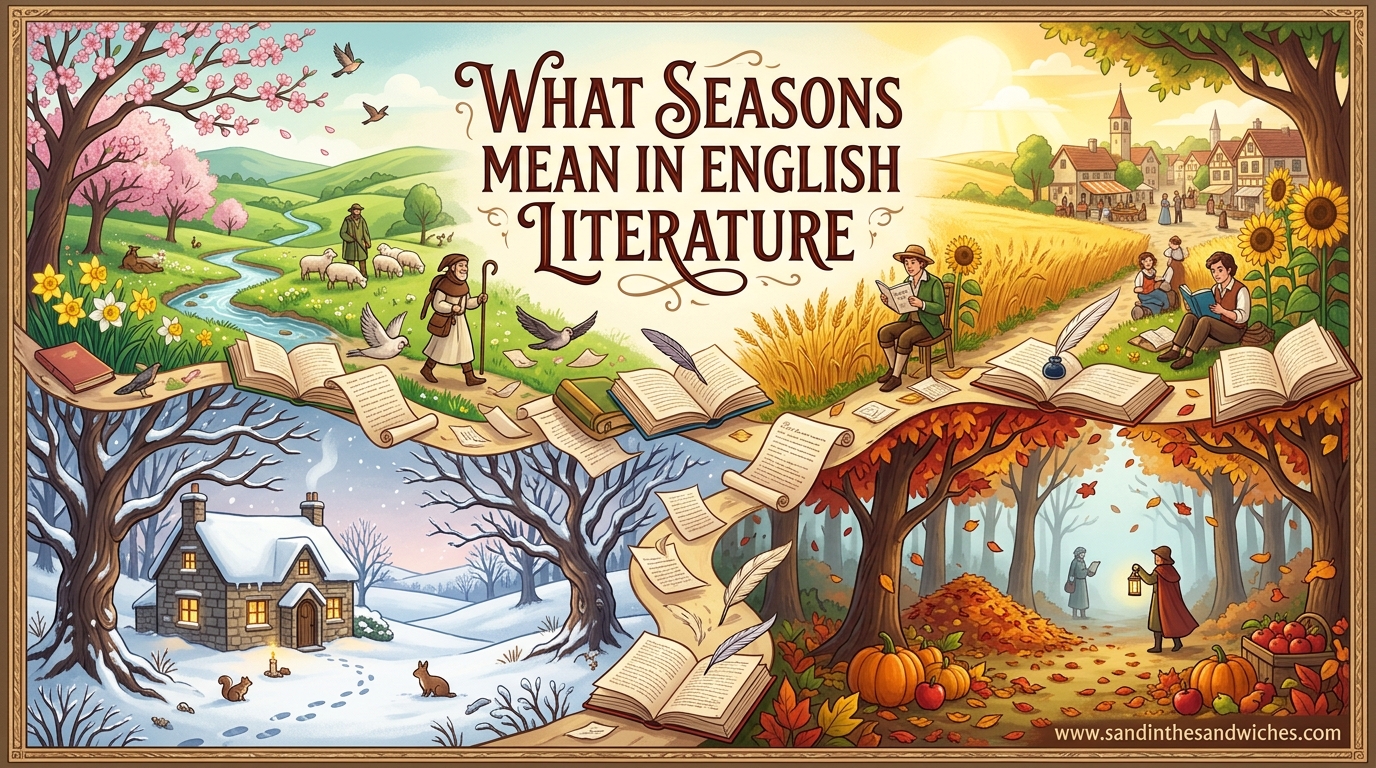
In English literature, the changing of seasons serves as a powerful literary device symbolizing the cyclical nature of life, death, and rebirth, with each season carrying distinct emotional and thematic associations. Writers use spring, summer, autumn, and winter to mirror character development, mark plot progression, and reinforce themes through imagery that resonates with readers on an almost instinctive level.
Seasonal symbolism matters because it allows writers to convey complex emotions and themes economically. A single mention of falling leaves can suggest loss, decay, and the approach of endings without a writer spelling any of it out. That compression of meaning is part of why seasonal motifs have survived for centuries in the literary tradition.
In this guide to what the changing of seasons means in English literature, we break down the symbolism attached to each season, trace how that symbolism has evolved from medieval poetry through Romantic and Victorian writing into modernist subversion, and look at concrete examples from canonical works you likely already know. Whether you are a literature student, a writer, or simply a curious reader, understanding seasonal imagery will change how you read forever.
Table of Contents
Why the Changing of Seasons Matters in English Literature
The changing of seasons in English literature functions as one of the most prevalent ways literary texts engage with and represent climate, time, and human experience. Authors rarely mention weather by accident. When a scene opens in winter, the cold is doing symbolic work.
Seasons matter because they create a shared emotional language. Every reader has felt the relief of spring after a long winter or the melancholy of shortening autumn days. Writers tap into those shared associations to establish mood, foreshadow events, and reinforce thematic resonance without lengthy exposition.
Seasonal imagery also operates as a natural clock inside a narrative. A story that begins in spring and ends in winter tells you something about its arc before a single plot point lands. This cyclical pattern lets authors dramatize growth and decay, hope and despair, vitality and decline.
Spring Symbolism: Rebirth, Hope, and New Beginnings
In English literature, spring symbolizes rebirth, renewal, hope, youth, fertility, and new beginnings. It is the season of awakening, when the world shakes off winter’s darkness and life returns to dormant landscapes. Writers reach for spring when they want to signal optimism, innocence, or the start of a meaningful change.
Spring’s connection to rebirth makes it the natural setting for scenes of forgiveness, reconciliation, and emotional recovery. A character emerging from grief, a relationship beginning again, or a community restoring itself after hardship often plays out against budding trees and lengthening days. The imagery of seeds, sprouts, and blossoms reinforces the idea that something new is growing.
The most famous English example is Geoffrey Chaucer’s The Canterbury Tales, which opens with rain showers piercing the drought of March and bathing every vineyard vein in sweet moisture. That single image sets the entire pilgrimage in motion. Spring prompts people to travel, to seek, and to begin again.
William Wordsworth builds much of his Romantic vision around spring imagery. In poems like “Lines Written in Early Spring,” the season becomes a marker of innocence and natural harmony, a brief window before the corruptions of adulthood and society set in. For the Romantics, spring is not just pretty scenery. It is a moral and spiritual state.
Shakespeare associates spring with youth and naive love. The enchanted woods of A Midsummer Night’s Dream pulse with the energy of young passion and irrational desire, and the play’s green world functions as a seasonal laboratory for working out emotional confusion before the characters return to the order of the city.
Writers also use spring ironically. A violent event set in spring feels more disturbing because it violates the season’s promise of renewal. That friction between expectation and event is part of what gives spring imagery its emotional power.
Summer Symbolism: Passion, Freedom, and Vitality
In English literature, summer symbolizes passion, freedom, vitality, youth’s full flowering, love, and abundance. It is the high point of the cyclical pattern, the moment when growth reaches its peak before the long slide into decline begins.
Summer scenes tend to carry an atmosphere of intensity and freedom. School is out, work slows, the days stretch long, and characters find themselves released from ordinary routine. That liberty makes summer the natural backdrop for romance, adventure, and coming-of-age stories. The heat itself becomes a metaphor for emotional and physical intensity.
Shakespeare’s sonnets use the summer’s day as a benchmark for beauty and transience. Sonnet 18 famously asks whether he should compare the beloved to a summer’s day, only to declare the beloved “more lovely and more temperate,” because summer is ultimately too short. Summer here is gorgeous but fragile.
Jane Austen uses summer in novels like Pride and Prejudice to mark periods of social liberty. Country walks, garden conversations, and outdoor gatherings create the conditions for courtship and confrontation. The warmth of the season reflects the warmth of feeling between characters.
John Keats and the Romantic poets treat summer as a moment of fullness that already contains the seeds of loss. To be in full bloom is to begin to fade. That bittersweet quality runs through much English summer writing, where the season’s pleasure is shadowed by awareness of its brevity.
Stephen King’s novella collection Different Seasons captures something similar. The summer story, “The Body,” uses heat, freedom from school, and aimless boyhood wandering to evoke the brief intensity of youth before adult realities close in. Summer stands for that rare window when everything feels possible.
Autumn Symbolism: Decline, Harvest, and Reflection
In English literature, autumn (or fall) symbolizes decline, harvest, maturity, reflection, transition, nostalgia, and the gentle approach of endings. It is the season of middle age, of gathering in what has been grown, and of looking back over what the year has produced.
Autumn’s symbolism is more layered than any other season. It carries both grief and gratitude. The leaves are dying, the light is fading, and yet the harvest is abundant. Writers use that duality to explore characters who are simultaneously at the height of their powers and aware of their decline.
John Keats’s “To Autumn” is the definitive English statement on the season. The ode celebrates autumn as full of ripeness and abundance, almost conspiring with the sun to “load and bless” the vines with fruit. Keats does not treat autumn as a tragedy. He sees it as a season with its own music, completing the cycle of growth.
Thomas Hardy takes a darker view. In poems like “The Darkling Thrush,” the winter-leading edge of late autumn becomes a landscape of cosmic exhaustion, where the century’s corpse seems to lean out over the fading landscape. For Hardy, autumn reveals the bones beneath the world’s vitality.
The Bronte sisters use autumn weather to establish the brooding, windswept atmospheres of novels like Wuthering Heights. Moors under lowering skies, dying foliage, and shorten days create the emotional weather in which passion curdles into obsession. The Yorkshire autumn is practically a character.
Autumn also marks the harvest, and harvest imagery carries its own symbolic weight. Reaping, gathering, and storing food become metaphors for reaping what one has sown in life. A character harvesting in autumn is a character confronting the consequences of earlier choices.
Winter Symbolism: Death, Isolation, and Endings
In English literature, winter symbolizes death, isolation, endings, dormancy, hardship, silence, and the stripping away of life’s surface beauty. It is the season against which every other season is measured, the symbolic zero point of the cyclical year.
Winter’s symbolic power comes from its visible emptiness. Bare branches, frozen ground, and shortened days give writers a ready-made language for loss. A scene set in winter feels immediately colder, lonelier, and more final than one set in any other season. Authors know this and deploy it deliberately.
William Shakespeare uses winter imagery to mark emotional and political barrenness. In The Winter’s Tale, the title itself signals a kingdom frozen by jealousy and grief, waiting for the spring of reconciliation. In King Lear, the storm on the heath externalizes Lear’s inner collapse, with the howling wind standing in for his fractured mind.
Charles Dickens is so closely associated with winter that readers often think of him in snowy terms. A Christmas Carol uses London winter to dramatize both the coldness of Scrooge’s heart and the possibility of thaw. The famous Dickens line about March, “when the sun shines hot and the wind blows cold: when it is summer in the light, and winter in the shade,” captures the transitional discomfort of late winter perfectly.
James Joyce’s “The Dead,” the closing story of Dubliners, uses falling snow as a symbol of mortality that settles on all the living and the dead alike. The snow becomes a great equalizer, suggesting that every passion, every relationship, and every identity eventually enters the same cold stillness.
T. S. Eliot famously inverts expectation in the opening line of The Waste Land: “April is the cruellest month.” That single sentence subverts the entire tradition of spring symbolism. For Eliot’s modernist generation, the renewal of spring feels painful because winter had at least allowed the dead to stay peacefully buried under snow. This is one of the clearest examples of a writer deliberately working against inherited seasonal symbolism.
Winter does not always mean literal death. It can also signal dormancy, a pause in which life continues underground, waiting. That subtler reading allows writers to use winter as a season of preparation rather than pure ending.
Seasons as a Metaphor for the Human Lifecycle
Beyond individual scenes, English literature often maps the four seasons onto the stages of human life. Spring becomes childhood and youth, full of innocence and possibility. Summer stands for early adulthood, when passions run hot and freedom feels total. Autumn represents middle age, harvest, and the slow accumulation of reflection. Winter marks old age, decline, and the approach of death.
This lifecycle mapping gives seasonal symbolism its emotional force. When a character moves through a story whose seasonal arc tracks their own development, readers sense the parallel without being told. The writer does not need to explain. The tradition does that work silently.
Seasons also function as a marker of character development. A character introduced in winter who reaches spring by the end has, by symbolic logic, been reborn. A character whose arc moves from spring to autumn has aged and matured through loss. This is why writers choose their seasonal settings so carefully.
The emotional landscape of a novel often tracks its seasonal one. Hope arrives with spring, peaks with summer, fades through autumn, and bottoms out in winter. When a story breaks that pattern, the break itself becomes meaningful. A hopeful scene in winter feels defiant. A death in spring feels cruel. The violation of expectation is the point.
This cyclical pattern also lets writers explore themes of recurrence. Spring returns every year, and so, the symbolism suggests, does hope. Winter always follows autumn, and so endings remain inevitable. The changing of seasons becomes a quiet argument about the structure of human experience itself.
Romantic, Victorian, and Modernist Approaches to Seasonal Imagery
The way English writers use seasons has shifted noticeably across literary periods. The Romantic poets of the late eighteenth and early nineteenth centuries, including William Wordsworth, Samuel Taylor Coleridge, and John Keats, treated nature as a source of spiritual truth. For them, seasonal imagery was not decoration. It was a way of accessing something real about human existence.
Victorian writers such as Alfred Tennyson, Thomas Hardy, and the Brontes inherited Romantic seasonal imagery but darkened it. The industrial revolution, scientific advances, and growing religious doubt made the natural cycle feel less comforting and more indifferent. Victorian autumn and winter scenes tend to carry a heavier weight of cosmic loneliness than their Romantic predecessors.
Modernist writers of the early twentieth century, including T. S. Eliot, Virginia Woolf, and James Joyce, actively subverted inherited seasonal symbolism. Eliot’s “cruellest month” April is the most famous example, but Woolf’s To the Lighthouse and Joyce’s The Dead also twist seasonal expectations to expose the dislocation of modern life. Modernist seasons do not promise renewal. They record fragmentation.
Contemporary writers continue to play with these inherited patterns. Some reclaim traditional seasonal symbolism for new purposes, while others expose how cliched it can become when used carelessly. The seasonal symbolism toolkit remains powerful, but it now carries the weight of centuries of use, and writers must work either with or against that history.
FAQs
What does the changing of seasons symbolize in literature?
In English literature, the changing of seasons symbolizes the cyclical nature of life, death, and rebirth. Each season carries distinct associations, with spring representing renewal, summer standing for vitality and passion, autumn suggesting harvest and decline, and winter signifying death and dormancy.
What does spring symbolize in literature?
Spring symbolizes rebirth, hope, renewal, youth, fertility, and new beginnings. It is the season of awakening, used by writers to mark optimism, innocence, forgiveness, and the start of meaningful change.
What does summer symbolize in literature?
Summer symbolizes passion, freedom, vitality, love, and the full flowering of youth. It marks the high point of the cyclical year and is often used as a backdrop for romance, adventure, and coming-of-age scenes.
What does autumn represent in literature?
Autumn represents decline, harvest, maturity, reflection, transition, and nostalgia. It carries both grief and gratitude, as the leaves die while the harvest is gathered, making it a season of layered emotional symbolism.
What does winter symbolize in literature?
Winter symbolizes death, isolation, endings, dormancy, hardship, and silence. Its visible emptiness, bare branches, and shortened days give writers a ready-made language for loss, loneliness, and finality.
Why are seasons important in literature?
Seasons are important because they allow writers to convey complex emotions and themes economically, create a shared emotional language with readers, establish mood, foreshadow events, mark plot progression, and reinforce themes through symbolic imagery.
Conclusion
Understanding what the changing of seasons means in English literature opens up a deeper layer of every text you read. Spring speaks of rebirth, summer of passion, autumn of harvest and decline, and winter of death and dormancy, and together these four seasons form a symbolic grammar writers have used for centuries.
That grammar is not fixed. Romantic poets, Victorian novelists, and modernist innovators each reshaped it to fit their own concerns, and contemporary writers continue to push seasonal imagery in new directions. Knowing the tradition lets you hear both when a writer is using it and when they are deliberately breaking it.
Next time you open a novel, poem, or play, notice the weather. Ask which season the scene falls in, and what that choice is doing. The answer is rarely just decoration. Seasonal symbolism is one of the oldest and most flexible tools English literature has for telling us who characters are, where they stand, and where they are going.