
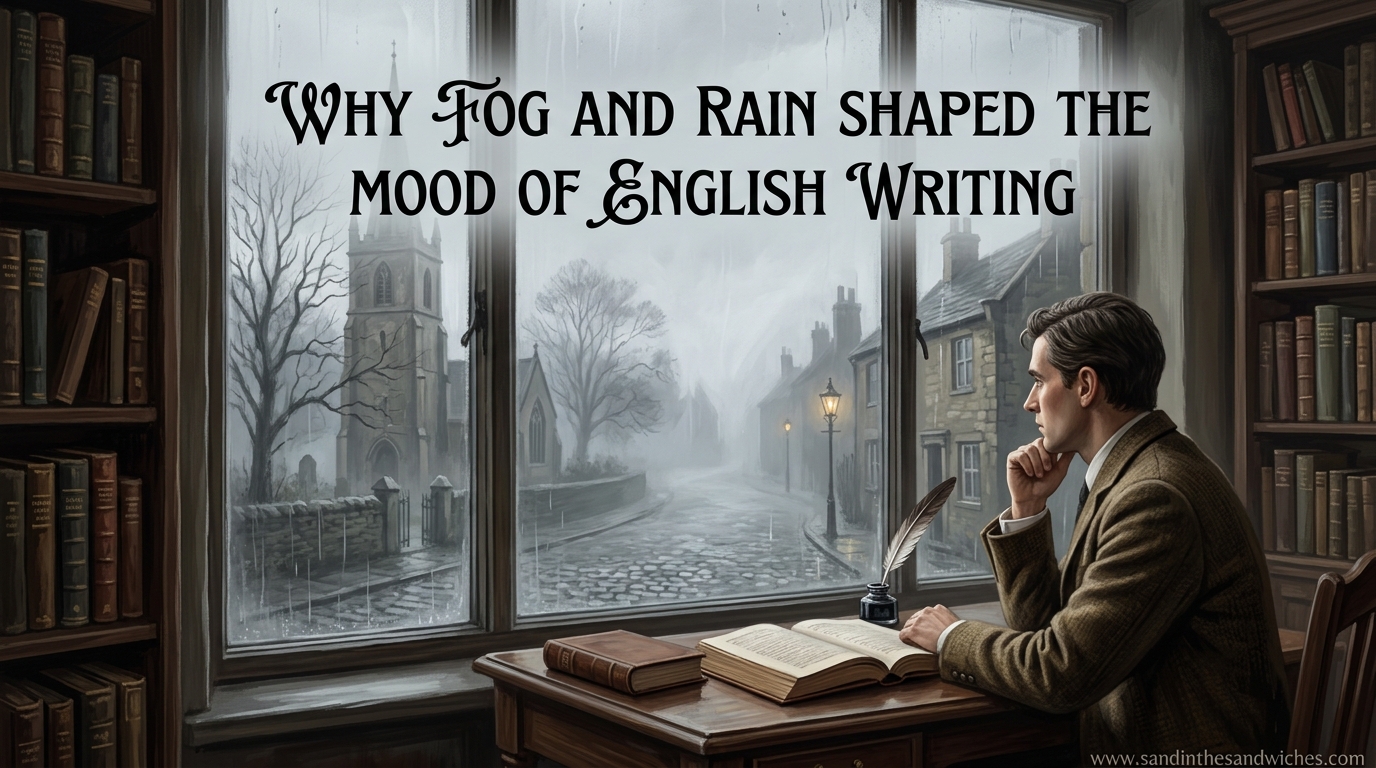
English literature is soaked in mist. From the sodden moors of Wuthering Heights to the gas-lit fogs of Bleak House, fog and rain shaped the mood of English writing long before literary critics had a name for the technique. I want to walk you through exactly why these two weather patterns became the emotional shorthand of an entire literary tradition, and how you can use them with the same care the Victorians did.
In this guide, I’ll explain the term behind the effect (pathetic fallacy), trace the cultural reasons it caught on, look at how fog and rain work differently on the page, and finish with practical ways to apply these techniques without sounding like a greeting card.
Table of Contents
How Fog and Rain Shaped the Mood of English Writing
Fog and rain shaped the mood of English writing by giving authors a ready-made vocabulary for uncertainty, grief, intimacy, and dread. Through a literary technique called pathetic fallacy, weather becomes a mirror for the inner life of a character. English writers leaned on this device for centuries because the climate they lived in made fog and rain feel less like a setting and more like a state of mind.
The phrase “pathetic fallacy” was coined by John Ruskin in 1856, but the habit it describes is much older. When Shakespeare wrote that “the rain it raineth every day” in King Lear, he was already doing what the Brontës, Dickens, and Hardy would later perfect. English prose, poetry, and drama took their emotional weather from the actual weather outside the window.
The English Climate and Literary Tradition
You cannot separate the technique from the place. England is an island, and its writers spent most of their working lives under slate-grey skies. Rain falls on roughly 150 days a year across the British Isles, and the kind of thick, dripping fog that Londoners called a “particular” was once a daily fact of life before the Clean Air Act of 1956.
That lived experience soaked into the books. Charles Dickens grew up watching industrial fog roll off the Thames, and he used it in nearly every novel. When a reader in 1850 picked up Bleak House, they did not need fog explained to them; they already felt it in their bones. The same goes for the moors that haunted the Brontës, or the rain-slicked streets where Sherlock Holmes later solved his cases.
This is a quiet but important point. Writers from sunnier traditions do reach for weather as a mirror, but English writers had so much more of it to draw on. Fog and rain stopped being unusual and became the default emotional backdrop. The result is a literary tradition where bad weather is rarely just weather.
What Is Pathetic Fallacy and Why It Matters
Pathetic fallacy is the literary technique of projecting human emotion onto nature, most often through weather. The sky weeps, the wind howls in rage, fog closes in like a trap. Ruskin gave it the name, but he was describing something English writers had been doing since Chaucer.
What makes the technique “fallacious,” in Ruskin’s view, is the assumption that the storm outside cares about the storm inside us. Of course it does not. But the illusion is so useful, and so natural to the English ear, that the term stuck as a label rather than a criticism. The Victorians embraced the device because it worked on readers, and modern writers still rely on it for the same reason.
The reason it matters is simple. A scene set in fog or rain is doing emotional work that dialogue alone cannot do. A character can say “I am lost,” but a character walking through a fog that hides the road is lost in a way the reader can see and feel. That extra layer of meaning is the gift fog and rain give to English writing, and it is the reason the tradition is so hard to imitate from a sunnier climate.
How Fog Creates Atmosphere in English Literature
Fog hides things. That single fact is the engine behind most of its literary uses. A character cannot see the danger, the lover, or the truth, and the reader feels that uncertainty in their own chest.
Look at Arthur Conan Doyle. In A Study in Scarlet, Holmes and Watson meet in a chemistry lab, but the London around them is a city of muffled shapes and gas lamps blooming in the murk. The fog is not decoration; it is the atmosphere in which mystery becomes possible. Holmes notices what the fog has hidden, and so the weather directly enables the genre of detective fiction.
Dickens does something similar, but with a heavier hand. In Bleak House, the famous opening with fog “everywhere” is not just a London joke. It is the moral weather of the entire novel. The Court of Chancery is a fog, the case itself is a fog, and Esther Summerson’s journey toward truth is a slow walk out of it. Fog becomes the symbol for everything that is slow, unjust, and difficult to see through.
In shorter forms, fog is a useful tool for ambiguity. A meeting in fog can be romantic, sinister, or both. A message delivered in fog is unreliable. A confrontation in fog is dangerous because the participants may not recognise each other. English writers, especially in Gothic and mystery fiction, learned to lean on that ambiguity as a form of suspense.
How Rain Shapes Mood and Plot in English Writing
Rain, unlike fog, falls on people. You can hide from fog; you cannot hide from a downpour. That physical contact makes rain the more intimate of the two weather patterns, and English writers use it when they want the reader to feel a scene in the body, not just the mind.
Thomas Hardy is the great example. In Far from the Madding Crowd, rain is a kind of plot engine. A storm destroys the ricks, separates the lovers, and exposes character. Bathsheba Everdene’s story is shaped by weather as much as by any human decision, and the same is true in Tess of the d’Urbervilles, where rain falls on moments of grief and revelation.
The Brontës do something similar with rain. In Wuthering Heights, the moors are drenched for a reason. Heathcliff and Catherine are not romantic figures in sunshine; they are figures of storm. Rain becomes the texture of their passion, the way silence is the texture of a library. When the rain stops, the story feels wrong.
For practical purposes, rain in a short story can do three jobs at once. It can set the mood (sorrow, dread, or release). It can drive the plot (a slip, a missed meeting, a forced shelter). And it can act as a symbol, especially for grief, renewal, or the long memory of old mistakes. The English tradition uses all three, often in the same scene.
Gothic Atmosphere: Where Fog and Rain Become a Genre
The Gothic novel is the form where fog and rain stop being weather and become genre. Horace Walpole’s The Castle of Otranto (1764) opened the door, and writers from Ann Radcliffe to Sheridan Le Fanu walked through it with the curtains drawn.
Gothic atmosphere relies on a small set of conditions: a ruined or oppressive building, a sense of the past pressing on the present, and weather that refuses to clear. Fog creeps through castle corridors. Rain hammers on attic windows. Wind finds the cracks in old walls. None of this is realistic weather; it is the climate of a guilty conscience.
Le Fanu, in particular, used fog and rain to build dread without ever showing the monster. In Carmilla and Uncle Silas, the threat is always slightly off-screen, partly because the weather itself is slightly off-screen. Mist hides the carriage. Rain washes away the footprints. The English Gothic tradition taught writers to use weather as a way of keeping the supernatural plausible, even when the reader half-believes in it.
Modern writers in the Gothic mode (Sarah Waters, the early chapters of Susan Hill’s The Woman in Black) still work the same seam. They set scenes in fog and rain because the genre has trained readers to associate those conditions with unease. The tradition is a kind of contract between writer and reader, and weather is the ink it is written in.
Sensory Details and Avoiding Weather Clichés
The danger of any tradition this rich is cliché. The phrase “it was a dark and stormy night” is a joke now precisely because Victorian writers overused the device. English weather writing is full of stale pairings: rain equals sadness, sunshine equals joy, fog equals mystery.
Strong writers get around this by going past the symbol and into the body. They describe what fog or rain actually feels like. The way it sits on the wool of a coat. The smell of wet cobbles. The way a streetlamp turns rain into a sheet of gold. These are sensory details, and they are the difference between weather as wallpaper and weather as character.
Another useful trick is the counterpoint. A funeral in bright sunshine is more unsettling than a funeral in rain, because the reader expects the latter. A romantic meeting in fog, where neither party can see the other clearly, can be more charged than one in clear daylight. English writers from Austen to Ian McEwan have used this kind of mismatch to keep the technique sharp.
The final point worth making is restraint. Not every scene needs weather. If fog and rain appear only at moments of crisis, they carry weight. If they appear on every page, they become wallpaper. The English tradition is at its best when weather is a tool chosen carefully, not a habit chosen by default. That is the line between mood and melodrama, and it is the line every writer using this technique has to walk.
Frequently Asked Questions
How does weather affect mood in English language?
Weather in English writing is a shorthand for emotion. Fog suggests uncertainty or concealment, rain suggests grief or intimacy, storms suggest conflict. These pairings are so well established in English literature that readers feel them before any character explains how they feel. The technique is called pathetic fallacy, and it works because writers and readers share the same unconscious weather associations.
What language technique uses weather to set the mood?
The language technique that uses weather to set the mood is called pathetic fallacy. Coined by John Ruskin in 1856, it describes the practice of attributing human emotions to nature, most often through weather. The sky can weep, the wind can rage, fog can close in like a trap. It is the dominant mood tool of English Gothic and Victorian fiction.
How does rain in a short story contribute to character mood or plot?
Rain in a short story contributes on three levels. It sets mood by making a scene feel intimate, somber, or heavy. It drives plot by causing accidents, missed meetings, or forced shelter. And it works as a symbol, often standing for grief, renewal, or the weight of the past. The Brontës, Thomas Hardy, and Charles Dickens are the great English examples of using rain for all three at once.
When the weather reflects the mood in literary?
When weather reflects the mood in a literary work, the technique is called pathetic fallacy. It happens when a storm breaks during a moment of anger, when rain falls during a funeral, or when fog hides a revelation. The English literary tradition uses this device more heavily than most because the actual climate of the British Isles gave writers more of this weather to draw on.
Final Thoughts on Fog, Rain, and the Mood of English Writing
So why did fog and rain shape the mood of English writing? Because English writers were surrounded by them, because readers learned to read them as emotional cues, and because the technique (pathetic fallacy) turned ordinary climate into a working vocabulary for inner life. From Shakespeare to the Brontës, from Dickens to Le Fanu, and into the modern Gothic novel, fog and rain have been the quiet engines of English mood.
If you are writing, the lesson is to treat weather as a craft tool rather than a default. Pick it when it carries meaning, describe it with sensory care, and break the pairing when the scene needs surprise. The English tradition is at its best when it does exactly that, and it is the reason this kind of weather writing has lasted for centuries.