
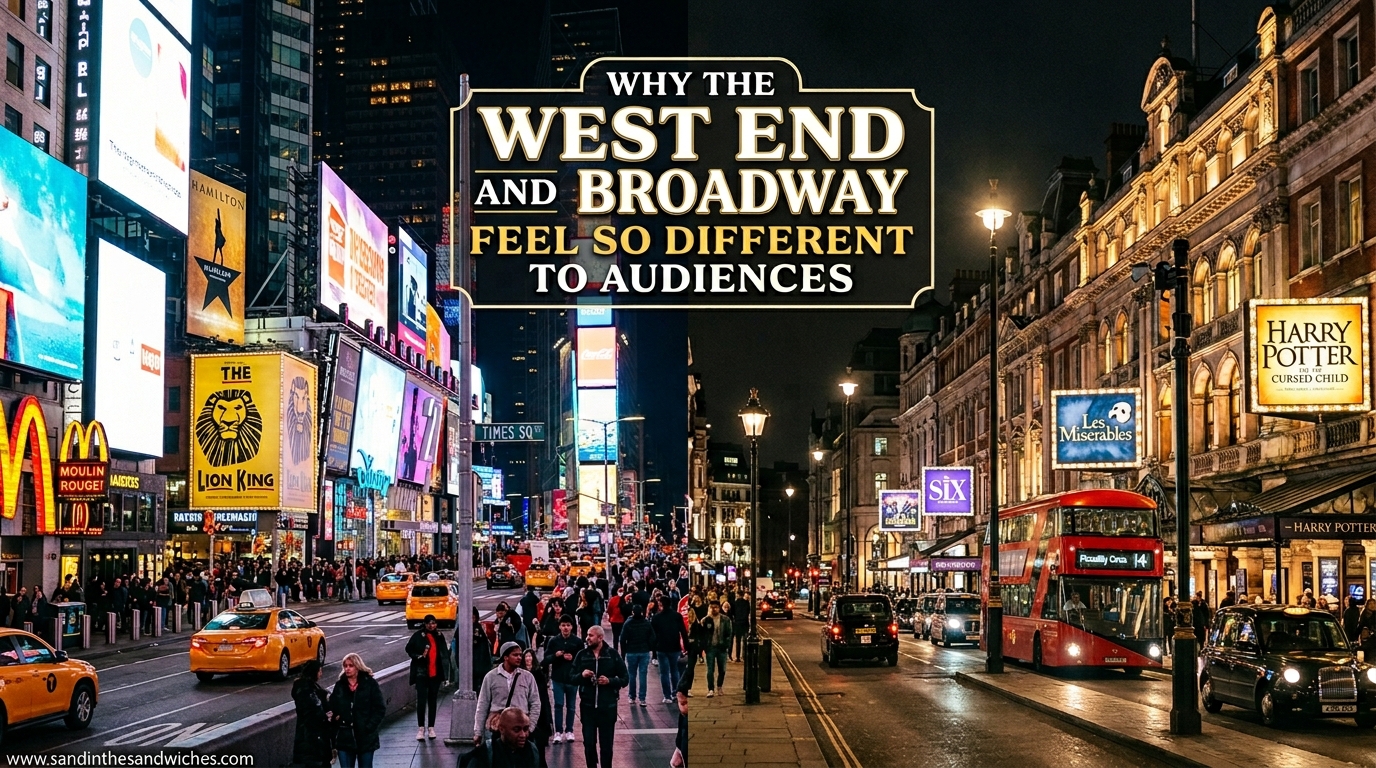
The West End and Broadway are the two most powerful commercial theatre districts in the English-speaking world, but anyone who has seen a show in both London and New York knows they feel like separate planets. The West End is London’s theatre district, anchored around Shaftesbury Avenue and Covent Garden, while Broadway is New York’s equivalent, clustered around Times Square between 41st and 54th Streets. Both operate as commercial ecosystems where hits run for years, but the way audiences show up, react, and behave inside those theatres tells two very different stories about how each city treats live performance.
I have sat through shows in both districts, and the contrast is not subtle. The same production can play to a quieter, more reserved room in London and a louder, more demonstrative one in New York. So what explains the gap? Below is my deep dive into the geographic, cultural, architectural, and behavioural reasons the West End vs Broadway experience diverges so sharply, drawing on theatre history, audience research, and the lived experience of regular theatregoers on both sides of the Atlantic.
Table of Contents
What defines the West End and Broadway geographically and culturally
Broadway is technically a street in Manhattan, but the term “Broadway theatre” refers to any of the 41 large professional theatres with 500 or more seats located in the Theatre District near Times Square. The West End works the same way by convention: it covers roughly 40 venues in London’s West End district, with the Society of London Theatre (SOLT) defining the boundary for industry purposes, awards eligibility, and audience research.
Both are commercial theatre districts, meaning shows are funded privately and run as long as they sell tickets. This separates them from subsidised or “not-for-profit” theatres such as the National Theatre, the Old Vic, and the Young Vic in London, or Lincoln Center, the Public Theater, and Manhattan Theatre Club in New York, which all receive public or donor funding. Despite this shared commercial model, the two districts have very different ancestries. The West End traces its modern form to 1663, when Charles II granted royal patents for two London playhouses (Drury Lane and Lincoln’s Inn Fields) after the Restoration of the monarchy. Broadway’s professional theatre scene began in the mid-1800s, when Manhattan became America’s entertainment capital, with the first major playhouse, the Laura Keene Theatre, opening in 1856.
That head start shows up in the architecture. The West End is full of Victorian and Edwardian theatres, ornate spaces built in the 1880s and 1890s during a major theatre-building boom under the supervision of architect C.J. Phipps and his contemporaries. Broadway’s oldest surviving houses date from the early 20th century, and many of the most popular venues have been rebuilt multiple times to modern specifications. The result is a West End that feels more like stepping into a gilded museum, with plasterwork cherubs and velvet curtains, and a Broadway that often feels like a purpose-built stadium designed for maximum ticket revenue.
Even the streets feel different. Shaftesbury Avenue in London is a relatively narrow, tree-lined street with theatres tucked between restaurants and pubs. 44th Street and 45th Street in Manhattan are canyon-like corridors flanked by electronic billboards, commercial chains, and a constant crush of foot traffic. Both work as theatre districts, but they set very different emotional tones before you ever reach your seat.
How audience demographics shape the experience
Who shows up matters as much as what is on stage. According to The Broadway League’s annual demographics report, the Broadway audience in 2026 skews heavily tourist: roughly 65% of attendees are visitors from outside the New York metropolitan area, with international tourists representing a significant share of that figure. The West End also draws tourists, but a larger portion of its audience is local Londoners, particularly in midweek performances, matinees, and the long-running subscription slots that have sustained the district for decades.
This shapes the energy of the room. A Broadway house on a Saturday night often includes families on holiday, first-time theatregoers celebrating a special occasion, and convention groups, all primed for spectacle and willing to be loud. A West End house on a Tuesday is more likely to include subscribers, regulars who have seen the same show multiple times, and theatre-literate locals who know the actors by name. Both audiences are paying customers with high expectations, but their reference points and their tolerance for risk differ.
Age distributions also vary in measurable ways. Broadway reports a strong concentration of attendees in the 25 to 44 age range, partly driven by the social and tourist experience, with 35 to 39 year olds typically the single largest cohort. The West End’s subscription base skews slightly older, with many attendees in the 50 to 70 range who treat theatre as a weekly habit rather than a special event. None of this makes one audience better than the other, but it does explain why Broadway shows often lean into big emotional payoffs, while West End shows can sustain more subtle, slow-burn storytelling that trusts the audience to follow.
Income and education levels also shape the conversation. Broadway’s tourist-heavy audience is willing to pay premium prices for the experience of seeing a hit, even if they have never set foot in a theatre before. The West End’s regular audience includes a strong base of middle-income professionals who have built theatregoing into their budgets over years. This affects everything from how aggressively theatres market to how shows are written and produced.
The feel of the venues: intimacy, architecture, and history
Walk into the Duke of York’s Theatre, the Noël Coward Theatre, or the Theatre Royal Haymarket in London, and you are standing in a room that has hosted performances for over a century. Plasterwork ceilings with carved rosettes, original wood panelling, and historic gas-lamp fixtures (now electrified) define the look. Broadway venues like the Lyceum, the Belasco, and the New Amsterdam carry similar history, but many of the largest houses, including the Gershwin, the Minskoff, and the Marriott Marquis, are modern builds from the 1970s and 1980s designed for capacity rather than charm.
Seating capacity reflects this architectural divide. The average Broadway house holds around 1,800 seats, with the largest (the Gershwin) at 1,933. The average West End venue holds around 750 to 1,000 seats, with only a handful above 1,500, including the London Palladium and the Coliseum. That gap is not just about size. Smaller houses create intimacy: you can often see the sweat on a performer’s face from the back of the stalls, and actors can deliver a whispered line and trust that 95% of the room will hear it. Larger Broadway houses demand bigger voices, broader gestures, and more visual spectacle to land the same emotional beat.
There is a knock-on effect on the shows themselves. A West End production can be scaled to a 700-seat room, with smaller casts of 12 to 20 performers and more nuanced staging that emphasises psychological realism. A Broadway transfer often has to expand to fill a 1,800-seat house, sometimes doubling the cast, and pushing sets and choreography toward the spectacular. This is why critics sometimes complain that London productions feel “bigger” emotionally while New York versions feel “bigger” physically. They are tuned to different rooms, and the tuning shows.
Accessibility and comfort also differ. Modern Broadway houses typically have better air conditioning, more spacious legroom in orchestra seats, and more accessible entrances and seating configurations. West End theatres, particularly the older Victorian houses, often have steep raked seating, narrow aisles, and tighter stalls. The trade-off is character. A West End theatre rewards the audience with the sense of stepping into history, while a Broadway theatre rewards them with the comfort of a contemporary entertainment venue.
Ticket prices and what you actually pay for
Broadway is the more expensive of the two. Top orchestra seats for a hit musical in 2026 routinely run $250 to $400, and premium seats for shows like Hamilton, Wicked, or The Lion King can exceed $500 on the secondary market. The West End’s most expensive seats generally top out at £150 to £250, with the same shows often available for half the Broadway price or less. The exchange rate, the cost-of-living gap, and the structural differences in the commercial theatre ecosystem all contribute.
Both districts use dynamic pricing, though with different intensity. Broadway employs it aggressively through TKTS booths in Times Square, digital lotteries through apps like Lucky Seat and Broadway Direct, and rush tickets sold at the box office on the day of performance. The famous red steps in Times Square sell up to 50% off same-day seats for selected shows. London has the Official London Theatre half-price booth in Leicester Square, plus day-of-show lotteries and “Friday Rush” schemes for under-30s run by individual producers. The pricing systems are similar in spirit but differ in scale: TKTS moves far more seats per day than its London counterpart, and Broadway’s lotteries tend to offer steeper discounts.
Subscription culture also diverges in measurable ways. Many Broadway regulars buy season tickets to a single theatre, locking in prices and seat locations for an entire year of programming. This creates a stable audience for the major houses and ensures a baseline of revenue. The West End’s subscription market is thinner, though growing, with organisations like TodayTix, LOVEtheatre, and theatre-specific schemes (the Donmar’s membership, the National Theatre’s Travel Extras) offering packages. The result is that regular Broadway attendees often pay less per show than the listed price, while West End regulars typically pay full price but face a lower ceiling.
For international tourists, the math shifts again. A Broadway visitor flying from London might find a West End show cheaper, even factoring in airfare, simply because the ticket price gap is so large. For a London visitor flying to New York, the trip is a destination event with Broadway shows as a key part of the itinerary. Both districts understand and price for their international visitors, but the Broadway tourist dollar is a much larger share of the overall revenue mix.
Audience etiquette: why reactions feel different
This is the area where the cultural gap is most obvious to anyone who has attended both. The most-cited difference is the standing ovation. On Broadway, standing ovations are routine. Audiences rise for almost every major musical, sometimes for nearly every show, regardless of quality. The expectation has become so entrenched that sitting during an extended curtain call can feel conspicuous. On the West End, a standing ovation is reserved. When a London audience stands, it signals genuine, exceptional impact. I have sat in both types of rooms, and the West End ovation carries more weight because it is rarer.
Reddit’s r/Broadway community has discussed this at length. One user posted after a London trip: “I saw Les Mis in London and cried through the entire second act. The standing ovation was three minutes long, but only half the house stood. In New York, everyone stands. In London, standing means something.” That asymmetry has been noted by critics, performers, and regular audience members alike, and it is one of the most frequently cited examples when theatregoers explain the difference in feel between the two districts.
Phone and talking rules also differ in enforcement. Broadway houses have grown stricter in recent years, with ushers quick to step in if a phone screen lights up or a conversation continues past the house lights going down. Several Broadway theatres have introduced locked pouch systems, branded as “Yondr,” that require audience members to seal their phones for the duration of the performance. West End audiences tend to police themselves, with social pressure (glares, whispered shushing, tutting) doing what staff enforcement does in New York. The result is that London audiences often feel less surveilled, but they also rely on collective enforcement of norms that some visitors find intimidating.
Arrival times follow the same pattern. Broadway showgoers are expected in their seats 10 to 15 minutes before curtain, with the lights dimming sharply to discourage latecomers. West End audiences trickle in until the lights dim, with latecomers often admitted during the first scene by an usher with a torch. This looser door policy is part of why the West End interval feels more like a continuation of a night out, while Broadway audiences tend to be fully seated and settled before the show begins. Neither is objectively correct, but they shape the emotional rhythm of the evening.
Applause at the end of a song or a scene also differs. Broadway audiences regularly break into applause at the conclusion of a big number, especially in musicals. West End audiences save their applause for natural scene breaks and the curtain call. This produces a different rhythm in the room: Broadway shows are punctuated by applause, while West End shows flow more continuously.
The interval versus the intermission: a social ritual
The interval is the West End’s signature cultural difference. At the 20 to 25 minute break, audiences pre-order drinks (often ordered before the show through a service that delivers them to a designated table in the foyer), champagne flutes in hand, and treat the pause as a social event. The foyer becomes a buzzing cocktail party, with conversations about the show, the actors, and the production values filling the space. It is theatre as a night out, not just a performance.
Broadway intermissions are typically 15 minutes and more transactional. People line up at bars, grab drinks, and head back to their seats. The energy is closer to a sports game timeout than a social gathering. The longer West End interval, combined with the more social bar culture, makes a London theatre night feel like a two-act dinner party with a show in the middle. A Broadway intermission feels like a brief reset before the second act.
Reddit users have noted the difference. One thread on r/Theatre asked why West End interval is “a whole vibe” while Broadway intermission feels like “an annoying pause.” The most upvoted response pointed to cultural differences in drinking culture and the social expectations built around the West End interval over generations. Pre-ordering interval drinks is a tradition, not a service. Many London theatres maintain standing relationships with nearby pubs, and audiences often spill into Soho or Covent Garden for a quick drink at the bar if the in-house foyer is too crowded.
The interval culture also changes who you talk to. In London, you are expected to mix: locals will chat with tourists, regulars will comment on the performers, and conversations about the show are a normal part of the experience. In New York, the intermission crowd is more siloed: tour groups cluster, regulars stay quiet, and the social friction of talking to strangers is higher. Both approaches reflect deeper cultural differences between the two cities, not just theatre-specific norms.
Programming philosophy: what gets staged and why
The West End leans conservative in its commercial core. The same 10 to 15 mega-musicals (Les Misérables, Phantom of the Opera, Wicked, Hamilton, The Lion King, Mamma Mia, The Book of Mormon) account for a huge share of ticket revenue in any given year. Producers know these shows sell, so they keep them running, sometimes for 20, 30, or even 40 years. Broadway has long runs too, but the pressure to open new productions is greater, in part because of the 41-theatre capacity and the need to fill all of them nightly.
New work is where the two diverge most clearly. Broadway invests heavily in original musicals, with major commercial producers (Disney, Warner Bros., independent firms like Jeffrey Seller and the Shubert Organization) funding new shows that cost $15 million to $25 million to open, with marketing budgets sometimes exceeding $5 million more. The West End has historically been more willing to stage smaller-scale plays and revivals, partly because the venue sizes and risk tolerances differ. Off-West End (venues under 100 seats outside the SOLT definition) and Off-Broadway (under 500 seats in New York) fill the experimental gap in both cities, with venues like the Donmar Warehouse and the Young Vic in London, or Playwrights Horizons and the Atlantic Theater Company in New York, taking the risks the commercial main stages will not.
Show transfers between the two cities follow a recognisable pattern. Broadway-to-West End transfers tend to succeed because British audiences trust American spectacle and there is a built-in audience for musicals that have been hits in New York. West End-to-Broadway transfers are more hit-and-miss. The recent flop of Tammy Faye, a British-produced musical that had been a critical success in London, sparked a Reddit discussion about why UK shows “do so much less well on Broadway.” The answer, according to the comments, came down to pacing, vocal projection, and the assumption that Broadway audiences want bigger emotional payoffs and more visual spectacle than the source production delivered.
Revival culture also diverges. The West End regularly revives classic plays and musicals in productions that feel new, partly because the long-run model has a built-in need for product turnover as older shows close. Broadway revivals exist, but they tend to be larger-scale, more expensive affairs, often with stars attached, designed to compete with the original runs of the same material. The West End’s revival model is leaner, with smaller casts, shorter runs, and lower ticket prices.
The performer perspective: how it feels on stage
Most competitors focus on the audience side of the West End vs Broadway comparison, but the actor’s experience differs too. British training tends to emphasise ensemble work, naturalistic delivery, and subtle physicality, with conservatories like RADA, LAMDA, and the Guildhall School producing performers who can do a great deal with restraint. American training, particularly at musical theatre conservatories like NYU, Juilliard, and the Boston Conservatory, builds vocal projection and athletic commitment, with an emphasis on filling a large room from a full-throated belt.
When performers move from one stage tradition to the other, they often have to recalibrate. British actors coming to Broadway frequently report the need to “push” more, both vocally and physically, to fill a 1,800-seat house. American actors moving to the West End frequently report the need to scale back, to trust the smaller room and the more restrained audience. The adjustment is not just technical: it changes the entire emotional life of a performance.
Weekly schedules also differ. West End performers typically play eight shows per week with two days off, a contract structure set by the actors’ union Equity. Broadway follows a similar pattern under Actors’ Equity Association rules, but American productions often rehearse new work for longer periods, with longer tech weeks before opening and a more extended preview period. This affects how performers approach roles: Broadway artists get extended previews to find the character in front of a paying audience, while West End artists typically get shorter rehearsal periods and longer runs to settle in and grow.
Stage door culture is one place where the two cultures align. Both cities have active stage door scenes, with fans gathering after performances for autographs, photos, and quick chats. The West End’s stage door tradition is older and more organised, with designated waiting areas, regular fans who know the actors’ exit times, and a sense of community that has developed over decades. Broadway’s stage door scene is more chaotic, with crowds spilling onto 44th Street and 45th Street, particularly after big premieres, and a higher turnover of fans who show up for specific stars. Performers on both sides of the Atlantic report that the stage door is one of the most meaningful parts of the job, a direct connection with the audience that the curtain call alone cannot provide.
Frequently asked questions
What is the difference between West End and Broadway?
The West End is London’s commercial theatre district around Shaftesbury Avenue and Covent Garden, while Broadway is New York’s equivalent around Times Square. Both operate commercially, but West End shows run in smaller, often Victorian-era venues with average capacities of 750 to 1,000 seats, while Broadway favours larger modern houses averaging around 1,800 seats. Audience culture, ticket pricing, and programming philosophy also differ between the two.
Is the West End more prestigious than Broadway?
Neither district is objectively more prestigious. Both are considered the pinnacle of commercial English-language theatre, and many shows, performers, and writers cross the Atlantic multiple times in their careers. The West End has a longer continuous history dating to 1663, while Broadway’s commercial theatre scene matured in the mid-1800s. Prestige tends to attach to specific shows, performers, and venues rather than to one district as a whole.
Why are Broadway standing ovations given so easily?
Broadway audiences give standing ovations more frequently, often regardless of perceived quality, as a sign of appreciation and support. West End audiences reserve standing ovations for genuinely exceptional performances, which makes a London standing ovation a more meaningful signal when it happens. The difference reflects broader cultural norms around expressiveness and the social meaning attached to the gesture in each city.
Why do some UK shows fail when they transfer to Broadway?
UK-to-Broadway transfers often underperform because of pacing, vocal projection, and emotional scale differences. British productions are typically staged for smaller, more intimate West End houses and feature more subtle, naturalistic performances. When expanded to larger Broadway venues, they can feel under-scaled. Audiences also bring different expectations: Broadway regulars tend to want bigger emotional payoffs and more visual spectacle than West End audiences typically expect.
The West End vs Broadway is a question of culture, not quality
Neither district is objectively better. The West End vs Broadway comparison is really a comparison of two theatrical cultures: one that treats theatre as a centuries-old social ritual with reserved gestures and a long interval, and one that treats it as a destination event with bold reactions and big spectacle. If you have not seen shows in both cities, plan to. The same production will feel different in London than in New York, and that difference is the whole point. Both cities are doing something distinctive with live performance, and the gap between them is what makes the English-language theatre world richer for having both.