
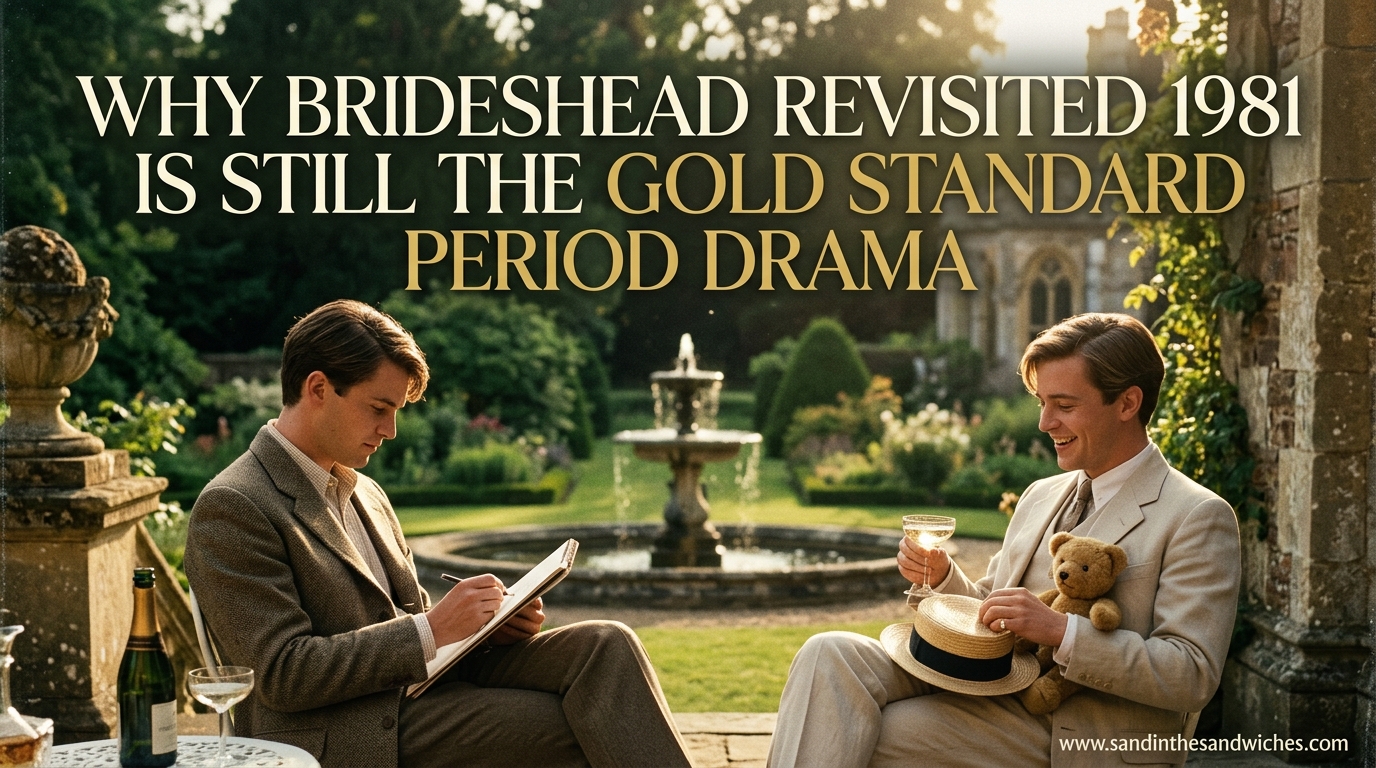
I have watched Brideshead Revisited three times in my life, and each viewing has rewarded me differently. The first time, I was a teenager drawn in by the golden interiors and the languid Oxford afternoons. The second time, as a university student, I noticed the theological machinery clicking beneath every scene. The third time, in my thirties, I wept at the final act of grace.
When people ask me why Brideshead Revisited 1981 still commands reverence more than four decades after it first aired, I struggle to give a single answer. It is not just one thing. It is the production values, the fidelity to Evelyn Waugh’s novel, the central performances, and the strange way the series takes its time. It is the music, the locations, the unresolved love stories. The 11-part Granada television serial remains, in my view, the gold standard period drama against which every literary adaptation since has been measured.
This article is my attempt to explain that judgment. I will walk through the production history, the casting choices that defined careers, the adaptation decisions that honored Waugh’s source material, the visual grandeur that gave the series its iconic look, and the themes that continue to resonate. I will also offer a comparison with the 2008 film, an episode-by-episode viewing guide, and answers to the questions I am asked most often.
If you have never seen the 1981 series, I hope this piece convinces you to give it the eleven hours it deserves. If you have, I hope it gives you fresh reasons to revisit Brideshead once more.
Table of Contents
How Brideshead Revisited 1981 Redefined British Period Drama
The story of how Brideshead Revisited 1981 came to television is itself a piece of British broadcasting history. Granada Television, the ITV franchise for the north of England, had spent the late 1970s building a reputation for ambitious literary adaptations. Producer Derek Granger, who had joined Granada in the 1960s and had shepherded projects like Country Matters, believed the time had come to tackle Evelyn Waugh’s 1945 novel.
Granger’s gamble was considerable. The book was famous, beloved, and notoriously difficult to film. Previous attempts had stalled. Granada committed to an 11-part serial, an unusual format at a time when most British drama was single 50-minute episodes. The total runtime stretched to 659 minutes, a sumptuous length that gave the writers and directors room to breathe.
Charles Sturridge, then in his late twenties, directed most of the serial, with Michael Lindsay-Hogg taking over for the final episodes. Sturridge later said he wanted the production to feel like “reading a great novel in one sitting.” That ambition shows in every frame.
The serial aired on ITV in late 1981 and immediately became a cultural event. Bars and restaurants reported empty seats on Sunday evenings. Newspapers ran features about the aristocratic decline it portrayed. The Guardian called it “a landmark in the history of British television drama.” Within months, Granada had renewed interest in the Waugh estate and launched a wave of heritage drama that continues today.
The series demonstrated that British television could compete with cinema on production values. It proved that slow, character-driven storytelling still had an audience. It showed that literary adaptations could be both faithful and commercially successful. These lessons shaped everything from Middlemarch in 1994 to Downton Abbey in 2010.
The Cast: Jeremy Irons and Anthony Andrews Define a Generation
No discussion of Brideshead Revisited 1981 can ignore its central performances. Jeremy Irons played Charles Ryder, the narrator and our guide through the story. Anthony Andrews played Lord Sebastian Flyte, the golden boy whose charm masks a deepening despair. Together, they created one of the most celebrated partnerships in British screen history.
Irons had been working in British television and theatre for several years, but Brideshead made him an international star. He brought to Charles a quality of restraint, a man observing his own life with something between curiosity and detachment. The voiceover narration that runs through the serial sits beautifully in his voice, dry and elegiac by turns. Irons won a BAFTA for the role, and he has said it remains among the most important work of his career.
Andrews, by contrast, was already a familiar face to British audiences from war dramas and period pieces. His Sebastian is the heart of the early episodes, radiant and vulnerable. Many viewers, myself included, consider Andrews’ performance even more memorable than Irons’. He captures the slow slide from golden youth into alcoholic exile with heartbreaking precision. The scene in the Marrakech hotel where Charles finds Sebastian broken is one of the great small moments of British television.
The supporting cast is equally distinguished. Diana Quick plays Lady Julia Flyte with a composure that hides deep passion. John Gielgud won a BAFTA for his brief but luminous appearance as the dying Lord Marchmain. Claire Bloom is unforgettable as Lady Marchmain, the matriarch whose Catholic faith governs the family. Nickolas Grace gives the doomed Anthony Blanche a camp theatricality that still feels modern.
For many of these actors, Brideshead Revisited 1981 became a calling card that opened doors to international work. The series is, in this sense, a hinge moment in British screen careers. It reminds us that prestige television did not begin with the streaming era. It began here, with writers, producers, and actors willing to take literary material seriously.
Faithful to Waugh: Why the Adaptation Still Reigns
One statistic often repeated about Brideshead Revisited 1981 is that approximately 95 percent of its dialogue comes directly from Evelyn Waugh’s novel. That figure explains a great deal about the series’ enduring quality. The writers did not try to out-Waugh Waugh. They trusted the source.
This fidelity is not the same as literalism. The serial reshuffles scenes, cuts minor characters, and occasionally condenses timelines. What it preserves is the texture of Waugh’s prose, the precise rhythm of his sentences, the way his dialogue reveals character through indirection. The result feels like the novel translated into another medium rather than reimagined.
The voiceover narration plays a crucial role in this fidelity. Charles Ryder, looking back from middle age, tells us his own story. The narration carries Waugh’s reflective voice into the production directly. It also gives the serial a contemplative pace, a sense that we are being shown memories rather than events as they happen.
Faithful literary adaptations were not common in 1981. The tendency in British television was to update settings, modernize dialogue, and soften moral complexity. Granada’s Brideshead did the opposite. It trusted its audience to sit with Waugh’s language and let his themes of sin, grace, and aristocratic decay unfold at their proper pace.
The decision to use Waugh’s own structure, a frame narrative set in the late 1940s with the main story unfolding in flashback, gives the serial an elegiac quality. We know from the first episode that something has been lost. That knowledge colors every golden scene at Oxford, every candlelit dinner at Brideshead. Few adaptations have managed to preserve both the literal events of a novel and its emotional architecture so completely.
Visual Grandeur: Castle Howard and the Filming Locations
The first image most people recall from Brideshead Revisited 1981 is Castle Howard in Yorkshire, the stately home that stands in for the Flyte family seat. Its Palladian facade, fountain court, and chapel interiors became so iconic that the house has since been marketed as “the real Brideshead.” Visitors still arrive asking to see the rooms where Sebastian drank himself into exile.
Castle Howard is more than a backdrop. The production designer, Peter Phillips, used the house to embody the family’s decline. The early scenes show Brideshead in full bloom, gardens trimmed, drawing rooms crowded. The later scenes find the same rooms shuttered, damp creeping into the corners. The architecture tells the story without a word of dialogue.
Oxford was filmed at a mix of colleges and locations. Christ Church and the Bodleian Library appear, alongside several locations in the wider city. The Oxford sequences have a slightly stylized quality, the script’s writing and directing choices lending the university a sunlit melancholy that suits the characters perfectly.
Episode nine, set largely in Venice, was filmed on location in Italy. The canal scenes, the palazzo interiors, and the final, devastating walk through the empty rooms all benefit from the real textures of the city. Waugh had loved Venice, and his prose carries that love into the novel. The television serial translates it into light on stone.
The costume design by Jane Robinson and the cinematography by Kevin Wheeler deserve special mention. Every frame looks like a John Singer Sargent painting brought to life. The 1920s wardrobe is meticulous without being museum-like, and Wheeler’s camera finds the moments of stillness that make period drama sing.
Themes That Endure: Faith, Class, and the Flyte Family
What makes Brideshead Revisited 1981 feel fresh even now is the seriousness with which it handles its themes. This is not background decoration. It is the engine of the entire story.
Faith is the central theme, specifically Roman Catholicism as practiced by the Flyte family. Lady Marchmain’s religion is not decorative. It shapes every decision she makes about her children, her marriage, and the family estate. Charles, the outsider, spends the entire serial circling this faith without ever quite committing to it. The ending, in which Lady Marchmain’s rosary is placed in Charles’s hands by a young man at Brideshead, is the series’ clearest statement that grace can reach even the most reluctant heart.
The homosexuality subtext between Charles and Sebastian is another layer that has aged remarkably well. The 1981 production could not depict the relationship explicitly, but the emotional intensity is unmistakable. Sebastian’s farewell to Charles in Episode Three, his slow descent into alcoholic isolation, and his final appearance in the Marrakech episodes all carry weight that contemporary viewers read with full awareness of what Waugh implied.
Class is the third great theme. The Flytes represent a vanished aristocratic order, their money old, their manners impeccable, their estate a kind of secular monastery. Charles Ryder, the middle-class scholarship boy who marries into the family through friendship rather than birth, is both insider and outsider. The serial asks whether the old order deserved to survive, and it answers with sadness rather than nostalgia.
Friendship is the quiet fourth theme. The relationships between Charles and Sebastian, between Charles and Julia, between Charles and Lord Marchmain, all carry a particular gravity. These are friendships formed in youth, tested by time, and weighed down by family loyalties. Few television dramas have portrayed the way old friendships can sustain and wound us with such clarity.
The 1981 Series vs the 2008 Film: Why the Original Wins
In 2008, Miramax released a feature film of Brideshead Revisited directed by Julian Jarrold. The film was handsome, well-cast, and modestly successful at the box office. Most viewers who had seen both, however, agreed that the 1981 Granada serial remained the definitive version.
The reasons are easy to identify. Waugh’s novel is densely layered, with themes and characters that need room to breathe. A two-hour film simply cannot contain them. The 2008 version compresses the timeline, reduces the supporting cast, and sacrifices the slow accumulation of detail that gives the serial its emotional power.
Ben Whishaw and Matthew Goode played Sebastian and Charles in the film, both giving committed performances. Yet the chemistry between Jeremy Irons and Anthony Andrews in the original has never been replicated. Partly this is the magic of casting. Partly it is the luxury of time. The 1981 Charles and Sebastian feel like friends we have known for years, while the 2008 versions feel like an introduction.
The Venice sequences are particularly telling. In the 1981 serial, the final Venetian act is nearly an hour long, paced like a chamber opera. In the 2008 film, it occupies a fraction of the runtime and rushes toward the ending. The emotional catharsis simply does not arrive.
This is not to dismiss the 2008 film. It is a respectable adaptation that introduces new viewers to the story. But it confirms a truth the 1981 production understood: Brideshead demands time. To compress it is to misunderstand it.
Critical Acclaim: Awards and Lasting Legacy
Brideshead Revisited 1981 was showered with critical recognition. It won the BAFTA for Best Drama Series. Jeremy Irons won the BAFTA for Best Actor. John Gielgud won Best Supporting Actor. Diana Quick was nominated for Best Actress. The serial also won the Golden Globe for Best Miniseries.
Television critics of the period compared it to the great BBC adaptations of the previous decade. The Guardian ranked it among the finest British dramas ever made. Time magazine later placed it on its list of the 100 greatest television shows of all time. The Telegraph has named it the greatest British literary adaptation ever televised.
The legacy of Brideshead Revisited 1981 stretches well beyond awards. It proved that British television could mount productions of cinema-grade ambition. It showed American and international audiences the appeal of British heritage drama, paving the way for later successes like Downton Abbey. It made stars of its lead actors. It cemented Granada’s reputation for prestige programming.
Perhaps most importantly, it introduced generations of viewers to Evelyn Waugh. Book sales of the novel spiked after the broadcast and have never entirely returned to their pre-1981 levels. The serial created a readership that continues to this day.
The cultural footprint is visible everywhere. Designers cite it as inspiration for interiors. Writers reference it in essays and novels. The phrase “the enchanted castle” has entered the British vocabulary as shorthand for a certain kind of stately-home nostalgia. Few television productions of any era have left such deep marks.
A Modern Viewer’s Guide to the 11 Episodes
First-time viewers often ask me how to approach the eleven episodes. My honest advice is to watch them all, in order, across a long weekend if you can. The pacing rewards sustained attention. That said, here is a guide to help you navigate the serial.
Episodes One and Two, “Et in Arcadia Ego,” introduce Charles Ryder at Oxford and his fateful meeting with Sebastian Flyte. These are perhaps the most purely enjoyable episodes, full of golden afternoons and eccentric charm.
Episodes Three and Four develop the Oxford friendship and introduce the Flyte family at Brideshead. Lady Marchmain first appears here, and the Catholic dimension of the story begins to take shape.
Episodes Five through Seven cover Charles’s marriage to Celia, his wartime service, and his reunion with the Flyte family. The pacing slows here, but the emotional groundwork laid in these episodes pays off later.
Episodes Eight and Nine contain the Venice episodes and Sebastian’s disappearance. Episode Nine, with its long Venetian sequences, is widely considered the serial’s masterpiece.
Episodes Ten and Eleven, “Brideshead Revisited” and “Orlando and the Sacred Flame,” bring Lord Marchmain home to die and resolve the central love story with a finale that has moved audiences for decades.
The series is available on DVD and Blu-ray through various retailers. Streaming availability changes, so I recommend checking current platforms before settling in. The Criterion Collection and BFI have both released high-quality editions worth seeking out.
One warning for modern viewers. The 1981 production uses pacing that feels slow by today’s standards. Resist the temptation to watch at double speed. The silences, the lingering shots of Castle Howard, the unhurried conversations, are where the power lives.
FAQs
Why is Brideshead Revisited 1981 considered the gold standard period drama?
The 1981 Granada television serial is widely regarded as the gold standard of British period drama because it combines faithful adaptation of Evelyn Waugh’s novel, exceptional central performances by Jeremy Irons and Anthony Andrews, sumptuous production values, and a runtime that gives the story room to develop. It won BAFTA and Golden Globe awards and remains a benchmark for literary adaptations.
Were Charles and Sebastian lovers in Brideshead Revisited?
Evelyn Waugh’s novel implies a deeply intimate, possibly romantic relationship between Charles Ryder and Sebastian Flyte, though it is never depicted explicitly. The 1981 television serial treats the relationship as a profound emotional and possibly physical bond that society could not name. Modern readers and viewers often interpret it as a gay or queerplatonic love story, though Waugh’s own intentions remain debated by literary scholars.
What is the most famous quote from Brideshead Revisited?
The most quoted line from the 1981 series is Sebastian’s remark that he and Charles are ‘two hearts which beat as one,’ drawn directly from Waugh’s novel. Another frequently cited moment is Lord Marchmain’s whispered prayer in his final hours: ‘Oh God, if I could only have died then.’ The closing image, with Lady Marchmain’s rosary placed in Charles’s hands, is itself one of the most quoted visual sequences in British television history.
Why did Julia and Charles separate at the end of Brideshead Revisited?
Charles and Julia are separated at the end of the novel and serial not because their love has faded but because Julia finally recognizes that being with Charles would mean betraying her mother’s Catholic faith and her family’s memory. The final scenes suggest that divine grace has reached Charles through Julia’s sacrifice, even though the couple cannot stay together. Waugh and the 1981 production both frame this as a tragedy of spiritual rather than romantic failure.
Where can I watch Brideshead Revisited 1981 today?
Brideshead Revisited 1981 has been released on DVD and Blu-ray by multiple distributors, including high-quality editions from the BFI. Streaming availability varies by region and changes over time, so I recommend checking current platforms such as BritBox, the Criterion Channel, or Amazon Prime Video for the most up-to-date options. Many public libraries also stock the DVD box set.
How does the 1981 series compare to the 2008 film?
The 1981 Granada serial is generally considered superior to the 2008 Miramax film. The television version benefits from 11 hours of runtime to develop Waugh’s characters and themes, while the film compresses the story into two hours. Critics and audiences have consistently preferred Jeremy Irons and Anthony Andrews to the 2008 leads, and the serial’s Venetian sequences and final episodes are particularly stronger than their film counterparts. The 2008 film remains a useful introduction but cannot replace the original.
The Verdict: Why This Brideshead Still Matters
Why Brideshead Revisited 1981 is still the gold standard period drama comes down to a simple fact. No subsequent adaptation has matched its combination of source fidelity, performance quality, visual ambition, and thematic seriousness. The series trusted Waugh’s novel, trusted its audience, and trusted that patience would be rewarded.
In an age of streaming binges and ten-episode seasons, the 1981 Brideshead looks almost stately in its unhurried confidence. Eleven episodes, eleven hours, one story told properly. That confidence is what we are still trying to recover in our own prestige dramas. Brideshead Revisited 1981 did it first, and it did it best.
If you have never given it your full attention, set aside a long weekend. Pour something you enjoy drinking. Watch the first two episodes. By the time Charles arrives at Brideshead for the first time, you will understand why this production has held its place at the top of British drama for more than forty years.
The enchanted castle is waiting.