
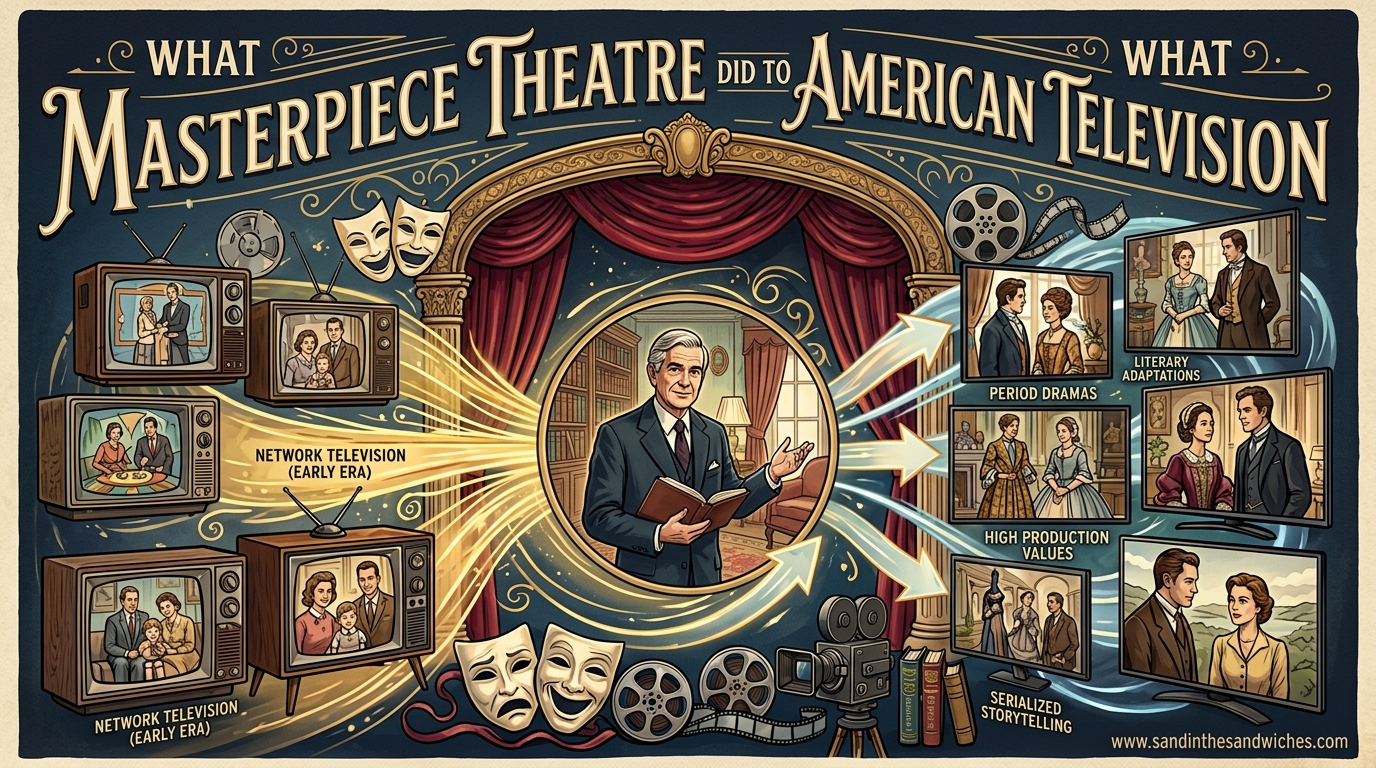
On January 10, 1971, a quiet revolution began on American public television. PBS aired the first episode of Masterpiece Theatre, a British drama anthology produced by WGBH Boston, and nothing about the American viewing landscape would be quite the same afterward.
For more than 50 years, the program now known simply as Masterpiece has introduced American audiences to literary adaptations, twisty mysteries, and original family sagas from across the Atlantic. Understanding what Masterpiece Theatre did to American television means looking at how a single Sunday night program reshaped the way Americans watched, discussed, and valued TV drama.
If you want the short answer up front: Masterpiece Theatre changed American television by pioneering the miniseries format, elevating literary adaptation on screen, proving American audiences would embrace sophisticated foreign drama, launching the prestige TV culture that defined the modern era, and helping create the Anglophilia that still drives streaming subscriptions in 2026.
Those five transformations are the foundation of everything that follows. Before Masterpiece Theatre, American television was largely episodic, advertiser-driven, and skeptical that audiences would sit through a 13-part British drama about Edwardian servants or Roman emperors. After Masterpiece Theatre, that skepticism looked quaint.
This article traces how that shift happened, show by show and decade by decade. We will cover the founding of the program, the miniseries revolution, the landmark productions, the cultural ripple effects, and the streaming-era legacy that keeps Masterpiece relevant in 2026. Whether you are a longtime PBS supporter or simply curious about how a British TV import reshaped American viewing habits, the story of Masterpiece Theatre is the story of how quality found a permanent home on American screens.
The influence is not just historical. Masterpiece Theatre’s DNA is visible in nearly every prestige drama currently streaming on Netflix, HBO Max, Amazon Prime Video, and Apple TV+. The limited series format, the willingness to adapt literary source material, the trust in ensemble casts, and the commitment to production polish all trace back to decisions made at WGBH Boston in the early 1970s.
Reddit users on r/television regularly cite Masterpiece Theatre as their gateway into British drama. Older viewers recall Sunday night viewing as a family ritual. Younger audiences discovered Sherlock and Downton Abbey through streaming, then worked their way backward into the deeper Masterpiece catalog. That generational reach is part of what makes the program’s influence so persistent.
Table of Contents
How Masterpiece Theatre Began: The 1971 Premiere
The story of what Masterpiece Theatre did to American television starts with a different program entirely: The Forsyte Saga. That 1967 BBC adaptation of John Galsworthy’s novels became a national obsession in Britain, with churches even rescheduling services so parishioners would not miss episodes.
American viewers who caught wind of the phenomenon had no legal way to watch. A few public television stations aired the series regionally, and the response was immediate. Stan Calderwood, then general manager of WGBH Boston, saw an opportunity. He believed American audiences were hungry for the kind of long-form, literary drama that commercial networks were not producing.
Calderwood’s vision needed money. He found it through an unusual source: Herb Schmertz, the vice president of public affairs at Mobil Corporation. Schmertz has been called the “Don Draper of Mobil oil” for his aggressive approach to corporate sponsorship, and he saw PBS underwriting as a way to associate Mobil with cultural prestige.
The deal was groundbreaking. Mobil would fund the acquisition of British dramas, and WGBH would package them into a weekly anthology with a distinguished host. The arrangement was so oil-industry-dominated that columnist George Will famously quipped that PBS stood for “Petroleum Broadcasting System.”
For the host, the producers turned to Alistair Cooke. Already known to American audiences as the host of Omnibus and a respected broadcaster, Cooke brought an avuncular authority that gave the program instant credibility. His introductions provided cultural context, explained British customs unfamiliar to American viewers, and made the often-daunting prospect of a costume drama feel approachable.
Cooke’s hosting style was itself a contribution to what Masterpiece Theatre did to American television. He treated viewers as intelligent adults capable of following complex stories. He assumed they could handle unfamiliar historical settings, British accents, and class dynamics without hand-holding. That assumption of intelligence became a quiet trademark of the Masterpiece brand.
The theme music was chosen almost by accident. Producer Christopher Sarson reportedly heard the Fanfare-Rondeau by Jean-Joseph Mouret during a Club Med vacation and realized its baroque grandeur was perfect. That trumpet fanfare became one of the most recognizable sounds in American television, instantly signaling to viewers that something refined and worth their attention was about to begin.
The first show aired on January 10, 1971, was The First Churchills, a 12-part drama about the 17th-century Duke and Duchess of Marlborough. It was not a blockbuster hit, but it found a loyal audience and proved the concept worked. By the time The Six Wives of Henry VIII arrived in 1972 and Upstairs, Downstairs in 1974, Masterpiece Theatre had become appointment viewing for millions of Americans.
Mobil sponsorship continued for nearly three decades, providing the financial stability that let the program take creative risks. That corporate-underwriting model was itself influential, demonstrating that prestige television did not need to rely on commercial advertising or mass-market ratings. It offered a third path between commercial television and pure public funding.
The arrangement also insulated Masterpiece from the ratings pressures that shaped commercial network programming. Because Mobil was paying for prestige and brand association rather than direct viewer response, the program could air challenging material that would never have survived on CBS or NBC. That creative freedom let Masterpiece build a catalog of literate, ambitious drama that no American commercial network would have greenlit.
How Masterpiece Theatre Pioneered the Miniseries Format in America
The most direct answer to what Masterpiece Theatre did to American television is this: it taught American networks how to tell stories across multiple episodes with a fixed ending. That sounds obvious in 2026, when binge-watching is the norm, but in 1971 it was radical.
American television in the early 1970s was built on two formats. Sitcoms and police procedurals aired as self-contained weekly episodes, while soap operas ran indefinitely with no planned conclusion. The idea of a drama designed to last exactly 7 or 13 episodes, with a clear narrative arc that built to a finale, was foreign to the major networks.
British television had been doing this for years. The BBC and ITV produced serials in limited runs, often adapting novels whose chapter structures naturally suggested an episode count. When Masterpiece Theatre brought this format to America, the response was immediate.
Upstairs, Downstairs (1971-1975) was the breakthrough. The saga of the Bellamy family and their servants at 165 Eaton Place ran for 68 episodes across five seasons, but each season had a clear arc. American audiences were captivated by the slow build of character and consequence, the way events in one episode rippled through later ones.
The influence was direct. Dallas, which premiered in 1978, adopted the ensemble saga structure and the class-and-money conflicts that Upstairs, Downstairs had perfected. The American primetime soap, from Dynasty to Knots Landing to Falcon Crest, owes a clear debt to the British import that showed how serialized character drama could hold a mass audience.
Then came Roots in 1977. The ABC miniseries was an American original, but it arrived in a landscape that Masterpiece Theatre had spent six years preparing. Audiences were already trained to commit to a multi-episode drama with a defined endpoint. Without that conditioning, Roots might have seemed like an impossible risk for a commercial network.
The miniseries boom of the late 1970s and 1980s, from Rich Man, Poor Man to Shogun to The Thorn Birds to Centennial, happened in part because Masterpiece Theatre had proven the format worked. American networks saw that audiences would plan their week around the next installment of a long story.
I, Claudius (1976) was another landmark. The 13-part historical drama about the Roman Empire, starring Derek Jacobi, proved that serialized historical drama could succeed with American audiences. It won an Emmy and influenced a generation of American writers who would later create prestige cable dramas.
The serialized format also changed how American television thought about character development. Episodic television of the 1960s had largely reset characters at the end of each installment. Masterpiece Theatre showed that audiences would follow characters through years of slow change, accumulating relationships, traumas, and triumphs in a way that felt closer to the experience of reading a novel.
This is one of the most overlooked answers to what Masterpiece Theatre did to American television. The binge-worthy serialized dramas of 2026, from HBO to Netflix, all descend from a format that Masterpiece Theatre mainstreamed on Sunday nights in the 1970s. The streaming release strategy of dropping entire seasons at once is built on the assumption that audiences want to follow a long story without interruption. Masterpiece trained them to want that.
The Top Masterpiece Shows That Changed American Television
Understanding what Masterpiece Theatre did to American television requires looking at the specific shows that drove the transformation. Each of these productions shifted something in the American viewing landscape.
Upstairs, Downstairs (1971-1975)
The Bellamy household saga was Masterpiece Theatre’s first true phenomenon. It ran for 68 episodes and won seven Emmy Awards, including Outstanding Drama Series in 1974, 1975, and 1977. No British show had ever achieved that level of American recognition.
The show’s influence went beyond ratings. It trained American audiences to follow ensemble casts through years of slowly accumulating story, to care about servants as much as aristocrats, and to accept that a drama might end. The class-conscious storytelling directly shaped American primetime soaps and prestige dramas for decades.
The 2012 revival, also aired on Masterpiece, demonstrated the enduring appeal of the format. A new generation of viewers discovered the Eaton Place world, and the production proved that the Masterpiece formula worked just as well in the streaming era as it had in the 1970s.
The Six Wives of Henry VIII (1972)
This six-part historical drama proved that biographical serials could captivate American audiences. Keith Michell’s performance as Henry VIII earned an Emmy, and the success of the format encouraged Masterpiece to keep investing in historical drama.
The show also demonstrated that American viewers would engage seriously with British history they had not studied in school. The appetite for royal drama that this show awakened is still visible in everything from The Crown to the endless Tudor documentaries on streaming platforms.
I, Claudius (1976)
Perhaps the most critically acclaimed Masterpiece production of the 1970s, I, Claudius won three Emmys and a Peabody Award. Its serialized political intrigue, voiceover narration, and willingness to depict historical brutality influenced a generation of American writers.
The show is often cited as a precursor to the political dramas that would define prestige television decades later. Its DNA is visible in everything from Rome to Game of Thrones, both of which acknowledged their debt to Robert Graves and the BBC production.
The Jewel in the Crown (1984)
This 14-part drama about the final days of British rule in India was a landmark for Masterpiece Theatre. It won a Peabody Award and multiple Emmys, and it proved that the anthology could handle complex postcolonial subject matter without alienating American audiences.
The production demonstrated that Masterpiece was willing to engage with difficult history rather than simply offering escapism. It set a standard for serious historical drama that the program has maintained ever since.
Prime Suspect (1991-2006)
Lynda La Plante’s police procedural, starring Helen Mirren as Detective Chief Inspector Jane Tennison, transformed American crime drama. Tennison was a flawed, complex woman fighting institutional sexism in a way that American television had never attempted.
The show directly influenced American female-led crime dramas, from The Closer to The Killing to Homicide: Life on the Street. The archetype of the brilliant, difficult female detective, now common across streaming services, traces back to Jane Tennison.
Nancy West, a University of Missouri scholar who wrote a book on Masterpiece’s 50-year history, has called Prime Suspect the origin of the female detective archetype in modern television. That is a significant claim about what Masterpiece Theatre did to American television, and it is hard to dispute when you compare Tennison to the female leads of contemporary crime dramas.
Sherlock (2010-2017)
When Masterpiece co-produced Steven Moffat and Mark Gatiss’s modernized Sherlock Holmes, it reached an audience that earlier productions could only dream of. Benedict Cumberbatch became a global star, and the show’s clever visual storytelling appealed to younger viewers who had never previously watched Masterpiece.
Sherlock proved that Masterpiece could update the classics for the internet age. It also demonstrated that American audiences, primed by streaming, were ready for short seasons of densely plotted drama. The four-episode seasons of Sherlock became a model that streaming platforms would adopt.
The show also illustrated how Masterpiece could leverage social media and online fandom. Tumblr, Twitter, and Reddit communities formed around Sherlock, bringing younger viewers to PBS in numbers the network had never seen. That digital engagement strategy became a template for how Masterpiece marketed subsequent productions.
Downton Abbey (2011-2016)
The most influential Masterpiece production of the modern era, Downton Abbey became a genuine cultural phenomenon. Its 2012 Season 2 finale drew 5.4 million American viewers, making it one of the most-watched PBS broadcasts of the era. Michelle Obama was reportedly a superfan who requested advance screeners.
Downton Abbey proved that period drama could be mainstream appointment television in the 2026 streaming landscape. Its success directly influenced The Crown, Bridgerton, and the broader revival of costume drama across Netflix, Amazon, and HBO. Without Masterpiece’s track record with Downton, those shows might never have been greenlit.
The program also spawned two feature films and a continuing franchise, demonstrating that Masterpiece properties could compete with Hollywood blockbusters. The 2019 Downton Abbey film grossed over $194 million worldwide, and the 2022 sequel Downton Abbey: A New Era confirmed the franchise’s ongoing commercial appeal.
Other Notable Productions
Beyond these landmarks, Masterpiece has aired dozens of influential productions. All Creatures Great and Small, both the original 1978 series and the 2020 reboot, established the comforting rural drama template. Wolf Hall (2015) brought Hilary Mantel’s historical novels to screen with critical acclaim. Victoria (2016-2019) extended the royal drama format. Poldark, The Durrells in Corfu, and Grantchester each found loyal American audiences.
The cumulative effect of this catalog is what makes Masterpiece Theatre’s influence so deep. Individual shows matter, but the sustained commitment to quality drama over 50 years is what fundamentally changed American television.
What Masterpiece Theatre Did to American Culture
The television influence was significant, but what Masterpiece Theatre did to American culture went beyond the screen. The program reshaped reading habits, fashion, and the way Americans thought about British identity.
The book sales impact was immediate and measurable. After Masterpiece Theatre aired Andrew Davies’s adaptation of Bleak House in 2006, sales of the Dickens novel increased by an estimated 40 percent in the United States. The same pattern repeated with adaptations of Jane Austen, George Eliot, and Anthony Trollope.
American publishers learned to coordinate book reissues with Masterpiece broadcast schedules. New covers, tie-in editions, and reading guides appeared in bookstores timed to PBS premieres. Masterpiece Theatre became, in effect, a marketing engine for classic British literature in America.
Book clubs across the country built reading schedules around Masterpiece seasons. Libraries reported spikes in checkout rates for source material novels. The program effectively functioned as a national reading recommendation service for classic literature, with measurable effects on American literacy and reading habits.
The fashion influence was equally striking. Downton Abbey prompted Ralph Lauren to launch an Edwardian-inspired collection. Marc Jacobs cited the show as an influence. Naeem Khan dressed Michelle Dockery for red carpet events. The costume drama became a runway inspiration in a way that American television had rarely achieved.
Earlier productions had similar effects. The Jewel in the Crown sparked interest in 1940s Indian-inspired fashion. Brideshead Revisited drove a revival of Oxford-style menswear. Masterpiece consistently influenced American fashion in ways that commercial television did not, partly because costume drama naturally invites aesthetic appreciation.
Anglophilia, the affection for British culture, has always existed in America. But Masterpiece Theatre gave it a weekly focal point. For more than 50 years, Americans could tune in on Sunday nights and immerse themselves in British accents, class distinctions, village life, and manor houses.
That sustained exposure created a market that streaming platforms now exploit heavily. Netflix invests in British productions because Masterpiece Theatre proved the audience was there. Amazon Prime Video acquired British sports and drama programming in part because Americans had been trained to take British culture seriously.
The Sunday night viewing tradition itself became a cultural institution. Families gathered around the television after dinner, often making it an intergenerational ritual. Masterpiece Theatre was one of the few programs that grandparents, parents, and children could watch together without embarrassment on any side.
PBS membership pledge drives capitalized on this loyalty. Stations across the country used Masterpiece Theatre as their primary lure for new donors, offering DVD box sets and tote bags as thank-you gifts. The program became, financially, one of the most important assets in the public broadcasting system.
The cultural ripple effects extended to education. High school and college literature teachers reported students who had discovered Dickens, Austen, and the Brontes through Masterpiece adaptations. The program became an informal supplement to American humanities education, introducing viewers to canonical literature through accessible dramatization.
How Masterpiece Theatre Paved the Way for Prestige Television
The Christian Science Monitor offered one of the sharpest assessments of what Masterpiece Theatre did to American television: “Long before HBO came along, Masterpiece introduced the world to TV excellence. They got there first and planted the flag.”
That claim is worth taking seriously. The HBO revolution that began in the late 1990s with The Sopranos, The Wire, and Six Feet Under is usually described as the start of prestige television. But HBO’s strategy of quality-first programming, limited episode counts, and willingness to trust audiences with complex drama had a clear precedent.
Masterpiece Theatre had been doing all of that since 1971. Limited series runs. Literary source material. Ensemble casts. Willingness to let stories breathe across many hours. Trust that audiences would follow difficult material. These were not innovations of the cable era. They were the founding principles of Masterpiece Theatre.
The difference was scale. Masterpiece operated on a public broadcasting budget with a niche audience. HBO brought the same principles to a mass audience with marketing muscle. But the creative DNA was the same, and several HBO executives and showrunners acknowledged the debt.
David Chase, creator of The Sopranos, has spoken about the influence of British television on his approach to serialized drama. Matthew Weiner of Mad Men similarly drew on the slow-burn character development that Masterpiece had normalized. The lineage from Masterpiece to modern prestige cable is clear, if often overlooked.
The miniseries format that Masterpiece pioneered became central to the streaming era. When Netflix releases a six-episode limited series, it is using a structure that Masterpiece Theatre mainstreamed decades earlier. When Amazon produces a literary adaptation, it is following a template that WGBH and the BBC perfected in the 1970s.
The international content strategy that now defines streaming is perhaps the clearest legacy. Netflix’s investment in The Crown, Bridgerton, and countless British co-productions exists because Masterpiece proved American audiences would embrace British drama. Amazon’s acquisition of British programming traces back to the same proof of concept.
Even the streaming subscription model itself echoes the Masterpiece formula. Viewers pay for access, originally through PBS donations and now through monthly fees, in exchange for quality drama without commercial interruption. The PBS Passport streaming service, which offers Masterpiece content on demand, is a direct ancestor of the modern streaming subscription.
Masterpiece Theatre also legitimized PBS as a destination for must-see television. Before Masterpiece, public broadcasting was valued for educational and children’s programming but not for scripted drama. After Masterpiece, PBS became a network where serious dramatic storytelling lived alongside documentaries and news.
That legitimacy mattered. It shaped how critics wrote about television, how awards shows treated the medium, and how audiences thought about the difference between “watching TV” and “engaging with quality drama.” Much of that distinction traces back to a Sunday night program that aired on public broadcasting for free.
The awards record reinforces the prestige claim. Masterpiece productions have won dozens of Emmy Awards, multiple Peabody Awards, and Golden Globes. Prime Suspect, The Jewel in the Crown, Downton Abbey, and Sherlock each accumulated major American television awards. That consistent recognition built the brand association between Masterpiece and quality that persists in 2026.
The Actors Masterpiece Theatre Launched to Global Fame
One of the most visible answers to what Masterpiece Theatre did to American television is the roster of actors it introduced to American audiences. Dozens of British performers who became Hollywood stars first reached the United States through Masterpiece.
Helen Mirren is the clearest example. Her performance as Jane Tennison in Prime Suspect made her a household name in America a full decade before she won the Academy Award for The Queen. Masterpiece Theatre effectively built the American audience that would later embrace her film career.
Benedict Cumberbatch followed a similar path. Sherlock aired on Masterpiece starting in 2010, and within two years Cumberbatch was starring in Hollywood blockbusters. The Masterpiece platform gave him the American exposure that made his film career possible.
Hugh Laurie appeared in Jeeves and Wooster on Masterpiece Theatre long before American audiences knew him as Dr. House. The comic persona he developed in that British series directly informed the dramatic range that later made him a star on Fox.
Claire Foy won an Emmy for Wolf Hall on Masterpiece before she became Queen Elizabeth in The Crown. The Masterpiece production proved she could carry a serious historical drama, and Netflix took notice.
Maggie Smith and Michelle Dockery reached American audiences through Downton Abbey, and both parlayed that exposure into Hollywood careers. Smith’s Emmy wins for Downton cemented her status as an international treasure, while Dockery moved on to American film and television projects.
Daniel Radcliffe made one of his early screen appearances in David Copperfield on Masterpiece Theatre in 1999, two years before the first Harry Potter film. The casting directors who found him were partly responding to his Masterpiece performance.
Derek Jacobi became known to American audiences through I, Claudius and went on to a long career in American film and television. Brian Cox appeared in Masterpiece productions before his American breakthrough. Jeremy Irons, Gabriel Byrne, and dozens of other performers followed similar trajectories.
The pattern continues in 2026. Masterpiece remains a launching pad for British actors seeking American exposure. For performers, the platform offers prestige, awards attention, and direct access to the Hollywood industry that follows quality drama wherever it appears.
The reverse is also true. American actors increasingly seek out Masterpiece productions for the prestige and creative freedom they offer. The cross-pollination between American and British talent that Masterpiece facilitated has become a defining feature of modern prestige drama.
The 2008 Rebrand: How Masterpiece Adapted for Modern Audiences
In 2008, after 37 years on the air, Masterpiece Theatre underwent a significant transformation. The program dropped “Theatre” from its name and restructured into three distinct strands: Masterpiece Classic, Masterpiece Mystery, and Masterpiece Contemporary.
The rebrand was the work of executive producer Rebecca Eaton, who had led the program since 1985. Eaton recognized that the original format, with its distinguished host introducing each episode, felt dated to younger viewers. The new structure let Masterpiece program different types of content under a unified brand while modernizing its presentation.
Eaton’s tenure was itself a significant chapter in what Masterpiece Theatre did to American television. Under her leadership, the program navigated the end of the Mobil sponsorship, the rise of cable competition, and the transition to digital media. She oversaw landmark productions including Prime Suspect, The Jewel in the Crown, and the early seasons of Downton Abbey.
Masterpiece Classic focused on period drama and literary adaptations, the format that built the program’s reputation. Masterpiece Mystery absorbed the long-running Mystery! anthology, consolidating detective and crime drama under the Masterpiece umbrella. Masterpiece Contemporary handled modern-set drama, appealing to viewers who wanted more current storytelling.
The rebrand also marked the end of the host format. After Alistair Cooke retired in 1992, Russell Baker and then Laura Linney took over introductory duties. By 2008, the program moved away from a single host entirely, letting the productions stand on their own.
Sponsorship changed as well. Mobil’s decades-long support ended in 2004, and the program cycled through corporate underwriters including Viking River Cruises and Raymond James. The Masterpiece Trust, a fundraising initiative supported by individual PBS stations, became increasingly important to sustaining the program’s budget.
The 2008 rebrand was a quiet but significant moment in understanding what Masterpiece Theatre did to American television. It demonstrated that even a beloved institution could reinvent itself for a changing media landscape. The decision to consolidate Mystery! into the Masterpiece brand unified the PBS drama strategy and made the program more navigable for viewers.
Susanne Simpson, who succeeded Eaton as executive producer, has continued the modernization. Under her leadership, Masterpiece has expanded its co-production relationships, leaned into streaming distribution through PBS Passport, and continued to invest in both period drama and contemporary thriller formats.
The willingness to adapt has been central to Masterpiece’s longevity. Programs that refused to evolve, from network anthologies of the 1950s to early cable experiments, largely disappeared. Masterpiece survived because it was willing to change its packaging while preserving its commitment to quality drama.
In 2026, the three-strand structure remains in place, though the boundaries have softened. Masterpiece programs contemporary crime dramas alongside Edwardian sagas, and viewers move freely between them. The brand has become shorthand for quality drama regardless of period or genre.
Masterpiece Theatre’s Legacy in the Streaming Era
The most pressing question about Masterpiece Theatre in 2026 is whether it can survive in a streaming-dominated landscape. The early answer is yes, but the challenges are real.
PBS Passport, the streaming service available to PBS members, has made the entire Masterpiece library accessible on demand. For the first time, viewers can watch classic productions from the 1970s and 1980s without hunting through DVD catalogs or waiting for broadcast reruns.
The streaming service has also solved one of the long-standing frustrations for Masterpiece fans: the difficulty of finding episodes in chronological order. PBS Passport organizes productions by series, season, and air date, making the full archive navigable for the first time.
The bigger challenge is competition. Netflix, Amazon, Apple TV+, and HBO Max all produce high-end British drama and literary adaptations. The Crown, Bridgerton, and The Great all draw on the audience that Masterpiece cultivated. These platforms have budgets that PBS cannot match.
But Masterpiece retains two advantages. First, its brand is established. When viewers want reliable quality drama, the Masterpiece name still means something. Second, its co-production model with the BBC and ITV gives it access to British productions that streaming platforms must license separately.
The Masterpiece Trust, supported by individual PBS stations and donors, provides a funding base that does not depend on advertising or subscription revenue. This stability lets the program take creative risks that commercial platforms might avoid.
The continued success of productions like All Creatures Great and Small, which premiered in 2020 and became one of PBS’s most-watched dramas, suggests that Masterpiece still knows how to find an audience. The 2022 film Downton Abbey: A New Era and the ongoing franchise expansions confirm that Masterpiece properties can compete across media.
The streaming era has also created unexpected opportunities. When Netflix or Amazon produce a British drama that viewers enjoy, those viewers often seek out more in the same vein. Masterpiece, with its deep catalog, is positioned to capture that downstream interest through PBS Passport.
The future of Masterpiece on PBS is not guaranteed, but it is secure for the near term. The program has adapted repeatedly over 50 years, from the Cooke era to the 2008 rebrand to the streaming transition. Each adaptation has reinforced the core mission: bring quality drama to American audiences, regardless of where they choose to watch.
The competition has also validated Masterpiece’s original thesis. When Netflix spends hundreds of millions on The Crown, it is confirming that quality British drama has a massive American audience. Masterpiece knew that in 1971. The streaming platforms figured it out 50 years later.
FAQs
What did Masterpiece Theatre do to American television?
Masterpiece Theatre changed American television by pioneering the miniseries format, elevating literary adaptation on screen, proving American audiences would embrace sophisticated foreign drama, helping launch the prestige TV culture that defined the modern era, and cultivating American Anglophilia that streaming platforms now exploit. The program premiered on PBS on January 10, 1971 and has run continuously for more than 50 years.
Is PBS Masterpiece British or American?
Masterpiece is an American program. It is produced by WGBH Boston for PBS, the American public broadcasting network. However, most of the dramas it airs are British productions, originally made by the BBC, ITV, or other UK broadcasters and then licensed for American broadcast. Masterpiece also co-produces many of its shows with British partners.
What is the best series on PBS Masterpiece of all time?
The most influential Masterpiece productions include Upstairs Downstairs (1971-1975), I Claudius (1976), The Jewel in the Crown (1984), Prime Suspect (1991-2006), Sherlock (2010-2017), and Downton Abbey (2011-2016). Downton Abbey is widely considered the most commercially successful Masterpiece production, while I Claudius and Prime Suspect are often cited as the most critically influential.
What will happen to MASTERPIECE on PBS?
Masterpiece continues to air on PBS in 2026, with new productions and ongoing co-productions with the BBC and ITV. The program is supported by corporate underwriters including Viking and Raymond James, along with the Masterpiece Trust funded by individual PBS stations and donors. PBS Passport, the streaming service for PBS members, offers the full Masterpiece library on demand.
What ended the golden age of television?
The Golden Age of Television, generally dated from the late 1990s through the 2010s, did not end so much as evolve. The rise of streaming platforms in the 2010s fragmented audiences and shifted budgets toward volume production. However, quality drama continues to thrive across HBO, Netflix, Amazon, Apple TV+, and PBS, with Masterpiece remaining a consistent contributor to prestige television.
How did the rise of television affect American culture?
Television transformed American culture by creating shared national experiences, shaping political discourse, and influencing consumer behavior. Masterpiece Theatre specifically affected American culture by boosting sales of British literature, influencing fashion trends through period drama costumes, and sustaining American interest in British culture over more than 50 years of continuous broadcasting.
Why do Americans love British television drama?
Americans love British television drama because Masterpiece Theatre spent 50 years training them to. The program introduced American audiences to ensemble storytelling, literary adaptation, and complex characters long before streaming made international content mainstream. British drama also offers a combination of prestige, escapism, and perceived cultural sophistication that American audiences find appealing.
How did Masterpiece Theatre change television storytelling?
Masterpiece Theatre changed television storytelling by mainstreaming the serialized miniseries format in America. Before Masterpiece, American television relied heavily on self-contained weekly episodes. The British serials that Masterpiece aired, with their multi-episode arcs and planned conclusions, taught American networks that audiences would commit to long-form drama. This format became central to prestige television and streaming in 2026.
Conclusion: The Enduring Legacy of Masterpiece Theatre
So what did Masterpiece Theatre do to American television? It did five things that together reshaped the medium.
It pioneered the miniseries format that became the backbone of modern serialized drama. It elevated literary adaptation from occasional special event to consistent programming category. It proved American audiences would embrace sophisticated foreign drama decades before streaming made that assumption obvious. It helped launch the prestige TV culture that defines the modern era. And it cultivated an American Anglophilia that streaming platforms now monetize at scale.
The program that began on January 10, 1971, with The First Churchills is still on the air in 2026, still producing new drama, and still introducing American audiences to British storytelling. That longevity is itself a testament to the soundness of the original idea.
For viewers who want to explore the Masterpiece library, PBS Passport offers the full archive on demand. For those new to the program, starting with Downton Abbey, Sherlock, or the classic Upstairs Downstairs will quickly show why this Sunday night tradition has lasted more than 50 years.
Masterpiece Theatre taught American television that quality could find an audience, that stories could take their time, and that viewers would follow serious drama wherever it aired. Those lessons are now common sense in 2026. They were radical in 1971. That transformation is what Masterpiece Theatre did to American television.
The program’s influence will continue to be felt as long as audiences seek out quality drama. The streaming platforms that now dominate the landscape are building on foundations that Masterpiece laid. The miniseries format, the literary adaptation, the ensemble period drama, the trust in audience intelligence, all of these are Masterpiece legacies that will outlast any single production.