
The first time I bit into a 99 Flake, the chocolate shard snapped clean and fell into the soft serve below. I was seven, my hands were sticky, and a Blackpool seagull was eyeing me with real menace. That single bite — cold vanilla, brittle Cadbury Flake, gritty wafer cone — is the smell of every British summer I have ever known.
The 99 Flake is more than an ice cream. It is a small edible ritual that ties together seaside holidays, Italian immigration, and a uniquely British sense of mischief. In this guide I will walk you through what a 99 actually is, where the strange name came from, and why this soft serve cone still means so much to the British seaside in 2026.
Table of Contents
What is a 99 Flake ice cream?
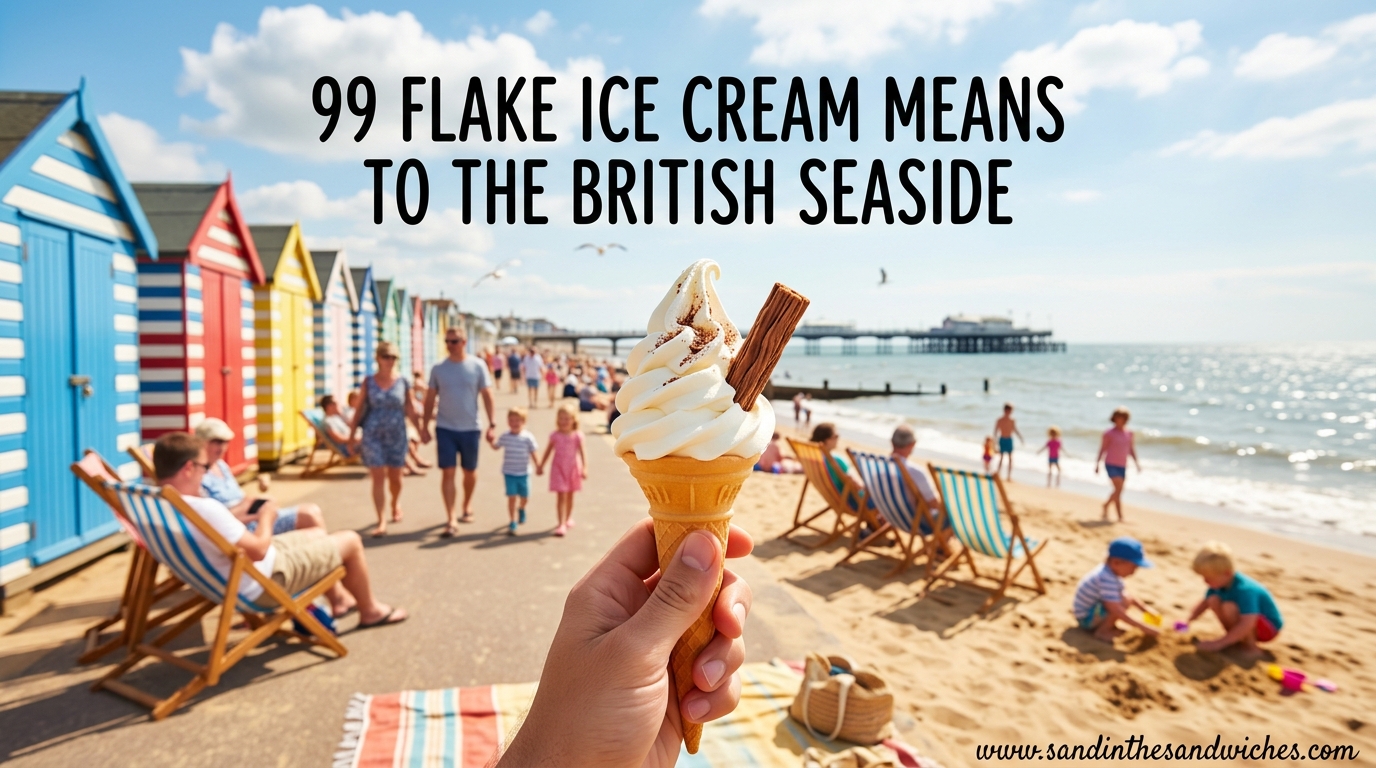
A 99 Flake is a soft serve vanilla ice cream served in a wafer cone with a half-length Cadbury Flake chocolate bar pushed into the top. That is the entire recipe, and that is exactly the point. A 99 is defined by its parts, not by anything fancy added on.
The soft serve — the frothy, pale yellow swirl sold by Mr Whippy vans up and down the coast — is usually made from a skim milk and cream mixture. It freezes inside the van’s machine and comes out at the perfect texture to balance a brittle Flake. Without the Flake, it is just a cone. Without the soft serve, the Flake has nothing to lean on.
The Cadbury Flake bar, technically a Cadbury Dairy Milk Flake, is what gives the 99 its name and its personality. It shatters when you bite it, scattering chocolate flakes through the ice cream. The Guardian once described it as giving “depth and body” to what would otherwise be “scummy, foamy ice cream.” Honestly, they were not wrong.
Why do Brits call it a 99? The leading theories
No one knows for certain where the name “99” came from, which is exactly why the debate has lasted more than a century. There are four serious theories, and I have heard all of them argued loudly in seaside queues.
The Italian guard of 99 soldiers
My favourite theory comes from Italy. The most popular origin story claims that the 99 was named after the elite guard of the Italian King, supposedly made up of 99 soldiers. When the King wanted a special treat, his personal gelato maker created something for those 99 men — and the name stuck when Italian ice cream sellers brought the idea to Britain.
It is a romantic story, and BBC’s Balderdash and Piffle once treated it as the leading explanation. I love it because it ties the British seaside to a small piece of Italian royal history most of us have forgotten.
The Portobello Edinburgh ice cream shop
Another strong contender places the 99 firmly on British soil. According to the Arcari family, who ran an ice cream shop on Portobello High Street in Edinburgh, the 99 was created there in the 1920s or 1930s. Stefano Arcari and his relatives claim the name came from the shop’s address, 99 Portobello High Street, where the Flake-topped cone was first sold.
It is a tidy story. The Scots-Italian ice cream community was enormous in that era, and Portobello’s beach and promenade were packed every summer. If the 99 was born anywhere in Britain, Portobello is a very plausible birthplace.
Roman numerals and the size of the Flake
A third theory focuses on the chocolate itself. The original Cadbury Flake bars sold in ice cream cones were shorter than the standard Flake sold in shops. Roman numerals for 99 are XCIX, and some researchers have suggested the 99 referred to the 99th size of a Flake bar in production — basically, the small one designed for ice cream cones.
Reddit threads on r/AskUK often settle on a version of this theory. Users there frequently conclude that the 99 refers to the size of the Flake rather than its price. The community consensus is real, even if the historical evidence is not.
The 99p price theory is a myth
Let me be direct: the 99 was not named because it cost 99 pence. It was sold and named long before decimalisation, and for most of its history a 99 cost only a few pence. Some sweet shops did sell 99 Flakes for 99p during the 1990s and 2000s, which is probably how the myth took hold. The price was a coincidence, not the origin.
The Italian immigrant connection to the 99
Whatever the name’s origin, the 99 itself is an Italian-British invention. Between the 1880s and 1950s, Italian immigrants — particularly from the north of Italy and Sicily — opened thousands of ice cream parlours, cafes, and vans across the UK and Ireland. They brought gelato techniques, espresso culture, and a willingness to work the long British summer season at the seaside.
The Scots-Italian community in Edinburgh was central to the soft serve revolution. Families like the Arcari, the Crollas, and the Valvonas ran ice cream businesses from the early 20th century, and many claimed to have invented or popularised the Flake-in-cone combo. The 99 became a quiet emblem of that immigrant success story.
When you buy a 99 from a van on Brighton seafront, Blackpool promenade, or Portobello beach, you are usually buying from a family business with Italian roots. I find that fact quietly moving. The 99 is one of the most British things you can eat, and it was made possible by people who came from somewhere else and made it theirs.
The Cadbury Flake chocolate role in a 99
A 99 without a Flake is not a 99. It is just a cone. The Flake bar — crumbly, melt-resistant, slightly snap-prone — is the structural and flavour heart of the whole experience. Cadbury has produced the Flake since 1920, and the ice cream version has been part of British seaside life for almost as long.
Today the Flake is owned by Mondelez, and production takes place in places like Coolock in Dublin and Cairo in Egypt. Most of us never think about the supply chain while we are licking one on a windy beach in Scarborough. That changes the moment the Flake disappears.
The 2021 Flake shortage
In 2021, Cadbury warned of a Flake shortage that hit ice cream vans hard. For a few months, some seaside sellers could not get hold of the proper bars and had to substitute other chocolate, or stop selling 99s altogether. The panic on social media was immediate. People realised, suddenly, that the 99 was not guaranteed.
It was a small supply chain crisis with a big emotional footprint. Brits do not just want a 99. They want the Flake in the 99. Anything else feels wrong.
The 99 and British seaside culture
Here is the part that no Wikipedia article quite captures. A 99 is not really about the food. It is about the moment.
The sensory ritual of a seaside 99
You have probably had one. You queue at a hatch in the side of a Mr Whippy van, listening to the soft whirr of the machine inside. The vendor twists the cone with a practised flick and slides the Flake in at a jaunty angle. You take it, and for about four minutes everything is right with the world.
The first bite is structural. The Flake snaps. Chocolate shrapnel sinks into the soft serve. The cone is gritty under your fingers. You learn, very quickly, to eat around the Flake’s tip first so it does not snap off and fall down a family member’s back. There is a whole etiquette to a 99, and most of us absorb it as children without ever being taught.
Childhood memories and generational identity
I asked a few of my friends what the 99 means to them, and the answers came back fast. Whitby. Skegness. Southend. Minehead. Almost every British adult has a seaside town stitched into their memory along with the taste of a Flake-topped cone.
That is the cultural trick of the 99. It is portable. A family on a coach holiday in 1974 and a couple on a day trip in 2026 are having the same experience. The 99 lets you carry a piece of childhood with you, even as the seaside towns around you change.
Regional traditions and seaside town differences
Not every 99 is the same. In some towns, the Flake is buried deep into the swirl. In others, it is balanced on top like a small chocolate flag. Some sellers add raspberry ripple, chocolate sauce, or even a Flake 99 with a Cadbury Flake 99 — the famous “double 99.”
Blackpool, Brighton, Scarborough, Whitby, and Weymouth all have their own 99 habits. I have a soft spot for the Margate style, where the Flake is broken into pieces and stirred into the top of the cone. Try a few on a coastal road trip and you will taste the regional difference for yourself.
The modern 99: prices, preservation, and the future
The 99 has a problem in 2026, and it is the price. Forum threads and news reports put the average cost of a seaside 99 between £4 and £5, with some London spots charging even more. That is a lot for a cone of soft serve and a Flake.
Reddit is full of complaints about the cost, and I understand the frustration. But I also know that traditional ice cream vans are vanishing. Operating costs are up, dairy is expensive, and many coastal sellers have given up altogether. Each surviving van is doing something quietly heroic.
The good news? The 99 is fighting back. Independent seaside shops, family-run vans, and a few determined coastal traders still sell them for under £3, and there are reports — including one I trust from a Reddit user — of a small shop that still sells 99s for 99p. Hold on to those places. They are part of the cultural inheritance.
Frequently asked questions
Why do Brits call ice cream a 99?
The name is debated, but the leading theories are an Italian royal guard of 99 soldiers, the Arcari family shop at 99 Portobello High Street in Edinburgh, a 99th-size Flake bar, or simply a number that stuck. The 99p price theory is a modern myth — the name long predates decimalisation.
What is a 99 ice cream in England?
A 99 is a soft serve vanilla ice cream in a wafer cone with a Cadbury Flake chocolate bar pushed into the top. It is sold by ice cream vans and seaside shops across the UK and Ireland.
What is a Flake ice cream in British slang?
In British slang, a Flake ice cream usually means the same thing as a 99 — a soft serve cone with a Cadbury Flake bar in it. The terms are used interchangeably, though “99” is more common at the seaside.
Why is a 99 Flake never actually 99p?
The 99 was named long before it cost 99p. It was sold for a few pence through most of the 20th century. Some shops briefly sold 99s for 99p in the 1990s and 2000s, which is probably how the price myth took hold, but the name is older than the price.
The cultural meaning of the 99 Flake on the British seaside
So what does a 99 Flake ice cream mean to the British seaside? It means a great deal more than a vanilla cone with a chocolate bar.
It is the taste of a generation that grew up with the chimes of the Mr Whippy van. It is the patient work of Italian immigrant families who turned a small chocolate into a national ritual. It is a name nobody can quite explain, which only makes it more loved. The 99 is portable, affordable nostalgia in a wafer cone, and it is one of the best things about a British summer.
If you are planning a coastal trip this year, find a proper seaside seller, queue up, and order a 99. Eat the Flake end first to stop it snapping off. Watch the seagulls. Lick your fingers when nobody is looking. That is what a 99 Flake means to the British seaside in 2026, and it has meant that for almost a hundred years.