
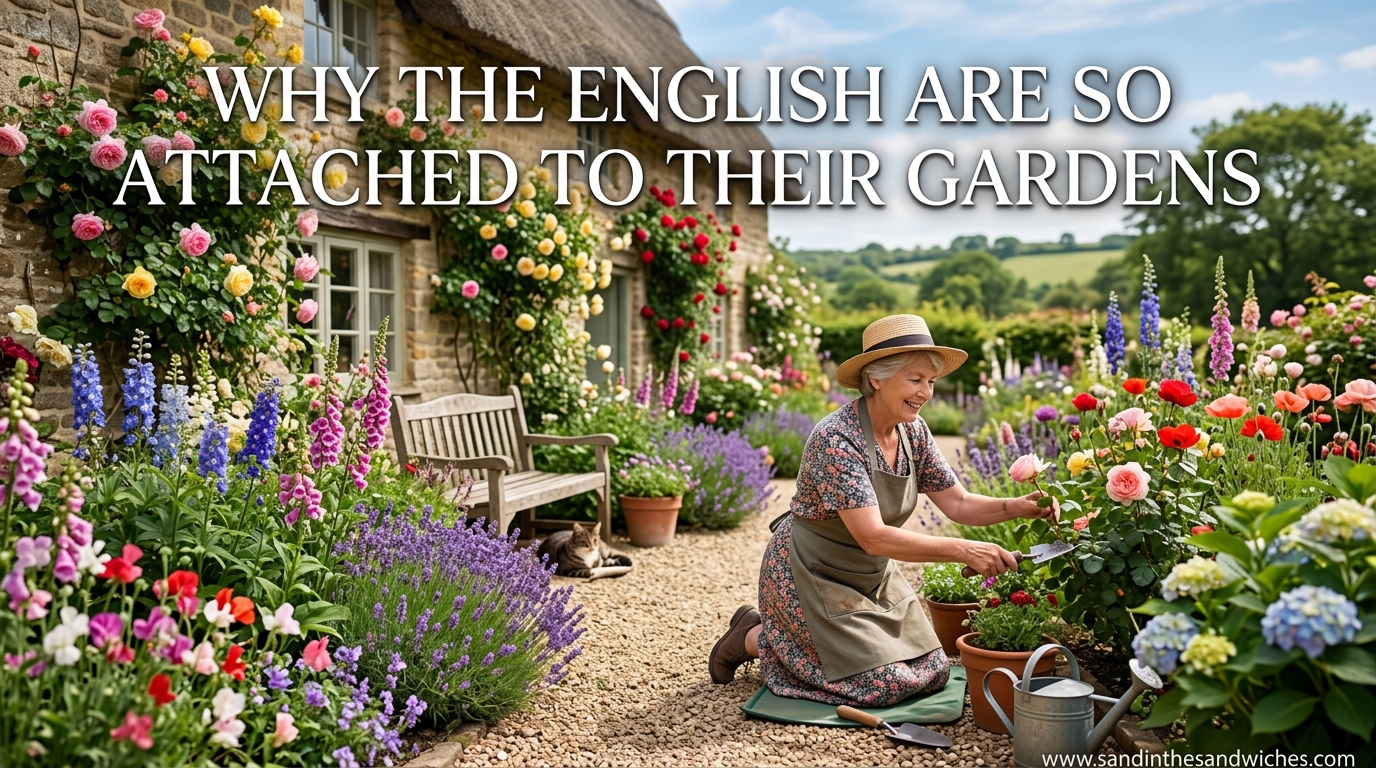
Around 27 million of us in the UK describe ourselves as active gardeners. That is roughly four in every ten adults, all tending flower beds, vegetable patches, hanging baskets, or window boxes. The number alone explains part of the answer to why the English are so attached to their gardens: this is not a niche hobby but a quiet national habit woven into ordinary life.
I grew up in a small terraced street in the Midlands where every house had a square of lawn out the back and a row of geraniums out the front. Neighbours compared seedling success across the fence. My grandparents rented an allotment for forty years. None of them called it a “lifestyle choice.” It was simply what you did, like putting the kettle on. This article is my attempt to explain that instinct to anyone who finds it puzzling, and to lay out the history, climate, culture, and psychology that have made the British garden one of the country’s most quietly powerful institutions.
Table of Contents
Why the English Are So Attached to Their Gardens: The Short Answer
The English attachment to gardens comes from a rare combination of climate, history, and culture. England’s mild, wet, temperate weather grows plants with almost absurd generosity. Centuries of empire brought back botanical treasures that became everyday garden staples. Land ownership has long carried a particular emotional weight, even when the land amounts to a few square metres behind a terrace. And in a crowded, urban nation, a private patch of green is a small but real sanctuary.
When you stack all of that together, gardening stops looking like a hobby and starts looking like a national reflex. Roughly 87% of UK homes have access to a garden, according to the Horticultural Trades Association, and the average household spends hundreds of pounds a year keeping theirs presentable. The garden is part of the home, part of the identity, and for many, part of the inheritance.
A Climate Made for Growing Things
Ask any seasoned gardener and they will tell you that climate is the first reason why the English are so attached to their gardens. England’s weather is, almost by accident, ideal for plants that fail in harsher places.
The UK sits in a temperate zone warmed by the Gulf Stream. Winters are mild enough that many evergreens survive without fuss. Summers are cool enough that plants do not scorch the way they do in southern Europe or the American South. Rain falls fairly reliably through the year, and the air carries enough moisture to keep leaves hydrated even in dry spells. The growing season is long, often eight months or more in the south, and the light, while never dramatic, is soft and consistent.
What this means in practice is that almost everything grows. Roses climb over fences without complaint. Hydrangeas turn blue in acidic Cornish soil and pink in chalky Kent. Foxgloves, delphiniums, lupins, lavender, and fuchsia all thrive. A beginner can stick a shrub in the ground, water it through one dry July, and have a respectable plant by autumn. That kind of easy success breeds enthusiasm, and enthusiasm becomes attachment over generations.
Compare this with countries where summer heat bakes the soil or winter frosts kill off tender plants. The English gardener is, in climate terms, spoiled. It is no accident that the language of gardening in Britain is unusually rich. We have words like “border,” “bed,” “parterre,” “allotment,” “potager,” and “rockery” used casually. The vocabulary is there because the activity itself is so constant.
How British Gardening Culture Took Root in History
The love of gardens in England did not appear out of nowhere. It has been building for the best part of a thousand years, with a few distinct bursts that shaped what we now think of as English garden style.
Medieval monks kept physic gardens for herbs and medicine. Tudor and Stuart gardens were formal, geometric, and full of topiary, knot gardens, and raised beds. The 18th century brought the landscape revolution, led by designers like Capability Brown, who swept away formal patterns in favour of rolling lawns, lakes, and carefully placed clumps of trees.
Then came the Victorians, and the great explosion of plant hunting. Explorers sponsored by wealthy patrons brought back rhododendrons from the Himalayas, fuchsias from South America, ferns from every damp corner of the empire, and a hundred varieties of lily from China. The Horticultural Society (later the Royal Horticultural Society, or RHS) was founded in 1804 to make sense of this flood. Kew Gardens, established as a national botanical institution, became the country’s living library of plants.
By the late 19th century, the gardening habit had spread well beyond the aristocracy. The railway network brought cheap potted plants to suburban stations. Seed catalogues arrived by post. The cottage garden, a dense, romantic mix of flowers, fruit, herbs, and vegetables, became the visual shorthand for an English home. A working-class family might not own a single acre, but they could still grow roses around the door and runner beans up a cane. That democratisation is the key reason the habit took root at every level of society and never let go.
Dig for Victory and the Wartime Garden Legacy
If one single event hardened the English attachment to gardens into something approaching patriotic duty, it was the Second World War and the Dig for Victory campaign.
In 1939, Britain faced the very real possibility of being blockaded out of its food supply. The government, led by the Ministry of Agriculture, encouraged every household with a scrap of ground to turn it into a vegetable plot. Posters, radio broadcasts, and newspaper editorials made digging the soil a contribution to the war effort. By 1943, an estimated 1.4 million new allotments had been created, and domestic food production had risen by more than a million tonnes a year.
Generations who had never considered growing their own food suddenly learned to dig, compost, and rotate crops. They raised children in households where the back garden was not decoration but a small farm. When the war ended, those habits did not disappear. The 1950s saw the rise of the lawn-and-flowerbed suburban garden, but allotments remained popular, and the idea that a British home ought to produce at least some of its own food never quite faded.
You can still see this legacy today. The waiting list for an allotment in many British cities runs into years. Seed companies report that vegetable seed sales reliably spike every time food prices rise or supply feels uncertain. The wartime instinct to grow your own has been passed down as a quiet kind of insurance policy, and it remains one of the strongest threads in the fabric of English gardening culture.
What Makes the British Garden Look the Way It Does
English garden style is a living argument between two traditions. On one side is the formal garden, the clipped yew hedge, the symmetrical rose bed, the neat gravel path. On the other is the cottage garden, exuberantly informal, plants spilling over one another in cheerful disorder.
Most real English gardens are a negotiation between the two. A short, straight path leads to a curved bed full of lavender, salvia, and geraniums. A clipped box hedge frames a wildflower patch. A stone pot of standard roses sits next to a wigwam of sweet peas. The principle, in gardening writer Robin Lane Fox’s phrase, is “right plant, right place.” Choose plants suited to your soil, your light, and your climate, and let them do the work.
Several features turn up so often they have become shorthand for the English garden. The herbaceous border, a long bed packed with perennials chosen to flower in sequence from May to October, was refined by gardeners like Gertrude Jekyll in the early 20th century. The mixed border adds shrubs and small trees for structure. Structural hedging, often yew, beech, or hornbeam, gives the garden bones through the winter when flowers are sparse.
The cottage garden packs fruit trees, vegetables, herbs, and flowers into one small space. A modern urban garden might echo this with raised beds, a small apple tree, pots of tomatoes, and a tangle of nasturtiums climbing the fence. The look is not accidental. It is the result of generations of trial and error in a climate that forgives almost anything except standing water.
There is also a particular English tolerance for imperfection. A lawn may have daisies and clover in it. A path may host moss. A hedge may be slightly uneven. This is not neglect. It is a sign that the gardener has chosen biodiversity and lived-in charm over the rigid formality you might see in a French parterre or an Italian villa garden. It is one of the most recognisable signs that you are looking at an English garden and not any other kind.
The House and Garden as One Living Space
One habit that often surprises visitors from abroad is the way the English treat the garden as a continuation of the house, rather than a separate piece of land. The boundary is porous, in every sense.
Patio doors open directly onto a paved terrace, which flows into a lawn, which gives way to a flower border. The kitchen garden sits steps from the back door. The conservatory, an English invention in everything but name, lets you sit among the plants in winter. Outdoor dining, the Sunday roast carried out on a tray, the evening drink at a weather-protected table, is treated as a normal part of domestic life from late April to early October.
This inside-outside living is partly forced by the climate. English summers are mild enough to eat outside without sweating, and the long twilights make evening use of the garden feel natural. But it is also cultural. Americans often treat the back garden as a place for children and dogs, with a small deck attached. In England, the garden is more often a sitting room without a roof.
This fusion has practical consequences. Buyers inspect the garden as carefully as the kitchen. Estate agents quote a property’s “outside space” in square metres. A house without a garden, in much of England, is a house that is harder to sell, and the same cannot be said of every country. The garden is, quite literally, part of the asset.
Why Gardening Feels So Good: The Psychology Behind It
It is easy to talk about history and climate, but the deeper answer to why the English are so attached to their gardens is psychological. Gardens do something for the mind that almost nothing else in modern life does.
Working with soil and plants delivers small, visible rewards on a human timescale. You plant a seed, you water it, and within a few weeks something has changed. In a country where most people spend their working hours in offices, shops, and schools, and most of their evenings in front of screens, the garden offers a return to slow, tangible cause and effect.
There is also the question of privacy. England is one of the most densely populated countries in Europe. A private square of green, fenced off from neighbours, is a small but real sanctuary. During the COVID-19 lockdowns, this mattered more than it had in living memory. Garden centre sales surged, seed companies sold out within days, and waiting lists for allotments doubled. Surveys afterwards reported sharp increases in reported wellbeing among people who spent more time gardening, and sharp drops in anxiety and depression.
There is a sense of ownership that runs deeper than a legal title deed. The garden is a place you have shaped. You chose the rose. You planted the apple tree. You trained the clematis up the wall. The garden reflects you back to yourself in a way that rented accommodation, employer branding, and mass-market retail do not. For an island nation that has spent centuries valuing private property above almost anything else, this is not a small thing.
And there is one more layer that is harder to put into words. A garden connects you to a longer story. The shrub your grandmother planted is still flowering. The apple tree your father pruned still bears fruit. You will probably never finish the garden, and that is part of its meaning. You are tending something that will outlast you, in a country that has been doing exactly that for a very long time.
Modern Britain: A Nation Still in Love with Its Gardens
Despite shrinking garden sizes, paved-over front yards, and a young generation facing a housing market that is tougher than any in living memory, the English love affair with gardens shows no sign of ending.
The numbers are striking. The garden retail market in the UK is worth several billion pounds a year. The RHS Chelsea Flower Show, founded in 1913, still draws enormous television audiences and turns the high street into a week of floral fever every May. The BBC’s Gardeners’ World, fronted for years by Monty Don, regularly pulls in two to three million viewers on a Friday evening in summer. These are not niche figures. They are mainstream, family-audience figures.
The demographic spread is wide. Garden centres now report strong sales among customers in their twenties and thirties, many of them growing food in containers on balconies. The social media age has brought a new layer of enthusiasm, with garden designers on Instagram, allotment bloggers on YouTube, and a thriving online conversation about everything from compost tea to pollinator-friendly planting. The English garden is being reinvented, again, by people who never knew a world without it.
Even climate change, which is making English summers hotter and drier, has not dimmed the enthusiasm. Gardeners adapt. They install water butts, choose drought-tolerant Mediterranean plants, and swap lawns for gravel and wildflower. The instinct to grow things has survived worse than a few dry summers.
And so the answer to why the English are so attached to their gardens turns out to be made of many small things. A climate that grows almost anything. A history of plant hunters and cottage plots and wartime digging. A culture that treats the garden as a sitting room without a roof. A private sanctuary in a crowded country. A psychological reward that is hard to find elsewhere. None of these on their own would be enough. Together, they form a habit so deeply embedded that it is part of what it means to be English.
Frequently Asked Questions
Why do the English love gardening?
The English love gardening because their mild, wet, temperate climate grows plants with unusual generosity, and centuries of history have made tending a private green space a normal part of domestic life. Around 27 million UK adults are active gardeners, and 87% of homes have access to a garden, reflecting a habit that crosses class, region, and generation.
What is the English garden theory?
The English garden theory blends two traditions. One is the formal style, with clipped hedging, symmetrical beds, and clear geometry refined by designers like Capability Brown. The other is the informal cottage garden, with dense, romantic planting of flowers, fruit, herbs, and vegetables together. Most modern English gardens combine both, prioritising the principle of right plant, right place.
What country has the prettiest gardens?
England, Japan, and the Netherlands are often cited as having the world’s most distinctive garden traditions. Japan is known for restrained, symbolic landscapes. The Netherlands excels in spring bulb displays and formal design. England stands out for its cottage gardens, herbaceous borders, and the way ordinary householders have turned small private plots into a national art form.
Is gardening only for wealthy people in England?
No. The English attachment to gardens crosses class. The cottage garden tradition, the Dig for Victory campaign of the Second World War, and the post-war allotment movement all mean that working-class families have gardened as actively as the aristocracy for at least a century. Today, rented allotments, community gardens, and container gardening on small balconies keep the habit alive across income levels.
The Garden as Quiet National Character
The question of why the English are so attached to their gardens does not really have a single answer. It is climate, history, class, privacy, psychology, and a touch of stubbornness, all mixed together over centuries. What is clear is that the garden is not a luxury or an optional extra. It is part of the architecture of an English life, kept alive by millions of people who do not think of themselves as garden enthusiasts, only as people with a garden.
If you have one, even a small one, the most useful thing I can say is this: plant something this year and watch what happens. By autumn, you will understand a little more about why we cannot quite let go of them.