
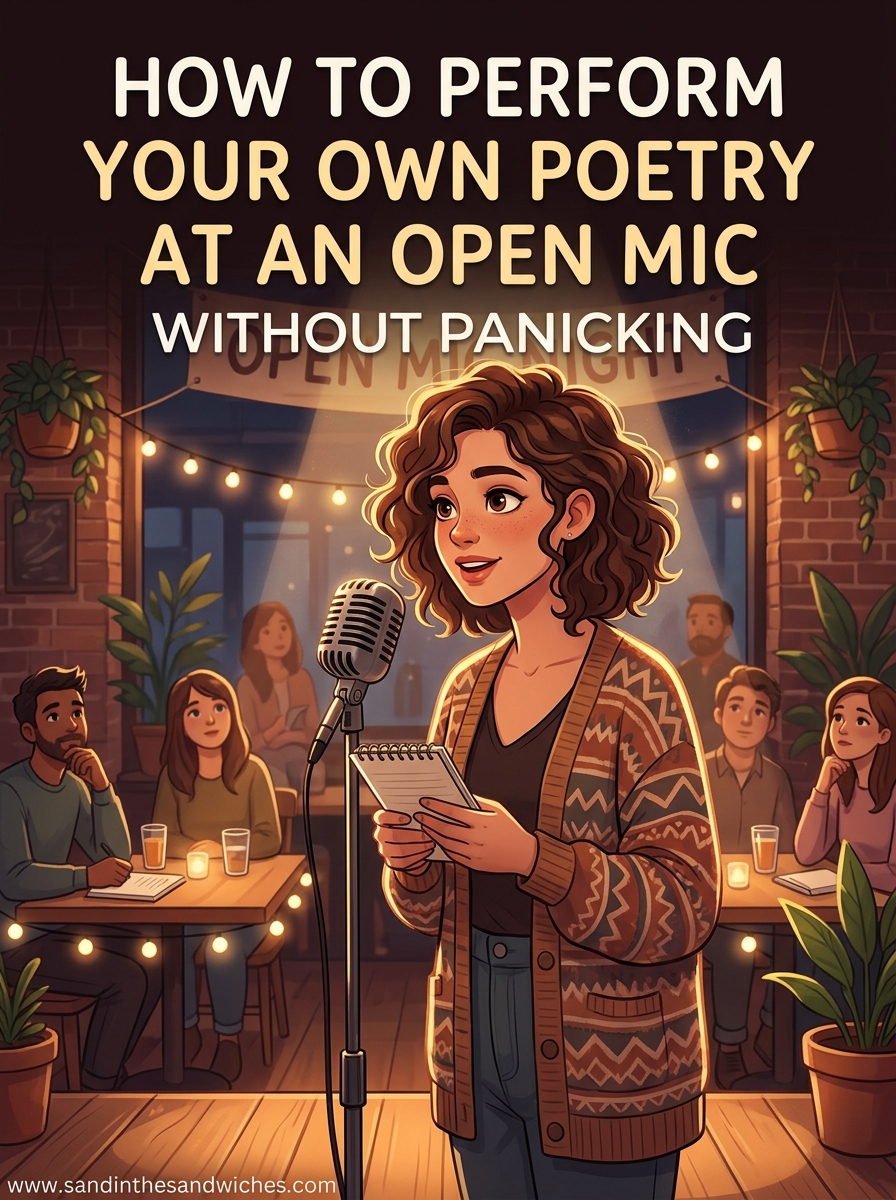
My hands shook so badly the paper rattled. I had written the poem six months earlier, edited it twenty times, and practiced it in my bathroom mirror until my neighbors probably thought I was arguing with myself. But standing in front of that microphone at my first open mic, I forgot how breathing worked.
I got through it. Barely. And you will too.
If you are looking for real, tested poetry open mic tips that go beyond “just be yourself,” this guide is for you. I have performed at open mics where the mic cut out mid-line, where I forgot an entire stanza, and where the audience was three people deep and half asleep. Every single time, I learned something I wish someone had told me beforehand.
Here is everything I know about how to perform your own poetry at an open mic without panicking, broken down into practical steps you can use tonight.
Table of Contents
How Does Open Mic Poetry Actually Work?
An open mic poetry night is a public event where poets sign up to read their original work to an audience. Most venues give each performer 3 to 5 minutes at the microphone. Some have a featured performer who gets a longer set, usually 15 to 20 minutes.
Here is the typical flow: you arrive, find the sign-up sheet, write your name down, and wait for your turn. Some venues use a lottery system. Others are first-come, first-served. A few let you pick your slot number, which is helpful if you want time to settle in before going up.
Most open mics are free or have a small cover charge. Some serve food and drinks. The vibe ranges from coffeehouse casual to competitive slam. If you are nervous, look for events that describe themselves as “community” or “welcoming” rather than “slam” or “competition.”
Signs an Open Mic Is Beginner-Friendly
Not all open mics are created equal. Here is how to tell if a venue will welcome first-timers:
The event description uses words like “all levels,” “beginner-friendly,” or “first-timers welcome.” There is a host who introduces each performer and makes the room feel warm. Regulars clap enthusiastically for newcomers, not just their friends. The venue offers a sound check or lets you test the mic before starting.
If the event page mentions “scored” or “judged,” that is a poetry slam. Those can be fun to watch, but they are not the best place to perform for the first time unless you thrive on competition.
Choosing the Right Poem for Your First Performance
Pick a poem you know cold. Not one you wrote last Tuesday and barely remember. One you have read aloud at least ten times, one that feels like putting on a comfortable jacket.
Shorter is almost always better for your first time. Aim for under two minutes when read at a slow, deliberate pace. That gives you enough time to make an impression without dragging out the anxiety.
Should You Memorize or Read From the Page?
This is one of the most common questions on poetry forums, and the honest answer is: read from the page your first time. Memorization adds a layer of pressure that can backfire. Even seasoned performers bring printed copies as a safety net.
That said, you want to be familiar enough with the poem that you are not staring at the paper the entire time. Practice looking up at key moments. Eye contact, even brief, helps the audience feel connected to you.
Bring a Backup Poem
Always bring a second poem. You might finish early and have time for another. You might realize your first choice does not fit the room’s energy. Having a backup gives you options, and options reduce panic.
Print your poems in a large, clear font. Double-space the lines. Number the pages. When your hands are shaking and the lights are in your eyes, you want text that is impossible to lose your place in.
How to Prepare for a Poetry Open Mic: Step by Step
Preparation is where confidence is built. The more work you do before the event, the less your brain has to improvise when the pressure hits.
Step 1: Practice Out Loud, Every Single Time
Reading silently is not practice. Thinking through the poem is not practice. You need to say the words out loud, at performance volume, standing up, at least a dozen times before the event.
Your mouth needs to learn the physical shapes of the words. When you practice aloud, you discover which phrases trip you up, where you naturally pause, and which lines hit harder than you expected.
Step 2: Film Yourself Performing
This tip came from a forum post by a poet who said filming was the single most helpful thing they did. I tried it, and I agree completely.
Record yourself on your phone doing the full performance, then watch it without cringing. Note your pacing, your posture, your hand gestures. Are you rushing? Are you swaying? Is your voice dropping at the end of every line? Video does not lie, and it will show you exactly what to fix.
Step 3: Master Your Pacing
The number one mistake new performers make is reading too fast. When adrenaline hits, everything speeds up. What feels like a normal pace to you is probably racing for the audience.
Practice reading your poem 30 percent slower than feels natural. Put deliberate pauses between stanzas. Let the important lines breathe. A three-second silence after a powerful line is not awkward. It is the moment where the poem sinks in.
Step 4: Learn Basic Mic Technique
Forum advice was unanimous on this point: get closer to the mic than you think you need to. About two inches from your mouth is right for most microphones. If you are too far back, the audience hears mumbling. Too close and you get popping on certain consonants.
Do not grab the mic stand and pull it toward you unless the host says it is adjustable. Adjust yourself to the mic, not the other way around. Keep your mouth at a consistent distance throughout the reading.
If there is no microphone, project from your diaphragm, not your throat. Imagine you are speaking to the person farthest from you in the room.
Step 5: Plan What to Bring
Here is your packing list: printed poems (two copies, large font), a bottle of water, a small snack, and a friend if possible. Going with someone you trust cuts anxiety dramatically. They give you a familiar face to look at, and they clap loudest when you finish.
Managing Stage Fright Before You Step Up
Stage fright is not a character flaw. It is your body’s fight-or-flight response activating in a situation it perceives as threatening. The good news is that you can work with your nervous system instead of fighting it.
Breath Control: The Technique Nobody Talks About
No competitor in the top search results covers breath control, and that is a missed opportunity because it works. Here is a simple technique called box breathing that military personnel and public speakers use:
Inhale through your nose for four counts. Hold for four counts. Exhale through your mouth for four counts. Hold empty for four counts. Repeat this cycle four times before your name is called.
Box breathing activates your parasympathetic nervous system, which slows your heart rate and signals to your brain that you are safe. It is not magic, but it is close. I do it every single time before I go on.
Reframe Anxiety as Excitement
Here is a neuroscience trick that actually works. Anxiety and excitement produce nearly identical physical responses: elevated heart rate, sweaty palms, butterflies in your stomach. The only difference is the label your brain assigns to those sensations.
Research from Harvard Business School found that people who said “I am excited” out loud before a stressful performance performed measurably better than those who said “I am calm.” Your brain cannot easily shift from aroused to calm, but it can shift from anxious to excited because both are high-arousal states.
So the next time your stomach is churning before your slot, say it out loud: “I am excited.” It sounds silly. It works anyway.
Physical Grounding Before You Go On
Plant both feet flat on the floor. Feel the weight of your body through your heels. Press your toes into the ground. This grounding technique pulls your attention away from racing thoughts and into your body, where you have control.
Roll your shoulders back and down. Unclench your jaw. Shake out your hands. These small physical resets release tension you probably did not realize you were holding.
The C.H.I.L.L. Framework
The Poetry Lab created a memorable framework for open mic anxiety that is worth knowing: Come prepared, Have an open mind, Illuminate your colorful voice, Look towards the regulars, and Loosen up. I would add a sixth letter for breath, but the acronym would suffer.
The point is simple: preparation plus community plus relaxation equals a performance you can be proud of.
During Your Performance: What to Do at the Mic
You hear your name. You walk up. The host hands you the mic or points to the stand. Now what?
How to Introduce Yourself
Keep it short. Say your name, say the title of your poem, and begin. Do not over-explain. Do not apologize. Do not tell the audience you are nervous (even if you obviously are).
A good introduction sounds like this: “Hi, I’m Jamie, and this poem is called ‘Saltwater.'” That is it. The poem does the talking from there.
If the poem needs context, give one sentence maximum. “I wrote this after my grandmother passed away.” Then start reading. Trust the audience to meet you where you are.
Eye Contact and Presence
You do not need to stare down individual audience members. But you do need to look up from your page periodically. Pick three spots in the room, left, center, and right, and rotate between them.
Looking up at line breaks or between stanzas is a natural rhythm. It makes the audience feel included without requiring sustained eye contact that might throw you off.
What to Do If You Freeze Completely
This is the scenario that keeps every new performer awake at night. You are mid-poem and your mind goes blank. The words vanish. Silence fills the room.
Here is exactly what to do: pause. Take a breath. Look down at your paper. Find your place. Start the line over. That is it.
The audience will not think less of you. In fact, most of them will relate. Everyone has experienced a brain freeze. What matters is how you handle it, and handling it calmly is far more impressive than a flawless performance.
If you truly cannot find your place, smile and say, “Let me start that section again.” Then do it. No apology needed. The audience wants you to succeed. They are on your side.
When Things Go Wrong: Mic Malfunctions and Disruptions
If the microphone cuts out, stop and look at the host. They will fix it or hand you a new one. If someone in the audience is being disruptive, the host or venue staff will handle it. Your job is to wait calmly, not to power through a broken situation.
If you drop your paper, pick it up. If you stumble on a word, repeat the line. If you accidentally skip a stanza, keep going. The audience does not have your poem memorized. They do not know what you skipped.
What Not to Do at an Open Mic
A few things will make your performance harder than it needs to be. Avoid these common mistakes:
Do not go over your time limit. Every performer gets the same courtesy of a time slot. Going long eats into someone else’s turn and signals disrespect for the community.
Do not explain your poem before, during, or after reading it. If the poem needs a paragraph of explanation, it is not ready for the stage yet. Let the words stand on their own.
Do not apologize on stage. Not for being nervous, not for forgetting a line, not for your voice cracking. Apologies make the audience uncomfortable and shift the energy downward.
Do not read from your phone unless the screen stays awake. Nothing kills momentum like watching a performer wake their screen mid-poem. Print on paper.
Do not leave immediately after your set. Stay for at least two more performers. The community aspect of open mics is what makes them special, and leaving right after you finish tells the room you were only there for yourself.
FAQs
What not to do at an open mic?
Do not go over your time limit, over-explain your poem, apologize on stage, or leave immediately after performing. Avoid reading from a phone that might lock mid-poem. Do not grab the mic stand without asking. Most importantly, do not drink heavily before performing, as it impairs your pacing and memory.
How does open mic poetry work?
You arrive at the venue, sign up on a list (usually first-come, first-served), wait for your turn, and read your poem at the microphone when called. Each performer typically gets 3 to 5 minutes. Some events have a featured performer who gets a longer set. The audience listens respectfully and applauds after each reading.
What are the 5 rules of poetry?
While there is no universally agreed-upon set of five rules, common poetic principles include: use concrete imagery instead of abstract statements, read your work aloud to test rhythm, revise relentlessly because first drafts are rarely stage-ready, respect line breaks as intentional choices, and write authentically rather than imitating what you think poetry should sound like.
What are the three R’s of poetry?
The three R’s commonly referenced in poetry are rhythm, rhyme, and repetition. Rhythm is the beat and flow created by stressed and unstressed syllables. Rhyme is the repetition of similar sounds at line endings or within lines. Repetition is the deliberate reuse of words, phrases, or structures for emphasis. Mastering these three elements strengthens both the written poem and the spoken performance.
You Already Have What It Takes
Every single open mic regular was once a shaking first-timer staring at a microphone wondering if they could do this. They could. And so can you.
The poetry open mic tips in this guide are not theory. They are things I learned by doing it wrong first, then figuring out what works. Preparation replaces panic. Breath control replaces spiraling. Reframing anxiety as excitement replaces fighting your own body.
Your first performance does not need to be perfect. It needs to happen. Sign up, bring your poem, breathe through the nerves, and read. Then come back next month and do it again.
That is how performers are made. Not through talent alone, but through repetition, community, and the willingness to stand at a microphone with a trembling voice and speak anyway.
Go sign up. Your poem is waiting for an audience.