
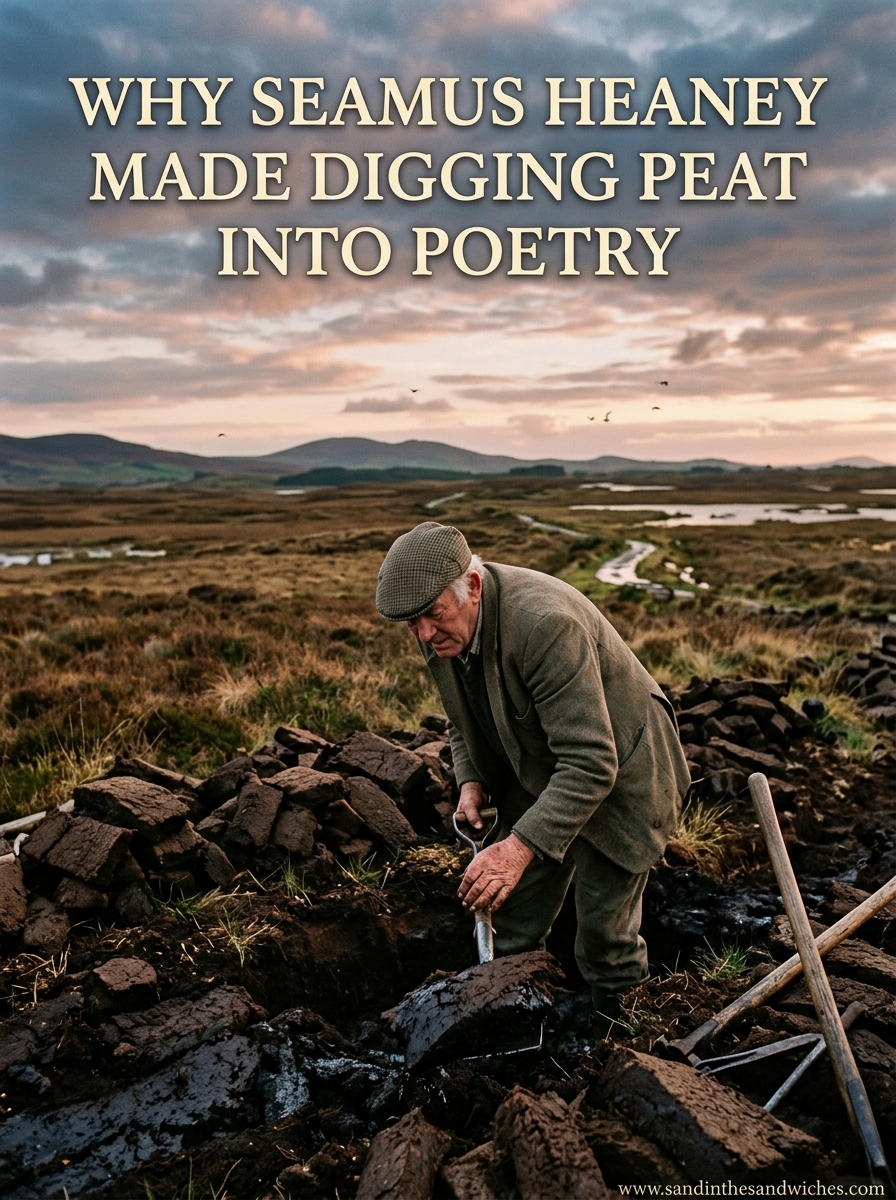
Between my finger and my thumb / The squat pen rests; snug as a gun.
Those two lines opened Seamus Heaney’s first major poem and announced a voice that would reshape English-language poetry for the next half century. But the poem that follows, “Digging,” is not really about a pen at all. It is about peat. It is about the dark, wet earth of County Derry, the squelch of a spade slicing into bogland, and the men who spent their lives working that ground.
“Digging” is an autobiographical poem by Seamus Heaney that juxtaposes the physical labor of his father and grandfather digging peat and potatoes in rural Ireland with his own work as a writer. Published in 1966 in his debut collection Death of a Naturalist, the poem transforms the act of turf-cutting into an extended metaphor for the poet’s craft, arguing that writing can be a form of digging — into memory, into heritage, into the living roots of family and place.
In this article, I want to explore why Seamus Heaney made digging peat into poetry. Not just what the poem means on a surface level, but why this specific material — the soggy, ancient, smoke-scented peat of Irish bogs — became the foundation for one of the most important poems of the twentieth century. We will walk through the poem stanza by stanza, examine its sensory language, place it in its historical context, and address the questions that students and readers ask most often.
Whether you are studying Heaney for the first time or returning to “Digging” after years away, the poem has something to teach about how memory becomes art, and how a poet can honor where he came from without being confined by it.
Table of Contents
Quick Summary: The Poem in Brief
“Digging” was written in 1964 and published in 1966 as the opening poem of Death of a Naturalist, Heaney’s first full-length collection. It describes the poet sitting at his window watching his father dig potato drills in the garden below. This sight triggers a memory of his grandfather cutting turf in Toner’s Bog decades earlier. The poem ends with Heaney resolving to use his pen as a tool for excavation — to dig, not with a spade, but with words.
The poem is written in free verse across eight irregular stanzas. It employs vivid sensory imagery, onomatopoeia, and an extended metaphor that equates the craft of writing with manual agricultural labor. At its core, “Digging” is a young poet’s declaration of artistic independence wrapped inside a love letter to three generations of working men.
Heaney later called the poem “the first place where I felt I had let down a shaft into real life.” That phrase — letting down a shaft — is itself a mining metaphor. Even his description of writing the poem borrows the language of physical labor and excavation.
Who Was Seamus Heaney?
Seamus Justin Heaney was born on April 13, 1939, at Mossbawn, a family farm near Castledawson in County Derry, Northern Ireland. He was the eldest of nine children in a Catholic family. His father, Patrick Heaney, was a farmer and cattle dealer. His mother, Margaret McCann, came from a family connected to the local linen industry. Both parents came from rural working-class backgrounds, and the rhythms of farm life shaped everything Heaney would later write.
As a boy, Heaney was surrounded by the physical reality of agricultural labor. He watched his father plow, plant, and dig. He helped with the annual potato harvest. He walked to Toner’s Bog with his grandfather to bring milk and to watch the older man cut turf. These were not romantic experiences filtered through nostalgia — they were the daily texture of existence for a farming family in mid-century Ulster.
Heaney won a scholarship to St. Columb’s College in Derry at age twelve, a path that separated him from his farming roots and set him on the road toward academia. He studied English at Queen’s University Belfast, where he began writing poetry seriously in the early 1960s. His early work appeared in literary magazines under the pen name “Incertus” — Latin for “uncertain” — a choice that tells you a great deal about the young poet’s confidence in his own voice.
“Digging” was the poem that ended that uncertainty. Heaney described writing it as a breakthrough moment, the first time his lived experience and his literary technique fused into something genuinely his own. The poem was originally going to be called “Digging for Potatoes,” but Heaney realized that the real subject was broader. It was about digging itself — as labor, as metaphor, as inheritance.
Heaney went on to publish more than twenty collections of poetry, translations, and critical essays. He taught at Harvard, Oxford, and Queen’s University Belfast. In 1995, he received the Nobel Prize in Literature for what the committee called “works of lyrical beauty and ethical depth, which exalt everyday miracles and the living past.” He died in Dublin on August 30, 2013, at the age of 74.
But the poem that started it all, the one that “let down a shaft into real life,” remained the work most readers encountered first. It opens Death of a Naturalist, and it has been anthologized in virtually every major collection of contemporary poetry used in schools today. Generations of students in 2026 still meet Heaney through “Digging” before anything else he wrote.
The World He Grew Up In: Bogland, Turf, and Rural Ireland
To understand why Seamus Heaney made digging peat into poetry, you need to understand what peat actually was in the Ireland of his childhood. Peat was not a curiosity or a picturesque detail. It was fuel. It was survival. It was the thing that heated your home and cooked your food when you could not afford coal or oil.
What Is Peat and Why Did It Matter?
Peat is partially decayed vegetation — mostly sphagnum moss — that accumulates in waterlogged bogs over thousands of years. Ireland has roughly 1.2 million hectares of bogland, one of the highest proportions of any country in Europe. For centuries, Irish families cut peat from local bogs, dried it into blocks called turves or sods, and burned it for heat. This dried peat is known as turf.
Before rural electrification reached all of Ireland in the 1950s and 1960s, and before fossil fuels became cheap and widely available, turf-cutting was an essential annual ritual. Every autumn, families would go to the bog with their spades, cut the peat, lay it out to dry over the summer, and stack it in ricks near the house. A family’s turf rick was its winter security. Without it, there would be no fire, no hot food, no warmth.
The smell of burning turf — smoky, earthy, ancient — is one of the most distinctive sensory markers of rural Irish life. Heaney grew up with that smell in his nostrils every winter of his childhood. When he writes about “the squelch and slap / Of soggy peat,” he is not reaching for a poetic image. He is describing a sound he heard hundreds of times, a sound embedded in his muscle memory.
Toner’s Bog and Mossbawn
The farm where Heaney grew up, Mossbawn, sat on the edge of bogland. Toner’s Bog — the specific bog mentioned in “Digging” — was a real place, a working bog where local families came to cut turf each year. Heaney’s grandfather, also named Seamus, was renowned as one of the best turf-cutters in the area. The poem’s description of him — “My grandfather cut more turf in a day / Than any other man on Toner’s bog” — is not exaggeration or literary license. It is family history.
The bog was more than an economic resource. It was a social space. Families gathered there during turf-cutting season. Children played among the cuttings. Neighbors worked side by side, shared food, exchanged news. The bog was where community happened — where boys learned to become men by watching their fathers and grandfathers work the spade.
This is the world Heaney left behind when he won his scholarship and moved into the academic sphere. And this is the world he spent the rest of his career trying to recover, examine, and honor through poetry. “Digging” is the first and most direct expression of that impulse.
The Bog as Memory and Mystery
Bogs in Ireland are also places of preservation. The anaerobic, acidic conditions of peat bogs can preserve organic material for thousands of years. Butter, leather, wooden tools, and even human bodies — the so-called bog bodies — have been found preserved in Irish and Danish bogs, some dating back to the Iron Age.
Heaney was fascinated by this quality of bogs throughout his career. In his later “bog poems” — including “The Tollund Man,” “Bogland,” and “The Grauballe Man” — he explored how bogs preserve the past, sometimes violently, and how Ireland’s landscape itself holds the memory of its history. “Digging” is the seed from which all those later poems grew. The idea that the earth holds things worth excavating — potatoes, turf, memory, identity — starts here.
Why Seamus Heaney Made Digging Peat Into Poetry
This is the central question, and it has several layers. Why peat? Why digging? Why turn agricultural labor into literary art? The answer involves personal biography, poetic ambition, cultural inheritance, and a deliberate act of redefinition.
The Personal Answer: Three Generations of Men
Heaney’s poem is structured around three men: the poet himself, his father Patrick, and his grandfather, also called Seamus. Each man has a tool. The grandfather wields a turf-spade in the bog. The father works a spade in the potato garden. The poet holds a pen. The poem’s question is whether these three tools — spade, spade, pen — belong to the same tradition of labor or whether they represent a rupture.
Many readers assume Heaney feels guilty about abandoning farm work for the life of the mind. The poem’s tone is more complex than simple guilt. Heaney admires his father and grandfather with unmistakable reverence — he describes their skill with the spade in language usually reserved for artists or athletes. The “clean rasping sound” of the spade hitting gravelly ground, the “nicking and slicing neatly” of the turf, the way his grandfather “could handle a spade” — these are tributes to mastery.
But Heaney also knows he cannot follow in their literal footsteps. He is not built for the spade. He has “no spade to follow men like them.” The poem’s resolution — “I’ll dig with it” — is not a rejection of their work but a translation of it. He is choosing to dig in a different medium while preserving the same impulse: to break ground, to go beneath the surface, to uncover what lies hidden.
The Poetic Answer: Writing as Excavation
Heaney once described the poet’s task as “digging and delving for the living roots.” This is not a metaphor he invented for the poem. It is a framework for understanding what poetry itself does. Poetry digs into language, into memory, into experience, and brings up what was buried. The connection between the farmer’s spade and the poet’s pen is not decorative. It is structural. Both tools serve the same fundamental purpose: uncovering what sustains life.
In this sense, “Digging” is not just a poem about Heaney’s family. It is a poem about what poetry is for. It is an apologia — a defense of poetry’s right to exist alongside, and perhaps in place of, the more visible forms of labor that society values. The poet digs too, Heaney insists. The poet’s work may look different, but it belongs to the same lineage of honest effort.
The Cultural Answer: Irish Identity and the Dignity of Labor
There is also a specifically Irish dimension to Heaney’s choice. For centuries, Irish identity under British colonial rule was associated with poverty, rural backwardness, and manual labor. The stereotype of the Irish peasant — uneducated, earth-bound, primitive — was used to justify political and economic subjugation. Anglo-Irish literary tradition often either ignored rural Catholic Ireland or treated it as colorful local color.
Heaney’s poem does something radical within that context. It takes the most emblematic activity of rural Irish life — turf-cutting, potato-digging — and elevates it to the level of art. Not by romanticizing it, not by making it quaint, but by describing it with the precision and reverence that a serious poet brings to any worthy subject. The spade work of Heaney’s father and grandfather is rendered with the same attention and dignity that Homer gave to the shield of Achilles.
This is why peat matters specifically. Coal mining, steel work, or factory labor could have served as the metaphor for writing-as-labor. But peat belongs to Ireland in a way those other materials do not. Irish bogs are ancient. They hold thousands of years of accumulated plant matter and human history. When Heaney writes about digging peat, he is connecting his pen to a tradition that goes back through his grandfather, through generations of Gaelic farmers, through the medieval and prehistoric peoples who lived on and around those bogs. The peat is not just fuel. It is compressed time.
Heaney’s Own Words
In interviews and essays, Heaney spoke about the poem with characteristic directness. He said the poem came to him after a weekend of trying to write something that felt true rather than merely literary. He had been imitating other poets, writing in borrowed voices. “Digging” was the first poem where his own voice — his own material, his own accent, his own memory — broke through.
He described the experience of watching his father actually digging potato drills through the window, and the sudden rush of memory it triggered. The sound of the spade. The sight of his father’s boot and knee. The recollection of bringing his grandfather milk in a bottle, corked with paper, and the old man straightening up just long enough to drink before returning to the turf. These were not invented images. They were recovered ones.
That word — recovered — is important. It connects back to the mining and excavation metaphors Heaney used throughout his career. The poet does not create from nothing. The poet recovers what is already there, buried in the dark earth of personal and cultural memory.
The Poem “Digging”: Stanza-by-Stanza Walkthrough
Let me walk through the poem section by section. “Digging” is not a long poem — thirty-one lines in most printings — but its density rewards close attention. I will focus on key passages and what they accomplish.
Stanza 1: The Pen as Gun
The poem opens with two short lines: “Between my finger and my thumb / The squat pen rests; snug as a gun.” That simile — snug as a gun — has provoked more discussion than almost any other line in Heaney’s body of work.
Why a gun? The poem is about farming, not violence. The comparison startles. It introduces an undertone of danger or power that the rest of the poem will complicate. Some readers connect the gun to the political violence brewing in Northern Ireland in the mid-1960s, when the poem was written. Others see it as a statement about the pen’s potency — the idea, dating back to Edward Bulwer-Lytton, that the pen is mightier than the sword.
For our purposes, the key word is “snug.” The pen fits comfortably in the hand, the way a gun fits a soldier’s grip, the way a spade fits a farmer’s grip. The poem is establishing a parallel between different kinds of tools and different kinds of wielders. Before we ever see a spade, we feel its ghost in the pen.
Stanza 2: Looking Out the Window
Heaney looks out his window and sees his father digging. The window frame becomes a threshold between two worlds — the indoor world of writing and reflection, and the outdoor world of physical labor and family tradition. The poet is literally looking down at his father’s work, a position that carries both affection and a slight remove.
The description is precise: “Under my window, a clean rasping sound / When the spade sinks into gravelly ground.” That phrase “clean rasping sound” does enormous work in two words. “Clean” suggests skill, efficiency, satisfaction — a well-executed action. “Rasping” conveys the rough texture of the sound, the friction of metal against gritty earth. Together, they capture both the auditory reality of digging and Heaney’s admiration for the man doing it.
Stanzas 3-4: The Father at Work
Heaney describes his father’s technique in admiring detail: “My father, digging. I look down / Till his straining rump among the flowerbeds / Bends low, comes up twenty years away / Leaning over the window-box.” The phrase “twenty years away” is the pivot. The present-tense sight of his father digging triggers a memory that reaches back two decades.
The description shifts to past tense as memory takes over: “The coarse boot nestled on the lug, the shaft / Against the inside knee was levered firmly.” Heaney uses technical vocabulary — lug, shaft, lever — that belongs to the specific craft of digging. He is not generalizing. He knows the vocabulary because he grew up hearing it and using it. This precision is part of the poem’s authenticity.
Then comes one of the most quoted lines in the poem: “By God, the old man could handle a spade. / Just like his old man.” The casual exclamation, the colloquial rhythm, the direct statement of admiration — these lines sound like something you would hear in conversation, not something you would find in a published poem. That was Heaney’s gift: making literary language sound like speech.
Stanzas 5-6: The Grandfather in Toner’s Bog
The poem now reaches further back, to the grandfather cutting turf in the bog. The shift from potatoes to peat is deliberate. Potatoes are food, sustenance, survival. Peat is fuel, warmth, comfort. But peat is also the deeper material — darker, older, more compressed. The poem’s metaphor deepens as its subject moves deeper into the earth.
Heaney recalls bringing his grandfather milk: “My grandfather dug turf in Toner’s bog, / … Once I carried him milk in a bottle / Corked sloppily with paper. He straightened up / To drink it, then fell to right away / Nicking and slicing neatly, heaving sods / Over his shoulder, going down and down / For the good turf. Digging.”
Those final words — “going down and down / For the good turf. Digging.” — have a hypnotic, incantatory quality. The repetition of “down” creates a sense of descent, of going deeper into the earth and deeper into memory. The single word “Digging,” set off on its own line, functions like a hammer strike. It is the poem’s thesis statement compressed into a single syllable.
Stanza 7: The Cold Smell of Memory
The poem pulls back from specific memory to general sensory recollection: “The cold smell of potato mould, the squelch and slap / Of soggy peat, the curt cuts of an edge / Through living roots awaken in my head.” These lines bring together smell, sound, and touch in a single breath. The “living roots” phrase is especially important — it suggests that memory itself is alive, that the past has roots that still grow and still connect to the present.
Notice the alliteration: squelch, slap, soggy. The sibilant sounds mimic the wet, sucking quality of peat under a spade. This is onomatopoeia in service of realism. Heaney is not inventing sounds for poetic effect. He is reproducing sounds he actually heard, and using poetic technique to make the reader hear them too.
Stanza 8: The Resolution
The poem returns to where it began, but with a difference: “But I’ve no spade to follow men like them. / Between my finger and my thumb / The squat pen rests. / I’ll dig with it.” The pen that was “snug as a gun” in the first stanza is now simply a pen, and it is going to do what the spade did: dig.
The word “But” at the start of this stanza carries enormous weight. It is a conjunction of转折 — a turn. The entire poem has been building admiration for the men with spades. Now the poet acknowledges that he cannot join them in that literal work. But the pen offers an alternative form of digging, one that honors the tradition while transforming it.
“I’ll dig with it” is one of the most famous closing lines in modern poetry. It is quiet, determined, and complete. It does not shout or grandstand. It simply states what the poet intends to do, and by extension, what poetry itself can do: dig into the earth of experience and bring up what nourishes.
The Extended Metaphor: Spade and Pen
The extended metaphor at the heart of “Digging” is the poem’s engine. Everything else — the sensory imagery, the family memories, the Irish context — serves this central comparison between the spade and the pen. Let me break down how it works.
The metaphor operates on three levels simultaneously. On the literal level, the poem describes actual physical digging: the father digging potatoes, the grandfather digging turf. These are real activities performed by real men in a real landscape. On the figurative level, the poem equates these acts of digging with the act of writing poetry — both involve breaking through a surface to reach what lies beneath. On the thematic level, the metaphor connects three generations of men through their tools, suggesting that the poet’s pen is continuous with his forefathers’ spades even as it differs from them.
The spade and the pen share several qualities. Both are held in the hand. Both require skill and practice to use well. Both produce tangible results: the spade brings up potatoes or turf, the pen brings up words and images. Both are tools of excavation — one physical, one mental. Both serve the purpose of uncovering what sustains life, whether that is food, warmth, or meaning.
But the metaphor also contains a tension. The pen is not the spade. Writing is not manual labor. Heaney knows this, and the poem knows it too. The “But” that begins the final stanza acknowledges the gap between the two tools. The metaphor does not erase the difference between physical and intellectual work. It bridges the difference by finding what the two activities share: the impulse to dig.
This is why “I’ll dig with it” is not a triumphant declaration but a quiet resolution. Heaney is not claiming that writing is the same as turf-cutting. He is claiming that writing is his way of doing what his father and grandfather did — going beneath the surface to find what matters. The spade belongs to them. The pen belongs to him. But the digging is the same.
Sensory Language: The Sound and Smell of Peat
One of the reasons “Digging” endures is the sheer physicality of its language. Heaney does not describe the experience of watching men dig from an emotional distance. He puts you inside the experience through sound, smell, and touch. Let me highlight the key sensory moments.
Sound: The Clean Rasping and the Squelch
Sound dominates the poem’s sensory landscape. The “clean rasping sound” of the spade sinking into gravelly ground is the first thing Heaney hears when he looks out the window. The word “rasping” — with its harsh consonants and rough texture — reproduces the actual sound of metal scraping against gritty earth.
Later, the “squelch and slap / Of soggy peat” creates a completely different sound world. These are wet sounds, soft and heavy. The onomatopoeia is exact: “squelch” captures the sucking, liquid quality of wet peat compressing under a spade, while “slap” captures the sound of a sod of turf hitting the ground as it is heaved over the digger’s shoulder. If you have ever walked on a wet bog, you know these sounds intimately.
Heaney also uses alliteration to create sound texture. “Spade sinks” in the second stanza pairs the sibilant s with the hard k of “sinks,” creating a percussive effect that mirrors the spade’s impact. “Nicking and slicing neatly” in the grandfather section uses the n and s sounds to suggest the precision and rhythm of skilled turf-cutting.
Smell: Cold Potato Mould and Turf Smoke
The “cold smell of potato mould” in the penultimate stanza is one of the most evocative olfactory images in modern poetry. Potato mould is the dark, rich earth in which potatoes grow. Its smell is earthy, slightly sweet, and unmistakably rural. The word “cold” adds a tactile dimension — the soil of a potato garden in autumn is indeed cold to the touch and cold in its scent.
Although the poem does not explicitly mention the smell of burning turf, anyone who has read Heaney’s broader work knows this was a foundational sensory experience for him. The smell of turf smoke is the smell of Irish domestic life, of family, of winter evenings by the fire. Its absence from the poem is almost as meaningful as its presence would be — the poem ends before the turf reaches the hearth, just as the poet’s memory reaches back but does not fully inhabit the past.
Touch: The Coarse Boot and the Levered Shaft
The poem’s tactile imagery is precise and technical. “The coarse boot nestled on the lug” gives us the feel of worn leather on the metal foot-rest of a spade. The word “nestled” is surprisingly gentle for such a rough object, suggesting familiarity and long use — the boot knows exactly where to go because it has been there thousands of times.
“The shaft / Against the inside knee was levered firmly” describes the physical mechanics of digging with anatomical accuracy. The shaft of the spade presses against the inside of the digger’s knee as he uses his leg to drive the blade into the ground. This is not a generic description of someone holding a tool. It is the description of a body that knows exactly how to use this specific tool, learned through years of repetition.
Themes: Heritage, Identity, and the Poet’s Calling
“Digging” explores several interlocking themes. Each one contributes to the poem’s emotional and intellectual depth.
Family Tradition and Generational Continuity
The poem is structured around three generations — grandfather, father, son. Each man works with a different tool in a different medium, but the poem suggests that all three share an essential quality: the discipline of digging. The grandfather’s turf-cutting, the father’s potato-digging, and the poet’s writing are presented as variations on a single inherited impulse. The poem is a family tree traced not through bloodlines but through tools and labor.
The Dignity of Manual Labor
Heaney treats farm work with the seriousness and precision that other poets reserve for heroic subjects. The spade-work of his father and grandfather is described with admiration that borders on awe. “By God, the old man could handle a spade” is an exclamation of genuine respect, not condescension. The poem insists that manual labor deserves literary attention, that a man cutting turf in a bog is as worthy a poetic subject as any king or warrior.
Heritage Versus Individualism
The poem does not resolve the tension between honoring your heritage and following your own path. Heaney acknowledges that he cannot follow his father and grandfather with a spade. But he refuses to see this as abandonment. Instead, he reframes the tradition: the digging continues, but the tool has changed. This is neither rejection nor simple continuation. It is translation — carrying the value of one form of labor into another.
Irish Identity and Place
The poem is deeply rooted in a specific Irish landscape: County Derry, Mossbawn, Toner’s Bog. But its Irishness is not performed or asserted. It is simply present, in the place names, the agricultural vocabulary, the turf-cutting tradition, the Catholic rural background. Heaney does not write an Irish poem. He writes a poem that could not have been written by anyone who was not Irish. The identity emerges from the material rather than being imposed on it.
The Writer’s Vocation
“Digging” functions as a poetic manifesto — a statement of what Heaney thinks poetry should do and why it matters. Poetry, in this vision, is not decorative or escapist. It is a form of work, as serious and necessary as any other. The poet digs into memory, language, and experience to bring up something that sustains. This idea — that poetry is labor, that the poet is a worker — runs through all of Heaney’s subsequent writing.
Literary Devices and Form
“Digging” is written in free verse, meaning it does not follow a fixed meter or rhyme scheme. But free verse does not mean formless. Heaney shapes the poem with careful attention to line breaks, stanza structure, and sound patterns.
Structure and Form
The poem consists of eight stanzas of varying length. The first and last stanzas are short — two and four lines respectively — and they frame the poem by repeating the image of the pen in the hand. This circular structure reinforces the poem’s argument: the poet begins with the pen, considers the spade, and returns to the pen with renewed purpose.
The middle stanzas vary in length to match the rhythm of the memory. Short stanzas mark moments of observation or reflection. Longer stanzas accompany the more detailed descriptions of the father and grandfather at work. The poem’s form breathes and flexes, expanding when the memory deepens and contracting when the poet returns to the present.
Heaney uses enjambment throughout — lines that run on without punctuation into the next line. This technique creates a flowing, conversational rhythm that mirrors the act of memory unfolding. The lack of terminal punctuation in many lines also creates a sense of continuity, as if the memories are spilling over the edges of the lines the way sods of turf spill over a digger’s shoulder.
Simile: Snug as a Gun
The poem’s most famous simile appears in the opening: “snug as a gun.” The comparison is unexpected and disturbing. A gun is not a comforting object. The word “snug” suggests comfort and fit, but the comparison to a weapon introduces an element of potential violence. This tension — between comfort and menace, between the domestic and the political — runs beneath the entire poem like a hidden root.
Flashback Technique
The poem uses a cinematic flashback structure. It begins in the present, with the poet at his window, then jumps “twenty years away” into a memory of his father, then reaches further back to his grandfather. This temporal layering — present, recent past, deep past — creates a sense of archaeological depth. The poem itself becomes a kind of excavation, digging through layers of time.
The Troubles and Political Context
“Digging” was published in 1966, just as the period known as the Troubles was beginning to intensify in Northern Ireland. The Troubles — a three-decade period of sectarian violence between Catholic nationalists and Protestant unionists — would eventually define Northern Irish life and politics for a generation. Heaney’s poetry throughout this period would grapple with the responsibility of the artist in a time of political violence.
The “snug as a gun” simile takes on additional resonance in this context. Written before the worst of the violence but at a moment of rising tension, the image introduces the specter of armed conflict into what is otherwise a pastoral poem. Heaney never made “Digging” explicitly political — he resisted pressure from both sides to use his poetry as a political weapon. But the gun in the opening line suggests that even the most personal and rural of poems cannot fully escape the political reality of Northern Ireland in the 1960s.
The broader context of Irish history also matters. Turf-cutting and potato-farming are not neutral activities in Irish memory. The potato famine of the 1840s, which killed or displaced millions of Irish people, is inseparable from the image of a man digging potato drills. British colonial policy shaped the patterns of land ownership and agricultural labor that Heaney describes. The bog itself, with its preserved bodies and ancient artifacts, is a repository of colonial and pre-colonial history.
Heaney’s genius is that the poem works on all of these levels without becoming a political tract. A reader who knows nothing about the Troubles or Irish colonial history can still respond to the poem’s emotional power. But the political and historical depth is there for those who want to find it, layered into the peat of the poem’s imagery like artifacts preserved in a bog.
FAQs
What is the meaning of the poem Digging by Seamus Heaney?
‘Digging’ means that the craft of writing can be a form of physical labor. Heaney compares his pen to his father’s and grandfather’s spades, arguing that poets dig into memory, language, and heritage just as farmers dig into earth for potatoes and turf.
What does Digging symbolize in the poem?
Digging symbolizes three things: literal agricultural labor, the act of recovering memory, and the poet’s craft of writing. The spade represents family tradition and manual work, while the pen represents the poet’s way of continuing that tradition in a different medium.
How does Heaney explore the multiple implications of the title in Digging?
Heaney layers the word ‘digging’ with several meanings across the poem: digging for potatoes, digging for turf, digging into memory, and digging with a pen for words. Each stanza adds a new dimension to the title until it becomes a metaphor for all purposeful human labor.
What is the theme of the poem Digging by Seamus Heaney?
The main themes are family tradition, the dignity of manual labor, the tension between heritage and individual calling, Irish rural identity, and the poet’s vocation. The poem explores how a writer can honor his working-class roots while choosing a different path.
What is the message of Digging by Seamus Heaney?
The message is that every person has their own tool and their own way of doing meaningful work. Heaney does not reject his farming heritage. He translates it. The pen becomes his spade, and writing becomes his form of digging into the living roots of family, memory, and place.
What is the metaphor in Digging by Seamus Heaney?
The central metaphor equates writing poetry with digging earth. Just as Heaney’s father digs for potatoes and his grandfather digs for turf, the poet digs with his pen into memory and language. The extended metaphor runs through all eight stanzas of the poem.
What is the symbolism in the poem Digging?
The spade symbolizes family tradition, manual labor, and rural Irish identity. The pen symbolizes the poet’s vocation, intellectual work, and artistic independence. The peat and bogland symbolize deep cultural memory and the layers of Irish history. The window symbolizes the threshold between the world of reflection and the world of action.
What does Seamus Heaney mean when he says he digs with his pen?
When Heaney writes ‘I’ll dig with it’ in the final line, he means that writing is his way of doing what his father and grandfather did with spades. Instead of digging for potatoes or turf, he digs into memory, language, and personal history to uncover meaning. The pen is his tool of excavation.
Conclusion: Why This Poem Endures
Why Seamus Heaney made digging peat into poetry is ultimately a question about how art transforms lived experience into something universal. Heaney did not choose peat because it was fashionable or because it carried obvious literary prestige. He chose it because it was the material of his life — the fuel that heated his childhood home, the substance his grandfather cut with legendary skill, the earth that held his family’s roots.
The poem endures because every reader has their own version of a spade. Every person comes from somewhere, from people who worked with their hands and tools that defined them. The question Heaney asks — how do I honor where I came from while becoming who I am — is not unique to Irish poets or to the 1960s. It is a question that every generation asks anew.
“Digging” answers that question with quiet confidence. You do not have to use the same tool as your parents to continue their work. You do not have to reject your heritage to find your own voice. You can pick up your pen, or your brush, or your camera, or whatever your instrument happens to be, and dig. The earth is the same. The impulse is the same. And what you bring up from the ground — if you dig honestly and deeply enough — will sustain you and the people who come after.
That is why, more than sixty years after it was written, students and readers in 2026 still return to this poem. It teaches us that the most personal memories, when described with precision and honesty, become the most universal art. And it reminds us that every serious act of creation — whether with a spade or a pen — is, at its heart, an act of digging.