
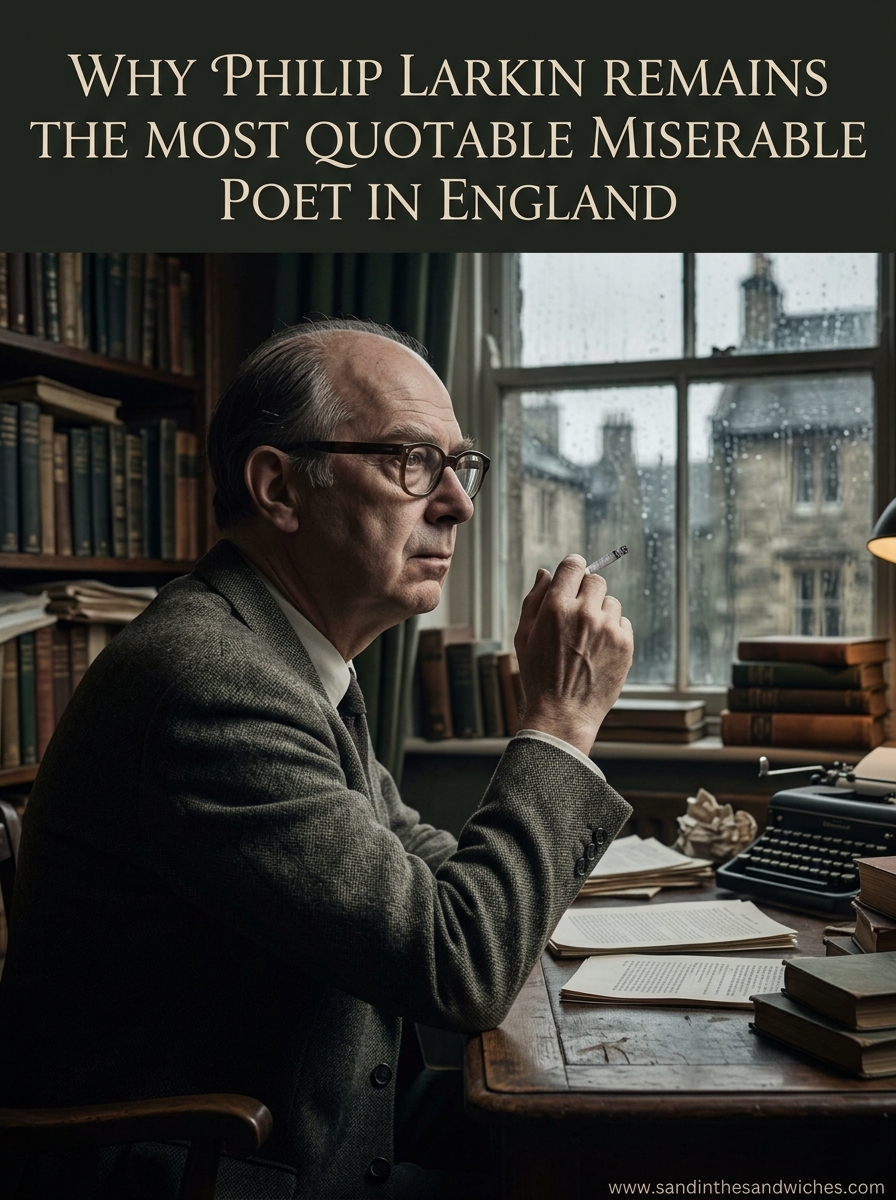
If you have ever read a poem that made you laugh and flinch at the same time, there is a good chance Philip Larkin wrote it. He is the poet people quote at dinner parties, in essays, on social media, and at funerals. He is also the one England associates with gloom, disappointment, and a very particular brand of cheerful despair.
Philip Larkin remains the most quotable miserable poet in England because his poems use plain, conversational language to express truths most people feel but cannot articulate. His lines stick because they are short, rhythmic, and brutally honest about death, love, family, and the slow grind of time. No other English poet of the last century combined such accessible phrasing with such unflinching emotional directness.
In this article, I want to explore why that combination has kept Larkin relevant for over four decades after his death in 1985. We will look at his most quotable lines, the poems that defined his reputation, how he compares to other gloomy English poets, and why teenagers and pensioners alike still reach for his words when they need to describe what it feels like to be alive and not entirely happy about it.
I have spent years reading, teaching, and arguing about Larkin. What follows is my attempt to explain why a grumpy librarian from Hull became the voice England turns to when it needs someone to say the unsayable.
Table of Contents
Philip Larkin’s Most Quotable Lines
The quickest way to understand why Larkin is the most quotable miserable poet in England is to look at the lines themselves. His poems produce sentences that function as standalone wisdom. You do not need to have read the whole poem to feel the impact. The lines work on their own, which is the secret to quotability.
Here are some of the most frequently quoted Philip Larkin lines, drawn from poems still taught in schools and shared across the internet:
- “They fuck you up, your mum and dad.” — The opening of “This Be the Verse.” Possibly the most quoted single line in twentieth-century English poetry.
- “What will survive of us is love.” — The final line of “An Arundel Tomb.” Featured on memorials, in wedding readings, and in countless essays about love and memory.
- “I work all day, and get half-drunk at night.” — The opening of “Aubade.” A line so recognizably human it has become shorthand for quiet middle-aged desperation.
- “Days. What are days for?” — The opening question of “Days.” Used in classrooms, podcasts, and philosophical discussions about routine and purpose.
- “Most things may never happen: this one will.” — From “Aubade.” Larkin’s bluntest statement about death, and one of his most shared lines online.
- “Get out as early as you can, / And don’t have any kids yourself.” — The closing couplet of “This Be the Verse.” Quoted by anyone who has ever questioned the wisdom of starting a family.
- “Never such innocence, / Never before or since.” — From “MCMXIV.” Larkin’s elegy for a world before the First World War, quoted in remembrance services and history classrooms.
- “The trees are coming into leaf / Like something almost being said.” — The opening of “The Trees.” Shared every spring by people who find hope in renewal, even if Larkin himself was skeptical about it.
- “Life is first boredom, then fear.” — From “Dockery and Son.” A line that gets passed around whenever someone needs to summarize the trajectory of an ordinary life.
Notice the pattern. These lines are short. They sound like things a person might actually say. They contain a surprising turn or a stark claim that stops you mid-scroll. That is not accidental. It is the result of a poet who worked relentlessly to make complex emotions feel simple without dumbing them down.
What Makes Philip Larkin So Quotable?
Quotability is not the same as fame. Many famous poets are rarely quoted because their language is too dense, too private, or too tied to their specific moment. Larkin’s lines travel. They leave the page and enter conversation, greeting cards, tweets, and academic essays with equal ease.
Five specific qualities make Larkin’s poetry so quotable compared to his contemporaries.
1. Plain Language That Sounds Like Speech
Larkin wrote in a register that feels close to ordinary English conversation. He avoided obscure allusions, archaic vocabulary, and the dense symbolic layering that makes much modern poetry inaccessible. When he says “I work all day, and get half-drunk at night,” you understand every word immediately. The simplicity is deceptive because the emotional weight underneath is enormous, but the surface is clear enough to quote in any context.
This commitment to plain speaking was a deliberate choice. Larkin was part of a group of post-war writers sometimes called The Movement, which included his friend Kingsley Amis. They rejected what they saw as the overwrought opacity of 1940s modernism and championed clarity, traditional forms, and Englishness. That stylistic decision is a huge part of why Larkin’s lines survive outside the classroom.
2. Traditional Forms With a Modern Voice
Larkin almost always wrote in rhyme and meter. “This Be the Verse” uses a bouncy, nursery-rhyme rhythm. “Aubade” moves in measured ten-syllable lines. “An Arundel Tomb” follows a regular stanza pattern. The forms are traditional, even old-fashioned. But the voice inside them is thoroughly modern, unsentimental, and at times transgressive.
This combination matters for quotability because rhyme and rhythm make lines memorable. Cognitive research on verbal memory consistently shows that rhymed, rhythmic phrases are easier to recall than free verse. Larkin’s formal choices gave his lines a physical grip on the brain. You remember them the way you remember a song lyric.
3. Universal Truths in Compact Phrasing
Every quotable Larkin line contains a claim that feels both personal and universal. “They fuck you up, your mum and dad” is about his own parents, but it speaks to anyone who has ever looked at their family and felt the weight of inherited damage. “Most things may never happen: this one will” is about Larkin’s terror of his own death, but it names a truth every living person carries.
The compactness matters too. Larkin was an economical poet. He did not sprawl. He compressed enormous emotional and philosophical territory into a handful of syllables. That density of meaning in a small space is exactly what makes a line worth quoting. You can carry it with you.
4. Surprise and Transgression
Several of Larkin’s most quoted lines work because they violate an expectation. The swear word that opens “This Be the Verse” shocked readers in 1971 and still carries a jolt of surprise now. The bluntness of “this one will” in “Aubade” arrives after a meditative buildup and hits like a door slamming. Quotable lines often depend on this kind of structural surprise, and Larkin was a master of the turn.
He also transgressed socially. He wrote about things English poetry had traditionally handled with more tact: the dullness of work, the disappointment of marriage, the pointlessness of religion, the horror of death. By saying these things plainly, he gave readers permission to acknowledge feelings they had been told to suppress.
5. Ambiguity That Invites Interpretation
“What will survive of us is love” is quotable partly because nobody can agree on whether Larkin meant it sincerely or ironically. Is it a genuine affirmation, or is it the last of several ironies in a poem about a stone tomb? Readers have argued about this for decades. That ambiguity means the line works in weddings and funerals, in essays defending Larkin’s tenderness and in essays attacking his cynicism.
The best quotable lines are not just memorable. They are flexible. They mean slightly different things depending on who is quoting them and why. Larkin’s lines have this quality in abundance, which is why they keep circulating through culture long after their original publication.
Three Poems That Define His Miserable Genius
If you want to understand why Philip Larkin remains the most quotable miserable poet in England, you need to spend time with the three poems that built his reputation. Each one approaches a different universal theme, and each contains lines that have escaped the page and entered the culture.
“This Be the Verse” — The Family Poem Everyone Knows
“This Be the Verse” was published in 1971 and immediately became one of Larkin’s most controversial and beloved poems. It opens with one of the most famous first lines in English literature: “They fuck you up, your mum and dad.” The poem goes on to argue that parents pass down their faults and miseries to their children, who in turn pass them along, in an unending chain of generational damage.
The poem’s closing advice, “Get out as early as you can, / And don’t have any kids yourself,” is quoted constantly. It appears in social media posts, in student essays, in discussions about whether to have children, and in casual conversations about family dysfunction. The poem’s transgressive language is part of its appeal, but the real reason it endures is that it names something most people have felt. Family is complicated. Parents are imperfect. We inherit wounds we did not choose.
What makes “This Be the Verse” especially quotable is its form. The poem uses a swinging, almost jaunty rhythm that sounds like a music-hall song or a bawdy pub rhyme. That mismatch between the bouncy form and the bleak content creates a dark comedy that feels distinctly English. You laugh and wince at the same time, which is the Larkin experience in miniature.
Forum discussions on Reddit confirm the poem’s reach. Users on r/RSbookclub note that “This Be the Verse” is a favorite among students because it “tells a great truth.” Others describe it as the poem that made them realize poetry could speak directly about their own lives. That directness is the foundation of Larkin’s quotability.
“Aubade” — The Masterpiece on Mortality
“Aubade,” published in 1977, is widely considered Larkin’s greatest poem and one of the finest poems about death in the English language. An aubade is traditionally a dawn love song, but Larkin inverted the form. His aubade is about waking at 4 a.m. and confronting the certainty of personal extinction. The poem describes the mind circling back, again and again, to the fact that death is not something that happens to other people. It is coming for you.
The opening line, “I work all day, and get half-drunk at night,” is one of the most quoted lines in modern poetry because it captures a routine that millions of people recognize. The line “Most things may never happen: this one will” is the poem’s philosophical core and gets shared constantly in discussions about mortality. Readers on r/Poetry and r/Pessimism describe the poem as giving them chills and being “as good as poetry gets.”
What makes “Aubade” so powerful is its refusal of consolation. Larkin considers religion and dismisses it. He considers the idea that philosophy might help and dismisses that too. He considers the notion that we get used to the idea of death and rejects it. The poem ends not with an answer but with the arrival of morning, the mail, and another working day. Death remains, unaddressed and unavoidable. That honesty is what readers return to again and again.
The poem’s quotability comes from its compression of a universal experience. Everyone who has ever woken in the dark and felt the cold certainty of their own mortality recognizes what Larkin is describing. He found the words for something that most people can only feel in the abstract.
“An Arundel Tomb” — What Will Survive of Us Is Love
“An Arundel Tomb,” published in 1956, describes the stone effigy of a medieval earl and his countess lying side by side in Chichester Cathedral. The poem observes how the couple’s joined hands, carved in stone, have survived the centuries. It ends with the most quoted line in all of Larkin’s work: “What will survive of us is love.”
This line has had a remarkable afterlife. It appears on memorial plaques, in wedding ceremonies, in obituaries, and in countless essays about whether love endures after death. The Poetry Foundation has called it the most quoted line in all of Larkin’s poetry. Its popularity is easy to understand. It offers a glimmer of hope in a body of work that is often read as relentlessly bleak.
But the line is famously ambiguous, and that ambiguity is central to its power. Critics have long debated whether Larkin intended it sincerely or whether it represents what the poem calls “an untruth” that survives because people need to believe it. The word “almost” in the preceding line, “What will survive of us is love” being the “almost-instinct” that proves true, suggests that Larkin himself was not entirely convinced. This tension between hope and skepticism is what makes the line endlessly quotable. People read into it what they need.
The poem also demonstrates Larkin’s skill at using plain description to carry enormous philosophical weight. Most of the poem is simply observing a carved stone tomb. But from that observation, Larkin builds a meditation on time, memory, and the stories we tell about the dead. It is a master class in making the ordinary carry the extraordinary.
The Miserable Poet Archetype: How Larkin Compares
England has never been short of gloomy poets. From A.E. Housman to Thomas Hardy to William Wordsworth in his darker moments, the English literary tradition is full of writers who stared at the void and wrote about it. But Larkin holds a special place in that lineage. He is not just miserable. He is the most quotable miserable poet England has produced. Understanding why requires comparing him to his peers.
Larkin Versus A.E. Housman
A.E. Housman is probably the closest parallel to Larkin in the English tradition. His “A Shropshire Lad” (1896) is a collection of brief, melancholy poems about death, lost love, and the futility of youth. Lines like “To an athlete dying young” and “blue remembered hills” are widely quoted. Housman shared Larkin’s taste for compression, traditional forms, and unsentimental bleakness.
But Housman’s language is more elevated and more consciously literary. His poems feel like they belong to another century because they do. Larkin’s voice sounds like a person talking, while Housman’s sounds like a poet writing. That conversational quality is what gives Larkin the edge in quotability. His lines work in casual speech in a way Housman’s rarely do.
Larkin Versus Thomas Hardy
Thomas Hardy was a profound influence on Larkin, and both poets share a preoccupation with disappointment, the indifference of the universe, and the smallness of individual lives. Hardy’s poems about the sinking of the Titanic, the death of his wife, and the emptiness of the modern world are powerful. But Hardy’s voice is more rugged and more formally varied. He experiments with unusual meters and sometimes sprawling stanza forms.
Larkin learned from Hardy’s emotional honesty but tightened the form. He took Hardy’s bleakness and put it in a more portable container. A Larkin line is easier to carry away from the poem than a Hardy line because it is shorter, more regular, and more syntactically straightforward. That portability is the essence of quotability.
Larkin Versus W.H. Auden
W.H. Auden was another master of the quotable line. “We are all here on earth to help others” and “Poetry makes nothing happen” are both widely shared. Auden’s intellect was dazzling and his range enormous. But Auden’s work is also more allusive, more formally various, and more overtly intellectual. His poems often require context that Larkin’s do not.
Larkin’s advantage is emotional directness. When Larkin writes about death or loneliness, you feel it in your body. When Auden writes about the same themes, you appreciate the brilliance but the experience is more cerebral. For quotability, visceral impact matters. People quote lines that make them feel something, and Larkin’s lines do that more consistently than any of his English contemporaries.
Why Larkin Wins the Quotability Contest
The comparison reveals a consistent pattern. Other English poets matched Larkin’s bleakness or his formal skill or his intellectual range. But none combined all three with his particular brand of conversational directness. Larkin found a way to write poems that sound like the smartest, saddest person you know talking honestly about life. That voice is what makes his lines stick.
The Hull Librarian: Biographical Context
Philip Larkin was born in Coventry in 1922 and died of oesophageal cancer in 1985 at the age of 63. He spent nearly his entire adult working life as a librarian, first at University College Leicester, then at Queen’s University Belfast, and finally at the University of Hull, where he served as Librarian from 1955 until his death. He never married, though he had several long-term relationships that were complicated and often painful for everyone involved.
The biographical details matter because they explain both the content and the tone of his poetry. Larkin’s daily life involved cataloguing books, managing staff, and living in a flat in a city that most English people associated with fishing and rain. He was not a bohemian. He was not a Romantic figure dashing around Europe. He was a civil servant who wrote poems in the evenings and on weekends. That ordinariness is central to his appeal.
His poems are full of the texture of daily English life. Railway stations, rented rooms, council estates, university common rooms, provincial shops. He wrote about the England most people actually lived in, not the England of literary mythology. When he describes a train journey in “The Whitsun Weddings” or a drive through the countryside in “Here,” you recognize the landscape because it is the one outside your window.
Larkin’s personal life was marked by a tension between longing for connection and fear of it. His relationships with women, particularly Monica Jones, Maeve Brennan, and Ruth Bowman, were intense but never resolved into marriage or stable domesticity. Some of this tension came from his mother, with whom he had a close but suffocating relationship. All of this feeds into the poems, which repeatedly explore the gap between desire and fulfillment, between the need for love and the inability to sustain it.
The Poet Laureate Refusal
In 1984, following the death of John Betjeman, Larkin was offered the position of Poet Laureate. He declined. The reasons were partly practical and partly temperamental. Larkin felt he was not producing enough new work to justify the role. He also disliked public ceremonies and the idea of writing occasional verse for state events. The position went to Ted Hughes instead.
The refusal has become part of the Larkin legend. It reinforced his image as a poet who preferred privacy to public life and who distrusted the machinery of official culture. It also means that Larkin achieved his extraordinary cultural reach without ever holding the country’s most visible poetry post. His reputation was built entirely on the poems themselves, not on institutional backing.
Why Students Still Love Philip Larkin
One of the most remarkable things about Larkin’s continued relevance is his popularity with young readers. Decades after his death, his poems are still taught in British schools to students aged 16 to 18. Forum discussions on Reddit confirm that teenagers and university students continue to discover and connect with his work. This is not something that can be said of every canonical poet.
Several factors explain why Larkin resonates so strongly with young readers.
Honesty Over Sentimentality
Young readers often feel that adults are lying to them about the world. They are told that hard work leads to success, that family is always a source of love, that things will get better. Larkin’s poems offer no such reassurances. “This Be the Verse” bluntly tells them that their parents messed them up. “Aubade” tells them that death is coming and nothing can prevent it. For a teenager who suspects that the adult world is full of comfortable lies, this honesty is refreshing and even exhilarating.
As one Reddit user put it, Larkin “tells us things we need to know, and doesn’t pull any punches.” That quality of unsparing truth-telling is rare in any art form and especially welcome when you are young and surrounded by platitudes.
Accessibility of Language
Larkin’s poems do not require a dictionary or an encyclopedia to understand. A 17-year-old can read “This Be the Verse” and grasp its meaning immediately. The formal complexity is there for those who want to study it, but the surface meaning is available to everyone. This makes Larkin an ideal entry point for students who are wary of poetry or convinced that it is not for them.
The Dark Humor
Larkin is funny. Not coincidentally funny, but deliberately, structurally funny. The mismatch between his bouncy rhythms and his bleak content produces a dark comedy that young readers appreciate. The opening profanity of “This Be the Verse” is shocking in a way that teenagers find thrilling. The dry wit of “Aubade,” where the arrival of the morning post is offered as the only available consolation for existential terror, is the kind of humor that resonates with anyone growing up in uncertain times.
Larkin in the Social Media Age
In 2026, Larkin’s quotability has found a new medium. His short, punchy lines are perfectly suited to social media sharing. They fit in a tweet. They work as an Instagram caption. They can be turned into a meme without losing their meaning. Lines from “This Be the Verse” and “Aubade” circulate constantly online, often detached from their original poems and presented as standalone wisdom.
This is not a degradation of the poetry. It is an extension of what Larkin always wanted his lines to do: to leave the page and enter the world. The digital age has simply made that process faster and wider. Young readers encountering a Larkin line on social media often seek out the full poem and discover the rest of his work. The quotability is both an end in itself and a gateway.
Controversies and Complexities
Any honest discussion of Larkin must address the controversies that have shadowed his reputation since his death. In 1992, his collected letters were published, revealing language and attitudes that were racist, misogynistic, and generally ugly. The same year, his biography by Andrew Motion further detailed his personal conduct, including his treatment of the women in his life. The revelations prompted a fierce debate about whether Larkin’s literary reputation could survive the exposure of the man behind the poems.
The accusations are serious and well-documented. The letters contain racial slurs and derogatory comments about women that cannot be defended or explained away as products of their time. They were ugly when written and they remain ugly now. The question for readers is not whether Larkin held repellent views but whether those views invalidate the poetry.
Different readers answer this question differently, and I do not think there is a single correct response. Some readers find the biographical revelations so distasteful that they can no longer enjoy the poems. Others are able to hold the two things in tension, appreciating the work while acknowledging the failings of the man. The BBC has noted that the accusations “did little to damage his stature as a writer,” though that assessment itself is contested.
What is clear is that the controversy has not dimmed Larkin’s quotability. If anything, the honesty of the poems, their willingness to acknowledge the worst in human nature, has taken on a different resonance in light of the biographical revelations. The poet who wrote “They fuck you up, your mum and dad” was himself deeply fucked up, and the poems know it. They are full of self-awareness about failure, limitation, and moral inadequacy. That self-awareness does not excuse the personal conduct, but it does explain why the poems continue to feel honest even when the poet behind them has been exposed.
The forum discussions capture this tension well. The r/RSbookclub community notes that “Larkin-the-man and Larkin’s poetry have always been inseparable and equally sad.” Readers on r/redscarepod debate whether you can separate the two, with some defending the transgressive honesty of the poems and others finding the personal conduct disqualifying. What nobody disputes is the power of the work itself.
Legacy and Cultural Impact
Philip Larkin’s cultural standing in England is extraordinary for a poet who wrote relatively few poems, lived in Hull, and refused the Laureateship. In 2003, the Poetry Book Society named him Britain’s best-loved poet of the previous 50 years. In 2016, he was memorialized in Westminster Abbey’s Poets’ Corner with a floor stone inscribed with the words “What will survive of us is love.” The Philip Larkin Society, a registered charity, continues to promote study and appreciation of his work.
His influence extends beyond literature into music and popular culture. Songwriters have drawn on his emotional directness and his gift for compressed, memorable lines. His jazz criticism, collected in “All What Jazz,” shows another side of his artistic sensibility and helps explain the rhythmic intelligence of his poetry. He listened to music with the same attention he brought to verse, and that musical ear is part of what makes his lines so sticky.
The continued teaching of his poems in British schools ensures that each new generation encounters Larkin. Students who read “This Be the Verse” at 16 may go on to discover “Aubade” and “An Arundel Tomb” in adulthood. The poems grow with the reader. What seems funny at 16 seems profound at 40. That capacity to reveal new layers over time is the mark of lasting literature.
Larkin’s England has changed dramatically since his death. The country he wrote about, with its provincial libraries, its railway journeys, and its post-war uncertainties, has been replaced by a different nation. But the emotional territory his poems map remains constant. People still fear death. They still struggle with family. They still drink too much and wonder why. They still want to believe that something survives. As long as those truths persist, Larkin will have readers, and his lines will continue to be quoted.
FAQs
What was Philip Larkin’s famous line?
Philip Larkin’s most famous line is u0022They fuck you up, your mum and dad,u0022 the opening of his 1971 poem u0022This Be the Verse.u0022 His other widely quoted lines include u0022What will survive of us is loveu0022 from u0022An Arundel Tombu0022 and u0022Most things may never happen: this one willu0022 from u0022Aubade.u0022
What is Philip Larkin’s most famous poem?
Philip Larkin’s most famous poems include u0022This Be the Verse,u0022 u0022Aubade,u0022 u0022An Arundel Tomb,u0022 u0022The Whitsun Weddings,u0022 u0022Church Going,u0022 u0022High Windows,u0022 and u0022The Trees.u0022 Among these, u0022This Be the Verseu0022 is probably his most widely known and quoted poem, particularly in British schools.
Why did Philip Larkin decline Poet Laureate?
Philip Larkin declined the position of Poet Laureate in 1984 because he felt he was not producing enough new poetry and because he disliked public ceremonies and the expectation of writing occasional verse for state events. The position went to Ted Hughes instead. Larkin preferred privacy and distrusted official literary culture.
What are some criticisms of Larkin’s work?
Criticisms of Larkin’s work include accusations that his poetry is too bleak and pessimistic, that his subject matter is narrow and provincial, and that his plain language style lacks the formal ambition of his modernist predecessors. On a personal level, the publication of his letters in 1992 revealed racist and misogynistic views that have led many readers to question whether his literary reputation is justified.
Why is Philip Larkin so quotable?
Philip Larkin is so quotable because his poems combine plain conversational language with traditional rhyme and meter, universal emotional truths, compact phrasing, and moments of surprising transgression. His lines are short, memorable, and speak directly about experiences that most people recognize, which makes them easy to carry away from the poem and use in everyday conversation.
Conclusion: Why Philip Larkin Endures
Philip Larkin remains the most quotable miserable poet in England because he did something no other modern English poet managed with the same consistency. He wrote poems that sound like honest speech, carry universal emotional weight, and lodge themselves in the memory after a single reading. His lines work in classrooms, in pubs, on social media, and at funerals because they name truths that most people feel but cannot express.
The misery is part of the appeal but it is not the whole story. Larkin’s poems are miserable in the way that good conversation is miserable. They acknowledge the difficult things, the things people usually avoid, and they do so with wit, rhythm, and precision. They do not wallow. They observe. And in observing, they make the reader feel less alone with their own darkness.
If you have never read Larkin, start with “This Be the Verse” and “Aubade.” If you already know those, go deeper into “An Arundel Tomb,” “The Whitsun Weddings,” and “Church Going.” His Collected Poems is a slim volume for a major poet, but every page contains at least one line worth remembering. That density of quotable wisdom is why, more than forty years after his death, Philip Larkin is still the poet England turns to when it needs someone to say the unsayable.