
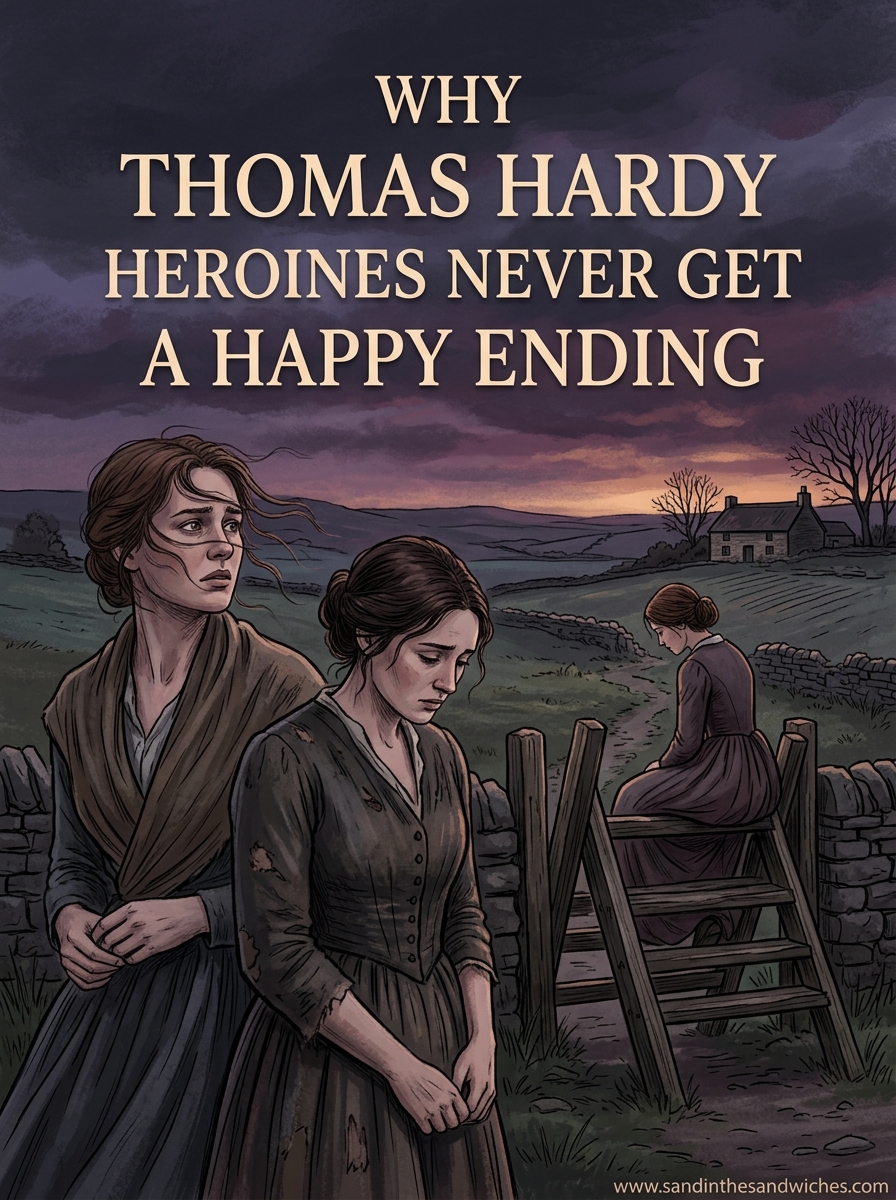
Thomas Hardy’s heroines never get a happy ending because he used their suffering as a mirror held up to Victorian society. Tess Durbeyfield is executed after being raped and abandoned. Sue Bridehead returns to a marriage she loathes after her children die. Eustacia Vye drowns in a freezing pond. Even Bathsheba Everdene, his most fortunate leading woman, only finds peace once her fierce independence has been worn down. Hardy did not write these endings out of cruelty. He wrote them because he wanted readers to feel the weight of a world that punished women for wanting more than survival.
Across Tess of the d’Urbervilles, Far from the Madding Crowd, Jude the Obscure, The Return of the Native, and The Mayor of Casterbridge, Hardy built a fictional landscape called Wessex. There, women who showed passion, intellect, or ambition collided with forces they could not control. Those forces were social convention, sexual double standards, bad luck, and what Hardy called the Immanent Will, the blind machinery of the universe grinding forward without compassion.
In this article, I want to walk through each major heroine and examine exactly why her story ends the way it does. I will look at the Victorian context Hardy was writing against, his personal philosophy, and the way modern feminist criticism has re-read these characters not as victims but as women ahead of their time. If you have ever closed a Hardy novel feeling gutted and wondering whether any of his female characters catch a break, this breakdown is for you.
Table of Contents
The Tragic World of Wessex
Wessex is the semi-fictional corner of rural England where nearly all Hardy’s novels are set. Modeled on Dorset and the surrounding counties, it is a place of ancient farms, dark heaths, and small market towns that feel cut off from the modernizing Britain of the late nineteenth century.
The landscape itself functions almost as a character. Egdon Heath in The Return of the Native is vast, indifferent, and ancient. It was there long before Eustacia Vye raged against it, and it remains after she is gone. This mattered to Hardy because it set up one of his central ideas: human beings are tiny, temporary creatures living inside forces far larger than themselves.
That cosmic indifference is part of the answer to the question of why Thomas Hardy heroines never get a happy ending. The world of Wessex is not governed by a loving providence. It is governed by weather, accident, inheritance, and the accumulated weight of social rules. When a woman in Wessex reaches for happiness, she is reaching against the grain of everything around her.
Hardy’s readers in the 1870s and 1880s expected novels to reward virtue and punish vice. He deliberately broke that contract. His heroines suffer not because they are wicked but because the system is rigged, and luck is never on their side.
Tess Durbeyfield: A Pure Woman Destroyed by Double Standards
Tess Durbeyfield is the most famous of Hardy’s doomed heroines, and for many readers she is the saddest. She is a country girl whose father discovers, falsely, that the family descends from the ancient d’Urberville line. That single piece of nonsense sets in motion the chain of events that destroys her.
Sent to claim kinship with a wealthy family of that name, Tess is raped or seduced, Hardy deliberately leaves the exact nature ambiguous, by Alec d’Urberville. She bears a child who dies in infancy. Later, after finding what seems like genuine love with Angel Clare, she confesses her past on their wedding night. Angel, who has his own sexual history, reacts with horror. He abandons her.
The subtitle Hardy gave the novel, A Pure Woman Faithfully Presented, was a direct provocation. Victorian readers were outraged that Hardy would call a woman who had a child out of wedlock pure. That was the entire point. Tess is pure in spirit, in intention, and in loyalty. The impurity belongs to the society that condemns her.
Angel Clare embodies the Victorian sexual double standard more completely than almost any character in literature. He forgives himself his own transgressions instantly. He cannot extend the same grace to Tess. As readers on forums repeatedly point out, Angel is the original fraudulent nice guy, a man whose progressive ideals evaporate the moment they inconvenience him.
The ending is shattering. Driven back to Alec by poverty and desperation after Angel’s departure, Tess murders Alec when Angel finally returns. She is arrested at Stonehenge and executed. Hardy’s narrator notes that the President of the Immortals had finished his sport with Tess. That single line tells you everything about how Hardy saw the universe: Tess was a plaything of forces that found her suffering entertaining.
Why does Tess die? Because Hardy needed to show, with no escape clause, what Victorian morality actually does to a woman who has done nothing wrong. A happy ending would have let society off the hook. The execution forces the reader to confront the injustice.
Bathsheba Everdene: Independence Tamed
Bathsheba Everdene, the heroine of Far from the Madding Crowd, is often cited as proof that not all Hardy heroines meet a tragic end. She survives the novel. She marries Gabriel Oak, the steadfast shepherd who has loved her patiently throughout. It is the closest thing to a happy ending in all of Hardy’s fiction.
But look more closely. When we first meet Bathsheba, she is bold, proud, and deliberately unconventional. She takes over a farm and runs it herself. She rejects Gabriel’s first proposal because she values her freedom. She is sharp with employees, playful with suitors, and entirely her own person.
By the end of the novel, two men have died because of their connection to her. Sergeant Troy, the dashing husband she married impulsively, treats her with contempt and is killed by the rejected farmer Boldwood. Boldwood himself is driven to madness and murder. Bathsheba has been through emotional devastation that leaves her diminished.
Her marriage to Gabriel Oak is presented as the right outcome, and it is, in the sense that Gabriel is decent, steady, and genuinely loves her. But notice what has happened to Bathsheba’s spirit. The woman who once refused to be any man’s property now marries quietly, almost in secret. Her fire has been spent by what she has endured. Hardy is not punishing her as severely as Tess, but he is saying something uncomfortable: even the lucky one pays a price.
This is the nuance that gets lost when people call Bathsheba’s ending happy. Hardy does not let his heroines escape without cost. Bathsheba lives, but the woman who walks down the aisle is not the same woman who once ran that farm with such fierce independence.
Sue Bridehead: The New Woman Crushed
If Tess is Hardy’s most famous tragic heroine, Sue Bridehead in Jude the Obscure is his most devastating. Published in 1895, the novel was Hardy’s last. The public reaction was so hostile that he never wrote another novel, turning exclusively to poetry for the final three decades of his life.
Sue is extraordinary for her time. She reads widely, questions religion, and refuses to accept marriage as an institution. She and Jude Fawley live together without marrying, which was scandalous enough to cost them work, housing, and social standing. Sue argues, with startling modern clarity, that a legal contract should not define love.
She is what late Victorian culture called a New Woman: educated, independent, skeptical of patriarchal authority. Hardy presents her sympathetically. He wants the reader to see her as brave and right.
Then the novel destroys her. The couple’s children, including a child from Jude’s marriage, are killed by Jude’s young son in a murder-suicide. The boy, known as Little Father Time, hangs the children and himself, leaving a note that reads: Done because we are too menny.
That line, with its childish misspelling, is one of the most harrowing moments in English literature. After the deaths, Sue breaks completely. She leaves Jude and returns to the husband she had fled, Phillotson, convinced that God is punishing her for living outside the rules. She submits to a marriage and a life she despises, her intellect and spirit extinguished.
Sue’s ending is worse than death. Tess dies but dies defiant, having struck back at her abuser. Sue survives but survives broken, surrendering everything that made her who she was. Hardy is showing what happens when a woman ahead of her time is ground down by a world that will not make room for her.
Readers on Reddit and Goodreads consistently name Sue’s fate as the most upsetting of any Hardy heroine. It is not just sad. It feels like a defeat of hope itself.
Eustacia Vye and Elizabeth-Jane: Two Sides of Ambition
The Return of the Native and The Mayor of Casterbridge give us two more heroines whose endings reveal Hardy’s pattern. Eustacia Vye and Elizabeth-Jane Henchard are opposites in temperament, but neither gets what could honestly be called a happy ending.
Eustacia Vye is passionate, restless, and deeply unhappy with her life on Egdon Heath. She dreams of escape, of Paris, of a world larger than the village where she is trapped. She marries Clym Yeobright, who has returned from Paris, believing he will take her away. Instead, Clym becomes a furze-cutter, an outdoor laborer, and settles deeper into the rural life Eustacia despises.
Through a series of misunderstandings and tragic accidents, Eustacia is shut out of her mother-in-law’s home on the night of her death. Blamed and isolated, she drowns, possibly by suicide, in a storm-water pool on the heath. She is a woman whose only crime was wanting something different from what life offered her, and the heath swallows her up.
Elizabeth-Jane in The Mayor of Casterbridge is the inverse. Where Eustacia is dramatic and rebellious, Elizabeth-Jane is quiet, observant, and patient. She endures her stepfather Michael Henchard’s temper, his disinheritance of her, and the chaos he brings to everyone around him. She watches, she adapts, and she survives.
Her reward is a marriage to Donald Farfrae, the man who becomes Henchard’s rival. But notice the terms. Elizabeth-Jane gets a stable life only because she has suppressed every trace of ambition or passion. She succeeds by being small, accommodating, and undemanding. Hardy rewards submission and punishes desire. That is not a happy ending so much as a negotiated surrender.
Put Eustacia and Elizabeth-Jane side by side and you see Hardy’s terrible logic. The woman who reaches for more is drowned. The woman who asks for nothing is permitted to live quietly. Neither outcome is presented as joyful. Both are presented as the terms Victorian society offers its women.
Victorian Society and Sexual Double Standards
To understand why Thomas Hardy heroines never get a happy ending, you have to understand the world they inhabit. Victorian Britain in the late nineteenth century was a society built on rigid expectations for women.
A respectable woman was expected to be sexually innocent before marriage, obedient within it, and entirely consumed by motherhood afterward. Marriage was not just a personal relationship but a legal and economic institution. Until the Married Women’s Property Acts of 1870 and 1882, a married woman’s property and earnings legally belonged to her husband. She had no independent legal existence.
Sexual double standards were woven into the fabric of daily life. A man’s sexual transgressions were expected and quietly forgiven. A woman’s destroyed her permanently. Angel Clare’s reaction to Tess’s confession is not unusual for the period. It is the period working exactly as designed.
Hardy saw all of this and refused to look away. His novels are not fantasies of escape. They are diagnostic documents. He created women who embodied the real desires and frustrations of actual Victorian women, then showed exactly what happened to them. The tragedy is not arbitrary. It is the predictable output of a system designed to contain and control.
When readers on literature forums say Hardy’s characters have no control over their lives, they are identifying the thing Hardy most wanted them to see. The lack of control is the point. It is the social critique rendered in narrative form.
This is why calling Hardy a pessimist misses the mark. He was not saying life is meaningless. He was saying this particular arrangement of society produces suffering, and if that makes you uncomfortable, the arrangement is what needs to change. The tragedy is an argument, not a worldview.
Fate, Providence, and the Indifferent Universe
Beyond social criticism, Hardy was obsessed with the question of cosmic justice. Raised in a devout Christian family, he lost his faith as a young man and never recovered it. In its place, he developed a philosophy that borrowed from Schopenhauer, Darwin, and ancient Greek tragedy.
Hardy’s universe is governed by what he called the Immanent Will: a blind, unconscious force that drives the cosmos without purpose or compassion. It is not evil. It is simply indifferent. Tess is not punished by God. She is caught in machinery that does not know she is there.
This is why coincidence plays such a large role in his novels. A letter slipped under a door goes unread. A chance meeting on a road changes a life. A child’s illness arrives at the worst possible moment. These are not plot contrivances. They are Hardy’s way of showing that human happiness rests on luck, and luck is unreliable.
In The Mayor of Casterbridge, Henchard’s entire downfall begins with a single impulsive act: selling his wife at a fair while drunk. The novel then traces how that one moment reverberates through decades. Hardy is showing that we are all one bad decision or one piece of bad timing away from catastrophe, and there is no providence waiting to catch us.
For his heroines, this philosophy is especially cruel. They already face social structures designed to limit them. On top of that, they live in a universe that will not even grant them the dignity of meaningful suffering. Their pain is not part of a divine plan. It is just weather.
Hardy’s Personal Life and Darkening Vision
It helps to know something about Hardy’s own life to understand why his endings grew darker over time. He married Emma Gifford in 1874, and their marriage was difficult. They grew emotionally distant, living largely separate lives under the same roof. After Emma died in 1912, Hardy was overwhelmed by guilt and grief, producing some of his most powerful poetry about a woman he had failed to appreciate while she was alive.
His second marriage to Florence Dugdale in 1914 was also troubled. Florence, decades younger than Hardy, found herself in the shadow of Emma’s memory and the demands of caring for an aging, famous husband. She struggled with her health and her role for years.
You can see the trajectory in the novels. Far from the Madding Crowd (1874) allows Bathsheba a measure of happiness. The Return of the Native (1878) ends in death. Tess of the d’Urbervilles (1891) ends in execution. Jude the Obscure (1895) ends in annihilation of the spirit. The arc is unmistakable: Hardy’s view of what was possible for his characters darkened as his own experience deepened.
The backlash to Jude the Obscure was the final blow. Reviews called it obscene. A bishop reportedly burned his copy. Libraries refused to stock it. Hardy, exhausted and embittered, decided that if this was the reception his honest work received, he would write no more novels. He kept his word. He spent the next thirty years writing poetry, never returning to the novel form.
Why the Tragic Endings Matter
So why do Thomas Hardy heroines never get a happy ending? Because Hardy refused to lie. He could see that the women around him were constrained by laws, customs, and expectations that made genuine fulfillment nearly impossible for anyone who did not fit the mold. He could have written novels where virtue was rewarded and love conquered all. Instead, he wrote the truth as he understood it, and the truth was that Tess deserved better, Sue deserved better, and Eustacia deserved better.
Modern feminist criticism has reframed these characters in important ways. Tess is no longer read as a passive victim but as a woman who acts with courage and dignity inside an impossible situation. Sue Bridehead is recognized as one of literature’s first fully realized New Woman figures, a character whose ideas about marriage and autonomy were decades ahead of their time. Bathsheba is reclaimed as a portrait of female competence and leadership.
Their endings are not failures of imagination. They are indictments. Every time a reader closes Tess of the d’Urbervilles feeling angry, every time someone finishes Jude the Obscure and needs to sit in silence, Hardy’s project is working. He wanted discomfort. He wanted outrage. He wanted readers to feel the weight of injustice so acutely that they could not look away from it.
His heroines never get a happy ending because the world they lived in did not offer them one. Hardy’s genius was to make sure we noticed.
FAQs
What is the saddest Thomas Hardy book?
Jude the Obscure is widely considered the saddest Thomas Hardy novel. The deaths of Jude and Sue’s children, followed by Sue’s complete psychological collapse and retreat into a loveless marriage, make it the most emotionally devastating of all his works. Many readers also find Tess of the d’Urbervilles equally heartbreaking due to Tess’s execution after a life of injustice.
Which Thomas Hardy novels have happy endings?
Far from the Madding Crowd is the Thomas Hardy novel most commonly described as having a happy ending. Bathsheba Everdene survives and marries the steadfast Gabriel Oak. However, even this ending is bittersweet, as Bathsheba’s fierce independence has been worn down by tragedy. Under the Greenwood Tree is another early Hardy novel with a relatively positive conclusion.
What is considered Thomas Hardy’s best novel?
Tess of the d’Urbervilles is generally considered Thomas Hardy’s best and most important novel. It appears on nearly every major greatest novels list and is the most widely studied of his works. Some critics and readers rank Jude the Obscure as his greatest achievement for its intellectual ambition, while others prefer Far from the Madding Crowd for its accessibility and relative warmth.
What happened to Thomas Hardy’s second wife?
Thomas Hardy’s second wife was Florence Dugdale, whom he married in 1914 after the death of his first wife Emma. Florence was 35 years younger than Hardy and struggled with poor health, the demands of caring for an aging famous husband, and living in the shadow of Emma’s memory. She outlived Hardy, who died in 1928, and spent her later years managing his literary estate.
Why did Thomas Hardy stop writing novels after Jude the Obscure?
Thomas Hardy stopped writing novels after the 1895 publication of Jude the Obscure because of the savage public and critical backlash. The novel was called obscene, banned by libraries, and reportedly burned by a bishop. Deeply hurt and frustrated by the reception, Hardy turned exclusively to poetry for the remaining three decades of his life and never wrote another novel.
Conclusion: Why Thomas Hardy Heroines Never Get a Happy Ending
The question of why Thomas Hardy heroines never get a happy ending has a single answer at its core. Hardy believed that the society he lived in made happiness impossible for women of intelligence, passion, or independence. Rather than writing fantasies of escape, he chose to document the damage.
His heroines are revolutionary precisely because they refuse to be passive. Tess demands to be seen as pure. Sue demands the right to define love outside legal contracts. Bathsheba demands the right to run her own farm. Eustacia demands a life larger than a village. Elizabeth-Jane endures with a dignity that amounts to its own form of resistance.
Their endings hurt because Hardy wanted them to hurt. Every act of tragedy in a Hardy novel is an invitation to ask what would have to change for the outcome to be different. The answer, consistently, is everything: the laws, the customs, the assumptions, the cosmic indifference that allows it all to continue.
That is why these novels still resonate in 2026. The specific Victorian structures have evolved, but the underlying questions about how society treats women who want too much have not disappeared. Hardy’s heroines never get a happy ending because Hardy was honest enough to admit that, in the world he knew, they were not going to get one. His gift to us was making sure we could not pretend otherwise.