
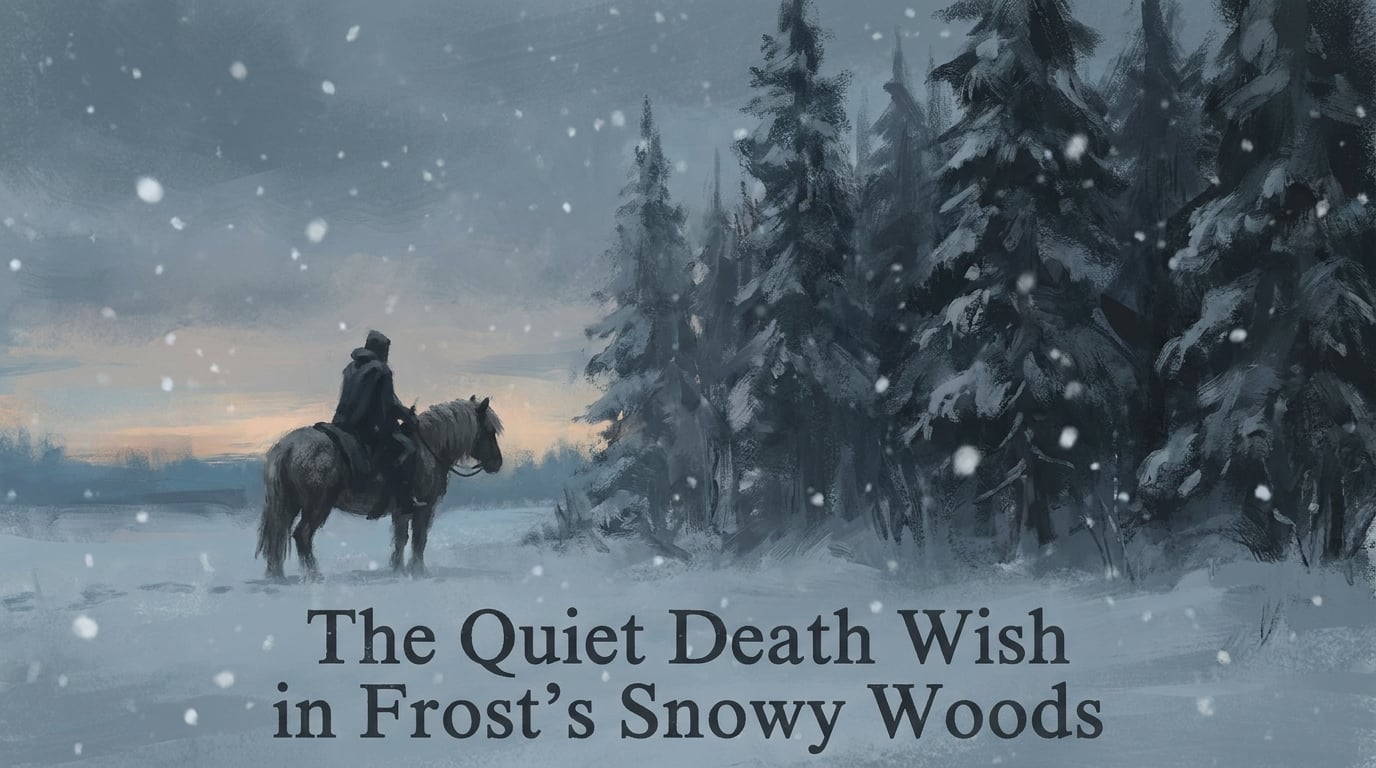
Most readers meet Robert Frost’s “Stopping by Woods on a Snowy Evening” as a gentle winter scene: a traveler pauses by a dark wood on the way home. The poem reads like a Christmas card. Snow, silence, a small horse. It feels safe.
It is not safe. Beneath the surface, this short 1922 poem hides a quiet death wish that Frost himself confirmed. When I first reread the poem in my thirties, after a winter that had worn me down, the famous final line landed differently. “The woods are lovely, dark and deep” is not just a pretty line about nature. It is the sound of a man considering staying in the dark forever.
This article walks through the full text, the form, and each stanza of the poem to show why the death wish reading is the most honest one. We will look at Frost’s own comments on the word “sleep,” at the pull of the woods, and at the small “but” that pulls the speaker back to his promises.
Table of Contents
The poem in full
Before the analysis, here is the complete poem so we can read it together with fresh eyes.
Whose woods these are I think I know.
His house is in the village though;
He will not see me stopping here
To watch his woods fill up with snow.My little horse must think it queer
To stop without a farmhouse near
Between the woods and frozen lake
The darkest evening of the year.He gives his harness bells a shake
To ask if there is some mistake.
The only other sound’s the sweep
Of easy wind and downy flake.The woods are lovely, dark and deep,
But I have promises to keep,
And miles to go before I sleep,
And miles to go before I sleep.
Read it once for the music. Read it again for what the speaker almost does.
How the poem came to life in one June night
Frost wrote “Stopping by Woods on a Snowy Evening” in June 1922, in a single burst of work. He had been up late struggling with another poem and had finally given up around dawn. He sat down to write something different and finished this one before lunch.
The speed matters. Most of Frost’s best-known poems took him years to shape. This one arrived in a sitting. That kind of writing usually means the material was already inside the poet and only needed a place to land.
The personal context sharpens the reading. Frost’s closest English friend, the poet Edward Thomas, had died by suicide in 1917. Frost and Thomas had walked these same English woods together. Frost was never casual about that loss. He told friends that “Stopping by Woods” carried a private weight he did not want to explain on the page.
The poem was published in 1923 in the collection New Hampshire. It won the Pulitzer the next year. Within Frost’s lifetime it became his most quoted work, and it is also the one most often softened into a greeting card.
Why iambic tetrameter and the Rubaiyat stanza matter
The form is part of the meaning. Frost used iambic tetrameter, a four-beat line with an unstressed-stressed pulse, for almost every line. That meter is the rhythm of a horse walking on a quiet road. The reader’s body falls into the speaker’s pace.
He also borrowed the Rubaiyat stanza, named after the quatrains of Omar Khayyam’s Rubaiyat. The rhyme scheme moves AABA BBCB CCDC, then the last stanza breaks form with DDDD. Three ordinary stanzas. A final, slightly off-balance one.
The “off” stanza is the one that repeats “And miles to go before I sleep.” Frost used the same device at the end of the final stanza. The repetition acts like a hook that catches the reader on the way out of the poem. It also turns the last stanza into a small closed room, the way a chant does, the way a prayer does.
The hypnotic effect is not accidental. Frost built a lullaby. Lullabies are what we sing to people as they fall asleep. In this poem, the lullaby is the pull of the woods.
Stanza one: a quiet pull toward the dark
Stanza one sets up the situation. The speaker knows whose woods these are. The owner lives in the village. The owner will not see him. That last line matters more than it looks: the speaker has checked that no one is watching.
“To watch his woods fill up with snow” is the only verb the speaker gives himself. He is not passing through. He has stopped to watch burial happen. Snow, in poetry this old, almost always signals death, silence, and the slow covering of the world.
He is alone. He has chosen to be alone. There is no farmhouse near. The scene is private, set apart, the kind of place a person picks when they want to be unseen.
Stanza two: the horse asks the only question
Stanza two introduces the horse. “My little horse must think it queer / To stop without a farmhouse near.” The horse thinks the stop is wrong. The horse is the only other mind in the poem, and it disagrees with the speaker’s choice.
The line “Between the woods and frozen lake” places the speaker in a no-man’s-land. The woods on one side. The frozen lake on the other. A frozen lake is still water, locked. It mirrors the woods: both are still, both are cold, both are images of a stop that does not end.
“The darkest evening of the year” is the famous line. Frost told an audience at a reading that he meant the winter solstice literally, the longest night. The solstice, the death of the year, the symbolic death of the light. The speaker has picked the darkest possible moment to stand still.
Stanza three: “The woods are lovely, dark and deep”
Stanza three is the heart of the temptation. The wind and snow make almost no sound. The world has shrunk to the speaker, the dark, and the pull. “The only other sound’s the sweep / Of easy wind and downy flake.” Easy wind. Downy flake. The language is soft. The poem is seducing itself.
And then the most quoted line in American poetry: “The woods are lovely, dark and deep.”
Read the adjectives. Lovely. Dark. Deep. Lovely is admiration. Dark is the absence of seeing. Deep is distance without end. Read in order, the line is a slow slide into the woods. The speaker is naming what he finds beautiful about disappearing.
Frost was not shy about the meaning. He told a friend that the line “froze” onto the page as he wrote it, and that he almost did not include it because it felt too revealing. He kept it. The line is still doing the work of seduction a hundred years later.
Frost’s own words: “sleep” is a metaphor for death
This is the most important point in the article, and the one most often missed. Frost was asked, more than once, what he meant by “sleep” at the end of the poem. He gave the same answer each time. He was talking about death, not rest.
When the poet and editor Louis Untermeyer asked Frost about the final line, Frost replied that “miles to go before I sleep” meant “miles to go before I die.” He said the “sleep” in the poem was a euphemism he had borrowed from the older English tradition, where death is often called sleep. He was explicit. There was no ambiguity for him.
That confirmation changes the last stanza. “And miles to go before I sleep” is no longer a tired traveler thinking about bed. It is a man telling himself how much life is still owed to him before he is allowed to stop. The repetition makes the promise heavier. It is the speaker saying the same thing twice, in case he did not hear it the first time.
This is also why the word “But” at the start of the final stanza is the most important word in the poem. The woods are pulling. The woods are lovely. The woods are dark and deep. But. The word turns the speaker away from the woods and back toward the world. Without the “But,” there is no poem. There is only the dark.
Stanza four: “promises to keep” as the saving line
The fourth stanza is the resolution. “But I have promises to keep.” The speaker does not say he is happy to leave. He does not say he has decided to live. He says he has promises. He has not chosen life out of joy. He has chosen life out of duty.
This is the part of the death wish reading that often gets missed. The poem is not a triumphant story. It is a sober one. The woods still call. The speaker is still tired. He just has debts he has not yet paid.
“And miles to go before I sleep” then becomes a kind of accounting. He has promises. The promises will take miles. The miles will take time. Sleep – the real sleep, the final sleep – comes after the miles are done. Not before.
That is a hard, modern kind of hope. It is not the hope of a man who feels fine. It is the hope of a man who keeps going because someone is counting on him. Frost knew that kind of hope. Many of his friends did not survive to feel it.
Why this quiet death wish still speaks to readers
This is the part of the analysis I want to be careful with. The poem is not a manual. It is a record of a feeling. A lot of readers meet “Stopping by Woods on a Snowy Evening” during a low season of their own lives, often in December, often after a loss. The poem meets them there.
The death wish reading does not require the speaker to be planning anything specific. It only requires us to take him at his word: the woods are pulling, the sleep means death, and what stops him is promises, not pleasure. That is a feeling many readers recognize without naming.
It is also a feeling that gets flattened when the poem is taught as a simple nature piece. The dark wood becomes scenery. The snow becomes weather. The final line becomes a cheerful sign-off. Each flattening strips a layer Frost meant to keep.
The poem endures because it does not pretend the dark is not beautiful. It says the dark is lovely. It says the dark is deep. It says there is a man on the edge of the dark, and that he chooses, barely, to turn back. That is a truer picture of how most of us keep going than any version of the poem that pretends the dark was never there.
Frequently asked questions about the death wish in “Stopping by Woods on a Snowy Evening”
What is the deeper meaning of Stopping by Woods on a Snowy Evening?
Frost’s poem is a quiet scene of a traveler pausing by snowy woods on the darkest evening of the year. Beneath the calm surface, the speaker is drawn toward the dark and the stillness of the woods. The final line confirms the pull: ‘sleep’ in the poem is Frost’s own word for death, and ‘promises to keep’ is what pulls him back to life. The deeper meaning is a sober choice to keep going, not a peaceful one.
What does sleep symbolize in Stopping by Woods?
In Stopping by Woods on a Snowy Evening, ‘sleep’ is a metaphor for death. Frost confirmed this in conversation with editors and friends. The repeated line ‘miles to go before I sleep’ means ‘miles to go before I die.’ The metaphor follows a long English tradition in which death is called sleep, and it is the hinge on which the entire poem turns.
Is Stopping by Woods on a Snowy Evening about suicide?
The poem does not depict a plan for suicide, but it openly considers the appeal of stopping. Frost’s own gloss on ‘sleep’ as death, combined with the speaker’s private setting, the dark woods, and the longest night of the year, make the death wish reading the most honest one. The ‘But’ at the start of the final stanza marks the choice to keep going rather than to act on that pull.
What does ‘the woods are lovely, dark and deep’ mean?
The line is the speaker naming what he finds beautiful about the dark woods. Read in order, the adjectives are a slow movement toward disappearance: lovely, then dark, then deep. Frost saw the line as revealing and almost left it out. In context, it is the moment the speaker admits, almost to himself, that the dark is what he wants.
What promises does the speaker have to keep?
Frost never lists the promises, and that is part of the point. The promises stand for the whole web of duty that ties a person to life: family, work, the people who expect them home. The speaker does not say he is happy to keep the promises. He says he has them. That restraint is what saves him in the poem.
What literary devices are used in Stopping by Woods on a Snowy Evening?
The poem uses iambic tetrameter, the Rubaiyat stanza (AABA BBCB CCDC DDDD), alliteration, personification of the horse, and repetition in the final stanza. The repeating ‘miles to go before I sleep’ works like a chant. The ‘But’ at the start of the final stanza is a hinge that turns the poem away from the dark.
Why did Robert Frost write Stopping by Woods on a Snowy Evening?
Frost wrote the poem in one sitting in June 1922, finishing it before lunch. He had been unable to finish another poem the night before. The material was already in him. Frost’s close friend Edward Thomas had died by suicide in 1917, and the woods in the poem echo the English landscapes the two of them walked together. Frost told friends the poem had a private weight he did not want to explain.
What is the darkest evening of the year meaning?
The phrase refers to the winter solstice, the longest night of the year. Frost confirmed this in a reading. The solstice is a symbolic death of light and the symbolic moment when the year turns. The speaker has picked the darkest possible moment of the year to stand still, which is not an accident. It is the moment he is most drawn to the woods.
Closing thoughts on a poem that pretends to be calm
“Stopping by Woods on a Snowy Evening” hides a quiet death wish, and Frost meant it to. The woods are not scenery. They are the place the speaker wants to go. The snow is not weather. It is the slow covering of the world. The sleep at the end of the poem is not rest. Frost told us so himself.
What saves the speaker is not a change of heart. It is a list of promises he has not yet paid. That is a thin, hard kind of hope, and it is the kind many readers recognize without naming. The poem is great because it does not pretend the dark was not beautiful, and it does not pretend the speaker was happy to leave it.
If you have ever stood still too long in a dark place and then driven home because someone was waiting, you already know the shape of this poem. Frost just wrote it down before lunch, in 1922, on a June night that was the darkest evening of his year.