
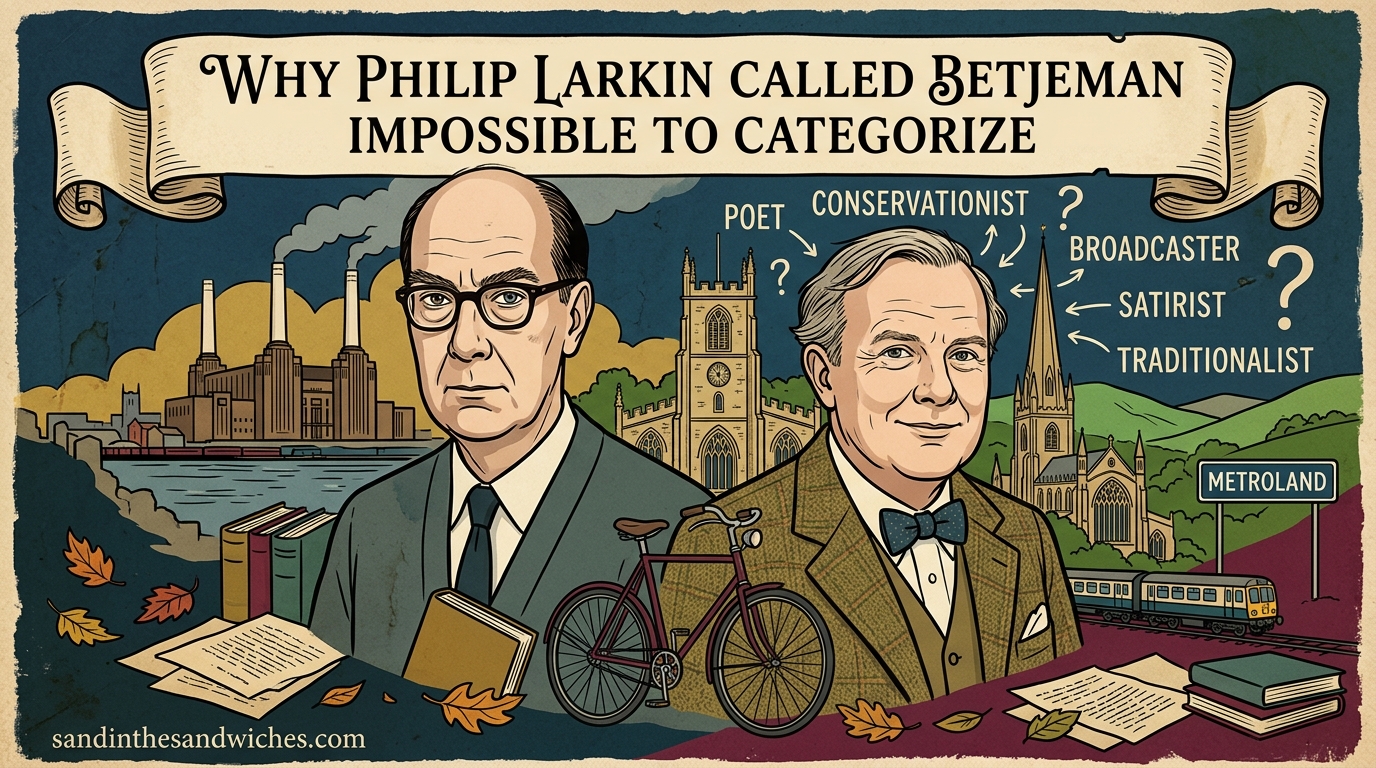
When Philip Larkin wrote that John Betjeman was “impossible to categorize,” he was not offering a polite compliment. He was identifying a real problem that 20th-century literary criticism could not solve. Betjeman’s poetry refused to sit neatly in the bins the modernists had built.
I have spent years reading post-war British poetry, and the Larkin-Betjeman question still surprises students and scholars alike. Why would one of England’s most demanding poets single out his contemporary as uncategorizable? The answer reveals more about how we define “serious” poetry than it does about Betjeman himself.
In this guide, I will walk you through the friendship between these two poets, the exact context of Larkin’s statement, and the wider debate about accessible versus difficult verse. By the end, you will understand why this single phrase matters to anyone interested in English poetry, and you will have a clearer sense of the forces that shaped British letters in the decades after 1945.
Table of Contents
Why Philip Larkin Called Betjeman Impossible to Categorize
Larkin called Betjeman impossible to categorize because Betjeman wrote popular poetry that was also good poetry, a combination 20th-century critics had declared impossible. The modernist movement had trained readers to equate literary value with difficulty, allusiveness, and formal experimentation. Betjeman wrote clear, witty, accessible verse about churches, suburbs, and train journeys, and millions of ordinary readers loved it. Critics could not decide whether to dismiss him as lightweight or praise him as a genius, so they often did both at once.
Larkin saw this dilemma clearly. In his 1964 essay, later collected in “Required Writing,” he described Betjeman’s work as having a “limpid quality” that made it feel transparent. There were no hidden codes, no dense references, no ironies that required footnotes. The poems worked on first reading, and they worked on the tenth reading too. That transparency was itself a problem for critics who needed complexity to justify their trade, and it is a major part of why Larkin settled on the phrase “impossible to categorize” as his honest summary.
The Larkin-Betjeman Friendship and Its Context
To understand why Philip Larkin called Betjeman impossible to categorize, you need to know that the two men were close friends for nearly three decades. They met in 1946 when Betjeman, already famous, championed Larkin’s early work in the pages of the “New Statesman.” That single review launched Larkin’s career, and Larkin never forgot the favor.
Their friendship was real and warm, even if it cooled slightly in later years. They wrote to each other often, and Larkin continued to admire Betjeman even when the older poet’s reputation dipped in the eyes of academic critics. When Betjeman died in 1984, the British government offered the position of Poet Laureate to Larkin. Larkin declined it. Many readers have seen that refusal as a quiet tribute to the man who made it okay, at least for one generation, to write poetry that ordinary people actually wanted to read.
Post-war British poetry was a battlefield of styles. The Movement poets, including Larkin himself, rejected modernist experimentation in favor of plain language and clear statement. But they kept a certain ironic distance. Betjeman had no such distance. He wrote with affection, nostalgia, and a love of English places that no Movement poet could match. This emotional directness, more than anything, set him apart, and it is one of the deeper reasons that the category problem refuses to go away.
The Modernist Shadow
T.S. Eliot had defined what counted as serious poetry for an entire generation. “The Waste Land” was the model: dense, allusive, demanding. To write simply was, in some circles, to write badly. Betjeman had come of age admiring Eliot, but his own work moved in the opposite direction. He chose clarity over obscurity, affection over detachment, and a conversational tone over the formal address of the high modernists.
Critics trained on Eliot could not process a poet who wrote so openly about tennis, plumbing, and seaside holidays. Yet Betjeman sold books by the tens of thousands. He appeared on television. He became a national figure, not just a literary one. This was the contradiction Larkin pointed to: how do you file a poet who is both mass-market and enduringly respected, both accessible and lasting, both a broadcaster and a quiet observer of English life?
Betjeman’s Accessible Style That Defied Categories
Betjeman’s accessibility was not a flaw to be excused. It was the central feature of his art, and it is the main reason Philip Larkin called Betjeman impossible to categorize. He wrote about subjects that other poets had abandoned: architecture, suburbia, lost country houses, the English church, the slow death of Victorian certainties. These were the places and structures that ordinary people passed every day without noticing, and Betjeman noticed them with devotion.
His poems read like conversation. They used rhyme without sounding forced. They mixed pathos with humor in a way that academic poetry often struggles to achieve. A reader who had never taken a literature course could open a Betjeman collection and feel understood within minutes. That was, and remains, a remarkable thing, and it is one of the qualities that made the existing categories look small.
Why Critics Found This Hard to Process
The critical establishment of the 1950s and 1960s had built its reputation on explaining difficulty. A poem was considered “serious” when it required interpretation, when it rewarded close reading, when it resisted easy paraphrase. Betjeman’s poems did not require interpretation. They offered their meaning directly, the way a song lyric does. Some critics praised this as a return to genuine communication. Others dismissed it as light verse dressed up as the real thing.
Larkin was on the side of the defenders, but he was too honest a critic to ignore the awkwardness. He knew that Betjeman’s accessibility made him an awkward fit alongside Eliot, Pound, and the high modernists. He also knew that Betjeman’s best poems were not “easy” in the sense of being shallow. They were easy in the sense of being clear, and clarity is its own kind of achievement, one that the modernist tradition had largely abandoned.
How Betjeman Bridged Popular and Literary Poetry
One key to understanding why Philip Larkin called Betjeman impossible to categorize is recognizing that Betjeman occupied a unique position in the British literary scene. He was Poet Laureate from 1972 until his death in 1984, an official honor. He was also a beloved broadcaster, a regular on television programs like “Pieces of Verse” and the famous 1964 BBC interview that introduced him to a wider audience. Few poets in any century have combined those two kinds of fame.
This combination of cultural roles had no real precedent. A century earlier, Tennyson had been both popular and laureate, but the cultural landscape was different. By the 20th century, high art and popular entertainment had split apart. Betjeman somehow kept a foot in both camps, and that is part of why he kept slipping out of every category the critics tried to assign him.
The Range of His Work
Betjeman did not write in a single mode. He wrote topographical poems about specific English counties. He wrote satirical verses about the pretensions of the well-to-do. He wrote tender elegies for lost buildings and lost ways of life. He wrote comic pieces that made readers laugh out loud. He wrote serious meditations on faith and doubt, and he wrote light verses about train timetables that felt like small love letters to a vanishing England.
This range made him hard to pin down. If a critic wanted to call him a nature poet, they had to ignore the satire. If they wanted to call him a satirist, they had to ignore the elegies. If they wanted to call him a religious poet, they had to ignore the jokes. The categories kept failing because the work kept overflowing them, and that is the heart of Larkin’s “impossible to categorize” remark.
The Baylor Thesis and Scholarly Interest
Academic interest in Betjeman has grown in recent years. A Baylor University thesis on “John Betjeman’s Influence on Philip Larkin” examined how Betjeman’s visual attentiveness to English culture shaped Larkin’s own approach. Scholars now read Betjeman for his precise observations of place, his affection for the overlooked corners of English life, and his willingness to find meaning in the ordinary. None of these were qualities the mid-century critics valued. All of them are qualities we now recognize as part of his strength, and they are qualities that still resist neat categorization.
What Larkin Really Meant by “Impossible to Categorize”
Larkin’s phrase was not a complaint. It was, I think, an admission of admiration tinged with critical frustration. He saw what Betjeman had done. He saw how the poetry reached readers that Eliot could never reach. He also saw that the usual tools of literary criticism could not explain that reach, and he was honest enough to say so.
When Larkin said Betjeman was impossible to categorize, he was pointing to the failure of categories, not the failure of the poet. The categories themselves were wrong. They had been built by a critical tradition that prized difficulty and distrusted popularity. Betjeman had broken through those categories by simply ignoring them, and the result was work that millions of people read and remembered, work that has now lasted long enough to be studied in universities on its own terms.
For Larkin, this was both inspiring and uncomfortable. He had built his own reputation on plain language and emotional honesty, but he always kept a layer of protective irony. Betjeman had no such armor. He wrote with his heart on the page, and he trusted his readers to meet him there. That kind of trust is rare in any era, and it is part of why the categorization problem persists even today, more than forty years after Betjeman’s death.
The Lasting Significance of the Comment
Today, Betjeman is read in universities, taught in schools, and quoted at weddings and funerals. His poem “Funeral Music” appears in school anthologies. His “Summoned by Bells” autobiography is a set text in some British literature courses. The very fact that serious academics now study him in depth proves Larkin’s point. If a poet who was once dismissed as “popular” now gets scholarly articles, monographs, and theses written about him, then the original category of “popular” has failed to contain him.
Larkin saw this coming. His comment in the 1964 essay was a quiet prediction. He was telling future readers that Betjeman did not fit the boxes of his own time, and that the boxes would eventually have to give way. They have, and the story of how they gave way is one of the more interesting chapters in the history of 20th-century British poetry, a story that is still being written as new readers discover Betjeman in today’s literary landscape.
Frequently Asked Questions
Was John Betjeman a good poet?
By almost any measure, yes. Betjeman was respected by his peers, including T.S. Eliot and W.H. Auden, and he was appointed Poet Laureate in 1972. His poems are studied in British schools and universities, and his work continues to be read widely. Critical opinion has shifted over time, but the scholarly consensus is that he was a serious and accomplished poet, not merely a popular one.
Is John Betjeman still popular?
Yes, John Betjeman remains popular. His poems are still anthologized, his television appearances are still widely viewed, and he continues to attract scholarly attention. Stations, churches, and places he wrote about draw literary tourists, and his biography by A.N. Wilson introduced him to a new generation of readers in the early 2000s.
Why did Philip Larkin decline Poet Laureate?
Larkin declined the position of Poet Laureate in 1984, after Betjeman’s death, for several stated reasons. He said the role would interfere with his writing and his private life, and he felt unsuited to the public duties it required. Many readers have also seen the refusal as a quiet tribute to Betjeman, who had been his friend and early champion.
What was Philip Larkin’s famous line?
Philip Larkin wrote many famous lines, but one of the most quoted is from the poem ‘This Be The Verse’: ‘They may not mean to but they do. / They fill you with the faults they had / And add some extra, just for you.’ Another widely cited line is from ‘Church Going,’ where he describes the act of visiting a church as something ‘serious’ that he will keep doing.
Conclusion
So why did Philip Larkin call Betjeman impossible to categorize? Because the categories were never big enough. Betjeman wrote poetry that was popular, serious, clear, emotional, witty, and lasting, all at once. The modernist critical tradition had no place for such a combination, and that is the failure Larkin was naming. Read a few Betjeman poems today, and you will see exactly what he meant, and you will understand why this single phrase continues to be quoted in literary circles around the world.