
“For God’s sake hold your tongue, and let me love.”
That is the opening line of John Donne’s poem “The Canonization,” and it lands on a modern reader like a hand on the shoulder. It is blunt,exasperated, intimate, and unmistakably alive. Four hundred years separate us from the man who wrote it, yet the voice feels close enough to interrupt.
This is the first surprise Donne offers anyone who picks him up in 2026: he does not sound dead. He sounds like a person thinking out loud in the next room, half annoyed and half in love, refusing to perform for an audience he cannot see. For readers raised on the polished decorum of much Renaissance verse, the shift can be startling. For readers coming to him from contemporary poetry, the surprise runs the other direction — toward recognizing how much of what we value now was already there in 1610.
So why does John Donne keep surprising modern readers? The short answer is that his poetry blends intellectual complexity with emotional urgency in a way few poets before or since have matched. His conceits yoke together ideas that should not fit and somehow produce truth. His religious poems argue with God the way we argue with ourselves. And his reputation has risen, fallen, and risen again so dramatically that the story of how we read him is almost as revealing as the poems themselves.
This article breaks down five reasons Donne still catches readers off guard, traces how his reputation was rebuilt by the Modernists, offers a starting path for newcomers, and addresses the harder questions about his work that contemporary readers rightfully raise.
Table of Contents
Who Was John Donne? A Life of Reversals
John Donne was born in London in 1572 into a recusant Catholic family at a time when practicing Catholicism could get you executed. His brother Henry died in prison after harboring a priest. His uncle, the Jesuit poet Jasper Heywood, was imprisoned in the Tower of London. Before Donne wrote a single love poem, he had absorbed a theology the state considered treasonous.
He was educated at Oxford, trained in the law, and launched into a diplomatic and secular career that seemed to promise worldly success. Then in 1601 he secretly married Anne More, the seventeen-year-old niece of his employer Sir Thomas Egerton. He was thrown into Fleet Prison. Anne’s father had him dismissed. For more than a decade the couple lived in poverty, dependent on the generosity of friends and patrons.
The reversal did not stop there. Donne eventually took Anglican orders in 1615, abandoning the faith of his childhood for the church that had persecuted it. He rose to become Dean of St Paul’s Cathedral, the most celebrated preacher in London, delivering sermons to packed congregations that included King James I himself. He died in 1631, leaving behind a body of work that ranges from erotic love lyrics to some of the most anguished devotional verse in English.
This biographical whiplash is not background trivia. It is the furnace in which Donne’s contradictions were forged. A man who wrote “The Flea” — a seduction poem built on the argument that since their blood is already mixed inside a flea, sex can hardly matter — also wrote “Batter my heart, three-person’d God,” in which he begs the divine to take him by force. Modern readers sense that the same mind produced both. The surprise is not that Donne contains contradictions but that he refuses to resolve them.
Why John Donne Keeps Surprising Modern Readers
When readers in 2026 encounter Donne, they tend to be caught off guard in five specific ways. Each one says less about Donne than about the gap between what we expect from a seventeenth-century poet and what he actually delivers.
1. His Emotional Directness Feels Shockingly Contemporary
Most Elizabethan love poetry is performative. Spenser, Sidney, and Shakespeare’s sonnets orbit around idealized figures, formal declarations, and elaborate praise. Donne walks into the room and starts talking.
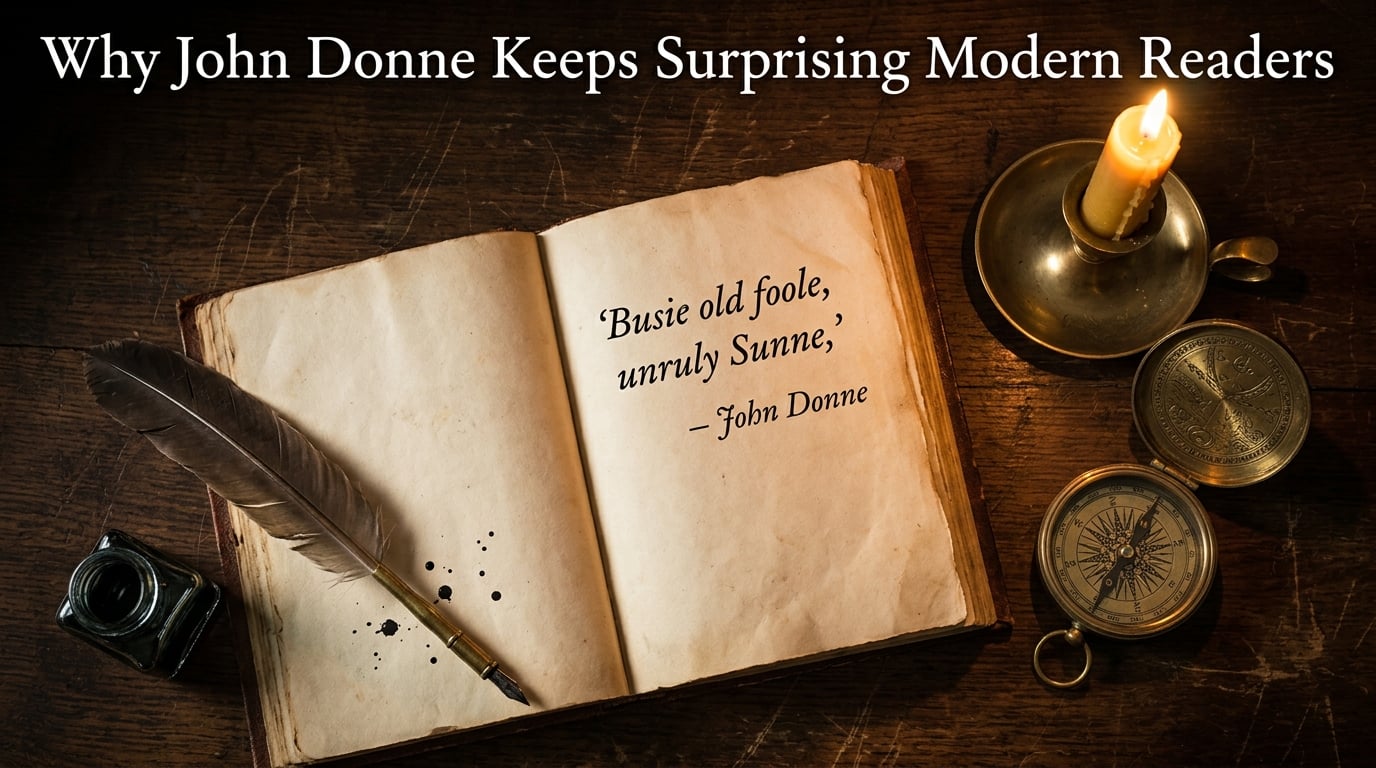
“For God’s sake hold your tongue” is not a compliment. “Busy old fool, unruly Sun, / Why dost thou thus, / Through windows, and through curtains, call on us?” — the opening of “The Sun Rising” — is essentially a man yelling at the dawn for interrupting him in bed. The voice is casual, hostile, tender, and grandiose within a few lines, the way an actual person sounds when they are in love and unwilling to admit how completely.
Reddit users who post about discovering Donne often mention this directness first. They describe being grabbed by poems they expected to find dull. The shock is not the language — though the language is hard — but the realization that an early modern poet is speaking with the urgency of someone texting at midnight.
“The Flea” is the canonical example. The speaker argues that because a flea has bitten both him and the woman he is pursuing, their blood is already mingled inside it, and sex would be no more consequential than the flea-bite. When the woman kills the flea, he reverses course instantly: if killing the flea was trivial, then yielding to him would be just as trivial. The argument is cynical, brilliant, funny, and a little repellent — all at once. Modern readers recognize this voice because we live with it. It is the voice of someone who will say anything to win, and who is also genuinely overwhelmed.
This is part of why John Donne still surprises modern readers. He refuses the polite distance that the lyric tradition had trained audiences to expect.
2. The Metaphysical Conceits Demand Active Reading
A conceit, in Donne’s hands, is not a metaphor. It is an entire argumentative structure built on a comparison that should not work.
In “A Valediction: Forbidding Mourning,” written to his wife before a long journey, Donne compares their souls not to vine and tree, not to river and bank, but to the two legs of a drawing compass. One foot stays fixed at the center. The other leans outward to draw the circle. As the moving foot travels farther, the compass leans more steeply — and when it returns, the two legs stand upright together again. The comparison is absurd on its surface. It is also exact. Distance in this love does not break the connection; it describes it.
Samuel Johnson famously complained that the metaphysical poets “yoked by violence together” ideas “which nature never intended to unite.” That is true, and it is also the point. Donne’s conceits work because they make the reader do work. You cannot skim “The Ecstasy,” where two lovers sitting on a riverbank have their souls leave their bodies and mix in the air between them. You have to follow the argument, hold the abstraction in your head, and notice where the comparison strains. The strain is where the meaning lives.
This is the second surprise Donne offers readers in 2026. His poetry rewards the kind of attention we now spend on puzzles, on dense novels, on intricate films. It assumes intelligence and pays it back with interest. Many readers report that the same poem gives them something new on the third or fourth reading — not because they missed details but because the conceit itself keeps generating insight.
3. His Religious Poems Wrestle With Doubt Like Ours
The Holy Sonnets are where many readers find Donne most surprising. Written after his ordination, in a period of failing health and chronic spiritual anxiety, they do not sound like the work of a confident priest.
“Batter my heart, three-person’d God; for, you / As yet but knock, breathe, shine, and seek to mend.” The opening of Holy Sonnet XIV does not ask God for comfort. It asks God to break in, to take the speaker by force, because gentle approaches have failed. The poem goes on to compare the speaker to a town that has been captured by an enemy and must be retaken — and then, shockingly, to a bride who wants to be ravished by a divine lover so she can be made chaste. The imagery is violent and erotic and theological at once.
Modern readers who do not share Donne’s faith still respond to these poems because the experience they describe is recognizable. They describe the feeling of wanting to believe something and finding yourself unable to. Of knowing what you should be and watching yourself fail to be it. Of arguing with a silence that does not argue back.
“Death, be not proud, though some have called thee / Mighty and dreadful, for, thou art not so.” Holy Sonnet X takes on the most absolute fact of human life and mocks it. By the end, the poem has turned death into a brief sleep before resurrection — and then, with a final twist, declares that death itself will die. The logic is theological. The nerve is personal. Donne is writing at a time when he has watched children die, when his own body is failing, when the funeral sermons he delivers at St Paul’s are growing more frequent. The defiance is not abstract.
4. His Paradoxes Mirror Our Contradictions
Paradox is not a decorative flourish in Donne’s work. It is his primary way of telling the truth.
“One short sleep past, we wake eternally / And death shall be no more; Death, thou shalt die.” The line works by forcing two contradictory propositions to coexist. Death is real enough to be addressed. Death is also an illusion that will dissolve. Both are true within the poem’s frame, and the reader has to hold them simultaneously.
This is what the Poetry Society essayist Linda Gregerson meant when she described Donne’s “soul-making” as the labor of forcing contradictions into proximity so that something new emerges. The flea is trivial and the marriage it implies is cosmic. The compass leg is far away and intimately joined. The speaker is a captured town and a willing bride. Donne will not choose.
Modern readers are used to contradiction. We hold opposing convictions about politics, about people we love, about ourselves. Donne’s refusal to resolve his tensions can feel more honest than the cleaner resolutions offered by poets with tidier theologies. He lets the contradictions stand and trusts the reader to live with them.
5. His Syntax Reenacts the Experience of Thinking
Read a Donne poem aloud and you will notice something. The sentences do not sit still. They interrupt themselves, double back, qualify, escalate. The line breaks often refuse to cooperate with the syntax, so the meaning spills across the line ending in ways that force you to carry one thought into the next.
In “The Sun Rising,” the speaker asks the sun to shine through “both the Indias of spice and mine” — and then immediately corrects the geography, insisting that his lover is every country, every king, every treasure. The movement of the sentence mimics the movement of a mind in love: confident, then overreaching, then sprawling past its own claims.
This is the surprise that close readers tend to mention last but value most. Donne’s poems do not just describe thinking. They perform it. The intellectual rigor is not separable from the emotional force. You feel the argument the way you feel a heartbeat, and the feeling persists after the argument is over.
For readers in 2026 accustomed to literature that announces its themes explicitly, this fusion of intellect and feeling can take time to recognize. Once it clicks, Donne becomes difficult to put down.
From Disrepute to Canon: How Donne Was Rehabilitated
Donne was not always admired. For nearly two centuries after his death, his reputation slid into disrepute.
The eighteenth century found his conceits barbarous. John Dryden complained that Donne “affects the metaphysics” and perplexes the minds of the fair sex with abstruse speculations. Samuel Johnson formalized the criticism in his Lives of the Poets, coining the term “metaphysical poets” almost as an insult. The Augustans wanted clarity, wit, and polish. Donne gave them tangled syntax and impossible comparisons. By the nineteenth century he was largely unread outside academic circles.
The reversal came in the early twentieth century, and it came because of T.S. Eliot.
Eliot’s 1921 essay “The Metaphysical Poets” argued that Donne and his contemporaries possessed something the modern age had lost: a unified sensibility in which thought and feeling were not yet separated. Eliot wrote that Donne’s mind could “devour any kind of experience” and transmute it into poetry. For Eliot, reading Donne was not nostalgia. It was a model for what modern poetry needed to recover.
The Modernist endorsement transformed Donne’s standing almost overnight. By the mid-twentieth century, the New Critics had adopted him as a centerpiece of the academic canon. Cleanth Brooks and other close readers treated Donne’s poems as machines for generating ambiguity, the kind of texts that rewarded exactly the patient attention they wanted to teach.
This history matters because it explains why Donne surprises modern readers in the first place. We inherit him through a tradition that values difficulty, ambiguity, and intellectual energy. When a reader in 2026 opens “The Canonization” and finds it electric rather than dusty, part of the reason is that the entire critical apparatus of the last hundred years has been rebuilt to make that recognition possible.
The story of Donne’s rehabilitation is also a reminder that literary reputations are not stable. The poet the eighteenth century dismissed as obscure is the poet the twentieth century canonized for his obscurity. What surprises us in him now may be what surprises the next century differently.
Reading Donne Today: Where to Start
One of the most common questions on forums like r/Poetry and r/literature is where to begin with Donne. His complete works are dense, and the early love poems sound very different from the late religious verse. A reader who starts in the wrong place may give up before reaching the work that would have grabbed them.
Here are five poems that consistently work for new readers, arranged to show his range:
The Flea. The most accessible entry point. Short, witty, argumentative, and a little scandalous. It shows Donne’s love-poetry voice at its most playful.
The Sun Rising. A longer love poem that moves from insult to cosmic grandiosity. The voice is unmistakably Donne’s — intimate, grand, and unwilling to be told what to do.
A Valediction: Forbidding Mourning. The compass poem. Quieter than the first two, and a good introduction to how his conceits actually function.
Holy Sonnet X (“Death, be not proud”). The best entry point to his religious verse. Short, defiant, and structurally tight enough to reward a first reading while leaving room for further exploration.
Holy Sonnet XIV (“Batter my heart”). Harder, more violent, more theologically dense. Worth reading after the others because it shows how far Donne will push the language of devotion.
Reading these five in order takes less than an hour and gives a fair sense of why Donne keeps surprising modern readers. From there, the Songs and Sonets and the longer Holy Sonnets open naturally.
Katherine Rundell’s recent biography Super-Infinite is widely recommended as a companion. It reconstructs Donne’s life with the urgency of a novel and makes the poems easier to read by situating them in the events that produced them.
The Question of Donne’s Problematic Side
Honesty requires acknowledging what makes some modern readers uncomfortable with Donne.
The early love poetry can be coercive in tone. “The Flea” is, on one reading, a pressure tactic dressed in wit. Some of the Elegies are openly misogynistic, treating women as objects to be ranked, mocked, or dismissed. The same poet who wrote “A Valediction” to his wife also wrote verse in which women exist primarily as occasions for male display.
Reddit threads on Donne frequently raise this point. One popular post from r/Poetry asked why Donne is not seen in a worse light, given the hypocrisy of his later priesthood and the misogyny of his early work. The thread generated serious discussion because the question is legitimate.
The honest answer is that Donne’s work is a product of its time, and that time was openly patriarchal in ways we should not paper over. He was also, by every biographical account, genuinely devoted to his wife Anne and devastated by her death in 1617 — after which he never wrote another love poem. Both things are true. The poems that endure do so because they contain more than the misogyny they sometimes display. They contain fear, tenderness, religious terror, and an honesty about desire that few contemporaries matched.
Modern readers do not need to excuse the problematic elements to value what survives them. Acknowledging both is part of reading Donne honestly in 2026.
FAQs
What are some interesting facts about John Donne?
John Donne was born in 1572 into a recusant Catholic family at a time when Catholicism was illegal in England. He was imprisoned in Fleet Prison for marrying Anne More in secret. He served as a Member of Parliament before his disgrace, later became Dean of St Paul’s Cathedral, and preached to King James I. The famous phrase ‘No man is an island’ and ‘for whom the bell tolls’ both come from his Meditation XVII.
What impact did John Donne have?
Donne defined the metaphysical poetry tradition through his conceits, paradoxes, and fusion of intellect with passion. His work was dismissed in the eighteenth century but rehabilitated by T.S. Eliot and the Modernists in the 1920s, who saw in him the unified sensibility modern poetry needed. He has influenced poets from Eliot to Seamus Heaney and remains a centerpiece of the English literary canon.
Who is John Donne a contemporary of?
Donne was a contemporary of William Shakespeare (1564-1616), Ben Jonson (1572-1637), John Milton (1608-1674) later in his life, and the other metaphysical poets including George Herbert and Andrew Marvell. He also overlapped with Francis Bacon and served in the same political circles as many Elizabethan and Jacobean courtiers.
What was Donne best known for in his lifetime?
In his lifetime Donne was best known as the most electrifying preacher in London. As Dean of St Paul’s he delivered sermons to packed congregations that included the King. His love poetry and satires circulated in manuscript among a sophisticated elite but were not published as a collected edition until after his death in 1631.
Why Donne Still Matters
John Donne keeps surprising modern readers because his poems refuse the distance that time is supposed to create. They speak with urgency, hold contradictions without resolving them, and assume the reader is intelligent enough to do the work. The five reasons laid out above — directness, conceits, religious wrestling, paradox, and syntax — overlap and reinforce each other. Take any one away and the experience dims.
The story of his reputation tells us that what we see in Donne is partly a product of our own critical moment. The Modernists built a Donne suited to their needs. Readers in 2026 are building another, one willing to confront the misogyny alongside the brilliance. The poet survives because his work is large enough to reward each new reading.
For anyone curious about why four-hundred-year-old verse can still feel this close, the only proof is the poems themselves. Start with “The Flea,” then “The Sun Rising,” then the Holy Sonnets. By the time you finish “Death, be not proud,” you will understand why John Donne keeps surprising modern readers — and why he is unlikely to stop.