
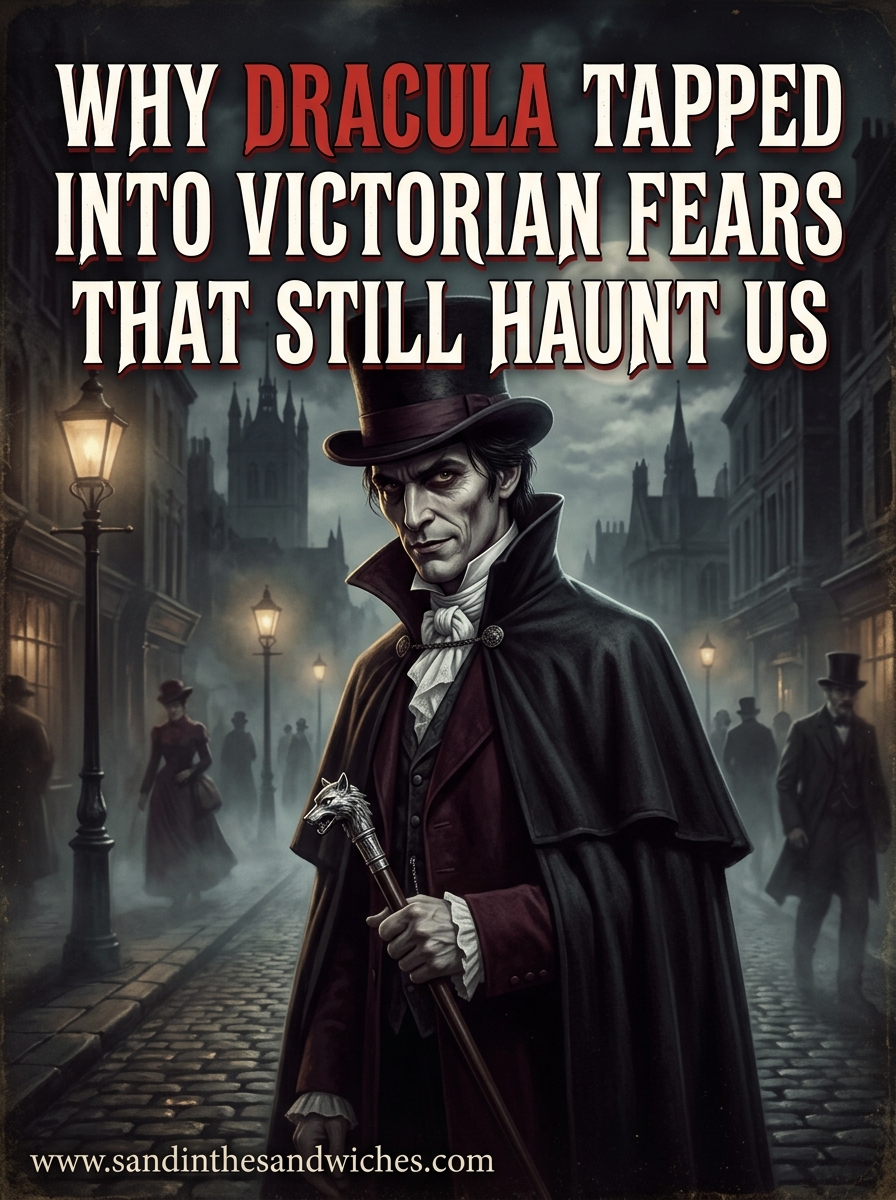
When Bram Stoker published Dracula in 1897, he had no idea he was creating one of the most enduring monsters in literary history. But the Count did not crawl out of a vacuum. He rose from the festering swamp of Victorian anxieties: fears about immigration, disease, sexual transgression, gender upheaval, and the terrifying possibility that modern science might not be enough to save anyone. The reason Dracula still scares us over a century later is that those same fears never really went away.
I have spent years studying Gothic literature and the cultural psychology behind monster stories. What strikes me every time I return to Dracula is how precisely Stoker bottled the terrors of his age. The novel is a cultural anxiety dream dressed up as a vampire hunt. And once you understand what each element of the story actually represents, the book transforms from a creepy thriller into something far more disturbing.
Here is the short answer to what Victorian fears Dracula represents: Bram Stoker’s novel embodies late-Victorian anxieties about Eastern European immigration and foreign contamination, the syphilis and tuberculosis epidemics, repressed sexuality and the threat of female desire, shifting gender roles embodied by the New Woman movement, and the tension between scientific rationalism and ancient superstition. These fears remain startlingly relevant because every generation rediscovers them in new forms.
Let me walk you through exactly how Stoker encoded these fears into his novel, and why the Count still has his teeth in our collective imagination in 2026.
Table of Contents
The Victorian World That Created Dracula
To understand why Dracula resonated so powerfully with Victorian readers, you need to understand the world that produced it. The late nineteenth century in Britain was a period of unprecedented change and pervasive unease. The British Empire was at its territorial peak, yet beneath the swagger of imperial dominance, society was cracking under the weight of its own contradictions.
The term fin de siecle, meaning “end of the century,” captured the mood perfectly. It carried connotations of decline, decadence, and the sense that civilization itself was rotting from within. Writers like Max Nordau, whose 1892 book Degeneration was a sensation in Britain, argued that modern urban life was physically and morally degrading the human race. Italian criminologist Cesare Lombroso claimed you could identify criminal types by their physical features, a pseudo-scientific framework that fed directly into how Stoker described Dracula’s alien appearance.
The Industrial Revolution had transformed Britain from a rural nation into an urban powerhouse. Cities swelled beyond their capacity. London in the 1890s was the largest city in the world, choked with smog, crime, and disease. The close-knit communities of village life had been replaced by the anonymity of crowded streets where, as many Victorians feared, monsters could move undetected.
This was also the golden age of invasion literature. Novels like George Tomkyns Chesney’s The Battle of Dorking (1871) and later works imagined foreign powers invading and conquering Britain. Stoker was writing directly in this tradition, but he did something more sophisticated. Instead of a foreign army, he sent a single, seductive predator who could pass unnoticed among the population. Dracula is invasion literature distilled to its most intimate and terrifying form.
The Foreign Invader: Immigration and Fear of the Other
Of all the Victorian fears Dracula tapped into, the fear of the foreign outsider is the most immediately visible on the page. Dracula is from Transylvania, a region that to the Victorian imagination represented the exotic, backward, and dangerous edges of Eastern Europe. He is the literal embodiment of “the Other,” a figure who looks almost human but whose differences mark him as fundamentally alien and threatening.
Consider how Stoker introduces Dracula to Jonathan Harker. The Count’s physical description draws heavily on the racial theories of the era. He has aquiline features, pointed ears, hair on his palms, and sharp white teeth that protrude over his lips. These details echo the work of Lombroso, who argued that criminals and degenerates could be identified by their atavistic physical traits. Dracula is coded as biologically other, a being whose body itself signals danger.
But the deeper fear is about immigration and cultural contamination. In the 1880s and 1890s, Britain experienced significant waves of immigration from Eastern Europe, particularly Jewish refugees fleeing pogroms in Russia and Romania. This influx triggered intense xenophobia and anti-immigrant sentiment. The British Brothers League, formed in 1901, campaigned aggressively against immigration, and their efforts culminated in the Aliens Act of 1905, Britain’s first modern immigration law designed to restrict entry.
Stoker, an Irishman living in London, was writing in the thick of this atmosphere. Dracula’s arrival in England, smuggled aboard a ship in boxes of his native earth, is a nightmare vision of uncontrolled immigration. The Count settles in Whitby and then moves to London, specifically to the Whitechapel area, the same neighborhood where Jack the Ripper had murdered and mutilated women less than a decade earlier. Whitechapel was also the heart of London’s immigrant community. The setting was not accidental.
As multiple readers on literary forums have pointed out, the core horror of Dracula for Victorian readers was the image of an “animalistic foreigner, an Eastern European, moving to England and preying upon its people.” The Count’s plan to infiltrate London society, buy property, and feed upon its citizens reads as a dark fantasy about reverse colonization. The empire that had been colonizing the world now faced the terrifying prospect of the colonized coming to colonize it in return.
Some scholars have noted troubling anti-Semitic coding in Dracula’s characterization. His physical features, his association with blood, his rootless wandering between countries, and his financial arrangements with Jonathan Harker echo centuries-old anti-Semitic tropes. This is not to say Stoker intended an anti-Semitic allegory, but rather that the cultural vocabulary of otherness available to him was saturated with these associations. The fear Dracula represents is the fear of the outsider who looks different, speaks differently, and threatens to contaminate the purity of British blood and British society.
This fear hits uncomfortably close to home in 2026. The debates that raged in Victorian England about immigration, border control, and cultural contamination sound remarkably familiar. Each generation finds its own version of the foreign invader to project its anxieties onto. Dracula endures because the fear of the Other never sleeps.
Blood, Disease, and the Sanguine Economy
If immigration fears represent the most visible anxiety in Dracula, disease fears represent the most visceral. The novel is saturated with blood, and blood in the Victorian imagination carried enormous medical and social significance. To understand why, you have to understand what blood meant in the 1890s.
Victorian Britain was in the grip of multiple health crises. Syphilis rates were soaring, and the disease was poorly understood and deeply stigmatized. The Contagious Diseases Acts of the 1860s had given police the power to arrest any woman in a garrison town suspected of prostitution and subject her to compulsory medical examination. These laws were eventually repealed after a fierce campaign by Josephine Butler, but the fear of sexually transmitted disease had seeped deep into the cultural psyche.
Tuberculosis, then called consumption, was the leading cause of death in nineteenth-century Britain. It was a disease that literally consumed its victims from within, leaving them pale, weak, and slowly wasting away. The symptoms sound eerily familiar to anyone who has read Dracula. Lucy Westenra’s transformation, with her growing paleness, her lethargy, and her slow drain of vitality, reads like a clinical description of advanced tuberculosis.
Stoker’s brother, Thornley Stoker, was a prominent surgeon, and Bram consulted him extensively about medical details during the writing of the novel. The blood transfusion scenes in the book, where Van Helsing and his associates pump blood into Lucy’s failing body, reflect cutting-edge medical science of the era. Blood transfusion was still experimental in the 1890s, and the discovery of blood groups would not come until 1901. The desperate, improvised transfusions in the novel capture both the hope and the terror of late-Victorian medicine.
But there is a deeper layer here that most analyses miss. Literary scholars have developed what they call the Sanguine Economy theory, which reads Dracula as a novel obsessed with the movement and exchange of blood. In Victorian medical thinking, blood was understood as a carrier of identity, heredity, and disease. When Dracula feeds on Lucy and she feeds on children, blood is being exchanged in a network that mirrors both disease transmission and sexual exchange.
The Sanguine Economy reading reveals that Dracula’s vampirism functions as a metaphor for blood-borne illness. Each bite is an infection. Each victim becomes a potential carrier. The Count does not just kill, he propagates a contagion that spreads through the population like an epidemic. This is precisely how Victorians understood syphilis, a disease that was transmitted through intimate contact and could lie dormant before destroying its victim from within.
When Mina Harker is forced to drink from Dracula’s chest, she describes herself as “unclean.” That word carries enormous weight. It is the language of disease, of contamination, of the sexually transmitted infection that marks its carrier as forever tainted. Mina’s shame is the shame of the syphilis victim, condemned by a society that viewed STDs as divine punishment for moral failure.
The medical anxieties encoded in Dracula find their modern echoes in every public health crisis since. The HIV/AIDS epidemic of the 1980s and 1990s followed an almost identical cultural script: a blood-borne disease, stigma attached to its transmission, fear of the infected, and desperate searches for treatment. The COVID-19 pandemic reignited contagion fears on a mass scale. Blood, disease, and the terror of invisible transmission remain among our most primal fears. Stoker knew exactly what nerve he was pressing.
Desire in the Dark: Sexuality and Repression
Victorian society was built on sexual repression, and Dracula is one of the most sexually charged novels ever published under the guise of a horror story. Stoker could never have written openly about sexual desire, but the vampire provided the perfect cover. Every bite is a seduction. Every penetration of the skin is a penetration of the body. And the consequences of these encounters are ruin, corruption, and death.
The connection between vampirism and sexuality is woven into the fabric of the novel. When Dracula forces Mina to drink from his breast, the scene is described with language that barely conceals its sexual nature. The three vampire women who nearly seduce Jonathan Harker in Castle Dracula represent pure, unbridled female desire, a force so terrifying to Victorian sensibilities that Jonathan can only describe it with a mixture of longing and horror.
The vampire’s bite is the perfect metaphor for sexual transgression because it combines desire, penetration, bodily fluid exchange, and irreversible transformation. Once bitten, the victim is changed forever. They become something that Victorian society could not tolerate: a being who has crossed the boundary of acceptable behavior and can never go back.
This fear must be read in the context of Oscar Wilde’s 1895 trial for gross indecency, which had sent shockwaves through British society just two years before Dracula was published. Wilde, who was a personal acquaintance of Stoker, was imprisoned for homosexual acts. His trial exposed the Victorian underworld of sexuality that polite society had tried to pretend did not exist. The fear of hidden desire, of respectable surfaces concealing transgressive depths, was at a fever pitch.
Several scholars have read Dracula through the lens of homosexuality and homosocial desire. Jonathan Harker is a man who is penetrated, physically and psychologically, by another male figure. He is rendered passive, feminized, and unable to speak about what happened to him. The shame he carries mirrors the shame imposed on homosexual men by a society that criminalized their desires.
The three vampire women at Castle Dracula create a complex scene that resists simple interpretation. They appear to be female, they appear to desire Jonathan, but they are extensions of Dracula himself, acting on his command. The scene blurs the boundaries between heterosexual and homosexual desire. Jonathan is simultaneously the object of female seduction and of male predation. The Sanguine Economy reading connects blood exchange to sexual fluid exchange, suggesting that in Dracula, all forms of bodily exchange carry the same dangerous, transformative charge.
Victorian attitudes toward sexuality were defined by a profound contradiction. Publicly, sex was not discussed. Privately, prostitution was rampant, STDs were epidemic, and the double standard that tolerated male sexual activity while punishing female desire was absolute. The vampire embodies everything this system repressed: open desire, female sexual agency, the fluid exchange of bodies, and the terrifying consequences of transgression.
Stoker’s genius was to make sexual liberation itself monstrous. The vampire is seductive, alluring, and intoxicating. But giving in to that temptation leads to damnation. The novel’s moral framework is unambiguous: desire must be controlled, boundaries must be maintained, and those who cross them must be destroyed. This is pure Victorian ideology, encoded as horror.
Lucy, Mina, and the Terror of the New Woman
If you want to understand Victorian gender anxiety, look no further than the treatment of Lucy Westenra and Mina Harker. These two women represent competing visions of femininity, and Stoker uses them to dramatize the most contentious social debate of his era: the rise of the New Woman.
The New Woman was a cultural archetype that emerged in the 1890s. She was educated, financially independent, sexually aware, and openly critical of traditional gender roles. She rode bicycles, wore rational clothing, demanded the vote, and refused to be treated as a decorative object. To progressive thinkers, she represented the future. To conservative Victorians, she was a threat to civilization itself.
Lucy Westenra embodies the fear of the New Woman taken to its most extreme. Before Dracula gets to her, Lucy is already pushing boundaries. In a famous passage, she confesses to Mina that she wishes she could marry three men, because she loves all of them. This fantasy of polyandry, of a woman desiring multiple male partners, was deeply transgressive in Victorian terms. It is no coincidence that Dracula targets Lucy specifically. The novel punishes her transgressive desires with monstrous transformation.
After Dracula feeds on her, Lucy becomes the anti-Victorian woman. She becomes sexually aggressive, predatory, and dangerous. In her vampiric form, known as the Bloofer Lady, she stalks children in the streets of London, luring them with maternal tenderness before feeding on them. This inversion of motherhood, the most sacred Victorian female role, is Stoker’s nightmare vision of female liberation. The New Woman, once freed from social constraint, becomes a monster who preys on the innocent.
Lucy’s death is deliberately violent and ritualistic. Van Helsing and the men drive a stake through her heart, decapitate her, and fill her mouth with garlic. The description of the staking reads like a sexual act, with the men taking turns to thrust the stake into her body. Scholars have noted the symbolic rape and forced re-confinement of female sexuality that this scene enacts. Lucy must be penetrated, punished, and silenced before order can be restored.
Mina Harker represents a more moderate vision of female capability. She is intelligent, resourceful, and genuinely helpful to the men’s investigation. She uses modern technology, taking shorthand on a typewriter and transcribing phonograph recordings. In many ways, she is the most competent character in the novel. Yet even Mina must be contained. When Dracula forces her to drink his blood, she is marked as “unclean” and progressively excluded from the group’s activities. Her intellectual contributions are valued, but her body must be protected and controlled.
The gender dynamics in Dracula reflect a society deeply anxious about changing roles. Women were demanding education, independence, and sexual freedom. The novel responds by making these desires monstrous and then destroying them. But there is an ambivalence here. Mina’s intelligence saves the men’s lives. Lucy’s desires, however transgressive, are presented with a surprising degree of sympathy. Stoker may have been encoding the fears of his era, but he was also capturing the genuine appeal of change.
The debate about whether Dracula is a progressive or regressive text has raged in literary criticism for decades. Forum discussions reveal genuine disagreement among readers about whether Stoker was critiquing Victorian gender norms or reinforcing them. The answer is probably both, and that tension is what makes the novel endlessly fascinating. Each generation brings its own gender anxieties to the text and finds new meanings in Lucy’s fate and Mina’s struggle.
Science Versus Superstition: When Technology Fails
One of the most overlooked tensions in Dracula is the battle between modern technology and ancient superstition. Van Helsing’s vampire-hunting toolkit is a bizarre mixture of cutting-edge science and medieval folklore. He uses blood transfusions and medical diagnosis alongside garlic, crucifixes, and communion wafers. This combination was not random. It reflected a genuine Victorian anxiety about the limits of scientific progress.
The novel is packed with the latest technology of the 1890s. Jonathan Harker keeps his journal on a shorthand typewriter. Mina transcribes phonograph recordings. Characters communicate by telegraph and train. Seward documents his cases with a phonograph, an early recording device. They use Kodak cameras to photograph Lucy’s transformations. These tools represent the pinnacle of Victorian modernity, the rational, scientific apparatus that was supposed to banish ignorance and superstition forever.
But none of it works against Dracula. The phonograph cannot capture his voice. The typewriter cannot translate his threat. The telegraph cannot warn distant towns in time. Medical science cannot diagnose what is happening to Lucy. Blood transfusions delay but cannot prevent her death. The instruments of modernity fail one by one, and Van Helsing must turn to the tools of pre-scientific religion to fight the vampire.
This failure is deeply significant. The Victorians believed they were living in an age of unprecedented progress, where science and reason would conquer all problems. Dracula argues that this confidence is misplaced. There are forces in the world that science cannot explain or combat. The garlic that repels Dracula works. The crucifix that burns his skin works. The communion wafer that seals his coffin works. Ancient wisdom, dismissed as superstition, turns out to be more effective than the latest medical technology.
This tension fed directly into degeneration theory, the idea that modern civilization was actually regressing rather than progressing. Max Nordau argued that the conditions of modern urban life were producing weaker, sicker, more morally degraded humans. Lombroso claimed that atavistic, primitive traits could resurface in supposedly civilized people. Dracula himself, with his combination of animalistic features and aristocratic refinement, embodies this fear of degeneration. He is simultaneously primitive and sophisticated, ancient and modern, a warning that the veneer of civilization is thinner than anyone dared admit.
The message is unsettling. Science and technology, the great hopes of the Victorian age, are insufficient against the darkness. Only faith, tradition, and ancient ritual offer protection. For a society that had placed its faith in progress, this was a deeply subversive idea. And it remains relevant today. We have more technology than any civilization in history, and yet we still feel the old fears gnawing at us, the sense that something ancient and irrational might be beyond our control.
The Lonely City: Industrial Isolation and Community Breakdown
There is a quieter, sadder fear running through Dracula that most readers miss: the fear of loneliness. The Industrial Revolution had torn apart the fabric of traditional community life. Extended families scattered from the countryside to the cities. People who had once lived among relatives and lifelong neighbors found themselves alone in crowded tenements, surrounded by strangers.
Dracula thrives in this environment of isolation. He preys on Lucy when she is alone in her bedroom. He targets Mina when she is separated from her husband. He attacks people on deserted streets and empty ships. The novel’s horror is as much about vulnerability in isolation as it is about supernatural predation.
Notice how the characters defeat Dracula. They do it by forming a community. Van Helsing gathers Seward, Arthur, Quincey, Jonathan, and Mina into what scholars have called the Crew of Light. They share information, protect each other, and work as a team. The surrogate family they create is the antidote to Dracula’s power. Alone, each character is vulnerable. Together, they are strong enough to hunt and destroy a centuries-old monster.
This theme reflects a real Victorian preoccupation. The loss of traditional community structures had created a society of atomized individuals, disconnected from each other and vulnerable to exploitation. The new urban poor were isolated in ways their rural ancestors had never been. Charities and mutual aid societies sprang up to fill the gap, but the sense of disconnection was pervasive.
Stoker was writing from personal experience. He himself had left his family in Ireland to work in London, managing the Lyceum Theatre for the actor Henry Irving. His life was one of professional success mixed with personal displacement. The surrogate family formed by the novel’s characters mirrors the social circles of educated, mobile professionals who had left their roots behind to pursue careers in the metropolis.
The loneliness theme resonates powerfully today. Research consistently shows that modern populations are experiencing epidemic levels of social isolation. Digital connection has not replaced the deep, place-based communities that the Industrial Revolution destroyed. We are, in many ways, more vulnerable to predation than ever, not by vampires, but by forces that exploit our disconnection. The loneliness that Stoker identified as Dracula’s hunting ground has only deepened in the intervening century.
Why Dracula Still Haunts Us: Victorian Fears in Modern Times
Every fear that Stoker encoded into Dracula has a direct modern counterpart. That is why the novel refuses to die. It is not just that vampires are cool or that gothic aesthetics never go out of style. It is that the anxieties Dracula represents are permanent features of human psychology whenever societies undergo rapid change.
The Victorian fear of immigration finds its echo in every modern border debate. The language has changed, the specific targets have shifted, but the underlying anxiety is identical. There are outsiders coming. They look different, they act different, and they threaten to contaminate our way of life. Replace Transylvania with any modern flashpoint and Dracula’s arrival in Whitby reads as a commentary on contemporary fears.
The Victorian fear of disease has been reprised in every modern health crisis. The HIV/AIDS epidemic followed the exact cultural script of syphilis anxiety: a disease transmitted through intimate contact, stigmatized as punishment for moral failure, and surrounded by fear of the infected. The COVID-19 pandemic revived the primal fear of invisible contagion, of a threat that could be anywhere and anyone. The vampire’s bite, transforming the healthy into carriers of corruption, is the oldest metaphor we have for epidemic disease.
Victorian sexual repression has transformed rather than disappeared. We live in an era of unprecedented sexual openness, yet anxiety about desire, transgression, and boundary-crossing remains intense. Debates about gender identity, sexual orientation, and bodily autonomy carry the same emotional charge as the Victorian arguments about the New Woman. The vampire, a being who violates bodily boundaries and transforms identity through intimate contact, remains a potent symbol of these tensions.
The Victorian faith in technology has been replaced by a more complicated relationship. We have more powerful tools than Van Helsing could have imagined. But like him, we are discovering that technology alone cannot solve our deepest fears. Social media connects us and isolates us simultaneously. Medical science advances but cannot conquer every disease. Artificial intelligence raises new anxieties about what it means to be human. The garlic and crucifixes of our era, the things we cling to when rational solutions fail, have taken new forms.
Perhaps most powerfully, the Victorian fear of loneliness has become a defining condition of modern life. The communities that the Industrial Revolution began to dissolve have been further fragmented by digital culture, economic mobility, and changing family structures. We recognize ourselves in the isolated victims of Dracula, alone in our rooms, vulnerable to forces we cannot see and cannot fight by ourselves.
This is why Dracula still haunts us. Stoker did not just write a vampire story. He wrote a map of human fear, a catalogue of the anxieties that emerge whenever a society is changing faster than its people can adapt. Every generation discovers new fears to project onto the old Count. Each era finds its own vampires, its own contagions, its own outsiders, its own losses of community. The faces change. The fears remain.
Conclusion: The Vampire as Eternal Mirror
Understanding why Dracula tapped into Victorian fears that still haunt us means recognizing that the novel is not really about a vampire. It is about us. Stoker held up a mirror to his age and captured the reflection of every society that has lived through rapid, disorienting change.
The fears of immigration, disease, sexual transgression, gender upheaval, technological limits, and loneliness that defined Victorian England are not artifacts of a bygone era. They are the permanent anxieties of modern life, dressed in whatever costume happens to fit the moment. Dracula endures because we need him. We need the monster who holds up the mirror, who shows us what we fear, and who, when we finally drive the stake home, lets us believe for a moment that we have won.
We never really win, of course. The fears always return in new forms. But each time we face them, we form our own Crew of Light, our own communities of resistance against the dark. That may be the most hopeful thing Dracula has to teach us: the monster is never defeated by the hero alone. It is defeated by the people who refuse to let each other face the night by themselves.
FAQs
What Victorian fears and anxieties does Dracula represent?
Dracula represents late-Victorian fears about Eastern European immigration and foreign contamination, the syphilis and tuberculosis epidemics, repressed sexuality and unchecked female desire, the changing gender roles embodied by the New Woman movement, and the tension between scientific rationalism and ancient superstition. Stoker encoded all of these anxieties into the figure of the vampire.
Why are vampires associated with the Victorian era?
Vampires are associated with the Victorian era because the late nineteenth century was a period of intense social anxiety about disease, sexuality, immigration, and cultural change. The vampire, as a creature that transmits contagion through intimate bodily contact, crosses gender boundaries, and invades from foreign lands, was the perfect symbol for these interlocking fears. Stoker’s 1897 novel cemented this association permanently.
How does Dracula reflect Victorian society?
Dracula reflects Victorian society by dramatizing its deepest anxieties. Dracula’s foreignness mirrors immigration fears, his blood-drinking symbolizes disease transmission, his seduction of women reflects fears about sexuality, and his infiltration of London embodies reverse colonization anxieties. The novel’s characters and their tools, from typewriters to garlic, represent the collision between Victorian modernity and primal fears.
What were Victorian attitudes towards sexuality?
Victorian attitudes toward sexuality were defined by public repression and private contradiction. Sex was not discussed in polite society, yet prostitution was rampant and STDs were epidemic. A double standard tolerated male sexual activity while punishing female desire as immoral. These contradictions created enormous anxiety that Stoker channeled into the sexually charged encounters between Dracula and his victims.
Is Bram Stoker’s Dracula LGBT?
Dracula contains significant homoerotic subtext that many scholars interpret through a queer lens. Jonathan Harker is penetrated and feminized by Dracula, the three vampire women act as extensions of male desire, and the novel was written shortly after Oscar Wilde’s 1895 trial for homosexuality. While Stoker likely did not intend an explicit LGBT allegory, the text reflects the intense Victorian anxiety about hidden homosexual desire that permeated the culture.
What disease did Bram Stoker have?
Bram Stoker suffered from an unknown illness during childhood that left him bedridden until around age seven. The exact nature of the disease has never been definitively identified, though some scholars speculate it may have been a form of rheumatic fever. His experience of illness and recovery may have influenced the detailed medical realism in Dracula, particularly the depiction of Lucy Westenra’s gradual decline.