
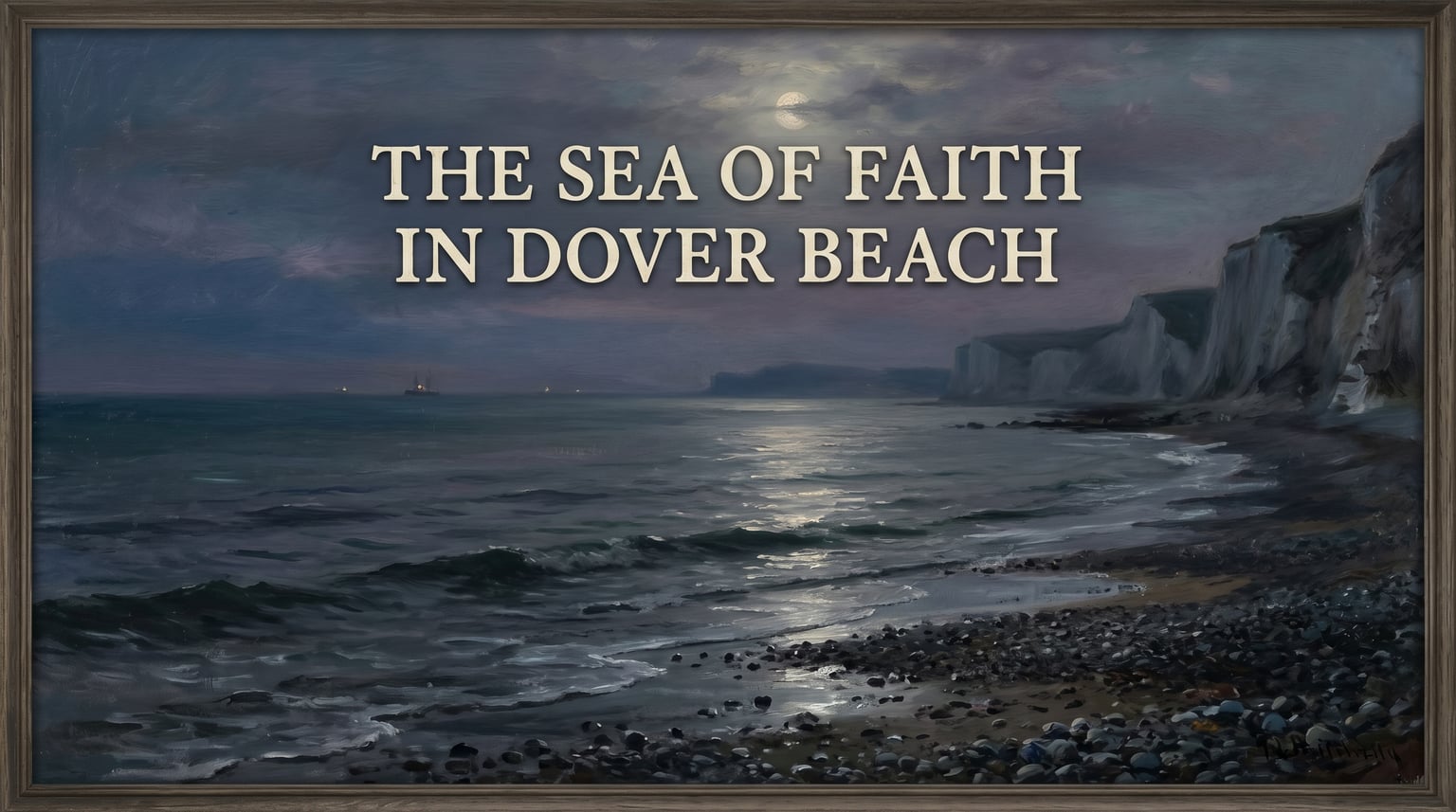
The Sea of Faith in Matthew Arnold’s “Dover Beach” is a metaphor for religious belief, specifically Christianity, that once filled the world like a vast ocean but is now withdrawing like an ebb tide. Arnold uses this image in the poem’s third stanza to express the Victorian era’s spiritual crisis, when scientific advances and modern thought were draining the strength of traditional faith.
Written in 1851 on his honeymoon, “Dover Beach” captures a moment of profound melancholy as Arnold watches the English Channel and contemplates what he sees as the slow retreat of religious certainty. The Sea of Faith metaphor has become one of the most quoted lines in Victorian poetry because it gives voice to a feeling many people share: that the world has grown quieter, colder, and less spiritually certain than it once was.
In this guide, I’ll walk you through what the Sea of Faith really means, how the ebb tide imagery works, why Arnold wrote this poem, and how the metaphor still speaks to readers today.
Table of Contents
What Does the Sea of Faith Symbolize in Dover Beach?
The Sea of Faith symbolizes Christianity, the dominant religious tradition of Victorian England, which Arnold believed was losing its hold on the modern world. The metaphor appears in lines 21-25 of the poem, where the speaker describes this “sea” as once being full, encircling the earth like a bright girdle, but now retreating with a “withdrawing roar.”
Here’s the key passage in full:
The Sea of Faith
Was once, too, at the full, and round earth’s shore
Lay like the folds of a bright girdle furled.
But now I only hear
Its melancholy, long, withdrawing roar
Arnold uses a body of water as his central image because the sea carries several layered associations at once. It suggests vastness, depth, and the sense of something that has been with humanity for as long as anyone can remember. When he says the Sea of Faith was “once, too, at the full,” he is telling us that religious belief, like the tide, reached a high point and seemed to touch every shore.
The metaphor is not a single religion being named. Most scholars read it as Christianity in the Western sense, given Arnold’s English context, but it can apply more broadly to organized religion and the sense of divine presence that once structured daily life.
How the Ebb Tide Imagery Connects to Faith
The ebb tide in “Dover Beach” is the natural image that gives the Sea of Faith metaphor its emotional power. Arnold opens the poem describing the literal sea, calm and full, then pivots to the metaphorical “sea” of faith that is doing the opposite, withdrawing.
There are three reasons this tidal imagery works so well:
- The tide feels natural and inevitable. Faith receding is not blamed on any single person. It is shown as a slow movement, like the ocean pulling back from the shore.
- The image invites sound into the poem. The “withdrawing roar” of the Sea of Faith mirrors the literal sound of waves pulling back from pebbles, which Arnold mentions just before.
- An ebb tide leaves the shore exposed. When the tide goes out, you see what was hidden. For Arnold, what is exposed is the world’s “melancholy” and the absence of the comfort religion used to provide.
The poem moves from physical description to metaphor almost without a break. The literal tide coming in on Dover Beach quietly becomes the spiritual tide going out across the world. That smoothness is what gives the lines their staying power.
Victorian Era Loss of Faith: Historical Context
Arnold wrote “Dover Beach” in 1851, at the height of the Victorian era, a period when traditional Christianity was being challenged by science, geology, and new ways of thinking. Charles Lyell’s geological work, Charles Darwin’s writings, and German biblical criticism were all reshaping how educated Victorians understood the age of the earth and the historical accuracy of scripture.
For many people of Arnold’s generation, the question was no longer whether religion mattered, but whether its core claims could survive the new knowledge. Arnold himself described this moment in his 1869 essay “Culture and Anarchy,” where he warned that his contemporaries were losing their way by abandoning the best of what tradition had given them.
Three forces were especially relevant:
- Scientific discovery pushed the age of the earth back far beyond the biblical timeline, undermining literal readings of Genesis.
- Higher criticism treated the Bible as a historical document compiled by many hands, which weakened the sense of it as direct divine revelation.
- Industrialization moved populations into cities, where traditional parish religion had less reach and new social problems demanded different kinds of answers.
Arnold felt this shift personally. The Sea of Faith metaphor is his way of giving a name to something he saw happening all around him. The ocean of belief was going out, and he wanted to describe the sound it made as it left.
Matthew Arnold’s Personal Religious Stance
Matthew Arnold is often described as an agnostic, though he disliked that label. He was the son of Thomas Arnold, the famous headmaster of Rugby School, and grew up in a serious Christian household. By the time he wrote “Dover Beach,” he had moved away from orthodox belief but had not given up on moral and spiritual seriousness.
In his essays, Arnold argued that literature and culture could do the work that religion used to do. Poetry, in his view, could replace the Bible as a source of meaning, comfort, and ethical guidance. That idea is the seed of the Sea of Faith metaphor. The metaphor is not just a complaint about the loss of faith. It is also a quiet offer of what might take its place.
Arnold himself would later say that the Christian religion had been “so great and so admirable” that he could not simply walk away from it. His melancholy in “Dover Beach” comes from this tension. He is not mocking faith. He is grieving its retreat.
The Sophocles Connection and Classical Influence
One of the most discussed passages in “Dover Beach” is the reference to Sophocles, the ancient Greek tragedian. The speaker imagines hearing the same sound across the Aegean that he hears on the English coast, the “eternal note of sadness” that runs through human experience.
Sophocles long ago
Heard it on the Aegean, and it brought
Into his mind the turbid ebb and flow
Of human misery
Arnold is suggesting that the loss of faith is not a Victorian problem. It is a permanent feature of human life. Sophocles, writing in the fifth century BCE, heard the same sadness. The image of ebb and flow that Arnold uses for faith comes directly from this Greek tragedy connection.
This reference does two things at once. It places the Victorian crisis inside a much longer story, and it lends the poem the authority of classical tradition. By tying his own moment to Sophocles, Arnold argues that the Sea of Faith is not a small English complaint. It is part of what it has always meant to be human.
Biblical Allusions: Does the Sea of Faith Have Religious Significance?
Readers often ask whether the Sea of Faith alludes specifically to the Sea of Galilee or another biblical body of water. This question comes up frequently in literary discussions, and the answer is that there is no scholarly consensus that Arnold was pointing to one specific biblical sea.
The metaphor is largely original. Arnold uses “sea” the way the Bible uses it in phrases like “sea of troubles” or “sea of glass,” as a way of describing something vast, sometimes threatening, sometimes holy. The biblical style is clearly present, but the image itself does not name one place.
What we can say with confidence is that the metaphor draws on biblical patterns of thought:
- Water as spiritual symbol. In the Bible, water often represents both life and chaos, blessing and danger. Arnold’s sea carries both weights at once.
- The “withdrawing roar.” This phrase echoes the way scripture describes God moving away from the Temple or the divine presence withdrawing from a place.
- Faith as something that once filled the world. The Psalms and the Prophets often speak of God’s glory filling the earth. Arnold inverts that image to describe its absence.
So while the Sea of Faith is not a direct biblical citation, it leans on a biblical way of seeing the world. That is part of why it has felt so familiar to readers for more than 170 years.
Modern Relevance of the Sea of Faith Metaphor
The Sea of Faith is not just a Victorian artifact. It keeps finding new readers because the feeling it names has not gone away. Each generation has its own version of the “withdrawing roar.”
In our own moment, several parallels stand out:
- Rising non-religious identity. In many Western countries, the share of people who say they have no religion has grown sharply over the past two decades. The sea of institutional faith has continued to recede.
- New sources of meaning. Just as Arnold hoped poetry might replace scripture, many people today look to psychology, science, art, or community for the comfort religion once offered.
- Political and cultural divides. The collapse of a shared religious story has not produced agreement. It has produced new battles over what should fill the space.
When modern readers find the lines “And we are here as on a darkling plain / Swept with confused alarms of struggle and flight,” they hear their own moment. The image of a darkened battlefield with no shared map fits almost any age that has lost its older certainties. That is part of why “Dover Beach” still turns up in everything from college syllabi to films and political speeches.
FAQs
What does the Sea of Faith symbolize in Dover Beach?
The Sea of Faith symbolizes Christianity and religious belief more broadly. Arnold describes it as a vast ocean that once encircled the earth but is now withdrawing like an ebb tide, leaving behind spiritual emptiness and uncertainty.
Does the Sea of Faith have biblical significance?
The Sea of Faith is not a direct citation of any specific biblical body of water, but it draws on biblical patterns. Water in scripture often stands for both blessing and chaos, and the phrase u0022withdrawing roaru0022 echoes the way the Bible describes God’s presence leaving a place.
What is the meaning of Dover Beach by Matthew Arnold?
Dover Beach is a Victorian lyric poem about the retreat of religious faith and the resulting sense of loneliness, uncertainty, and melancholy. Arnold moves from a calm seascape to a vision of a world without spiritual certainty, and ends by urging his companion to be true to each other in a darkened world.
What themes are explored in Dover Beach?
The main themes are the loss of religious faith, the melancholy of modern life, the permanence of human suffering, the contrast between natural beauty and spiritual emptiness, and the need for personal loyalty between two people in an uncertain world.
Conclusion
The Sea of Faith is Matthew Arnold’s way of giving a single image to the slow retreat of religious belief in the modern world. Once full and encircling, like a tide at its height, this ocean of faith now pulls back with a melancholy roar, leaving behind a world that feels colder, darker, and more uncertain.
Arnold’s poem still matters because that image has not stopped being true. Each generation has felt its own version of the ebbing tide, and each has had to decide what to hold on to in its place. For Arnold, the answer was love, art, and loyalty between two people standing together on a “darkling plain.” That answer is still worth thinking about in 2026, more than 170 years after he first wrote the lines down.