
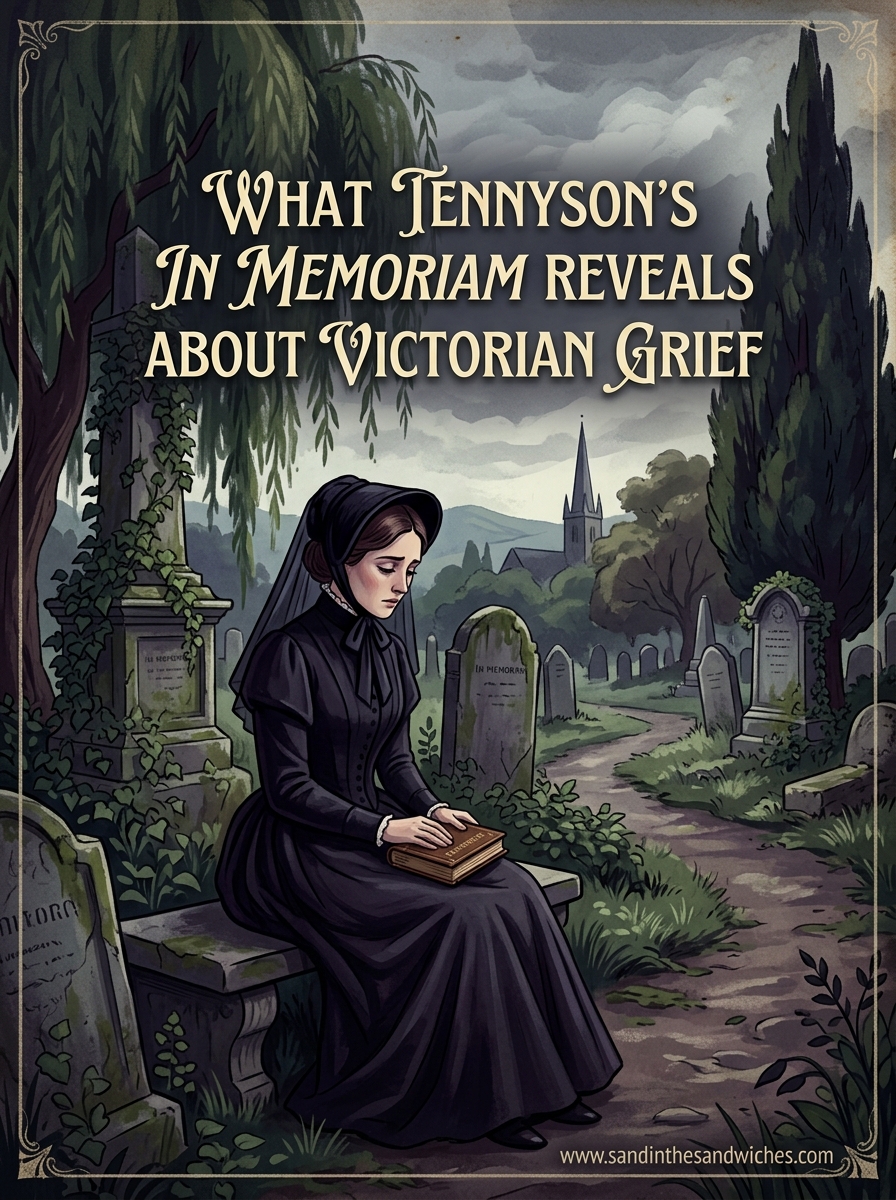
Alfred, Lord Tennyson wrote In Memoriam A.H.H. over seventeen years after losing his closest friend, Arthur Henry Hallam, in 1833. What started as private grief became one of the most significant poems of the Victorian era, capturing an entire nation’s complicated relationship with death, faith, and hope. The poem’s 131 cantos trace a raw emotional journey from despair toward something resembling acceptance. When Queen Victoria called it her comfort after Prince Albert’s death, it cemented the work as the definitive text on Victorian grief. Understanding what Tennyson’s In Memoriam reveals about Victorian grief means looking at the culture that produced it, the man who wrote it, and the emotional honesty that still moves readers today.
Table of Contents
What Tennyson’s In Memoriam Reveals About Victorian Grief
Tennyson’s In Memoriam reveals that Victorian grief was far more emotionally raw, spiritually turbulent, and psychologically complex than the era’s reputation for stiff formality suggests. The poem shows a culture where death was constant, faith was being tested by new scientific discoveries, and people desperately wanted to believe their lost loved ones still existed somewhere.
Victorians lived with death in ways that are difficult for modern readers to fully grasp. Childhood mortality was high, medicine was limited, and disease could take anyone at any time. Tennyson’s own grief for Hallam, who died of a brain hemorrhage at just 22, was devastating but not unusual. What made it extraordinary was his willingness to put every doubt, every moment of rage, every flicker of hope onto the page.
The poem became a mirror in which Victorian England saw itself. Readers recognized their own losses in Tennyson’s words. His willingness to question God, to scream into the void, and to slowly find his way toward belief gave others permission to do the same. That honesty is precisely what Tennyson’s In Memoriam reveals about Victorian grief: behind the black crepe and mourning rituals, people were wrestling with the same anguish anyone faces when someone they love is gone.
Arthur Henry Hallam: The Friend Tennyson Lost
To understand the poem, you need to know who Arthur Henry Hallam was. Tennyson met Hallam at Trinity College, Cambridge, in 1828. The two young men became inseparable friends almost immediately. Hallam was brilliant, charming, and widely regarded as a future leader of English letters. He was also engaged to Tennyson’s sister, Emily, which bound the families together even more closely.
Hallam died suddenly in Vienna in September 1833. He was 22 years old. The cause was a brain hemorrhage, likely the result of a congenital condition. The news reached Tennyson weeks later, and the loss shattered him. He was not merely mourning a friend but mourning the future they had planned together, the intellectual partnership, the family connection, the shared ambitions.
What strikes modern readers is the intensity of Tennyson’s grief for a friend. Some have asked whether the relationship was romantic, but the evidence points to a profound platonic friendship between two young intellectuals. In Victorian culture, friendship between men could carry enormous emotional weight without the constraints we sometimes impose on male relationships today. Hallam was Tennyson’s sounding board, his literary collaborator, and his deepest intellectual companion.
Tennyson’s response to the loss was not to move on quickly but to sit with the grief. He began writing fragments almost immediately. Some were raw cries of pain. Others were philosophical meditations on death and immortality. Over the next seventeen years, those fragments became In Memoriam A.H.H., a poem that turned private devastation into a universal text on mourning.
The Victorian Culture of Grief and Mourning
Victorian England had an elaborate grief culture that shaped how Tennyson wrote and how readers received the poem. Death was not hidden away in hospitals or sanitized institutions. It happened at home, in families, in communities. People witnessed it regularly, and entire systems of mourning developed to give structure to the chaos of loss.
Mourning customs were specific and socially enforced. Widows wore full black for a year or more, followed by periods of half-mourning in gray or lavender. Black crepe covered doors when someone died. Mourning jewelry made from the deceased’s hair was common. Queen Victoria herself set the ultimate example, wearing black for forty years after Prince Albert’s death in 1861 and withdrawing from public life for decades.
These rituals were not empty performance. They gave people a framework for expressing grief at a time when the emotional landscape was vast and largely uncharted. But they also created a culture where grief was shared and communal rather than private and isolating. When Tennyson published In Memoriam in 1850, he was speaking into a culture that understood mourning as a central life experience.
The Victorian relationship with death was also deeply religious. Most Victorians believed in some form of Christian afterlife, and the hope of reunion in heaven provided genuine comfort. But the nineteenth century also brought challenges to that faith. Geological discoveries, biblical criticism, and Charles Darwin’s work on evolution created a crisis of belief that Tennyson addresses directly in the poem. The tension between wanting to believe and struggling to do so is one of the most Victorian things about In Memoriam.
Death was also sentimentalized in Victorian culture. Literature of the period is full of deathbed scenes, angelic children, and tearful reunions expected in heaven. Some of this sentimentality can feel excessive to modern readers, but it reflected a genuine emotional reality. People processed loss through art, poetry, and shared cultural narratives because they had to. There was no grief counseling industry, no five-stage model, no clinical framework. There were poems like Tennyson’s.
Structure of the Poem: 131 Cantos and the ABBA Rhyme Scheme
The structure of In Memoriam is inseparable from its meaning. The poem consists of 131 numbered sections, or cantos, plus a Prologue and an Epilogue. Tennyson did not write them in order. He composed individual fragments over seventeen years and only later arranged them into a narrative that moves from grief toward hope.
Each canto follows the same metrical pattern: four-line stanzas in iambic tetrameter with an ABBA rhyme scheme. This is sometimes called an envelope stanza because the outer rhymes (A) enclose the inner rhymes (B). The effect is a sense of enclosure, containment, and circularity that mirrors the experience of grief, where thoughts loop back on themselves and the mourner feels trapped inside a repeating cycle of loss.
The ABBA scheme creates a feeling of pressure and release. The first and fourth lines rhyme, creating a frame. The second and third lines rhyme within that frame. When you read it, the sound seems to move inward and then outward again, like breathing. Tennyson chose this form deliberately, and its controlled musicality provides a container for emotions that would otherwise be unbearable.
The poem also includes several Christmas sections, spaced throughout the sequence at intervals. These mark the passage of time and show Tennyson’s grief evolving across years. Each Christmas looks different. The early ones are full of pain and forced cheer. The later ones show gradual healing. This structure gives readers a map of grief that unfolds over time rather than resolving quickly.
What Tennyson’s In Memoriam reveals about Victorian grief through its form is that mourning was understood as a long process, not a single event. The seventeen years of composition, the 131 cantos, the cyclical return of Christmas, and the enclosed rhyme scheme all communicate that grief is something you live inside of, not something you pass through in a weekend.
The Emotional Journey: From Despair to Hope
The emotional arc of In Memoriam is one of the poem’s most powerful features. Tennyson does not pretend that grief follows a straight line. Instead, the poem moves through waves of despair, anger, doubt, longing, and gradually, hope. The journey is messy, non-linear, and painfully honest.
In the early cantos, the grief is raw and physical. Tennyson describes ringing the doorbell and expecting Hallam to answer. He writes about the empty room, the silence, the unbearable weight of absence. These sections are some of the most relatable in all of Victorian poetry because they capture the mundane moments where loss ambushes you.
The middle sections are where the poem gets dark. Tennyson questions everything he has been taught to believe. He wonders if Hallam still exists anywhere. He confronts the possibility that death is simply the end and that all his religious faith is wishful thinking. Canto 55 contains the famous line about nature: “So careful of the type she seems, / So careless of the single life.” Tennyson is wrestling with the idea that nature is indifferent to individual suffering, a thought that terrified him and many of his contemporaries.
The Christmas cantos punctuate this journey and show time passing. In the early Christmases, Tennyson cannot bear the festivities. The songs and decorations feel like insults. By the later Christmases, he is starting to find moments of genuine peace, even if the loss never disappears.
Toward the end of the poem, something shifts. Tennyson begins to experience what he describes as a spiritual awakening. In Canto 95, he describes a moment of trance-like connection where he feels Hallam’s presence. Whether this was a mystical experience, a psychological event, or a poetic invention, it marks the turning point where grief transforms from pure pain into something that also contains love and gratitude.
The poem’s final movement is toward hope, but it is not cheap hope. Tennyson does not claim that everything is fine. He arrives at a place where he can hold grief and faith simultaneously, where he can believe in reunion without pretending the loss did not happen. The Epilogue, which describes his sister’s wedding, suggests that life continues and that Hallam’s influence lives on in the people who loved him.
Modern psychologists will recognize this pattern. Elisabeth Kubler-Ross identified stages of grief (denial, anger, bargaining, depression, acceptance), and later researchers emphasized that these stages are not linear. Tennyson’s poem, written more than a century before Kubler-Ross, captures this same non-linear quality. The speaker cycles through stages repeatedly, sometimes moving forward and sometimes falling back. What Tennyson’s In Memoriam reveals about Victorian grief is that people in the nineteenth century understood intuitively what science would later confirm: grief is a long, winding, unpredictable process.
Faith, Doubt, and Victorian Anxiety
One of the central revelations of In Memoriam is how deeply Victorian grief was intertwined with religious faith and doubt. Tennyson was a man of his time, and his time was one of enormous theological upheaval. The early nineteenth century saw the rise of geological science that challenged biblical timelines. The publication of Charles Lyell’s Principles of Geology in the 1830s suggested the Earth was far older than the Bible implied. Darwin’s On the Origin of Species would not appear until 1859, but the intellectual ground was already shifting.
Tennyson felt this shift personally. In In Memoriam, he questions whether the soul survives death, whether God is paying attention, whether nature has any moral purpose at all. Canto 54 contains the lines: “Oh yet we trust that somehow good / Will be the final goal of ill.” The word “somehow” carries enormous weight here. Tennyson wants to believe, but he cannot be certain, and the poem does not let him off the hook.
The most famous expression of this anxiety comes in Canto 56: “Nature, red in tooth and claw.” Tennyson is imagining nature as a violent, indifferent force that creates and destroys without moral purpose. If nature is all there is, then Hallam’s death means nothing. The individual life is simply food for worms. This thought horrified Tennyson, and he spent dozens of cantos fighting it.
Christian eschatology, the theological study of death and final things, gave Victorians a framework for hope. The promise of resurrection and reunion in heaven was the counterweight to despair. Tennyson leans on this hope throughout the poem, but he does so honestly. He does not simply declare that Hallam is in heaven and move on. He wrestles with doubt, confronts his own skepticism, and arrives at faith through struggle rather than blind acceptance.
This is perhaps the most Victorian thing about the poem. The era was defined by tension between traditional religious belief and new scientific knowledge. People wanted desperately to believe their loved ones still existed, but they were also educated enough to find belief difficult. Tennyson gave voice to that tension with such honesty that the poem became a kind of scripture for doubting Victorians. When people called it a religious poem, Tennyson reportedly said it was not religious but the cry of the whole human race.
Famous Lines and Their Significance
Several lines from In Memoriam have become part of the English literary consciousness. They appear in graduation speeches, memorial services, and popular culture. Understanding them in context deepens their meaning considerably.
The most quoted line from the poem is: “‘Tis better to have loved and lost / Than never to have loved at all.” This comes from Canto 27, and it is often used as a reassuring platitude. In context, however, it is a hard-won conclusion. Tennyson has spent twenty-six cantos in agony, and this line is his first tentative step toward gratitude. He is not saying the pain was worth it casually. He is saying it after surviving the worst thing that ever happened to him.
The phrase “Nature, red in tooth and claw” from Canto 56 is frequently quoted in discussions of evolution and natural selection, even though Tennyson wrote it before Darwin published his theory. Tennyson intuited from his own observations and from contemporary science that nature was not the benevolent force romantic poets described. The line captures a distinctly Victorian anxiety about what science was revealing about the world.
“Ring out, wild bells” from Canto 106 has become a New Year’s tradition in many English-speaking countries. In context, it is a prayer for renewal and for leaving behind grief, division, and old ways of thinking. Tennyson asks the bells to “ring out the false, ring in the true” and to “ring in the Christ that is to be.” It is one of the poem’s most hopeful passages, arriving after the long darkness of the middle sections.
Each of these lines endures because it crystallizes a universal human experience. The fear of loss, the terror of meaninglessness, the hope for renewal. These are not exclusively Victorian concerns, which is why the poem still speaks to readers today.
Why In Memoriam Comforted an Entire Nation
When In Memoriam was published anonymously in 1850, it became an immediate sensation. Readers guessed Tennyson was the author within months, and the poem went through numerous editions. It was not just popular but deeply personal for many readers. People wrote to Tennyson telling him the poem had helped them survive their own losses.
Queen Victoria was among the poem’s most famous admirers. After Prince Albert’s death in 1861, she reportedly found more comfort in In Memoriam than in any other text. She met Tennyson and told him personally what the poem had meant to her. The connection between the monarch’s grief and the poet’s work cemented In Memoriam as the definitive Victorian text on loss.
The poem’s comfort came from its honesty. Tennyson did not offer easy answers. He did not tell readers their pain was part of a divine plan they were too small to understand. Instead, he sat with them in the darkness and admitted that the darkness was real. Only after fully acknowledging the pain did he begin to point toward hope. That sequence, despair before comfort, was what made the poem trustworthy. Readers felt they were not being consoled by someone who did not understand but accompanied by someone who had been there.
Critic Harold Bloom included In Memoriam in his collection of the best poems in the English language, calling attention to its extraordinary combination of intellectual depth and emotional power. The poem’s ability to comfort while refusing to simplify is what made it the right poem for Victorian England and what keeps it relevant.
In Memoriam and Modern Grief Psychology
One of the most striking things about reading In Memoriam through a modern lens is how accurately it anticipates contemporary grief psychology. Elisabeth Kubler-Ross published her five-stage model of grief (denial, anger, bargaining, depression, acceptance) in 1969. Modern grief researchers like George Bonanno have since complicated that model, showing that grief is more varied and individual than any fixed sequence suggests.
Tennyson, writing more than a century earlier, already understood this. The speaker in In Memoriam does not move neatly through stages. He cycles through denial, rage, bargaining, despair, and acceptance multiple times. He has good days and terrible days. He experiences moments of unexpected peace followed by crushing relapses. This is what real grief looks like, and it is what researchers now describe as a non-linear, individualized process.
Modern grief theory also emphasizes the continuing bond between the living and the dead. Rather than requiring mourners to “move on” and sever ties with the deceased, contemporary psychology recognizes that healthy grief involves finding a new relationship with the person who is gone. Tennyson models this beautifully. By the end of the poem, Hallam is not forgotten or left behind. He is transformed into a spiritual presence that continues to shape Tennyson’s life.
Forum discussions about In Memoriam reveal that modern readers still turn to the poem when they are grieving. Reddit users in poetry communities share how specific cantos captured exactly what they felt when they lost someone. Book club participants describe reading “Ring Out, Wild Bells” aloud at memorial gatherings. The poem has become a living text that people use to process loss, much as Victorian readers did.
What Tennyson’s In Memoriam reveals about Victorian grief, then, is something that transcends the Victorian era. It reveals that grief has always been a long, complicated, non-linear process. It reveals that people have always needed art and language to give shape to loss. And it reveals that honesty, the willingness to say exactly how much it hurts without rushing to comfort, is the most compassionate thing a writer can offer someone in pain.
FAQs
What is the main purpose of Tennyson’s In Memoriam?
The main purpose of In Memoriam is to process and articulate Tennyson’s grief over the death of his closest friend, Arthur Henry Hallam. Written over seventeen years, the poem transforms private mourning into a universal exploration of loss, faith, doubt, and eventual hope for reunion after death.
What is the poem about grief in Victorian poetry?
In Memoriam A.H.H. is the defining Victorian poem about grief. It captures how nineteenth-century Britons experienced mourning: through elaborate rituals, deep religious faith challenged by scientific doubt, and a communal understanding of death as a constant presence. The poem gave Victorian readers language for their own losses.
What is the famous line of In Memoriam?
The most famous line is: u0022’Tis better to have loved and lost / Than never to have loved at all.u0022 Other widely quoted lines include u0022Nature, red in tooth and clawu0022 and u0022Ring out, wild bells.u0022 Each captures a different facet of the poem’s exploration of grief, doubt, and hope.
What are the Victorian elements in Tennyson’s poetry?
Victorian elements in Tennyson’s poetry include the tension between Christian faith and scientific doubt, elaborate mourning culture, deep engagement with nature, moral seriousness, and concern with social progress. His work reflects the era’s anxieties about evolution, industrialization, and the survival of the soul after death.
What is the main theme of In Memoriam?
The main theme is the passage through grief from despair toward hope. The poem explores how loss tests faith, how memory sustains connection with the dead, and how love can survive even when the person you love is gone. Secondary themes include nature’s indifference, the possibility of immortality, and the tension between belief and doubt.
How are life and death represented in the poem In Memoriam?
Life and death are portrayed as intertwined rather than opposed. Death is presented as a painful separation but not necessarily a final one. Tennyson represents life as something that continues after loss, shaped by memory and love, while death is explored as a possible threshold to reunion and spiritual transformation rather than simply an end.
Conclusion
What Tennyson’s In Memoriam reveals about Victorian grief is that behind the formal mourning rituals and religious certainty, Victorians experienced loss with the same rawness, confusion, and desperate hope that anyone faces today. Tennyson’s genius was refusing to simplify that experience. He gave his readers despair and faith, doubt and hope, all at once, and trusted them to hold the contradiction.
The poem endures because grief endures. Every generation discovers it anew when loss enters their lives. If you have not read In Memoriam in full, start with the most famous cantos (27, 54, 55, 56, 106) and let the poem find you where you are. Tennyson wrote it for himself, but he also wrote it for anyone who has ever loved someone and lost them.