
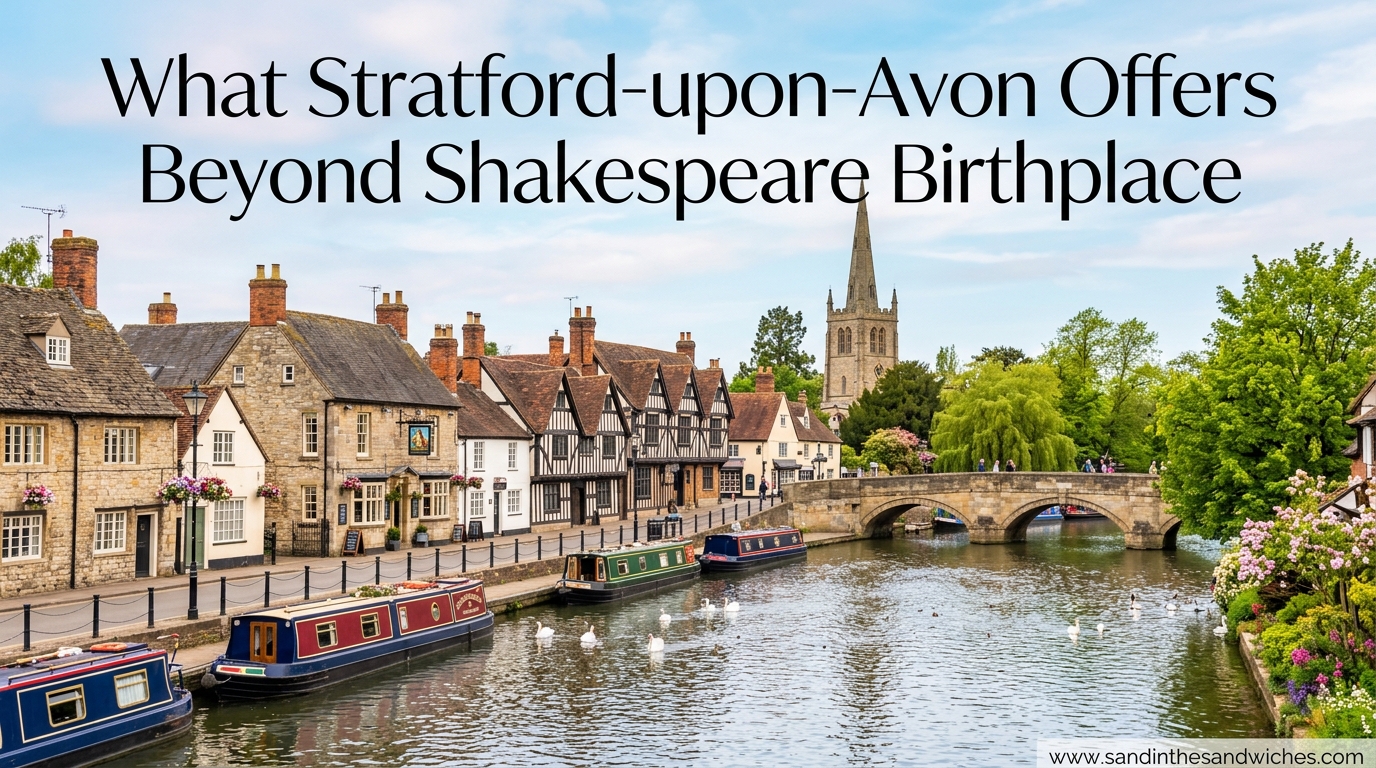
Ask most people what comes to mind when they think of Stratford-upon-Avon and you get the same answer: Shakespeare. His birthplace on Henley Street, the tat shops selling quill pens, the coach parties pouring off buses from London. But spend a few days here the way I have and a different town emerges. Stratford-upon-Avon beyond Shakespeare turns out to be a working Warwickshire market town with a river running through it, half-timbered Tudor streets that locals actually live on, a working canal basin, and a food scene that has nothing to do with Elizabethan theme pubs. There are walking and cycling routes most visitors never find, world-class theatre that stands on its own merits, and quiet corners where the only crowd is swans on the water. This guide is for the people who want to explore Stratford-upon-Avon beyond Shakespeare’s Birthplace without queuing behind forty tourists to see a recreated sixteenth-century bed.
I have put this together from multiple visits across different seasons, conversations with residents, and a fair amount of wandering down alleys that turn out to lead somewhere interesting. Whether you have a single day or a long weekend, what follows is the Stratford that exists once you step off the obvious tourist track.
Table of Contents
Why Most Visitors Miss the Real Stratford-upon-Avon
The problem with Stratford is that the obvious attractions are genuinely good, so most itineraries stop there. Shakespeare’s Birthplace, Anne Hathaway’s Cottage and Holy Trinity Church can fill a day on their own, and the coach tour operators know it. The result is that thousands of visitors each week cluster in a tight rectangle between Henley Street, Bridgefoot and the RSC theatre, then leave convinced they have seen the town.
They have not. The town centre is genuinely compact, which is part of the trick. You can walk from one side to the other in fifteen minutes, and that breeds the assumption that there is nothing else. But Stratford sits on a river, a canal, and the edge of open Warwickshire countryside, all within twenty minutes on foot from the Birthplace. The Greenway cycle path starts almost in the town centre. The racecourse and its skylarks are a short walk south. There are Tudor streets with no signage, no ticket office and no queue, just residents getting on with their lives in sixteenth-century buildings.
The other reason people miss the real Stratford is that the official marketing leans heavily on the Shakespeare Birthplace Trust properties. Those are brilliant and worth doing, but they frame the town as a single-theme destination. Locals on the r/StratfordUponAvon subreddit joke that the place feels overrun by one story. It does not have to be that way for you.
The Royal Shakespeare Company: Theatre Worth Travelling For
Here is the thing people forget about the Royal Shakespeare Company: it is one of the best theatre companies in the English-speaking world, regardless of what is on the stage. The RSC performs Shakespeare, yes, but it also stages new writing, modern classics and experimental work across three venues. If you have written off the RSC because you do not care about the Bard, you are missing the point.
The Royal Shakespeare Theatre on Waterside is the headline venue, with its thrust-stage auditorium that puts the audience on three sides of the action. There is no bad seat in that room, and the building itself has been redesigned in the last fifteen years into a genuinely public space. You do not need a ticket to walk in. The ground-floor foyer opens onto the river, the rooftop restaurant has one of the best views in town, and the 32-metre Tower gives you a panorama over Stratford and the Avon valley for a small fee.
The Swan Theatre, tucked inside the same building, is the more intimate space and often where the most interesting work happens. Smaller casts, braver programming. The Other Place, a short walk away on Southern Lane, is the RSC’s studio theatre and rehearsal home, opening for smaller productions and open days. I once caught a rehearsal-room sharing there that was more memorable than the main-house show I had come to see.
Practical tip: tickets are cheaper than West End equivalents, and the RSC runs a tickets scheme for under-25s and students at reduced prices. Even if you think you do not like theatre, book something. It is what residents do on a Tuesday night, and it is the single best reason Stratford-upon-Avon is more than a museum town.
Anne Hathaway’s Cottage and the Shottery Walk
Anne Hathaway’s Cottage is on most Stratford itineraries, so I am not going to pretend it is a hidden gem. What most visitors miss is the walk to get there. The cottage sits in Shottery, a village that has effectively been swallowed by Stratford but still feels separate. You can reach it by road in ten minutes, but the better route is on foot across the fields.
The footpath starts near the railway station and follows hedgerows and the edge of arable land for about a mile. You emerge at the cottage gardens having crossed proper Warwickshire countryside, swallows in summer, ploughed fields in winter. It completely changes how you read the place. Anne Hathaway, then Anne Whateley or whoever she was, lived in a working farmhouse in a working landscape, not a tourist attraction on a coach route.
The cottage itself is a beautiful thatched and timber-framed building, with twelve rooms open to explore and a garden that is far larger than most people expect. The Shakespeare Birthplace Trust has planted the orchard with heritage varieties, and there is a sculpture trail and woodland walk that extends the visit well beyond the house. Budget ninety minutes minimum, not the thirty most coach parties give it.
For the walk back, take the lane through Shottery village rather than the field path. There are cottages, a small churchyard, and a couple of houses that would not look out of place in aCalendar photo. It is a quiet end to the visit and takes you back into town past the back of the RSC.
Holy Trinity Church: Shakespeare’s Grave and Beyond
Holy Trinity Church is where Shakespeare is buried, which is the reason most people visit, and the reason many others skip it. Both reactions are wrong. The church is one of the most atmospheric buildings in Warwickshire, set on the banks of the Avon in the oldest part of the town, and worth a visit even if you have no interest in the Bard.
The building itself is mostly fifteenth-century, with a chancel that contains the Shakespeare grave and a fine set of carved misericords. The plaster and timber roof is genuinely impressive. You enter through the south porch and immediately feel the weight of the place, the kind of hush you only get in English parish churches that have been in continuous use for six hundred years. There is a small fee to enter the chancel where Shakespeare is buried, but the nave is free and the rest of the church rewards slow looking.
What I love most is the setting. The churchyard slopes down to the river, with weeping willows and a footpath that leads along the Avon back into town. On a summer evening, with swans on the water and the tower of the church behind you, it is one of the most peaceful spots in Stratford. I have sat on that bench for an hour and not seen another tourist.
The Avon Bank footpath from the church to the Tramway Bridge is the riverside walk everyone tells you to take. Take it, then keep going. The path continues past the RSC and Bancroft Basin, all the way to the weir, and forms part of a longer loop if you cross at Lucy’s Mill and come back along the other side.
River Avon, Bancroft Gardens and the Canal Basin
The River Avon is the reason Stratford exists where it does. The town was a ford, then a bridge, then a market, and the river still shapes everything. Treat it as a feature, not a backdrop, and the town opens up.
Bancroft Gardens sits between the RSC and the river, and on a sunny weekend it is full of locals in a way that surprises visitors expecting a tourist honeypot. There are flower beds, a Victorian fountain, the Gower Memorial (Shakespeare surrounded by four of his characters), and an open lawn where buskers play and kids run around. Free, always open, and a great place to eat a takeaway lunch from one of the nearby cafes.
The canal basin, properly called Bancroft Basin, is where the Stratford-upon-Avon Canal meets the river. This is the quiet end of the waterfront. Narrowboats moor here, the lock keepers work the gates, and there is a small marina with liveaboard boaters who are usually happy to chat. The towpath heads north-west out of town along the canal, and within twenty minutes you are in deep countryside with the town completely behind you.
For river activities, you have options. Avon Boating runs rowing boats and small motor launches from the Bancroft Basin side of the river, and the larger passenger boats run 45-minute sightseeing cruises from just below the RSC. The passenger cruises are touristy but a genuinely nice way to see the town from a different angle, especially the upstream stretch towards Holy Trinity. Bring a coat; the wind on the water is colder than you think.
If you want a longer walk, the Avon footpath heads upstream through the Lench meadows, a flood plain with wild flowers in summer and big skies all year. It is the kind of walk residents do on a Sunday morning, and you will pass maybe three other people in an hour.
The Greenway: Stratford’s Best Kept Cycling and Walking Route
Of all the Stratford-upon-Avon beyond Shakespeare attractions, the Greenway is the one I most want people to know about. It barely features in standard tourist guides, but for residents it is the single best thing about the town for getting outdoors.
The Stratford Greenway is a traffic-free path that starts at the Seven Meadows Road car park, just south of the town centre, and runs along the route of a disused railway line. It is part of the Sustrans National Cycle Network, surfaced and well maintained, suitable for bikes, wheelchairs, pushchairs and walking boots. The first stretch takes you out past the back of the racecourse and through open fields.
You can cycle the whole route to Long Marston and back in about two hours at a gentle pace, or walk the first couple of miles for a shorter outing. There are benches, wildflower banks in summer, and the skylarks that the Guardian writer fell in love with when she moved here. It is properly quiet. You hear birdsong and wind, not traffic.
Bike hire is available in town from a couple of outlets near the railway station, or you can bring your own. The surface is fine for hybrids and gravel bikes, less fun on a road bike with skinny tyres. Families love it because it is completely car-free and flat.
For non-cyclists, the Greenway is also a beautiful walk and connects into a wider network of footpaths if you want to extend it. You can loop back along the river and into town through the Lench meadows, making a half-day circuit that takes in canal, river and disused railway. That loop is my single favourite thing to do in Stratford, and almost no tourist will ever take it.
Shakespeare’s Schoolroom, Guildhall and the Tudor Streets
Shakespeare’s Schoolroom and Guildhall is the attraction most often skipped, and the one I would argue is most worth your time if you only have one day. It sits on Church Street in the heart of the old town, above the King Edward VI school that Shakespeare attended, and it is one of the few buildings in Stratford where you genuinely feel you are walking through a room he walked through.
The Guildhall is a medieval and Tudor building with original wall paintings, a Council Chamber where the town was governed, and the upstairs schoolroom where Latin was drummed into young William. Costumed interpreters run short lessons, and you can sit at the same kind of bench he would have sat at. It is hands-on, intimate and properly historical, in a way that the recreated Birthplace rooms upstairs are not.
The Guild Chapel next door is free to enter and has one of the most extraordinary sets of medieval wall paintings in the country, uncovered during restoration work. The Doom painting over the chancel arch is rare and powerful. Most visitors walk straight past on their way to somewhere else. Do not be most visitors.
From the Schoolroom, wander the surrounding streets. Chapel Street, Sheep Street and Ely Street are lined with half-timbered buildings, many of which are still private homes or offices. Harvard House, on the corner of Sheep Street, is a stunning 1596 townhouse with carved timbers that has nothing to do with Shakespeare and everything to do with how wealthy Stratford was in the Elizabethan period. Just walk and look up. The architecture is the attraction, and it is free.
Hidden Gems: MAD Museum, Butterfly Farm and Magic Alley
For families, non-Shakespeare fans, or anyone who has done the obvious sights, Stratford has a small cluster of alternative attractions that punch above their weight. None of them require any interest in the Bard.
The MAD Museum (Mechanical Art and Design) on Henley Street is a love-it-or-hate-it kind of place, and I love it. It is a small museum of kinetic art, automata and mechanical contraptions, with buttons to press, handles to turn and marble runs that take ten minutes to complete. Children go slightly mad for it. Adults do too, in my experience. It is the kind of place where you go in for half an hour and emerge two hours later having missed lunch.
The Stratford-upon-Avon Butterfly Farm is just across the river from the RSC, in a set of heated glasshouses full of free-flying tropical butterflies. It is genuinely magical in a way that surprised me. The butterflies land on you, the air is warm and humid, and there is a leafcutter ant colony running across vines overhead. Excellent on a cold or rainy day when the rest of your plans have been scuppered.
Magic Alley, on Bell Court, is harder to describe. It is part shop, part experience, part immersive puzzle trail, themed loosely around magic and Shakespeare. You buy a ticket to an indoor quest that takes you through rooms solving clues, with a strong Hogwarts-meets-Stratford vibe. Families with older children rate it highly, and it is unlike anything else in town.
The Shakespeare Distillery over on the Drayton Manor Industrial Estate is the town’s only working distillery, producing gin and vodka using local ingredients. They run tours with tastings, plus a gin school where you can distil your own bottle to take home. It is a genuinely adult activity in a town that can feel very child-focused during school holidays. Book ahead.
Where Locals Eat and Drink in Stratford-upon-Avon
The food scene in Stratford-upon-Avon beyond Shakespeare is genuinely better than the tourist-focused pub menus in the town centre suggest. The trick is to know where locals actually go.
For a proper pub lunch, the Old Thatch Tavern on Greenhill Street is the one I send people to. It is a Grade II listed fifteenth-century timber-framed building, with low ceilings, open fires in winter, and a menu that goes well beyond the usual carveries. The Lamb on Sheep Street is another good option, more modern in style but still in a historic building. Both get busy in the evening, so book.
For something different, try Loxley’s Restaurant and Bar on the canal basin. It is themed around Robin Hood and the Forest of Arden, which sounds tacky but is not. The setting is excellent, right on the water, and the menu is modern British with game and local produce. Good for a slow dinner.
The local cafe scene is stronger than the chains on the high street suggest. The Foodist, near the train station, does excellent brunch and is where commuters grab coffee in the morning. Barnaby’s on Sheep Street is the ice cream institution, with a queue down the street on a hot day. Chestnut Court, the small shopping courtyard off the high street, hides a couple of independent coffee shops worth tracking down.
For a treat, the Rooftop Restaurant at the RSC is genuinely good and has the best view of any restaurant in town. It is not cheap, but the food is serious and the panorama over the river and Bancroft Gardens is unmatched. Book a window table for sunset.
One to avoid unless you specifically want a tourist experience: the themed Elizabethan banquets. Locals do not go. Walk ten minutes in any direction and you will find better food for less money in a building that is just as old.
A One-Day Stratford-upon-Avon Itinerary (Beyond Shakespeare)
If you only have one day, here is how I would structure it to see the best of Stratford-upon-Avon beyond Shakespeare’s Birthplace without burning yourself out. Timings are approximate and assume a moderate walking pace.
9:00 am: Start at the canal basin behind the RSC. Spend twenty minutes watching the narrowboats and the lock, then walk five minutes up to Holy Trinity Church. Arrive early to beat the coach parties at Shakespeare’s grave.
10:00 am: Walk the river path from the church past the RSC and into Bancroft Gardens. Coffee at a cafe on Waterside. If it is a nice morning, sit in the gardens and watch the swans.
11:00 am: Shakespeare’s Schoolroom and Guildhall on Church Street. This is the one historical site I would prioritise over the Birthplace itself. The wall paintings in the Guild Chapel next door are free.
12:30 pm: Walk to Anne Hathaway’s Cottage via the Shottery footpath. The walk is part of the experience, so do not cheat and take a taxi unless mobility requires it.
1:00 pm: Lunch. If you have come from Shottery, the options in town are better than out that way. Head back to the town centre for the Old Thatch Tavern, or grab takeaway and eat in Bancroft Gardens.
2:30 pm: Pick your afternoon. If you are theatre-curious, do the RSC Tower for the view and the building tour. If you have kids, the MAD Museum or Butterfly Farm. If you want quiet, walk the Greenway or the canal towpath for an hour.
4:00 pm: Ice cream at Barnaby’s, then wander Sheep Street and Chapel Street looking at the half-timbered buildings. Harvard House is on the corner and worth ten minutes of slow looking.
7:30 pm: Dinner at Loxley’s on the canal basin, or the Rooftop Restaurant at the RSC if you have booked ahead. Then catch a show at the RSC, the Swan, or The Other Place. Even if you do not think you like theatre, this is what Stratford does best.
If you have a second day, the Greenway cycle ride, the longer river loop, and a trip out to Charlecote Park or Warwick Castle fill a more leisurely day without ever going near the Birthplace.
Practical Tips: Getting There, Getting Around and Avoiding Crowds
Stratford-upon-Avon is in southern Warwickshire, about a hundred miles north-west of London. It is one of the easier English market towns to reach car-free, which is a real bonus.
By train, there are two stations. Stratford-upon-Avon station is the main one, walkable to the town centre in five minutes. Trains from London Marylebone run direct via Leamington Spa and take around two hours. Stratford Parkway, on the eastern edge, is closer to the Greenway and serves some Birmingham and London trains. Both are well connected.
By car, Stratford is at the intersection of the A46 and A3400. Parking in the town centre is expensive in summer and busy on weekends. Use the park and ride. It runs from Bishopton to the south of the town, costs around £1.70 for all-day parking with the bus into town included, and is genuinely excellent. Locals use it. There is also a large car park at Seven Meadows Road near the leisure centre, close to the start of the Greenway.
Once you are in town, you walk. Stratford is genuinely compact, and the most rewarding streets are narrow and Tudor, which is not fun in a car. There is a hop-on hop-off bus that loops the main sights, including Anne Hathaway’s Cottage, if you want to save your legs. It is a tourist thing but a sensible one if you have mobility issues or are short on time.
On avoiding crowds: the trick is timing. Coach parties arrive mid-morning and leave mid-afternoon. If you can be at the main Shakespeare Birthplace Trust sights either before 10 am or after 3 pm, you will have a much quieter experience. Weekdays are quieter than weekends. Shoulder season (March, April, October) is the sweet spot for weather and quiet. Avoid school holidays if you possibly can.
A note on closed attractions: the Shakespeare Birthplace Trust has rotated its properties over recent years, with Mary Arden’s Farm and Hall’s Croft sometimes closed for conservation work or reopening on different schedules. Check the Trust website before you commit to a multi-property ticket. The Explorer Pass covers all the open Trust properties and is the best value if you plan to do several.
If you have time for a day trip beyond Stratford, Charlecote Park (National Trust, Elizabethan mansion with deer park) is ten minutes away and stunning. Warwick Castle is twenty minutes on the train and is excellent if you like your history with a side of commercial spectacle. Both make good extensions to a Stratford visit without diluting it.
FAQs
What is worth seeing in Stratford-upon-Avon besides Shakespeare’s Birthplace?
Beyond the Birthplace, the highlights are the Royal Shakespeare Company theatres, Anne Hathaway’s Cottage with the Shottery footpath walk, Holy Trinity Church on the river, the MAD Museum, the Butterfly Farm, and the Greenway cycling and walking route. The canal basin, Bancroft Gardens and the half-timbered Tudor streets around Sheep Street and Chapel Street are also worth exploring.
Is Stratford-upon-Avon worth visiting if you are not a Shakespeare fan?
Yes. The town has world-class theatre at the RSC that goes well beyond Shakespeare, attractive Tudor architecture, river and canal walks, a local food scene, independent shops, and nearby countryside including the Greenway. Many non-Shakespeare fans find the riverside and the half-timbered streets alone justify the visit.
How long do you need in Stratford-upon-Avon?
A long day gives you the major sights and a riverside walk. A full weekend lets you add an RSC show, the Greenway, Anne Hathaway’s Cottage at a relaxed pace, and a meal at one of the better local restaurants. Two nights is the sweet spot for most visitors.
Can you do Stratford-upon-Avon as a day trip from London?
Yes. Direct trains from London Marylebone take around two hours each way, making a long day trip perfectly feasible. Aim for an early train out and a late train back to fit in the RSC, a meal, and at least one of the historic properties without rushing.
What is the best way to avoid crowds in Stratford-upon-Avon?
Visit the main Shakespeare Birthplace Trust sights before 10 am or after 3 pm, come on a weekday outside school holidays, and spend the middle of your day on the river, the canal basin, the Greenway or the Lench meadows where coach parties do not go.
The Stratford Most Visitors Never See
Stratford-upon-Avon beyond Shakespeare is a working town with a working river, a working theatre company and a working canal. The attractions most visitors queue for are genuinely good, but they are a small fraction of what is on offer. Spend an extra day, walk the Greenway, eat where the locals eat, sit by the Avon at dusk, and the place opens up in a way the coach-tour version never quite manages. The next time someone tells you Stratford is just Shakespeare, send them this guide.