
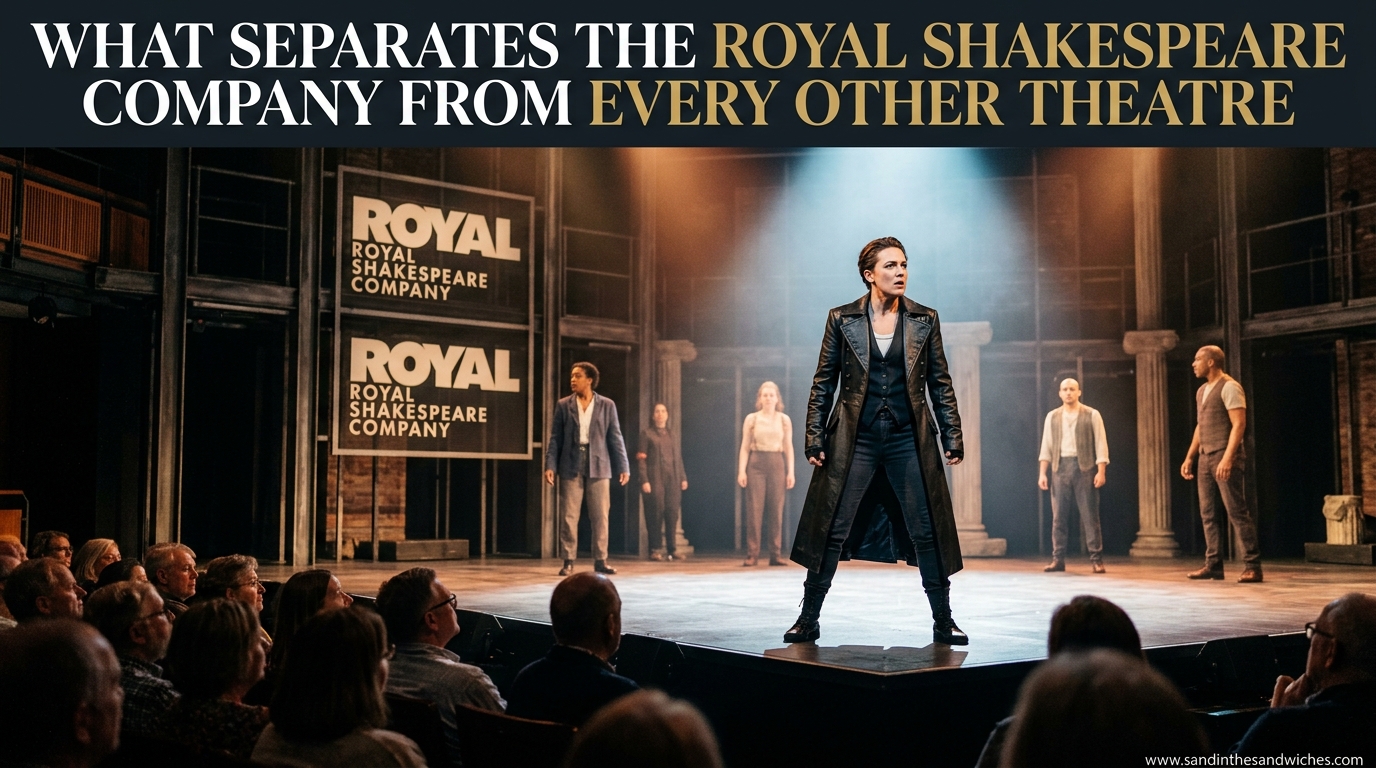
Ask any serious theatregoer which company most defines how Shakespeare is performed today, and one name comes up again and again: the Royal Shakespeare Company. But what separates the Royal Shakespeare Company from every other theatre in Britain, or indeed the world? The answer is not just that it stages Shakespeare in Stratford-upon-Avon. Plenty of theatres do that. The RSC stands apart because of how it was built, how its actors work together, how its stages were designed, and how it has shaped the careers of some of the most recognisable performers of the last century.
I have spent years following productions across the UK, from the National Theatre on the South Bank to Shakespeare’s Globe on Bankside. Each of those institutions has real strengths. None of them, however, operates quite like the RSC. The Royal Shakespeare Company combines a resident ensemble, a purpose-built thrust stage modelled on Elizabethan playhouses, a dual commitment to Shakespeare and new writing, and a global touring footprint that most regional theatres can only dream of. Together, those pieces form a model that no other theatre has fully replicated.
This guide breaks down exactly what separates the Royal Shakespeare Company from every other theatre. We will look at its origins in the 1879 Shakespeare Memorial Theatre, the 1961 rebranding under Peter Hall, the ensemble acting model that remains its beating heart, the Stratford and London venues that shape its work, and a direct comparison with the National Theatre and the Globe. By the end, you will understand not just what the RSC does, but why no other company does it the same way.
Table of Contents
What Separates the Royal Shakespeare Company From Every Other Theatre: The Short Answer
Before getting into the history and detail, here is the direct answer. The Royal Shakespeare Company is separated from every other theatre by six distinguishing features that, taken together, no comparable institution matches at the same scale:
- A resident ensemble company of actors, directors, and writers who rehearse and perform together across a full season, rather than being cast show-by-show.
- A founding mandate to perform Shakespeare and new plays side by side, set out by Peter Hall in 1961.
- A purpose-built thrust stage in the Royal Shakespeare Theatre, designed to mirror the audience-actor relationship of Elizabethan playhouses.
- Three permanent Stratford-upon-Avon venues (the Royal Shakespeare Theatre, the Swan Theatre, and The Other Place) plus a London residency history at the Barbican and Aldwych theatres.
- Royal patronage and a national mission, formalised when the Shakespeare Memorial Theatre Company became the Royal Shakespeare Company by royal charter.
- A pipeline of elite actor training that has produced Patrick Stewart, Ian McKellen, Judi Dench, Maggie Smith, David Tennant, and generations more.
No other single theatre combines all six. The National Theatre has an ensemble tradition but no Shakespeare birthplace mandate. The Globe recreates an Elizabethan playhouse but operates as a summer-season open-air venue without a resident company. The RSC is the only institution that holds all of these threads at once, and that is the core of what makes it different.
Historical Origins: From Shakespeare Memorial Theatre to the RSC
You cannot understand what separates the Royal Shakespeare Company from every other theatre without understanding where it came from. The institution on the banks of the River Avon did not begin life as a company at all. It began as a memorial.
In 1879, the Shakespeare Memorial Theatre opened in Stratford-upon-Avon, the brainchild of local brewer and philanthropist Charles Edward Flower. The original building was a Victorian Gothic structure intended to honour Shakespeare in his home town with an annual festival of his plays. For its first decades, the operation ran on a festival model rather than a repertory one. A visiting company would arrive each spring, mount a season, and leave. There was no permanent ensemble and no year-round programme.
That festival-only model persisted well into the twentieth century. A fire destroyed the original building in 1926, leaving only the shell of the theatre and the adjoining library and picture gallery. Funds were raised, and a redesigned Shakespeare Memorial Theatre opened in 1932, this time with a larger auditorium designed by Elisabeth Scott, one of the first women to design a major British public building.
The decisive shift came in 1960 and 1961. A young director named Peter Hall, already famous for the English-language premiere of Beckett’s Waiting for Godot, was appointed to run the company. Hall argued that Stratford needed a permanent ensemble that would not only stage Shakespeare and his contemporaries but also commission and produce brand-new plays. He won the argument. In 1961, the Shakespeare Memorial Theatre Company was formally rebranded as the Royal Shakespeare Company, the royal title granted to signal its new national standing.
That rebranding was not cosmetic. It changed the company’s funding structure, its obligations, and its ambitions. The RSC became one of the two flagship publicly funded theatre companies in Britain, alongside the National Theatre, which itself had only been formally established in 1963. From that moment, the RSC was expected to be a year-round institution with a resident company, a London presence, and a mission that stretched far beyond an annual festival in a Warwickshire market town.
This history matters because it explains the RSC’s institutional DNA. Unlike theatres that were founded to put on plays and grew from there, the RSC was deliberately engineered to be a national company with a Shakespearean anchor. The combination of a long local heritage, a mid-century reinvention, and royal patronage is something no other theatre in the English-speaking world shares in quite the same form.
The Ensemble Acting Model: The Beating Heart of the RSC
If you want to know what separates the Royal Shakespeare Company from every other theatre at a working, day-to-day level, look at the ensemble. The RSC ensemble model is the single most important thing that distinguishes the company from most producing theatres in Britain and abroad, and it is the reason so many actors credit their time in Stratford as the making of them.
Most theatres cast show-by-show. A director is hired, auditions are held, and a company is assembled for the run of a single production, after which everyone goes their separate ways. The RSC, by contrast, hires a core group of actors for a season. Those actors rehearse multiple plays simultaneously and perform them in repertoire, often alternating roles across two, three, or four productions over several months.
That sounds like a small administrative difference, but it changes everything about how the work feels. When you watch an RSC season, the same actor might play Hamlet one night and a supporting role in The Comedy of Errors the next. The company has lived together, rehearsed together, and developed a shared physical and vocal language that you simply do not get from a group of strangers thrown together for six weeks of rehearsal. Forum discussions among actors and audience members regularly describe the RSC ensemble as a training ground of rare intensity.
The ensemble model also reshapes the rehearsal room. RSC rehearsal periods are typically longer than commercial theatre allows, and they are layered with physical and vocal training workshops. Voice work, movement, text analysis, and stage combat are not bolted on; they are part of how the company prepares a season. Actors have spoken publicly about how that immersion rebuilt their confidence with classical text and gave them tools they carried into film and television work for decades afterwards.
This is why the RSC has been called a training ground for elite British acting. Patrick Stewart, Ian McKellen, Judi Dench, Maggie Smith, David Tennant, Antony Sher, Harriet Walter, and Sinead Cusack all spent formative seasons in Stratford. The list goes on. Few other theatres in the world have produced such a dense concentration of internationally recognised talent, and the ensemble structure is the principal reason. Repertory work forces actors to stay flexible, to listen, and to support each other over a long season rather than chasing a single opening night.
The model has not always been smooth. Through the 1990s and early 2000s, funding pressures led to experiments with shorter contracts and looser ensemble arrangements, and critics argued the company drifted from its founding principles. Under Michael Boyd, artistic director from 2002 to 2012, the long-form ensemble was explicitly rebuilt. Boyd assembled a company of 30 actors for a landmark Complete Works Festival that staged all 37 of Shakespeare’s plays across a single year, and he re-established the principle that RSC actors should be a resident company, not a rotating cast.
That commitment to ensemble is the thing that, more than any other, separates the RSC from the open-air summer season at the Globe or the show-by-show model of most West End producers. It is also, frankly, the thing that audiences notice. There is a texture to RSC acting that comes from people who have been working together for months, not weeks.
Venues and Theatre Spaces: Stratford, London, and the Thrust Stage
The buildings the RSC works in are another major part of what separates it. The company does not just occupy any auditoriums. Its Stratford-upon-Avon home was designed around a thrust stage that deliberately echoes the playing conditions of Shakespeare’s own time, and that architectural choice shapes every production that goes up on it.
The flagship venue is the Royal Shakespeare Theatre, rebuilt and reopened in 2010 after a major redevelopment. The redeveloped auditorium seats around 1,040 people in a single-tier fan arrangement around a thrust stage that juts into the audience on three sides. This is fundamentally different from a proscenium arch theatre, where the audience sits on one side of a framed stage. A thrust stage puts actors in the middle of the room. Eye contact is constant. Asides land directly. It is the closest modern equivalent to the experience an Elizabethan playgoer would have had at the Globe or the Rose.
The second Stratford venue is the Swan Theatre, opened in 1986 inside the shell of the 1879 Memorial Theatre. The Swan is a galleried, more intimate space seating roughly 450, modelled on the indoor playhouses of the Jacobean period. It has become the home for the RSC’s work on Shakespeare’s contemporaries and for new writing, and many critics consider it the most beautiful theatre of its size in Britain.
The third venue is The Other Place, originally a tin-roofed rehearsal room turned experimental theatre in the 1970s, rebuilt in 2016 as a flexible studio space for new work, education, and experimental productions. Together, the three Stratford venues give the RSC a toolkit no other British theatre matches: a large thrust stage for the canon, an intimate galleried space for the contemporaries, and a studio for risk-taking new work.
Outside Stratford, the RSC has a long and complicated London history. From 1982 until 2002, the company had a permanent London home at the Barbican Theatre, presenting transfers and London-originated work. That arrangement ended in 2002 amid funding disputes, and since then the RSC has brought individual productions into the West End and to venues like the Roundhouse, rather than maintaining a fixed London base. The company also has a long-standing residency arrangement with Newcastle-upon-Tyne, where RSC productions tour each autumn, giving audiences in the north-east regular access to the company’s work without travelling to Stratford or London.
The architecture is not a side detail. The thrust stage in particular changes how directors block, how actors project, and how audiences receive the work. When you ask what was unique about Shakespeare’s theatre, the answer is partly the building, and the RSC is the only major British company whose flagship stage was rebuilt specifically to recreate that audience-actor relationship at scale.
RSC vs National Theatre vs Globe Theatre: A Direct Comparison
None of the major competitors covering the RSC directly answers the comparison question, so let us do that here. When people ask what separates the Royal Shakespeare Company from every other theatre, they are usually thinking about its two closest British peers: the National Theatre and Shakespeare’s Globe. Each is excellent, but they operate on fundamentally different models.
The National Theatre, based on the South Bank in London since 1976, is Britain’s other flagship publicly funded company. It has a permanent ensemble tradition of sorts, a large multi-stage building, and a mandate to produce both classical and new work. Where it differs from the RSC is mandate and geography. The National has no special obligation to Shakespeare; its remit covers the whole of world drama and new British writing equally. It is also resolutely London-based, with no birthplace pilgrimage attached. The National stages Shakespeare regularly and brilliantly, but Shakespeare is not its anchor in the way he is the RSC’s.
Shakespeare’s Globe, reconstructed on Bankside and opened in 1997, has a different relationship again. The Globe is a reconstruction of the 1599 open-air playhouse for which Shakespeare wrote. It does extraordinary educational and research work on original staging practices, and its summer season gives audiences a vivid sense of what Elizabethan theatre looked like. But the Globe is seasonal, open-air, and works largely without a permanent ensemble. Its actors are typically cast per production, and its playing conditions, while authentically Elizabethan, are not the same as the RSC’s modern, weatherproof, year-round thrust stage.
Put simply, the RSC combines things that the National and the Globe each hold only in part. From the National it borrows the idea of a publicly funded, year-round, multi-venue national company with a resident ensemble. From the Globe it borrows the Shakespeare mandate and the architectural echo of an Elizabethan playhouse. It then wraps both around a single institution in the playwright’s home town, with royal patronage attached. That triple combination is the answer to what separates the Royal Shakespeare Company from every other theatre.
There is also a difference of scale. The RSC tours internationally to venues such as the Brooklyn Academy of Music and the Kennedy Center in Washington, runs an annual residency with the University of Michigan, and streams productions through Digital Theatre. Few producing theatres in the English-speaking world match that footprint. The Globe tours too, but its open-air model limits where it can play; the National tours selectively but keeps its core identity in London.
Notable Artistic Leadership: The Directors Who Built the RSC
The RSC’s identity has been shaped by a succession of strong artistic directors, each of whom left a distinct stamp on the company. Understanding that lineage is part of understanding what separates the Royal Shakespeare Company from every other theatre, because few institutions have had such a clear through-line of leadership.
Peter Hall (1960-1968) founded the modern RSC. He argued the Memorial Theatre Company into a permanent ensemble, won the royal title in 1961, established the principle that Shakespeare and new plays should sit side by side, and pushed for a London base. Without Hall, the RSC as we know it does not exist.
Trevor Nunn (1968-1986), often working alongside Terry Hands, expanded the company’s reach dramatically. Nunn’s era gave the RSC its Barbican London home, opened the Swan Theatre in 1986, and produced landmark stagings including the celebrated 1976 Macbeth with Ian McKellen and Judi Dench. Nunn also pushed the company into large-scale musicals, most famously Les Miserables, which began life at the RSC’s Barbican before becoming a global phenomenon.
Adrian Noble (1991-2003) led the company through a turbulent period of funding cuts and the ambitious but controversial plan to demolish and rebuild the main Stratford theatre, a project that was ultimately realised in revised form after his departure.
Michael Boyd (2002-2012) is widely credited with restoring the company’s founding spirit. Boyd rebuilt the long-form ensemble, staged the 2006-2007 Complete Works Festival covering all 37 Shakespeare plays, oversaw the 2010 reopening of the redeveloped Royal Shakespeare Theatre, and re-established The Other Place as a creative hub.
Gregory Doran (2012-2022) brought a sustained focus on the Shakespeare canon, programming the entire cycle of works and championing diverse casting. Doran also led the company through the COVID-19 closure and the difficult reopening period.
Tamara Harvey and Daniel Evans took over as co-artistic directors in 2023, marking the first time the RSC has been jointly led. Their early seasons have signalled a renewed commitment to new writing alongside Shakespeare, including productions like My Neighbour Totoro, adapted from the Studio Ghibli film, which became one of the company’s most talked-about recent hits and a clear signal that the RSC will not be boxed into the canon alone.
Few other theatres can point to such a clear lineage of artistic leadership stretching from 1961 to the present day. That continuity is part of what separates the Royal Shakespeare Company from every other theatre; it is an institution with a memory and a self-aware tradition, not just a building that puts on plays.
Repertoire and Productions: Shakespeare and Beyond
The RSC’s repertoire philosophy is one of the most overlooked parts of what makes it different. From Hall’s founding mandate onward, the company has been expected to stage Shakespeare alongside new writing, and that dual commitment is rare.
Most theatres specialise. The Globe does Shakespeare. The National does a broad classical and modern mix. New-writing houses like the Royal Court focus on contemporary playwrights. The RSC deliberately runs both tracks in parallel. A single Stratford season might include Hamlet, a rarely staged Jacobean tragedy in the Swan, and a brand-new play by a contemporary British playwright across the courtyard.
The most ambitious expression of that philosophy was the 2006-2007 Complete Works Festival, the first time all 37 of Shakespeare’s plays (plus the poems) were staged in a single festival by the RSC and visiting companies over the course of a year. Michael Boyd’s brainchild, the festival drew international attention and remains one of the most ambitious Shakespeare projects any theatre has ever attempted.
Productions like the recent My Neighbour Totoro adaptation show the other side of the mandate. By staging a stage version of a beloved Studio Ghibli story with the same care and budget it would give The Tempest, the RSC underlined that it is not a museum for Shakespeare. It is a producing house that happens to be anchored in Shakespeare. That distinction is a big part of what separates the Royal Shakespeare Company from every other theatre that lays claim to his work.
Audiences notice the difference on the page. Forum discussions among theatregoers regularly praise RSC productions for the depth of text work, the clarity of verse speaking, and the physical confidence of the ensemble. Criticism tends to focus on whether productions lean too traditional in delivery or whether ticket pricing for London transfers is too steep. Both reactions point to the same underlying reality: the RSC is held to a different standard because of its institutional weight.
Education, Outreach, and Digital Initiatives
Education is baked into the RSC’s identity in a way that separates it from most producing theatres. The company runs extensive programmes for schools, a long-standing partnership with the University of Michigan that brings RSC artists to Ann Arbor each year, and regular workshops for younger audiences and emerging theatre makers.
The education work is not a marketing afterthought. It includes a standing Learning and Performance team, partnerships with thousands of schools across England, and dedicated programmes aimed at children who might never otherwise encounter live Shakespeare. That infrastructure is expensive to maintain and is one of the reasons the RSC’s public funding matters; few commercial producers would invest at this level in classroom-facing work.
More recently, digital initiatives have become a distinguishing feature. The RSC has partnered with Digital Theatre to stream productions online, extending the company’s reach well beyond Stratford and London. Forum viewers have specifically praised the accessibility of the Digital Theatre releases, which let international audiences watch RSC productions they could never see live. That streaming presence matters when the company’s core venues are a two-hour train journey from London and a long way from anywhere if you live outside the UK.
The combination of school-facing education work, university partnerships, and digital distribution gives the RSC a public-service footprint that most theatres simply do not have. It is part of what the royal title was meant to signal in 1961, and it remains a defining feature today.
International Reach: Stratford to the World
The RSC’s international presence is another piece of what separates it from most other theatres. The company tours regularly to major venues in the United States, including the Brooklyn Academy of Music and the Kennedy Center in Washington. Its productions have played in cities across Europe, Asia, and Australia, and the University of Michigan residency has become one of the most distinctive international partnerships in world theatre.
Few British theatres tour at this scale. The National tours selectively, and the Globe’s reconstructed open-air model limits where it can play. The RSC, by contrast, builds productions that can be mounted in major international houses and often transfers its most successful Stratford work to London and then abroad. That touring footprint is part of why the company is one of the British cultural institutions most readily named by international audiences.
The international reach also reinforces the ensemble model. When an RSC production travels, it typically travels with a core of actors who have already performed the work together for months in Stratford. International audiences therefore see the same texture and depth that Stratford audiences do, rather than a recast touring version.
Frequently Asked Questions About the Royal Shakespeare Company
What is the Royal Shakespeare Company known for?
The Royal Shakespeare Company is known for its resident ensemble acting model, its productions of Shakespeare and his contemporaries at the Royal Shakespeare Theatre in Stratford-upon-Avon, and its dual commitment to staging both classical works and new plays. It is also famous for producing generations of elite British actors including Patrick Stewart, Ian McKellen, Judi Dench, and David Tennant.
What did Shakespeare’s theatre company change its name to?
In 1961 the Shakespeare Memorial Theatre Company was rebranded as the Royal Shakespeare Company under artistic director Peter Hall. The name change signalled the company’s transformation from an annual Stratford festival into a permanent, year-round national ensemble with royal patronage.
What was unique about Shakespeare’s theatre?
Shakespeare’s theatre, and the modern Royal Shakespeare Theatre rebuilt in 2010, is built around a thrust stage that places actors among the audience on three sides rather than behind a proscenium arch. This design mirrors Elizabethan playhouses, allowing constant eye contact, direct asides, and a closer relationship between performers and spectators than a conventional stage permits.
How prestigious is the Royal Shakespeare Company?
The RSC is considered one of the most prestigious theatre companies in the English-speaking world. It holds a royal charter, receives major public funding alongside the National Theatre, and has produced many of the most decorated British actors of the last sixty years. Securing a place in the RSC ensemble is widely regarded as a career-defining milestone for classical actors.
How much do RSC actors get paid?
RSC actor pay varies by contract length, role size, and whether the actor is an ensemble member or a guest. Equity minimums apply, and ensemble contracts typically run for several months across a season. Detailed current figures are not published by the company, but long-form ensemble roles are generally paid at established UK repertory rates rather than West End commercial rates.
Is the RSC Hamlet production worth seeing?
Yes. RSC productions of Hamlet are consistently praised for verse-speaking, ensemble depth, and clarity of storytelling, and several recent stagings with actors like Paapa Essiedu and David Tennant have drawn strong critical acclaim. Because the Royal Shakespeare Theatre’s thrust stage puts the audience close to the action, the soliloquies land with unusual intimacy.
Conclusion: What Separates the Royal Shakespeare Company From Every Other Theatre
So, what separates the Royal Shakespeare Company from every other theatre? The honest answer is a combination of things that no single rival matches. The RSC is the only major British theatre that pairs a permanent ensemble acting model with a Shakespeare mandate, a purpose-built thrust stage in the playwright’s home town, royal patronage, a year-round three-venue operation, a dual classical and new-writing repertoire, and an international touring and digital footprint.
The National Theatre shares the national-company status but not the Shakespeare birthplace anchor. The Globe shares the Shakespeare focus and the Elizabethan architecture but not the year-round ensemble. West End producers share none of the institutional weight. Put together, those differences explain why the RSC, more than sixty years after Peter Hall’s 1961 reinvention, remains the standard against which other classical theatre is measured.
If you have never been, the practical next step is simple: check the current 2026 season at rsc.org.uk, pick a Shakespeare title you already love, and make the trip to Stratford-upon-Avon. Sit close enough to the thrust stage to catch the actors’ eyes during the soliloquies. That single evening will tell you more about what separates the Royal Shakespeare Company from every other theatre than any article, including this one, ever could.