
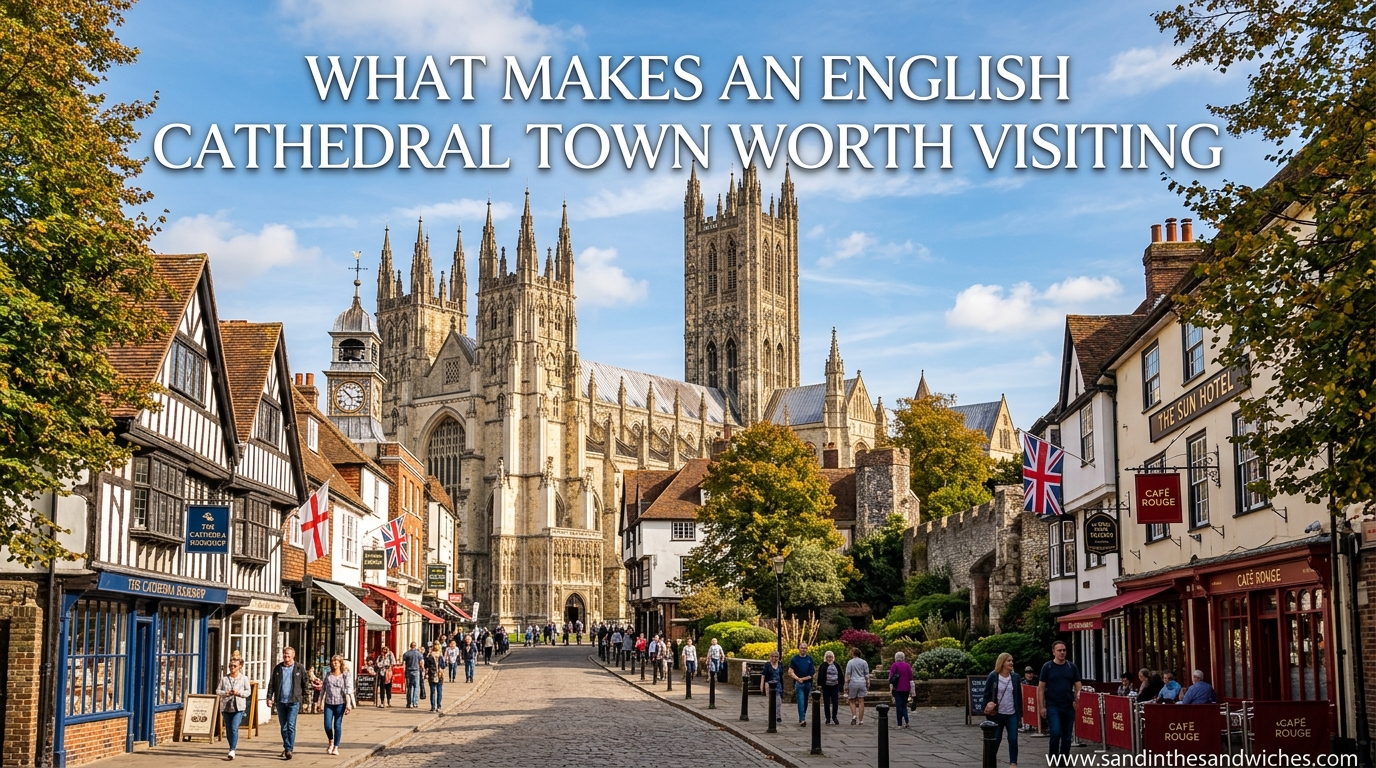
English cathedral towns are worth visiting because they bundle nearly a thousand years of living history, breathtaking medieval architecture, and a distinctly walkable charm into compact places that most visitors can explore in a single weekend. These towns grew around great churches built between the 11th and 14th centuries, and the cathedral still anchors everything from the street layout to the local festivals today. I have spent the last several years wandering through dozens of them, and the same pattern keeps showing up: a skyline dominated by spires, a maze of cobbled lanes, and a surprisingly lively cultural scene that has nothing to do with the church itself.
If you have ever wondered what makes an English cathedral town worth visiting compared with a typical English market town, the short answer is scale and significance. The cathedral pulled in pilgrims, merchants, stonemasons, and scholars for centuries, and that concentration of money and talent left behind architecture, art, and stories you simply do not find in ordinary villages. Whether you are planning a day trip from London or a slow week of heritage tourism, these towns deliver more per square mile than almost anywhere else in the country.
Our team has pulled together the architectural history, the cultural highlights, and the lesser-known picks that travel guides often skip, so you can decide exactly which English cathedral towns belong on your itinerary. We have also folded in real traveler feedback from UK travel forums, because local opinions on parking, crowds, and hidden corners tend to be far more useful than glossy brochures.
Table of Contents
What Makes an English Cathedral Town Worth Visiting
An English cathedral town is worth visiting because it combines monumental architecture, layered history, walkable scale, choral and cultural traditions, and a sense of place that larger cities often lose. In other words, the cathedral does not just sit there as a museum piece. It shapes everything around it, from the street pattern to the calendar of events.
Here are the characteristics that show up again and again in the cathedral towns worth visiting:
1. Architectural dominance. The cathedral is the single largest structure for miles. Towers, spires, and fan-vaulted ceilings were engineered to awe medieval worshippers, and they still overwhelm the modern visitor standing in the nave. York Minster, Lincoln Cathedral, and Salisbury all illustrate how a single building can define an entire skyline.
2. Walkable medieval cores. Most English cathedral towns were designed long before cars, which means the historic center sits within a fifteen-minute stroll of itself. You can park once, walk the cobbled lanes, dip into the cathedral close, browse independent shops, and still have time for tea.
3. Layered history. These places usually started as Roman settlements, Saxon churches, or Norman strongholds before the cathedral arrived. Canterbury has Roman roots, York sits on top of Viking streets, and Durham was built to house the bones of Saint Cuthbert. Every visit feels like peeling back centuries.
4. Living choral tradition. English cathedrals are still working places of worship, which means evensong is sung most evenings, often for free. The choristers and organ scholars represent an unbroken musical tradition stretching back to the medieval period.
5. Cultural scenes that go beyond the church. The same density that attracted pilgrims also attracted writers, brewers, market traders, and academics. Canterbury has Chaucer, Oxford and Cambridge grew around their cathedrals before the universities took over, and Winchester still has one of the largest farmers’ markets in southern England.
6. A manageable escape from big-city crowds. Smaller English cathedral towns like Ely, Wells, and Ripon give you world-class architecture without the queues you will face at Westminster Abbey or St Paul’s. That balance of grandeur and intimacy is rare.
Those six traits are the reason travelers on UK forums consistently rank English cathedral towns among their favorite places to slow down. Now let’s dig into the detail behind each of them.
A Thousand Years of Architectural Heritage
English cathedral towns are worth visiting in large part because they are open-air textbooks of medieval architecture. The buildings were constructed across several centuries, which means a single cathedral can show you the evolution from heavy Norman arches to delicate Perpendicular Gothic tracery.
Norman Roots (11th to 12th Century)
The earliest cathedrals still standing in England were built by the Normans shortly after 1066. Durham is the supreme example, with its massive cylindrical pillars and rounded arches that look almost fortress-like. The Normans built to last, and the sheer weight of their stonework still dominates places like Ely, Norwich, and Winchester.
If you love heavy, solemn architecture, the Norman naves are unforgettable. Stand inside Durham and you can feel the engineering confidence of builders working nearly 950 years ago.
Early English and Decorated Gothic (13th to 14th Century)
By the 1200s, English masons were pushing toward taller, lighter buildings. The Early English style gave us the soaring pointed arches of Salisbury Cathedral, while the later Decorated Gothic produced the intricate window tracery you see at Exeter and Lincoln. This is the period when stained glass, ribbed vaults, and flying buttresses transformed dark Norman spaces into walls of light.
For many visitors, the Decorated Gothic period is when English cathedral architecture reaches its peak. Wells Cathedral, with its scissor arches and the famous chapter house, is arguably the most beautiful medieval interior in the country.
Perpendicular Gothic and Fan Vaulting (14th to 16th Century)
The distinctly English Perpendicular style stretched cathedrals upward and added enormous windows. This is where you find the spectacular fan-vaulted ceilings at Bath Abbey, the cloisters of Gloucester Cathedral (familiar to Harry Potter fans), and the central tower of York Minster. Fan vaulting is a purely English invention, and seeing it in person is worth the trip alone.
Architectural heritage is the headline reason most people visit English cathedral towns, but it is also the reason these places survived at all. The cathedral was the economic engine, and the wealth it generated funded the medieval streets, guildhalls, and bridges you can still walk today.
The Historical Significance of Cathedral Towns
To really understand what makes English cathedral towns worth visiting, you have to look at why they exist in the first place. These were not random settlements. They were deliberately built as religious, political, and economic centers, and that layered purpose is still legible in the street plan.
Pilgrimage and the Medieval Economy
Before the Reformation, English cathedrals attracted pilgrims who came to venerate saints’ relics. Canterbury was the biggest draw, thanks to the shrine of Thomas Becket, but Durham (Saint Cuthbert), Winchester (Saint Swithun), and Ely (Saint Etheldreda) all had their own cults. Pilgrims needed food, beds, and souvenirs, and the towns that grew up around the cathedrals were essentially medieval service economies.
The pilgrim trade funded inns, breweries, and market charters. When you drink in a 15th-century pub in Canterbury or stay in a former coaching inn in Salisbury, you are using infrastructure built for pilgrims.
Monastic Communities and Scholarship
Most English cathedrals were originally run by monastic communities, and those monks were the scholars, librarians, and doctors of their day. They copied manuscripts, ran schools, and kept the local economy ticking. After Henry VIII dissolved the monasteries in the 1530s, the buildings survived because they were repurposed as cathedrals of the new Church of England.
That monastic legacy is also why cathedral towns often have impressive medieval libraries, cloisters, and chapter houses. Oxford and Cambridge took the scholarly tradition to a different level, but Ely, Norwich, and Worcester all retain visible reminders of their monastic past.
Power, Politics, and the English Crown
Cathedral towns were also political stages. Kings were crowned in some, married in others, and buried in many. Canterbury, York, and Winchester all hosted pivotal moments in English history. Winchester was the capital of Anglo-Saxon England and the burial place of early kings, while York was the religious capital of the north.
Walking through these towns today, you are literally following the footsteps of monarchs, archbishops, and rebels. That depth of historical significance is something you feel the moment you step inside.
Cultural Experiences Beyond the Cathedral Doors
The cathedral gets most of the attention, but English cathedral towns are worth visiting because the cultural life spills out into the streets. The same concentration of people and money that built the cathedral also built the markets, the inns, and the festival calendars that still run today.
Markets and Local Food
Most cathedral towns still hold weekly markets that date back to their medieval charters. Winchester’s farmers’ market is one of the largest in southern England. Salisbury has a thriving market square right under the cathedral spire. Ely and Ripon run smaller markets that feel genuinely local rather than staged for tourists.
For food lovers, the cathedral town circuit is a quiet tour of regional produce, from Kentish cherries in Canterbury to Yorkshire ale in York and Ripon.
Choral Music and Evensong
One of the most underrated experiences in any English cathedral town is evensong. It is usually free, lasts around 45 minutes, and lets you sit inside buildings that cost millions to maintain while professional choirs sing centuries-old settings. We try to plan our arrival so we can catch evensong at least once per town.
Major cathedrals like York, Salisbury, and Wells have internationally renowned choirs. Smaller foundations like Ripon and Truro punch well above their weight musically.
Literary and Pop Culture Connections
Canterbury is famous because of Chaucer’s Canterbury Tales. Oxford and Cambridge are inseparable from centuries of English literature. Gloucester Cathedral’s cloisters doubled as Hogwarts in the Harry Potter films. Durham Cathedral appeared in the first two Marvel Avengers films and countless period dramas.
These connections add an extra layer for visitors who want to walk in the footsteps of fictional characters as well as historical ones.
Walking and the Outdoors
Cathedral towns almost always sit beside rivers, on hills, or both, which makes them excellent bases for walking. Durham has its famous riverside loop. York has its medieval city walls. Wells sits under the Mendip Hills. Ely rises out of the Cambridgeshire fens like the “Ship of the Fens” it is nicknamed after.
If you enjoy a long walk followed by a pub lunch in a 600-year-old building, English cathedral towns were practically invented for you.
Hidden Gems: Lesser-Known Cathedral Towns Worth Discovering
One of the most consistent themes on UK travel forums is that the big-name cathedral towns, York and Canterbury in particular, can feel overrun in peak season. The good news is that England has more than 40 cathedral towns, and several of the smaller ones offer just as much without the crowds.
Ely
Ely is a tiny Cambridgeshire city of around 20,000 people that is dominated by one of the largest cathedrals in England. The “Ship of the Fens” is visible for miles across the flat fenland, and the interior features a unique painted ceiling and the octagonal lantern tower that is a masterpiece of medieval engineering. You can wander the whole town in half a day and still have time for tea.
Wells
Wells is officially the smallest city in England, but its cathedral is one of the most beautiful. The scissor arches in the crossing, the medieval Vicars’ Close (the oldest continuously inhabited residential street in Europe), and the Bishop’s Palace with its swans and moat make Wells feel like a film set. Forum regulars consistently rate Wells as one of the most photogenic cathedral towns in the country.
Ripon
Ripon in North Yorkshire is one of the oldest cathedral cities in England, with a church on the site since the 7th century. The current cathedral is modest in size but stunning inside, and the town itself has a market square, Alleyn’s workhouse museum, and easy access to Fountains Abbey nearby.
Truro
Truro is the southernmost cathedral city in Britain and the only cathedral town in Cornwall. The cathedral itself is a 19th-century Gothic Revival building, which makes it a refreshing change from the medieval norm. Truro also gives you access to the Cornish coast, so you can combine heritage with beaches.
Lichfield
Lichfield in Staffordshire has the only medieval English cathedral with three spires. The close is one of the most complete in the country, and the town has strong literary connections as the birthplace of Samuel Johnson. It is rarely on overseas itineraries, which makes it perfect if you want grandeur without crowds.
These hidden gems are the reason forum travelers keep recommending cathedral towns over more obvious destinations. You get the architecture, the history, and the atmosphere without queuing behind 500 other people.
Comparing England’s Cathedral Towns
One thing missing from most guides is a clear way to compare cathedral towns, so let’s fix that. Think of English cathedral towns as falling into three loose tiers.
The icons. York, Canterbury, Durham, Salisbury, and Winchester. These have the most famous cathedrals, the strongest tourist infrastructure, and the biggest crowds. They are unmissable, but plan for peak-season queues.
The beauties. Wells, Ely, Lincoln, Exeter, Gloucester, and Norwich. Slightly less famous, just as architecturally impressive, and considerably easier to enjoy at a slow pace.
The hidden corners. Ripon, Truro, Lichfield, Chelmsford, and St Asaph (technically in Wales but useful for context). These reward travelers who want to escape the main circuit and see working English cathedral towns that still feel local.
Picking between them comes down to your interests. For pure architectural impact, choose York or Lincoln. For romance, Wells or Durham. For peace and quiet, Ely or Ripon. For literary connections, Canterbury or Oxford.
Practical Tips for Visiting English Cathedral Towns
Most English cathedral towns are straightforward to visit, but a little planning goes a long way, especially in summer. Here are the tips that have saved us time and frustration over the years.
Visit early or late in the day. Cathedrals are quietest first thing in the morning and around evensong. Mid-morning in July is when the tour buses arrive, and the big names like Canterbury and York can feel packed.
Check tower tour availability. Tower tours are one of the best experiences in any cathedral town, because they get you above the rooftops for photos and a real sense of the medieval skyline. They sell out and they have strict age and mobility limits, so book ahead.
Plan parking in advance. Smaller cathedral towns like Ely and Wells have limited parking in the historic core. Use the park-and-ride if one exists, or look for cathedral-owned car parks that often charge less than the central meters.
Allow time for evensong. Evensong is free, lasts under an hour, and is often the highlight of the visit. Most cathedrals run it daily during term time, but check the schedule because school holidays and special services change things.
Combine two towns in one trip. Lincoln and York pair well. Canterbury and Rochester are close. Wells and Bath make a great two-day loop. You can see a lot of cathedral England without long drives between stops.
Respect the worship schedule. Cathedrals are working churches. Tourist access is restricted during services, especially on Sundays. Arriving mid-afternoon on a Saturday usually gives you the most flexibility.
Frequently Asked Questions
What do you know about cathedral town?
A cathedral town is a settlement that grew around a cathedral, which is the principal church of a diocese and the seat of a bishop. In England, most cathedral towns date back to the medieval period, when the cathedral acted as the religious, economic, and cultural center of the surrounding area.
What makes a cathedral city?
A city in England traditionally needed a cathedral to be formally called a city, although that rule no longer strictly applies. A cathedral city is therefore a settlement that contains the seat of a bishop and the main church of a diocese, usually built between the 11th and 14th centuries.
Which is the most beautiful cathedral in the UK?
Beauty is subjective, but Wells Cathedral, Salisbury Cathedral, York Minster, Durham Cathedral, and Lincoln Cathedral are the most frequently nominated for the title. Wells is often singled out for its scissor arches and chapter house, while Salisbury is admired for its unified Early English Gothic design and the tallest spire in Britain.
What is a cathedral city known for?
A cathedral city is known for its dominant cathedral building, medieval street plan, historic market traditions, and choral heritage. Most cathedral cities also have a cathedral close, a bishop’s palace or residence, and a calendar of festivals and markets that date back to their medieval charters.
Are English cathedral towns worth visiting in winter?
Yes. Winter is one of the best times to visit English cathedral towns because crowds are thinner, the candlelit interiors feel more atmospheric, and many cathedrals host special Advent and Christmas services, concerts, and markets. Wrap up warm, because medieval buildings are not heated like modern spaces.
Conclusion
What makes an English cathedral town worth visiting is the rare combination of monumental architecture, layered history, walkable scale, and living cultural tradition. These are places where you can stand inside a 900-year-old building in the morning, browse a medieval market in the afternoon, and listen to a world-class choir for free at evensong. Few other destinations in England pack so much into such a small footprint.
Start with the icons like York, Canterbury, and Durham if you have never been, then branch out to the hidden gems like Wells, Ely, Ripon, and Lichfield once you are hooked. Plan around tower tours and evensong, travel early or late in the day, and pair neighboring towns into a single trip. However you approach them, English cathedral towns are one of the most rewarding corners of the country to explore slowly.