
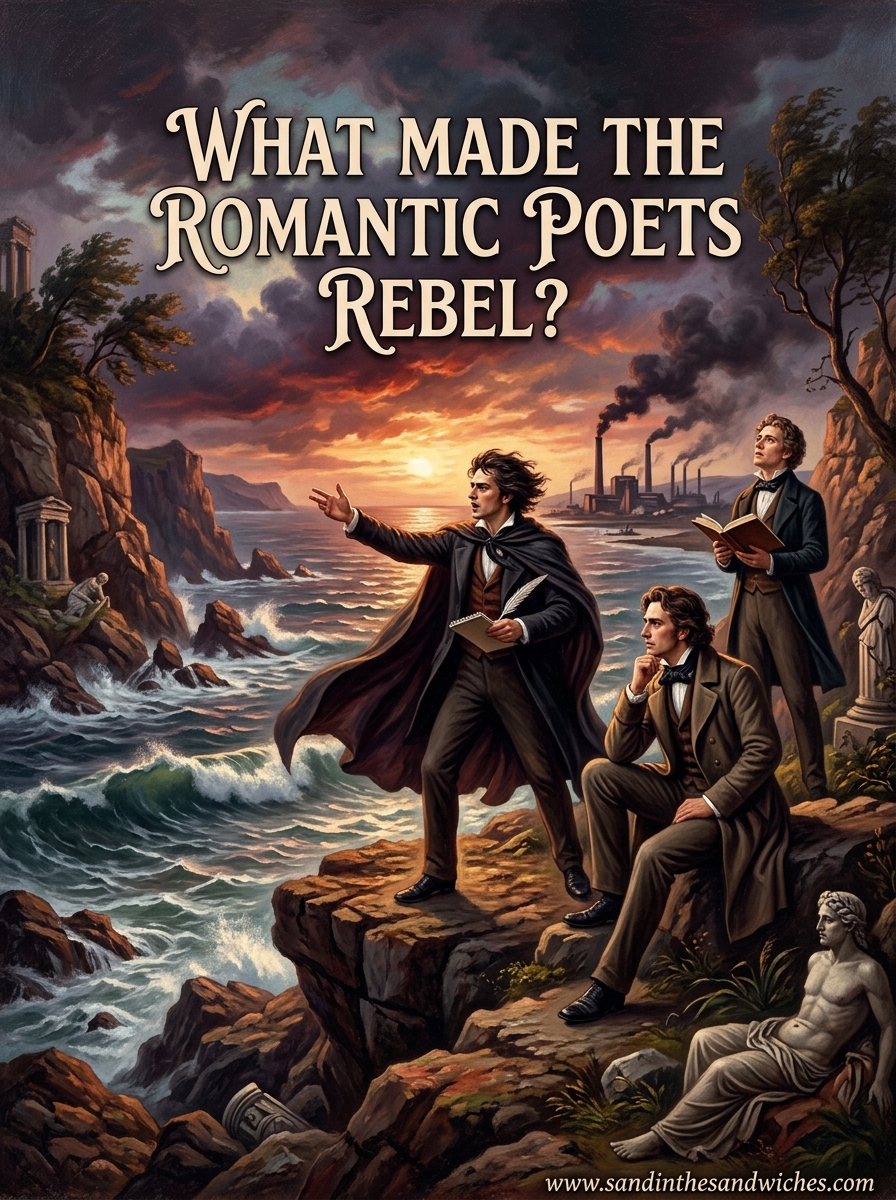
The Romantic poets rebelled against the neoclassical ideals of decorum, hierarchy, reason, and order that had dominated eighteenth-century poetry and thought. In place of these, they embraced the spontaneous, the emotional, the imaginative, and the irrational. This was not a minor stylistic shift. It was a full-scale revolution in how poets understood their art, their purpose, and their place in the world.
What made the Romantic poets rebel against everything before them was a combination of philosophical frustration, political upheaval, and industrial transformation. The generation of writers born between roughly 1750 and 1800 inherited a culture that prized rational control and rigid artistic convention. They looked at that inheritance and decided it was suffocating the human spirit.
When I first studied Romantic poetry, what struck me was how personal the rebellion felt. These were not detached academics arguing over literary theory. They were young people watching factories swallow the countryside, watching governments betray the promise of revolution, and watching poetry itself become a sterile exercise in formal obedience. They fought back with everything they had.
Understanding the Romantic poets rebellion means understanding what they were pushing against. It also means understanding what they built in its place. The movement they created between roughly 1780 and 1850 reshaped not just poetry but the entire modern conception of what art is supposed to do.
Table of Contents
The World the Romantics Inherited: The Enlightenment and Neoclassicism
To understand why the Romantic poets rebelled, you first need to understand what they were rebelling against. The intellectual world they entered was dominated by two forces: the Age of Enlightenment and the neoclassical tradition in poetry.
The Enlightenment, which peaked in the seventeenth and eighteenth centuries, elevated reason above all other human faculties. Thinkers like John Locke, Isaac Newton, and Immanuel Kant argued that the universe operated according to rational laws that could be discovered through observation and logic. This was genuinely transformative. It gave the world the scientific method, democratic theory, and enormous technological progress. But by the late eighteenth century, many younger writers felt that Enlightenment thinking had hardened into something cold and reductive, treating human beings as machines rather than souls.
In poetry, the Enlightenment era had produced neoclassicism. Neoclassical poets imitated the forms and values of ancient Greece and Rome. They wrote epics, odes, satires, elegies, and epistles in carefully measured verse, most commonly the heroic couplet. Alexander Pope was the supreme master of this style, and his precise rhyming couplets became the gold standard that every educated poet was expected to follow.
Neoclassical poetry prized decorum, wit, and restraint. It addressed universal themes through objective observation rather than personal confession. The poet was supposed to be a skilled craftsman working within established rules, not a visionary pouring out private emotions. Hierarchy mattered. There were proper subjects for poetry and improper ones. There were proper ways to write and improper ways.
For a young writer like William Wordsworth growing up in the Lake District, surrounded by mountains and common rural people, this whole system felt like a cage. Why should poetry only deal with elevated subjects in elevated language? Why should a poet suppress personal feeling in service of artificial decorum? The neoclassical rules, once liberating in their own time, had become a straitjacket.
Why the Romantics Rebelled Against Enlightenment Rationalism
The core of the Romantic poets rebellion was a philosophical rejection of pure rationalism. The Romantics did not hate reason. What they hated was the claim that reason alone could capture the fullness of human experience. They believed that something essential was being lost when the Enlightenment reduced human life to logic, measurement, and categorization.
Forum discussions among literature students capture this tension well. As one Reddit commenter in r/AskLiteraryStudies put it, Romanticism involved counter-Enlightenment thinkers who championed subjectivity over empiricism. They were not anti-knowledge. They were anti-reduction. They insisted that emotion, intuition, and imagination were not inferior faculties to be suppressed but powerful forms of knowing in their own right.
The philosophical roots of this rebellion run deep. Immanuel Kant had tried to reconcile reason with human experience, arguing that our minds actively shape reality rather than passively recording it. The Romantics took this insight and ran with it. If the mind creatively participates in constructing reality, then the imagination is not a decorative luxury. It is the most powerful tool humans possess.
Before the full flowering of English Romanticism, the German movement known as Sturm und Drang, meaning storm and stress, had already broken ranks with Enlightenment decorum. Writers like the young Goethe and Friedrich Schiller produced works of wild emotional intensity, rejecting polite restraint in favor of passion and individual rebellion. This proto-Romantic movement showed that a different kind of literature was possible, one that took inner turmoil seriously rather than smoothing it away.
The defining moment of the English Romantic rebellion came in 1798, when Wordsworth and Samuel Taylor Coleridge published Lyrical Ballads. The collection itself was revolutionary. It used ordinary language to write about ordinary people. It treated beggars, leech-gatherers, and wandering madwomen as worthy subjects for serious poetry. And in the 1800 edition, Wordsworth added a Preface that served as the movement’s manifesto.
Wordsworth defined poetry as the spontaneous overflow of powerful feelings, emotion recollected in tranquility. This single sentence dismantled centuries of neoclassical assumption. Poetry was not about clever imitation of classical models. It was about authentic emotional experience, processed through memory and reflection. The poet was not a craftsman following rules but a sensitive soul responding to the world.
The Industrial Revolution: Smoke, Machines, and the Flight to Nature
The Romantic poets rebellion was not purely intellectual. It was also a response to physical changes transforming the British landscape. The Industrial Revolution was remaking the country at staggering speed, and the Romantics watched it happen with horror.
Factories spread across the countryside. Cities swelled with displaced rural workers living in squalor. The Enclosure Acts fenced off common lands that had sustained peasant communities for centuries. Rivers ran thick with industrial waste. The natural world that had shaped these poets’ childhoods was being destroyed within their lifetimes.
William Blake captured this devastation with surgical precision. In his poem Milton, he wrote of the dark Satanic Mills that were defiling England’s green and pleasant land. Blake saw industrialization not just as an economic shift but as a spiritual catastrophe, a mechanization of human life that deadened the soul along with the landscape.
This is why nature became so central to Romantic poetry. Nature was not merely a pretty backdrop. It was a refuge, a teacher, and a spiritual force. Wordsworth’s poetry is filled with moments where the speaker encounters the natural world and is transformed by it. In his autobiographical poem The Prelude, nature shapes his moral and spiritual development more powerfully than any human institution.
The Romantics saw in nature something that industrial society was actively destroying: a connection to the transcendent, to beauty, to the parts of human experience that cannot be measured or mechanized. Their love of nature was inseparable from their critique of industrialism. Defending nature meant defending the human spirit against the machine.
The French Revolution and Political Disillusionment
You cannot understand the Romantic poets rebellion without the French Revolution. When the Revolution began in 1789, it electrified progressive thinkers across Europe. Here, finally, was a people rising up against aristocratic tyranny and demanding liberty, equality, and fraternity.
The young Romantics were overwhelming sympathetic. Wordsworth visited France and was swept up in revolutionary fervor. He later wrote in The Prelude about the hope he felt in that moment: bliss was it in that dawn to be alive, but to be young was very heaven. Shelley, Byron, and even the young Keats all absorbed revolutionary ideals about human freedom and the overthrow of oppressive social structures.
Then came the Terror, the guillotine, and Napoleon’s descent into imperial conquest. The Revolution’s promise curdled into bloodshed and tyranny. For many Romantics, this was a defining trauma. Wordsworth was devastated, his political hopes shattered. His poetry increasingly turned inward, seeking in nature and memory what political action had failed to provide.
But the disillusionment did not kill the Romantic rebellion. It redirected it. Instead of changing society through political revolution, the Romantics sought to change consciousness itself through art. They critiqued aristocratic norms, social inequality, and political oppression through poetry rather than pamphlets. Shelley’s The Mask of Anarchy is a direct response to the Peterloo Massacre of 1819, when British cavalry charged a peaceful crowd of protesters. Shelley was in Italy at the time, but his fury pours off the page.
What the Romantics Put in Place of the Old Order
The Romantic poets rebellion was destructive, tearing down neoclassical conventions and Enlightenment assumptions. But it was also deeply constructive. The Romantics did not just reject the old order. They built an entirely new vision of what poetry could be and do.
Emotion and the Spontaneous Overflow
If neoclassical poetry valued wit and restraint, Romantic poetry valued emotional authenticity above all. Wordsworth’s spontaneous overflow of powerful feelings became the movement’s guiding principle. Poetry was supposed to move you, to make you feel something real, not just admire the poet’s technical skill. Keats wrote poems that ached with beauty and mortality. Shelley wrote verses that burned with righteous anger. Byron wrote with swaggering, self-mocking passion. The shared commitment was to emotional truth over polished surface.
Imagination as Creative Power
The Romantics elevated imagination from a minor mental faculty to the supreme human capacity. Coleridge distinguished between fancy, which merely rearranges existing images, and imagination, which creates something genuinely new. For the Romantics, the imagination was a divine spark that allowed poets to perceive deeper truths hidden beneath surface reality. This was a direct challenge to the Enlightenment view that knowledge came only through empirical observation and logical deduction.
Nature as Teacher and Spiritual Force
Romantic nature poetry is not about pretty scenery. It treats nature as a living presence, a moral instructor, and a source of spiritual revelation. Wordsworth believed nature could teach more about goodness and truth than any book or institution. In his best poems, encounters with nature produce moments of visionary insight that transform the speaker permanently. This idea, sometimes called pantheism, sees the divine immanent in the natural world rather than separate from it.
The Sublime: Terror and Awe
The sublime was one of the most powerful concepts in Romantic poetry, and it deserves special attention. The sublime refers to experiences that overwhelm the mind with their vastness, power, or danger, producing a mixture of terror and exhilarating awe. Think of standing at the edge of a massive waterfall, or alone on a mountain in a thunderstorm, or staring into a star-filled sky and feeling the universe’s incomprehensible scale. The sublime is the opposite of the pretty and the picturesque. It confronts you with your own smallness while simultaneously expanding your sense of what exists.
For the Romantics, the sublime was proof that not all human experience could be captured by reason and measurement. You cannot reduce the feeling of standing before a thundering glacier to a rational proposition. The sublime was a direct refutation of Enlightenment reductionism, a reminder that reality exceeds our categories.
Individualism and Subjectivity
Perhaps the most lasting legacy of the Romantic poets rebellion was its insistence on the individual voice. Neoclassical poetry aimed for impersonal universality. Romantic poetry insisted that truth is always filtered through a particular consciousness. Wordsworth’s poetry is intensely personal, rooted in his own memories and experiences. Byron created a literary sensation out of his own larger-than-life personality. Even when Romantic poets wrote about historical or mythological subjects, they filtered them through unmistakably personal perspectives.
This commitment to subjectivity over objectivity was revolutionary. It asserted that the inner life of the individual is as real and important as any external fact. Modern culture takes this for granted, but before the Romantics, it was a radical claim.
The Voices of the Rebellion: Key Romantic Poets
The Romantic poets rebellion was carried out by specific individuals, each contributing something unique. Understanding their distinct voices helps make sense of the broader movement.
William Blake was the visionary outsider. Largely unrecognized in his lifetime, Blake produced poems and illuminated prints of staggering originality. He rejected institutional religion, conventional morality, and rational philosophy alike, insisting that true knowledge came through visionary imagination. Songs of Innocence and of Experience paired childlike simplicity with devastating moral critique, exposing the cruelty hidden beneath respectable society.
William Wordsworth and Samuel Taylor Coleridge were the movement’s founding partnership. Lyrical Ballads was their joint declaration of independence from neoclassical convention. Wordsworth’s contributions used simple language to find the extraordinary in ordinary life. Coleridge’s contributions, including The Rime of the Ancient Mariner, explored the supernatural and the psychologically uncanny. Together they proved that a new kind of poetry was possible.
John Keats came later and died tragically young at 25, but his work represents Romanticism at its most sensuous and philosophically rich. Keats wrote about beauty, mortality, and the ache of human transience with a precision that can still take your breath away. His odes, including Ode to a Nightingale and Ode on a Grecian Urn, are among the greatest poems in English.
Percy Bysshe Shelley was the movement’s political radical. He wrote poems and essays attacking monarchy, organized religion, and social injustice. Prometheus Unbound imagines a world liberated from all forms of tyranny. Shelley genuinely believed poetry could change the world, and he wrote as though every word mattered.
Lord Byron became the movement’s celebrity and its most famous export. His swaggering, self-dramatizing persona created a cultural phenomenon called the Byronic hero: brilliant, passionate, rebellious, and self-destructive. Don Juan, his comic masterpiece, mocked the very neoclassical solemnity that earlier Romantics had fought so hard to escape.
Charlotte Smith deserves more attention than she typically receives. Writing in the 1780s and 1790s, before the publication of Lyrical Ballads, Smith produced deeply emotional, politically engaged poetry that helped establish the sensibility Romanticism would later claim as its own. Her Elegiac Sonnets were wildly popular and influential. Her work carries an ironic, weary intelligence that complicates any simple narrative of Romantic exuberance. Modern scholars increasingly argue she was not just a precursor to Romanticism but one of its founding voices, sidelined by a literary establishment that did not know what to do with a brilliant, debt-ridden woman.
How the Romantic Rebellion Still Shapes Culture Today
The Romantic poets rebellion did not end in the nineteenth century. Its values shaped modern culture so thoroughly that we often forget they were ever controversial. The idea that art should express authentic personal emotion rather than follow formal rules is essentially Romantic. The assumption that each individual has a unique inner life worthy of attention and respect is essentially Romantic. The conviction that nature has spiritual value worth protecting from industrial destruction is essentially Romantic.
You can see Romantic influence in contemporary culture everywhere. The environmental movement’s insistence that nature has intrinsic value beyond what industry can extract from it echoes Wordsworth and Blake. Modern fantasy and science fiction, with their emphasis on wonder and the sublime, descend directly from Romanticism’s embrace of imagination over mere probability. Even the modern celebrity, defined by a compelling personal narrative as much as by talent, owes something to Byron’s invention of poetic self-mythology.
The Romantics taught us that feeling matters, that imagination reveals truth, and that the individual voice deserves to be heard. We are all, in a sense, their inheritors.
FAQs
What were the Romantic poets rebelling against?
The Romantic poets rebelled against neoclassical ideals of decorum, hierarchy, reason, and order that dominated eighteenth-century poetry and the broader Enlightenment worldview. They rejected rigid poetic forms like the heroic couplet, the restriction of poetry to elevated classical subjects, and the belief that rationality alone could capture human experience.
Why did the Romantics rebel against the Enlightenment?
The Romantics rebelled against the Enlightenment because they believed its emphasis on pure reason had hardened into a cold, reductive system that ignored emotion, imagination, and spiritual experience. They felt Enlightenment thinking treated humans as machines rather than souls, and they insisted that feeling, intuition, and creative imagination were equally valid ways of understanding reality.
What were Romantic poets reacting against in society?
Romantic poets reacted against aristocratic social norms, industrialization that destroyed the natural landscape, political oppression, and the Enclosure Acts that displaced rural communities. The French Revolution’s betrayal of its own ideals and events like the Peterloo Massacre further fueled their critique of established power structures.
How did Romanticism differ from neoclassicism?
Neoclassicism valued reason, order, decorum, imitation of classical models, and impersonal universal themes expressed through formal structures like the heroic couplet. Romanticism valued emotion, imagination, spontaneity, personal subjectivity, nature, and the sublime, expressed through freer verse and ordinary language about ordinary people and experiences.
What is the sublime in Romantic poetry?
The sublime refers to experiences of overwhelming vastness, power, or danger that produce a mixture of terror and awe, such as standing before a massive waterfall or beneath a stormy sky. Romantics used the sublime to prove that not all human experience can be captured by reason and measurement, making it a direct challenge to Enlightenment reductionism.
How did the Industrial Revolution influence Romantic poets?
The Industrial Revolution horrified Romantic poets by transforming the countryside with factories, polluting rivers, and displacing rural communities through enclosure. This devastation drove the Romantics to elevate nature as a spiritual refuge and moral teacher, and inspired works like Blake’s critique of dark Satanic mills. Their love of nature was inseparable from their opposition to industrialization.
Conclusion: A Rebellion That Never Really Ended
What made the Romantic poets rebel against everything before them was a convergence of forces: a philosophical tradition that felt spiritually dead, a poetic tradition that felt creatively suffocating, an industrial transformation that felt physically destructive, and a political moment that went from hope to heartbreak. They pushed back against all of it with the tools they had, which happened to be extraordinary talent and absolute conviction.
The Romantic poets rebellion succeeded so completely that its victories became invisible. When we assume that art should be emotionally authentic, that individuals have unique inner lives worth expressing, that nature deserves protection and reverence, we are speaking Romanticism’s language without knowing it. The movement that began as a revolt against the conventions of 2026 two centuries ago became the common sense of modern culture.
But understanding the rebellion matters beyond appreciating its legacy. It reminds us that the values we treat as natural were once fought for, fiercely and at great personal cost. Wordsworth, Coleridge, Blake, Keats, Shelley, Byron, and Smith did not just write beautiful poems. They insisted that human experience is richer, stranger, and more important than any system can fully capture. That insistence is worth remembering, especially in a world that still sometimes feels like it is trying to reduce us to data points.
The Romantics looked at the world they inherited and said: this is not enough. Then they built something better. That is what rebellion looks like when it works.