
Evelyn Waugh published Brideshead Revisited in 1945, and readers have been arguing about what it is really mourning ever since. If you have come away from the novel feeling emotionally wrecked, you are not alone. Forum readers describe it as a book that “stays with you long after reading,” and many say the prose is so beautiful that the sadness hits harder because of it.
Understanding what Brideshead Revisited is really mourning means looking past the surface love story. The novel mourns the loss of Catholic faith in the modern world, the death of innocence that comes with adulthood, and the slow collapse of the English aristocratic order between the two World Wars. It is also, more quietly, a book about a man grieving a friendship that he could never fully name.
In this analysis, I want to walk through each layer of that grief. We will look at the Catholic themes, the decline of the old world, the tragic split between Charles and Julia, and even the personal losses Waugh was working through while writing the book. By the end, you should have a clear answer to the question of what Brideshead Revisited is really mourning, and why that grief still feels so raw to readers in 2026.
Table of Contents
What Brideshead Revisited Is Really Mourning
At its core, what Brideshead Revisited is really mourning is the loss of access to grace. Waugh, a convert to Catholicism, believed that the modern world was turning away from the sacred and settling for the profane. Charles Ryder begins the novel as a man with no faith and no real sense of wonder. He encounters the Flyte family and, through them, glimpses something eternal that he can never quite possess.
The novel mourns three specific losses at once. First, it mourns the loss of innocence, the moment when the golden days of youth at Brideshead give way to disappointment and compromise. Second, it mourns the loss of faith, as characters like Charles resist the very grace that could save them. Third, it mourns the decline of an entire social order, the English Catholic aristocracy that Brideshead Castle represents.
Waugh himself described the book as his attempt to write about “the operation of divine grace on a group of diverse but closely connected characters.” That phrase is key. The mourning in the novel is not just sadness about lost love or lost status. It is a theological grief, a lament that human beings turn away from the very thing that would make them whole.
This is why readers often feel emotionally wrecked by the ending. The novel does not offer easy comfort. It suggests that grace is real and present, but that most of the characters refuse it, and that refusal is the deepest tragedy of all.
The Death of the Old World
One of the things Brideshead Revisited mourns most visibly is the death of the old English aristocratic world. Brideshead Castle is not just a setting. It is a symbol of an entire civilization that was already crumbling when Waugh wrote the novel during World War II. The country house, the inherited wealth, the centuries of tradition, all of it was passing away.
Waugh was deeply ambivalent about this loss. He knew the aristocracy was flawed, decadent, and often ridiculous. Lord Marchmain abandons his family for a life in Italy with his mistress. Lady Marchmain is well-meaning but suffocating. The family’s Catholicism is real but tangled with privilege and control. Yet Waugh still grieves for the passing of this world, because with it went a certain kind of beauty, order, and spiritual seriousness.
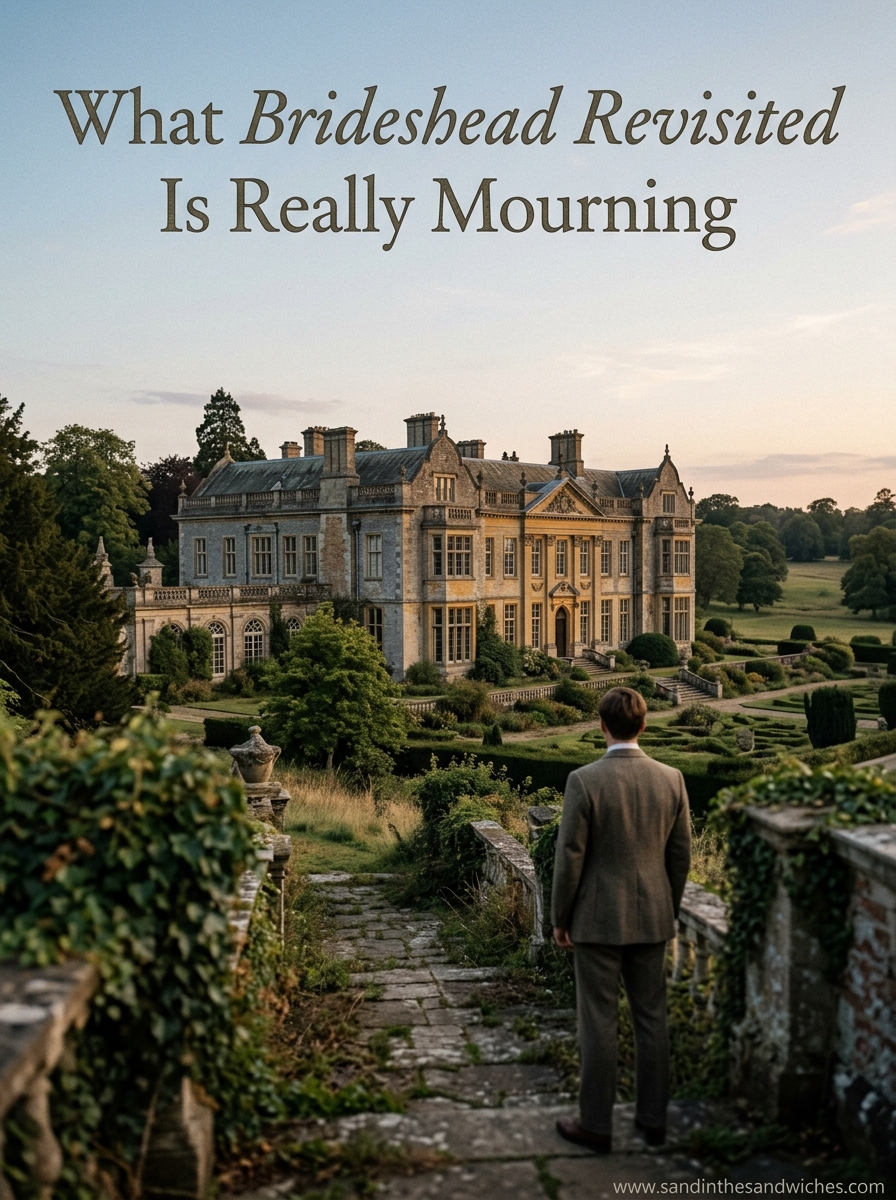
The frame narrative makes this explicit. Charles Ryder, now a middle-aged army captain during World War II, returns to Brideshead and finds it occupied by soldiers. The great house is being used as a military camp. The gardens are overgrown. The chapel has been stripped. This is the image of a civilization that has lost its soul, and Charles recognizes it with a mixture of grief and reluctant faith.
Charles and Sebastian: The Mourning of Innocence
The relationship between Charles Ryder and Sebastian Flyte is the emotional heart of the novel, and it carries some of the deepest mourning in the entire book. When Charles meets Sebastian at Oxford, he enters a world of beauty, freedom, and possibility that he has never known. The long summer days at Brideshead, the teddy bear Aloysius, the picnics and the wine, all of it represents a golden period that cannot last.
Many readers and critics have noted the obvious emotional and romantic dimension of Charles and Sebastian’s bond. The novel never uses the word, but the intensity of Charles’s devotion to Sebastian, his jealousy, his longing, and his devastation when Sebastian spirals into alcoholism all point to something far deeper than ordinary friendship. This is one of the things the novel mourns: a love that could not be named or fulfilled in the world these characters inhabited.
Sebastian Flyte’s alcoholism is not just a personal tragedy. It represents the corruption of innocence. The beautiful, charming young man Charles first meets slowly destroys himself, and Charles cannot save him. Sebastian eventually finds a kind of damaged peace working in a monastery in Morocco, but the Sebastian that Charles loved is gone forever. That loss, the loss of the person Sebastian was, is one of the sharpest griefs in the novel.
Charles himself changes in ways that the reader may find painful. The sensitive young man who loved Sebastian becomes a cynical, hard-drinking painter who drifts through an empty marriage. The novel mourns the loss of who Charles was, not just who Sebastian became. As one forum reader put it, “there is so much sorrow and misguided love throughout the book,” and the Charles-Sebastian relationship is where that sorrow is most concentrated.
Catholicism, Sin, and Grace
The Brideshead Revisited Catholic themes are impossible to separate from the question of what the novel is really mourning. Waugh was a devout Catholic convert, and the novel is structured around a specifically Catholic understanding of sin, grace, and redemption. Every major character in the Flyte family struggles with faith in a different way, and their struggles are the source of much of the novel’s grief.
Lady Marchmain represents the kind of faith that is sincere but can feel like a cage. She is a devout Catholic who wants her children to share her faith, and her attempts to guide them sometimes feel like manipulation. Lord Marchmain represents the faith that has been abandoned, a man who left the Church and his family to live in sin in Italy. His deathbed scene is one of the most powerful in the novel, because it is the moment when grace finally breaks through his resistance.
Julia Flyte carries the most painful moral conflict. She marries Rex Mottram, a man she does not love and who is divorced, which means the Catholic Church does not recognize the marriage as valid. Later, when she falls in love with Charles, she is caught between her desire and her Catholic conscience. Julia’s sin, in the theological sense, is not just the affair itself but the whole pattern of trying to build happiness outside the structure of faith. Her eventual decision to leave Charles is, for Waugh, an act of painful obedience to grace.
This is what makes the novel so haunting. The Catholic faith is presented as something real and good, but also something that demands sacrifice. Characters who follow it lose the people they love. Characters who reject it find temporary happiness that turns to ash. The mourning in the novel comes from the fact that there is no easy path. Grace is costly.
The Failed Romance of Charles and Julia
The romance between Charles and Julia is one of the most tragic elements in the novel, and it carries an enormous weight of grief. After years apart, Charles and Julia reconnect and begin an affair while both are married to other people. For a brief time, it seems as though they might build a life together. They plan to divorce their respective spouses and marry.
But Julia cannot escape her Catholic conscience. Lord Marchmain’s death and the signs of grace that surround it shake her to the core. She realizes that she cannot live in a state she believes is sinful, even for love. Her decision to end the relationship with Charles is devastating to both of them, and it is the moment many readers cite as the most emotionally wrecking in the book.
As one reader on a literature forum described it, “the haunting and tragic way Charles and Julia split up at the end really got me.” The grief of their separation is not just about lost love. It is about the realization that love, without grace, is not enough. Julia chooses God over Charles, and Charles is left with nothing but memory.
Waugh’s Personal Grief Behind the Novel
Understanding what Brideshead Revisited is really mourning also requires understanding something about Evelyn Waugh himself. Waugh wrote the novel during World War II, while serving in the British military. He was away from his family, disillusioned with army life, and haunted by the destruction he saw around him. The novel was, in part, an act of nostalgia for a world he believed was being destroyed.
Waugh had also experienced personal grief. His first marriage had ended in betrayal and divorce, a wound that never fully healed. His conversion to Catholicism was, in some sense, his way of finding meaning in the wreckage. The themes of lost love, misplaced trust, and the search for something eternal in a broken world are not abstract literary devices for Waugh. They come from his own life.
The novel’s subtitle, The Sacred and Profane Memories of Captain Charles Ryder, tells you exactly what Waugh was doing. He was writing about the tension between the sacred and the profane, between the things of God and the things of the fallen world. The grief in the novel is the grief of a man who has seen both and knows that most people, including himself, spend their lives choosing the wrong one.
This personal dimension is part of why the novel feels so raw. Waugh is not writing about grief from a distance. He is writing from inside it. The beauty of the prose, which readers consistently praise, is the beauty of a man trying to find order and meaning in loss.
Key Quotes That Capture the Mourning
Waugh’s prose is dense with grief, and several passages distill what the novel is really mourning. These lines are worth returning to because they capture the specific texture of the novel’s sadness.
“Et in Arcadia ego.” The phrase, referenced through the novel’s structure, reminds us that even in paradise, death is present. The golden days at Brideshead are shadowed from the start by the knowledge that they cannot last.
“I caught a trickle of water from the tap, and as I drank I remembered the very first evening at Brideshead when the fountain was playing and Sebastian said, ‘It is a small fountain; I expect it is very old.'”
This moment of memory at the end of the novel captures the entire mourning of the book. Charles is remembering not just a place but a vanished self and a vanished world.
“Something quite remote from anything the builders intended has come out of their work and come out of it in their own day.”
This observation about the chapel at Brideshead speaks to the novel’s deepest hope: that grace can work through human efforts in ways we do not expect. Even in mourning, there is the possibility of redemption.
FAQs
Why couldn’t Julia marry Charles in Brideshead Revisited?
Julia could not marry Charles because both were already married to other spouses, and Julia’s Catholic faith taught her that her relationship with Charles was sinful. After witnessing the signs of grace at her father’s deathbed, Julia chose to end the affair and return to her faith rather than live in a state she believed separated her from God.
What was the famous quote from Brideshead Revisited?
One of the most quoted lines is Sebastian Flyte’s warning to Charles: ‘I warned you,’ he said, ‘not to get too fond of me.’ This line foreshadows the entire arc of their relationship and captures the novel’s central grief. The opening phrase ‘Et in Arcadia ego’ is also widely cited as the novel’s thematic key.
What was Julia’s sin in Brideshead Revisited?
Julia’s primary sin, in Catholic terms, was marrying Rex Mottram outside the Church while he was still divorced, and then entering into an adulterous relationship with Charles while both were married. Her struggle is that she knows her actions separate her from God, yet she loves Charles deeply. She ultimately chooses faith over the relationship.
Is Brideshead Revisited tragic?
Yes, Brideshead Revisited is tragic, but it is a specifically Catholic kind of tragedy. Characters lose love, innocence, and status, but the deepest tragedy is spiritual: the refusal of grace. The novel ends with a faint note of hope through the chapel at Brideshead, but the journey there is marked by loss on every side.
What are the main themes of Brideshead Revisited?
The main themes include the loss of innocence and its replacement with experience, the operation of Catholic grace on resistant souls, nostalgia for the dying English aristocracy, the tension between the sacred and the profane, the tragedy of love without faith, and the destructive power of sin and alcoholism.
Why did Charles and Julia split up in Brideshead Revisited?
Charles and Julia split up because Julia, shaken by her father’s death and the visible signs of grace surrounding it, decided she could no longer live in what her Catholic faith defined as sin. She chose to return to the Church even though it meant losing Charles, the man she loved. Charles accepted her decision but was left devastated and alone.
Conclusion
So what is Brideshead Revisited really mourning? It is mourning the loss of grace in a world that has turned away from it. It is mourning the death of innocence, the collapse of the old English aristocratic order, the corruption of a friendship that could not be named, and the failure of a love that was real but not enough. It is also, at a deeper level, mourning the human tendency to resist the very grace that could save us.
Waugh offers no easy comfort. The characters who follow grace lose the people they love. The characters who resist it find temporary happiness that turns to dust. And yet the novel ends, quietly, with a candle burning in the chapel at Brideshead. The mourning is real, but so is the hope that grace has not abandoned the world. That combination of grief and faint faith is why the book stays with readers long after the final page.